
Industrial video surveillance • Tanzania product guidance
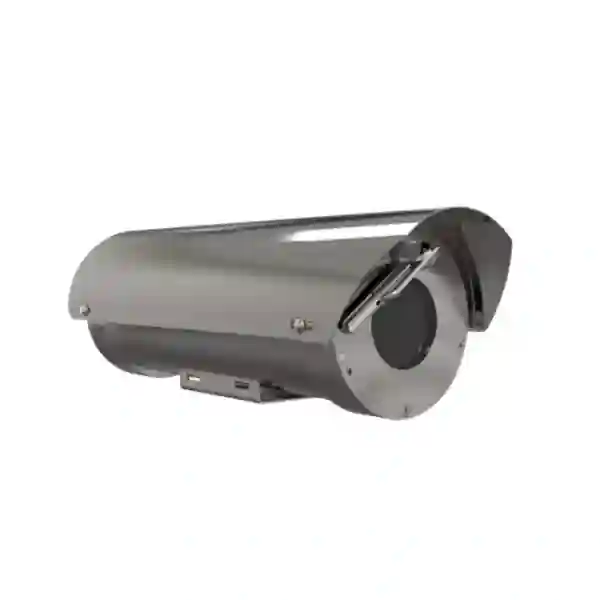
Hanwha TNO-X6320E2F2T1-Z Explosion-Proof Zoom Camera
For industrial sites that need close optical observation from a protected fixed viewpoint, the Hanwha TNO-X6320E2F2T1-Z explosion-proof camera brings together Full HD video, 32x optical reach, single-mode fiber support, and a stainless-steel enclosure. It is a specialist choice whose value depends on correct hazardous-area selection and installation.
Before requesting a quote: confirm the area’s required certification, 110 VAC supply design, fiber link, mounting method, and the exact model’s wiper configuration. These checks protect the project against unsuitable substitutions and unplanned installation costs.
Important selection checks
- Use only if the exact certified unit and complete installation are suitable for the site classification.
- 110 VAC input requires an engineered supply assessment for many Tanzanian sites.
- The F2 fiber connection must be matched to compatible network equipment and documented cabling.
- Wiper inclusion is unconfirmed because manufacturer materials are inconsistent for this suffix.
- Local price, stock, delivery, warranty, and installation scope require a specific quotation.
Technical specification at a glance
These are manufacturer-published characteristics for the stated model or its explicitly identified F2 interface. Check current documentation and ordered configuration before relying on any item in a contract.
| Camera type | Explosion-proof fixed-direction optical zoom IP camera |
|---|---|
| Imaging | 1/2.8-inch CMOS; up to 1920 × 1080 |
| Maximum H.265/H.264 video | Up to 60 fps / 50 fps by frequency mode |
| Optical lens | 4.44–142.6 mm; 32x optical zoom; autofocus |
| Horizontal angle of view | Approx. 61.8° to 2.19° |
| Network interface | Ethernet information published; duplex single-mode 9/125 µm fiber on F2 models |
| Video formats / interoperability | H.265, H.264, MJPEG; ONVIF S, G, T |
| Edge storage | 2 × microSD-family slots, up to 256 GB each |
| Power input / peak consumption | 110 VAC / 37 W maximum |
| Operating environment | −40°C to +60°C; 0–90% RH, non-condensing |
| Enclosure | STS316L stainless steel; IP66 / IP67 listed |
| Approximate size and mass | 176 × 154 × 720 mm; 21 kg |
| Wiper | Confirm exact variant; manufacturer references conflict |
Designed for industrial observation, not ordinary home CCTV
The Hanwha TNO-X6320E2F2T1-Z explosion-proof camera is aimed at industrial surveillance designs where equipment location, mechanical protection, and installation certification matter as much as image quality. It is an optical network camera with motorized zoom, housed for demanding environments. It is not a thermal imaging instrument, a gas detector, a safety shutdown controller, or an automatic substitute for a hazardous-area risk assessment. A buyer should begin with the physical area to be observed and the applicable site classification rather than choose solely by resolution or zoom.
Its primary commercial value is bringing distant operational details into a fixed field of view while supporting IP video workflows. For example, a camera positioned at an approved observation point may provide useful pictures of a pipe rack, loading activity, fenced boundary, machinery access route, or processing zone. Whether a particular image is sufficient for identification or incident investigation still depends on distance, lens settings, illumination, scene movement, and recording design. A site survey should turn those practical needs into measurable acceptance criteria.
This exact model combines Full HD imaging, 32x optical zoom, a single-mode fiber interface, intelligent analytics, and a rugged stainless-steel enclosure. It uses 110 VAC and is therefore a different purchasing decision from standard PoE surveillance cameras. Fixed camera direction, optical framing, wiring access, service clearance, and the location classification should all be reviewed before an order is committed. FourTeck Tanzania can be asked to assess the requirements and prepare an appropriate quotation without assuming stock or installation scope in advance.
First decide whether the hazardous-location classification fits
Explosion-proof is not a universal permission to install any device in any hazardous location. A plant may classify areas according to the presence and frequency of flammable gases, vapors, dust, or other risks. The camera selected must match the applicable classification, certification scope, temperature conditions, protective method, and all site-specific installation requirements. Hanwha documentation references cLCus Class I Division 1 within the product family, but buyers must examine the exact unit marking and certificate rather than infer full suitability from a marketing description.
For projects in Tanzania, the engineering or health-and-safety team should document the zone or division at the proposed mounting point, any relevant gas group and temperature classification, maintenance constraints, and the authority or internal standards that govern acceptance. Imported certifications can be useful evidence, but they should not be presented as automatic Tanzanian regulatory approval. If the site requires a different certification regime, the project must resolve that before purchasing. Request current manufacturer certificates and the applicable installation manual for the full model suffix.
An installation is a complete assembly, not merely a camera body. Approved glands, cable entry fittings, conduit seals where required, enclosure integrity, grounding, and compatible junction arrangements all affect the result. A protected housing does not make an inappropriate power cable or accessory safe. Have a competent hazardous-area practitioner review the final installation drawing and perform the prescribed inspection. Where the classification cannot be established, pause equipment selection until the responsible site team provides the information.
Full HD performance and frame-rate decisions
Hanwha specifies a 1/2.8-inch CMOS sensor, 1920 × 1080 output, and up to 60 frames per second in H.265 or H.264 operation when the corresponding frequency mode is used. This makes the unit appropriate for evaluating detailed movement in a defined view, subject to lighting and shutter settings. Higher frame rates can help operators follow moving objects, but they also increase potential storage and network demand. Set frame rate according to an actual monitoring requirement rather than automatically selecting the maximum.
The camera offers several lower output resolutions as well as MJPEG streaming. Resolution choices matter because operators, recorders, and remote viewers may need different profiles. A full-resolution recording stream can be retained for investigation while a lower-bandwidth stream supports routine multi-camera viewing. The available bandwidth, event density, compression choice, and storage period should drive the final profile design. Compression efficiency is scene-dependent, especially in rain, fine motion, noise, and complex industrial backgrounds.
Do not confuse recorded pixel count with guaranteed recognition at long range. A wide overview covers more context but uses fewer pixels on a distant subject; narrowing the optical field of view changes that balance. Before final approval, calculate the approximate pixels on the target using installation distance and lens setting. Then test representative daytime and nighttime footage with the intended VMS or NVR. This produces evidence that the selected camera will answer the site’s actual operating questions.
What the 32x optical zoom makes possible
The specified 4.44–142.6 mm lens provides 32x optical zoom with auto, manual, and one-shot autofocus. Hanwha lists a horizontal angle of view from approximately 61.8 degrees at the wide end to 2.19 degrees at telephoto. At wide angle, the operator gets greater scene context; at maximum optical zoom, a narrower section can be examined in more detail. Those values are useful planning inputs, not promises about the readable distance of labels, faces, or vehicle registrations.
Optical zoom differs from digital enlargement. The physical lens changes the scene captured by the sensor, whereas digital zoom crops or enlarges sampled information and cannot restore detail that was not captured. In a plant, this distinction matters when watching a long pipe corridor, access gate, distant pump platform, or loading area from one permitted mounting position. The best operational setting depends on which task is more valuable: overview, investigation, or a preselected detailed view.
A zoom lens does not make this fixed-position product a remotely steerable pan-tilt-zoom camera. If operators must actively rotate across multiple unrelated directions, consider a separately specified PTZ solution with the correct hazardous-area approval. For a fixed camera, choose the viewing direction carefully, confirm the proposed mounting elevation, and document useful zoom presets or operating instructions where supported by the management system. A site survey prevents the costly mistake of buying zoom reach without obtaining the required viewing coverage.
Managing darkness, glare, haze, and movement
The published minimum-illumination specifications include 0.05 lux in color and 0.005 lux in black-and-white under the manufacturer’s stated exposure and image-level conditions. Those figures describe laboratory-style performance settings, not guaranteed identification in an unlit industrial scene. Plan illumination around the real target, reflective surfaces, moving equipment, and permissible lighting fixtures. In hazardous locations, any additional lighting must independently satisfy the applicable area requirements. Do not assume that the camera includes a dedicated infrared illuminator.
Day/night operation with an automatic infrared-cut filter supports changing conditions. Hanwha also lists wide dynamic range, backlight-related processing, digital noise reduction, electronic image stabilization, and defog processing. These tools may improve usable video in scenes with strong contrast, light mist, or structural vibration, but none can overcome total obstruction. The manufacturer’s marketing highlights and technical specification contain different numeric wide-dynamic-range values, so this copy intentionally avoids asserting one unverified figure.
Industrial scenes can be especially difficult at night because floodlights, reflective metal, headlights, vapour, and steam interact in unpredictable ways. Positioning matters more than a feature list. Test the view when lamps are actually operating and when machinery is moving. Examine blurred frames, overexposure, focus hunting, and reflections before acceptance. Where the window is likely to accumulate dirt or spray, verify cleaning access and the correct wiper-equipped variant instead of assuming this particular suffix includes a wiper.
Analytics that support a defined operating response
Hanwha lists motion detection, tampering, fog and shock detection, and analytic rules involving virtual lines and areas. Depending on configuration, area rules can address intrusion, entry, exit, loitering, appearance, or disappearance, while line rules can address crossing direction. Those capabilities can help a control room find relevant changes within a long video stream. They are decision aids; they do not replace verified process alarms, fire systems, access control, or a trained response team.
Useful analytics begin with a specific question. For a restricted gate, the question may be whether movement crosses a line in the wrong direction. For a plant boundary, it may be whether a person enters a designated area at a particular time. The camera’s field of view must make that activity visible, and the operator must know what an alert should trigger. Birds, moving vegetation, steam, lighting changes, and vibration can produce nuisance events unless rules are tested and tuned.
Before deployment, document the area or line geometry, alert schedule, recording response, operator responsibility, and escalation procedure. Test analytics across representative work shifts rather than only during a quiet installation window. Some events can trigger notifications or local recording, while compatibility with a third-party VMS must be checked separately. Keep a record of configuration changes, since overly sensitive rules can burden operators and overly narrow rules can fail to flag meaningful activity.
Single-mode fiber and IP network design
The F2 version of this model is documented with a duplex single-mode 9/125 micrometre fiber interface, alongside the manufacturer’s published Ethernet information. That is particularly relevant when an industrial site uses fiber between field equipment and a central control network. A fiber pathway can be appropriate for long site runs and electrically challenging surroundings, but the optical interface, termination, accessories, topology, and permitted cable routes must be engineered for the specific installation. Fiber does not remove the need for local power.
A complete design should identify the precise fiber type, connector and optical specifications, available switch ports or media conversion, fiber distribution points, patching, loss budget, routing, and spare capacity. Do not infer a guaranteed transmission distance from the word single-mode alone; the transceiver specification and site conditions determine the supported link. Verify whether the network equipment at the other end can communicate with the camera and whether the chosen termination arrangement preserves the hazardous-area installation approvals.
Plan network segmentation, address assignment, time synchronization, multicast rules where relevant, monitoring, and recovery after a link interruption. Streaming to several destinations may be useful, but the aggregate load still needs to be evaluated. A commissioning checklist should record fiber test results and measured packet performance under representative load. For remote industrial cameras, good network documentation is part of security and maintainability, not optional paperwork after the unit is installed.
Video compression, viewing, and recorder compatibility
The camera supports H.265, H.264, and MJPEG, with manufacturer-listed multi-streaming and WiseStream II processing. These choices allow an engineer to balance image quality, compatibility, and bandwidth for recording and operator viewing. They are not interchangeable in every recording platform: a VMS might support a basic live image but not every event, metadata field, or advanced control. Confirm the exact required capabilities before promising a complete integration.
Hanwha lists ONVIF profiles S, G, and T, plus SUNAPI and an open-platform interface. Those published interfaces provide a useful starting point for integration discussions, but they are not evidence that any particular Tanzanian customer’s recorder has been tested with this model. Confirm the recorder’s supported firmware, authentication method, stream configuration, time synchronization, event mapping, and retained-video retrieval. Consider a small end-to-end proof of concept when the existing system is older or heavily customized.
The preferred recording architecture should define continuous or event-led capture, resolution, frame rate, bitrate control, clip retention, user permissions, and export procedures. It should also identify what happens during network or recorder outages. The most useful surveillance system is the one that can reliably retrieve relevant video after an incident, not merely display a sharp image on installation day. Require a recorded sample and successful playback test before operational handover.
Edge storage and recording resilience
Hanwha lists two microSD/SDHC/SDXC card slots with support for up to 256 GB per slot, or 512 GB total. Edge storage can complement a central recording architecture by providing local recording options or selected event capture, subject to supported configuration. It is not automatically a complete backup system. The available retention period depends on frame rate, scene complexity, video compression, recording schedule, and actual usable capacity rather than card size alone.
An operations team should decide what happens when the main network path fails, when a card reaches its expected life, and when the local storage fills. Different recording policies may overwrite older material or require active health alerts. Use memory media appropriate to the operating environment and verify the manufacturer’s recommendations. Where footage forms part of a safety or security investigation, align retention and export settings with the site’s documented rules and applicable legal obligations.
For a defensible handover, demonstrate a short recording sequence, alarm event, recorded timestamp, search, export, and playback on the actual authorized client. Check both normal service and an intentionally interrupted connection where site procedures allow testing. Document whether the desired recording fallback is implemented and which system is the official evidence repository. Edge storage should be described as an additional capability, not a guarantee against all failure scenarios.
Cybersecurity for an industrial surveillance network
Published network security functions include HTTPS, digest authentication, IEEE 802.1X options, IP-based access controls, and audit logging. These features can contribute to a controlled camera network when they are configured properly. A device that remains on a default password, has unnecessary management exposure, or is reachable from an untrusted segment can still create risk. Start with the site’s own cybersecurity standard and confirm the exact firmware and management tools used for the installation.
Good practice includes unique credentials, defined administrator roles, approved certificate management, protected time services, restricted management access, and a documented firmware update process. Determine which remote support methods are permitted by the customer’s IT and operational-technology teams. Avoid exposing the camera directly to the public internet merely to simplify mobile viewing. If a recording server, secure gateway, or site VPN is required, include that architecture and the relevant permissions in the project scope.
During commissioning, record configuration backups, firmware identification, audit settings, network addresses, and the responsible owner for future maintenance. Review which ONVIF or API services are necessary and disable those that the accepted design does not need where supported. A small, well-managed camera estate is often easier to defend than a large unmaintained one. Cybersecurity requirements should be included in the purchase specification, not negotiated only after the hardware has arrived.
A critical electrical check for projects in Tanzania
This exact camera variant is specified for 110 VAC input with maximum power consumption listed at 37 W. That requirement deserves early attention because TANESCO describes the ordinary low-voltage distribution supply used for many Tanzanian premises as 230 V phase-to-neutral. A field electrician must not connect a 110 VAC-only unit directly to an unsuitable 230 V circuit. Confirm the available supply, frequency suitability, isolation requirements, protective devices, and the manufacturer’s approved installation method before selecting power equipment.
If an engineered voltage-conversion or dedicated 110 VAC supply arrangement is needed, it must be reviewed for the hazardous location and its upstream installation environment. A generic indoor travel adaptor should not be assumed suitable for an industrial classified area. Identify a safe position for any transformer or power-conversion equipment, assess cable size and voltage drop, and document protective earthing and isolation. The project’s electrical designer should verify compatibility with the specific unit and all applicable site standards.
Power continuity is another practical question. An outage may interrupt surveillance even where fiber remains intact, so the design might need a site-approved backup supply or coordinated restart sequence. Decide whether recording equipment, network switches, and the camera will share the same resilience standard. Test the system after controlled loss and restoration of power. The quotation should distinguish the camera itself from electrical engineering, protection equipment, conversion equipment, cables, and installation labor.
Stainless-steel housing and environmental limits
Hanwha identifies stainless steel STS316L as the enclosure material and lists an operating temperature range of −40°C to +60°C with 0–90% relative humidity under non-condensing conditions. The published mechanical figures are approximately 176 × 154 × 720 mm and 21 kg. These values are important for mounting design, handling procedures, and clearance around the unit. They do not remove the need to assess wind, vibration, corrosion exposure, or access for safe maintenance.
The manufacturer lists IEC 60529 IP66 and IP67 environmental protection for this model. Those classifications describe specified resistance to dust and water under test conditions; they should not be interpreted as unlimited resistance to pressure washing, chemical attack, submersion, or every coastal atmosphere. Review the actual site, including cleaning chemicals, salt exposure, dust deposits, and condensation. Cable entries and fittings must preserve the complete installed assembly’s required protection level.
Temperature ratings are not a reason to ignore solar loading, enclosure placement, or process heat. A camera installed close to steam piping, furnaces, or a reflective structure can experience conditions unlike the ambient forecast. Evaluate both the ordinary ambient environment and potential local heat sources. Service teams should have a plan to inspect seals, surfaces, fittings, supports, and the optical window without compromising the explosion-protection arrangement.
Choosing a useful mounting position
A successful camera location serves an operational purpose before it serves an architectural drawing. Identify the assets, boundaries, access routes, or activities that decision-makers need to observe. Measure the longest relevant target distance, decide which details must remain recognizable, and consider moving equipment or obstructions that may hide the view. A fixed viewing direction makes this early exercise especially important. Optical zoom can narrow the image but cannot turn around a corner or see behind a tank.
Mounting elevation affects both useful detail and perspective. A very high position can show equipment movement but make identification or label reading difficult, while a low position may suffer obstruction or damage risk. Consider glare, weather direction, windows, night lighting, vibration, and routine maintenance access. Use representative still images or a temporary permitted test setup where the site allows it. Establish a small number of scenes that all stakeholders agree the camera must capture.
The proposed location also needs a suitable structural support, approved cable path, adequate service clearance, and the correct hazardous-area classification. The camera’s approximately 21 kg mass must be included in structural calculations with all accessories and applicable loads. Brackets, poles, anchors, and isolation arrangements require independent selection. A project should not assume a generic CCTV wall bracket is acceptable solely because its nominal load capacity appears high enough.
Cable entries, installation methods, and inspection
Explosion-proof camera installation involves mechanical, electrical, and procedural controls. Verify the latest Hanwha installation manual for the exact suffix before preparing a method statement. The installer should identify permitted cable entry types, seals, torque requirements, grounding provisions, orientation constraints, and any restrictions on opening the enclosure. Where classified-area rules apply, the work should follow the site’s required permit, isolation, and inspection processes. These steps are as important as choosing the camera model.
Plan wiring so maintenance staff can identify fiber, power, protective earth, and any site-specific connections without confusion. Protect bends, avoid strain on terminations, and provide a pathway that can be inspected without disturbing unrelated systems. Do not specify cable glands or junction boxes based only on outdoor waterproof ratings. The selected parts and installation technique must comply with the complete hazardous-location design. When there is uncertainty about an entry or seal, obtain manufacturer or qualified engineering clarification.
Before energizing, the responsible team should verify mechanical security, cable integrity, grounding, protective devices, enclosure closure, and certification-related installation details. Record inspection results and deviations. Afterwards, confirm network communication, focus, stream stability, recording, event behavior, and the operator’s final view. A carefully documented handover is valuable because future maintenance teams may not have been present for the original installation.
Practical commissioning and acceptance tests
Acceptance should be defined before the supplier places an order. Start with the real scenes to be monitored, the intended capture quality, and the required event or recording behavior. A functional test might include full-resolution live view, controlled zoom and focus, day/night changeover, two stream profiles, time synchronization, and playback from the nominated recorder. Each test should have a clear expected result and the name of the person authorized to sign it off.
Network testing should include the fiber link, any intermediate switching, normal video traffic, and recovery after an approved outage simulation. Verify authentication and access restrictions with the customer’s IT team. For analytics, test a known crossing or intrusion scenario and confirm the downstream action rather than relying on a configuration screenshot. At night, use the site’s normal lighting; in industrial operations, test while typical equipment is active to expose vibration and motion-related image problems.
Document serial information, model suffix, firmware, IP configuration, camera orientation, optical settings, recording policies, and the final as-built cable route. Keep the applicable safety inspections and certificates with the project records. Commissioning results should distinguish a verified function from a feature that remains to be configured by the customer. This makes the system easier to maintain and gives procurement a practical basis for evaluating whether the delivered installation meets the specification.
Operational use cases in Tanzanian industrial settings
Petroleum processing, chemical handling, and fuel-transfer sites may need CCTV at carefully selected observation points. Potential uses include checking access activity, viewing transfer positions, or investigating movement near plant infrastructure. Such environments may also have specific hazardous classifications and strict maintenance rules, so a product’s general explosion-proof description is only the beginning of suitability assessment. A camera can supplement security observation; it is not a certified leak, flame, or gas detection system.
Mining, bulk materials, and heavy industrial processing sites may benefit from observing distant equipment or restricted approaches through a narrow zoomed view. Dust, vibration, harsh cleaning, backlighting, and remote communications infrastructure can become important design factors. Determine whether the actual camera location is classified and whether this version’s protective and electrical characteristics match the needs. Some sites may be better served by ordinary rugged cameras in non-hazardous zones, thermal imaging, or a specialized PTZ, depending on the objective.
Ports, logistics areas, power infrastructure, and large production facilities can also present a mix of long sight lines and difficult environmental conditions. Where a project needs fiber connectivity and a fixed observation angle, this model may be worth assessing. The decision should be based on surveyed locations and site rules, not an assumption that every industrial facility needs explosion-proof equipment. FourTeck Tanzania can assess the inquiry against the customer’s actual site specification without implying an existing local installation or guaranteed supply.
How this model differs from nearby variants
Hanwha’s explosion-proof family includes variants with different power inputs, connection arrangements, environmental limits, and window-cleaning equipment. Those differences can be decisive even when model numbers look similar. The TNO-X6320E2F2T1-Z is the 110 VAC, single-mode-fiber configuration identified in manufacturer materials. Earlier manufacturer product lists describe this specific suffix as a non-wiper version, while the general product page includes a wiper reference. Confirm the current build and feature set with Hanwha before making wiper performance a contractual requirement.
If routine cleaning is difficult and a powered wiper is essential, request verification of a separately designated wiper-equipped SKU or exact model variant. If the site is designed around a different power source, consider the relevant alternative instead of trying to adapt a camera after installation. If an extremely cold environment, different certification scheme, or remote pan-and-tilt motion is required, these may justify another product family. The safe choice is the fully specified configuration, not the closest-looking product code.
Check the suffix on the quote, purchase order, packing label, installation manual, and commissioning record. Ask for the current technical datasheet and exact hazardous-area certificate, especially when a project spans multiple approval authorities. Price and lead time must be confirmed for Tanzania, not copied from a foreign catalog. A clear variant comparison reduces substitution errors and avoids field discoveries about power, fiber, wipers, or environmental capability.
Project procurement and scope definition
Requesting a quotation should start with a useful project brief: exact model, project location within Tanzania, deployment environment, number of cameras, area classification, intended views, cable distances, available power, fiber topology, and preferred recording platform. Include any required certificates, deliverables, training, commissioning tests, and maintenance documentation. Clear information helps distinguish an equipment-only quote from a turnkey engineered system. It also helps identify unresolved questions before cost or delivery commitments are made.
Ask the responding supplier to state the camera configuration, relevant accessories, exclusions, warranty terms if offered, shipping assumptions, installation responsibilities, and whether any regional approvals require additional verification. No current Tanzania price, stock level, lead time, or specific warranty is asserted here because these conditions have not been verified for a particular listing. A quotation should state them explicitly. Any power-conversion components, approved glands, fiber equipment, mounts, surge protection, and recording licenses should be identified separately if required.
For internal approval, compare proposals against total project risk rather than headline device price. Check the quality of hazardous-area documentation, the proposed electrical architecture, network testing, ease of maintenance, recording integration, and acceptance criteria. When an alternative model is proposed, insist on a clear technical comparison. FourTeck Tanzania can receive a specification request for this exact model, review requirements, and discuss the next step after the relevant project information is available.
A staged approach from survey to handover
The first stage is requirements capture: define why the camera is needed, the hazards at the location, the useful scenes, and the operational response. Next comes technical selection, confirming that model suffix, certification, lens reach, power, fiber interface, mounting arrangement, and required accessories suit the design. This order matters. If the electrical or area-classification constraints are discovered only after procurement, the project may face expensive redesign or an unusable device.
The engineering stage should convert the selected product into drawings and specifications for power, networking, civil supports, cable routing, recording, and security. A responsible technical reviewer should check the whole system, including nearby infrastructure and future service access. Installation must follow approved procedures, particularly in classified areas. Only once the equipment is physically and electrically suitable should software commissioning and analytic tuning become the focus.
The last stage is operational acceptance. Compare field footage with the original monitoring requirements, prove the recording and search workflow, confirm the security configuration, and hand over maintenance and inspection documents. Identify who will manage firmware, credentials, cleaning, repair, and replacement media. A well-defined handover turns a camera purchase into a maintainable surveillance capability and gives the owner a clear path to resolve future issues.
Frequently asked buying and deployment questions
Is TNO-X6320E2F2T1-Z a thermal camera?
No. The manufacturer’s specifications describe a CMOS optical network camera with Full HD video and a motorized 32x optical zoom lens. It is intended for visible-light surveillance with day/night functionality. Do not select it for temperature measurement, thermal hotspot detection, or visibility through smoke solely because its model code begins with TNO. Those functions require an appropriately specified and independently verified instrument.
Does it provide pan and tilt movement?
This model is described as an explosion-proof zoom camera, not a remotely steerable PTZ unit. Its optical zoom can change framing along the installed viewing direction, but a project needing routine rotation between separate viewpoints should evaluate a correctly certified PTZ alternative. Check the site layout before deciding that one zoom camera can cover several areas.
What resolution and frame rate does it support?
Hanwha lists 1920 × 1080 resolution with up to 60 fps using compatible H.265 or H.264 settings in the corresponding frequency mode. The final recorder, bandwidth budget, lighting conditions, and storage retention plan can determine whether a lower frame rate is preferable. Test the recorded stream, not only the camera’s live preview.
Can I connect it directly to Tanzania’s standard mains supply?
Do not assume so. This exact camera specifies 110 VAC input, while TANESCO describes ordinary low-voltage service at 230 V phase-to-neutral. A qualified electrical engineer must design an appropriate supply and verify frequency, protective devices, isolation, wiring, and hazardous-location installation requirements. Do not use a casual travel adaptor as an industrial solution.
Is a wiper included with this model?
The manufacturer’s general product page mentions a wiper, but manufacturer product-list descriptions identify TNO-X6320E2F2T1-Z as a no-wiper fiber variant. Because those references conflict, wiper inclusion must be confirmed against the current exact-model datasheet, manufacturer quotation, and ordered hardware. Do not make window-cleaning assumptions before the project is specified.
Can the camera use single-mode fiber?
Yes. The F2 configuration is documented with a duplex single-mode 9/125 micrometre interface. However, actual cable reach and interoperability depend on the complete optical link, connectors, transceiver specifications, network equipment, and site conditions. Plan the fiber route and test the link rather than relying on an unspecified distance claim.
What recording integrations are possible?
The published interface information includes ONVIF profiles S, G, and T, Hanwha SUNAPI, H.265, H.264, and multiple streaming profiles. These are useful integration starting points. Verify actual interoperability with the selected NVR or VMS, including alarm handling, playback, event metadata, credentials, firmware, and storage behavior, before approving the final design.
How much local memory does it support?
The manufacturer specifies two microSD-family card slots with up to 256 GB each, for a stated total of 512 GB. Storage duration depends on compression, frame rate, bitrate, scene activity, and recording rules. Cards and edge recording do not automatically replace the site’s central recording, retention, evidence-handling, or backup policy.
Is the camera certified for every hazardous area in Tanzania?
No universal approval should be inferred. Hanwha documentation identifies explosion-proof certification information, including a Class I Division 1 reference in manufacturer materials. The project engineer must confirm the exact product marking and certificate against the classified location and the acceptance requirements applicable to that Tanzanian site. The complete cable, power, and mounting assembly must also comply.
Does IP66 or IP67 mean it needs no maintenance?
No. Environmental ratings describe defined dust and water protection tests rather than immunity to corrosion, damaged seals, chemical washing, vibration, or poor cable entries. The site’s maintenance plan should include safe inspections, window cleaning, support checks, and checks of enclosure and cable integrity in accordance with the manufacturer and the responsible hazardous-area procedures.
What information should accompany a quotation request?
Supply the exact model code, quantity, intended monitoring locations, hazardous-area classification, target distances, power information, fiber route, VMS or NVR type, preferred installation scope, and required documentation. State whether a wiper is necessary and what acceptance tests are expected. That information helps the supplier evaluate suitability and distinguish equipment from engineering and installation costs.
Does an explosion-proof camera replace process safety equipment?
No. Surveillance can help an operator observe activity or investigate incidents, but a video camera is not a certified substitute for gas detection, fire detection, emergency shutdown, or other required process safety systems. Site operators should continue to use the instruments and safety procedures prescribed by their risk assessment and applicable standards.
Request an exact-model project quotation
Ask FourTeck Tanzania to review the Hanwha TNO-X6320E2F2T1-Z against your site requirements. Include the quantity, area classification, camera location, viewing distances, site electrical supply, fiber network details, preferred recording platform, and any required installation or commissioning services. A clear enquiry makes it easier to confirm the correct model and the scope of the proposed solution.
Current Tanzania availability, price, regional documentation, and commercial terms will need specific confirmation. No order, service appointment, delivery date, or approval is promised by this product information.




Reviews
There are no reviews yet.