
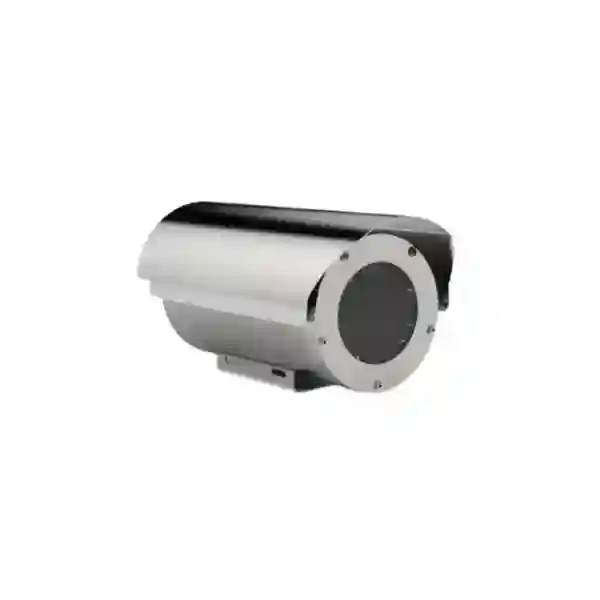
Industrial network video · Explosion-proof housing · Zoom surveillance
Hanwha TNO-X6320EPT0-Z Explosion-Proof 32x Zoom Camera
Need a detailed industrial CCTV view in a potentially hazardous area? The Hanwha TNO-X6320EPT0-Z combines 1080p network video, 32x optical zoom and a 316L stainless-steel explosion-proof enclosure. It is designed for projects in which both the image and the exact hazardous-area equipment specification must be assessed before purchase.
For an enquiry through FourTeck Tanzania, describe the site’s classified area, observation target, distance, lighting and recording platform. Request a quotation only after the relevant engineer has checked the exact model marking and installation requirements.
Verified technical specifications at a glance
The figures below summarize Hanwha Vision’s published product information for this exact model. They are camera specifications, not an assessment of a particular installation’s hazardous-area compliance or local commercial availability. The detailed discussion that follows explains how to use these facts in a buying decision.
| Imaging | 1/2.8-inch CMOS; 1920 × 1080 |
|---|---|
| Frame rate | Up to 60 fps (H.265/H.264) |
| Zoom | 32x optical; 4.44–142.6 mm |
| Field of view | Horizontal 61.8°–2.19° |
| WDR | 150 dB |
| Video formats | H.265, H.264, MJPEG |
| Analytics | Motion, line, area, tamper and more |
| Interfaces | RJ-45 10/100BASE-T; ONVIF S/G/T |
| Edge storage | 2 × microSD; up to 256 GB each |
| Power | IEEE 802.3af Class 3 PoE; 12 W |
| Construction | 316L stainless steel |
| Ingress protection | IP66 and IP67 |
| Operating temperature | −10°C to +55°C |
| Size and mass | 176 × 334 mm; 8.54 kg |
The manufacturer lists hazardous-location certification families, including cLCus C1/D1, alongside its environmental data. Obtain the precise delivered variant’s marking and certificate documents for review by the site’s competent engineer. The model suffix and approved installation method matter; do not infer regulatory acceptance in Tanzania from a product description.
Start with the surveillance task
The Hanwha TNO-X6320EPT0-Z is intended for projects that need detailed visual observation and a purpose-designed explosion-proof enclosure. A conventional outdoor bullet camera may provide good images in an ordinary location, yet it does not automatically meet the enclosure and certification requirements of a hazardous industrial area. This product brings Full HD network video and a long optical zoom range into a specialist housing. Its value is the combination of camera functionality with a construction approach designed for demanding industrial settings.
For buyers in Tanzania, the first question is not simply how many megapixels a camera has. It is whether the proposed mounting position lies within a classified hazardous area, what the operator must see, and whether the required certificates and installation methods are accepted for that exact facility. A camera that is technically impressive but has the wrong marking, field of view or cable-entry arrangement is not a suitable purchase. Resolve those issues before finalizing equipment selection.
A useful initial inquiry should describe the site, the process being observed, approximate camera-to-target distance, lighting, desired recording duration, connectivity, and the classified-area documentation held by the facility. Include whether staff want continuous contextual viewing, close observation of a distant asset or recorded evidence of activity. FourTeck Tanzania can then receive a technically meaningful quotation request rather than a model number without installation context.
What the product is, and what it is not
Hanwha Vision identifies this model as an explosion-proof zoom camera. Its imaging device is a 1/2.8-inch CMOS sensor and its published maximum output includes 1920 × 1080 video. That makes it a visible-light network surveillance camera rather than a thermal imager. It can provide color or monochrome images using its day/night function, but its specification does not turn it into a heat-measuring instrument or a fire-detection sensor.
The lens offers 32x optical zoom with autofocus. Optical zoom changes the lens’s field of view while retaining the imaging sensor’s native resolution; it should not be confused with digital enlargement after capture. The housing is a fixed-position style that needs deliberate aiming during installation. Do not assume a full pan-tilt-zoom assembly, integrated illuminator, automatic lens wiper or explosion-monitoring intelligence unless a separate, exact-model specification confirms that function.
This distinction affects procurement. A buyer seeking temperature visualization should investigate a dedicated thermal camera. A buyer needing continuous mechanical pan and tilt should specify a certified PTZ unit rather than assuming this zoom camera moves in every direction. When the requirement is to observe a fixed industrial process area and examine detail across changing distances, the TNO-X6320EPT0-Z deserves evaluation within its stated performance envelope.
Explosion-proof design: understand the purpose
The term explosion-proof is a description of a certified equipment protection approach, not a promise that the unit prevents explosions or makes any location intrinsically safe. Hazardous-area equipment is assessed under specific conditions, groups, temperatures, and installation rules. A camera can be suitable for one classified location and unsuitable for another. The manufacturer’s product information lists hazardous-location certification families; the exact marking on the delivered variant and the site’s engineering requirements must govern acceptance.
Before ordering, request the applicable current certificate, equipment nameplate information, installation instructions and any conditions of safe use for the precise model. Have the facility’s hazardous-area specialist review the area classification, gas or dust characteristics, equipment protection level or division requirements, ambient temperature and cable entry. Certification systems and local acceptance rules are not interchangeable merely because both mention explosion protection.
Equipment installed in a hazardous area may also depend on correctly selected glands, seals, conduit methods, bonding, mounting hardware and work procedures. The camera alone does not certify the entire installed system. Procurement should therefore connect product selection to the electrical and safety design, rather than treat explosion-proof wording as a substitute for a site-specific compliance review.
Video resolution and frame rate
The manufacturer’s video table lists 1920 × 1080 as a supported image resolution, commonly described as Full HD or approximately two megapixels. It also lists up to 60 frames per second with H.265 or H.264 under the stated frequency settings. This combination can be useful where an operator needs smooth images of moving objects, conveyors, rotating equipment surroundings or activity near a controlled process, provided safe viewing and privacy rules are followed.
Resolution should be considered alongside the distance and width of the scene. A 1080p image may cover an entire operating area, but the pixels available for a small object decrease as the scene grows wider. Optical zoom is one way to concentrate those pixels on a smaller field. For evidential identification, instrument readings or tiny label details, validate pixel density through real scene measurements or a practical demonstration instead of relying on the advertised megapixel count alone.
Full frame rate is not always the best configuration. More frames can increase network traffic and recorded data, while a lower frame rate may be sufficient for a slow-changing process overview. Choose resolution, frame rate, compression and exposure together. The final camera profile should be tested against the actual movement, lighting and monitoring purpose, not copied from a generic CCTV preset.
32x optical zoom and the viewing geometry
The specified focal-length range is 4.44–142.6 mm, with 32x optical zoom and automatic, manual or one-shot focusing controls. Hanwha states a horizontal angle of view ranging from approximately 61.8 degrees at wide angle to 2.19 degrees at telephoto. Wide viewing helps operators understand the surrounding scene; telephoto can isolate a more distant pipe section, platform or equipment detail without relying entirely on digital cropping.
Zoom does not remove environmental limitations. Heat shimmer, dust, vibration, water on the window, poor lighting and atmospheric haze can reduce useful detail, especially at a long focal length. A narrow telephoto view also removes much of the broader context, so operators may miss adjacent activity while concentrating on one point. Decide how frequently the camera must be returned to a wider view and whether a second overview camera is necessary.
A site survey should document target size, camera distance, expected viewing angles and whether objects obstruct the line of sight. Note that Hanwha specifies a minimum object distance of 1.5 metres in its general lens data. Close-range inspection and long-range observation are different requirements; the focus range, mounting position and expected results should be validated for each use case before procurement.
Autofocus and operator usability
Automatic focus reduces the need for an operator to adjust the lens manually whenever the zoom changes. This can be valuable in control rooms where staff move between a wide industrial overview and a close view of one item. Hanwha also specifies manual and one-shot autofocus modes, allowing a camera setup to reflect a relatively stable scene or a use case where focus hunting must be minimized.
Autofocus still depends on the visibility and contrast of the subject. Smoke, glare, rain, featureless surfaces or movement behind a fence may interfere with the image. A viewing plan should identify whether autofocus performs reliably at the selected location and whether an operator needs permission to change zoom or focus. Configure the lens for the normal observation task rather than assuming every scene benefits from automatic adjustments.
The camera should be commissioned using real examples of the inspection target. Ask the user of the video system to confirm that a wide view is comprehensible and that the required close-up view can be acquired quickly. This feedback often matters more than reviewing a lens specification in isolation and helps avoid disappointment when a camera is installed high above a working area.
Wide Dynamic Range for difficult contrast
The manufacturer specifies 150 dB Wide Dynamic Range, together with backlight and highlight compensation options. WDR helps a camera cope with areas containing very bright and darker regions in the same scene. Industrial examples may include an open doorway leading to an interior area, reflective metal surfaces, or machinery beside daylight-facing openings. The goal is to retain interpretable image information across uneven illumination.
WDR is not a substitute for good lighting, and the published decibel figure is not a guarantee that every scene will be legible. A camera pointed toward intense glare can still produce difficult images. Lens direction, exposure settings, reflective surfaces and the placement of lights should be considered together. Where images must support a safety investigation, test them during the actual bright and dark conditions expected at the site.
Configure WDR, exposure and any highlight-compensation features conservatively. Excessive processing can change the appearance of fast motion or introduce artifacts in challenging conditions. Recording samples at different times of day provides evidence for choosing a stable operational profile and for explaining any remaining limitations to the people who will rely on the footage.
Day and night operation
The camera supports automatic infrared-cut filter removal, commonly called day/night ICR. Hanwha lists minimum illumination figures of 0.05 lux in color and 0.005 lux in black-and-white under specified exposure conditions. These values describe the sensitivity stated in the manufacturer information, not a universal promise of clear identification in every dark scene. Frame rate, exposure time, movement and lens position influence usable results.
Do not assume this model includes a built-in infrared LED array merely because it has a day/night mode. If observation is required after dark, the lighting plan should address the actual operating zone and any limitations on equipment permitted in that classified area. An external illuminator, where appropriate, would need its own suitability and installation assessment. Local procedures may also restrict new light sources near sensitive operations.
A practical night test should show the relevant target with the intended camera settings and production lighting. Confirm whether the image is useful in monochrome, whether shadows or reflective backgrounds mask activity, and whether image noise creates unwanted detection alerts. A lighting assessment is particularly important where the camera must observe small detail rather than simply show movement.
Image stabilization, defog and noise reduction
Hanwha lists digital image stabilization with a built-in gyro sensor, a defog function and SSNR V digital noise reduction. These processing features may improve operator viewing where minor vibration, haze or image noise affects the picture. They are particularly worth evaluating at longer zoom settings, where a small movement of the camera can shift the apparent position of a distant object dramatically.
Digital stabilization cannot repair an unstable mounting structure or compensate for every form of camera shake. Similarly, defog processing cannot remove a physical obstruction or make dense smoke transparent. Noise reduction may help the picture appear cleaner but should be balanced against the need to preserve movement detail. Each function should be tested with the actual scene rather than enabled indiscriminately.
For critical industrial observation, the best first steps remain a rigid mount, suitable positioning, clean viewing window and adequate lighting. Image processing can then provide a useful refinement. Document which adjustments were made and retain a reference image so that future maintenance teams can tell whether image quality has changed due to site conditions or configuration changes.
Intelligent video analytics
The product information identifies analytics including motion detection, tampering, fog detection, face detection, shock detection, virtual area events and virtual line crossing. Area-based options include intrusion, enter and exit, appearance and disappearance, and loitering-type events. These are potential tools for directing operator attention, organizing recordings or generating notifications from a camera stream. The relevant function and its configuration should be verified in the deployed software version.
Video analytics are not a certified safety instrument. They can be affected by shadows, lighting changes, moving machinery, weather and camera positioning. For instance, steam or blowing dust may resemble motion, while a reflection may create an unwanted crossing event. Design event rules around a real operational question, such as detecting entry to a restricted observation area, instead of enabling every available trigger.
Each alert should have a defined recipient and a response procedure. Confirm whether the monitoring team uses live views, event thumbnails or an integrated video-management system. Test false alarms and missed events under typical site conditions. For process-critical alarms, use the facility’s approved safety and control systems; camera analytics should not be presented as a replacement for those systems.
Privacy masking and responsible observation
Hanwha’s specification includes up to 24 rectangular privacy-mask zones with selectable colors or mosaic presentation. In an industrial environment, masks can help limit views into areas that are not necessary for the stated security or operational purpose. Where workers, contractors or visitors may appear in the picture, the camera design should follow the facility’s own privacy, access-control and retention procedures.
A privacy mask is useful only if it is configured and tested against the real field of view. With a zoom camera, the installer should verify how the masking implementation behaves across the operating settings required for the site. Document who can edit masks and who is authorized to view or export recorded clips. A good video design seeks necessary coverage without capturing more than the use case requires.
Customers should distinguish between camera-side masking and the permissions enforced by the recorder or video-management system. Restrict privileged access, maintain an audit trail where available, and establish a controlled process for retrieving incident footage. These measures address the human and organizational side of surveillance, which is just as important as the hardware’s technical capability.
Video compression and streaming choices
The TNO-X6320EPT0-Z supports H.265, H.264 and MJPEG. The manufacturer also lists WiseStream II, constant or variable bit-rate control for the relevant codecs, and up to ten streaming profiles. A multi-profile configuration lets different consumers of video receive settings appropriate for their role, such as a high-quality recording stream and a lighter live-monitoring stream where the system supports it.
Real bandwidth depends on movement, detail, noise, codec settings, frame rate and the compression profile. A quiet scene may use considerably less data than one filled with moving material or changing reflections. It is therefore risky to estimate storage solely from the maximum resolution or to promise a fixed number of recording days based on a camera model name.
Work with the recording-system designer to select a primary stream for evidential or operational quality and suitable secondary profiles for operator screens. Check whether the target software supports the intended codecs and analytic events. Keep a record of the actual bit rates measured during commissioning and revisit them whenever exposure, compression or scene conditions change.
Local edge storage and recording architecture
Hanwha specifies two microSD, SDHC or SDXC slots, supporting up to 256 GB per slot and a combined stated maximum of 512 GB. This provides an edge-storage option that may be used with appropriately compatible media and configured recording rules. The manufacturer also describes event-related recording to local media or network-attached storage, depending on the configured functions.
Edge storage should not be mistaken for guaranteed evidence retention or an unlimited recorder. Memory-card life, recording mode, overwrite behavior, failure detection and retrieval procedures affect reliability. Continuous high-bitrate video can consume capacity quickly. If the organization requires long retention, redundant recording or centrally managed footage, design those functions into the complete system rather than placing all responsibility on the camera’s removable media.
Ask what happens when the network connection is lost and how footage is recovered once communication returns. The exact behavior depends on recorder compatibility, card configuration and available software functions. Commissioning should include a controlled disconnect test, an event recording test and verification that authorized users can retrieve the video they expect to retain.
Video management system integration
The manufacturer lists ONVIF Profiles S, G and T along with SUNAPI and the Hanwha Vision Open Platform. These interfaces are relevant when the site uses an existing video-management system or needs to connect the camera to a new control-room platform. They provide a useful starting point for integration discussions, but a published interoperability interface does not guarantee every advanced camera function will appear in every third-party recorder.
Check the exact VMS version, driver, license, firmware requirements and supported features before procurement. Confirm live video, recording, time synchronization, analytic event reception, edge-storage behavior, user roles and any required export workflow. If a particular feature is essential, request a compatibility statement or conduct a demonstration against the actual software environment.
Integration should also consider who owns configuration changes. A camera may be reachable through a browser and through a VMS, but those interfaces can expose different controls. Define an authoritative configuration record, an approved update process and a troubleshooting path. This reduces the chance of a well-meaning change at the camera inadvertently disrupting the central recording service.
IP network and communications planning
The camera uses an RJ-45 10/100BASE-T Ethernet connection and supports common IP networking protocols, including RTSP and secure web communication options. The required network should be designed around the site’s security policy, bandwidth budget, switch location and maintenance access. Industrial sites may have substantial distances between the desired camera position and the nearest network cabinet, so physical connectivity is part of the selection decision.
Choose a network topology that keeps video traffic visible to authorized operators while limiting unnecessary access. Depending on existing architecture, that may mean dedicated camera VLANs, controlled routing, approved DNS and NTP sources, and recorder connections through managed infrastructure. Do not expose cameras directly to the public internet simply to simplify remote viewing.
Test continuous transmission, time synchronization, packet loss and recovery after a network interruption. If the camera serves a remote operating area, ask whether the communication path can maintain the chosen bit rate during peak site activity. The project design should document the camera IP plan and network dependencies so maintenance personnel can identify and restore a failed component without guesswork.
Cybersecurity and user access
Hanwha lists digest authentication, IEEE 802.1X network authentication options, IP-based access control and access or event logs. Those capabilities support a disciplined approach to camera security, but they require correct deployment. Assign individual administrative responsibility, remove unnecessary access, use strong credentials and select secure management protocols supported by the final firmware and the organization’s network policies.
Firmware and configuration should be reviewed against the manufacturer’s current support information for the exact model. A site should establish who approves firmware changes, how maintenance windows are planned and what rollback or recovery procedures are available. Do not assume an update is appropriate merely because a file is downloadable for another similar camera family. Match the intended device and documentation carefully.
Video security includes the recorder, operator workstations, remote access method and backup procedures. Ensure that footage is available only to authorized roles and that exported evidence is handled according to company rules. A properly secured installation is a system-level outcome, not a property of the camera enclosure alone. Include these questions in procurement and acceptance testing.
Power over Ethernet and electrical design
The published input is IEEE 802.3af Power over Ethernet, Class 3, with a stated power-consumption figure of 12.0 W. This can simplify architecture because network and camera power share an Ethernet connection in a suitable system. However, the convenience of PoE does not exempt installation in hazardous areas from the relevant wiring, entry, sealing and equipment requirements.
Verify that the PoE switch or injector has sufficient available power budget and that the proposed cable length, conductor quality and installation route are appropriate. The classification of the camera location and the placement of network equipment may impose additional design constraints. Any surge protection, earthing, isolation or cable interface equipment must be selected and installed under the project’s electrical and hazardous-area rules.
Avoid substituting a different power supply or assuming a 24 VAC variant is identical to this PoE model. Related Hanwha explosion-proof cameras may have different power and accessory combinations. The purchase document should specify the complete model suffix, power standard, hardware scope and approved installation diagram so that the supplied unit matches the engineered design.
Cable entry, glands and installation integrity
Cable-entry details are not a minor accessory decision for an explosion-proof camera. The way a cable or conduit enters an enclosure can affect the installed equipment’s hazardous-location suitability and environmental sealing. Designers should refer to the exact manual and approved certificate conditions rather than choosing a generic gland solely on the basis of cable diameter or an outdoor-use description.
The installation package should identify approved cable type, route, gland or conduit components, sealing details, earthing and inspection requirements. Also examine the transition between the camera and any network cabinet or power source. Components outside the camera assembly may need their own protection measures; compliance of the camera housing does not automatically establish compliance of connected items.
A qualified installer should inspect the received hardware against the approved drawings before work begins. During installation, protect seals and mating surfaces, follow specified torque values and do not modify the housing without authorized instructions. The final inspection should be recorded with the certificates and commissioning report so the site has evidence of the completed installation configuration.
316L stainless-steel construction
Hanwha specifies a stainless-steel STS316L body for this camera. This material choice is relevant to facilities where an enclosure may be exposed to challenging industrial atmospheres, cleaning procedures or corrosive contaminants. It is especially worth considering for outdoor process equipment where equipment durability and access for replacement are major procurement concerns.
No metal enclosure is maintenance-free. Actual corrosion behavior depends on chemicals, exposure, temperature, surface condition and installation methods. Check compatibility with the site’s operating atmosphere, washdown solutions and adjacent materials. When maintenance access is expensive or restricted, consider the total installed cost rather than comparing only the upfront camera price.
The project team should also consider the viewing window and any surfaces that collect residue. The camera may have a durable enclosure yet still become unusable for observation if deposits obstruct the lens window. Define safe cleaning procedures and a feasible inspection interval, especially where access requires shutdown, permits or specialist personnel.
Ingress protection and the environment
The official product data lists protection to IEC 60529 IP66 and IP67. These ratings are important when planning exposure to dust, rain and water ingress, but they are tested categories with defined conditions. They should not be read as universal permission for unlimited submersion, unrestricted pressure washing or any cleaning chemical. Follow the manufacturer’s installation instructions and limits for seals, cable entry and the assembled product.
For an outdoor industrial site, wind-driven rain, airborne dust, salt-laden air and cleaning practices should all be included in the site review. Consider where water will run, whether structures create splash zones and whether the camera can be inspected without entering an unsafe area. A suitable ingress rating helps, but the camera’s orientation and cable installation remain important.
Do not confuse ingress protection with explosion-protection certification. IP66 or IP67 alone does not make a camera suitable for a flammable-gas or combustible-dust atmosphere. Similarly, the presence of a hazardous-location marking does not eliminate the need to meet moisture and environmental requirements. Both aspects must be considered together during engineering approval.
Ambient temperature and humidity limits
Hanwha states an operating temperature range of minus 10 to plus 55 degrees Celsius and a non-condensing relative-humidity range of zero to 90 percent. The wider temperature figures shown for storage are not the same as the operating limits. A site engineer should compare the operating range with the expected conditions at the selected mounting point, including radiant heat from equipment and any unshaded outdoor exposure.
A facility’s regional climate is only one part of this assessment. A camera mounted beside a hot process line, vent or roof surface may experience a much harsher microclimate than nearby weather readings suggest. Humidity, condensation and rapid temperature changes can also affect lens visibility or the reliability of an installation. Check the manufacturer’s documentation for any restrictions relevant to the application.
Where ambient conditions may exceed the specified limits, choose an appropriate alternative model or revise the location. Do not promise reliable operation outside the published range or assume that the enclosure automatically includes heaters, cooling systems or other environmental controls. Designing within verified limits is more dependable than relying on undocumented performance margin.
Dimensions, weight and structural support
The listed dimensions are approximately 176 by 334 millimetres and the product weighs about 8.54 kilograms. These figures should be considered during bracket and structural selection. A mount must support the camera under the site’s defined mechanical loads, including any applicable wind, vibration, safety-factor and maintenance-access requirements. A mounting plan needs more than a drawing of a generic CCTV pole.
Examine the condition and material of the proposed support structure, especially on older industrial assets. A stable image at a long zoom setting can be more sensitive to movement than a wide overview image. Mounting hardware should be appropriate for the local environment and any corrosion exposure. Do not assume unspecified brackets, fasteners or adapters are included with the camera.
A physical survey should verify clearance, safe reach, cabling path and the expected direction of view. Consider future equipment changes that might obstruct the lens. The project should provide an approved mounting drawing, load assessment where required and a method for safely realigning or servicing the camera without unnecessary operational disruption.
Where this camera can add value
Potential use cases include visual observation of selected petrochemical equipment, process skids, industrial storage areas, energy infrastructure and other locations where a camera must be evaluated against hazardous-area requirements. In each case, the purpose is situational awareness or recorded visual evidence. The product’s existence does not establish that a particular site, sector or zone automatically accepts the camera.
For example, a plant may want a wide view of an equipment corridor while retaining the ability to zoom closer to a distant valve arrangement. Another project may need to observe personnel movement at a controlled access point within a specialist industrial area. In both cases, the camera location, classification, lighting and required scene detail determine whether this model is appropriate.
A useful specification should state the operational decision that footage will support. If the task involves reading small labels at long distances, evaluate resolution and atmospheric conditions. If it involves seeing activity across an entire yard, a narrow zoom setting may be the wrong default. If the purpose is process control, verify that video is an appropriate supplementary input and not a substitute for approved instruments.
Designing control-room workflows
A surveillance camera is only useful if the right person receives an understandable image at the right time. For control-room use, define which stream appears on the overview wall, whether operators can change zoom and how recorded footage is reviewed. The camera supports multiple profiles and events, but their benefit depends on a workflow built around operator tasks rather than feature count.
Create simple operating procedures for viewing a designated area, inspecting a distant asset and returning to the normal view. If the camera’s focus and zoom are operator-adjustable, determine who has permission to change them and how changes are documented. Where multiple users share access, a consistent normal view reduces confusion and makes incident review easier.
Test the system with the people who will operate it, not just the integrator. Confirm labels, time stamps, image quality, event notifications and recording retrieval. A successful handover includes an explanation of visual limitations: a close-up may omit surrounding activity, and a night image may not show everything visible in daylight. These expectations help operators interpret footage responsibly.
Evaluating this model against alternatives
Select this model when a fixed-location explosion-proof camera with substantial optical zoom and network video is the defined need, subject to the exact hazardous-area assessment. A standard industrial outdoor camera might be more economical in a non-hazardous zone, but it should not be used inside a classified location solely to save cost. A different certified camera may be required where the marking, temperature, power architecture or movement requirement differs.
A dedicated explosion-proof PTZ model may be more suitable if the operator must pan across multiple directions. A thermal camera may be appropriate if the objective is to visualize temperature patterns rather than ordinary visible-light video. A fixed wide-angle camera may be preferable when constant comprehensive coverage matters more than detailed zoomed viewing. These choices should follow the observation task and applicable approvals.
The comparison should cover more than camera specifications. Consider the installation method, accessory availability, certifications, VMS support, maintenance burden, replacement strategy and total cost of ownership. Document why the selected model meets each mandatory requirement. This makes procurement decisions more auditable and helps prevent substitution of an apparently similar but technically incompatible part number.
Questions to resolve in a Tanzania project
For a Tanzania-based industrial project, request site-specific information rather than assuming country-wide operating conditions, available stock or approval status. The end user should confirm the applicable engineering standard, hazardous-area classification documents, operating temperature, plant security policy and any procurement requirements. These are project inputs; they cannot be inferred reliably from a product name or a general website listing.
Procurement may also need to determine the required certificate package, shipping arrangements, inspection expectations and acceptance criteria. None of those commercial or administrative details should be assumed to be included with this product. Request written confirmation of local quotation terms, delivery feasibility, warranty conditions and any relevant support scope before issuing a purchase order.
The installation plan should account for qualified personnel, permit-to-work procedures, access equipment and the downtime available for fitting and testing. These practical considerations may dominate the schedule and cost of a specialist camera. Share the project requirements with FourTeck Tanzania so the conversation can address the whole deployment rather than a headline camera feature alone.
Site survey before a quotation
An effective site survey begins with the reason for surveillance. Record the scene to be viewed, desired detail, estimated distance, lighting variation and whether the image must be monitored live or retained for investigation. Capture annotated photographs or drawings of the proposed mount from a safe and authorized position. Identify obstructions, reflective surfaces and sources of vibration or heat.
Next review the classified-area documents and the proposed installation path with the responsible facility engineer. Determine which equipment protection marking is required, what electrical and mechanical interfaces are permitted and where the network switch or recording equipment can be located. This step may reveal that a different camera variant or another mounting position is more suitable.
Finally confirm the operational system: recorder or VMS, permitted network interfaces, desired recording retention, alert handling, authorized viewers and commissioning tests. A quote that is grounded in this information can specify the appropriate equipment and clarify what is excluded. It also creates a baseline against which the completed installation can be inspected and accepted.
A practical procurement checklist
Include the full manufacturer model TNO-X6320EPT0-Z in the equipment request, together with the current manufacturer’s datasheet and the certificate documents required by the site. State the desired number of units and whether the quote should include mounting accessories, network equipment, installation consumables, recording licenses or commissioning services. Do not assume any accessory is included unless explicitly listed.
Ask the vendor or integrator to clarify model suffix, PoE requirements, interface compatibility, environmental constraints and the exact documentation supplied. If a hazardous-area engineer has specified particular markings, provide them as written. Request confirmation that the equipment offered matches those markings before approving any substitution. This is particularly important where different suffixes identify different certification or environmental configurations.
The commercial comparison should separately show equipment price, accessories, freight or import arrangements where applicable, installation, testing and support. Since no current verified Tanzanian price or stock status is available here, the product description does not present one. A project-specific quotation is the reliable way to establish costs and availability for the intended order.
Installation and commissioning checks
Qualified personnel should follow the approved engineering drawings and the exact manufacturer’s instructions for mounting, electrical entry, bonding and commissioning. Before energizing the system, verify that the equipment marking and site classification match, the housing has not been modified and the installed accessories meet the agreed design. Document the final camera location and orientation for future reference.
Commissioning should include a live image check across the necessary zoom range, focus performance, daylight or night observation as applicable, image stability, network connectivity and the actual recording profile. Verify the time source and recover a sample recording. If analytics or alarm outputs are in scope, test their intended triggers and recipients rather than assuming that default settings meet the user’s needs.
A useful acceptance report includes configuration records, firmware identifier, certificates, installation inspection results, photos of the completed mounting and operator approval of the field of view. Record any limitations or deviations explicitly. This approach creates a maintainable system and helps the owner distinguish later operational issues from incomplete handover.
Maintenance over the camera’s life
Industrial cameras require planned inspection even when the enclosure is built from robust materials. Maintenance should check the clarity of the viewing window, mount condition, corrosion exposure, cable protection, water sealing and signs of physical damage. Any work on the explosion-proof enclosure or certified entry system should follow the site’s safety procedures and the manufacturer’s instructions.
The operational team should periodically verify that recordings can be retrieved, that the camera clock remains correct, and that event notifications still reach the intended destination. Test network resilience and review storage health when edge recording is used. An image visible on a live monitor does not prove that the recording system will preserve footage for the required period.
Keep a service record for cleaning, adjustments, approved firmware changes and any equipment replacement. If the viewing task changes, repeat the line-of-sight and image-quality assessment. A maintenance schedule based on actual site exposure is more useful than assuming the same interval suits every industrial environment.
Avoid common specification mistakes
One common mistake is to equate an IP ingress rating with hazardous-area approval. They address different risks. Another is to assume that every explosion-proof product has the same certification family, group or temperature classification. The exact equipment label and installation documentation must be checked against the plant’s own hazardous-area schedule.
A third error is to assume a zoom camera can replace all overview and detail cameras. Narrow zoom is helpful for inspecting a distant subject, but it sacrifices contextual coverage. Likewise, a high frame rate does not automatically provide readable images in darkness, and a sensitive day/night sensor does not necessarily include its own illumination. Each feature needs an application-specific validation.
Finally, do not rely on a generic retailer part number as the exact local product SKU, or treat an old regional lead-time estimate as a current Tanzanian commitment. Procurement records should use the verified full manufacturer model alongside any separately confirmed seller SKU and quotation terms. These distinctions reduce the risk of ordering a superficially similar but unsuitable device.
Total cost and long-term value
The cost of a specialist industrial camera includes more than its purchase price. Mounting structures, qualified installation, approved cable entries, network infrastructure, recording storage, software licensing and acceptance tests may all be material. In a restricted location, safe maintenance access and downtime constraints can be as important as hardware cost. Compare options on the basis of the complete installed solution.
Consider how much staff time is required to operate and maintain the system. A correctly positioned zoom camera may improve the quality of routine remote observation, but a poor view may create repeated trips or unnecessary alarms. An adequately designed network and recording platform can protect the usefulness of the image over time. These benefits should be evaluated against real workflow requirements, not assumed from marketing claims.
Replacement planning also matters. Save model details, certificate copies and configuration backups with the project file. If a future replacement is needed, the relevant approvals and installation constraints will still apply. The most defensible purchase is the model that meets the required site conditions and can be supported within an agreed operating plan.
What to provide when requesting a quote
To obtain a meaningful offer, send the full model name, quantity and project location together with a short description of the observation task. State whether the installation area is classified and provide the exact required marking or the site’s classification documents through an appropriate secure business process. Include the camera-to-target distance, expected lighting conditions and the recording system in use.
Also identify whether the request covers only supply or a wider scope such as accessories, mounting, networking, integration, configuration or commissioning. If the project has preferred standards, an approved vendor list or a mandatory submittal package, describe those requirements early. This will help the supplier distinguish between product availability questions and engineering work needing further review.
FourTeck Tanzania can be contacted for a project-specific quotation request and product suitability discussion. Final selection should remain subject to technical approval by the responsible project team, written commercial confirmation, and verification of current manufacturer documents. No local inventory, price, delivery date or site approval is asserted on this page.
Frequently asked questions
These answers address common pre-purchase questions about the Hanwha TNO-X6320EPT0-Z. They support early evaluation but do not replace the manufacturer’s current documentation or the site’s engineering approval.
Is the TNO-X6320EPT0-Z a thermal camera?
No. The manufacturer specifies a conventional 1/2.8-inch CMOS video sensor with visible-light imaging, day/night operation and Full HD video output. It is an explosion-proof optical zoom camera, not a thermal imager for measuring temperatures or visualizing infrared heat patterns. If the application calls for temperature monitoring, the project needs a separately specified and appropriately certified thermal solution.
Does the model provide 32x optical zoom?
Yes. Hanwha lists 32x optical zoom through a 4.44–142.6 mm lens. The field of view narrows as the lens zooms toward distant subjects. This is useful for viewing detail, although image usefulness still depends on distance, lighting, vibration and atmospheric conditions. Buyers should test their desired target size and detail before assuming a specific identification range.
Can it be installed in every hazardous area?
No. The camera is marketed as explosion-proof, but suitability requires verification of its precise certificate and equipment marking against the site’s classified area, gas or dust conditions, operating temperature and installation rules. A qualified hazardous-area engineer should approve the equipment and cable-entry arrangement. Certification associated with one jurisdiction does not automatically establish acceptance under every project requirement.
What recording resolution and frame rate are supported?
The manufacturer lists 1920 × 1080 among the available resolutions and up to 60 frames per second using H.265 or H.264 at the corresponding frequency configuration. The usable combination depends on settings, network capacity, scene conditions and recording-system support. A commissioning test should confirm the delivered profile and real image quality.
Is an infrared illuminator included?
The specification identifies automatic day/night infrared-cut filter operation and published low-light sensitivity, but it does not establish that an integrated infrared LED illuminator is supplied with this exact product. A project requiring illumination in darkness should confirm the lighting strategy separately, including whether any proposed lighting hardware is suitable for its installation area.
What power does the camera require?
The official specification lists IEEE 802.3af PoE, Class 3, with power consumption of 12.0 watts. The switch or injector must support the camera and the installed cabling, while any work in a classified environment must follow the relevant electrical design and certification conditions. Other similar Hanwha explosion-proof variants can have different power arrangements.
What is the operating temperature range?
The manufacturer lists minus 10 degrees to plus 55 degrees Celsius for operation, with non-condensing humidity up to 90 percent relative humidity. The camera location must be evaluated for radiant heat, enclosure exposure and actual environmental conditions. A published storage temperature range should not be used as an operating guarantee.
Can I use it with an existing video-management system?
Possibly. The camera lists ONVIF Profiles S, G and T, SUNAPI and multiple streaming options. Exact compatibility must be checked with the intended VMS version, license and driver. Basic video display may function while specialized analytics or edge recording features require additional integration. Validate required workflows before purchasing.
Does the camera include built-in storage?
Hanwha lists two microSD, SDHC or SDXC slots with a maximum of 256 GB per slot, or 512 GB combined. Card compatibility, configuration and recording settings affect actual capacity and retention. For longer retention or centralized evidence management, a suitably configured network recorder or VMS may still be necessary.
What does IP66/IP67 mean for this product?
IP66 and IP67 are ingress protection classifications cited in the manufacturer’s product data. They relate to defined dust and water exposure tests, not unlimited immersion or resistance to every chemical washdown. They also do not replace the hazardous-area certification review. Installation practices and seals must preserve the required protection of the complete assembly.
Does this camera automatically pan and tilt?
The verified model description is an explosion-proof zoom camera with autofocus. Optical zoom is not the same as a motorized pan-tilt mechanism. If the use case requires the camera body to rotate between directions, specify that requirement and review a separately verified hazardous-area PTZ model. Do not assume pan and tilt from the word zoom.
How do I request a quotation in Tanzania?
Provide the exact model TNO-X6320EPT0-Z, desired quantity, project use case, site classification, location, viewing distance and any integration or installation requirements. Request written confirmation of current stock, price, delivery terms, documentation, warranty and accessory scope. Those commercial details are not established by the camera specification itself and must be confirmed for the intended order.
Can camera analytics replace process safety controls?
No. Analytics such as line crossing, motion and intrusion can support observation and notification workflows, but they can generate false or missed events. They are not represented here as independently certified process safety functions. Facility safety controls and operational alarms should remain with systems engineered and approved for those purposes.
Why verify the exact model suffix?
Closely named explosion-proof models can differ in certification configurations, power methods and accessories. An apparently minor suffix change may make an otherwise similar camera unsuitable for a specified location. The procurement team should match the full model, nameplate marking and manufacturer’s certificate documentation with the project engineer’s approved equipment schedule.
Request a project-specific Hanwha camera quotation
Contact FourTeck Tanzania with the full camera model, quantity, classified-area requirements, viewing distance and integration scope. Ask for written confirmation of equipment suitability, required documentation, accessories and commercial terms. Pricing, stock, delivery, warranty and local installation services are not assumed.
Next step: request a technical review and quotation.




Reviews
There are no reviews yet.