
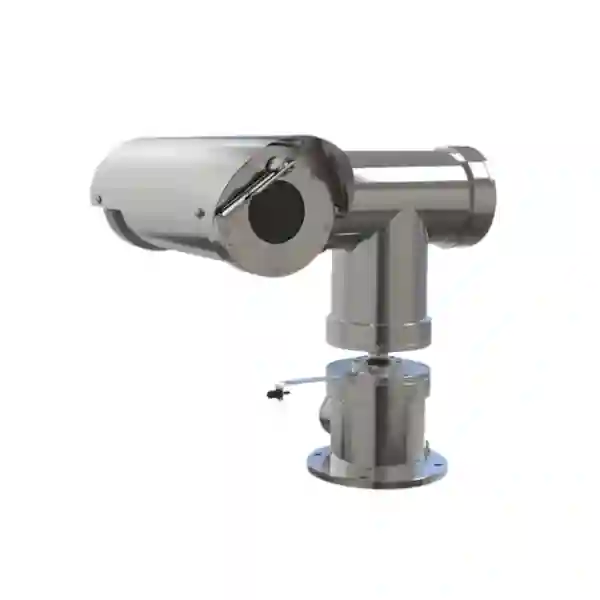
Hanwha TNU-X6320E1WT1-Z explosion-proof PTZ camera
An industrial 2MP, 32× optical-zoom positioning camera for carefully assessed hazardous locations. Understand the real specifications, safety checks and discontinued-product implications before procuring a unit for your facility.
At a glance: verified original-model specifications
| Device type | Explosion-proof IP PTZ positioning camera |
|---|---|
| Maximum video | 1920 × 1080; up to 60fps with H.265/H.264 |
| Lens and movement | 4.44–142.6 mm, 32× optical zoom; 0–360° pan, -90° to +90° tilt |
| Image features | 150 dB WDR, autofocus, digital stabilisation, day/night, defog |
| Housing and weather | 316L stainless steel; IP66/IP67; integrated wiper |
| Power | 24VAC input; manufacturer-listed maximum 80W |
| Storage | Dual microSD/SDHC/SDXC slots; up to 256GB per slot |
| Networking | RJ-45 IP interface; ONVIF Profiles S and G |
| Environmental range | -40°C to +60°C operating temperature |
| Size and mass | 176 × 154 × 480 mm; listed weight 53 kg |
| Lifecycle | Discontinued; identified replacement TNU-X6320A1WT1-Z |
Ratings are based on the manufacturer’s exact-model product information. A product specification is not a site approval, stock confirmation, installation method or quote.
Who this industrial camera is for
The Hanwha TNU-X6320E1WT1-Z explosion-proof PTZ camera is intended for a very different procurement decision from an ordinary office or retail security camera. It is a networked positioning camera for a facility whose monitoring locations may have a classified hazardous atmosphere and where a carefully selected explosion-proof enclosure is part of a larger safety-engineered installation. An engineering team might consider this category when designing perimeter views around process equipment, monitoring external tank-related infrastructure, observing material handling or improving visual awareness of equipment approaches. Whether this particular version belongs at a given mounting point is an engineering determination, not something that can be established by the words explosion-proof alone. Ask the site safety specialist to supply the applicable area classification, gas or dust risks, installation rules and approval requirements before accepting a quotation.
For Tanzania-based project teams, the useful purchase question is not simply whether this camera captures Full HD footage. It is whether the exact discontinued model is still supportable and acceptable for the proposed hazardous location, whether its power and mounting arrangements are viable, and whether the deployed recorder or video-management system can handle the planned operating profile. A prudent enquiry should include the plant environment, desired visual coverage, available electrical infrastructure, network connection, viewing distance and maintenance constraints. FourTeck Tanzania can be asked to review a specification, but customers should separately verify any local supply, service, conformity or installation arrangement rather than treating a website description as confirmation of those services.
Product lifecycle: understand the replacement before you buy
Hanwha Vision currently marks TNU-X6320E1WT1-Z as discontinued and names TNU-X6320A1WT1-Z as its replacement model. This is an important purchasing fact, not a minor footnote. It means a project specifying the older E-series model needs a deliberate conversation about whether an unused or replacement unit is genuinely required, whether a compatible alternative is permitted, and how future spares and service will be handled. The manufacturer identification of a successor should not be interpreted as a promise of identical mechanical interfaces, firmware functions, approvals, power draw or drop-in compatibility. Engineers should obtain the current documentation for both exact model codes and complete a change review before accepting a substitution.
If the requirement is to replace one device in an established system, document the existing enclosure, connected equipment, mounting bracket, junction arrangement, cable entry, controller behaviour and recorder settings. A new-build project may have more flexibility to move directly to the currently listed alternative after reviewing its certification and design details. For a tender, it is reasonable to show the original model as the requested reference while noting that it is discontinued and requesting a fully documented alternative proposal. Do not rely on generic family brochures or dealer descriptions that combine information from different variants. The correct product code matters because electrical supplies, interface options and ratings differ across related explosion-proof camera models.
Full HD video and what its resolution means
The specified image output reaches 1920 × 1080 pixels, with H.265 or H.264 video at up to 60 frames per second under the stated frequency conditions. Full HD resolution provides a practical balance between visual detail and the storage or network resources required for a moving camera, particularly where operators need to switch rapidly between wide views and zoomed inspection angles. The higher frame-rate setting can make fast activity easier to follow, but it can also increase recording and transmission demand. Select frame rate according to movement, incident-review expectations, retention policy and available bandwidth. Do not assume that all recording systems will capture every stream at the maximum stated setting without capacity planning.
Image quality also depends on lens position, available light, weather, atmospheric haze, vibration, camera cleaning and how much detail the target occupies in the scene. A long-distance view can show useful context without necessarily producing identification-quality footage. Determine whether the objective is detecting activity, observing a process, reading a marking or recognising a person; each objective imposes different pixel-density requirements. Conduct a field-of-view survey rather than relying on megapixels alone. Where illumination is poor, verify the proposed light level and exposure configuration with a test or engineering calculation. The manufacturer does not present this model as a thermal imager or a gas detector, so do not infer either capability from its hazardous-area-oriented housing.
32× optical zoom and field-of-view planning
The lens offers a 4.44–142.6 mm focal-length range with 32× optical zoom and autofocus. Optical zoom lets an operator move between a broad scene and a narrower view while using the camera’s lens to preserve more useful detail than simple electronic enlargement. Hanwha lists a horizontal field of view of about 61.8 degrees at the wide end and 2.19 degrees at the telephoto end, with a 16× digital zoom option. These are important design inputs: at long focal lengths, a small change in camera direction shifts the viewed scene substantially, and vibration or heat shimmer can make remote inspection more difficult. Auto focus should be tested with the expected working distances and scene conditions.
Create a coverage plan for each mounting position that identifies overview scenes, critical equipment, approach routes and the narrowest view operators will realistically use. Do not promise that a single PTZ unit will continuously watch all these directions at once. Once the lens zooms in on a distant target, activity outside that current field of view may not be recorded by that unit. Fixed overview cameras can be considered alongside a PTZ when uninterrupted area coverage is necessary. The manufacturer’s stated minimum object distance is 1.5 m, but hazardous-area clearance, mechanical positioning and the practical viewing geometry will usually drive installation choices more than this number alone.
Pan and tilt behaviour in real operations
Hanwha specifies a 0–360 degree pan range and a -90 to +90 degree tilt range for the older model, together with maximum preset speeds of 45 degrees per second for pan and 24 degrees per second for tilt. Those figures describe the movement mechanism and should not be confused with guaranteed response times for an entire monitored system. Operator commands, network delays, control software, preset accuracy and scene complexity all influence how useful a camera feels during an incident. A viewing plan should identify which positions deserve presets, how operators choose them, and how a camera returns to a safe overview after a manual intervention.
A PTZ camera is most effective when the operational team knows its purpose. Establish who is permitted to steer it, whether guards can take priority during an event, how the camera should behave on a network interruption, and which critical zones need independent fixed coverage. Moving devices also introduce mechanical wear and require attention to mount rigidity. In industrial locations, repeated swings across high-temperature equipment, moving vehicles or bright sources may require a carefully tuned exposure and focus strategy. Confirm controller functions, firmware compatibility and the supported automation methods for the specific device rather than assuming every feature marketed across a wider camera series exists in this model.
Wide dynamic range, low light and stabilisation
A published 150 dB wide dynamic range rating helps explain why this model can be attractive where bright and dark portions of a scene coexist. A gate facing a strong sky, a shaded access point beside bright process lighting or a structure with strong reflections can challenge ordinary exposure settings. WDR seeks to retain useful detail across contrasting regions, but the result still depends on the actual scene and camera configuration. The unit also includes day-and-night switching using an IR-cut filter, backlight-related controls, noise reduction and defog functions. These are image-processing tools, not substitutes for adequate illumination or a clean optical window.
Manufacturer specifications include minimum illumination figures of 0.05 lux in colour and 0.005 lux in black and white under specified test conditions. Those measurements should not be read as a guarantee of usable evidential detail at every low-light site. Confirm what frame rate, shutter speed, subject movement and light-source characteristics are acceptable for your application. Built-in gyro-assisted digital image stabilisation may help the picture under vibration, yet severe structural movement can still make a telephoto image difficult to use. Installation engineering should treat stable mounting and realistic night-scene testing as essential parts of a successful deployment.
Explosion-proof claims and hazardous-area design
The product is described by its manufacturer as an explosion-proof PTZ camera, with cLCus C1/D1 and other certification references shown on its published specification. Such references are useful evidence about a specific configuration, but they are not a blanket authorisation to install the device in any potentially explosive atmosphere worldwide. Hazardous-location suitability depends on the exact equipment marking, gas or dust group, temperature class, location classification, construction, entry fittings and requirements of the authority responsible for the site. A catalogue summary cannot substitute for the full certification document, installation instructions or a documented assessment by qualified professionals.
In a Tanzania project, arrange an explicit review of the equipment’s markings and current documentation against the site’s applicable engineering and regulatory requirements. The procurement team should ask whether the relevant local authority, project standard or client specification accepts the proposed certification for that classified area. An installation may also require certified cable glands, seals, junction boxes, earthing, bonding and other protective measures; those must be selected as part of the overall system. The camera cannot make an unsafe electrical installation safe simply because its housing has an explosion-proof designation. Never perform enclosure modifications, wiring alterations or servicing in a hazardous location outside the manufacturer’s procedures and an approved safe-work process.
316L stainless-steel housing and outdoor exposure
Hanwha lists a stainless-steel STS316L housing with IP66 and IP67 environmental ingress-protection ratings. These characteristics matter at industrial sites where weather, water, airborne dust and corrosion exposure make standard housings less suitable. Stainless steel can be a sensible material choice for certain demanding locations, but the actual service life depends on environmental chemistry, surface condition, maintenance, fixing materials and the compatibility of surrounding parts. A product described as stainless is not automatically immune to every aggressive substance. Project engineers should assess any exposure to salt spray, chemical washdown, sulphides, abrasive dust or other relevant conditions before finalising the installation.
The integrated wiper is a practical feature when rain or contamination can obscure the window, yet it is not a promise of continuous visibility. A wiper removes some water and loose material, not every oily film, mineral deposit or hardened residue. Establish an inspection and cleaning regime appropriate to the actual site and refer to the maintenance instructions for materials and methods. When a location requires a washer system, confirm the exact accessory and its suitability rather than assuming a tank or pump is included. Temperature, humidity and environmental ratings also need to be evaluated together with the chosen cable entry, seals, mounting arrangement and electrical supply.
Temperature range, weight and mechanical support
The original TNU-X6320E1WT1-Z lists an operating temperature range from -40°C to +60°C and non-condensing relative humidity from 0 to 90 percent. Its specified dimensions are approximately 176 × 154 × 480 mm, and the manufacturer lists its weight as 53 kg. This is a substantial piece of industrial equipment, not a lightweight building camera. Weight alone does not describe the complete mounting load: bracket geometry, wind, vibration, maintenance access, service tools and dynamic movement may also matter. Engineering drawings and approved mounting instructions should determine how the support structure is designed and checked.
Before proposing a pole or wall location, confirm there is enough working clearance for pan and tilt movement and suitable access for inspection. Determine the load path through the bracket, anchors and supporting structure. Where exposure to severe weather or frequent vibration is expected, include it in structural review rather than assuming that an environmental rating solves the problem. Lifting and handling should be planned by a competent team with suitable equipment; the unit’s size and mass affect both installation safety and future maintenance. The product specification must be checked against the precise supplied variant before a contractor fabricates final mounting hardware.
24VAC power: a critical purchasing distinction
This exact model requires 24VAC power, with a manufacturer-listed maximum consumption of 80 W. These numbers should be used in the electrical design rather than copied from an unrelated network camera. Although the device transmits video over an IP network, the manufacturer does not identify the TNU-X6320E1WT1-Z as a Power over Ethernet camera. A reseller page may show a generic PoE attribute for a network camera category; that is not a reliable basis for wiring this unit. Check the supply voltage, transformer capacity, cable run, voltage drop, protective devices and installation requirements before equipment is ordered or energised.
The power design should cover starting and operating conditions, future maintenance access and the separation or protection of network and power infrastructure where the site standards require it. Consider how the camera will behave if the supply is interrupted and whether the larger surveillance system needs backup power. A UPS strategy must account for the actual electrical arrangement, not just the nominal camera wattage. Where the hazardous area imposes special wiring methods or equipment selection, those conditions take precedence over ordinary convenience. Ask the integrator to document a verified bill of materials for the camera, supply, cable, entries, seals and isolating hardware.
Ethernet networking and the limits of variant assumptions
Hanwha’s published interface information includes RJ-45 10/100BASE-T Ethernet for the applicable model, with the manufacturer separately identifying fibre modules in F2 variants. The requested code is not the F2 fibre variant. Procurement teams should therefore not infer that a built-in fibre interface is present because a related model or family overview mentions one. If the proposed mounting position is remote from the network cabinet, the system designer needs to decide where the appropriate network termination and conversion equipment can safely be located and how cable routes will be protected.
Industrial networks should be designed with realistic expectations about bandwidth, latency, switch capacity, lightning and surge protection, segmentation, remote support and failure recovery. The camera supports common IP video protocols including RTSP, and its manufacturer lists ONVIF Profiles S and G plus SUNAPI integration. Even with familiar standards, recorder discovery, event handling and PTZ control can vary by software and firmware. Test the exact camera and VMS combination before promising every control, playback or analytics function. Network architecture must also respect the hazardous-area classification; industrial-grade switches or media converters are not automatically approved for installation inside every classified area.
H.265, H.264, multiple streams and bandwidth
The camera supports H.265, H.264 and MJPEG video formats, together with multiple streaming profiles and Hanwha’s WiseStream II functionality. Different profiles can serve different clients: one feed may be suitable for a recording server, while a lower-bandwidth stream can help remote operators or monitoring displays. The manufacturer lists up to ten profiles and up to twenty unicast users, but an actual design still needs to budget for the bitrates and concurrency of each intended connection. User count should not be treated as a substitute for a capacity calculation.
Choose compression settings according to the image detail needed, scene motion and incident retention requirements. The highest compression ratio is not always appropriate where small moving details must remain recognisable after export. Fast pan movements, rain, foliage, steam and visual noise can also change bitrates markedly under variable-rate encoding. Build a bandwidth and storage plan using the proposed frame rate, resolution, encoding settings, recording mode and expected scene complexity. Network congestion and packet loss deserve attention on isolated industrial links where remote troubleshooting can be difficult. Test exported footage, not just a live preview, to ensure the evidence workflow is useful.
Onboard microSD recording and retention planning
Hanwha specifies two microSD/SDHC/SDXC slots supporting up to 256GB in each slot, for a combined maximum stated card capacity of 512GB. That is a device capability, not a guarantee of a particular number of recording days. Retention changes with bit rate, frame rate, activity, quality settings and whether the camera records continuously or by events. The site should decide whether cards will provide primary short-term recording, failover protection or limited local event capture. A centrally managed recorder or VMS may still be necessary for wider operational and evidence requirements.
Memory cards used in demanding installations should be selected against the manufacturer’s compatibility guidance and the intended write workload. A maintenance programme should include checks that cards are detected, recording triggers function, time settings are correct and the expected clips can actually be retrieved. If there is a network outage, confirm the precise recovery behaviour of the integrated system rather than assuming all missed footage will automatically synchronise. Storage design also needs a cybersecurity and privacy policy: who can view video, how long it is kept, when it is exported and how it is deleted. Those policy decisions must be made by the responsible operator.
Intelligent analytics: useful events, not guaranteed judgments
The model’s published analytics include motion detection, tampering and fog-related alerts, as well as face detection and virtual-area or virtual-line functions such as intrusion, entry and exit, crossing and direction. These tools can help route operator attention to significant changes in a monitored scene. They are not a substitute for staff supervision, an independently engineered process-safety system or reliable fire and gas detection. Scene conditions, target distance, illumination, movement, camera position and rule configuration affect the quality of event detection. For each analytics rule, identify what event matters, where it should be detected and what the operator should do when the alarm is received.
A realistic acceptance test includes both positive and negative cases: expected activities that should trigger an event and ordinary site activity that should not. Vehicle headlights, rain, shadows, steam and changing equipment positions can create nuisance alerts in some environments. Avoid configuring so many overlapping rules that operators ignore alarms. For a moving PTZ camera, confirm which analytics are useful at a given position and whether rule areas remain valid through zoom or preset changes. Event linkage, email or network notifications and integration with the control room should be tested on the intended recorder version rather than assumed from the presence of an analytics feature name.
Cybersecurity and controlled remote access
Hanwha lists HTTPS secure communication, IEEE 802.1X network authentication, digest authentication, IP-based access control and system or event logging among the camera’s security features. They create useful design options, but safe deployment also depends on administrator practice and the wider network. Place surveillance devices in an appropriately managed segment, assign individual access rights where the supporting system permits them, disable unused interfaces where feasible and protect administrative credentials. Define how technicians gain access to the camera and how that access is removed when work ends. Do not make an exposed camera management page the default solution for off-site viewing.
For a discontinued model, maintenance planning is especially important. Ask the manufacturer or authorised support channel what firmware and security support is currently available for the exact hardware revision, and assess unresolved vulnerabilities through the site’s normal change-control process. Firmware changes should be tested for VMS compatibility, retained settings and operational consequences before a production rollout. Document date-and-time configuration, logging, account ownership and backup procedures. Cybersecurity does not remove the obligation to keep the explosion-proof enclosure, power supply and hazardous-area protective measures compliant with the site engineering requirements. Both aspects must be managed in parallel.
Video-management-system integration and operator workflow
The camera is best evaluated as part of an operational surveillance system rather than as an isolated product. Identify which NVR or VMS will receive its streams, how PTZ commands are issued, how events are displayed and how footage is exported. ONVIF and network-streaming support can improve interoperability, but they do not prove that every particular VMS version offers all advertised analytics, camera presets, search functions or failure-recovery features. A short acceptance trial on the intended platform is a sensible requirement for high-value industrial procurement.
Define operator tasks before configuring the interface. A security team may need a default overview and rapid preset selection; an operations team may need scheduled visual checks of a specific plant area; an incident response team may need exportable evidence and access logs. These are different workflows with different priorities. Decide how control handover works when multiple operators request movement and whether the PTZ should return to an overview after a timeout. If an area must be permanently observable, provide an independent fixed view rather than depending on the PTZ to face the correct direction at every moment.
How to assess suitability for a Tanzania project
Tanzania industrial buyers often have to coordinate several disciplines in one request: site engineering, safety, electrical contractors, network administrators, security operations and procurement. The right starting point is a concise site requirement rather than a product-only quotation request. Document the mounting location, area classification, environmental exposures, expected temperature range, available power, cable route, communications backbone, desired fields of view and current recorder environment. Add drawings or photographs only when they can be shared safely under the organisation’s security policy. This information allows a technical discussion that is more meaningful than asking whether a camera is good for a factory.
Do not assume that a manufacturer approval listed in an international catalogue automatically satisfies every applicable Tanzania requirement. The responsible client and qualified project professionals should determine the necessary standards, inspections and authority acceptance. Similarly, no stock position, import processing, support coverage, delivery promise or local warranty is established by the technical specification alone. Ask for those commercial details in writing for the exact quoted model or successor. Where procurement rules require an approved-equivalent submission, request a comparison of the critical electrical, mechanical, environmental, network and certification characteristics before approving any replacement.
Practical tender and quotation checklist
A useful request for quotation should clearly distinguish the product code, the engineering duty and the commercial terms. Start with the exact reference TNU-X6320E1WT1-Z, then flag the manufacturer-discontinued status and permit an alternative only if the project can accommodate a formally reviewed substitution. Request the exact alternative part number, applicable certification documents and any proposed changes to brackets, power, connections or network design. Include the available 24VAC infrastructure and mention that PoE should not be assumed for the original unit. State the relevant monitoring distance and whether a fixed reference camera is also required.
Ask the respondent to identify accessories that are included, optional or excluded: mounts, approved glands and seals, transformer or power equipment, network hardware, recorder licenses, compatible memory cards, protective equipment and commissioning services. Include documentation deliverables such as drawings, configuration backup, user handover, acceptance test results and maintenance guidance. Obtain separate commercial confirmation of taxes, currency, lead time, installation scope, warranty terms and support arrangements; do not infer these details from a product page. If multiple suppliers respond, compare the technical compliance schedule before comparing prices. A lower price for an unsuitable certification, different power input or unsupported camera is not an equivalent offer.
Installation planning, safe handling and acceptance
A competent installation plan begins with a location survey, classification review and documented mechanical design. Ensure the chosen structure can carry the published camera mass along with the permitted bracket and environmental loads. Check access for lifting, wiring, commissioning and later maintenance. Verify that each cable entry, termination and protective fitting is suitable for the exact approved installation method. All work on hazardous-area equipment must follow the manufacturer’s instructions and the facility’s authorised safety procedures. Do not use this page as a wiring guide, certification document or permission for unqualified work.
The acceptance process should be practical and evidence-based. Inspect markings against the approved bill of materials; verify mounting security and earthing arrangements; confirm correct 24VAC supply and relevant protection; then test network reachability, firmware baseline and secure access. Capture sample views at wide and telephoto settings, verify focus and low-light performance, move through the intended preset positions and check the wiper under permitted conditions. Record sample footage and retrieve it through the actual VMS. Test network interruption handling, event notifications and retained configuration. Close with operator training and an agreed preventive-maintenance schedule, noting any unresolved issue before the system enters normal operation.
Ongoing maintenance and cleaning strategy
A camera mounted in a difficult industrial location needs a maintenance strategy before it is installed. The plant should decide who is responsible for visual checks, how access will be obtained, what conditions require an immediate inspection and which actions must be completed by qualified hazardous-area personnel. Common operational checks include picture quality, wiper condition, cleanliness of the viewing window, mechanical movement, card or server recording health and network availability. Exact cleaning products, replacement parts and procedures must come from the applicable manufacturer documentation, not assumptions about what stainless steel or glass can withstand.
Keep a record of model code, serial information, hardware revision, commissioning settings, approved drawings and any certifications needed for the installation. For a discontinued device, consider the risk that specific components or service options may be harder to obtain. Confirm the manufacturer’s actual support position before building a spare-parts plan. A replacement strategy should include the functional requirements, the minimum acceptable safety and environmental documentation and the integration testing that would be required for a future change. Maintenance is not just cleaning the window: it also includes firmware review, user-account governance, video retention checks, mounting inspection and confirmation that the monitored scene still meets the original operational need.
Where this PTZ makes sense—and where it does not
This camera category makes sense where an engineering assessment requires a specialised hazardous-area-rated visual device and where controllable long-range observation is genuinely useful. Examples to evaluate include industrial processing sites, designated equipment approaches, infrastructure around bulk material storage and selected external locations where security and operations staff need to inspect different directions. Each example is conditional on site classification, exact approval and the intended surveillance task. A PTZ may reduce the need for an operator to travel to a distant vantage point, but it cannot replace a formal inspection, process instrument or life-safety system when those are required.
It may be a poor choice for an ordinary office or warehouse that has no need for its specialised housing, or for a site where permanent simultaneous coverage is the overriding objective. It may also be inappropriate where the available power arrangement is incompatible, where the mounting structure cannot safely support the unit, where the certification does not match the site or where the customer needs an actively supported new-design product rather than a discontinued reference. These constraints should be discussed at the start, not discovered after a purchase order. Selecting the correct camera often involves choosing fewer features but a better operational fit.
The replacement model: a responsible comparison
The manufacturer points buyers to TNU-X6320A1WT1-Z as the replacement for the older E1WT1-Z version. Its current information still describes a 2MP explosion-proof PTZ camera with 32× optical zoom, 24VAC power, a wiper and IP66/IP67 environmental protection. However, headline similarities should not be used to equate every parameter. For example, the newer published model lists a different WDR figure from the older model. The comparison therefore needs to be based on each product’s own latest datasheet and any certification documents relevant to the proposed site.
For replacement procurement, compare the video requirements, pan and tilt controls, required presets, network protocol support, card recording, mechanical envelope, power requirements, operating temperature, certifications and accessory compatibility. Existing VMS licences, firmware support and the ability to recover saved configurations deserve separate testing. The successor designation is a helpful starting point for vendor discussion, not a universal approval for a field substitution. When the project specification is written around a discontinued item, asking for an approved-equivalent review can prevent both a dead-end order and an unsafe or unsupported equipment change.
What information to send for an informed quotation
Share the complete model reference, the intended number of cameras, whether the project is new or a replacement and whether a newer approved model is acceptable. Include the country of deployment, mounting height if known, general site conditions, proposed connection method and the relevant recorder or VMS brand and version. Indicate the functions that matter most: 32× zoom, preset movement, image quality at night, a wiper, local storage, event analytics or a particular network integration. Explain whether the specified hazardous-area certification is a hard requirement and which authority or project standard governs acceptance.
When asking for pricing, request a written breakdown for the exact camera or replacement and every necessary accessory, plus separate confirmation of availability and delivery. If the existing installation is being repaired or upgraded, provide the model and the type of bracket and wiring arrangement, but do not share passwords, private network details or sensitive plant drawings in an unsecured message. Ask about the supplier’s documented support route, warranty terms and commissioning responsibilities. FourTeck Tanzania can use these questions as a basis for a requirements discussion; this product text itself does not constitute a quote or a confirmation that the discontinued device is available.
Questions and answers for industrial buyers
Is the TNU-X6320E1WT1-Z still a current model? No. Hanwha Vision marks this specific model discontinued and identifies TNU-X6320A1WT1-Z as its replacement. A supplier should confirm actual orderability or propose a documented alternative rather than implying that the old model is current. Existing installations can still be evaluated individually for service and replacement needs.
Does the camera use PoE? The manufacturer specifies 24VAC for this exact model and a maximum consumption of 80W. Do not plan the electrical installation around generic network-camera PoE claims seen in retailer templates. Ask the integrator to confirm the proper supply, protective devices, cable lengths and hazardous-area installation details.
What resolution and optical zoom does it provide? The published maximum resolution is 1920 × 1080, and the lens provides 32× optical zoom from 4.44 to 142.6 mm. Video can reach 60fps using H.265 or H.264 under the specified operating conditions. Useful detail at any distance still needs a site-specific field-of-view calculation.
Does explosion-proof mean it is approved for every hazardous area? No. Its published certifications must be checked against the particular hazardous-area classification, installation location, gas or dust hazards and requirements of the responsible authority. A qualified specialist should verify the marking and complete documentation for the exact unit and accessories.
Can this replace a fixed surveillance camera? It can provide selectable views over a broad area, but a PTZ cannot guarantee simultaneous observation in every direction. When continuous evidence of an entrance, boundary or critical asset is required, use a fixed overview camera or another engineered coverage arrangement alongside it.
What are the ingress and temperature ratings? The manufacturer lists IP66/IP67 and an operating range of -40°C to +60°C. These are environmental design parameters, not assurances that every possible chemical, mechanical or weather exposure is acceptable. Cable-entry, mounting and maintenance choices remain important.
Is there an integrated wiper and washer? An integrated wiper is part of the published feature set. Do not assume a separate washing tank or cleaning system is supplied with the camera. The quote and relevant accessory list should identify any additional cleaning equipment needed for the site.
How much internal recording space is supported? The camera lists two microSD slots, each supporting up to 256GB, for a total maximum stated capacity of 512GB. The actual recording duration depends on settings and activity. Confirm card compatibility, recording health monitoring and the retention policy before relying on edge storage.
Will it work with our existing NVR or VMS? It supports IP video protocols and manufacturer-listed ONVIF Profiles S and G, but exact PTZ controls, analytics, event triggers and playback behaviours can depend on software versions. Require an integration test on the intended platform before accepting full compatibility.
Can we buy the model in Tanzania and what does it cost? This page does not establish current Tanzania stock, lead time, price or warranty. Because the product is discontinued, obtain a project-specific quotation and ask whether the proposed supply is the exact requested model or its current successor. Confirm the technical and commercial details in writing.
Is it suitable for watching gas leaks or heat signatures? It is a visible-light surveillance camera, not an advertised gas-detection or thermal-imaging instrument. It may provide visual context around a process area, but it should not be presented as a replacement for certified gas monitoring, fire detection or other process safety controls.
What is the most important step before specifying it? Have the responsible engineering team validate the exact hazardous-area classification, accepted certification, power supply and mechanical installation. Then check the video objective, recorder integration and successor-model options. Those checks are more consequential than a headline zoom or resolution figure.
Request a requirements-based industrial camera quotation
Ask FourTeck Tanzania to discuss the original Hanwha TNU-X6320E1WT1-Z reference or an appropriate current alternative. Share the intended application, hazardous-area classification, mounting location, power provision and VMS requirements. Request written confirmation of product identity, suitability documents, price, availability and included equipment before purchase.
No Tanzania inventory, price, delivery period, certification acceptance or service scope is asserted by this page.




Reviews
There are no reviews yet.