
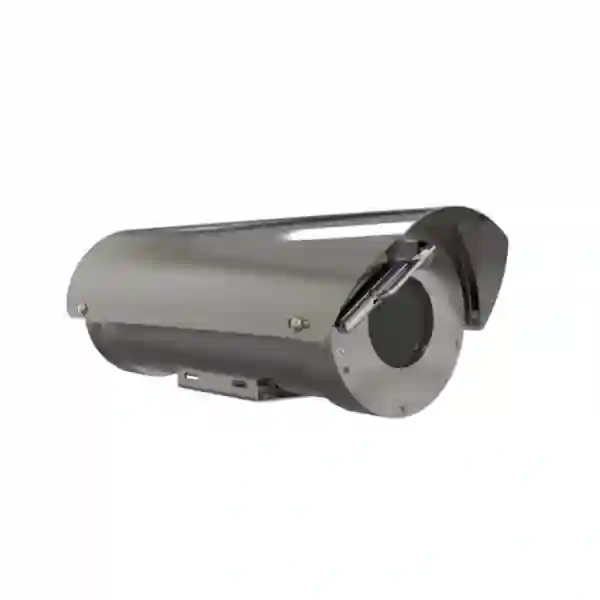
Hanwha TNU-X6320E2F2WT1-M Explosion-Proof PTZ Camera
An industrial network positioning camera combining 2MP video, 32× optical zoom, an integrated wiper, single-mode fibre and 110VAC input. This legacy model is discontinued, so buyers should verify their exact application and review the designated replacement before purchasing.
Important: discontinued model
Hanwha Vision identifies this exact model as discontinued. Its manufacturer-designated successor is TNU-X6320A2F2WT1-M. Verify current sourcing, certification suitability, mounting and integration; neither available stock nor identical replacement characteristics are implied.
Technical snapshot
| Exact model | TNU-X6320E2F2WT1-M |
|---|---|
| Camera type | Explosion-proof network PTZ positioning camera |
| Lifecycle | Discontinued per manufacturer |
| Designated replacement | TNU-X6320A2F2WT1-M |
| Published legacy video | 2MP; up to 1920 × 1080 / 60fps |
| Lens | 4.44–142.6mm; 32× optical zoom |
| Legacy WDR | 150dB |
| Network variant | F2 single-mode fibre |
| Cleaning | Integrated wiper |
| Storage | Dual microSD-family slots |
| Input | 110VAC |
| Housing family | 316L stainless steel |
| Ingress rating | IP66/IP67 family rating |
| Marking variant | -M, INMETRO; check local suitability |
Published legacy or family characteristics require exact-variant verification for engineering approval.
Buying decision and lifecycle
The Hanwha Vision TNU-X6320E2F2WT1-M is a specialist explosion-proof network positioning camera for industrial surveillance. Its role is to provide remote views of exposed or classified process areas through a stainless-steel assembly with optical zoom, pan-tilt motion and a window wiper. The immediate buying issue is lifecycle: Hanwha Vision currently describes this exact camera as discontinued and identifies the TNU-X6320A2F2WT1-M as its replacement. A project should not proceed on the assumption that the older camera remains in production or that a replacement is identical.
For a new Tanzania project, obtain a current model proposal and assess it against the actual viewing task, classified-area requirements and site infrastructure. For maintenance of an existing installation, record the fitted part number, firmware, optical and power interfaces, mounting details and control-system requirements. The right starting point is a model-specific technical review, not an unsupported stock indicator or an unqualified promise of compatibility.
Who this product information is for
This legacy camera is relevant to industrial maintenance engineers, security integrators, plant operators, procurement teams and engineering consultants. A maintenance team may be searching for a matching spare; an integrator may be asked to substitute a discontinued model; a consultant may need to verify whether the approved design can be revised. These use cases have different acceptance criteria, and the quotation needs to state which problem is being solved.
Illustrative settings include oil and gas facilities, chemical processing areas, bulk-storage infrastructure and other industrial sites where a formal hazardous-area assessment influences equipment selection. This does not establish that the camera is certified for every zone or that a particular Tanzania facility can install it. The site classification and competent engineering review govern the decision, while the surveillance requirement determines whether a PTZ is the right camera type.
Core technical specifications
The published legacy model features are 2MP Full HD video at up to 60 frames per second, 32× optical zoom with autofocus, multiple network streams, intelligent analytics, a built-in wiper, fibre connectivity and two microSD-family storage slots. Hanwha identifies 110VAC power for this exact configuration. WDR is listed at 150dB on the legacy model page. These figures describe a specialised visible-light network camera, not a thermal imaging or temperature-measurement device.
Model suffixes matter. The F2 designation denotes a single-mode fibre configuration, T1 relates to the published minus 40°C to plus 60°C operating-temperature class and -M denotes the INMETRO variant. The Wisenet T-series documentation describes 316L stainless-steel construction and IP66/IP67 ingress protection. Each site must verify the precise model’s certificate, datasheet revision, environmental suitability and installed options before the equipment is approved.
Pan and tilt for changing observation tasks
A positioning camera can be redirected from a remote control room to inspect different parts of a plant. Published family documentation describes continuous 360-degree panning and a 180-degree tilt range, giving flexibility when a single mounting location must view several assets. Operators may need to look at a gate, vehicle route, loading station or process assembly at different times. Presets should be configured around meaningful observation tasks and documented with the commissioning records.
A PTZ does not watch every direction simultaneously. When zoomed toward one object, other areas may be outside the frame, so essential continuous coverage may require additional fixed cameras. Think through operator permissions, control priorities and preset behaviour. If multiple users share the camera, their control workflow must avoid one operator unexpectedly redirecting the view while another is responding to an event.
The practical value of 32× optical zoom
The legacy lens is specified at 4.44–142.6mm, delivering 32× optical zoom and autofocus. The wide setting provides context, while the telephoto setting brings distant objects into a larger portion of the frame. This can help personnel inspect activity around equipment from a remote viewing point instead of positioning an ordinary camera next to every item. It is a valuable capability where field access is constrained or hazardous.
Do not confuse optical magnification with guaranteed identification at any distance. Light, air quality, target size, motion, mounting vibration, camera angle and pixel density determine the detail that can actually be recovered. Ask the designer for a field-of-view assessment at the specified ranges, including sample views under realistic conditions. If the task is reading small markings, define that task expressly rather than relying on the zoom figure alone.
Image detail and frame rate
At 1920 × 1080 pixels and up to 60fps, the published imaging specification is suitable for a range of industrial observation tasks, including monitoring movement in yards and facilities. More frames can help portray fast motion, but the chosen codec, bitrate and recorder configuration influence what the operator ultimately sees. A camera’s maximum figure is not a guarantee that every installed stream will run continuously at that setting.
Define a recording profile based on actual operational needs. A slowly changing pump platform may not require the same frame rate as a vehicle route. Verify live view and playback at the control room, not just in a camera configuration menu. Check timestamps, dropped frames, night performance and event playback during commissioning. Where footage may be used as evidence, preserve the settings and test results in the handover package.
Wide dynamic range in difficult light
The published legacy feature set lists 150dB wide dynamic range, intended to assist with scenes containing bright and dark areas. Industrial cameras may face reflective pipework, direct sunlight, vehicle headlights, security lights or partially shaded structures. WDR can improve the ability to see information across such contrasts, but performance remains scene dependent. Strong glare or unsuitable exposure settings can still obscure a specific object.
A camera location should be evaluated at relevant times of day and in different operating conditions. Record sample views from the intended mounting point, including a wide contextual shot and the close-up that operators need. If substituting the newer A-series model, compare its own specifications: Hanwha publishes 120dB WDR for the designated replacement, so the legacy 150dB number must not be copied into a successor listing.
Day and night imaging
The camera family incorporates day/night switching and low-light image functions for surveillance across changing illumination. An IR-cut mechanism supports the camera’s transition between relevant viewing modes. That does not make the unit a thermal camera or guarantee a useful image in total darkness. Industrial sites often have uneven lighting, distant objects, strong point sources and significant shadow regions that must be considered separately from the nominal sensor specification.
Review the light available at the object of interest, not merely beside the mounting location. A distant gate can be dim even when a nearby pole is well lit. If additional lighting is required, its electrical and hazardous-area suitability must be assessed. Define whether the operator needs to recognise movement, distinguish clothing colours, see a number plate or read a gauge; those outcomes require different tests.
Built-in window wiper
The integrated wiper helps maintain a useful view when rain, spray or deposits interfere with the front glass. That is particularly relevant to cameras installed where maintenance visits are inconvenient and the viewing window faces outdoor weather. Hanwha also identifies associated accessories for some configurations, but an accessory pictured beside a product must not be assumed to be included in its base package.
A wiper cannot replace scheduled inspection or proper cleaning. Dust, oils, sticky residues, salt deposits and abrasive contamination may require different maintenance methods. Check the current instructions for safe cleaning materials and inspection intervals, and include wiper operation in acceptance testing. If a washer system is proposed, verify the exact accessory compatibility, electrical and mounting details and suitability for the classified location before adding it to the bill of materials.
Single-mode fibre connection
The F2 suffix identifies a single-mode fibre variant, making the model relevant to site networks built around fibre routes between field cameras and a control room. Fibre can be attractive in industrial designs that require long routes or optical connections through challenging electrical environments. However, the interface must be matched to the installed fibre plant and network equipment; a label saying fibre is not a complete link design.
Confirm connector and optical details using the exact product documentation and existing installation records. Inspect fibre condition, route protection, termination, permitted cable entries and the network devices at the other end. Fibre does not power this camera. A replacement project should test end-to-end video and PTZ control on the actual network rather than assume that a newer fibre-enabled camera has identical modules or cabling requirements.
Power specification is a purchasing gate
Hanwha’s legacy listing states 110VAC input for the TNU-X6320E2F2WT1-M. Supply voltage is therefore a mandatory check, particularly when assessing a facility with other distribution arrangements. The device should never be advertised as a generic PoE camera or as compatible with any available AC voltage. The actual power circuit, protective devices, isolation, earthing and safe cable installation belong in the project’s approved electrical design.
Before quoting, ask the plant electrical team to document the supply available at the proposed mounting point. If conversion or a new circuit is needed, it must be engineered and approved for the site’s environment. Check the replacement model’s supply independently and include commissioning tests for start-up, PTZ operation, safe isolation and continuity. The right approach prevents a seemingly simple camera exchange from becoming an unsafe field workaround.
316L stainless steel and industrial construction
The product family uses electro-polished 316L stainless steel on welded assemblies. This helps explain its suitability for demanding industrial service where conventional decorative housings may be inappropriate. Stainless steel is still subject to site-specific material compatibility, and the overall installation includes fasteners, brackets, cable fittings and optical surfaces that require their own selection and maintenance.
Review corrosive exposure, wind loading, possible vibration, accessibility and physical interference with nearby equipment. Do not infer that the stainless-steel material guarantees resistance to every chemical or cleaning agent. A design should account for the complete assembly’s mechanical loads and the site’s planned inspection practices. Check any replacement model’s housing and bracket dimensions before attempting to reuse existing hardware.
Ingress protection is not explosion certification
IP66/IP67 appears in the Wisenet T positioning-camera family documentation. These ratings describe protection against defined dust and water ingress conditions, important for outdoor equipment where weather and airborne contamination can affect performance. But IP ratings do not prove that a camera is suitable for an explosive gas or dust atmosphere; those questions require the correct protection design, certificate and installation rules.
Seals, glands, unused entries, fittings and enclosure workmanship all affect the installed result. An incorrect gland or a damaged gasket can compromise an otherwise well-designed product. Site inspection should include the complete enclosure and cable system, not only the manufacturer’s product label. Ensure maintenance personnel follow the relevant safe-work process before handling or opening protected equipment.
INMETRO and hazardous-area selection
The -M model variant relates to INMETRO certification. The manufacturer markets this product as an explosion-proof PTZ camera, but the suffix alone is not a universal approval for every hazardous-area classification. Before installation, competent personnel must compare exact certificate markings and schedules with the site’s hazardous-area assessment, including gas or dust grouping, temperature limitations, ambient conditions and any specific installation restrictions.
For a Tanzania project, do not interpret an INMETRO designation as automatic Tanzanian legal acceptance. The applicable project standards, local authority requirements and competent engineering review need to be determined for the actual facility. Require documentation for the exact unit or replacement being offered. Never substitute a similarly named camera with a different approval suffix without a full certification and technical comparison.
Ambient temperature and site exposure
Published T-series model designation information associates T1 with an operating-temperature class of approximately -40°C to +60°C. This broad class may be relevant to exposed industrial sites, but ambient temperature is only one part of suitability. Solar loading, local process heat, enclosure placement, cable materials, corrosion, vibration and maintenance access all influence long-term performance.
Confirm that the proposed camera and its accessories meet the actual temperatures and environmental conditions at the selected mounting position. A temperature class for a product family should not be treated as blanket approval for every configuration or explosive atmosphere. Where a replacement is proposed, compare its own ambient range and certificate conditions rather than transferring a legacy specification by assumption.
Video analytics and event design
The published legacy feature set includes intelligent video analytics and functions such as motion and other rule-based event detection in the camera family. These features may help a security control room identify activity requiring review, but they should not be described as guaranteed intrusion detection, fault diagnosis or a certified life-safety system. Camera motion, rain, shadows, vapour, changing light and moving machinery can influence analytic behaviour.
Establish a clear purpose for each rule. A virtual line at a gate may be configured differently from motion observation around an equipment platform. During acceptance testing, confirm the full chain from camera event to recorder, operator alert, acknowledgement and stored video. Critical safety functions require appropriately designed dedicated systems. Video analytics should be used as complementary information with known limitations and operating procedures.
Multiple video streams and compression
Hanwha publishes multiple video streams and supports industry-standard compression formats in the camera family, including H.265, H.264 and MJPEG. This allows integrators to consider separate profiles for high-quality evidence, control-room live views and lower-bandwidth remote access. The ideal profile depends on the VMS, recorder capacity, link performance, scene motion and storage objectives rather than a single universal setting.
Plan network bandwidth using expected and peak encoded video loads. Test the chosen stream at the control room during normal operation and simulated link impairment. Verify that the recorder supports selected codecs, time stamps and event metadata, and that the operators can recover clips without relying on obsolete software. A discontinued camera’s cybersecurity posture and long-term software support deserve careful evaluation before it is retained in a new design.
Onboard microSD storage
The legacy camera incorporates two memory-card slots for microSD-family media. Such edge storage can support local recording arrangements when correctly configured, although actual behaviour depends on installed cards, firmware, power, recording policy and system design. A card slot should never be taken as proof of an unlimited retention period or of guaranteed recovery after every outage.
Calculate storage needs from measured bitrate and the required recording schedule. Specify suitable media, health monitoring, replacement intervals and export procedures. Test what happens during a central recorder failure, a network break, power interruption and restoration. Protect access to sensitive footage and document how evidence is retrieved, timestamped and retained in accordance with the organisation’s governance requirements.
VMS and operator integration
The value of a PTZ is limited if the control room cannot operate its functions reliably. Define requirements for pan, tilt, zoom, autofocus, presets, wiper actuation, recording, event display and user permissions. A stream that plays in a browser does not demonstrate that the site’s video-management system supports every control or metadata function needed by operators.
Record the exact VMS version, recorder, camera firmware and network topology. If the designated replacement is considered, run the same integration checklist again rather than assuming its control interfaces or configuration imports are identical. Establish a control priority policy for multiple operators and preserve standard preset names in the handover documentation. These operational choices can matter as much as nominal optical specifications.
Camera placement and scene coverage
Choose a camera location from the surveillance objective. Identify which assets or approaches must be visible, the expected viewing ranges, likely occlusions, night lighting, sun angles and practical mounting options. High placement can improve overview but can also reduce useful detail on small targets. An ambitious zoom specification cannot compensate for a poor mounting geometry or persistent atmospheric obstruction.
Prepare wide and telephoto field-of-view illustrations before committing to a bracket. Decide which scenes need uninterrupted observation from fixed cameras and which benefit from a movable PTZ. Allow space for the camera’s mechanical movement, window cleaning and safe inspection access. Verify wind and vibration loads with the structural designer and check that all proposed supports and fittings are suitable for the intended industrial installation.
Installation in a classified location
Explosion-protected equipment must be installed in accordance with its applicable documentation and site procedures. Plan cable entries, sealing, support structures, earthing, electrical isolation, fibre termination and inspection access before procurement. The correct equipment is only one part of the safety outcome; installation workmanship, approved materials and inspection practices matter throughout the camera’s service life.
A legacy replacement can require more work than expected if the new housing differs in weight, mounting pattern, cable-entry size or power needs. Ask the engineering team to compare drawings and review whether any old bracket or gland may be retained. Follow permit-to-work and safe-isolation rules for all relevant field tasks. Keep as-built drawings and inspection records with the finished surveillance system.
Control-room operating procedures
Define meaningful PTZ presets for the facility, such as the access route, loading platform or specific process asset, and document a normal home view. Operators should know how to restore context after zooming, what to do when visibility is obstructed and who may change camera settings. Where footage informs operations, distinguish visual observation from verified process measurements.
Create incident procedures for preserving recordings and communicating what the camera actually shows. If two teams share a unit, establish command priority and escalation rules. Train staff to recognise a failed wiper, incorrect preset, degraded fibre link, inaccurate timestamp and changing night-time conditions. A well-operated camera provides more reliable awareness than a technically capable unit without supporting procedures.
Tanzania site-engineering considerations
Tanzania-focused procurement should begin with actual facility information, not an unsupported local marketing claim. The facility’s hazardous-area classification, electrical distribution, fibre routes, ambient exposure, recording requirements and project approval process determine whether this legacy specification has any role. No claims are made here regarding FourTeck stock, offices, delivery time, local warranty, installation coverage or Tanzanian certification of the model.
Provide the prospective supplier with the exact part number and a short project brief. Ask whether an old unit can genuinely be sourced or whether the manufacturer-designated replacement is being quoted. Require the proposed model to be reviewed against the site’s power arrangement, network connection, mounting and certification requirements. A written technical clarification process is preferable to a speculative price or unverified availability statement.
Comparing the legacy and successor models
Hanwha Vision names TNU-X6320A2F2WT1-M as the successor to TNU-X6320E2F2WT1-M. This is useful lifecycle guidance, but it is not proof of a direct mechanical, electrical or software interchange. The replacement’s own manufacturer page describes a 2MP explosion-proof PTZ, single-mode fibre, integrated wiper and 110VAC supply, yet certain published feature figures differ from the old model.
Compare the exact documentation side by side. Check video output, WDR, optical and PTZ behaviour, ambient limits, certificate conditions, weight, dimensions, cable entries, mounting, network interface, software support and maintenance accessories. Have the integrator state which parts of the existing system can remain and which must change. Request approval of the proposed substitute from the responsible engineering authority before ordering.
When a different camera type is better
This camera is for a specialised industrial job. In a nonclassified outdoor area, a conventional IP PTZ might accomplish the viewing task with simpler installation. For fixed continuous observation, a stationary camera could provide more dependable coverage. When temperature measurement or heat-based anomaly detection is required, choose a properly specified thermal imaging system rather than treating an explosion-proof visible-light device as a thermal camera.
If the scene requires higher pixel density, evaluate the actual lens and sensor together with viewing distance. If there is no appropriate fibre or 110VAC infrastructure, account for the engineering changes instead of improvising a connection. The best procurement result is the right equipment for the environment, not necessarily the model whose name appeared on an old bill of materials.
What to send with a quotation request
Supply the exact model name, quantity, whether the request is a legacy replacement or new installation, site classification and the camera’s intended viewing tasks. Useful supporting information includes existing equipment labels, approved drawings, mounting details, power source, fibre terminations, VMS version, recording needs and applicable site standards. Share only operational documents that your organisation permits the supplier to review.
Ask the quotation to identify the proposed exact model, current lifecycle status, confirmed documentation and any deviations from the original specification. Require separate statements for optional accessories, engineering assumptions, supply conditions and installation responsibilities. The page makes no offer of a price, delivery window or warranty. Those commercial details need current verification in an actual response to the buyer.
Suggested design approval workflow
Begin by confirming the model and suffix. Review the published legacy and replacement technical documents and obtain current certificates applicable to the chosen configuration. Determine the site hazardous-area requirements, then confirm the supply voltage, fibre route, mounting and software interfaces. Use a field-of-view assessment to establish that the camera can perform the stated observation tasks.
Next, obtain a substitution matrix if the older camera cannot be supplied. Have qualified personnel approve electrical, structural, network and hazardous-area aspects before commissioning. Agree an acceptance checklist with operations and security staff. A structured sequence protects buyers against a wrong certification suffix, unsuitable voltage, incompatible mounting or overlooked surveillance gap.
Commissioning and acceptance
Commissioning must prove the complete installed system. Verify wide and zoomed images at relevant distances, pan and tilt movement, autofocus, presets, wiper controls, live streams, event notifications and recorded playback. Use realistic operating light and representative scene conditions. Confirm time synchronisation and test network recovery and evidence retrieval after relevant interruptions.
The site’s competent personnel must complete the required electrical and explosion-protection inspections. Keep the installed model identification, firmware details, certificates, drawings, configuration backups, acceptance results and maintenance instructions in the handover package. This record is particularly important for a discontinued camera because future teams may need to select another approved replacement.
Maintenance through the installed life
A maintenance programme should consider the window, wiper, seals, external housing, mounting and accessible cable fittings, within the manufacturer’s approved methods and the site’s safe systems of work. Avoid unauthorised modifications, unsuitable cleaning agents or opening protected equipment without following the applicable procedures. Include the network and recording platform in regular checks rather than inspecting the physical camera alone.
Because the model is discontinued, plan for uncertain parts and software support without claiming a particular service deadline. Preserve secure configuration backups, review account permissions and check stored-footage retrieval. A proactive replacement strategy can reduce disruption if the unit develops a fault, particularly when a classified-area installation requires shutdown or specialised personnel for access.
Avoiding common procurement mistakes
Frequent errors include treating a seller’s SKU as the buyer’s SKU, assuming the successor’s specifications match the legacy model, mistaking IP protection for explosion certification and overlooking the required 110VAC supply. Buyers may also focus only on optical zoom and fail to check field of view, pixel density or continuous coverage. Any one of these errors can make an apparently straightforward camera purchase unsuitable.
The practical safeguard is a traceable comparison against actual project requirements. Record verified manufacturer information separately from assumptions, request formal clarification of missing details and have qualified parties approve exceptions. If a catalogue cannot confirm the exact hazardous-area variant or the quoted power and network configuration, leave the question open until supporting documents are obtained.
Final selection checklist
Before approving an order, identify the exact suffix and current product status; verify applicable explosion-protection documents; review IP and ambient limits; confirm power supply, fibre terminations and safe cable-entry design; assess mounting loads and service access; and test the required image quality. Check PTZ and recorder integration, security controls, event handling and edge recording where these are part of the specification.
For replacement projects, approve a documented matrix comparing the legacy model with TNU-X6320A2F2WT1-M or another proposed solution. The supplier should confirm the exact quoted item and any accessories, while the project team confirms site suitability. This disciplined approach is more useful than assuming a discontinued product has an automatically interchangeable successor.
Buyer FAQs
Is TNU-X6320E2F2WT1-M discontinued?
Yes. Hanwha Vision marks this exact model as discontinued. This does not prove whether a particular supplier has historical inventory. Ask for a confirmed offer, or request a review of the manufacturer-designated successor for a new project.
Which model replaces it?
Hanwha Vision identifies TNU-X6320A2F2WT1-M. The replacement must still be checked against the site’s certification requirements, mechanical arrangement, fibre interface, supply, imaging expectations and video-management system. A replacement designation alone is not a complete interchangeability statement.
Is this a thermal camera?
No. It is a visible-light 2MP network positioning camera with day/night imaging, zoom and explosion-protected construction. It is not described as measuring temperature or providing thermal imagery. A thermal sensing requirement needs a separate product selection.
Does 32× zoom guarantee identification at long range?
No. Optical zoom is only one factor. Target size, pixel density, light, atmosphere, vibration and camera position all influence usable detail. Specify the required task and ask the integrator for an appropriate field-of-view and image-quality assessment.
Does the F2 model support fibre?
The F2 designation refers to a single-mode fibre configuration. The actual link still needs compatible fibre equipment and termination details, and the camera separately requires its specified electrical supply. Verify every network and cable-entry detail for the exact installation.
What input voltage should be planned?
Hanwha publishes 110VAC for this legacy variant. The project’s electrical team must approve the complete circuit and protection arrangement. Do not assume compatibility with a different mains voltage or treat the device as a PoE-powered camera.
Is the unit suitable for every hazardous zone?
No. The actual hazard classification, certificate markings, ambient limits, gas or dust characteristics and applicable approval requirements must be compared by competent personnel. The -M suffix is associated with INMETRO, which is not automatic Tanzania approval.
Can the camera record onto memory cards?
The manufacturer lists two microSD-family slots. Storage duration and resilience depend on chosen media, recording settings, firmware, power and bitrate. Test behaviour during network outages and document how footage will be recovered and retained.
Can the wiper eliminate all cleaning?
No. It may help keep the optical window clear during rain or similar exposure, but scheduled inspection and approved cleaning remain necessary. The site’s environment determines the type and frequency of maintenance.
Is IP67 the same as explosion-proof?
No. IP67 addresses defined ingress conditions, while explosion protection is a separate engineered and certified property. Both must be reviewed, along with installation workmanship, cable entries and ongoing maintenance.
Can existing mounting brackets be reused?
Not without checking the exact hardware, dimensions, load capacity and relevant installation conditions. A replacement model may have different mechanical requirements even if the product names are similar. Obtain a drawing-based compatibility decision.
What information should a Tanzania buyer provide?
Include the exact part number, project or replacement purpose, site classification, quantity, viewing distance, power arrangement, fibre details, mounting and VMS information. Request a technical comparison, current certification documents and a confirmed quotation rather than relying on assumed local stock or pricing.
Request a technical quotation and replacement review
Share the precise legacy model, quantity, site classification, required view, electrical supply, fibre interface and existing system details. Ask FourTeck Tanzania for a confirmed product proposal, appropriate technical documentation and a documented comparison with the manufacturer-designated successor.
Local availability, pricing, delivery, warranty and certification acceptance must be confirmed for the actual enquiry.




Reviews
There are no reviews yet.