
UBIQUITI | OUTDOOR WIRELESS INFRASTRUCTURE
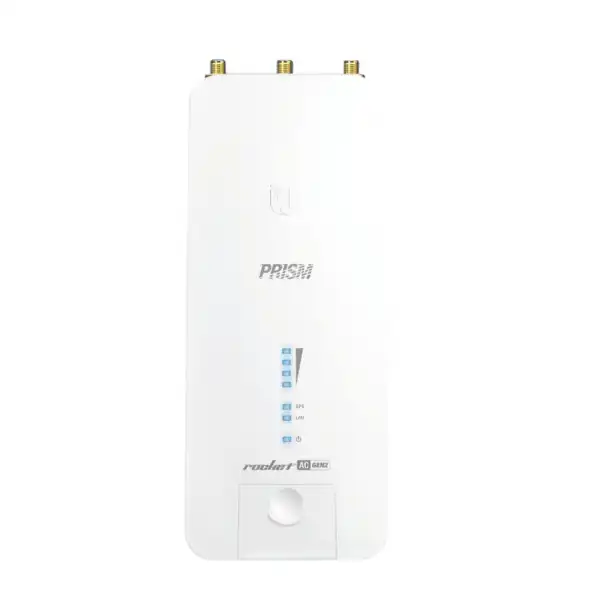
Ubiquiti airMAX Rocket Prism 2AC (R2AC-PRISM)
Build a planned 2.4 GHz point-to-point or point-to-multipoint network with an airMAX ac base station featuring airPrism RF filtering, Gigabit Ethernet and 24 V passive PoE.
For Tanzania network projects: request a model-specific quote and confirm antenna, endpoint compatibility and local operating requirements.
At a glance
What this base station is designed to do
The Ubiquiti airMAX Rocket Prism 2AC is a specialist outdoor wireless radio for building fixed wireless connections in the 2.4 GHz band. It can serve as the radio at a point-to-point link or as the central base station for a point-to-multipoint network. It is intended for network engineers, wireless internet service providers, organisations connecting buildings, and system integrators designing reliable infrastructure rather than ordinary indoor Wi-Fi coverage. The distinction matters: a buyer should choose the Rocket Prism 2AC when the project calls for a planned outdoor radio network with suitable airMAX-compatible endpoints, a matched antenna and clear line-of-sight engineering. It is not a standalone consumer router and should not be purchased with the expectation that standard phones and laptops will use it as an ordinary Wi-Fi access point. Before requesting a quotation, confirm the intended topology, approximate link distances, number of remote sites, antenna type and available mounting location.
Why choose 2.4 GHz for a fixed wireless project?
A 2.4 GHz fixed wireless design can be useful where the available spectrum plan, obstacles and deployment constraints make that band a practical choice. Compared with a 5 GHz design, it has different propagation behaviour, but that does not make it automatically more reliable or faster. The 2.4 GHz band is shared with many other devices, and nearby transmitters can create congestion. Survey the installation area, review competing channels and verify the permitted operating rules before selecting equipment. Treat frequency selection as an engineering decision rather than a marketing shortcut. Ask how much capacity each remote site requires, which channels are usable, what signal margins can be achieved and whether future network growth could increase interference. This product is suitable when 2.4 GHz airMAX ac is a considered part of the link design, not merely because the site has poor mobile reception.
airPrism filtering and crowded radio environments
The Rocket Prism 2AC includes Ubiquiti airPrism active RF filtering technology. In practical terms, this feature is intended to help the receiver handle signals outside the desired channel in demanding RF conditions. For installers, that makes radio-frequency planning especially important: filtering is a useful design feature, not a guarantee that a congested channel will become interference-free. Use appropriate surveys and spectrum observations to identify the strongest competing signals, choose a defensible channel width, and assess any nearby transmitters on the same structure. Maintain separation and sound antenna practices where applicable. The real-world benefit depends on network configuration and the RF environment. A well-positioned antenna and realistic throughput expectations remain essential even with a radio that includes advanced filtering. Buyers should evaluate airPrism together with antenna placement, available spectrum, service requirements and ongoing monitoring.
airMAX ac and client compatibility
The airMAX ac system is designed for coordinated fixed wireless links using compatible Ubiquiti equipment. A fundamental purchasing check is whether the remote subscriber units and bridge radios support the required airMAX mode and firmware. Do not infer compatibility from a shared 2.4 GHz frequency alone. Similarly, the letters AC in the product name should not be interpreted as permission to replace an ordinary household Wi-Fi router with this base station. It is designed around a specialised wireless infrastructure role. Before integrating an existing estate, record each remote model, firmware level, operating mode, desired channel width, antenna polarisation and network role. Confirm the planned combination in the relevant Ubiquiti documentation and, where possible, test one representative link before rolling out many endpoints. This approach reduces avoidable installation visits and expensive mismatches.
Point-to-point network applications
For point-to-point service, the radio can form part of a link between two fixed locations when paired with an appropriate counterpart and antenna system. Examples include connecting an office to an outbuilding, linking a remote operations site, or extending connectivity across a property with a suitable clear path. The radio alone does not determine the achievable distance. Antenna gain, mounting height, terrain, Fresnel-zone clearance, interference, regulatory power limits and link budget all contribute. Engineer the path before purchasing the antenna and mounting kit. Also consider capacity needed in both directions, latency sensitivity, resilience and the effect of weather on the installation hardware. Where a cable or fibre route is available and affordable, compare total lifecycle costs rather than assuming wireless is always the better solution. A properly designed fixed radio bridge is a system, not simply two purchased devices.
Point-to-multipoint network applications
In a point-to-multipoint design, one base-station site communicates with multiple appropriately configured remote sites. This topology may suit managed estate networks, distributed facilities and wireless service-provider infrastructure. Capacity is shared across connected remote locations, so the advertised radio throughput should not be interpreted as a dedicated allowance for every endpoint. Evaluate the number of subscribers, expected simultaneous traffic, uplink demand, intended service plans and contention policies. Antenna sector width is important because a narrow sector and a broad sector support very different coverage layouts. A sector antenna must be selected for the 2.4 GHz band, correct connectors and engineering requirements. For growth, consider when additional sectors, extra sites or an alternative technology would offer better results than increasing the number of clients on one radio.
What 150+ Mbps means for a buyer
Ubiquiti currently describes the Rocket Prism 2AC as providing 150+ Mbps total throughput. This is a manufacturer-stated system figure, not a guaranteed internet speed, per-user speed or contractual service level. Real throughput depends on channel conditions, compatible endpoints, selected settings, traffic overhead, antenna alignment and the distribution of users. During design, estimate usable capacity conservatively and leave margin for peak demand and future growth. Ask the network designer to distinguish radio capacity from the bandwidth of the upstream internet connection. A powerful upstream connection does not compensate for a congested wireless segment. Conversely, a healthy airMAX link can still appear slow if routing, switching, power or the backhaul is constrained. Validate performance with measurements taken under representative operational conditions rather than relying solely on headline specifications.
Gigabit Ethernet handoff
The device has one Gigabit Ethernet RJ45 networking interface. This wired connection provides the handoff between the outdoor radio and the connected network or power-injection infrastructure. A Gigabit port does not imply that the wireless air interface supplies one gigabit of throughput. Cable quality, termination, water ingress protection and the connected switch also matter. Use an appropriate outdoor-rated cable where required by the installation and protect cable entry points against moisture. Plan the Ethernet route so that service technicians can access the power injector and network termination safely. Before commissioning, verify the negotiated Ethernet speed, link stability, addressing, access to management and expected traffic path. A correctly operating Ethernet link is one of the first things to check when the radio powers on but network performance is not as expected.
Passive PoE and power planning
The manufacturer specifies passive Power over Ethernet using two pairs, with a 24 V, 0.5 A Gigabit PoE adapter included in its standard package description. The supported input range is 20–27 V DC, and maximum radio consumption is listed at 9.5 W. These numbers matter when comparing an existing power setup with the device requirements. Do not assume that an arbitrary 802.3af or 802.3at switch port powers this passive-PoE device directly. Check the exact injector or compatible power-delivery solution and observe the required polarity and cable arrangement. For a site where grid power interruptions would affect connectivity, size any backup system for the complete network path, including upstream switching, routing and ancillary equipment. Installation planning should also accommodate safe electrical protection and proper grounding practices.
Outdoor enclosure and environmental tolerance
The radio uses a die-cast aluminium enclosure and is specified for operation from -40 to 80 degrees Celsius and 5 to 95 percent relative humidity, noncondensing. These values describe manufacturer-rated environmental limits, not immunity to every condition at every installation site. In Tanzania, installers should evaluate the actual rooftop or mast environment, exposure to intense sunlight, wind, rain, dust and the quality of surrounding mounting hardware. Select mechanical arrangements that resist movement and allow maintenance access. Avoid creating unprotected cable paths or mounting positions where water may collect around connectors. Keep air circulation, cable strain relief and corrosion risk in mind. Physical deployment decisions can affect link availability as much as software configuration. Confirm suitability for the specific site before installation rather than treating the enclosure specification as a blanket installation guarantee.
RF and GPS connections
Manufacturer documentation lists two waterproof RP-SMA RF connections and one waterproof GPS connector. The RF connections are used with a suitable compatible antenna system, while the GPS provision supports the device’s relevant synchronisation capabilities. An antenna is a separate engineering choice and should not be assumed to be built into the radio. Check whether the intended antenna is a sector, omnidirectional or directional unit, its frequency range and gain, connector type, cable losses and permitted effective radiated power. The GPS component should be planned according to the specific installation and synchronisation requirements. Weatherproofing, strain relief and connector handling require care during installation. Buyers specifying a complete system should ask for a bill of materials that identifies the radio, antenna, mounting hardware, cables and any required GPS accessories separately.
GPS synchronisation in multi-radio sites
GPS-based synchronisation can be relevant where operators co-locate multiple supported base-station radios and require coordinated operation. It is not a substitute for spectrum planning, compatible firmware or proper sector design. Before relying on synchronisation as a project requirement, check the exact firmware capabilities, supported operating configuration, GPS installation conditions and the intended neighbouring-sector arrangement. Discuss whether all affected radios use compatible settings and whether timing will remain reliable at the proposed installation location. Large sites can also encounter antenna-pattern overlap, self-interference and operational complexity. A structured design review should address those issues before commissioning. If a buyer has only one short point-to-point link, GPS-based coordination may not be the main purchasing criterion. Features should be valued according to the real network topology rather than included automatically in the purchasing brief.
Management and commissioning
The Rocket Prism 2AC is supported in Ubiquiti’s airMAX software ecosystem, with device-specific firmware resources available from the manufacturer. Commissioning normally includes initial access, authorised credentials, network settings, wireless mode, antenna and power settings, and verification of link performance. Record the installed software version and configuration before bringing the site into production. Secure administrator access, restrict management exposure, and follow a documented update process. Because firmware can alter supported behaviour, use the current model-specific release information when planning an upgrade. Initial setup is only the beginning: operators should also monitor throughput, signal quality, errors and link stability and maintain a configuration backup. Where a site is critical, establish who is responsible for alerts, spare equipment and remote access before an outage occurs.
Choosing the right antenna
Antenna selection should begin with the actual service footprint rather than with the highest published gain. For a point-to-point link, evaluate a directional antenna arrangement aligned to the intended path. For point-to-multipoint coverage, evaluate sector geometry, subscriber distribution and the possibility of overlapping cells. An omnidirectional antenna may fit some scenarios but should not be selected simply to avoid alignment work. Check dual-polarisation requirements, supported mounting interfaces, actual connector compatibility and local permitted output limits. The transmitter and antenna together determine effective radiated power, so regulatory assessment must cover the complete assembly. Review azimuth, downtilt, mounting height and line of sight on drawings or a field survey. A well-matched antenna can make a greater practical difference than a headline equipment rating considered in isolation.
Planning line of sight and Fresnel clearance
For outdoor links, visual line of sight is a useful starting point but does not replace radio-path engineering. Terrain, buildings, trees, seasonal vegetation and the Fresnel zone can affect the usable signal. A path that appears open from ground level may be partially obstructed at the intended mast height. A survey should review both endpoints, the mounting structure, expected antenna height and obstacles along the path. For longer links, assess earth curvature and link budget with suitable planning tools. Do not promise a specific distance without those inputs. Consider site access restrictions and whether the final mast height is legally and physically achievable. When constructing a new link, leave allowance for antenna adjustment and documented alignment tests. Good planning can prevent repeat installation work after unexpected interference or obstruction is discovered.
Interference and channel-width decisions
The 2.4 GHz band can carry significant activity from local wireless networks and other radio systems. Select a channel using measurements from the actual service area, not just a generic recommendation. Wider channels may be tempting when an operator wants maximum peak throughput, but they also occupy more spectrum and may perform poorly under congestion. Narrower channel plans can sometimes improve stability or coexistence, depending on compatible configuration and requirements. Review adjacent-channel effects, neighbouring sectors and regulatory constraints. Document the chosen frequencies and the reasons for them so that later technicians understand the design. Where several base stations are installed at one tower, include coordination between sectors in the channel plan. Treat interference troubleshooting as an ongoing operational process: new nearby deployments can change the environment after commissioning.
Installation materials and accessories
A complete project may require more than the radio. Identify the intended 2.4 GHz antenna, mounting equipment, outdoor Ethernet cable, suitable PoE power delivery, grounding and surge protection, cable glands or weather-resistant routing provisions, and management or switching hardware. The manufacturer quick-start guidance recommends Ethernet surge protectors near the outdoor radio and at the building entry point. The correct materials depend on the site and should be specified by a qualified installer. Verify any accessory package contents against the exact commercial offer rather than assuming every photograph depicts included hardware. A proper bill of materials makes pricing comparable between suppliers and helps prevent a project from being delayed by missing connectors or mounting parts. Also agree who supplies and installs mastwork, protection and power backup.
Site safety and regulatory checks in Tanzania
Outdoor radio installations must be engineered and operated according to applicable local requirements. The manufacturer’s installation guidance assigns responsibility for local regulatory compliance to the professional installer. For a Tanzanian project, confirm the relevant Tanzania Communications Regulatory Authority requirements, authorised frequency use, permitted radiated power and any licensing or approval questions for the proposed service and deployment. The presence of CE, FCC or IC marks in manufacturer specifications does not establish a specific Tanzania approval or permission to operate any configuration. Power settings must take antenna gain and losses into account. For tall structures, rooftops or difficult access locations, arrange appropriate structural, electrical and occupational safety review. Regulatory status depends on the actual installation and intended use; it should be verified rather than inferred from a globally marketed product.
Designing for continuity and maintenance
A practical fixed wireless link should have an operating plan as well as a purchase order. Decide how failures will be detected, which technician or provider can access the site, and how quickly replacement hardware could be deployed. Keep a record of both endpoint configurations, labelled cable routes, antenna orientation, firmware and management addresses. Protect the radio and connected network against avoidable power disruptions. If the link carries critical business traffic, compare the value of an alternate path or backup connection. Routine review of link quality can identify degradation before a full outage occurs. Environmental changes, construction and additional nearby radios can alter performance over time. Maintenance access is particularly important at elevated sites; design the mounting arrangement with safe inspection and replacement in mind.
When another wireless solution may be better
The Rocket Prism 2AC is a strong candidate only when the design actually needs a 2.4 GHz airMAX ac fixed wireless base station. If the requirement is ordinary client Wi-Fi for staff or guests, consider an access point designed for standard Wi-Fi devices. If fibre is available and operationally appropriate, compare its long-term capacity and reliability. If the 2.4 GHz spectrum is severely crowded, evaluate other permitted frequencies or alternate site arrangements. If the service requires substantially more aggregate bandwidth than the current manufacturer throughput specification, select a platform with sufficient capacity margin instead of assuming upgrades to the upstream switch will solve the limitation. The right equipment choice follows from topology, spectrum, compatible endpoints, realistic capacity and a maintenance plan.
Buyer checklist before requesting a quote
Prepare a short deployment brief that records the number and type of sites, approximate distances, geographic or rooftop constraints, expected users, required application performance, existing compatible devices and preferred network topology. State whether the radio is for a new network or a replacement in an existing installation. Include desired antennas, backup power, outdoor cabling and surge protection in the requested scope. Ask for confirmation of the exact model R2AC-PRISM, included accessories, software compatibility and any installation services separately. If there are existing devices, provide their model numbers without sharing private administrator credentials publicly. Clarify whether the quotation covers only the radio or a complete working link. This checklist gives suppliers and installers enough context to propose a solution without inventing a guaranteed range or bandwidth figure.
Frequently asked questions
Is the Rocket Prism 2AC a normal indoor Wi-Fi router? No. It is a specialised outdoor fixed-wireless airMAX base-station radio. Does it operate in 2.4 GHz? Yes, its primary wireless operating range is in the 2.4 GHz band, subject to regional rules. Can it support point-to-point and point-to-multipoint connections? Yes, Ubiquiti markets it for both topology types when used in an appropriate compatible network. Is the antenna built in? The radio exposes external RF connectors, so an appropriate antenna system must be chosen for the installation. Does it have a Gigabit port? Yes, one Gigabit Ethernet interface is specified. Does the port guarantee gigabit wireless speeds? No; the manufacturer currently advertises 150+ Mbps total throughput for the radio. Does it use passive PoE? Yes, the specification identifies 24 V passive PoE, and the exact supply compatibility must be checked.
More deployment questions
Can the Rocket Prism 2AC be used in Tanzania? Suitability depends on the proposed installation and applicable national spectrum and equipment requirements; the installer should verify these for the actual project. Is it supplied with a PoE injector? Ubiquiti lists a 24 V, 0.5 A Gigabit PoE adapter in its standard package information, but the exact vendor offer should be confirmed. How far will a link reach? No universal distance should be promised because antennas, terrain, clearance, interference and output limits vary. What does airPrism do? It provides active RF filtering to help the radio operate in challenging radio environments. Why does it have a GPS connection? The connector supports relevant GPS synchronisation applications in suitably designed deployments. Can I retain existing remote radios? Confirm the specific model, airMAX mode and firmware compatibility before ordering.
Procurement and commissioning questions
What information helps with a quotation? Provide planned site layout, required capacity, antenna preferences, remote device inventory and installation scope. Can the radio replace an internet connection? No. It carries traffic over a fixed wireless link and normally requires an upstream network or internet service where needed. Is a 5 GHz management radio the same as its main wireless service? No. The manufacturer identifies a separate management-radio frequency range; the primary service radio is 2.4 GHz. Should a buyer select the largest antenna available? Not automatically: coverage shape, mounting, signal budget and local power rules determine suitable antenna gain. What should be tested at handover? Verify power, wired negotiation, radio alignment, link quality, achievable operational throughput, monitoring access and documented configuration. What about warranty, stock or delivery? Those are offer-specific commercial details and should be confirmed in the quotation.
Request a Tanzania project quotation
If your project needs an outdoor 2.4 GHz fixed-wireless base station, request a quotation for the Ubiquiti airMAX Rocket Prism 2AC (R2AC-PRISM) with the deployment details above. Specify whether you require the radio alone or a complete point-to-point or point-to-multipoint solution including compatible antennas, power equipment and installation accessories. Ask for confirmation of current commercial availability, the exact supplied package, applicable warranty terms and any services in scope. Pricing, delivery and deployment commitments must come from an actual reviewed offer rather than an assumed product description. A technically complete request supports a more useful comparison and helps the selected installer design a link that meets the site’s real requirements.
Request a product quote
Ask FourTeck Tanzania about the R2AC-PRISM and share your network topology, installation location, antenna requirements and preferred accessories. Stock, price and commercial terms require confirmation.
Request a quote for R2AC-PRISM




Reviews
There are no reviews yet.