
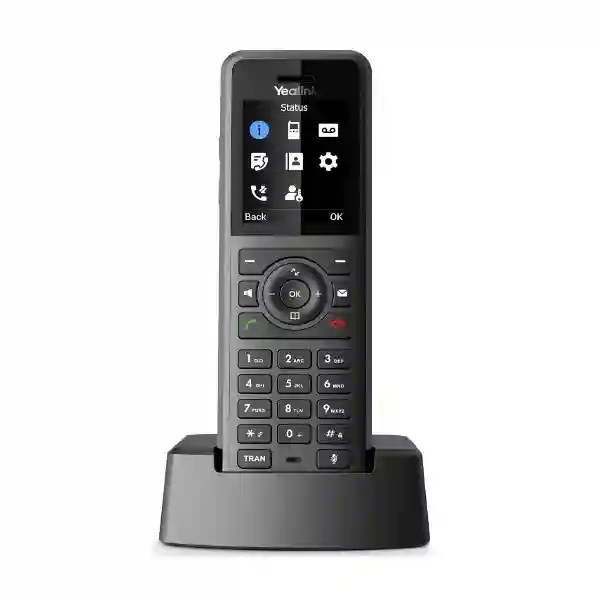
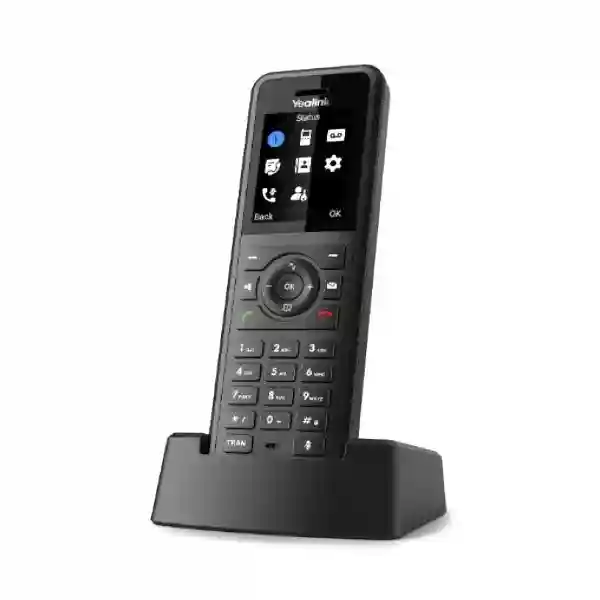
Yealink W57R Rugged DECT Handset
The Yealink W57R Rugged DECT Handset is built for organisations that need mobile voice communication beyond a conventional desk-phone environment. It is designed for users who move between work zones, carry a handset throughout a shift and need dependable calling in places where dust, splashes, knocks, handling and background noise are part of normal operations. Yealink positions the W57R as a professional ruggedised DECT handset with IP54 protection, a tough rubberised exterior, an integrated vibration alarm, HD audio, Flexible Noise Reduction and support for its business DECT ecosystem.
For businesses in Tanzania, the practical value of the W57R is its combination of mobility and familiar telephony. Staff can remain reachable without being tied to a desk, while organisations can plan coverage around Yealink single-cell or multi-cell DECT platforms. The handset is compatible with the Yealink W70B single-cell base and Yealink W80/W90 multi-cell systems, allowing it to fit deployments ranging from smaller offices to larger sites where roaming and handover are required. This makes the W57R relevant to warehouses, logistics operations, hotels, service teams, retail back offices, light industrial facilities, maintenance departments, clinics, campuses and other workplaces where users need a portable business voice device.
Designed for work environments where dust, splashes, frequent handling and everyday knocks are realistic operating conditions.
Yealink HD audio and Flexible Noise Reduction help make conversations easier to follow in busy or acoustically difficult workplaces.
Works with Yealink W70B and W80/W90 DECT systems for deployments that need portable voice, roaming and handover.
A useful alert option for noisy, active or customer-facing environments where an audible ring can be missed or undesirable.
What the Yealink W57R solves
Fixed desk phones work well for stationary users, but many operational roles are mobile by nature. Warehouse supervisors walk between aisles, hotel personnel move between floors, maintenance teams work across equipment rooms, and retail or logistics staff may spend little time at a desk. In those situations, the communication problem is not simply making a call; it is keeping the user reachable while they move through the work area. The W57R addresses that requirement by combining portable DECT calling with a ruggedised enclosure and business telephony features.
The handset supports up to two simultaneous calls per handset and includes functions such as hold, mute, call transfer, call waiting, call forwarding, redial, speed dial, voicemail access, three-way conferencing, do-not-disturb and emergency calling. It also supports directory functions including local or base-stored phonebook entries, remote phonebook options, LDAP and XML phonebooks, depending on the associated Yealink deployment and configuration. These capabilities make the W57R useful as part of a structured business voice platform rather than as a standalone consumer cordless phone.
Verified Yealink W57R features
| Area | Verified capability | Business relevance |
|---|---|---|
| Protection | IP54-rated rugged handset, scratch-resistant and disinfectant-resistant surface | Suitable for demanding workplaces where a normal office handset may be more vulnerable to wear. |
| Display | 1.8-inch 128 x 160 TFT colour screen | Provides a compact visual interface for caller information, menu navigation and phone functions. |
| Audio | HD audio, full-duplex speakerphone and Flexible Noise Reduction | Supports clearer voice use in active workplaces and during hands-free calls. |
| Alerts | Vibration alarm, visual notification light and configurable ringer levels | Helps users notice calls in noisy environments or use a less disruptive alert method. |
| DECT range | Up to 50 m indoors and up to 300 m outdoors in ideal conditions | Useful planning figures, but actual coverage depends on walls, racking, interference, materials and site layout. |
| Compatibility | Yealink W70B and Yealink W80/W90 multi-cell systems | Enables small-site and scalable multi-cell deployment models within Yealink’s DECT ecosystem. |
Battery figures vary by hardware version. Yealink’s current support information lists W57R V0-V3 with up to 40 hours of talk time and up to 575 hours of standby time in ideal conditions, while W57R V4 is listed with up to 28 hours of talk time and up to 320 hours of standby time in ideal conditions. Procurement teams should therefore confirm the supplied hardware revision when battery runtime is a key requirement. The handset dimensions are 157 mm x 51 mm x 24 mm and the listed weight is 183 g. Operating temperature is specified from 0°C to 40°C and operating humidity from 10% to 95%.
Compatibility and deployment planning
The W57R should be selected as part of a complete DECT design rather than viewed only as a handset purchase. For smaller offices or compact sites, the Yealink W70B single-cell base can be appropriate when one cell provides sufficient radio coverage and capacity. For larger facilities, Yealink W80 or W90 multi-cell systems are designed to support wider coverage and roaming between cells. The right architecture depends on floor area, wall construction, shelving, storage density, equipment, expected concurrent calls, user movement patterns and the number of handsets.
A site survey or at least a structured coverage assessment is especially important in warehouses, hotels, healthcare facilities and multi-floor buildings. The headline indoor and outdoor DECT ranges are ideal-condition figures, not guaranteed site distances. Concrete walls, metal racks, lifts, machinery, server rooms, glazing and RF interference can change real-world coverage substantially. A good deployment plan maps the places where staff actually make and receive calls, identifies transition zones and tests handover where multi-cell roaming is expected.
Yealink documentation notes that its DECT technology is not compatible with third-party DECT devices. Buyers should therefore check the entire base-and-handset ecosystem before mixing equipment from different manufacturers. If an organisation already operates another DECT platform, compatibility should be verified before procurement. If the organisation is standardising on Yealink, the W57R can be evaluated alongside the W70B and W80/W90 architecture according to scale and mobility needs.
Who should consider the W57R?
The strongest use cases are roles where staff move frequently, need immediate voice contact and work in environments that are tougher than a typical executive office. Warehousing and logistics teams can use a rugged handset while moving between receiving, storage, dispatch and loading areas. Hospitality teams can carry handsets between guest-service areas, housekeeping zones and back-of-house operations. Facility and maintenance personnel can remain reachable while inspecting plant rooms, electrical areas and building infrastructure. Retail teams can use mobile voice without depending on personal mobile phones for internal calls.
The W57R can also suit manufacturing support, security coordination, campus operations, clinics and service organisations where mobility matters. The important distinction is that rugged does not automatically mean suitable for every hazardous or extreme environment. IP54 protects against dust ingress to a defined degree and water splashes; it is not an immersion rating, nor does it by itself make the handset suitable for explosive atmospheres or specialist safety environments. Buyers with such requirements should state them explicitly during product selection.
Yealink W57R Rugged DECT Handset Tanzania
For organisations in Tanzania, the Yealink W57R is a practical option where staff need business voice mobility in warehouses, hotels, logistics operations, campuses, maintenance environments and operational offices. The buying decision should start with the working environment rather than the handset specification alone. Procurement teams should map how many users require a handset, where they move, the size and construction of the premises, the number of simultaneous calls expected and whether the site is a single building or a collection of zones. These details determine whether a W70B single-cell design is sufficient or whether a W80/W90 multi-cell solution is more appropriate.
Tanzania deployments often need careful planning around building materials, wide compounds, warehouse racking and mixed indoor-outdoor movement. Although Yealink publishes ideal-condition DECT range figures, the correct way to plan is to treat those figures as a starting point and validate coverage where users actually work. A warehouse with high metal shelving can behave very differently from an open office. A hotel with reinforced walls and multiple floors can also require a different cell layout from a retail shop or service centre. For this reason, buyers should provide floor plans, approximate dimensions and user movement paths when requesting a quotation.
The W57R’s IP54 protection, vibration alert and HD audio are relevant to Tanzanian businesses that need a handset capable of handling frequent movement and day-to-day operational wear. It can reduce dependence on personal mobile phones for internal extension calling while keeping staff within a managed business telephony environment. Organisations should also confirm PBX or SIP platform requirements through the selected Yealink DECT base system, because the handset itself is part of a larger voice deployment. For related regional communications and infrastructure options, FourTeck’s broader Africa technology solutions can be reviewed when planning multi-site standardisation.
Yealink W57R Rugged DECT Handset Dar es Salaam
Dar es Salaam organisations evaluating the Yealink W57R often have a strong need for mobility because commercial operations are spread across offices, warehouses, hotels, service facilities and logistics sites. In these environments, the W57R can serve staff who must remain reachable while moving between desks, stock areas, loading points, technical rooms or customer-facing spaces. The handset is especially relevant where a normal desk phone does not match the user’s work pattern and where a consumer cordless handset may not offer the required durability or business integration.
A Dar es Salaam deployment should be designed around the physical site. Multi-floor buildings, dense storage areas and compounds with several operational zones can require more than one DECT cell. If users cross coverage areas while on active calls, a W80/W90 multi-cell approach may be more appropriate than a single-cell deployment. The number of bases should not be guessed from published range alone; walls, structural materials, equipment and interference affect radio performance. Asking for a survey or coverage design before large-scale rollout can prevent dead zones and poor handover performance.
When requesting pricing, buyers should specify the number of W57R handsets, preferred base architecture, existing PBX or SIP service, number of extensions, approximate coverage area and whether PoE is available for the DECT base infrastructure. It is also useful to state whether staff need belt clips, spare charging positions or additional handsets for shift rotation. These details make a quotation more accurate and help ensure that the equipment list reflects the operating environment rather than just the handset quantity.
Yealink W57R Rugged DECT Handset Mwanza
In Mwanza, the Yealink W57R can suit businesses that need portable voice communications across operational environments such as distribution facilities, hospitality properties, maintenance teams, workshops and commercial sites. Its role is to keep staff connected while they move, without requiring each internal conversation to depend on a personal mobile device. The ruggedised build and vibration alert make it suitable for roles where users handle equipment, move frequently or work in louder areas where a conventional office handset is not ideal.
For a Mwanza site, buyers should first decide whether the requirement is simply cordless extension mobility in one compact area or seamless movement across a larger facility. A W70B single-cell base may suit a smaller deployment, while the W80/W90 multi-cell family is intended for broader coverage and roaming. The final design should account for concrete, metal storage systems, machinery and the actual places where calls are expected. Even when published range looks sufficient, practical validation is valuable because ideal-condition figures do not reflect every building.
Procurement teams should also check the expected hardware revision because battery specifications differ between W57R revisions. If long shifts with limited charging opportunities are part of the requirement, ask which version is being quoted and compare its stated talk and standby figures. For businesses operating more than one Tanzanian branch, it can be useful to standardise extension numbering, handset naming, base configuration and support documentation so staff experience remains consistent across locations.
Yealink W57R Rugged DECT Handset Arusha
Arusha businesses in hospitality, tourism support, logistics, facilities management and service operations can benefit from a rugged DECT handset when staff need reliable internal calling across active work areas. The W57R is particularly relevant for personnel who are not continuously seated at a desk. Its IP54 enclosure, vibration alert, backlit keypad and compact colour display make it a practical operational tool for day-to-day movement between departments or work zones.
Hotels and larger properties should pay particular attention to radio design. Guest rooms, service corridors, stairwells, kitchens, technical rooms and outdoor transition spaces can create coverage challenges that are not obvious from a floor plan alone. A multi-cell Yealink design can support roaming and handover, but cell placement needs to reflect where users actually walk during a call. A staged deployment with testing can be more effective than installing bases purely by distance estimates.
When evaluating the W57R for Arusha, buyers should describe their operational workflow in the quotation request. Useful details include the number of mobile users, total floors, key departments, PBX platform, required extensions, peak concurrent calls and any difficult coverage areas. If staff work long shifts, include charging arrangements in the design. If the site is customer-facing, consider how ringer and vibration settings should be configured to balance responsiveness with guest or visitor experience.
Yealink W57R Rugged DECT Handset Dodoma
The Yealink W57R can fit Dodoma offices, institutions, service teams and operational facilities that need staff to remain contactable while moving away from desks. It offers business telephony features in a rugged portable format and can be deployed on a Yealink single-cell or multi-cell DECT infrastructure. For organisations with administrative offices connected to stores, maintenance rooms or support areas, this can create a consistent extension-based communication experience across different parts of the premises.
The main deployment question is coverage design. A smaller office may only need one base cell, while a campus-style or multi-building environment may require a structured multi-cell design. Walls, corridors, floor slabs and equipment influence radio coverage, and outdoor ideal-condition range should never be treated as a guarantee through buildings. A good design identifies the areas where voice is mission-critical and verifies those zones before the system is considered complete.
Dodoma buyers should also plan provisioning and administration. Directory structures, extension names, call groups, voicemail access, forwarding rules and emergency call behaviour should be defined as part of the voice system rather than left as handset-by-handset decisions. Because the W57R supports OTA upgrade through the base system, administrators can manage firmware within the Yealink environment rather than treating each handset as an isolated device. This is particularly valuable when a deployment grows beyond a small number of handsets.
Yealink W57R Rugged DECT Handset UAE
In the UAE, the Yealink W57R is relevant to warehouses, hotels, property management teams, retail back offices, service operations and technical departments where staff need durable mobile voice. The handset’s IP54 protection and vibration alert are useful in busy work environments, while compatibility with Yealink multi-cell DECT makes it possible to plan communication across larger premises. Organisations that operate both UAE and East African sites may also value the ability to standardise around one DECT handset family.
For UAE deployments, air-conditioned indoor areas may be connected to loading bays, service corridors, plant rooms or semi-outdoor zones, so coverage should be assessed across the user’s actual route. Multi-cell deployment planning should consider building materials, lifts, fire doors, metal structures and areas with dense wireless infrastructure. The objective is not maximum theoretical distance; it is stable communication at the points where staff must reliably receive or continue a call.
Regional buyers can review FourTeck UAE technology solutions when the procurement project includes UAE-based sites, unified communications or broader IT infrastructure. For multi-country organisations, using consistent naming, firmware policies, extension design and deployment documentation can simplify support and user training across branches.
Yealink W57R Rugged DECT Handset Uganda
Ugandan organisations looking for a rugged cordless business handset can consider the Yealink W57R where mobility, durability and controlled business calling are important. The handset is suitable for staff who move between operational areas and still need extension-based voice communication. Warehouses, hospitality sites, workshops, service companies and facilities teams are common examples of environments where a rugged DECT endpoint can be more suitable than a fixed desk phone.
The choice between W70B single-cell and W80/W90 multi-cell infrastructure should be made from site size and user movement. A single base can be efficient in a compact workplace, while larger buildings or compounds benefit from a design that supports roaming. The published DECT range is measured under ideal conditions, so Uganda deployments should still account for reinforced structures, metal storage, machinery and interior partitions before deciding how many cells are required.
For Uganda-specific projects and regional coordination, buyers can also review FourTeck Uganda solutions. A strong quotation request should include handset quantity, number of sites, PBX details, base requirements, estimated concurrent calls, coverage dimensions and any areas where calls are operationally critical.
Yealink W57R Rugged DECT Handset Kampala
Kampala businesses often combine offices with storerooms, workshops, hospitality floors, service areas or distribution spaces. In these environments, the W57R can keep mobile staff connected to the business phone system without forcing them back to a desk. The ruggedised body helps protect against normal operational wear, while vibration and visual alerts can support users in noisier areas or environments where a loud ringtone is undesirable.
Coverage planning in dense urban buildings should account for floor slabs, lifts, stairwells and building services. Multi-floor sites may need a multi-cell architecture even when the total floor area seems modest. The important design target is continuity along user movement paths, especially where an active call must remain connected while staff change floors or move between departments. A staged test can reveal weak areas before the full handset quantity is deployed.
Kampala procurement teams should define whether the project is a new Yealink DECT deployment or an addition to an existing one. If adding handsets, confirm base compatibility, firmware expectations and available system capacity. If starting fresh, include PBX integration, network readiness and extension provisioning in the project scope. Clear documentation at the start helps avoid buying handsets before confirming that the required base and voice platform are in place.
Yealink W57R Rugged DECT Handset Arua
For organisations in Arua, a rugged DECT handset can be valuable where staff move between offices, stock areas, technical rooms and operational zones. The W57R combines a business-focused feature set with portable DECT communication, allowing organisations to keep voice traffic within a managed extension environment. It can also reduce the need for staff to use personal mobile numbers for routine internal communications.
Arua buyers should consider the physical spread of the site and the number of concurrent users. Smaller workplaces can often be designed around a single-cell base, while larger compounds may need multi-cell coverage. Power and network availability at proposed base locations are also important. The DECT base system integrates into the IP network, so network switches, PoE planning where applicable, VLAN strategy and PBX reachability should be considered alongside radio coverage.
When comparing quotations, check that the equipment list clearly distinguishes handsets from base stations and any required accessories. A handset-only price can appear attractive but may not represent a complete deployable solution. Confirm the exact hardware revision, charging arrangement, number of bases and whether configuration or deployment assistance is included in the quoted scope.
Yealink W57R Rugged DECT Handset Mbarara
Mbarara businesses with mobile teams can use the W57R as a durable extension device for day-to-day operational calling. Distribution, hospitality, maintenance and service organisations can benefit when workers need to answer calls while away from a fixed workstation. The handset’s keypad lock, vibration alert and backlit keypad are useful practical features for staff who carry the device throughout a shift.
Before deployment, identify the areas where communication failure would be most disruptive. Receiving bays, technical rooms, isolated corridors, outdoor transition zones and stock areas can all behave differently from open office space. A coverage plan should prioritise these zones and verify that the chosen Yealink DECT architecture provides adequate service. In larger sites, seamless handover can be more important than maximum distance from any one base.
Mbarara procurement should also account for lifecycle administration. Assign a naming convention to handsets, record which employee or role uses each device, document charger locations and keep firmware management within the DECT base platform. Operational discipline becomes more important as the number of handsets grows, particularly where devices rotate between shifts or departments.
Yealink W57R Rugged DECT Handset Gulu
In Gulu, the Yealink W57R can help organisations provide portable business calling to staff whose work is spread across operational spaces. The handset is not just a cordless replacement for a desk phone; it is designed for users who need to carry a business extension while moving. Its ruggedised construction and IP54 rating are particularly relevant to busy workplaces with dust, frequent handling and occasional splashes.
System design should begin with the user journey. If staff spend most of their time within one compact zone, single-cell DECT may be enough. If they move between separate floors, buildings or large work areas, multi-cell planning is more appropriate. The design should also consider simultaneous call load, because radio coverage alone does not define total system capacity. A complete quotation should therefore include both coverage and user-capacity assumptions.
Gulu buyers should verify which W57R hardware version is offered because battery runtime differs by revision. For sites with long shifts or limited access to charging, this detail can affect operational planning. Charging stations should be placed where handsets can be returned predictably between shifts, and spare devices can be considered where constant availability is critical.
Yealink W57R Rugged DECT Handset Kenya
Kenyan businesses can deploy the Yealink W57R where mobile staff need a durable handset linked to the organisation’s voice environment. Warehousing, hospitality, property management, logistics, maintenance and service operations are strong examples. The handset’s IP54 design, vibration alert and noise-reduction features help it fit active workplaces where a desk phone would be impractical.
For Kenya, deployment planning should distinguish between a small single-site requirement and a larger multi-cell rollout. W70B suits single-cell scenarios, while W80/W90 systems address broader coverage. Organisations with more than one branch can benefit from standardising configuration templates and extension policies, but each physical site still needs its own coverage assessment because construction and layout differ.
For Kenya-specific sourcing and related infrastructure, customers can review FourTeck Kenya technology solutions. When requesting a quote, include user count, building layout, intended base platform and existing PBX details so the proposal addresses the complete system rather than only the handset quantity.
Yealink W57R Rugged DECT Handset Kuwait
Kuwait organisations in logistics, retail, hospitality, facilities and technical services can consider the W57R when users require portable extension calling in demanding work areas. The handset’s rugged shell and IP54 protection make it better aligned with operational use than a standard office cordless phone. Vibration alert can help in loud environments, while HD audio and noise reduction support clearer communication.
Large facilities should be planned as radio environments rather than simply as floor area. Concrete, metal, equipment rooms and long corridors can create coverage patterns that differ from open spaces. Multi-cell Yealink systems are intended for broader mobility, but proper base placement and testing remain essential. Sites that include warehouses or service yards should test both indoor and transitional zones used during live calls.
When comparing proposals, Kuwait buyers should verify whether they are receiving W57R V0-V3 or V4 hardware because published battery specifications differ. They should also confirm base station quantities, PBX integration and whether the scope includes provisioning. A complete proposal should make clear what is hardware, what is configuration and what assumptions were used for radio coverage.
Yealink W57R Rugged DECT Handset Ghana
Ghanaian businesses with mobile workers can use the W57R to keep staff connected through an extension-based system while they move through active workspaces. It can be especially useful in warehousing, hospitality, maintenance, distribution and service environments. The rugged design, vibration alert and business call features give teams a purpose-built alternative to relying on personal phones for routine internal communications.
A Ghana deployment should include a clear base-system decision. Compact facilities can begin with a W70B single-cell design, while larger or more complex sites can be assessed for W80/W90 multi-cell infrastructure. Coverage should be validated where users work rather than assumed from ideal-condition distance figures. If uninterrupted calls while moving are important, roaming and handover paths should be tested during commissioning.
Procurement teams should provide building details, handset quantity, PBX information, expected call load and any challenging areas when requesting pricing. This improves the quality of the proposed bill of materials and reduces the risk of under-specifying base coverage. For multi-country projects, consistent handset models and documented configuration standards can also simplify support.
Yealink W57R Rugged DECT Handset Nigeria
Nigeria has many operational environments where portable business voice can improve coordination, including warehouses, hotels, facilities, retail operations, logistics sites and technical services. The Yealink W57R is designed for exactly this kind of use: a user carries the handset throughout the workday while remaining connected to the business phone environment. IP54 protection and a ruggedised surface help the device tolerate regular workplace handling.
The system should be sized according to both coverage and capacity. A wide facility may need multiple DECT cells, but a smaller site with many concurrent calls can also require careful capacity planning. The right design therefore considers user count, peak call load, movement paths, building construction and the intended PBX integration. Multi-cell deployment should be tested at cell boundaries to confirm the expected roaming behaviour.
Nigeria buyers should ask suppliers to identify the exact handset revision and base models in the quotation. Battery runtime, charger planning and firmware management can affect operations over time. Clear asset records and extension naming are recommended when many handsets are deployed across departments or shifts.
Yealink W57R Rugged DECT Handset Seychelles
In Seychelles, hospitality, resort operations, facilities teams and service organisations can benefit from a rugged mobile handset where staff move across guest areas, back-of-house zones and technical spaces. The W57R provides portable business calling with vibration alert and an IP54 enclosure, allowing users to carry a business extension rather than depend solely on personal mobile phones.
Resort and hospitality deployments can be challenging because coverage may extend across multiple buildings, corridors, service areas and outdoor transitions. Published DECT distance figures should be treated as planning references only. A multi-cell design may be required for seamless movement, and base locations should be chosen around actual staff routes. Particular attention should be paid to walls, terrain, plant rooms and separate structures that may affect radio propagation.
Seychelles procurement should also consider resilience and supportability. Standardising handset models, documenting base placement and maintaining a clear firmware process can simplify ongoing management. Where sites have seasonal staffing or shift changes, a centralised handset naming and assignment process helps ensure devices are returned, charged and ready for the next user.
Buying and quotation checklist
Provide floor plans or dimensions, number of floors, warehouse racking, separate buildings and difficult coverage zones.
State the number of W57R users, concurrent call expectations, shift patterns and whether users need seamless roaming.
Identify the current PBX or SIP platform and whether the project is new, an expansion or a handset replacement.
Confirm the W57R revision where battery endurance is important because Yealink publishes different runtime figures for V0-V3 and V4.
Frequently asked questions
Is the Yealink W57R waterproof?
The W57R carries an IP54 protection rating. That means it is designed to resist dust ingress to the defined IP54 level and water splashes. It should not be treated as an immersion-proof handset. If your environment requires a higher ingress-protection level, state that requirement before purchase.
Does the W57R work with the Yealink W70B?
Yes. Yealink lists the W57R as compatible with the W70B single-cell base. It is also compatible with Yealink W80/W90 multi-cell systems for larger deployments that need roaming and handover.
Can the W57R be used with third-party DECT bases?
Yealink documentation states that its DECT technology is not compatible with third-party DECT devices. Buyers should therefore plan the W57R within the supported Yealink DECT ecosystem.
What is the W57R battery life?
The answer depends on hardware revision. Yealink lists V0-V3 at up to 40 hours of talk time and up to 575 hours of standby time in ideal conditions. V4 is listed at up to 28 hours of talk time and up to 320 hours of standby time in ideal conditions.
How far can the W57R work from a base?
Yealink publishes ideal-condition DECT range figures of up to 50 metres indoors and up to 300 metres outdoors. Real coverage can be lower because walls, metal, equipment, interference and building design affect radio performance. Coverage should be validated for the actual site.
Is the W57R suitable for warehouses?
Yes, warehouses are a strong use case because the handset is ruggedised and designed for mobile users. However, metal racking and large floor areas can affect DECT coverage, so base placement and radio planning are important.
Decision recap
Choose the Yealink W57R when the user needs to move, the working environment is tougher than a typical office and the business wants voice communication to remain inside a managed Yealink DECT system. Its IP54 construction, HD audio, Flexible Noise Reduction, vibration alert, backlit keypad and business call functions make it a strong fit for operational roles. The most important design decision is the DECT architecture: W70B for suitable single-cell deployments or W80/W90 multi-cell where scale, roaming and handover are required.
The handset should not be purchased in isolation from coverage and PBX planning. Confirm base compatibility, site dimensions, hardware revision, user quantity, concurrency, charging arrangements and voice-platform integration before finalising the bill of materials. For broader communications and IT projects, visit FourTeck technology solutions to review complementary infrastructure and business communication services.
Plan your Yealink W57R deployment
For a useful quotation, provide the number of handsets, site layout, expected coverage zones, PBX platform and whether you need a single-cell or multi-cell design. FourTeck can use those details to prepare a more relevant equipment proposal instead of treating the requirement as a handset-only purchase.



Reviews
There are no reviews yet.