
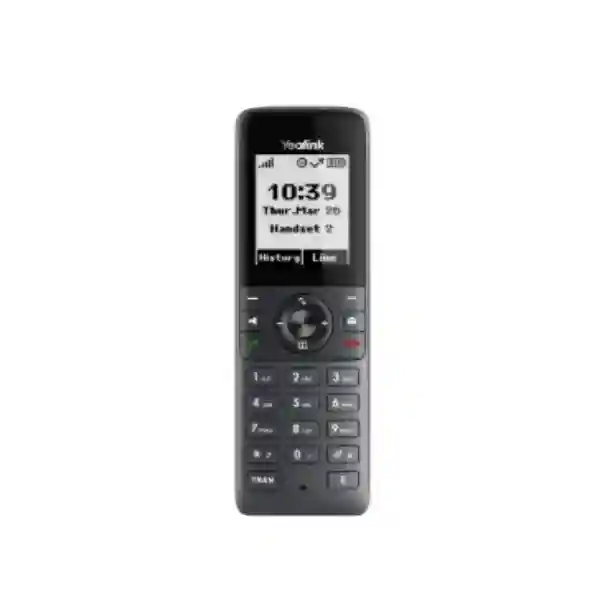
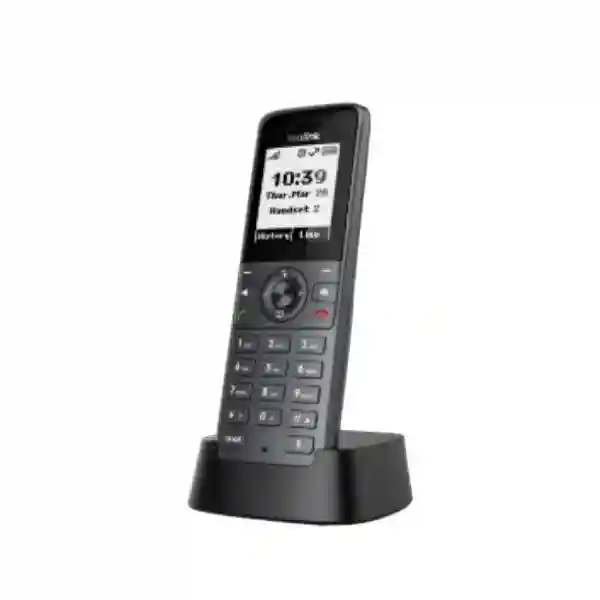
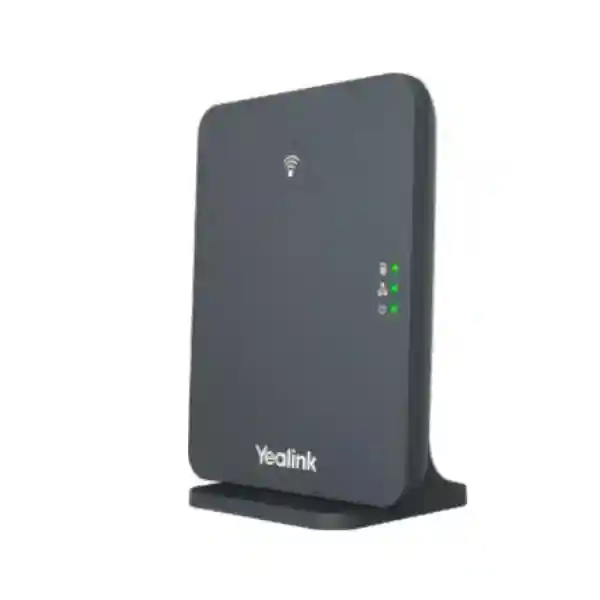
Yealink W71P DECT Phone System Tanzania
The Yealink W71P DECT Phone System is a single-cell business SIP cordless solution built around the Yealink W70B base station and W71H handset. It is designed for organisations that want employees to move away from a fixed desk while keeping familiar PBX features such as extension calling, call transfer, call waiting, voicemail notification, three-way conferencing and directory access. For Tanzania organisations evaluating cordless business phones, the W71P offers a practical balance of mobility, SIP capacity, centralized administration and straightforward network integration.
Up to 10 Yealink DECT handsets, up to 10 SIP accounts, up to 20 simultaneous calls, up to six RT30 repeaters per base, 10/100 Ethernet, IEEE 802.3af Class 1 PoE, TLS and SRTP security, OTA handset upgrades, and stated radio reach of up to 50 metres indoors or 300 metres outdoors in ideal conditions.
Useful for mapping extensions or identities according to the PBX design.
The base supports up to two simultaneous calls per handset within the system limit.
W71H battery life is rated up to 30 hours of talk time in ideal conditions.
Long standby capacity can reduce the frequency of charging between active shifts.
What the Yealink W71P solves for business users
A fixed desk phone works well when the user stays at one workstation. It is less convenient for supervisors who move between rooms, retail staff who assist customers away from the counter, hospitality teams who cover several service points, or warehouse coordinators who need to remain reachable while walking through an operational area. The W71P changes the endpoint rather than the business call system: the user carries a SIP-capable DECT handset while the W70B base connects to the IP network. This gives organisations a way to add cordless mobility without turning every call into a personal mobile-phone workflow.
The system is particularly useful when a company already has an IP PBX or hosted SIP service and wants cordless extensions tied to that communications platform. It can support up to ten handsets and ten SIP accounts, making it suitable for small and medium deployments where several mobile users share one base coverage area. The ability to process up to twenty simultaneous calls gives the platform useful capacity for busy environments, subject to PBX, SIP-trunk and network capacity. If a site requires a larger roaming domain across many floors or buildings, the design should be reviewed against Yealink multi-cell options rather than assuming that a single W70B base is the correct architecture.
FourTeck Tanzania can also help buyers evaluate the broader voice environment rather than looking at the handset alone. A DECT phone still depends on switching, VLAN design, DHCP or static addressing, SIP reachability and suitable firewall policy. Buyers planning a wider communications refresh can review the FourTeck Tanzania services portfolio, which explains how IP telephony, networking and related infrastructure can be considered together.
Yealink W71P verified technical features
| System composition | W70B DECT IP base station with W71H handset package |
| Handset capacity | Up to 10 compatible Yealink DECT handsets on the W70B platform |
| SIP capacity | Up to 10 SIP accounts |
| Call capacity | Up to 20 simultaneous calls; up to 2 simultaneous calls per handset |
| Radio range | Up to 50 m indoors and 300 m outdoors in ideal conditions |
| Repeater support | Up to 6 Yealink RT30 repeaters per base station |
| Ethernet and power | 1 × RJ45 10/100M Ethernet; IEEE 802.3af Class 1 PoE |
| Audio | HD voice, full-duplex speakerphone, FNR noise reduction, HAC support, G.722 and additional supported codecs |
| Security | TLS, HTTPS, SRTP, digest authentication, AES-encrypted configuration file support and multiple SHA options |
| Provisioning | TFTP, FTP, HTTP, HTTPS, RPS, PnP and OTA handset upgrades |
| W71H battery | Up to 30 hours talk time, up to 340 hours standby, plus quick charging rated at 10 minutes for up to 2 hours talk time in ideal conditions |
Published range and battery figures are stated for ideal conditions. Building materials, radio interference, deployment layout, call usage, battery condition and environmental factors can change real-world results. DECT frequency variants also differ by market, so the correct regional product version should be confirmed when ordering.
W71H user experience
The W71H handset uses a compact 1.8-inch 90 × 65 black-and-white display with keypad backlighting, soft keys and navigation controls. Business features include caller ID, call transfer, hold, call waiting, forwarding, DND, voicemail indication, speed dial, intercom, paging and three-way conferencing. A 3.5 mm headset jack can support users who prefer hands-free work. The handset is intended for practical everyday calling rather than app-heavy smartphone behaviour, which can be an advantage in operational teams that need predictable call handling and simple user training.
W70B network integration
The base station connects over Fast Ethernet and supports PoE, allowing a compatible switch to provide data connectivity and power through one cable. Administrators can configure the platform through browser, phone and auto-provisioning workflows. VLAN and LLDP support help place voice endpoints into a controlled network design. For a company already standardising managed switches and voice VLANs, this is useful because cordless users can be incorporated into the same operational model as desk phones. Review the FourTeck Tanzania technology shop for related business networking and telephony categories.
Selection guidance before requesting a quote
Count mobile users, not just extensions. Confirm how many staff need cordless handsets at the same time, how many SIP identities are required and how many concurrent calls the site can generate. Then review coverage. A base stated for up to 50 metres indoors in ideal conditions can provide less usable range through reinforced walls, lift cores, metal shelving, machinery or multiple floors. A practical site assessment should consider where the W70B will be mounted, how users move and whether repeaters are appropriate.
Next, confirm the call platform. The W71P is a SIP system, but compatibility should still be checked with the exact PBX, hosted voice service or SIP profile. Features such as directory integration, provisioning, codec choice and caller presentation may depend on the platform. Network teams should check DHCP, VLANs, PoE availability, firewall handling and QoS. Procurement teams should also confirm the precise package, regional DECT frequency version, quantity of extra W71H handsets and any RT30 repeaters required. These checks create a better quotation than asking only for “one cordless phone”.
Yealink W71P DECT Phone System Tanzania
For organisations in Tanzania, the Yealink W71P is relevant when business communication needs to extend beyond a fixed desk without losing the structure of an IP PBX. A sales office may want staff to move between reception, stock areas and customer meeting rooms while remaining reachable on a business extension. A hotel can need cordless communication for supervisors who walk between guest-service areas. A clinic, training centre or warehouse may have users whose work depends on mobility but who still need transfer, hold, voicemail and internal extension calling. The W71P addresses those scenarios with one W70B base serving compatible Yealink DECT endpoints inside a planned coverage zone.
Tanzania buyers should start by defining the number of mobile users and the physical area they must cover. Yealink publishes a maximum of 50 metres indoor range and 300 metres outdoor range in ideal conditions, but a real building rarely behaves like an open test space. Dense concrete, steel doors, shelving, machinery, stair cores and multiple floors can reduce coverage. The W70B supports up to six RT30 repeaters, which can help extend a single-cell deployment, but placement should be planned. If the requirement involves broad roaming across a campus or many buildings, a multi-cell Yealink architecture may be more appropriate than stretching a single base beyond its intended role.
The network is equally important. The W70B uses a 10/100 Ethernet interface and supports IEEE 802.3af Class 1 PoE. In a well-planned office, a managed PoE switch can power the base while placing voice traffic in the correct VLAN. DHCP, DNS, NTP, SIP reachability, firewall policy and QoS should be checked before installation. The system supports TLS and SRTP, but security features only help when they are configured consistently with the PBX or service provider. For customers building a broader communications environment, the FourTeck Tanzania technology solutions overview explains how voice, switching, wireless, security and structured infrastructure can be coordinated rather than purchased as separate islands.
A useful Tanzania quotation should therefore include exact handset quantity, SIP account requirement, current PBX or hosted platform, number of simultaneous calls, likely base location, expected user movement, PoE availability and any repeater requirement. That information helps distinguish a simple one-handset starter system from a multi-user mobile voice deployment and reduces the chance of discovering coverage or compatibility issues after procurement.
Yealink W71P DECT Phone System Dar es Salaam
Dar es Salaam businesses often combine reception areas, offices, stores, meeting rooms and operational spaces within the same site. That layout creates a practical use case for cordless SIP telephony: users can leave a fixed workstation without giving customers a personal mobile number or depending on consumer calling apps. The Yealink W71P can serve reception support staff, supervisors, stock coordinators, hospitality teams and service personnel who need their business extension while moving through the premises.
For a Dar es Salaam office, base placement deserves deliberate attention. Mounting the W70B near the centre of the user movement area can provide better radio distribution than hiding it in a distant communications room simply because network cabling already exists there. If the data rack is at one edge of the floor, it may be worth extending a network drop to a more suitable position. The base can use PoE from a compatible switch, which can simplify that placement. If a UPS already protects the PoE switching layer, the base may also remain powered during short mains interruptions, although the broader PBX, router and internet path must be protected if external calling depends on them.
Dar es Salaam procurement teams should also consider call-flow requirements. One site may assign one SIP account per handset, while another may use different registration and line arrangements. The W70B supports up to ten SIP accounts and twenty simultaneous calls, but the PBX and SIP trunk must also have enough capacity. Features such as call groups, queues, after-hours routing, voicemail and recording are normally controlled by the PBX rather than by the DECT handset alone. Buying the W71P should therefore be part of a complete voice design rather than treated as a stand-alone replacement for every phone-system function.
When requesting a Dar es Salaam quote, share floor count, approximate distances, wall type, user quantity, handset quantity, PBX platform and whether network switches provide PoE. If the site includes warehouses or metal shelving, identify those areas because they can affect radio behaviour. A basic coverage conversation before purchase is more valuable than selecting repeaters after users begin reporting dropped or weak DECT coverage.
Yealink W71P DECT Phone System Mwanza
In Mwanza, the W71P can suit businesses that need small or medium cordless extension deployments across offices, retail premises, hospitality environments, service counters and operational facilities. The main benefit is controlled mobility. Instead of tying a user to one desk, the W71H handset allows them to answer and manage SIP calls while moving around the coverage area. That can be useful where staff regularly leave their workstation to assist customers, inspect stock, coordinate field preparation or manage front-and-back-office activity.
Planning should begin with radio coverage and user density. Yealink specifies up to 50 metres indoors and 300 metres outdoors in ideal conditions. Actual results vary, so the buyer should map the areas where calls are critical. A corridor with clear line-of-sight can behave differently from a storeroom with racks, thick walls or equipment. If the site needs more reach, the W70B can work with up to six RT30 repeaters. Repeaters should be positioned where the base signal is still healthy, not simply placed in the final dead zone. If users must roam over a significantly larger estate, multi-cell DECT should be considered instead.
Mwanza buyers should also review the communications back end. The W71P does not replace the PBX or SIP service; it registers to that environment. Confirm extension numbering, SIP credentials, codec policy, directories, time settings and security requirements. The base supports TLS, SRTP and HTTPS, and its provisioning methods include HTTP, HTTPS, TFTP, FTP and Yealink RPS. For a single small site, manual configuration may be acceptable. For several branches or repeated rollouts, centralized provisioning can make standards easier to maintain.
A strong Mwanza procurement brief should state whether the purchase is a starter package or part of a wider phone-system upgrade. Include handset quantities, extra batteries or charging needs if relevant, PoE availability, existing switch model, PBX brand and target coverage. That information helps the supplier recommend the complete bill of materials and avoids treating a DECT phone as if every site has the same network and radio conditions.
Yealink W71P DECT Phone System Arusha
Arusha organisations in tourism, hospitality, professional services, education, retail and operations can use cordless business telephony where staff need to stay reachable while moving between guest, customer and service areas. The Yealink W71P is designed as a business SIP DECT system rather than a consumer cordless phone. It can integrate with an IP PBX, support multiple SIP accounts and provide common business call functions on the W71H handset. That makes it attractive for sites where mobility is important but call control still needs to remain inside the company telephony environment.
Hotels and hospitality sites in particular should separate two questions: how many people need handsets, and how large the roaming area is. The W70B can support up to ten handsets, but a property spread across multiple buildings may need a different radio architecture even if the handset count is low. A site survey or careful floor-plan review can prevent the mistake of choosing a single-cell solution for a multi-building requirement. Conversely, a compact hotel or lodge office may find a W70B with carefully placed repeaters sufficient for its staff workflow.
Arusha deployments should also be planned around network reliability. The W70B can be powered by PoE and supports VLAN-related network features. If voice traffic shares the same LAN as guest Wi-Fi, CCTV, staff data and internet services, managed switching and sensible segmentation can improve administration and troubleshooting. The phone system must also reach its SIP server consistently. Where external calls use an internet-based trunk or cloud PBX, WAN reliability becomes part of the voice design, so buyers should not evaluate the handset in isolation from the router, firewall and internet service.
When requesting a quotation in Arusha, provide the building type, expected coverage zones, number of simultaneous users, required handsets and whether the system must integrate with an existing hotel PBX, office PBX or hosted service. Include any need for directory access, call groups or departmental extensions. This creates a clearer technical scope and allows the W71P to be judged against the actual operating environment rather than only its headline capacity numbers.
Yealink W71P DECT Phone System Dodoma
For offices and institutions in Dodoma, the Yealink W71P can support staff who need business extension mobility inside a defined site. Typical examples include administration teams moving between departments, reception staff supporting meeting areas, stores personnel, facilities supervisors and service desks. The W71H handset keeps call handling on a dedicated business device while the W70B base connects into the IP network and SIP environment. This gives IT teams a more controlled alternative to relying on personal mobile phones for internal extension communication.
The capacity ceiling is important for planning. A W70B-based W71P system can register up to ten handsets and ten SIP accounts and handle up to twenty simultaneous calls. Those numbers do not mean every organisation should plan exactly to the limit. Future growth, busy-hour calling patterns and the possibility of adding users should be considered. If an office is likely to exceed the capacity or needs roaming between many blocks, evaluating Yealink multi-cell products early may be more efficient than building an oversized single-cell arrangement with repeaters.
Dodoma sites should also consider resilience. PoE can simplify base deployment and allow the W70B to draw power from a centrally protected switch, but continued calling during a power event depends on the whole communication chain. The PBX, switch, firewall, router and any local SIP gateway may also need UPS support. For cloud calling, internet availability matters. For on-premises calling, internal extension service may continue even if the external trunk is unavailable, depending on how the PBX is designed. These details belong in the voice architecture rather than in the handset specification alone.
A Dodoma buyer preparing a request should list departments, extension count, call groups, handset mobility zones and existing infrastructure. If the purchase is part of a new office, include switch and cabling requirements. If it is an upgrade, provide the current PBX platform and any existing Yealink endpoints. That allows compatibility and provisioning to be discussed before the equipment is ordered and keeps the project focused on a complete working system.
Yealink W71P DECT Phone System UAE
UAE businesses evaluating the Yealink W71P often need cordless extension mobility in offices, retail, logistics, hospitality and service environments. The core decision is whether a single-cell DECT system matches the site. With support for up to ten handsets, ten SIP accounts and twenty simultaneous calls, the W71P can cover a compact team efficiently. The handset offers business calling features, HD voice and noise reduction, while the W70B can be powered through PoE and centrally provisioned.
For UAE deployments, building layout can have a large effect on coverage. Offices with glass partitions may behave differently from warehouses with steel racking, concrete walls or industrial equipment. The published 50-metre indoor figure is an ideal-condition maximum rather than a guaranteed radius. Buyers should identify the locations where users actually make calls and determine whether repeaters or a multi-cell design are necessary. It is usually better to design around the movement path than to install the base wherever a spare switch port happens to be available.
Compatibility with the existing PBX is another purchasing checkpoint. SIP registration is widely supported, but specific features and provisioning workflows vary by platform. Organisations using enterprise PBX, hosted voice or managed SIP should confirm credentials, codec policy, encryption, dial plan and directory needs. For UAE buyers researching the wider Yealink portfolio, FourTeck’s Yealink business phone guide for Dubai and the UAE provides additional context on desk, DECT and communication endpoint choices.
A useful UAE quotation request should therefore include the exact model, W71H handset quantity, any repeater needs, PBX or SIP service, switch and PoE details, and the physical environment. Buyers should also confirm the correct regional DECT frequency version for deployment. This prevents confusion between apparently identical products intended for different regulatory markets and supports a cleaner procurement process.
Yealink W71P DECT Phone System Uganda
In Uganda, the W71P can be a practical fit for organisations that need mobile extensions inside offices, retail sites, hotels, clinics, warehouses and support facilities. The W71H handset gives users a dedicated business calling device while the W70B base links those handsets to a SIP platform. This helps organisations maintain extension numbering, call transfer, voicemail and internal calling processes even when users are not seated at a fixed desk.
Coverage planning is the most important radio decision. Up to 50 metres indoors and 300 metres outdoors are ideal-condition figures, so each site should be assessed for walls, floors, metal structures and operating areas. A compact Kampala office may need only one well-positioned base. A larger warehouse could need repeaters, and a dispersed campus may call for a multi-cell design. The W70B supports up to six RT30 repeaters, but repeaters extend a single-cell architecture; they are not a substitute for every larger DECT design.
Uganda businesses also need to consider the LAN and PBX together. PoE can simplify installation, VLAN support can help separate voice traffic and TLS/SRTP can protect signaling and media when the wider platform is configured to use them. If the business uses a hosted PBX, the internet link and firewall policy become part of call quality and availability. If it uses an on-premises PBX, local switching and power resilience may be more significant. Either way, the handset alone cannot compensate for an unstable network path.
For organisations working across East Africa, standardisation can reduce support complexity. The FourTeck Uganda regional site can be used for related regional technology discussions, while the Tanzania site remains the reference for this product page. A procurement brief should identify handset count, calling platform, branch model, coverage and switch environment so the same technical standard can be repeated where appropriate without assuming every building has identical radio conditions.
Yealink W71P DECT Phone System Kampala
Kampala businesses often operate in multi-room offices, retail environments, hospitality properties and service spaces where staff cannot remain beside a desk phone throughout the day. The Yealink W71P supports that mobility while keeping calls on the business SIP system. Reception assistants can transfer a call to a cordless user, managers can remain reachable while moving between offices, and stock or service staff can answer extension calls without carrying a personal mobile as the primary company endpoint.
For a Kampala site, start with the user journey. Mark where staff pick up the handset, where they spend most of their time and where a call must remain stable. Then review whether a central W70B location can cover those points. Concrete, metal, lift shafts and multiple floors can reduce real-world range. Repeaters can be considered when the base signal reaches part of the site but not the full movement area. If several buildings need seamless roaming, a multi-cell platform should be evaluated rather than trying to bridge every gap with a single base.
The system’s call capacity is strong for its class: up to ten handsets, ten SIP accounts and twenty simultaneous calls. Yet those limits should be matched to the PBX and trunk. A busy support desk may generate different traffic from a manager-only handset deployment. The W71H can support two simultaneous calls per handset, which helps with waiting or switching between calls, but the user workflow still depends on how the PBX handles transfers, queues and line appearances.
Kampala procurement teams should include the network team early. Check PoE, VLAN assignment, DHCP, switch ports, security settings and WAN quality. If there is an existing Yealink deployment, administrators may be able to align provisioning and firmware management. If this is the first Yealink DECT system, define naming, extension assignment and backup procedures from the beginning. That small amount of documentation makes future handset additions or replacement much easier.
Yealink W71P DECT Phone System Arua
Arua organisations considering the Yealink W71P should focus on practical mobility, maintainability and infrastructure readiness. In a compact business environment, one base can provide cordless extensions for users who move between customer-facing and back-office areas. The W71H is designed as a dedicated business handset with caller ID, call transfer, call forwarding, DND, voicemail indication, speakerphone and headset support, making it suitable for staff who need telephony functions without a complex mobile application.
Coverage must be treated as a design variable, not a guaranteed circle around the base. The site’s construction and interior layout can affect the signal. Open spaces can provide better reach than rooms divided by concrete or metal. A warehouse may have long aisles but still create radio shadows because of stock and shelving. Before ordering repeaters, identify where the base can be installed and whether the required user paths are within reliable range. In some cases moving the W70B to a better network point is more effective than adding equipment.
The base can use PoE, which is useful when a compatible switch is available. This can remove the need for a separate AC outlet at the selected mounting position and make central UPS protection easier. However, PoE availability should be checked by port and total switch power budget. If several phones, access points and cameras share the same PoE switch, the overall power plan matters. Voice VLANs and QoS can also be considered where the LAN carries multiple critical services.
An Arua quote request should state whether the system is connecting to an on-premises PBX, cloud PBX or other SIP service. Include desired extension numbers, handset count, coverage zones and whether extra handsets will be added later. The W70B supports up to ten handsets, so buyers should plan reasonable growth but also recognise when a larger architecture would be more suitable. A complete requirement description helps avoid choosing solely on price or headline range.
Yealink W71P DECT Phone System Mbarara
Mbarara businesses can use the W71P where staff need to move while remaining connected to a company extension. A single system can support several compatible handsets for supervisors, customer-service staff, hospitality personnel or operations teams. Because the W70B is a SIP base rather than a traditional analog cordless base, it fits naturally into modern IP telephony environments where extension control, routing and voicemail are handled centrally.
The decision should begin with capacity and coverage. Ten handsets and twenty simultaneous calls may be more than enough for many small sites, but call patterns should be examined. A hotel shift with several operational users may generate short internal calls, while a sales team could hold longer external conversations. The PBX and SIP trunk need to support the expected traffic. Radio range should be tested or conservatively planned around the physical layout rather than the published ideal maximum alone.
Battery performance is another operational consideration. The W71H is rated for up to 30 hours talk time and up to 340 hours standby in ideal conditions, with a quick-charge function that can provide up to two hours of talk time from a ten-minute charge. That can be useful in shift-based environments, but organisations should still establish a charging routine. Leaving handsets off the cradle for long periods, battery aging and environmental temperature can affect runtime. Users should know where chargers are located and how to report battery problems.
Mbarara deployments can also benefit from consistent provisioning. The W70B supports several automatic provisioning methods and OTA handset upgrades. If an organisation has multiple branches, a standard template for extensions, VLANs, firmware and security can simplify support. At quotation stage, identify whether centralized provisioning is required or whether the system will be configured locally. This affects the implementation approach even though it does not change the basic W71P hardware.
Yealink W71P DECT Phone System Gulu
For Gulu organisations, a cordless SIP phone system can reduce the practical gap between desk-based communications and mobile work inside a site. The W71P lets users carry a W71H handset while calls remain associated with a business extension. This can be useful for administration, stores, hospitality, education and service operations where users regularly leave their desk but should still answer internal and external calls through the company system.
The W71P is a single-cell design, so its suitability depends strongly on the physical area. A small office may be straightforward. A compound with several structures, thick walls or long outdoor paths needs more careful planning. Yealink publishes ideal-condition ranges of up to 50 metres indoors and 300 metres outdoors, but real environments vary. Up to six RT30 repeaters can be used with the base, yet buyers should evaluate whether a multi-cell system would provide better architecture if seamless coverage is required across a wide site.
Network preparation should not be overlooked. The W70B needs Ethernet connectivity and can use PoE. If the site uses managed switches, placing voice devices on an appropriate VLAN and applying QoS can make administration clearer. SIP signaling may need firewall rules when the PBX is external. TLS and SRTP support are available, but both ends of the connection must be configured compatibly. DNS and NTP availability also matter for predictable operation and correct time information.
For procurement in Gulu, document the expected number of handsets today and after growth, the SIP platform, handset roles and coverage locations. If users require headsets, confirm the 3.5 mm interface and preferred accessory. If the site depends on call continuity, include UPS and network resilience in the conversation. These are small details compared with the headline product features, but they determine whether the W71P feels reliable in daily operation.
Yealink W71P DECT Phone System Kenya
Kenya businesses looking for the Yealink W71P often have the same core requirement as Tanzania buyers: business-grade cordless calling integrated with a SIP PBX. The W71P provides a W70B base and W71H handset foundation that can scale to multiple compatible DECT endpoints. It supports up to ten SIP accounts and twenty simultaneous calls, which makes it suitable for compact offices and operational teams that need more mobility than desk phones can provide.
In Nairobi offices and other Kenyan sites, one of the first design questions is whether the users remain within one radio zone. High-rise offices, warehouses and hospitality properties can introduce construction materials and floor separation that reduce usable range. Buyers should map areas such as reception, stores, corridors, meeting rooms and loading zones before choosing a base position. The W70B supports RT30 repeaters, but large roaming requirements can justify evaluating Yealink multi-cell systems from the outset.
The platform also integrates well with structured IP networks. PoE support can simplify installation, and VLAN features can fit a managed LAN. Organisations that already standardize voice endpoints may use Yealink provisioning methods to reduce manual setup. Security options include TLS, SRTP and HTTPS, while the exact configuration depends on the PBX or service provider. For regional project coordination, the FourTeck Kenya regional site can support Kenya-focused requirements while maintaining common technology standards across branches.
A Kenyan quotation should identify whether additional W71H handsets are required immediately, how many concurrent calls the branch expects and whether the system will connect to a local PBX or cloud platform. If multiple branches are being standardised, define one reference configuration but still validate coverage at each site. Consistency is valuable for support, yet radio design must remain site specific.
Yealink W71P DECT Phone System Kuwait
Kuwait organisations can consider the Yealink W71P for office, retail, hospitality and operational areas where staff need cordless extension access within a defined site. The system combines enterprise-style SIP functions with a compact cordless handset. Users can answer and transfer calls, access voicemail, place calls on hold and use speakerphone or a 3.5 mm headset while moving inside the DECT coverage area. This is useful for teams that want a dedicated business phone rather than relying on employee smartphones.
The local building environment should guide coverage planning. Reinforced concrete, metal partitions, service areas and multiple floors can all change the usable radio footprint. The maximum indoor and outdoor ranges in Yealink documentation are ideal-condition figures. A central base location and sensible repeater design can improve results, but a very large site may require a multi-cell system instead. Procurement teams should therefore share floor plans or at least describe the key movement zones before finalizing quantities.
Network and power planning also matter. The W70B can receive power through IEEE 802.3af PoE, which is convenient for central administration and UPS-backed switching. The base supports static or DHCP addressing, VLANs and common SIP transport options. Security features include TLS, SRTP and HTTPS. When the PBX is hosted, WAN quality and firewall traversal must be considered. When it is on premises, the LAN and PBX power path become key parts of service continuity.
A Kuwait quote should specify the PBX platform, number of handsets, exact regional DECT version and whether repeaters are needed. Organisations with larger contact-centre style call volumes should verify that a DECT handset is the right endpoint for the user role; users who spend all day on calls may prefer desk phones or wireless headsets, while roaming supervisors can be excellent candidates for W71H handsets. Matching the device to the role usually produces a better result than standardizing every employee on the same endpoint.
Yealink W71P DECT Phone System Ghana
For businesses in Ghana, the Yealink W71P offers a way to deploy cordless extensions on a SIP phone system without moving users to consumer mobile calling. It can be useful for reception support, hospitality operations, warehouses, clinics, offices and customer-service environments where staff move frequently but still need the company’s extension plan and call-control features. The W71H is lightweight and purpose-built for voice, while the W70B centralizes registration and network connectivity.
Capacity planning should include both handset and call counts. Up to ten handsets can register to the base, and the system can support up to twenty simultaneous calls. A small office may use only a few of those resources, leaving room to grow. However, organisations expecting more than ten mobile users should not assume that adding extra bases without a roaming design will create one seamless system. Larger requirements should be reviewed against Yealink multi-cell options or a planned multi-zone approach.
Coverage in a Ghana site will depend on the building. Open-plan offices are different from warehouses, hotels and multistorey buildings. Buyers should avoid treating 50 metres indoors as a guaranteed radius. The number and type of barriers between the base and handset are important. Repeaters can extend coverage, but proper placement depends on receiving a good signal from the base. A simple radio plan can save time during installation and reduce user complaints later.
Network integration should include switch port availability, PoE, voice VLANs, DHCP, firewall rules and PBX reachability. If call quality is important during periods of heavy data use, QoS and overall WAN capacity should be reviewed. For a quotation, provide the SIP platform, user count, likely base position and any existing Yealink equipment. This allows compatibility, provisioning and accessories to be discussed as one complete system rather than as separate line items.
Yealink W71P DECT Phone System Nigeria
Nigeria organisations with mobile staff inside an office, hotel, retail site, logistics facility or service operation can use the Yealink W71P as a business cordless extension system. The benefit is not simply that the phone has no cable to the user; it is that the handset remains part of the SIP environment. Calls can follow company routing rules, users can transfer conversations, voicemail can remain centralized and IT can manage the base and firmware rather than relying on personal mobile devices.
For Nigerian deployments, size the system against the busy period rather than the average moment. Ten handset capacity and twenty simultaneous calls can be sufficient for a compact site, but a heavily used operational team should estimate how many calls may overlap. The SIP trunk or hosted service must also have sufficient channels or licensing. The W71P cannot create external call capacity that the upstream platform does not provide.
Power and network resilience may be important planning factors. PoE allows the W70B to draw power from a compatible switch, which can simplify centralized backup power. Yet end-to-end availability still depends on the PBX, switch, router, firewall and internet service where relevant. If the organisation already uses UPS or generator-backed network infrastructure, place the base on that managed power path. Keep firmware and configuration backups documented so a replacement or recovery can be handled efficiently.
Radio coverage should be validated in the actual environment. Steel racking, concrete and equipment can affect propagation, while outdoor open areas may provide longer reach. Repeaters can extend a single base, but large properties should consider multi-cell DECT. A Nigeria procurement request should include the number of sites, handsets per site, PBX type, base locations and branch connectivity. This makes it easier to build a repeatable standard without assuming that every branch requires identical radio hardware.
Yealink W71P DECT Phone System Seychelles
Seychelles businesses in hospitality, professional services and operations may value the W71P where staff need cordless access to a business phone system while moving around a defined property. Hotels and service sites can especially benefit from assigning mobile extensions to supervisors or teams that are rarely at one desk. The W71H provides straightforward business calling features, while the W70B ties the handset into a SIP environment and can support additional compatible Yealink DECT devices as the requirement grows.
Property layout is central to the design. A resort or spread-out site can quickly exceed the assumptions of a single-cell DECT deployment, even if only a few handsets are required. Open outdoor spaces may offer good radio reach, while concrete, service cores, guest-room walls and multiple structures can create weak zones. Buyers should describe the physical property and movement paths before assuming that repeaters will solve every gap. Where broad roaming is critical, a Yealink multi-cell system can be more appropriate.
Network architecture also matters because the W70B is an IP endpoint. A PoE switch can power the base, VLANs can separate voice traffic and security settings can align with the SIP platform. If the PBX is hosted, reliable internet and suitable firewall configuration are necessary for outside connectivity. If a local PBX is used, the local LAN can support internal extension calling, subject to that PBX design. In both cases, configuration should be documented and the base should be placed where radio performance and network access are both suitable.
A Seychelles quotation should include handset quantity, rooms or operational zones to cover, PBX or hosted-service details, switch model and whether the base requires PoE. For hospitality environments, specify which staff roles will carry the phones and whether handsets will be shared across shifts. That helps determine charging arrangements, naming conventions and whether extra handsets are needed for rotation or future expansion.
Compatibility, deployment and procurement checklist
Confirm registration method, credentials, codecs, encryption, dial plan and any vendor-specific feature requirements.
State handset count today, expected growth and approximate peak simultaneous calls.
Describe floors, walls, warehouses, outdoor areas and movement paths where calls must stay stable.
Check PoE, switch port, VLAN, DHCP, QoS, firewall and UPS requirements.
Identify extra W71H handsets, RT30 repeaters, headset needs and charging locations.
Confirm the correct DECT frequency version for the destination market before purchase.
Frequently asked questions about Yealink W71P
How many handsets can the Yealink W71P support?
The W70B base used by the W71P can register up to ten compatible Yealink DECT handsets. The exact endpoint combination should be checked against current Yealink compatibility information, especially when mixing handset models.
How many calls can it handle?
The platform supports up to twenty simultaneous calls, with up to two simultaneous calls per handset. The connected PBX, SIP service and trunk capacity must also support the required call load.
Does the W70B support PoE?
Yes. Yealink specifies IEEE 802.3af Class 1 PoE support on the W70B, so a compatible PoE switch can provide both power and Ethernet connectivity.
What is the range of the W71P?
Yealink states up to 50 metres indoors and up to 300 metres outdoors in ideal conditions. Real range depends on construction materials, interference, base placement and site layout.
Can the range be extended?
The W70B supports up to six Yealink RT30 repeaters. Repeaters should be planned carefully, and larger roaming requirements may be better served by a Yealink multi-cell DECT system.
Does the W71H support a headset?
Yes. Yealink specifies a 3.5 mm headset jack on the W71H handset.
How long does the battery last?
Yealink rates the W71H for up to 30 hours of talk time and up to 340 hours of standby time in ideal conditions. Actual runtime varies with usage, battery age and environment.
Can it be centrally provisioned?
Yes. The platform supports provisioning methods including TFTP, FTP, HTTP, HTTPS, PnP and Yealink RPS, plus OTA handset upgrades.
Is the W71P compatible with every third-party DECT handset?
No. Yealink documentation warns that its DECT system is not intended to be treated as universally compatible with third-party DECT bases or handsets. Use supported Yealink combinations and confirm compatibility before purchase.
What should I include in a quotation request?
Include destination country, handset quantity, PBX or SIP service, expected simultaneous calls, building layout, base location, PoE availability, extra handset or repeater needs, and any installation or configuration scope. This gives the supplier enough information to prepare a more useful quotation.
Decision recap
Choose the Yealink W71P when a compact office or operational site needs SIP cordless mobility for up to ten compatible Yealink DECT handsets and the coverage can be served by a single W70B base with optional repeaters. It is especially relevant for users who move frequently but still need business extension features, centralized provisioning and a dedicated voice endpoint. Consider another architecture when the requirement exceeds ten handsets, spans many buildings or demands wide seamless roaming.
Consultation panel
Before you buy, share your PBX platform, number of handsets, coverage area and PoE/network details. FourTeck can help translate those inputs into a bill of materials and deployment plan rather than quoting a cordless handset without its dependencies. This is especially useful for businesses standardizing voice across multiple offices or integrating phones with new switches, VLANs or SIP services.


Reviews
There are no reviews yet.