
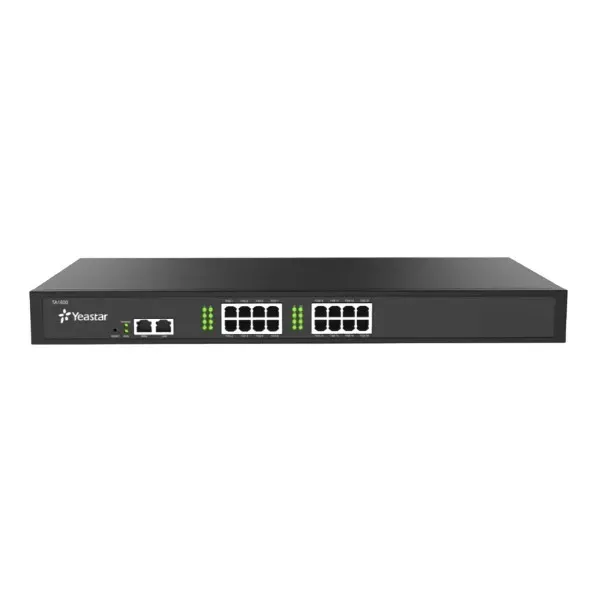
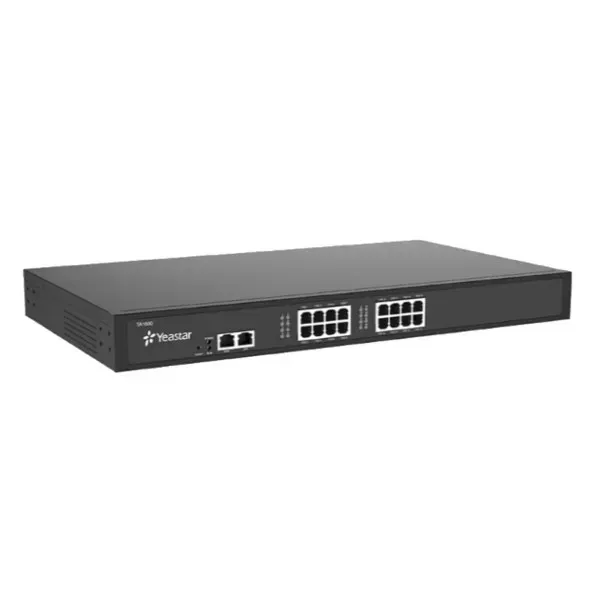
Yeastar TA1600 FXS VoIP Gateway
The Yeastar TA1600 is built for organizations that want to keep valuable analog telephones, fax machines or legacy PBX-side extensions while moving call control and transport onto an IP network. With sixteen FXS interfaces, SIP and IAX2 support, T.38 fax capability, flexible dialing rules and browser-based administration, it gives IT teams a controlled migration path from traditional telephony toward modern IP-PBX infrastructure.
Suitable when a project needs up to sixteen analog endpoints to operate as extensions of an IP-based phone system without replacing every handset or fax device at once.
What the Yeastar TA1600 does
A modern IP-PBX expects SIP-based endpoints and IP transport, while many offices, hotels, clinics, campuses, factories and service organizations still have analog devices that remain perfectly usable. The TA1600 sits between those two worlds. Each FXS port can present an analog station interface to a telephone or fax machine, while the gateway communicates with the IP telephony platform over the data network. This architecture lets a business preserve endpoint investments while centralizing call control, extension numbering, routing and administration on an IP system.
Yeastar positions the TA series as stand-alone FXS VoIP gateways. For the TA1600, the manufacturer specifies sixteen FXS ports, RJ11 plus an RJ21 50-pin telephony connector, 10/100 Mbps LAN and WAN interfaces, SIP RFC3261 and IAX2, UDP/TCP/TLS transport, SRTP, T.38 and fax pass-through, standard voice codecs, QoS controls, VLAN capability and web-based management. The device is designed for desktop or rack deployment and is particularly relevant where analog extension density is higher than a simple two-port adapter can address.
16 FXS ports
Connect up to sixteen compatible analog endpoints such as telephones or fax devices to an IP-PBX environment.
SIP & IAX2
Supports widely used VoIP signaling options, with flexible registration and routing possibilities for different deployment models.
T.38 fax support
Provides T.38 and fax pass-through options so analog fax workflows can be evaluated during IP telephony migration.
Managed deployment
Web administration, SNMP, RADIUS, TR-069, system logs, packet capture, backup/restore and firmware maintenance support structured operations.
Verified technical highlights
| Analog interfaces | 16 FXS ports; RJ11 and RJ21 50-pin telephony connector |
| Ethernet | 10/100 Mbps LAN and WAN |
| VoIP protocol | SIP (RFC3261), IAX2 |
| Transport/security | UDP, TCP, TLS, SRTP |
| Voice codecs | G.711 a-law/u-law, G.722, G.723, G.726, G.729A, GSM, ADPCM |
| Fax | T.38 and pass-through |
| QoS | DiffServ, ToS, 802.1P/Q VLAN tagging |
| Network features | DHCP, DDNS, OpenVPN, PPPoE, static route, VLAN |
| Management | Web UI, SNMP, RADIUS, TR-069, backup/restore, HTTP/TFTP firmware upgrade, system logs, packet capture, API |
| Physical format | 440 × 250 × 44 mm; desktop or rack-mount; 0°C to 40°C operating range |
Feature availability can vary by hardware generation and firmware branch. Confirm the exact V3/V4 unit and intended PBX integration before deployment or firmware upgrade.
Where the TA1600 fits in a voice network
The most common role is analog extension migration. Existing analog desk phones can connect to the gateway while the IP-PBX controls numbering and routing. The same approach can support fax machines where T.38 or pass-through is technically suitable. It can also be useful in sites with distributed analog devices that would be expensive or disruptive to replace simultaneously, provided cabling length, signaling and electrical conditions remain within the gateway’s supported design.
Before purchasing, count the analog endpoints that genuinely need FXS service, verify whether the target PBX supports the intended registration mode, document the SIP server details, determine whether faxing is business-critical, and confirm how the gateway will be addressed on the LAN. For wider voice planning in Tanzania, see FourTeck’s business technology and IP telephony overview, the services and deployment capabilities page, and the Tanzania technology shop when planning complementary voice and network components.
Compatibility and deployment planning
Yeastar documents interoperability with common IP-PBX and softswitch environments and provides integration guidance for its own P-Series as well as examples involving platforms such as 3CX. The practical compatibility question is not only whether two products both support SIP. Registration method, authentication, dial plan, caller ID format, DTMF handling, codec selection, NAT behavior, TLS requirements, fax method and failover rules can affect the result. A short pre-deployment checklist prevents many avoidable configuration problems.
For voice quality, place the gateway on a well-managed LAN, use sensible VLAN and QoS policies where appropriate, and avoid unnecessary packet loss or unstable WAN paths between the gateway and a remote PBX. For faxing, verify end-to-end T.38 support or test pass-through with the actual service provider. When the gateway is rack mounted, include it in the site’s power, UPS, grounding and cable-management plan. When it is used at a branch office, document the remote management method and restrict administrative access according to the organization’s security policy.
Yeastar TA1600 FXS VoIP Gateway Tanzania
For organizations in Tanzania, the Yeastar TA1600 is most relevant when analog telephony still performs useful work but the core communications platform is moving toward SIP and IP-PBX. A business may have analog handsets in reception areas, service counters, guest rooms, workshops, warehouses, security posts or back-office spaces where replacing every endpoint is not immediately necessary. The TA1600 allows these devices to remain connected while call control is centralized on an IP platform. This can reduce migration disruption, especially when existing extension cabling is already routed through a building and remains serviceable.
A Tanzania deployment should start with an endpoint survey. Count every analog device, identify which devices require caller ID or message waiting indication, separate ordinary phones from fax machines, and note any special dial patterns. Sixteen ports can be a good fit for a site that needs more than a few analog interfaces but does not require a very high-density chassis. Buyers should also decide whether one central gateway or several smaller gateways better matches the building layout. Long cable runs, multiple floors and remote blocks can influence this choice just as much as the number of extensions.
Network planning is equally important. The gateway should receive a stable IP configuration, the PBX path should be predictable, and voice traffic should not compete unnecessarily with large file transfers, video or backup traffic. VLAN separation and QoS are useful where the network is shared by many services. If the PBX is hosted or located at another site, internet stability, firewall rules and NAT behavior must be tested. The TA1600 supports TLS and SRTP options, but these should be configured in line with the PBX and security policy rather than enabled in isolation.
When requesting a quote in Tanzania, provide the current PBX make and model, required number of analog ports, whether fax is needed, the preferred rack or desktop installation, branch connectivity details and any requirement for remote administration. This information helps determine whether the TA1600 itself is sufficient or whether switching, UPS protection, cabling changes, SIP trunk work or PBX configuration should be included. For broader regional technology planning, FourTeck also maintains an Africa-focused IT solutions resource covering multi-country project considerations.
Yeastar TA1600 FXS VoIP Gateway Dar es Salaam
In Dar es Salaam, the TA1600 can suit offices, hotels, clinics, logistics companies, schools, professional services firms and multi-floor commercial facilities that already have analog handsets or fax devices but want centralized IP telephony. The city’s concentration of larger office environments means one frequent requirement is staged migration: the PBX may be upgraded first, while desk or room endpoints are replaced gradually. A sixteen-port FXS gateway gives project teams a way to preserve selected analog endpoints without delaying the broader PBX transition.
For a busy Dar es Salaam site, telephone service often depends on more than the gateway. Reception call flows, departmental routing, after-hours rules, call queues and SIP trunking should be designed together. The TA1600 should therefore be treated as an access component in the telephony architecture rather than the entire solution. Before installation, map each physical analog pair to an extension number, label patching clearly, and confirm which users need features such as call waiting, transfer or caller ID. Proper documentation makes later moves, changes and fault isolation much easier.
Power continuity is another practical consideration. If the gateway and network switch lose power, analog endpoints connected through the gateway will lose IP-PBX access. Businesses that depend on continuous calling should include the gateway, switch, router and PBX-side equipment in a suitable UPS design and review how external calling behaves during ISP or power interruptions. Where the PBX is cloud-hosted or at another location, a secondary connectivity strategy may be useful, but it should be planned as part of the network architecture rather than assumed to work automatically.
A Dar es Salaam procurement request should identify the number of active analog extensions, whether the site has an existing rack, the type of PBX, any required fax channels, expected growth and the person responsible for network changes. That enables an accurate bill of materials and prevents overbuying accessories that are not needed. For complementary network and telephony planning, FourTeck’s Tanzania service pages can be used to coordinate the gateway with LAN switching, UPS protection, structured cabling and IP-PBX configuration instead of sourcing each part without a common design.
Yeastar TA1600 FXS VoIP Gateway Mwanza
For businesses in Mwanza, the Yeastar TA1600 can help bridge analog endpoints into a centralized VoIP architecture without forcing an immediate replacement of every telephone. This may be useful for hotels, healthcare facilities, education campuses, warehouses, branch offices and administrative sites where existing copper extension cabling already reaches many rooms or work areas. If those analog lines are still in good condition, a gateway-based migration can turn them into IP-PBX extensions while keeping the physical endpoint layer familiar to users.
The key planning question is density. A TA1600 offers sixteen FXS ports, so a site with twelve to sixteen analog devices may use the capacity efficiently. A site with only two or four analog endpoints may be better served by a smaller model, while larger deployments may need multiple gateways or higher-density alternatives. Buyers should count present requirements and near-term expansion rather than purchasing solely on a model number. It is also worth deciding whether the gateway will be centralized in the main rack or located closer to analog cable termination points.
Mwanza deployments that connect to a remotely hosted PBX should pay particular attention to WAN quality. Voice traffic is sensitive to latency variation, packet loss and congestion. A fast internet service alone does not guarantee stable call quality if the LAN is poorly segmented or if heavy traffic saturates the link. The TA1600’s QoS and VLAN-related capabilities can be part of a wider voice-ready network design, while the router and switches must also be configured consistently. For fax use, test T.38 with the SIP provider and PBX before moving critical business fax workflows.
When obtaining a Mwanza quote, include the current extension count, existing analog cable layout, PBX platform, SIP provider where known, rack availability and power-backup expectations. If the organization operates multiple sites, indicate whether extensions should dial internally across branches. This may change firewall, VPN and routing requirements. A well-prepared requirement allows the TA1600 to be integrated as part of a predictable communications system rather than installed as an isolated appliance with undocumented settings.
Yeastar TA1600 FXS VoIP Gateway Arusha
Arusha organizations often combine hospitality, tourism, administration, education and professional services workloads, and many such environments still rely on analog devices in guest rooms, service counters, back offices or security points. The Yeastar TA1600 provides sixteen FXS interfaces that can connect these devices to an IP-PBX while allowing the organization to modernize its call control platform. This can be attractive where the building’s analog extension cabling is already established and endpoint replacement would add cost without creating equivalent operational value.
Hospitality and guest-service environments require careful call-flow planning. A gateway can deliver the analog connection, but features such as room extension numbering, reception transfers, wake-up integrations or billing functions depend on the PBX and application environment. Buyers should therefore confirm the full workflow before assuming that replacing the old PBX with a gateway alone will reproduce every legacy feature. The TA1600 is best viewed as the FXS access layer within a broader SIP solution.
For branch or distributed operations around Arusha, centralized management can simplify support if the network has dependable connectivity. The gateway provides web administration and management options such as SNMP and TR-069, but administrative exposure should be controlled. Use secure management practices, restrict access, maintain configuration backups and document firmware generation before updating. Yeastar publishes separate V3 and V4 firmware branches for the larger TA models, so hardware generation must be checked before any upgrade process.
A useful Arusha procurement brief should state whether the project is a new IP-PBX deployment, a replacement of an existing analog PBX, or an expansion of analog ports on an established VoIP system. Add the number of phones, fax machines and any special analog devices, plus the cable termination method and rack location. With that information, the gateway can be sized alongside the PBX, SIP trunk, network switch, firewall and UPS requirements so the finished system is supportable and easier to expand.
Yeastar TA1600 FXS VoIP Gateway Dodoma
In Dodoma, the Yeastar TA1600 can be considered by public-sector offices, educational institutions, NGOs, service organizations and private enterprises that are updating their telephone infrastructure while retaining analog endpoints. Its sixteen FXS ports provide a practical middle layer between legacy handsets and a SIP-based PBX. This allows migration to be phased: the organization can adopt centralized IP call control while delaying endpoint replacement in locations where existing devices continue to meet user needs.
Procurement teams should distinguish the gateway requirement from the PBX requirement. The TA1600 does not replace the call-control platform; it extends analog stations into that platform. The project therefore needs confirmed PBX capacity, extension licenses where applicable, SIP trunking strategy, dial plan and network readiness. If the target PBX is cloud-based, secure and reliable WAN connectivity is essential. If it is on-premises, rack space, UPS capacity and local switching should be planned alongside the gateway.
Documentation is especially important in larger institutional deployments. Assign each FXS port to a clearly named extension, label analog cable pairs, record IP settings and store configuration backups. If the gateway is integrated with a voice VLAN, keep the VLAN ID, switch port configuration and QoS policy in the network records. These steps help future administrators understand the system without reverse engineering it after staff changes or site expansion.
A Dodoma quotation request should identify required quantity, endpoint count, PBX make and model, rack location, cabling status, fax requirements and whether installation/configuration is needed. Buyers should also state if they require inter-branch dialing or remote extensions, because those needs can add firewall, VPN or WAN design work. Taking this structured approach makes the TA1600 part of a complete communications plan rather than a standalone purchase whose integration is left unresolved.
Yeastar TA1600 FXS VoIP Gateway UAE
In the UAE, the Yeastar TA1600 is relevant to organizations modernizing analog extensions in hotels, warehouses, offices, clinics, education facilities and multi-site enterprises. A common scenario is a new SIP or cloud PBX being introduced while many analog devices remain installed in rooms or operational areas. The gateway allows up to sixteen such endpoints to register or route through the IP telephony platform without changing the user-facing device immediately. This can reduce migration complexity in buildings where analog cabling is extensive.
UAE projects frequently involve multi-vendor networks, so interoperability should be tested against the actual PBX and SIP service. SIP support is necessary but not sufficient; authentication, DTMF, codec selection, caller ID presentation, fax mode, NAT and TLS settings should all be checked. For hosted PBX deployments, firewall policies and WAN failover behavior deserve particular attention. The TA1600 can support secure transport options, but end-to-end compatibility depends on the service and PBX configuration.
High-density commercial sites should also consider physical installation. The TA1600’s rack-mount form factor is convenient for a structured communications rack, but analog patching should remain clearly labeled. RJ21 connectivity can help where telecom distribution blocks are already used, while RJ11 ports are straightforward for individual patching. Power protection, grounding and airflow should be included in the rack plan together with switches, router and PBX appliances.
For UAE purchasing, request a configuration that matches the hardware generation and intended integration rather than relying on generic TA-series assumptions. If regional sourcing or deployment support is part of a broader project, FourTeck’s UAE IT and telecom solutions site provides a regional reference point for associated PBX, networking and infrastructure work. Provide the final endpoint count, PBX platform and site topology to receive a more accurate quotation.
Yeastar TA1600 FXS VoIP Gateway Uganda
Ugandan businesses can use the Yeastar TA1600 as a migration bridge where analog handsets, fax machines or legacy extension wiring need to remain in service after an IP-PBX is introduced. Sixteen FXS ports make it suitable for medium-density analog requirements, including hotels, administrative buildings, clinics, schools and branch offices. Instead of treating every telephone as a replacement project, the gateway lets the organization migrate call control and routing first, then modernize endpoints according to operational priority and budget.
For multi-site Ugandan organizations, the design question is often whether to place a gateway at each branch or backhaul analog circuits to a central location. In most IP deployments, local gateways near the analog endpoints are easier to manage because they avoid long physical analog runs between sites. The branch gateway can then communicate with a central PBX over the IP network. This approach requires dependable branch connectivity and a clear plan for what happens if the WAN link is unavailable.
Voice VLANs, QoS and consistent switch configuration can improve predictability on shared networks, but they should be implemented across the whole path, not only on the gateway. Administrators should also document the registration mode, SIP server, credentials, dial rules and firewall requirements. If the environment uses remote management, restrict access and maintain backups. Firmware updates should follow the correct hardware generation, especially because Yeastar publishes separate firmware branches for TA1600 V3 and V4.
When requesting an Uganda quote, include the number of analog endpoints at each site, the PBX location, expected branch dialing patterns, internet topology, rack requirements and whether fax remains necessary. This gives the supplier enough information to recommend whether one TA1600, multiple units or a different FXS density is appropriate. The purchasing decision should be based on the full telephony architecture rather than the lowest per-port hardware cost alone.
Yeastar TA1600 FXS VoIP Gateway Kampala
Kampala has many organizations operating mixed-generation telephony environments: new IP-PBX platforms may coexist with analog phones in reception areas, stores, guest rooms, security desks and service departments. The Yeastar TA1600 addresses this transition by presenting sixteen FXS ports to analog devices while using SIP or IAX2 toward the IP telephony system. It can therefore reduce the need to replace functioning endpoints purely because the central PBX has moved to IP.
In a Kampala office or campus, the gateway should be installed as part of the network and power design. Place it in a secure communications area, connect it to managed switching, use stable addressing, and document every port-to-extension mapping. Where the office uses a voice VLAN, align switch and gateway configuration. For a hosted PBX, test NAT, firewall and WAN behavior during both normal operation and link failover. These checks matter because a gateway can be configured correctly yet still experience poor calls if the network path is unstable.
Fax requirements deserve separate testing. Although the TA1600 supports T.38 and pass-through, successful faxing depends on the PBX, SIP service and end-to-end codec behavior. Organizations that still exchange critical documents by fax should conduct practical tests before decommissioning the previous line arrangement. Similarly, any legacy analog device that is not a standard telephone or fax should be validated individually rather than assumed to work.
A Kampala buyer can improve quote accuracy by sending an extension schedule, PBX make/model, SIP provider details if known, rack photo or available rack units, and information about the analog distribution frame. If installation is required, note working hours and whether service migration must happen in phases. This allows configuration to be planned around business continuity rather than treating deployment as a simple hardware swap.
Yeastar TA1600 FXS VoIP Gateway Arua
For organizations in Arua, the Yeastar TA1600 can support modernization where analog telephones remain useful but the central communication platform is moving to SIP. Branch offices, education facilities, health organizations, NGOs and service businesses may have extension wiring that is already installed and difficult to replace. By converting those endpoints into IP-PBX extensions at the gateway, the organization can obtain centralized numbering and call routing without rewiring every desk or room immediately.
Connectivity should be assessed carefully in branch deployments. If the PBX is located in Kampala or another city, the TA1600 depends on the WAN path for registration and call transport. The internet service, router and firewall therefore become part of the voice system. A link that is acceptable for email may still cause problems for real-time voice if it has unstable latency or packet loss. Monitoring and QoS can help, but the design should also consider what users need to do during a WAN outage.
Physical conditions matter too. The gateway has an operating range specified by the manufacturer, and it should be installed in a clean, ventilated, secure equipment area rather than exposed to dust, heat or accidental disconnection. Add UPS protection if short power interruptions would disrupt important calls. Analog cable pairs should be labeled so technicians can identify which endpoint corresponds to each FXS port without tracing the entire building every time.
An Arua quotation should state whether the gateway will connect to a local or remote PBX, how many analog devices are active, whether faxing is required, and how many additional ports may be needed over the next few years. If a single TA1600 leaves almost no spare capacity, it may be wise to consider future growth before finalizing the design. The goal is a solution that remains understandable, maintainable and expandable after the initial migration is complete.
Yeastar TA1600 FXS VoIP Gateway Mbarara
Mbarara organizations with mixed analog and IP telephony can use the Yeastar TA1600 to preserve existing handsets while moving call control onto a modern PBX. Its sixteen FXS ports provide a practical density for branch offices, clinics, hotels, schools and business sites where there are more analog endpoints than a small ATA can accommodate. This approach can lower migration disruption because users keep familiar devices while administrators gain centralized extension and routing control.
The best deployment starts with a cable and extension audit. Identify unused analog pairs, defective handsets and lines that no longer need to be retained. Doing this before sizing the gateway can prevent paying for capacity that will never be used. For the lines that remain, assign extension numbers consistently and document the relationship between PBX users, FXS ports and physical wall outlets. This becomes particularly useful when several buildings or departments share the same communications rack.
If the IP-PBX is off-site, network quality becomes a first-class requirement. Configure the gateway with stable addressing, ensure the router permits the intended SIP traffic, and avoid exposing management interfaces unnecessarily. Where TLS and SRTP are used, confirm certificate and PBX compatibility. If the site uses VPN transport, verify that voice packets follow the intended path and that backup internet behavior does not unexpectedly change NAT or routing.
For Mbarara procurement, provide the number of phones and fax machines, required call features, location of the PBX, LAN/VLAN information and whether the gateway will be rack mounted. Also note if the project is an expansion or a complete PBX replacement. An expansion often has different integration constraints from a greenfield installation, because existing extension numbers, call routes and user expectations need to be preserved during cutover.
Yeastar TA1600 FXS VoIP Gateway Gulu
In Gulu, the Yeastar TA1600 may be selected where organizations need to connect a meaningful number of analog devices to a SIP-based communications system. Sixteen FXS ports make it well suited to a building that has retained analog telephones in operational areas while management wants to centralize call control and reduce dependence on an older analog PBX. The gateway can support a phased modernization strategy rather than forcing all endpoint replacement into one project window.
Phased projects should define a clear cutover sequence. Start with non-critical extensions, verify internal and external calling, confirm caller ID and DTMF behavior, and only then migrate departments that depend heavily on telephony. For fax machines, test actual send and receive workflows. If the site has emergency or safety-related analog lines, evaluate them separately because some specialized devices may have requirements that standard voice ports do not meet.
The TA1600’s management capabilities are useful for support, but remote access should be designed securely. Administrators can use web management and monitoring protocols, yet those services should be limited to trusted networks or managed access paths. Configuration backups should be stored after major changes. When firmware is updated, confirm the gateway’s hardware generation first and follow the matching Yeastar branch to avoid loading incompatible firmware.
A Gulu purchase request should include the current telephone system diagram if available, active extension count, cable termination details, intended PBX, required SIP trunk or inter-branch behavior, and power protection needs. This information helps determine the true project scope. In many cases, a successful analog-to-VoIP migration depends more on network and call-flow preparation than on the gateway installation itself, so planning time should be included in the deployment schedule.
Yeastar TA1600 FXS VoIP Gateway Kenya
Kenyan businesses with legacy analog phones can use the Yeastar TA1600 to connect those endpoints to an IP-PBX while keeping migration under control. The sixteen-port capacity is useful for medium-density analog extension requirements in hotels, warehouses, healthcare, education, retail administration and branch offices. Instead of replacing all handsets and rewiring every location, the organization can centralize telephony first and refresh endpoints later where IP phones provide additional business value.
For Nairobi or multi-branch Kenyan environments, the TA1600 may be deployed at a local site while registering to a central PBX. This allows branch users to retain analog devices and still participate in the corporate dial plan. However, remote registration makes the WAN link part of the phone system. Voice traffic should be monitored for loss and jitter, and firewall/NAT behavior must be predictable. If an SD-WAN or VPN architecture is already in place, ensure SIP signaling and RTP media follow the intended path.
Organizations that require fax should evaluate T.38 compatibility with the selected SIP provider and PBX. The gateway supports T.38 and pass-through, but reliability is an end-to-end issue. For ordinary voice, codec choices can also influence bandwidth and quality. G.711 may be appropriate on well-provisioned links, while other supported codecs may be selected when bandwidth efficiency matters, subject to PBX and provider compatibility.
Kenya procurement teams should compare the TA1600 not only on price per port but on fit with the existing environment: PBX type, rack layout, analog cabling, management method, expansion plan and support workflow. A documented design reduces later troubleshooting. For regional projects, procurement can also coordinate model consistency and spare strategy across neighboring offices so support teams do not have to maintain many unrelated gateway platforms.
Yeastar TA1600 FXS VoIP Gateway Kuwait
In Kuwait, the Yeastar TA1600 can support commercial offices, hospitality properties, schools, clinics, warehouses and service organizations that need to extend an IP-PBX to analog devices. Sixteen FXS ports provide enough capacity for a meaningful group of handsets or fax machines while maintaining a compact 1U-style rack footprint. This is especially useful where older extension cabling is already installed and operational but the organization wants SIP-based central call control.
A careful site survey should determine whether analog endpoint retention is temporary or part of the long-term design. If only a few devices will remain after migration, a lower-density gateway may make more sense. If analog room phones, lifts, service desks or fax devices will remain for years, a sixteen-port model can be efficient. Specialized analog equipment should be validated separately, because not every device behaves like a standard telephone.
Kuwait deployments often place voice equipment in structured racks alongside switches, firewall appliances and UPS systems. The TA1600 should be integrated into that environment with labeled patching, reliable power and documented network settings. Where remote PBX services are used, TLS/SRTP and firewall configuration can strengthen the architecture when supported across the full path. Monitoring should include both gateway status and WAN quality, because call issues may originate outside the appliance.
When requesting a Kuwait quotation, include the number of analog extensions, PBX platform, expected call volume, fax use, rack requirements and any branch connectivity. Also identify whether the project needs configuration only, physical installation, cabling changes or a complete PBX migration. Separating those tasks clarifies scope and helps avoid comparing hardware-only prices with turnkey deployment proposals that include engineering work.
Yeastar TA1600 FXS VoIP Gateway Ghana
For organizations in Ghana, the Yeastar TA1600 offers a route from analog endpoint infrastructure to IP telephony without forcing an all-at-once replacement. Its sixteen FXS ports can support analog telephones and fax devices as extensions on a compatible PBX. This is useful where established buildings have extensive copper extension cabling or where users do not need the advanced display and application features of IP phones at every location.
In Accra and other commercial centers, deployment may involve a mix of local and remote offices. The gateway can be installed at a branch and connected over IP to centralized call control, but the branch network must be engineered for real-time voice. Router stability, latency, packet loss and firewall policy should be checked. Voice VLANs and QoS can help in congested environments, while configuration backups and monitoring support ongoing administration.
Organizations migrating from a legacy PBX should document existing extension behavior before cutover. Users may rely on transfer patterns, reception groups, fax numbers or call-forward rules that need to be recreated in the new PBX. The TA1600 handles analog access, but the PBX is responsible for much of the call logic. Separating those responsibilities during design avoids expecting the gateway to reproduce features that actually belong to the call-control platform.
A Ghana quotation request should include endpoint count, current PBX, desired PBX, SIP provider if chosen, analog distribution details and whether rack installation is available. If growth is expected, indicate the projected number of additional analog ports so the solution can be sized with headroom. A structured requirement makes it easier to compare proposals on technical completeness rather than headline hardware cost alone.
Yeastar TA1600 FXS VoIP Gateway Nigeria
Nigerian organizations that operate legacy analog handsets alongside newer IP communications can use the Yeastar TA1600 to consolidate those endpoints under an IP-PBX. Sixteen FXS ports offer a useful middle ground between small adapters and very high-density gateways. Hotels, offices, schools, clinics, warehouses and distributed business sites can retain selected analog devices while gaining centralized SIP-based routing and extension management.
For Lagos, Abuja and multi-site deployments, resilience planning is important. If a branch gateway registers to a central or cloud PBX, internet quality and firewall design directly affect call continuity. A secondary WAN can improve availability, but failover should be tested to confirm how SIP registrations and active calls behave after public IP or route changes. The gateway should also be powered from an appropriate UPS where short outages would disrupt essential communications.
Network administrators should use clear addressing, restrict web management, back up configurations and monitor the device. If voice traffic shares links with CCTV, cloud backup or large business applications, QoS and capacity planning may be necessary. The TA1600 supports VLAN and QoS-related features, but effective prioritization requires coordinated configuration on the switches, routers and PBX path as well.
Nigeria procurement teams should provide a detailed endpoint schedule before ordering. Include analog phones, fax devices, required caller ID behavior, extension numbers, PBX platform, rack location and planned growth. For migrations, identify any critical departments that need phased cutover. This lets installers prepare configuration and testing around business operations. The desired outcome is not simply sixteen working dial tones; it is a documented voice system that users can rely on and administrators can troubleshoot.
Yeastar TA1600 FXS VoIP Gateway Seychelles
In Seychelles, hospitality, tourism, administration and service organizations may have many analog phones distributed across rooms, desks or operational areas. The Yeastar TA1600 can connect sixteen of these endpoints to an IP-PBX, allowing the central telephony platform to be modernized while existing analog devices remain in use. This staged approach can be practical when endpoint replacement would require significant room access, cabling work or service interruption.
For island or multi-property environments, remote management and standardized configuration can simplify support. A common gateway model, consistent extension plan and clear documentation reduce the number of unique troubleshooting procedures across sites. However, any connection to a remote PBX depends on WAN stability. Voice traffic should be assessed separately from ordinary web usage, because packet loss and jitter can be noticeable during calls even when general browsing appears acceptable.
Hospitality buyers should verify application requirements beyond basic calling. Room status integrations, billing, wake-up services or property-management functions are PBX/application matters and should not be assumed from the presence of FXS ports. The TA1600 provides analog connectivity, while the rest of the hospitality telephony workflow depends on the selected PBX and software. This distinction is important when replacing an older integrated hotel PBX.
A Seychelles quote request should describe the property layout, number of analog rooms or devices, cable termination, PBX platform, internet topology and expected redundancy. If multiple gateways are required, consider rack space, UPS capacity and labeling standards from the beginning. A well-planned deployment makes future room changes and maintenance much easier than an undocumented point-to-point replacement of the old system.
Buying and quotation checklist
Frequently asked questions
What is the difference between an FXS and FXO gateway?
An FXS gateway provides station ports for analog telephones or fax machines. An FXO gateway connects analog PSTN lines or PBX trunk-side interfaces. The TA1600 is an FXS gateway, so its primary role is to connect analog endpoints to an IP telephony system.
Can the TA1600 connect sixteen analog phones?
Yes. The TA1600 provides sixteen FXS ports. The exact deployment should still confirm PBX capacity, cabling, power, registration method and any fax or special endpoint requirements.
Does the Yeastar TA1600 support fax?
Yeastar specifies T.38 and fax pass-through support. Real-world fax success depends on the PBX, SIP service, codec handling and network path, so critical fax workflows should be tested end to end.
Can it be used with 3CX or other IP-PBX platforms?
Yeastar publishes integration guidance involving 3CX and documents interoperability with a broad range of IP-PBX and softswitch platforms. Compatibility should still be validated against the exact software version, registration model and required features.
Does the TA1600 support secure VoIP transport?
The published specifications list TLS and SRTP. These options only provide their intended benefit when the PBX and surrounding architecture are configured consistently, with appropriate certificate and policy management.
What information should I send for a quotation?
Send the number of analog endpoints, PBX platform, site location, fax requirements, network topology, rack and UPS availability, expected future growth and whether you need installation/configuration. This allows the gateway and related infrastructure to be sized correctly.
Decision recap
Choose the Yeastar TA1600 when the project specifically needs a sixteen-port FXS bridge between analog endpoints and an IP-PBX. It is strongest in staged migration scenarios where phones or fax machines still have operational value, while the organization wants centralized SIP-based call control. Do not select it solely because sixteen ports sounds sufficient; verify PBX compatibility, analog-device behavior, WAN quality, rack and power conditions, and long-term extension growth.
If the requirement is for incoming analog telephone lines rather than analog station devices, an FXO gateway is the relevant product category instead. If only a handful of analog devices remain, a smaller FXS gateway may be more efficient. If significantly more than sixteen analog endpoints are required, compare higher-density options and the operational benefit of consolidating several gateways versus distributing them closer to endpoint cabling.
Consult FourTeck about your TA1600 deployment
A productive consultation starts with your existing telephony diagram and target outcome. FourTeck can help assess the analog endpoint count, IP-PBX integration path, LAN readiness, power protection, cabling and migration sequence. The aim is to make the gateway part of a documented solution rather than an isolated appliance.
Use the FourTeck Tanzania contact page to send your requirements, including project location, PBX details, number of analog extensions and expected deployment schedule.



Reviews
There are no reviews yet.