
YEASTAR ANALOG-TO-VOIP CONNECTIVITY
Yeastar TA410 FXO VoIP Gateway
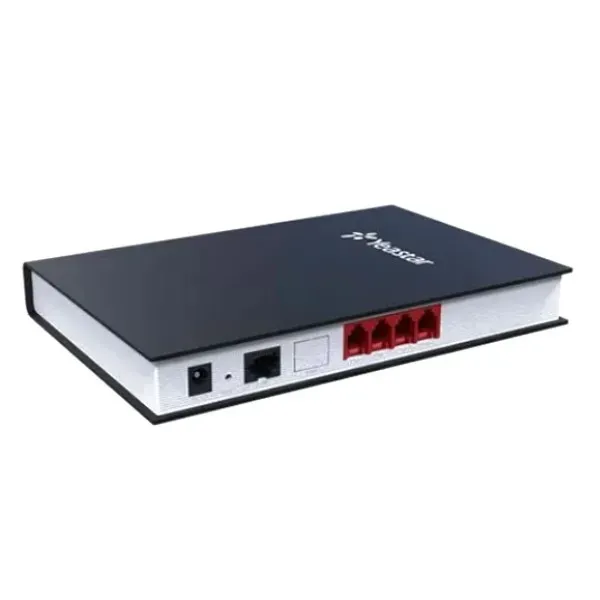
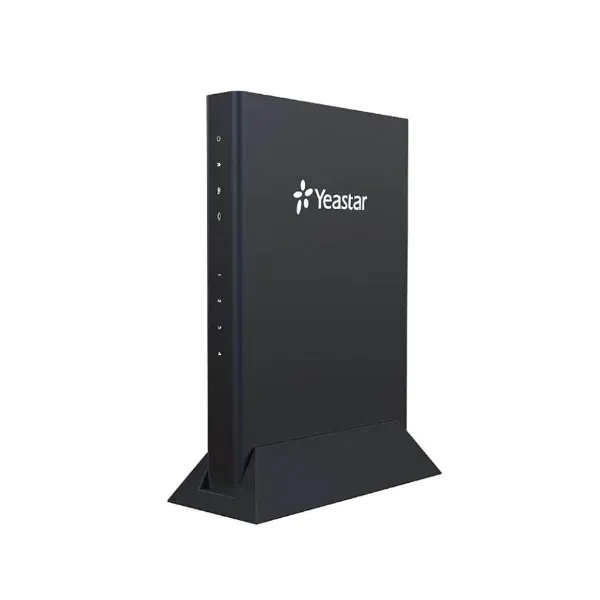
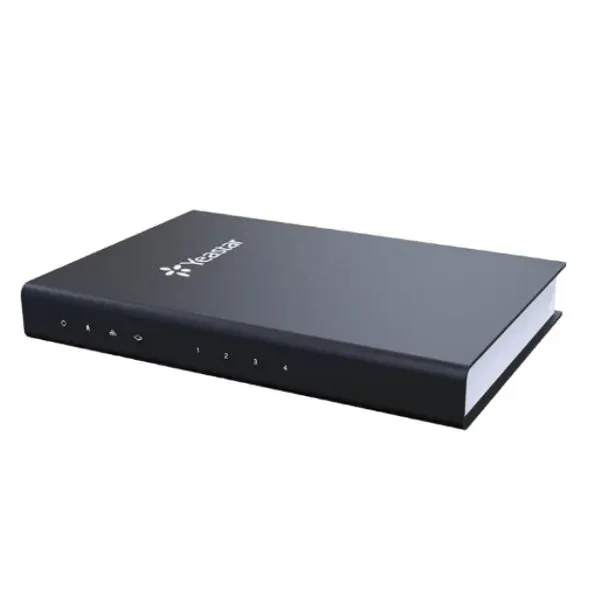
The Yeastar TA410 is a compact four-port FXO VoIP gateway designed to connect traditional PSTN lines or analog PBX trunk interfaces with an IP-based telephony environment. For businesses modernizing voice infrastructure without immediately abandoning existing analog lines, the TA410 provides a practical bridge between conventional telecom circuits and SIP-based communications. It is particularly relevant for offices, branches, reception environments, retail operations, hospitality sites, professional services, and organizations that need to keep local PSTN connectivity while introducing an IP PBX or hosted voice platform.
Officially verified core model facts
4 × RJ11 FXO ports · 1 × 10/100 Mbps LAN · SIP (RFC3261) and IAX2 · UDP/TCP/TLS/SRTP · T.30 fax · VLAN/QoS support · web-based management · desktop or wall mounting.
4 FXO Ports
Connect up to four PSTN lines to an IP telephony environment without replacing the analog circuits immediately.
SIP & IAX2
Use established VoIP signaling options for integration with compatible IP PBX, hosted PBX, call-routing, and branch voice systems.
Secure Transport Options
Official specifications list UDP, TCP, TLS and SRTP support, helping administrators align signaling and media transport with the surrounding VoIP design.
Web Management
Configuration, call records, logs, backup, firmware tasks and troubleshooting tools can be handled through an administrator-friendly management workflow.
What the Yeastar TA410 solves
A common voice-migration challenge is that a business already has working PSTN lines but wants to adopt an IP PBX, improve internal extension management, create better call routing, or standardize branch communications. Replacing every external line on day one may be commercially unnecessary or operationally inconvenient. The TA410 gives the organization a controlled migration path: incoming and outgoing analog trunk traffic can enter an IP telephony system through four FXO interfaces while users gain the benefits of an IP-based call-control platform.
This architecture is useful when an organization needs local PSTN fallback, when existing telephone numbers remain on analog circuits, when a branch is being migrated in stages, or when an IP PBX must interoperate with a traditional line source. Yeastar’s own documentation describes the TA FXO family as a way to connect analog telephone lines or a PABX extension interface to VoIP networks. The gateway therefore sits at the boundary between the analog telecom side and the IP network side rather than replacing the PBX by itself.
Before purchase, FourTeck recommends confirming how many active analog lines are required, whether four FXO channels are sufficient at peak call periods, what PBX or hosted platform will terminate the SIP connection, which caller-ID method is used by the telecom provider, and how busy-tone, polarity-reversal, answer and hangup behavior should be detected. These details influence the final configuration and prevent a simple hardware purchase from becoming a difficult installation later.
Verified technical specifications
| FXO interfaces | 4 × RJ11 FXO ports |
| LAN | 1 × 10/100 Mbps Ethernet |
| VoIP protocols | SIP (RFC3261), IAX2 |
| Transport / security | UDP, TCP, TLS, SRTP |
| Voice codecs | G.711 a-law/u-law, G.722, G.723, G.726, G.729A, GSM, ADPCM |
| Voice handling | ITU-T G.168 line echo cancellation, dynamic jitter buffer, VAD, CNG, PLC |
| DTMF | RFC2833, SIP Info, in-band |
| Fax | T.30 |
| QoS / VLAN | DiffServ, ToS, 802.1p/Q VLAN tagging |
| Network functions | DHCP, DDNS, OpenVPN, PPPoE, static route, VLAN |
| Management protocols | FTP, TFTP, HTTP, HTTPS, SSH; RADIUS listed for the TA410 |
| Caller ID | BELL202, ETSI V23, NTT V23-Japan and DTMF-based CID |
| Disconnect methods | Busy tone, polarity reversal |
| FXO detection features | Programmable AC impedance, hangup detection, answer detection, caller-ID detection |
| Power | 12V, 1A |
| Dimensions | 200 × 137 × 25 mm |
| Operating environment | 0°C to 40°C; 10–90% humidity, non-condensing |
| Mounting | Desktop or wall mount |
Deployment and compatibility planning
Yeastar publishes integration guidance showing TA FXO gateways working with Yeastar PBX platforms, 3CX and FreePBX through SIP-based trunking. Those examples are valuable because they demonstrate the typical role of the device: the PSTN circuit terminates on an FXO port, the gateway creates the IP-side connection, and the PBX then applies extension, routing, IVR, hunt-group, queue, voicemail or other call-control logic. Compatibility should still be confirmed against the specific PBX version, firmware, routing design and local line behavior used in the target deployment.
The physical installation is straightforward but should be planned carefully. Yeastar’s installation guide states that the LAN port connects to the router or PBX, FXO ports connect to PSTN, and power is supplied through the adapter. The TA410 has no dedicated WAN function in the official specification; its WAN position is reserved. The device can sit on a desk or be wall-mounted using the provided mounting arrangement. Network settings, VLAN design, firewall rules and QoS policies should be documented so the voice path remains stable and support teams can identify the gateway quickly.
For organizations building or expanding a complete phone platform, review FourTeck Tanzania’s IP PBX and business technology services, the Tanzania technology shop, and the broader FourTeck Tanzania solutions overview. These pages help buyers plan the gateway together with PBX, IP phones, switches, VLANs, internet links and supporting infrastructure rather than treating the FXO gateway as an isolated box.
Buying guidance: is the TA410 the right size?
The TA410 is specifically the four-FXO-port model in Yeastar’s TA FXO family. If the site needs four or fewer active analog PSTN channels, it can be a compact fit. If the organization expects more simultaneous analog trunk channels, procurement should compare the requirement with higher-port models rather than adding complexity later. Count active lines, expected simultaneous calls, expansion plans and any line reserved for a special purpose. The number of extensions in the PBX is not the same as the number of FXO ports required; FXO sizing is based on the analog trunk channels that must enter or leave through the gateway.
Also verify the telecom provider’s caller-ID and disconnect behavior, because these settings can affect how accurately the gateway detects ringing, caller identity and call release. This is particularly important when migrating older analog environments, where line conditions and signaling may vary. A pre-deployment checklist helps avoid abandoned calls, delayed hangup, wrong inbound routing or unexpected audio behavior.
Yeastar TA410 FXO VoIP Gateway Tanzania
For organizations in Tanzania, the Yeastar TA410 addresses a practical modernization requirement: continue using existing analog PSTN lines while introducing a more flexible IP-based phone system. Many businesses do not migrate telecom infrastructure in one single step. An office may already have trusted published telephone numbers, an existing analog service from a carrier, or a requirement to preserve a conventional trunk as part of a continuity plan. In that environment, a four-port FXO gateway can turn those line resources into SIP-accessible trunks for the PBX while leaving the external carrier relationship unchanged.
The most important procurement question is not merely whether the TA410 has four ports; it is whether four ports match the real concurrent-call requirement. A company with ten internal extensions could still need only two external PSTN channels, while another organization with fewer users could require four dedicated lines because of reception, reservations, customer service or operational calling patterns. FourTeck recommends documenting line purpose, current telephone numbers, peak simultaneous calls, preferred outbound line selection and the inbound destination for each line before configuration begins.
Tanzania deployments should also consider the surrounding IP infrastructure. Voice gateways depend on clean LAN connectivity, predictable addressing, DNS where required, and firewall policies that do not interfere with SIP or RTP. If the PBX is hosted elsewhere, internet stability and security design become more significant. If the PBX is on the same site, VLANs and QoS can help organize voice traffic and simplify troubleshooting. Power conditions should also be assessed; the gateway, PBX, router and switch may need coordinated UPS support if the business expects telephony to remain available during short power interruptions.
For quotations in Tanzania, provide the exact PBX platform, current analog line count, desired inbound routing, number of branches, available LAN topology, and whether installation or configuration assistance is required. FourTeck can then align the TA410 with the larger telephony design instead of quoting hardware without context.
Yeastar TA410 FXO VoIP Gateway Dar es Salaam
Businesses in Dar es Salaam often operate fast-moving customer-facing functions where telephone continuity remains important even as internal communications move toward SIP and IP PBX platforms. The TA410 can be useful for offices that want to preserve up to four traditional PSTN circuits while modernizing extensions, reception routing and branch connectivity. A reception team can continue receiving calls on existing analog numbers, while the PBX controls which extensions ring, how unanswered calls are handled and whether departments use groups, queues or other features supported by the chosen phone platform.
A Dar es Salaam deployment should start with a line inventory. Identify which lines are still operational, which telephone numbers are public-facing, how often lines are busy at peak periods and whether any number must remain dedicated to a department or service. This avoids connecting four lines simply because four ports are available. If only two lines are needed, the unused ports become expansion capacity; if more than four concurrent analog channels are genuinely required, another model or a different trunk strategy should be considered before procurement.
Network planning is equally important in busy offices. The gateway’s 10/100 Mbps LAN interface is more than adequate for the voice channels it serves, but call quality depends on the entire path. Switch configuration, VLANs, firewall behavior, packet loss, jitter and PBX placement all matter. Where the PBX is cloud-hosted, internet resilience and secure signaling become part of the design. Where the PBX is local, administrators should still document the TA410 address, route rules, backup configuration and line mapping so future support work is straightforward.
For Dar es Salaam procurement, include office location, PSTN line count, PBX vendor and version, expected concurrent calls, any existing SIP trunks, and whether the gateway will be used for primary PSTN access or as a secondary path. This produces a clearer commercial scope and makes installation planning much more reliable.
Yeastar TA410 FXO VoIP Gateway Mwanza
For organizations in Mwanza, the TA410 can provide a sensible bridge between established analog telephone services and a newer IP-based communication system. A branch office, hotel, clinic, school, retail operation or administrative site may have PSTN circuits that still serve a useful role. Rather than discarding those lines during an IP PBX rollout, the gateway can present them to the new voice platform through SIP or IAX2 and allow the PBX to centralize call control.
The planning advantage is gradual migration. Internal users can move to IP phones or soft clients while the public-facing phone numbers remain on analog trunks. The PBX can then organize extensions, hunt groups, working-hours logic or other features independently of the analog line technology. This separation is useful when the organization wants operational change without requiring every telecom dependency to change at the same time.
Mwanza deployments should pay attention to site supportability. The gateway should be installed in a clean, ventilated position within Yeastar’s specified operating environment, with the network and PSTN cables clearly labeled. Configuration backups should be retained after commissioning. If a remote IT team will manage the branch, the management path should be secured rather than casually exposed to the internet. For hosted PBX designs, confirm whether NAT, firewall rules, TLS/SRTP and routing behavior match the service provider’s expectations.
A useful quotation request for Mwanza should explain the current telephone service, the number of analog trunks, whether caller ID is important, the PBX or cloud voice service to be used, and the desired call flow. If the organization has branches in other regions, include those sites as well so numbering and routing can be designed consistently instead of solving each location in isolation.
Yeastar TA410 FXO VoIP Gateway Arusha
Arusha organizations in tourism, hospitality, professional services, education and administration may need voice systems that combine modern IP-based call handling with traditional external telephone circuits. The Yeastar TA410 fits this hybrid requirement when up to four analog PSTN lines need to be presented to a compatible PBX. It is particularly useful where published numbers should remain active while the internal phone system is reorganized or replaced.
Hospitality and reservation environments should think carefully about call flows before deployment. A single incoming line may need to ring reception first, then an alternate extension, or follow different rules after hours. Multiple lines may need to be grouped for outbound calling or assigned to different business functions. The TA410 transports the analog lines into the IP environment, but the final customer experience is created by the PBX configuration. Defining that logic before installation reduces repeated changes after go-live.
Line detection also deserves attention. The TA410 supports caller-ID detection, answer detection, hangup detection, programmable AC impedance, busy-tone handling and polarity reversal. The correct settings should reflect local line characteristics and the carrier’s signaling. Technicians should test inbound caller ID, outbound audio, call release, unanswered calls and back-to-back calls on each port. A gateway should not be considered commissioned merely because dial tone is available.
For Arusha buyers, FourTeck recommends a small acceptance plan: confirm every PSTN number reaches the intended PBX destination, verify outbound line selection, test DTMF through IVR systems, check call clearing, retain configuration backup and document which physical port maps to which number. This creates an installation that is easier for both local staff and remote support teams to understand.
Yeastar TA410 FXO VoIP Gateway Dodoma
In Dodoma, the Yeastar TA410 is relevant for public-sector offices, professional organizations, branches, education environments and businesses that are introducing IP telephony while retaining analog trunk services. The device does not replace the carrier line; it converts the relationship between that line and the PBX so the organization can route calls through an IP-based platform. That makes it valuable when continuity of existing numbers is important but internal call handling needs to become more structured.
A procurement team should separate three questions. First, how many analog lines must remain connected? Second, how many simultaneous external calls are expected? Third, what PBX features are required after the calls enter the IP environment? These questions clarify whether the TA410’s four FXO ports are correctly sized and whether the surrounding PBX has the needed licenses, trunks, extensions or feature capacity. The gateway itself should not be expected to provide all PBX functions.
For centralized IT teams, configuration governance matters. Use a clear naming convention, static addressing where appropriate, restricted management access, backups, firmware records and documentation of line mapping. If the organization has several offices, standardize the same template across sites. Consistent SIP trunk names, dial patterns, VLANs and monitoring practices make troubleshooting faster and reduce dependence on individual technicians remembering how each branch was built.
When preparing a Dodoma quotation, include current line counts, existing PBX details, desired internal extension quantity, any call-recording or queue requirement, internet connectivity model and whether the analog circuits are primary or backup. This allows product pricing to be tied to a complete and supportable design rather than a standalone equipment request.
Yeastar TA410 FXO VoIP Gateway UAE
For UAE-based branches or group companies standardizing communications across multiple countries, the TA410 can serve as a compact analog-line gateway where local PSTN circuits must remain connected to an IP PBX. The strongest use case is not a greenfield all-SIP environment; it is a mixed environment in which analog trunks still have operational value. Organizations can use the gateway to integrate those lines with a centralized or distributed PBX architecture while keeping extension plans and user experience more consistent across sites.
Cross-border IT teams should pay special attention to configuration standards. Use the same device naming scheme, backup method, SIP trunk conventions, security baseline and documentation template in every location. Telecom line signaling and regulatory requirements can differ by market, so do not assume settings proven in Tanzania will be identical in the UAE. Confirm caller-ID behavior, analog circuit presentation, dial patterns and local provider requirements for the specific site.
If the branch uses a hosted PBX, review NAT traversal, firewall policy, signaling encryption and RTP media paths carefully. If the PBX is local, ensure the LAN has appropriate VLAN and QoS policy and that the gateway is not exposed unnecessarily. The TA410 supports TLS and SRTP, but the far-end PBX or provider must support and be configured for the same security approach. Interoperability depends on matching both sides rather than enabling a feature in isolation.
FourTeck customers with UAE requirements can also review FourTeck UAE business technology solutions. This is useful when a procurement team wants one regional conversation covering a Tanzania site and a UAE branch while preserving local design differences where necessary.
Yeastar TA410 FXO VoIP Gateway Uganda
Uganda-based organizations can use the Yeastar TA410 where traditional analog lines need to join a SIP-based telephone system without forcing an immediate carrier migration. This can suit offices moving from a legacy PBX to IP telephony, branch sites that still depend on PSTN circuits, and multi-country businesses that want a consistent PBX architecture while keeping local line services at each site.
When sizing the gateway, count trunks rather than users. Four FXO ports can support up to four separate analog line connections, but the number of internal extensions can be much larger because the PBX handles internal calling. The correct port count depends on how many external PSTN conversations may need to occur simultaneously and whether any line is reserved for a specific purpose. Analyze busy-hour traffic before ordering rather than using total staff count as the only metric.
Integration testing should include caller ID, DTMF, inbound ring detection, outbound dialing, answer supervision and hangup detection. The TA410 exposes configuration options for these analog behaviors because PSTN characteristics are not identical everywhere. After commissioning, save a backup and record the firmware version, IP address, PBX trunk name and physical line-to-port mapping. This operational detail has more long-term value than a simple purchase receipt.
For Uganda projects that involve wider communications or networking, the FourTeck Uganda regional site can support local solution discovery while the Tanzania team coordinates multi-country requirements where appropriate.
Yeastar TA410 FXO VoIP Gateway Kampala
Kampala offices often combine customer-facing telephone numbers with increasingly IP-based internal systems. The TA410 can bridge these two worlds by connecting up to four analog PSTN circuits to a compatible IP PBX. This allows businesses to retain established external lines while improving internal extension dialing, receptionist handling, call routing and branch communications through the PBX.
A good Kampala deployment begins with a call-flow drawing. List each analog number, its purpose, who answers during business hours, what should happen when the destination is busy, and whether after-hours calls require a different destination. Then determine outbound behavior: should every extension use any available line, or should departments be restricted to certain ports? These rules belong mainly in the PBX, but the gateway configuration must correspond to them accurately.
Network security should also be intentional. The TA410 offers web management and supports HTTPS and SSH, so administration can be controlled within the LAN or through a secure management path. Avoid exposing device administration directly to the public internet simply for convenience. Where the gateway connects to a remote PBX, use firewall policy and supported secure transport methods that align with the PBX design.
For procurement teams, ask for the device, power adapter, required cabling, configuration scope and compatibility validation as separate line items when comparing proposals. Clarify whether the quotation includes PBX trunk configuration, line testing, documentation and post-installation adjustments. This makes commercial comparison more meaningful than comparing hardware prices alone.
Yeastar TA410 FXO VoIP Gateway Arua
For an Arua branch or regional operation, the TA410 can be valuable when reliable analog lines already exist and the organization wants to add IP-based call control without discarding useful telecom infrastructure. A four-port FXO gateway can keep local numbers connected while the PBX centralizes extension numbering, reception handling, inter-office calls or other functions supported by the selected platform.
Remote-site maintainability should be prioritized. Install the gateway in a labeled network location, document which PSTN number connects to each FXO port, retain a configuration backup and note the IP address and administrator ownership. If support is provided from another city or country, clear documentation prevents unnecessary site visits and makes telephone troubleshooting more systematic.
Power and connectivity planning are also important in branches where infrastructure may differ from a headquarters site. If the business expects calling to continue during brief utility interruptions, the gateway alone is not enough; the router, PBX or internet device, switch and any IP phones involved in the call path also require appropriate power protection. Similarly, if the PBX is hosted remotely, voice continuity depends on the WAN path as well as the PSTN line itself.
When requesting an Arua quotation, state whether the site is standalone or part of a larger branch network. Include the PBX location, line quantity, user quantity, internet path and support model. A complete site view helps determine whether the TA410 is simply a local PSTN bridge or one part of a broader multi-site voice architecture.
Yeastar TA410 FXO VoIP Gateway Mbarara
Mbarara businesses that depend on existing PSTN lines can adopt IP telephony gradually with a Yeastar TA410 rather than forcing all external connectivity to change at once. The gateway provides four analog FXO interfaces and converts those trunks into an IP-side connection for a compatible PBX. This is useful when a company wants centralized extensions, new call-routing logic or branch integration while retaining familiar telephone numbers.
A technical review should confirm both analog and IP sides. On the analog side, verify line condition, caller-ID behavior, ring detection and call release. On the IP side, confirm SIP addressing, authentication or peer mode, codec priorities, DTMF method, firewall policy and route patterns. A problem on either side can appear to users simply as a failed call, so deployment testing should isolate each layer.
The TA410 includes call detail records, system logs and packet-capture capabilities that can assist diagnosis. These tools are most useful when administrators also maintain a documented baseline. Record a successful inbound and outbound test on every port, note the PBX route used, and keep a backup after final configuration. If settings change later, the team has a known-good reference point.
For Mbarara procurement, avoid buying based only on the phrase “4-port gateway.” Confirm that the ports are FXO, because FXS products serve a different purpose: FXS gateways connect analog endpoints such as traditional phones, while the TA410’s FXO ports are intended for analog trunk or line connectivity. Selecting the wrong interface type is a common and avoidable procurement error.
Yeastar TA410 FXO VoIP Gateway Gulu
In Gulu, organizations modernizing office communications can use the TA410 when analog carrier lines remain part of the design. The gateway lets a compatible IP PBX originate and receive calls over those PSTN circuits while users work with IP extensions. This hybrid design can be appropriate for businesses, NGOs, schools, clinics and branch offices that want a manageable transition rather than a complete voice replacement project.
Planning should distinguish resilience from redundancy. Keeping an analog line may create an alternate external path, but the overall phone system still depends on power and the PBX call path. If the PBX, switch or gateway loses power, the existence of a PSTN line alone does not guarantee users can place calls through IP phones. A resilience plan should therefore assess UPS coverage, alternative endpoints and the architecture of the entire voice solution.
Call quality should be evaluated in context. The gateway supports common codecs and echo-cancellation functions, but LAN congestion, WAN loss, poor line quality or incorrect analog impedance can still affect the experience. Test both local PSTN-to-PBX calls and any branch-to-branch or cloud-routed calls that cross additional networks. This helps identify whether an issue originates on the analog line, gateway, PBX or data network.
For Gulu buyers, a detailed request should include the exact analog line count, whether the numbers are business-critical, current PBX or planned PBX, expected growth and any need for remote administration. Clear requirements make it easier to decide whether the TA410 is the correct four-line model or whether a different capacity should be specified.
Yeastar TA410 FXO VoIP Gateway Kenya
For Kenya operations, the Yeastar TA410 can support hybrid voice deployments where existing analog circuits need to remain available to an IP PBX. Multi-country organizations may use the same gateway family across branches to create a familiar management model while adapting analog settings and carrier details to each country. The benefit is architectural consistency without assuming that every telecom market behaves identically.
A Kenya branch should confirm local line signaling, caller-ID delivery and disconnect method before copying configuration from another country. Even where SIP trunking standards are consistent on the IP side, analog lines can require different tone profiles or detection parameters. The TA410’s configurable FXO behavior is designed for this kind of variation, but it still needs proper commissioning and tests on the actual circuit.
For enterprise groups, consider whether analog trunks are intended as the primary public telephone access, temporary migration links or continuity circuits alongside SIP services. That role affects route priority and failure behavior in the PBX. A backup line that is never tested can create false confidence, so operational procedures should include periodic outbound and inbound tests if the analog path is part of continuity planning.
Customers with Kenya requirements can explore FourTeck Kenya for regional technology discussions. For group procurement, document the common standard—gateway family, PBX trunk template, security baseline and naming—and then record country-specific exceptions separately.
Yeastar TA410 FXO VoIP Gateway Kuwait
A Kuwait branch that retains analog telephone circuits can use the Yeastar TA410 as a four-line bridge into a compatible VoIP or IP PBX environment. This is relevant when established numbers must remain active, when the migration to SIP services is phased, or when a legacy line has a specific operational role. The gateway allows IP users and PBX features to interact with those circuits without requiring analog handsets to be the central communications platform.
Procurement should verify interface type carefully. FXO ports connect toward analog line sources; they are different from FXS ports, which supply analog endpoint interfaces. Buyers searching for “analog VoIP gateway” can easily encounter both product categories. The TA410 belongs to the FXO family, making it appropriate for bringing PSTN lines into the VoIP system rather than directly powering ordinary analog telephones.
For a Kuwait deployment linked to a regional PBX, latency and network security must be considered if signaling or media crosses a WAN. Decide whether the branch gateway registers to a central PBX, connects as a peer or terminates to a local PBX. Then define firewall rules and supported encryption accordingly. Yeastar lists TLS and SRTP among supported transport features, but end-to-end use depends on matching capabilities and configuration on both endpoints.
A commercial proposal should state what is included beyond the hardware: initial configuration, line testing, PBX trunk setup, route creation, documentation, remote support and future expansion options. This avoids comparing a fully configured solution with a box-only quote as if they were equivalent purchases.
Yeastar TA410 FXO VoIP Gateway Ghana
In Ghana, the TA410 can support organizations that want to preserve up to four analog PSTN lines while deploying a more flexible IP PBX. The device is particularly suitable when an existing telephone service is still useful but the business needs better internal call management. Because the gateway operates between analog trunks and the IP network, it can be introduced as part of a phased migration without requiring every endpoint or line to change simultaneously.
A Ghana site should document the analog line characteristics before configuration. Caller-ID format, busy tone, polarity reversal and hangup behavior can affect how the gateway detects call state. The TA410 includes relevant detection settings, but technicians should validate them against the live carrier circuits rather than rely only on defaults. Each port should be tested independently so a fault can be traced to a particular line when necessary.
The IP side also needs disciplined setup. Assign an address that fits the site plan, restrict management access, back up the configuration, define the PBX trunk clearly and ensure network routing does not expose the device unnecessarily. Where cloud PBX services are involved, review firewall and NAT requirements and confirm codec and DTMF interoperability. Reliable voice is an end-to-end result, not a single product specification.
When comparing offers in Ghana, request the exact model designation TA410, quantity, included power hardware, configuration scope, compatibility validation and any installation assumptions. Avoid relying on marketplace descriptions that may mix TA FXO and TA FXS feature sets. Official Yeastar specifications should be the reference for technical capability.
Yeastar TA410 FXO VoIP Gateway Nigeria
Nigeria has many business environments where a mix of legacy telecom and IP communications may coexist. The Yeastar TA410 is designed for exactly that type of transition when up to four analog telephone lines must connect to a SIP-capable PBX. A company can modernize extensions and internal call workflows while still using established PSTN services for selected inbound or outbound traffic.
For larger Nigerian offices, verify that four channels are genuinely enough. External call concurrency can be higher than expected when reception, sales, customer service and management call simultaneously. Review call records from the existing system if available, or estimate peak-hour demand conservatively. If the site regularly needs more than four simultaneous PSTN calls, selecting a larger gateway at the design stage can be cleaner than combining multiple small units later.
The TA410 includes system logs, call detail records and packet capture tools that can support troubleshooting. For distributed organizations, central IT teams should use those functions within a documented support process. Record firmware versions, maintain backups and control administrative credentials. If different branches use different carrier line behavior, store port-specific notes so future technicians understand why settings differ.
For Nigeria procurement, include current PBX information, analog line quantity, desired route behavior, expected growth and branch architecture. If the business is considering future SIP trunk migration, define whether the TA410 is a transitional gateway, long-term PSTN bridge or continuity component. That purpose helps determine how much expansion margin should be built into the design.
Yeastar TA410 FXO VoIP Gateway Seychelles
Seychelles organizations in hospitality, professional services, administration and multi-site operations may need a compact way to bring existing analog telephone circuits into an IP PBX. The TA410 provides four FXO ports and is therefore appropriate where a small number of traditional lines remain operationally important. This can help a hotel, office or branch modernize internal phones and call routing while keeping published PSTN numbers in service.
Hospitality environments should consider resilience and guest-facing workflows carefully. Reservation or reception numbers may need predictable routing during working and after-hours periods. If the PSTN lines are part of a fallback strategy, test the fallback process periodically and ensure the PBX route actually changes as intended. A backup path that depends on manual reconfiguration may not deliver the expected continuity during an incident.
For remote support, simplify the deployment. Use clear port labels, maintain a configuration backup, document the device IP address and secure administrator access. Keep the gateway firmware within the vendor-supported path and review release guidance before upgrades. The official Yeastar firmware page continues to publish TA410/TA810 firmware, which is a useful indicator that administrators should maintain a controlled upgrade process rather than leaving the device unmanaged indefinitely.
A Seychelles quotation should identify the number of lines, PBX platform, user count, inbound call destinations and any requirement for after-hours or failover routing. If several hotels or branches are involved, standardize the core template but allow port behavior and carrier details to remain site-specific. This balances consistency with the realities of local telecom infrastructure.
Related FourTeck resources
Tanzania IP telephony services
Use FourTeck Tanzania services to plan PBX, IP phones, switching, VLANs and related technology as one solution.
Business technology purchasing
Browse the FourTeck Tanzania shop for related IP PBX, IP phone, networking and infrastructure requirements.
Regional branch standards
For cross-border projects, use FourTeck Uganda, FourTeck Kenya and FourTeck UAE to coordinate related regional requirements.
Frequently asked questions
What is the Yeastar TA410 used for?
It connects up to four traditional analog PSTN lines or compatible analog trunk interfaces to a VoIP network so an IP PBX can make and receive calls through those lines.
Does the TA410 provide four FXS ports?
No. The TA410 is an FXO gateway with four RJ11 FXO ports. FXS gateways are a different product category intended for analog endpoints such as traditional telephones.
Which VoIP protocols does it support?
Yeastar officially lists SIP using RFC3261 and IAX2. Supported transport options include UDP, TCP, TLS and SRTP.
Can the TA410 work with 3CX or FreePBX?
Yeastar publishes configuration guides demonstrating TA FXO gateway integration with both 3CX and FreePBX. Production compatibility should still be confirmed against the exact PBX version, gateway firmware and call-routing design.
Does the TA410 support T.38 fax?
Yeastar’s current FXO gateway specification lists T.30 fax for the TA FXO series and separately notes that TA FXO gateways do not support T.38. This distinction is important when comparing reseller descriptions.
How should I size the FXO gateway?
Size it by the number of analog trunks and simultaneous PSTN calls required, not by the number of PBX extensions. The TA410 provides four FXO ports; larger requirements should be reviewed against higher-port models or alternative trunk strategies.
Can it be wall mounted?
Yes. Yeastar’s installation guide describes desktop placement and wall mounting using the supplied stand arrangement.
What information should I send for a quotation?
Provide the quantity, analog line count, PBX platform and version, current phone numbers or trunk purpose, expected simultaneous calls, site location, LAN environment, and whether configuration, installation or remote support is required.
Quotation checklist
Before requesting the Yeastar TA410, prepare the following information so the quotation reflects the actual deployment rather than only the hardware.
Decision recap
Choose the Yeastar TA410 when the requirement is specifically to bring up to four analog PSTN trunk lines into an IP telephony environment. It is a compact FXO gateway rather than an IP PBX and rather than an FXS analog-phone adapter. Its value is strongest in hybrid migration, branch, continuity and legacy-integration projects where analog lines still matter.
The best purchase decision combines the verified hardware specification with line-capacity planning, PBX interoperability, analog signaling tests, network security, power resilience and documentation. FourTeck can help review those dependencies before procurement so the gateway becomes a reliable part of the phone system rather than an isolated device that is difficult to commission.
Consult FourTeck Tanzania
Share your analog line count, PBX details, branch location and desired call flow. FourTeck Tanzania can help prepare a product quotation, review TA410 suitability, identify supporting network requirements and clarify whether a four-port FXO gateway is the correct capacity for the project.
You can also review about FourTeck Tanzania to understand the broader integrated IT, telecom, security and infrastructure approach before requesting a solution.



Reviews
There are no reviews yet.