
Cisco Meraki MS130-8X Tanzania
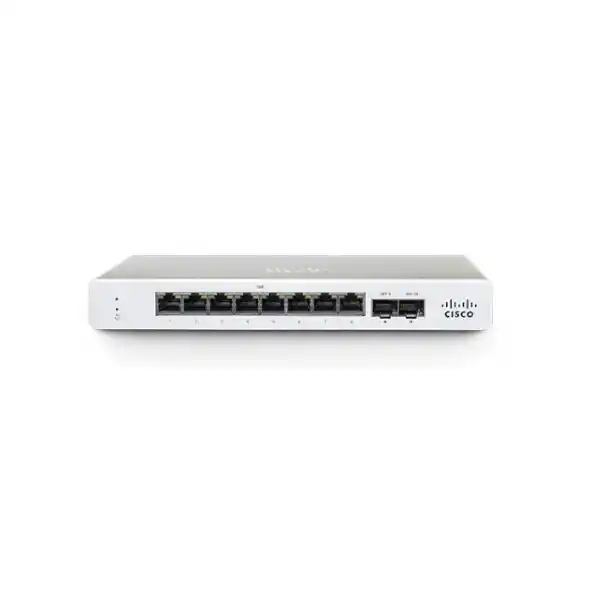
Cisco Meraki MS130-8X is a compact, cloud-managed Layer 2 access switch built for business networks that need a small footprint without giving up multigigabit access, PoE+ or high-speed fiber uplinks. Cisco documents six 10/100/1000 RJ45 ports, two 100M/1G/2.5G multigigabit RJ45 ports, two 10GbE SFP+ uplinks, a 120W PoE budget and 62Gbps switching capacity. It is managed through the Meraki Dashboard and supports remote troubleshooting, firmware management, VLANs, IPv4/IPv6 ACLs, DHCP snooping, 802.1X and other access-layer capabilities. For buyers in Tanzania, the key purchasing question is not simply whether the model has eight copper ports; it is whether its PoE capacity, 2.5G edge connectivity, 10G uplinks and Meraki licensing align with the planned access points, IP phones, cameras, workstations and upstream network.
What is the Cisco Meraki MS130-8X?
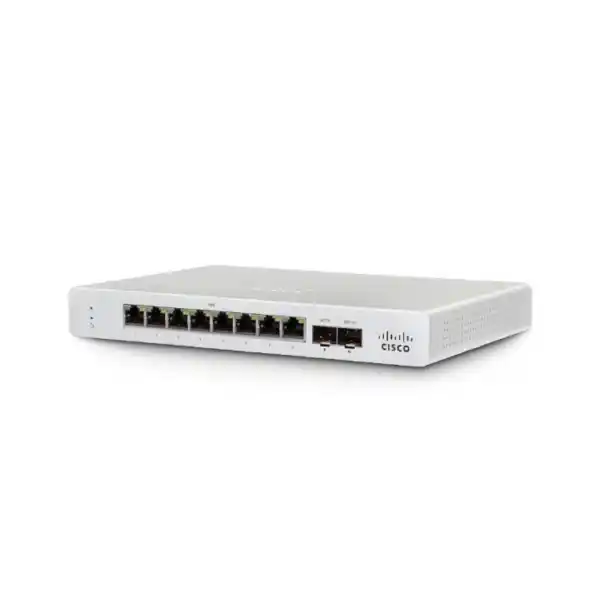
The MS130-8X belongs to Cisco Meraki’s MS130 family of cloud-managed access switches. Cisco positions the family for branch and campus access, while the compact -8X model is particularly useful where administrators want a small switch with faster-than-gigabit edge ports and 10G uplinks. The six 1GbE ports suit common endpoints such as PCs, phones, printers, cameras and IoT devices. Two 2.5GbE ports provide additional headroom for multigigabit devices, especially modern wireless access points or other endpoints that can exceed a single gigabit. Two SFP+ interfaces provide 10GbE uplink options for fiber or supported direct-attach connectivity.
Cloud management is central to the product. Meraki Dashboard lets authorized administrators configure ports, VLAN behavior and policies, monitor status and use remote troubleshooting tools without relying on a traditional locally hosted switch controller. That model can simplify multi-site operations, but it also means procurement should include the appropriate Meraki license and a clear ownership plan for the Dashboard organization. Hardware should not be ordered in isolation from licensing, uplink modules, power-cord requirements, PoE calculations and the site’s wider switching architecture.
Cisco Meraki MS130-8X verified specifications
| Copper interfaces | 6 × 10/100/1000 RJ45 + 2 × 100M/1G/2.5G multigigabit RJ45 |
| Uplinks | 2 × 10GbE SFP+ |
| PoE | 802.3at PoE+, up to 30W per port, 120W switch PoE budget |
| Switching capacity | 62 Gbps |
| Management | Cisco Meraki Dashboard cloud management |
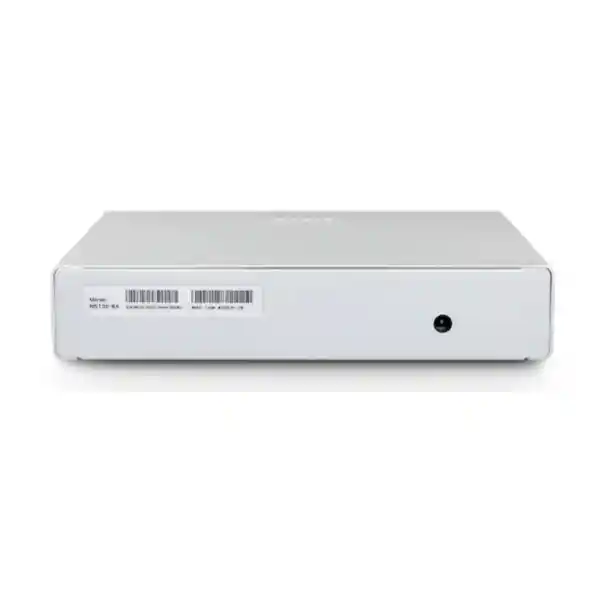
| Power | External 54VDC, 2.78A power input; Cisco lists MA-PWR-150WAC-ADP for MS130-8X |
| Operating environment | 0°C to 45°C; 5% to 95% humidity |
| Form factor | Desktop / integrated wall mount; approximately 4.4 × 23 × 23 cm |
| Weight | Approximately 0.96 kg |
Why businesses consider the MS130-8X
Multigigabit access
Two 2.5GbE ports help avoid a 1GbE access-port ceiling for capable wireless access points and other high-throughput endpoints. This is particularly relevant when new Wi-Fi infrastructure is being introduced but a compact access switch is preferred.
10G uplink path
Two SFP+ uplinks provide a higher-speed path to distribution, core or another upstream switch. The benefit depends on correct supported optics or cables and on the upstream infrastructure also supporting the intended speed.
Central operations
Meraki Dashboard supports centralized configuration, visibility and remote troubleshooting. This can be valuable for organizations with multiple offices or branches that want repeatable standards and less dependence on local configuration access.
PoE for edge devices
A 120W PoE+ budget can power a practical mix of access points, phones, cameras and other compliant devices, provided the total power calculation is completed before installation and individual port requirements remain within supported limits.
Deployment, licensing and integration guidance
A reliable MS130-8X deployment starts with the endpoint list. Count every wired connection, then identify which devices require PoE and which can benefit from 2.5GbE. A switch with eight copper ports may look adequate on a spreadsheet but become constrained if six ports are immediately occupied and future expansion is expected. PoE should be calculated in watts, not simply by counting powered ports. Cameras, access points and phones can have different maximum power requirements, and the 120W budget is shared across the switch.
The uplink design is equally important. The two SFP+ interfaces are useful when the switch must feed traffic toward a higher-capacity aggregation or core layer, but the correct Cisco Meraki-supported SFP/SFP+ module or direct-attach cable should be selected for distance, fiber type and the upstream device. Cisco lists supported modules including 1G SX/LX/TX and 10G SR/LR/ER options for the SFP+ models, along with supported twinax cables. Procurement should verify the exact module needed rather than treating all SFP+ transceivers as interchangeable.
Licensing should be decided at quotation stage. Cisco documents Enterprise and Advanced licensing options for the MS130 family, with Advanced adding capabilities such as Adaptive Policy where supported. License term and licensing model should match the customer’s existing Meraki organization. Administrators should also define Dashboard ownership, network naming, VLAN structure, port profiles, alert recipients, firmware windows and change-control responsibilities before rollout. For broader project planning, FourTeck Tanzania’s technology services page explains how networking, security, cabling and lifecycle requirements can be coordinated, while the business technology shop helps frame adjacent hardware categories.
Related Cisco Meraki and network solutions on FourTeck Tanzania
The MS130-8X is usually more useful when considered with the devices it will power and connect. FourTeck Tanzania already lists related Meraki wireless products that can be evaluated alongside multigigabit PoE switching. The Cisco Meraki CW9162I-MR is a Wi-Fi 6E access point with a 2.5G uplink, making it a logical example of an endpoint that can use an MS130-8X multigigabit port. For higher-capacity indoor wireless, review the Cisco Meraki CW9164I-MR and Cisco Meraki CW9166I-MR. Outdoor or specialist coverage requirements can be compared with the Cisco Meraki CW9163E-MR. Organizations planning newer wireless generations can also review the Cisco Meraki CW9171I. These related pages are useful because access-point selection affects PoE budget, access-port speed, cabling and uplink sizing.
For wider network architecture, the FourTeck Tanzania integrated IT and networking overview explains how switches, firewalls, Wi-Fi, voice and surveillance share infrastructure, and the Tanzania contact and quotation page lists the information buyers can provide for a more accurate recommendation.
Regional procurement and deployment guidance
Cisco Meraki MS130-8X Tanzania
Organizations evaluating the Cisco Meraki MS130-8X in Tanzania should begin with a device, power and uplink inventory. The compact format is attractive for branch offices, retail back offices, hospitality administration, clinics, schools, professional workplaces and distributed operational sites where a full 24-port access switch is unnecessary. Yet the model should be chosen because its port mix fits the requirement, not merely because it is small. Six gigabit ports can serve ordinary endpoints, while two 2.5GbE ports are better reserved for devices that can make use of multigigabit connectivity, such as capable wireless access points. The 120W PoE+ budget should be compared with the maximum draw of every powered endpoint, including planned expansion.
For Tanzanian projects, power quality, rack conditions, temperature, cable routes and access to upstream fiber can influence the design as much as the switch specification. The MS130-8X is rated by Cisco for operation from 0°C to 45°C, so cabinet ventilation and placement matter where equipment rooms become warm. The external power adapter and region-appropriate power cord should be included in procurement planning. If the switch is wall mounted, cable strain, airflow and physical access for service should be considered before installation.
Meraki Dashboard can simplify administration across multiple Tanzanian sites by allowing a central team to apply consistent port, VLAN and monitoring standards. Before quotation, provide the site city, endpoint count, PoE device models, required uplink distance, existing core switch, firewall, available fiber type, preferred license term and whether the organization already uses Meraki Dashboard. FourTeck can then assess whether the MS130-8X is appropriately sized or whether a larger MS130 model would provide better growth room.
Cisco Meraki MS130-8X Dar es Salaam
Dar es Salaam businesses may use the MS130-8X in head offices, branch floors, retail locations, meeting-room zones, small equipment rooms and edge cabinets where a compact switch needs to support both conventional gigabit endpoints and newer multigigabit devices. A common design scenario is a small office or floor with several IP phones or cameras plus one or two Wi-Fi access points. In that layout, the 2.5GbE ports can be assigned to suitable APs while the remaining copper ports serve lower-bandwidth devices. The network designer should still calculate whether eight copper ports leave enough spare capacity for growth.
High-density business districts and multi-tenant buildings can make wireless traffic more demanding, so uplink design deserves attention. If multiple access points, video endpoints or camera streams converge on the switch, a 10G SFP+ uplink can help keep the access layer from being limited by a 1G trunk. The upstream switch must support the chosen optic and speed, and fiber type and distance need to match the transceiver. Where the switch connects back to a central rack over building fiber, document patch-panel ports and optic type during installation.
For a Dar es Salaam quotation, procurement teams should include the number of connected devices, which ports need PoE, expected AP models, uplink medium, cable category, existing Meraki organization, required license tier and the desired installation location. If the site is part of a multi-branch network, include the branch standard as well. That makes it easier to use Dashboard templates and repeatable port profiles instead of configuring each branch as an isolated network.
Cisco Meraki MS130-8X Mwanza
Mwanza organizations considering the MS130-8X may prioritize centralized support when specialist network staff are not present at every site. Meraki Dashboard allows authorized administrators to inspect switch status, review connected clients and use remote troubleshooting functions from another location. That capability can reduce the need to travel for routine configuration checks, but it works best when the site has reliable internet access for cloud management and the physical installation is properly documented.
The compact port count can suit a branch, clinic, shop, hospitality office, school administration area or small communications room. Before choosing it, count printers, phones, cameras, access points, workstations and any local servers or appliances that require direct wired connections. Separate the list into PoE and non-PoE endpoints, then calculate the wattage required by powered devices. If the site needs more than eight copper connections or expects rapid growth, moving to a higher-port-count switch may be more sensible than filling every MS130-8X port on day one.
Uplink resiliency and serviceability should also be considered. A 10G SFP+ link can be useful between an edge cabinet and a central rack, but the selected optic must match available fiber and the upstream port. Keep a record of fiber pair, patch-panel position, switch port, VLAN assignments and Meraki Dashboard network. Mwanza buyers requesting a quote should specify the site type, device list, PoE needs, uplink distance and medium, current firewall and switching environment, and license term. This gives procurement and technical teams a clearer basis for evaluating the complete installed requirement.
Cisco Meraki MS130-8X Arusha
In Arusha, the Cisco Meraki MS130-8X can fit compact enterprise, hospitality, professional-service, education and branch environments that need cloud-managed switching with PoE and a path to multigigabit wireless. Hospitality and meeting-oriented sites often combine Wi-Fi access points, IP phones, cameras and room devices on the same physical switching infrastructure. The design should keep those services logically separated with suitable VLANs and access policies rather than leaving every endpoint in one unrestricted network.
The 120W PoE budget can support a practical mix of devices, but power planning becomes especially important when access points and cameras are installed together. Calculate each device’s supported PoE class and expected maximum draw, then leave some margin for replacement models or future additions. If two 2.5GbE ports are reserved for modern access points, verify the copper cabling path and ensure the upstream network has enough capacity to benefit from the faster edge links. A multigigabit AP connected to a 2.5G access port can still be limited by a congested trunk or firewall.
Arusha projects should also consider the physical environment of the communications cabinet. Cisco specifies a 0°C to 45°C operating range for the MS130-8X, so avoid sealed, heat-trapping spaces. Include the external power adapter, appropriate power lead, SFP+ modules and mounting needs in the bill of materials. For quotations, provide room or site type, endpoint quantities, Wi-Fi AP models, fiber details, existing upstream switch, internet/firewall design, Meraki licensing preference and whether remote centralized administration is required.
Cisco Meraki MS130-8X Dodoma
Dodoma offices and institutional environments evaluating the MS130-8X should focus on standardization, security segmentation and lifecycle management. A compact switch can be a strong fit for small departments, branch rooms, executive areas or dedicated technology zones where eight copper access ports are enough. Because Meraki management is centralized, the switch can also fit organizations that want consistent configuration across several offices, provided license management and Dashboard ownership are handled centrally.
Use the six 1GbE ports for ordinary wired devices and reserve the two 2.5GbE interfaces for endpoints that genuinely benefit from additional throughput. Where the switch supports wireless access points, review their PoE requirements and total network traffic. If access points, IP cameras and voice devices coexist, configure VLANs and appropriate access controls to reduce unnecessary lateral communication. DHCP snooping and 802.1X support can form part of a broader access-security strategy where the organization’s authentication and policy design supports them.
A Dodoma procurement checklist should include the exact hardware model, license tier and term, external power adapter, region-appropriate cable, required SFP+ optics or direct-attach cables, mounting method and installation scope. Record the intended uplink path and core-switch compatibility. Buyers should also state whether the switch will join an existing Meraki organization because license type and feature consistency can matter across the environment. FourTeck can use this information to prepare a more complete quotation and flag when a 24-port or larger model would provide better capacity.
Cisco Meraki MS130-8X UAE
UAE buyers may evaluate the MS130-8X for offices, retail branches, hospitality sites, service counters and distributed locations where compact cloud-managed switching is preferred. In multi-site companies, Meraki Dashboard can support consistent templates and remote operational visibility across branches. The commercial decision should include hardware, licensing and any required optics rather than comparing switch hardware prices alone. FourTeck’s broader UAE technology presence at FourTeck UAE can be referenced for regional IT procurement requirements.
The MS130-8X is particularly interesting where modern wireless access points need 2.5GbE but the site does not justify a large access switch. Two 10G SFP+ uplinks can connect the compact switch into faster aggregation infrastructure, while PoE+ can power edge devices. High ambient temperatures outside equipment rooms make correct indoor cabinet placement and cooling important. The switch itself should be installed within Cisco’s specified operating range, with adequate airflow around the external power supply and chassis.
For UAE quotation planning, provide the branch type, required quantity, endpoint count, PoE demand, uplink distance and fiber type, existing Meraki organization, desired license term and any configuration or installation requirement. Regional enterprises operating across the Gulf and East Africa may also want consistent VLANs, port templates and naming across countries. Standardization can reduce troubleshooting time, but local cabling, power and regulatory conditions still need to be checked at each site rather than assuming one identical physical deployment everywhere.
Cisco Meraki MS130-8X Uganda
Uganda organizations can use the MS130-8X as a compact access-layer option for branches, offices, clinics, retail locations and other sites requiring cloud-based administration. The value is strongest when central IT wants to monitor distributed switches without maintaining local controller infrastructure at every branch. For organizations with East African operations, the FourTeck Uganda site provides a regional point of reference for adjacent technology needs.
Before selecting the model, verify that eight copper access ports are enough after accounting for growth. A branch may begin with two access points, two IP phones, a printer, camera and workstation, leaving little spare capacity. If endpoint count is likely to rise, a larger switch could be more efficient than cascading several compact units. Where the MS130-8X is correctly sized, the 2.5GbE ports can serve high-throughput APs while 10G SFP+ uplinks connect toward distribution or a fiber backbone.
Uganda procurement should include power planning and licensing. The switch has a 120W PoE+ budget, so calculate the maximum draw of all powered devices. Confirm the correct external power adapter and suitable power lead. For Meraki Dashboard, document the organization owner, administrator roles, license term, network naming and support process. Quotation requests should state site city, device quantities, PoE requirements, uplink design, existing firewall and core switch, and whether FourTeck should include optics, cabling, configuration or installation components.
Cisco Meraki MS130-8X Kampala
Kampala businesses with branch offices, customer sites, hospitality locations and professional workplaces may choose the MS130-8X when they need a compact managed switch that supports both PoE and faster access connectivity. In offices adopting newer Wi-Fi, the two 2.5GbE ports can prevent the AP uplink from being limited to 1GbE. That advantage should be matched with suitable cabling and upstream capacity; otherwise, the faster edge port does not automatically improve application performance.
A common Kampala design question is how to combine voice, wireless, cameras and user devices on limited access ports. Start by separating critical and optional endpoints. Define VLANs for business data, voice, guest wireless, surveillance and management where the broader architecture supports that structure. Confirm which devices need PoE and reserve sufficient budget. Remote Dashboard visibility can help a centralized team troubleshoot branch connectivity, but accurate port descriptions, device naming and cable labels remain essential for local hands-on support.
When requesting pricing, Kampala buyers should specify whether the project is hardware-only or includes design, license, optics, configuration and deployment. Share the AP and camera models so PoE can be checked precisely. Include the upstream switch model and fiber details for SFP+ compatibility planning. If the Kampala site is one of several branches, provide the corporate Meraki organization and standard VLAN or port profile requirements. A complete request reduces the risk that hardware arrives without the license, transceiver, power component or configuration information required for commissioning.
Cisco Meraki MS130-8X Arua
For Arua branch and operational sites, centralized Meraki management can be useful when network expertise is concentrated elsewhere. Administrators can monitor the switch through Dashboard, which supports remote visibility and troubleshooting. That can improve response to configuration or connectivity issues, yet it does not replace good physical documentation. Every cable, uplink, powered endpoint and patch-panel position should still be labeled so a local technician can perform simple checks without guessing.
The MS130-8X should be selected only after a realistic port forecast. Smaller locations may have fewer users but still require access points, IP cameras, voice devices and operational equipment. Two 2.5GbE ports are valuable for capable APs, and the six gigabit ports can serve other edge devices. If future expansion will exceed eight connections, plan a higher-port-density platform early. PoE demand should also be reviewed in watts, with headroom for device replacement or an additional AP.
Arua buyers should include connectivity conditions in the deployment plan. Meraki cloud management requires reliable reachability to the Meraki cloud, so WAN resilience and firewall rules matter. If a fiber uplink is used, verify optic type, fiber connector path and upstream switch support. For a quotation, include site type, quantity, license term, endpoint list, PoE draw, uplink medium, existing switch/firewall, cabling availability and whether installation assistance is required. This creates a clearer total requirement than requesting only an MS130-8X hardware price.
Cisco Meraki MS130-8X Mbarara
Mbarara organizations can consider the Cisco Meraki MS130-8X for compact office, education, healthcare, hospitality and commercial environments that need a manageable network edge. The model is particularly practical when one or two higher-performance wireless access points must coexist with ordinary gigabit endpoints. The two 2.5GbE interfaces can be prioritized for AP uplinks while PoE+ supplies power over the same Ethernet cable, reducing the number of separate power adapters at the ceiling or device location.
The physical network must support the intended result. Check cable category and condition, patching quality, uplink capacity, switch placement and UPS strategy. In a compact cabinet, avoid overcrowding power supplies and blocking airflow. If the switch is mounted away from the main rack, 10G SFP+ can provide a high-capacity fiber path back to distribution, provided the supported transceiver matches fiber type and distance. Do not select an optic solely because its connector fits.
For lifecycle planning, include the Meraki license and define who will administer Dashboard. Decide whether the switch will use standardized port profiles and VLANs used at other branches. A Mbarara quotation request should list endpoint quantities, PoE requirements, Wi-Fi AP models, uplink distance, current switch and firewall, expected growth, license preference and any optics or cabling required. If the location is expected to expand beyond eight copper endpoints, compare the total cost and operational simplicity of a higher-port-count MS130 before finalizing procurement.
Cisco Meraki MS130-8X Gulu
Gulu deployments may benefit from the MS130-8X when local sites need dependable managed switching but centralized IT teams want cloud-based visibility. Small branches and service locations can be difficult to support if every change requires onsite console access. Meraki Dashboard helps move routine configuration, monitoring and troubleshooting into a common interface. The operational benefit grows when branch configurations use consistent naming, VLANs and port profiles.
Capacity planning remains local. Count every wired endpoint, then decide which need PoE and which justify the 2.5GbE ports. A pair of newer access points could use both multigigabit interfaces, leaving six 1GbE ports for phones, cameras, printers or user devices. Compare their aggregate power demand with the 120W PoE budget. If camera quantities or AP counts are expected to rise, consider whether a larger switch creates better expansion space and reduces the need for an additional power adapter and uplink later.
Gulu procurement should also include WAN and power considerations. Cloud management depends on internet connectivity for normal administration, while network availability may benefit from appropriate UPS protection for the switch, firewall and ISP equipment. Where fiber links back to another building or rack are required, specify distance and fiber type before choosing SFP+ modules. A useful quotation request includes model quantity, license term, PoE device list, uplink requirements, existing infrastructure, mounting location and configuration scope so the bill of materials reflects the complete deployment.
Cisco Meraki MS130-8X Kenya
Kenyan businesses with branch networks, retail sites, professional offices and hospitality environments may consider the MS130-8X for cloud-managed access switching where compact port density and multigigabit capability are both important. Organizations operating across Kenya and Tanzania can standardize Dashboard administration while adapting physical deployment to each site’s cabling, power and endpoint count. The FourTeck Kenya site provides regional context for wider procurement.
The model is well suited to edge areas that need six conventional gigabit ports, two 2.5GbE connections and high-speed SFP+ uplinks. It should not be selected only because the 2.5G and 10G figures are attractive. Confirm that the APs or other endpoints actually support multigigabit Ethernet, the copper cabling is suitable, and the upstream switch has compatible 10G interfaces. Otherwise, a simpler model may meet the requirement at lower complexity.
Kenya procurement teams should request hardware and licensing together and identify whether optics, power components, configuration and installation are part of scope. For multi-country networks, decide which settings are global standards and which are local exceptions. VLAN numbering, SSID mapping, voice ports, security controls and Dashboard administrator roles can often be standardized, while ISP interfaces and building fiber differ. A quotation should include branch size, user/device counts, PoE demand, AP types, uplink medium, existing core/firewall and desired license term.
Cisco Meraki MS130-8X Kuwait
Kuwait organizations can deploy the MS130-8X in compact offices, retail branches, hospitality areas and distributed business sites where centralized cloud operations simplify management. The switch’s 2.5GbE edge ports can support modern wireless infrastructure, while 10G SFP+ uplinks provide a fast path toward aggregation. FourTeck’s Kuwait technology site can be used for regional requirements beyond this Tanzania-focused product page.
Equipment-room conditions matter in hot climates. The MS130-8X is designed for Cisco’s specified indoor operating range, so the cabinet or communications room should provide adequate cooling and airflow. Avoid placing active network equipment in spaces that can exceed rated temperature. Power protection and proper adapter placement should also be considered. If the switch is wall mounted, leave enough clearance for cabling, airflow and service access.
For procurement, identify whether the switch joins an existing Meraki environment and which license model applies. Confirm license term, feature tier, Dashboard organization, administrator roles and firmware policy. The hardware bill should include required SFP+ modules, supported power adapter, power cord and any fiber patch components. Kuwait quotation requests should state quantity, endpoint types, PoE load, uplink distance, current network equipment and whether implementation support is expected. This allows technical review to identify missing dependencies before purchase approval.
Cisco Meraki MS130-8X Ghana
Ghanaian businesses can consider the MS130-8X for branch, office, education, hospitality and service locations that require centrally managed access switching. Its value is particularly clear when a site needs a small number of wired endpoints but also wants multigigabit support for capable Wi-Fi access points. For wider Ghana technology sourcing, the FourTeck Ghana site provides regional context.
A site assessment should determine whether the eight copper ports are sufficient, how the 120W PoE budget will be allocated and whether 10G uplinks are required. In a typical branch, one or two APs may use the 2.5GbE ports while phones, cameras and PCs use the 1GbE ports. If surveillance expansion is expected, additional cameras can quickly consume both ports and PoE budget, so growth should be considered before finalizing the model.
Cloud management simplifies remote operations, but it also requires licensing and clear administrative ownership. Procurement should therefore include the desired license term, Dashboard organization, optics, power accessories and installation requirements. If fiber is used between cabinets or floors, state the fiber type and distance. Ghana quotation requests should provide endpoint quantity, AP and camera models, PoE requirements, expected growth, existing firewall/core switch and any branch-standard configuration. This enables the switch to be reviewed as part of the whole network rather than as an isolated item.
Cisco Meraki MS130-8X Nigeria
Nigeria deployments may use the MS130-8X in compact enterprise branches, retail, finance, hospitality, professional services and other distributed environments where cloud management can reduce the operational burden of many small sites. The FourTeck Nigeria site provides regional technology context for customers with requirements there.
Power resilience should be included in network design. A cloud-managed switch still depends on local power, firewall and WAN availability. Appropriate UPS planning for the switch, power adapter and upstream equipment can help reduce disruption during short power events, while good cabinet ventilation protects the hardware from excessive heat. The PoE budget should be calculated with all attached APs, cameras and phones at expected maximum draw; do not assume every eight-port PoE switch can power any eight PoE devices simultaneously.
For larger organizations, standard port profiles and VLAN templates can make branch rollouts more consistent. The 2.5GbE ports can support selected high-throughput devices, and SFP+ uplinks can connect to faster aggregation where available. Nigerian buyers should request pricing with license term, power components, optics and implementation scope clearly separated. Provide branch size, endpoint quantities, PoE needs, fiber/copper details, existing Meraki organization, firewall and upstream switching. That information makes it easier to determine whether the compact MS130-8X is the right size or whether a larger switch offers a cleaner expansion path.
Cisco Meraki MS130-8X Seychelles
Seychelles businesses in hospitality, professional services, retail and distributed operations may value the MS130-8X where compact equipment spaces and centralized administration are important. Hotels and guest-focused environments can have demanding wireless requirements even when an individual edge cabinet serves only a small number of devices. In that situation, the two 2.5GbE ports can be allocated to capable access points while six gigabit ports support local phones, cameras, building devices or staff endpoints.
Island deployments can make planning and spares discipline especially important because replacement components and specialist visits may require more coordination. The bill of materials should therefore identify the correct external power adapter, suitable power lead, exact SFP+ optics and any fiber patch leads needed for commissioning. If the switch serves a guest network, separate guest, staff and infrastructure traffic according to the organization’s security design. Meraki Dashboard can help a remote IT team monitor multiple properties or sites, but local cabling and port labels should be maintained carefully.
A Seychelles quotation request should specify the property or site type, number of switches, connected devices, PoE load, AP models, required uplink distance and fiber medium, Meraki license term and whether the deployment will join an existing Dashboard organization. If multiple buildings are involved, provide the inter-building connectivity design. The objective is to confirm that the compact MS130-8X provides enough port, power and uplink capacity while avoiding unnecessary over-specification.
Cisco Meraki MS130-8X FAQ
How many Ethernet ports does the MS130-8X have?
It has eight copper access ports in total: six 1GbE RJ45 ports and two multigigabit RJ45 ports supporting up to 2.5GbE. It also has two 10GbE SFP+ uplink interfaces.
Does the Cisco Meraki MS130-8X provide PoE?
Yes. Cisco documents 802.3at PoE+ with up to 30W per port and a 120W total switch PoE budget. Actual device planning should use the maximum required power of all attached endpoints.
Is a Meraki license required?
Meraki licensing is part of the management and support model. The MS130 family has Enterprise and Advanced options under applicable licensing models, and the correct tier and term should be confirmed against the customer’s Meraki organization.
Can the MS130-8X connect Wi-Fi 6E or Wi-Fi 7 access points?
It can provide Ethernet and PoE connectivity to compatible access points. Its two 2.5GbE ports are useful for APs with multigigabit uplinks, but PoE requirements, cabling, regulatory requirements and upstream capacity must be checked for the specific AP model.
Which SFP+ modules are supported?
Cisco’s MS130 documentation lists supported 1G and 10G Meraki modules for SFP+ models, including MA-SFP-10GB-SR, LR and ER plus supported twinax cables. Select the exact module based on fiber type, distance and upstream interface.
Quotation checklist for Cisco Meraki MS130-8X
A complete quotation request should state the quantity, deployment city, connected-device count, PoE device models, expected total PoE load, number of 2.5GbE endpoints, required SFP+ uplink speed, fiber type and distance, existing upstream switch, firewall, available cabling, preferred Meraki license term, existing Dashboard organization and whether optics, cabling, configuration, installation or UPS protection are required.
This information helps distinguish a simple hardware request from a complete access-network requirement. It also makes it easier to compare the MS130-8X with larger MS130 models when future growth, port count or PoE demand suggests that a higher-density switch would be a better long-term fit.
Decision recap
Choose the Cisco Meraki MS130-8X when you need a compact cloud-managed Layer 2 access switch with a mixed gigabit/multigigabit edge, PoE+ and 10G SFP+ uplinks, and when eight copper access ports provide enough practical capacity. Its strengths are centralized Meraki operations, two 2.5GbE ports for faster endpoints and a 120W PoE budget in a small form factor. It is less suitable when a site will quickly exceed eight copper ports or needs substantially more PoE power.
Before approval, validate licensing, optics, power accessories, endpoint PoE requirements and uplink compatibility. For multi-site deployments, also define Dashboard ownership, port-profile standards, VLAN design and documentation. FourTeck can help translate those requirements into a bill of materials and compare the model with alternatives where capacity indicates a different switch would be more appropriate.
Discuss your Cisco Meraki switching requirement
Tell FourTeck Tanzania how many endpoints you need to connect, which devices require PoE, whether you need 2.5GbE for access points, what fiber or copper uplink is available and whether you already operate a Meraki Dashboard organization. A more complete requirement enables a more accurate product, license and accessory recommendation.


Reviews
There are no reviews yet.