
Cisco Meraki MS130-24 Tanzania
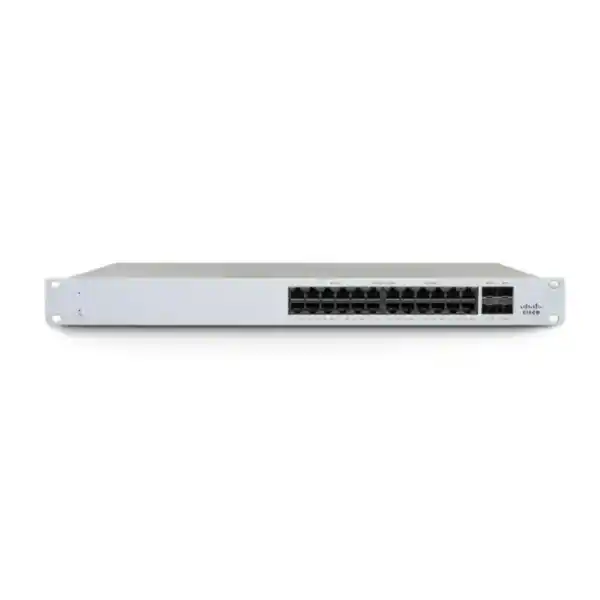
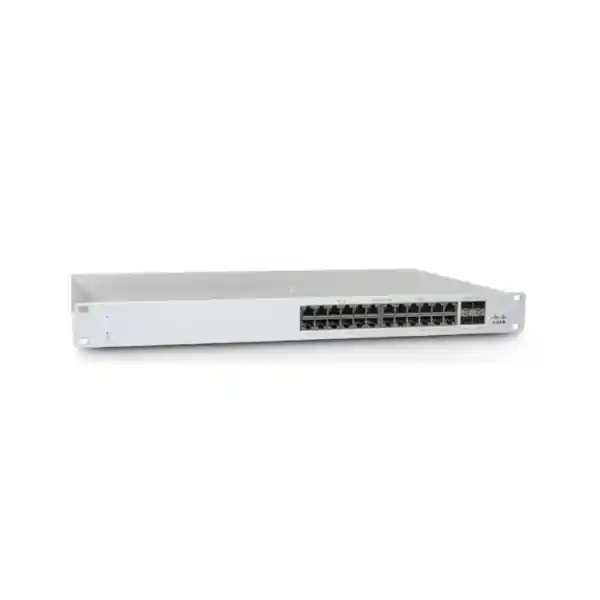
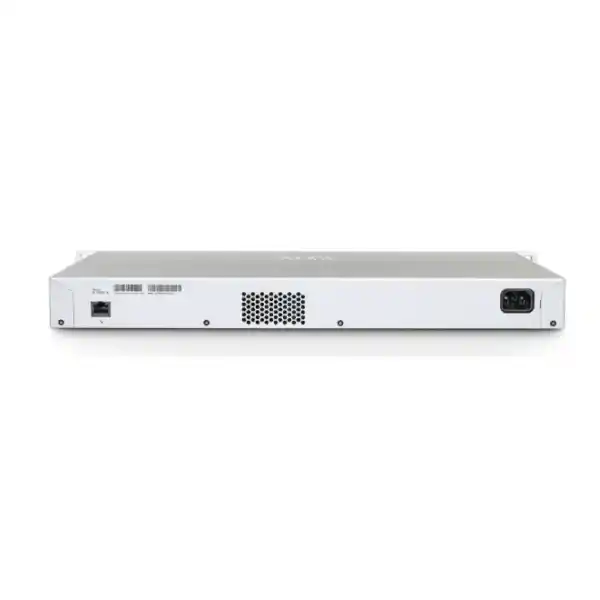
Cisco Meraki MS130-24 is a cloud-managed, full-size Layer 2 access switch built for organizations that want dependable wired connectivity without maintaining a separate on-premises switch-management platform at every location. The MS130-24 provides 24 × 1 Gigabit Ethernet RJ-45 access ports, four 1G SFP uplink ports and a dedicated management interface. Its strongest operational value comes from Meraki cloud management: administrators can prepare configurations before hardware arrives, view status across multiple sites, schedule firmware activity, investigate port and cable issues remotely, and apply consistent policies from a central dashboard. For businesses in Tanzania, this model is particularly relevant to office LAN refreshes, branch rollouts, education facilities, hospitality networks, professional services, retail administration, light industrial environments and distributed organizations that want an easier way to manage access switching.
What the Cisco Meraki MS130-24 solves
Many organizations do not struggle because Ethernet switching is inherently difficult; they struggle because each branch, floor or remote office becomes a separate operational island. Traditional switch administration can require individual device access, local credentials, configuration tracking, manual software maintenance and on-site troubleshooting. The MS130-24 addresses that operational burden by combining a conventional access-switch role with the Meraki cloud-management model. Instead of treating every switch as an isolated appliance, an IT team can manage switching as part of a wider Meraki organization, with common visibility, standardized configuration and remote diagnostic tools.
For procurement teams, the practical question is whether the network needs a 24-port non-PoE access switch with Gigabit Ethernet edge ports and fiber-capable SFP uplinks. If the answer is yes, the MS130-24 can be a strong fit where endpoints such as desktop computers, printers, servers, uplinked wireless infrastructure, IP-PBX appliances, building systems or other Ethernet devices already have their own power source. If the project requires the switch itself to provide power to phones, access points or cameras, a PoE-capable MS130 variant should be evaluated instead of assuming the MS130-24 supplies PoE. That distinction prevents a common procurement error and helps ensure the quoted model matches the actual endpoint design.
The other major consideration is licensing. Meraki switches are designed around cloud-managed operation and require the appropriate licensing model for production use. License selection should therefore be included in the quotation and lifecycle plan, rather than treated as an afterthought. Organizations should confirm the preferred Meraki licensing model, required term, existing Meraki organization status and whether new hardware will be added to an established dashboard environment. This is especially important when a company already manages Meraki security, wireless or switching products and wants consistent renewal dates and governance.
24 Gigabit access ports
Twenty-four 1 GbE RJ-45 ports provide a practical density for offices, branch racks and wiring closets where users and devices require standard Gigabit Ethernet connectivity.
Four SFP uplinks
Four 1G SFP interfaces give designers flexibility for fiber uplinks, inter-rack links or other SFP-based connectivity where copper distance, electrical isolation or cabling architecture favors fiber.
Centralized management
Meraki Dashboard enables administrators to monitor, configure and troubleshoot switches remotely, making the platform attractive for organizations with multiple sites or limited IT presence at branch locations.
Zero-touch deployment
Switch settings can be prepared centrally so deployment teams can install hardware with less repetitive configuration work, particularly useful for standardized branch openings and refresh projects.
Verified Cisco Meraki MS130-24 technical profile
| Item | MS130-24 detail | Planning relevance |
|---|---|---|
| Switch role | Cloud-managed Layer 2 access switch | Best suited to access-layer deployments rather than projects that depend on advanced local Layer 3 routing functions. |
| Access interfaces | 24 × 1 GbE RJ-45 | Matches office and branch environments with up to 24 directly connected wired endpoints before allowing for uplinks and future growth. |
| Uplinks | 4 × 1G SFP | Supports fiber-based or SFP-based uplink design, subject to compatible optics and the wider network architecture. |
| PoE on this model | No | Choose a PoE-capable sibling model when endpoints need switch-supplied power. |
| Management | Meraki cloud management | Enables centralized provisioning, monitoring, firmware scheduling and remote troubleshooting. |
| Operating temperature | 0°C to 45°C | Rack cooling, room ventilation and heat load should be considered, especially in warm equipment rooms. |
| Humidity | 5% to 95% | Environmental conditions should remain within Cisco guidance and the needs of the rest of the rack equipment. |
Deployment, licensing and integration guidance
A successful MS130-24 deployment begins with port planning. List every wired device, classify it by VLAN and business function, determine whether it requires PoE, and identify expected growth over the next three to five years. A 24-port switch can look sufficient when only current devices are counted, yet the design may become constrained when new workstations, access points, printers, building controllers or voice endpoints are added. Leaving reasonable port headroom can reduce future recabling and emergency switch additions.
Uplink design deserves equal attention. The MS130-24 has four 1G SFP uplinks, so the network architect should decide whether those ports will connect to an upstream switch, firewall, another rack, building backbone or fiber handoff. Optical transceivers and fiber type should be selected for the actual distance and existing cabling plant; compatibility should be validated before ordering. If the project requires multigigabit edge ports or 10G SFP+ uplinks, the standard MS130-24 should not be stretched beyond its intended specification. The MS130-24X or another switch family may be more appropriate depending on bandwidth, PoE and uplink requirements.
Cloud management changes the deployment workflow. Device claiming, network assignment, switch-port configuration, VLAN definitions and policy can be prepared in advance, allowing an installation team to focus on physical mounting, cabling and verification. Remote tools can help diagnose cable faults, cycle ports and investigate endpoint behavior without dispatching staff for every routine issue. For multi-site customers this operational consistency can be more valuable than individual switch features because it reduces configuration drift and provides a common management experience.
Licensing should be part of the bill of materials. Cisco publishes Enterprise and Advanced licensing options across the MS family and also supports subscription licensing models. The correct choice depends on the organization’s licensing model, existing Meraki environment and feature requirements. Procurement teams should provide any existing Meraki organization information when requesting a quotation so that licensing can be aligned properly. Mixing licensing tiers can have organization-level implications under certain licensing models, so renewal and migration planning should be reviewed before adding devices to a large installed base.
Cisco Meraki MS130-24 Tanzania buying guidance
For Tanzanian businesses, the MS130-24 is most compelling when centralized operations are a priority. A company with an office in Dar es Salaam and branches in other cities can administer switching through the same Meraki environment rather than maintain independent switch configurations at every location. This can simplify standardization for branch LANs, retail administration, private education, professional services, hospitality back offices, healthcare administration, NGOs and distributed enterprise environments. The key is to scope the switch as part of a complete LAN design rather than as an isolated 24-port purchase.
Before requesting pricing, buyers should document the number of copper endpoints, whether any device requires PoE, the number and type of fiber uplinks, expected VLANs, internet edge/firewall architecture, rack availability, UPS capacity, cooling conditions and the desired Meraki licensing term. If the existing environment already uses Meraki wireless or security appliances, including that information can help determine how the new switch should be organized and monitored. If the environment uses other vendors, the switch can still participate in standards-based Ethernet and VLAN designs, but the integration should be mapped carefully.
FourTeck Tanzania presents networking as part of an integrated business technology environment, including switches, Wi-Fi, firewalls, servers, structured cabling, racks and power protection. Customers planning a broader network refresh can review the FourTeck Tanzania technology portfolio to connect switching requirements with wireless, security and infrastructure decisions instead of treating the switch as an isolated line item.
Cisco Meraki MS130-24 Dar es Salaam
Organizations searching for Cisco Meraki MS130-24 in Dar es Salaam are often balancing two priorities: reliable access switching for a primary business site and simpler administration for locations that may be spread across the city or connected to up-country branches. The MS130-24 fits well into this discussion because its 24 Gigabit access ports are practical for departmental floors, branch offices, server-room edge racks and office zones where endpoints use conventional 1 GbE connections. Its Meraki cloud-management model allows administrators to work from a central interface, which is valuable when a network team cannot be physically present at every rack whenever a port needs investigation or a configuration needs to change.
A Dar es Salaam deployment should begin with a physical and logical survey. On the physical side, confirm rack space, patch-panel layout, cable quality, fiber paths, UPS protection and room ventilation. The official operating range for the MS130 series makes environmental planning important; equipment rooms should not be treated as storage spaces with uncontrolled heat. On the logical side, map user VLANs, server VLANs, guest or IoT segments, uplink paths, spanning-tree design and security policy. If cameras, access points or phones need PoE, the standard MS130-24 is not the correct power source, so the design should use a PoE variant or separate power arrangement.
For businesses occupying multiple floors or buildings, the four SFP uplinks can be useful for fiber connections, but the 1G uplink speed must be considered against aggregate traffic. A busy wireless floor, large backup transfers or data-heavy applications can justify evaluating higher-bandwidth switch options. The goal is not simply to fill 24 copper ports; it is to make sure the access layer has enough uplink capacity for the workloads behind it. Buyers should therefore share expected traffic patterns and any plans for Wi-Fi upgrades when asking for a quotation.
Dar es Salaam customers may also be procuring firewalls, wireless access points, racks, structured cabling and UPS systems as part of the same project. Coordinating those dependencies early reduces incompatible optics, insufficient rack capacity and last-minute changes. For broader East African projects, the FourTeck Africa solutions site provides a regional context for integrated IT, networking and infrastructure planning.
Cisco Meraki MS130-24 Mwanza
For customers considering Cisco Meraki MS130-24 in Mwanza, remote manageability can be a decisive requirement. Businesses with headquarters elsewhere or with limited specialist networking staff at the Mwanza site can use Meraki Dashboard to obtain switch visibility, review port status and perform supported troubleshooting tasks without relying on a technician to access the switch locally for every event. That model is useful for branch banking environments, education, healthcare administration, hospitality, logistics, professional services and regional offices where network uptime matters but the local team may not include a dedicated network engineer.
The procurement process should distinguish between port count and powered-port requirements. MS130-24 supplies 24 Gigabit Ethernet access ports but does not provide PoE on those ports. If the Mwanza project includes IP phones, wireless access points, surveillance cameras or other powered devices, identify exactly how each endpoint will receive power. Selecting a PoE-capable model can simplify cabling when the endpoint supports Power over Ethernet. Conversely, where endpoints have local power and the objective is straightforward data access, the non-PoE MS130-24 may avoid purchasing an unnecessary PoE budget.
Fiber planning is another useful part of the quotation. The switch includes four 1G SFP uplinks, so buyers should state whether they need short intra-rack links, building-to-building fiber, long-distance campus links or simply copper uplink connectivity through another design element. SFP optics are not interchangeable by assumption; connector type, fiber mode and distance should be validated. A complete request should also state existing upstream switches and firewalls so the uplink design can be checked before shipment.
When the Mwanza switch will be part of a multi-branch Meraki rollout, template-style configuration and centralized monitoring can help maintain a consistent operational baseline. VLAN assignments, port purposes and naming conventions should be standardized before deployment. This reduces the chance that an emergency change at one branch becomes a permanent undocumented exception and makes later expansion easier to audit.
Cisco Meraki MS130-24 Arusha
Cisco Meraki MS130-24 buyers in Arusha may include hospitality groups, tourism operators, education facilities, professional offices, NGOs, conference venues and regional branches that need a stable access layer with simple remote oversight. In these environments, the benefit of a cloud-managed switch is not that switching fundamentals disappear; rather, it becomes easier to apply those fundamentals consistently. Port configuration, monitoring, firmware scheduling and remote diagnostics can be handled through the Meraki platform, while local teams focus on cabling, physical equipment and endpoint support.
A hospitality or guest-facing network, for example, should separate staff, operational systems, guest access and building devices through an appropriate VLAN and security design. The MS130-24 can provide Layer 2 access switching for these segments, but the wider architecture still needs a firewall or routing layer to control traffic between networks. Buyers should therefore avoid evaluating the switch in isolation. The project may involve a Meraki security appliance or a third-party firewall, wireless access points, captive-portal services and structured cabling, all of which influence how switch ports and uplinks are configured.
Arusha sites should also consider environmental and power conditions. Use a suitable rack or secure mounting area, maintain airflow, and include UPS protection sized for the complete network stack rather than the switch alone. If a rack includes a firewall, router, NVR, server and multiple switches, the UPS calculation should consider the combined load and desired runtime. Where the network supports reservation systems, POS services, voice or business-critical cloud applications, power stability may be just as important as switch selection.
For organizations expanding beyond Tanzania, Meraki’s centralized model can support common management practices across regional branches. The hardware choice at each site should still reflect local port density, PoE demand and uplink bandwidth. Standardizing on one model only makes sense when those requirements are genuinely similar; otherwise, a mixed but centrally managed Meraki switching estate can be more appropriate.
Cisco Meraki MS130-24 Dodoma
For Cisco Meraki MS130-24 deployments in Dodoma, buyers frequently need a disciplined approach to government-adjacent offices, professional services, education campuses, NGOs, branch operations and growing private-sector facilities. A 24-port managed access switch can serve a workgroup, floor or departmental rack effectively when the number of wired devices is known and the design leaves sensible capacity for expansion. Meraki cloud management adds the ability to supervise the switch remotely, which is helpful when central IT teams support offices across more than one city.
Procurement specifications should state the required port role rather than just the model name. If the plan is to connect desktop computers, printers, locally powered appliances and other standard Ethernet devices, the MS130-24’s 24 Gigabit ports can be suitable. If the site expects to connect PoE access points, IP telephones or cameras directly, verify whether a PoE-capable MS130 model is needed. Making this distinction in the bill of materials prevents a situation where hardware reaches site but cannot power the intended endpoints.
The four 1G SFP uplinks can support fiber-based distribution links, but designers should assess whether 1G uplink capacity is enough for the project. A conventional office with normal business applications may fit comfortably, while dense Wi-Fi, large file transfers, video workloads or server access can create higher aggregate demand. It is better to validate traffic and growth assumptions during design than to replace the switch shortly after commissioning. Buyers should also state whether redundant uplink paths are required and how the upstream architecture handles spanning tree and failover.
Licensing is part of the operational architecture. The Meraki Dashboard experience depends on the selected licensing model, so Dodoma organizations should include license duration, renewal ownership and administrator responsibility in project documentation. A clear handover should record dashboard organization details, device naming, VLAN design, port labels, uplink topology and support contacts so future changes can be made safely.
Cisco Meraki MS130-24 UAE
Organizations sourcing Cisco Meraki MS130-24 for UAE operations often value the platform for multi-office standardization, branch deployment and centralized administration. The switch’s 24 Gigabit Ethernet access ports suit many office and branch wiring closets, while four 1G SFP interfaces provide uplink flexibility where fiber connectivity is part of the building or campus design. Meraki’s cloud management can be particularly useful for companies with offices in multiple Emirates or with IT governance centralized in one location, because administrators can view and manage switching without treating every site as a separate management domain.
The UAE procurement process should still start with technical fit. Confirm whether connected devices require PoE, because the standard MS130-24 does not provide PoE. Review whether 1G uplinks are adequate for the office’s aggregate traffic, especially where high-density wireless, large cloud backups, media workflows or local servers are in use. If multigigabit edge connectivity or 10G SFP+ uplinks are required, evaluate the MS130-24X or a higher-capability access-switch option rather than assuming the base model can be upgraded through software.
Meraki licensing should be quoted alongside hardware. Existing organizations should provide their current licensing approach and switch estate so additions can be planned correctly. For new deployments, the responsible IT team should decide who owns the Meraki organization, how administrators are authorized, how change control is recorded and how renewals are tracked. Cloud management simplifies many operational tasks, but governance remains essential.
UAE customers coordinating broader network and security projects can use the FourTeck UAE technology solutions site for regional IT, telecom, security and infrastructure planning. A switch quotation becomes more accurate when firewall design, Wi-Fi density, structured cabling, rack space, fiber optics and UPS requirements are considered together.
Cisco Meraki MS130-24 Uganda
Cisco Meraki MS130-24 projects in Uganda can benefit from the same cloud-managed operating model that makes Meraki attractive to distributed organizations. A central network team can prepare configurations, monitor switch health and investigate supported issues across branches without requiring console-level access at every site. This is useful for companies with offices in Kampala and regional locations, as well as NGOs, education groups, healthcare networks, financial services, logistics and retail organizations managing multiple facilities.
The hardware profile should be matched carefully to each Ugandan site. Twenty-four 1 GbE access ports are appropriate when the wired endpoint count falls within that range and there is room for planned growth. Because the base MS130-24 is non-PoE, powered endpoints must use another power method or a PoE switch variant. Four 1G SFP uplinks can connect to fiber distribution or upstream switching, subject to suitable optics and link design. Where WAN or LAN traffic demands more than 1G uplinks, a different model should be considered at the planning stage.
A robust branch rollout also needs standardized cabling and rack practices. Each switch should be labeled, patch panels documented, critical uplinks identified and UPS capacity checked. Meraki’s centralized dashboard makes logical consistency easier, but physical documentation remains important because remote teams still need reliable information when guiding on-site staff. A branch that has clean labels and an accurate port map can often be diagnosed much faster than one where cabling has grown informally over time.
Ugandan customers can explore the FourTeck Uganda networking and IT solutions site when planning switching alongside firewall, wireless, communications and infrastructure requirements. For multi-country projects, standardization should focus on design principles and management consistency while allowing each site to use the port density and power features it actually needs.
Cisco Meraki MS130-24 Kampala
Kampala organizations evaluating Cisco Meraki MS130-24 often have dense office networks, branch connectivity requirements and a need to reduce the amount of device-by-device administration. The MS130-24 gives a network team 24 standard Gigabit Ethernet access ports in a full-size access-switch format while retaining centralized Meraki management. For a business with several Kampala locations or a headquarters supporting up-country sites, the dashboard approach can provide a consistent view of switches and ports without requiring every site to host its own management server.
The correct deployment begins with endpoint classification. Workstations, printers, locally powered appliances and some server connections can use standard data ports. Wireless access points, IP phones and cameras often require PoE, so those devices should be counted separately. If the switch needs to power them, the non-PoE MS130-24 is not sufficient. This simple inventory step can prevent incorrect orders and also helps designers calculate how many switches are needed in each rack.
Kampala offices with multiple floors may rely on fiber between closets. The MS130-24’s four SFP ports can support 1G fiber uplinks, but designers should verify cable type, optics, distance and the expected traffic concentration from each floor. If a floor contains high-density Wi-Fi or bandwidth-intensive departments, higher-speed uplinks may be preferable. Network resilience should also be considered: redundant links only improve availability when the upstream topology and spanning-tree design are planned correctly.
Finally, include Meraki license and account governance in the handover plan. Define who can administer the organization, who receives alerts, how configuration changes are approved and who is responsible for license renewals. Cloud management works best when operational ownership is clear; otherwise, a technically simple platform can still become difficult to manage over several years.
Cisco Meraki MS130-24 Arua
For Cisco Meraki MS130-24 deployments in Arua, centralized visibility can reduce the operational gap between a remote branch and the main IT team. Organizations with headquarters in Kampala, another East African city or outside the region can preconfigure the intended switch network and use Meraki Dashboard to monitor the device after installation. This is valuable where a site needs reliable business connectivity but does not have a full-time network specialist available locally.
Arua projects should prioritize simple, supportable physical design. Use a secure rack or equipment area, label every patch-panel connection, protect the network stack with appropriately sized UPS capacity and keep uplink paths easy to identify. The MS130-24 offers 24 1 GbE copper ports and four 1G SFP uplinks, which is often sufficient for a branch access layer when traffic demand is moderate. However, the switch should not be selected purely because 24 ports sounds adequate; allow spare capacity and verify that uplink bandwidth can carry the combined branch traffic.
If the branch uses wireless access points, IP phones or surveillance cameras, confirm their power design. The MS130-24 itself is not a PoE model, so an endpoint that expects PoE will require a PoE-capable switch or another approved power arrangement. For a branch with many powered devices, choosing a PoE variant can simplify installation and allow power to be protected centrally through the rack UPS. For a site dominated by desktop computers and locally powered devices, the base model may remain the cleaner choice.
Remote troubleshooting is most effective when the deployment is documented. Device names, VLANs, uplink ports, connected circuits and local contact details should be recorded at handover. Meraki tools can show a great deal remotely, but accurate physical records are still needed when someone on site must move a cable, inspect a power source or replace an endpoint.
Cisco Meraki MS130-24 Mbarara
Cisco Meraki MS130-24 can be a practical access switch for Mbarara offices, education facilities, healthcare administration, hospitality properties, logistics operations and distributed businesses that want cloud-based network supervision. The value proposition is straightforward: standard Gigabit access connectivity at the edge, SFP uplink flexibility and a management system that allows network staff to work centrally rather than configure every switch as a standalone device.
For a Mbarara deployment, count endpoint types rather than just total devices. A desktop computer and a Wi-Fi access point both consume a switch port, but their power and bandwidth requirements differ. The base MS130-24 has no PoE capability, which makes it suitable for locally powered endpoints but not for directly powering PoE devices. If the project includes access points, phones or cameras, the designer should decide whether those devices will use a PoE-capable switch model. That decision also influences UPS sizing because PoE loads can substantially increase the power consumed by the network rack.
Fiber uplinks should be specified precisely. Four 1G SFP ports give options for uplink and distribution connectivity, but buyers should state the fiber type, connector, distance and upstream hardware so compatible optics can be selected. Where multiple switches feed a single uplink, calculate aggregate demand rather than assuming every user only needs a small amount of bandwidth. Cloud applications, video meetings, backups and wireless traffic can create peaks that are much higher than average utilization.
The Meraki platform can simplify configuration consistency across branches, particularly when VLANs and port profiles are standardized. Mbarara sites should still have local physical documentation and clear escalation procedures. A well-managed branch network combines centralized digital visibility with simple on-site labeling, clean power and cabling, and a known support process.
Cisco Meraki MS130-24 Gulu
Organizations looking for Cisco Meraki MS130-24 in Gulu may be supporting regional offices, education sites, NGOs, healthcare services, hospitality or commercial operations where specialist IT staff are centralized elsewhere. In that context, Meraki cloud management can improve operational visibility because the switch can be monitored and configured through the dashboard rather than requiring routine local console access. Remote cable testing and port-level troubleshooting tools can also help central teams distinguish between switch, cabling and endpoint issues before arranging a site visit.
The switch is a Layer 2 access platform with 24 Gigabit copper ports and four 1G SFP uplinks. That makes it suitable for many conventional office LANs, but it should be paired with an appropriate firewall or routing layer for inter-VLAN control and internet security. If a Gulu office requires local routing capabilities beyond the MS130’s intended role, that requirement should be handled elsewhere in the architecture rather than assumed to be part of the access switch.
Power planning should also be explicit. The MS130-24 is non-PoE, so it will not directly power wireless access points, cameras or IP phones. For environments where powered endpoints dominate the port count, a PoE-capable model can reduce adapter clutter and simplify centralized power backup. Where most endpoints are PCs, printers and locally powered devices, the non-PoE model may still be a cost-effective and operationally simple fit.
A clean deployment package for Gulu should include the switch, correct licensing, validated optics where required, rack accessories, cabling information and a documented configuration plan. That package makes handover easier and helps the remote support team understand exactly how the site is connected. Standardized naming and port descriptions are especially useful when the same IT team manages several Ugandan branches.
Cisco Meraki MS130-24 Kenya
Cisco Meraki MS130-24 deployments in Kenya are well suited to organizations that operate multiple branches, professional offices, schools, healthcare facilities, retail locations, hospitality sites and distributed enterprise networks. Cloud management allows switch configuration and monitoring to remain centralized even when the hardware is deployed across different counties. That can reduce the amount of site-specific administration and help IT teams maintain a more consistent switching baseline.
The hardware profile remains important. MS130-24 provides 24 × 1 GbE RJ-45 ports plus four 1G SFP uplinks. It does not provide PoE on the access ports. A Kenyan customer planning new Wi-Fi or IP telephony should therefore state how many access points and phones require switch-supplied power. If a PoE requirement is significant, a PoE-capable MS130 variant may be the correct choice. For conventional data endpoints that already have power, the base model can be a straightforward access-layer option.
Large Nairobi offices and campus environments should assess uplink concentration. Four 1G SFP interfaces offer flexibility, but 1G may not be enough for every floor or high-density wireless environment. The design should consider current utilization, growth, backup traffic, cloud services and any local data-center access. Selecting a switch solely on port count without evaluating the uplink can create a bottleneck that becomes visible only after users and applications are connected.
Customers can review the FourTeck Kenya IT and networking solutions site for regional project planning. When Kenya and Tanzania operations belong to the same company, Meraki’s shared management model can help standardize administration while each site still receives the switch model, optics, licensing and power design appropriate to its actual requirements.
Cisco Meraki MS130-24 Kuwait
For Cisco Meraki MS130-24 buyers in Kuwait, cloud-managed switching can support branch offices, retail administration, professional services, hospitality, education and multi-site enterprises that want a common operational model across locations. The switch combines a familiar 24-port Gigabit access layer with Meraki Dashboard management, making it possible to standardize configuration and monitoring without installing a separate switch-management platform at each site.
Environmental design deserves attention in Kuwait because network equipment is often installed in rooms where cooling and dust control can vary. The switch should operate within Cisco’s published environmental limits, with adequate rack airflow and a room condition suitable for the complete IT stack. UPS protection, cabinet organization and cable management should be planned together. A well-ventilated rack and stable power can have as much effect on long-term reliability as the choice between two similar access switches.
The MS130-24 provides four 1G SFP uplink ports, which can support fiber-based distribution links. Buyers should identify the required fiber standard, connector, link distance and upstream equipment so appropriate optics can be quoted. If the project requires 10G uplinks or multigigabit edge connectivity, select a model designed for those speeds rather than overextending the base MS130-24. Similarly, PoE requirements must be identified before ordering because the standard model does not provide powered access ports.
Licensing, dashboard ownership and renewal tracking should be included in the project handover. Organizations managing multiple Middle East and African locations can benefit from a common Meraki operational framework, but only when governance is consistent. Device naming, administrator roles, change procedures and renewal responsibility should be defined so the cloud-managed environment stays orderly as the network grows.
Cisco Meraki MS130-24 Ghana
Cisco Meraki MS130-24 is relevant to Ghanaian organizations that want centralized switching operations for offices, branches, education, healthcare administration, hospitality, NGOs and commercial environments. A central dashboard is particularly useful when a network team supports sites beyond Accra or manages several buildings with a relatively small technical staff. Administrators can prepare device configuration, monitor ports and use supported remote diagnostic tools without treating every branch as a separate management island.
The access-layer fit should be checked carefully. Twenty-four Gigabit Ethernet ports can serve a typical office workgroup, but the project should reserve capacity for growth. If all 24 ports are committed on day one, even a small expansion can require another switch. Buyers should count workstation, printer, server, uplink and infrastructure ports separately. PoE endpoints must also be identified because the base MS130-24 does not supply PoE. A model with PoE may be preferable where wireless access points, phones or cameras need centralized power.
Fiber design is also part of a good quotation. The four 1G SFP ports can connect distribution links, but optics should be matched to the installed fiber and distance. If a Ghana site is migrating to high-density Wi-Fi, large cloud workloads or local virtualization, uplink bandwidth should be reviewed to ensure 1G links are not an avoidable bottleneck. Choosing the right switch family at the start is more efficient than replacing access hardware after the first major network upgrade.
For regional organizations, Meraki can provide a consistent management experience across multiple countries. The most successful deployments standardize policy, naming and operations while still sizing each branch independently. That means a small Ghana office might use an MS130-24 while a larger site receives a different Meraki model with more ports, PoE or faster uplinks.
Cisco Meraki MS130-24 Nigeria
Nigerian enterprises evaluating Cisco Meraki MS130-24 may be looking for a manageable access switch for branch offices, retail operations, professional services, private education, healthcare networks, hospitality or distributed corporate environments. Meraki’s cloud-managed approach can reduce operational complexity where IT teams support sites in different cities. Rather than maintaining separate switch-management tools at each branch, administrators can work through a common dashboard and apply repeatable configuration practices.
The switch should be selected as part of a power and connectivity plan. The MS130-24 offers 24 standard 1 GbE copper ports and four 1G SFP uplinks, but the access ports are not PoE. Nigerian projects with IP phones, access points or cameras should therefore determine whether a PoE-capable switch is needed. This decision also affects backup-power calculations: a PoE switch feeding many endpoints can draw substantially more power, while the base model has a simpler load profile.
Power quality and environmental control are important operational considerations for network racks. Use suitable UPS protection, grounding, ventilation and rack organization. The switch should operate within Cisco’s specified environmental range, and the full rack should be treated as an integrated system. A network that depends on cloud applications and remote management still needs stable local power and cabling; cloud management does not remove the physical dependencies of Ethernet infrastructure.
For larger Nigerian campuses or data-heavy offices, assess whether 1G uplinks are enough. High-density Wi-Fi, large backup jobs, video workloads and server access can generate more aggregate traffic than a simple user count suggests. If a project requires higher-speed aggregation, specify that at the design stage so the access switch and upstream architecture are aligned. Licensing term, administrator ownership and renewal responsibilities should be documented at handover.
Cisco Meraki MS130-24 Seychelles
Cisco Meraki MS130-24 can be attractive in Seychelles for hotels, resorts, professional offices, government-adjacent organizations, education, retail administration and distributed island operations where remote network visibility is especially useful. A cloud-managed access switch allows an off-site network team to monitor switch and port status, prepare configuration changes and carry out supported troubleshooting activities without requiring a specialist to travel for every routine issue. That operating model can be valuable where sites are geographically separated and technical resources are centralized.
The switch provides 24 1 GbE copper ports and four 1G SFP uplinks. In a resort or hospitality environment, these ports may connect front-office computers, back-office systems, locally powered appliances and other wired endpoints. Wireless access points, IP phones and cameras often require PoE, and the standard MS130-24 does not provide it. Buyers should therefore map every endpoint before choosing between the base model and a PoE-capable alternative. In hospitality projects, powered endpoints can represent a large percentage of the access layer, so this is an important distinction.
Fiber is commonly useful between buildings, floors or network closets, and the SFP uplinks can support 1G fiber paths when correct optics are selected. The design should account for fiber type, connector, distance and redundancy. Island and coastal environments also make equipment-room quality important: network hardware should be installed in controlled, secure spaces with appropriate ventilation, clean power and protection from environmental exposure.
Remote management is most effective when paired with disciplined documentation. Every switch should have a clear name, location, uplink description and port map. When a local staff member is asked to check a cable or reboot upstream equipment, accurate documentation helps the central IT team guide the task without ambiguity. Licensing and administrator access should also be governed centrally so the Meraki environment remains manageable across properties and business units.
Where the MS130-24 fits in a business network
The MS130-24 is best understood as an access-layer building block. It connects end devices and forwards their traffic toward upstream network services. In a typical office design, the switch may sit behind a firewall or router, connect user devices on several VLANs, and use one or more SFP uplinks toward a distribution switch or core. Wireless access points can connect elsewhere on a PoE-capable switch or through a different power design. Servers, printers and user computers can connect to the MS130-24 where standard Gigabit Ethernet meets the application requirement.
Meraki management provides network-wide visibility and centralized configuration, but architecture still matters. VLAN segmentation should reflect business roles and security requirements. Voice, surveillance, guest access, corporate users and building systems often deserve separate logical treatment. The access switch enforces port-level settings, while inter-VLAN security and routing decisions typically occur at an upstream Layer 3 or security device. A clean design defines that responsibility clearly so administrators know where to troubleshoot policy and connectivity.
Organizations planning a complete LAN refresh should consider structured cabling quality, patch panels, rack layout, UPS protection, firewall capacity and Wi-Fi design at the same time. Switch upgrades can expose weak cabling or insufficient uplinks that were previously hidden by lower traffic. Treating the project as a system produces a more predictable result than replacing one device while leaving every surrounding dependency unchanged.
Cisco Meraki MS130-24 use cases
Branch office access
Standardize 24-port access switching across branches while managing configuration and monitoring centrally through Meraki Dashboard.
Departmental wiring closet
Serve a department or floor that needs conventional 1 GbE edge connectivity and fiber-capable 1G uplinks.
Distributed enterprise
Give a central IT team remote visibility across multiple sites and use consistent naming, monitoring and configuration practices.
Non-PoE endpoint networks
Connect workstations, printers and other locally powered devices where switch-supplied power is not part of the requirement.
Quotation checklist for Cisco Meraki MS130-24
A useful quotation request should describe the deployment, not just ask for a unit price. Providing the information below helps determine whether the MS130-24 is the right model and whether any licensing, optics, cabling or related infrastructure needs to be included.
- Number of required switches and destination city or country.
- Number and type of wired endpoints per switch.
- Whether any endpoint requires PoE or PoE+.
- Required fiber uplinks, fiber type, connector and approximate distance.
- Existing firewall, router, core/distribution switch and Meraki organization details.
- Preferred Meraki licensing model and term, if already standardized.
- Rack, UPS, patch panel and structured-cabling requirements.
- Expected VLANs, guest networks, voice, surveillance or IoT segmentation.
- Desired installation, configuration, migration, testing or documentation assistance.
- Growth plans that may change port density or uplink-speed requirements.
Regional project continuity
Organizations operating across Tanzania, Uganda, Kenya, the UAE and wider African markets can benefit from maintaining a common design language even when individual sites use different switch models. That means standardized VLAN naming, device naming, administrator roles, documentation format, firmware governance and change-control practices. Meraki’s cloud-managed architecture supports this kind of operational consistency because the management plane is centralized rather than tied to a server at each location.
For cross-border projects, hardware selection should still follow local site requirements rather than forcing one SKU everywhere. A small branch may need a non-PoE MS130-24, while another office may require PoE, multigigabit edge ports or 10G uplinks. Regional coordination works best when standards define outcomes and governance, while the bill of materials remains flexible enough to match actual endpoint and bandwidth needs. Customers planning wider rollouts can use the verified regional FourTeck sites linked throughout this page to coordinate networking and infrastructure discussions in the relevant market.
Frequently asked questions
How many ports does the Cisco Meraki MS130-24 have?
The MS130-24 has 24 × 1 Gigabit Ethernet RJ-45 access ports and four 1G SFP uplink ports, plus a dedicated management interface. The SFP uplinks can be used in an appropriate fiber or SFP-based network design with compatible optics.
Does the MS130-24 provide PoE?
No. The standard MS130-24 is a non-PoE model. If the switch must power wireless access points, IP phones, cameras or other PoE endpoints, evaluate a PoE-capable MS130 model and size the PoE budget for the connected devices.
Is the Cisco Meraki MS130-24 a Layer 3 switch?
The MS130 is positioned as a cloud-managed Layer 2 access switch. It supports functions such as DHCP relay, but projects requiring broader Layer 3 routing capability should evaluate the upstream architecture or another switch family designed for that role.
Does the MS130-24 require a Meraki license?
Meraki cloud-managed switches are designed to operate with the appropriate Meraki licensing model. Licensing should be included in procurement planning. The exact license depends on the organization’s licensing approach, term and feature requirements.
Can the MS130-24 be managed remotely?
Yes. Remote management is a central feature of the Meraki architecture. Administrators can use Meraki Dashboard for provisioning, monitoring, configuration, firmware scheduling and supported troubleshooting tasks such as cable testing and port actions.
What is the difference between MS130-24 and MS130-24X?
The base MS130-24 uses 24 × 1 GbE RJ-45 access ports and four 1G SFP uplinks. The MS130-24X is a higher-bandwidth variant with a mix that includes 2.5 GbE multigigabit access ports and 10G SFP+ uplinks. Select between them based on endpoint and uplink bandwidth requirements rather than model naming alone.
Is the MS130-24 suitable for multiple branch offices?
It can be, provided each branch needs this port density and feature set. Meraki Dashboard can simplify centralized management across multiple sites, but individual branches should still be sized for local endpoint count, PoE demand and uplink bandwidth.
What information should I provide for an MS130-24 quotation in Tanzania?
Provide quantity, destination, endpoint count, PoE requirements, uplink and fiber needs, existing network equipment, Meraki organization or licensing information, rack and UPS requirements, and whether configuration, installation or migration assistance is needed.
Decision recap
Choose Cisco Meraki MS130-24 when you need 24 standard Gigabit Ethernet access ports, four 1G SFP uplinks, cloud-based centralized switch management and a non-PoE access-layer design.
Consider another MS130 variant when endpoints need PoE, when multigigabit access is required, or when 10G SFP+ uplinks are necessary for the traffic design.
Plan the complete deployment by including Meraki licensing, optics, VLANs, upstream routing/security, structured cabling, rack space, UPS capacity, environmental conditions and handover documentation. A correctly scoped switch is more valuable than a low-cost line item that does not fit the site.
Consult FourTeck for MS130-24 sizing and quotation
FourTeck can help translate a port count into a more complete networking requirement by reviewing endpoint types, PoE demand, uplinks, optics, licensing, VLAN design, rack conditions and related firewall or Wi-Fi dependencies. This is especially useful when a project involves several branches or when the MS130-24 will replace an older switch and must fit an existing fiber and VLAN architecture.
Send the site location, quantity, endpoint count and any existing network details available. The goal is to quote the correct switch variant and required licensing rather than assume every 24-port Meraki requirement is identical.



Reviews
There are no reviews yet.