
Cisco Meraki cloud-managed switching for business networks
Cisco Meraki MS130-24P
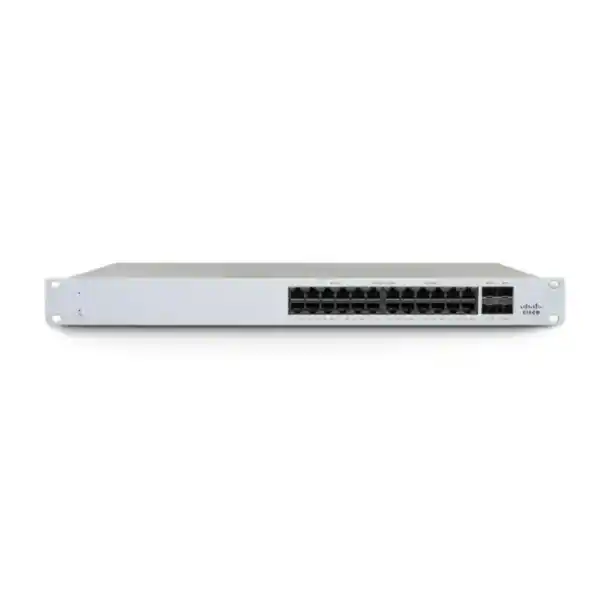
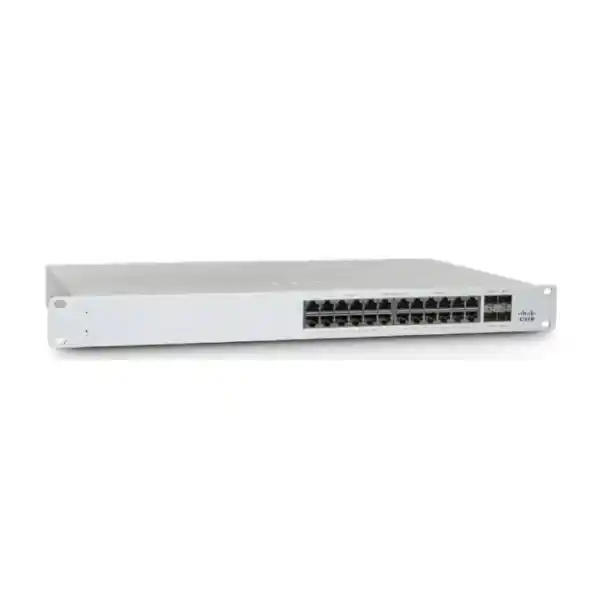
The Cisco Meraki MS130-24P is a 24-port cloud-managed access switch created for organizations that want simple centralized operations, dependable Gigabit Ethernet access and integrated PoE for connected business devices. Cisco documents the model with 24 x 1 GbE RJ45 access ports, 4 x 1 GbE SFP uplinks, a dedicated management interface and a 370 W PoE switch budget. It is positioned for branch and campus use, with Meraki Dashboard management that can reduce the effort required to configure, monitor and troubleshoot dispersed sites. For Tanzania buyers, the practical decision is not only whether twenty-four ports are enough today, but whether the PoE budget, uplink architecture, licensing model, rack environment and growth plan make the MS130-24P the right access-layer platform for the site.
Gigabit RJ45 access ports for users, phones, access points, cameras and other Ethernet endpoints.
Fiber-capable uplinks for rack, floor or building connectivity where 1 Gigabit SFP links fit the design.
A substantial PoE budget for compatible powered devices, subject to endpoint power requirements and port planning.
Meraki Dashboard provides centralized configuration, visibility, firmware workflows and remote troubleshooting tools.
What the Cisco Meraki MS130-24P solves
A modern access switch often sits at the center of several business systems at once. Staff computers need stable wired access, Wi-Fi access points need both Ethernet and power, IP phones may require PoE and voice VLANs, and surveillance devices can consume switch ports and power continuously. The MS130-24P brings these endpoint requirements onto one managed platform while giving administrators cloud-based visibility instead of requiring local-only management for every switch. That is particularly useful for organizations with branch offices, distributed IT responsibilities or sites where experienced network staff are not always physically present.
Cisco describes the MS130 family as cost-effective access switching for branch and campus environments. In practical deployments, the 24P model can be a strong fit where one rack needs around two dozen Gigabit access ports and a meaningful PoE budget, but does not require the higher-speed multigigabit and 10 Gigabit uplinks of the MS130-X variants. The four SFP uplinks can support fiber connections to an upstream switch or other network segment, but buyers should check bandwidth requirements carefully. If several high-throughput access points, large camera groups, storage workloads or heavy east-west traffic are expected, the uplink design deserves the same attention as the access-port count.
Cloud management is one of the major reasons organizations consider Meraki. Features such as zero-touch provisioning, remote troubleshooting, scheduled firmware upgrades and centralized policy workflows can simplify operations across multiple sites. These capabilities do not remove the need for sound LAN engineering. VLAN design, IP addressing, spanning-tree behavior, power protection, rack cooling, fiber choice and firewall policy still matter. FourTeck helps buyers connect the product specification to those deployment decisions so the switch is selected as part of a complete network rather than as an isolated line item.
Verified MS130-24P technical highlights
| Item | Cisco published detail |
|---|---|
| Access ports | 24 x 1 GbE RJ45 |
| Uplinks | 4 x 1 GbE SFP |
| PoE capability | PoE model with 370 W total switch power budget |
| Management | Meraki cloud-managed operation with centralized Dashboard controls |
| Layer / routing position | Layer 2 access switching with DHCP relay capability in the MS130 family |
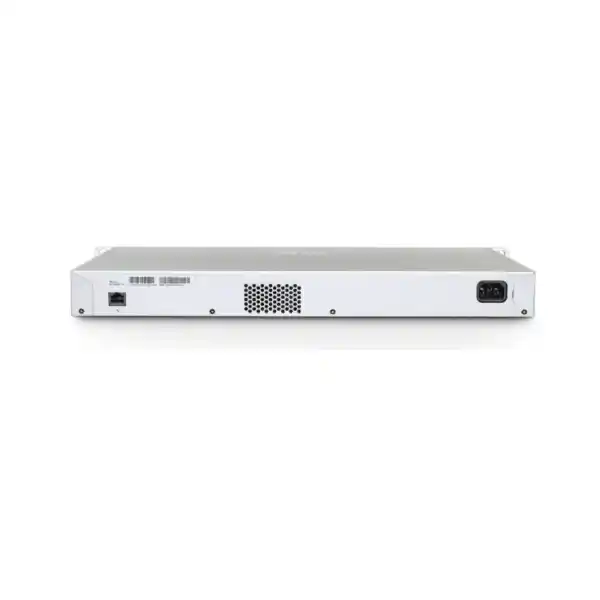
| Power input | 100-240 V AC, 50-60 Hz |
| Operating temperature | 0°C to 45°C |
| Licensing | Meraki licensing is required; Enterprise and Advanced licensing structures are documented for MS130, with term and licensing-model rules that should be checked before order |
The specification should be treated as a starting point for design. For example, a 370 W PoE budget does not mean every connected device can draw its maximum port power simultaneously without calculation. Add the expected consumption of access points, phones, cameras and other endpoints, allow reasonable headroom, and consider future additions. Likewise, the four SFP uplinks are valuable for fiber distribution, but the optical modules, fiber type, link distance and upstream switch compatibility must be selected correctly.
Licensing, Meraki Dashboard and lifecycle planning
Meraki licensing is part of the operating model, so procurement teams should include the appropriate license in the bill of materials rather than budgeting only for the hardware. Cisco publishes Enterprise and Advanced license options for the MS130 platform and also documents subscription licensing paths. The correct choice depends on the organization’s existing Meraki licensing model and feature requirements. In co-termination environments, license-tier consistency rules can apply across supported switch families, while per-device and subscription licensing use different administrative approaches. A quotation should therefore identify not only the switch but also the intended license tier, term and organizational context.
For a new deployment, the purchasing team should decide who will own the Meraki organization, who will have administrator access, how devices will be claimed, and how change control will be handled. For an existing Meraki customer, the switch should be added in a way that preserves the current organizational structure and licensing policy. These details are easy to overlook during purchasing but become important during deployment, renewal and audit. FourTeck can help buyers prepare the requirement so the hardware and licensing discussion happen together.
Related FourTeck Tanzania network planning resources
A PoE access switch normally interacts with several other infrastructure layers. Review the FourTeck Tanzania technology solutions overview when the switching requirement is part of a larger office, security or infrastructure project. The FourTeck Tanzania services page is useful for organizations that also require design, installation, configuration or lifecycle support. Buyers can also browse the FourTeck Tanzania IT product shop when comparing complementary network and business-technology products. Regional organizations with East African projects can review FourTeck Kenya for related procurement planning across Kenya. These links are intended to help procurement teams connect switching, wireless, security and infrastructure requirements rather than purchase each component without context.
Cisco Meraki MS130-24P Tanzania
For organizations in Tanzania, the Cisco Meraki MS130-24P fits a common requirement: a manageable 24-port access switch that can deliver both data and PoE to business endpoints while allowing centralized administration. A head office, branch, school, hotel, healthcare site, professional-services firm or retail operation may need to connect desktop users, wireless access points, IP phones, CCTV cameras and other Ethernet devices within one rack. The 24 Gigabit ports provide a practical access density, while the 370 W PoE budget can reduce reliance on separate power adapters for compatible endpoints. The four SFP uplinks make it possible to plan fiber connectivity between racks, floors or buildings when 1 Gigabit optical links suit the traffic design.
The strongest reason to select this switch is often operational consistency rather than port count alone. Tanzania businesses with more than one site may not have a network engineer physically available at every branch. Meraki Dashboard can help an authorized administrator see switch status, examine ports, apply configuration, schedule firmware and perform remote troubleshooting from a central interface. That capability can shorten diagnosis when a phone, access point or camera is reported offline, although proper documentation and local physical support are still important when the problem involves cabling, power or damaged hardware.
Before requesting a Cisco Meraki MS130-24P Tanzania quotation, prepare the number and type of powered devices, expected port growth, uplink medium, rack location, existing firewall and VLAN design, internet availability for cloud management, and preferred license term. Tanzania projects should also consider stable power and cooling. Network switches are expected to operate continuously, so the rack should have adequate ventilation and an appropriate UPS strategy. Where the site uses fiber, confirm connector type, optical module requirements and distance before procurement. For multi-site deployments, standardize naming, VLANs and port profiles so future branches can follow a repeatable template.
FourTeck can use these details to help determine whether the MS130-24P is correctly sized or whether another MS130 model is more appropriate. A site with fewer endpoints may not need a full 24-port PoE switch, while a larger environment may require 48 ports, additional switches or higher-speed uplinks. The aim is to match the model to the architecture, license it correctly and leave realistic room for business growth.
Cisco Meraki MS130-24P Dar es Salaam
Dar es Salaam contains a wide range of offices, commercial buildings, hotels, logistics operations, retail sites and professional organizations that depend on always-available wired and wireless networks. In these environments, the Cisco Meraki MS130-24P can serve as a practical access-layer switch for a rack that needs to connect staff endpoints and power network devices. Twenty-four Gigabit Ethernet ports give administrators enough density for many small and medium business floors, while the 370 W PoE budget can support a planned mix of Meraki or third-party access points, compatible IP phones, cameras and other PoE equipment. Port power should still be calculated from the actual endpoint specifications rather than estimated from device count alone.
For a Dar es Salaam office located across multiple floors or connected to a separate server room, the four SFP uplinks can be useful for fiber distribution. Fiber choice should be driven by distance, installed cabling and upstream interface requirements. The MS130-24P uses 1 Gigabit SFP uplinks, so high-throughput environments should evaluate whether that capacity matches aggregate traffic. A floor serving ordinary office users, voice and moderate Wi-Fi loads may be comfortable with this design, while dense wireless, video or storage traffic may justify a model with faster uplinks.
Cloud management can be particularly valuable for businesses with several Dar es Salaam sites or with IT leadership shared between Tanzania and another country. An administrator can standardize configurations, inspect port behavior and use remote tools without treating every branch as a separate management island. This works best when device naming, VLAN assignments, user access and change procedures are documented in advance. Internet connectivity is also part of the management path, so the deployment should include a sensible gateway and firewall design rather than assuming the switch alone solves network availability.
When preparing a quote, buyers should provide floor count, rack location, total wired devices, PoE endpoint types, fiber requirements, expected internet speed, firewall model and any existing Meraki organization details. In a city where businesses may grow from one office suite to several departments or locations, planning spare ports and PoE headroom at the outset can reduce disruptive replacements later. FourTeck can help convert those practical requirements into a clearer switching bill of materials, including licensing and compatible infrastructure considerations.
Cisco Meraki MS130-24P Mwanza
Businesses in Mwanza may deploy network infrastructure across offices, education facilities, healthcare environments, hospitality sites, distribution operations and branch locations where simple remote administration has real value. The Cisco Meraki MS130-24P is suitable when a site needs a full-size 24-port managed switch with PoE and does not require multigigabit access ports. It can consolidate wired computers, printers, IP phones, cameras and wireless access points into a centrally managed access layer, reducing the operational complexity that comes with unmanaged or independently configured switches.
A common design question is whether one 24-port switch is sufficient. Count all current endpoints, then include ports for uplink connections, spare capacity, future access points, additional phones, cameras and temporary needs. If the expected total is already close to twenty-four, it may be more economical to plan a second switch or a larger access layer from the beginning. PoE planning is similar. The published 370 W budget is generous for many mixed endpoint environments, but high-power devices can consume that budget quickly. Procurement teams should list each powered endpoint model and its expected demand before finalizing the quantity.
For Mwanza sites where local IT staffing is limited, Meraki Dashboard can help a central support team observe the network, make authorized changes and diagnose many logical issues remotely. This does not replace the need for clean patching, accurate labels and power protection. A remote administrator is much more effective when the rack is organized and port numbers correspond to documented outlets and devices. UPS capacity should also be reviewed because powering phones, wireless access points and cameras from the switch means a switch outage can affect several business systems at once.
Organizations requesting Cisco Meraki MS130-24P Mwanza pricing should share whether the switch will serve a new site or an upgrade, whether fiber already exists, what Meraki licensing model is in use, and whether the network carries voice, surveillance or guest Wi-Fi. This allows the quotation to account for licenses and design dependencies instead of treating the hardware as a standalone purchase. For branch standards, use consistent VLAN names, port profiles and documentation across Mwanza and other Tanzania locations so support remains predictable as the network expands.
Cisco Meraki MS130-24P Arusha
Arusha organizations in tourism, hospitality, professional services, education, NGOs, retail and administration often operate environments where guest connectivity, office systems, voice and surveillance must coexist on one physical LAN. The Cisco Meraki MS130-24P can provide the managed access layer for this type of mixed network. Its 24 Gigabit RJ45 ports can connect fixed devices, while PoE allows compatible phones, cameras and access points to receive power over the same cabling. This simplifies edge deployment, but it also makes VLAN separation and port configuration important so guest, staff, voice and security traffic are not unintentionally placed in the same logical network.
For hospitality and guest-facing environments, wireless usage can be highly variable. The access switch must therefore be planned together with the Wi-Fi design. Confirm how many access points will connect, what their uplink speeds are, and how much PoE they require. The MS130-24P has standard 1 Gigabit access ports and 1 Gigabit SFP uplinks. That is appropriate for many deployments, but buyers expecting newer high-throughput access points or unusually dense traffic should compare the MS130-24P with multigigabit options rather than choosing solely on purchase price.
Meraki cloud management is useful for properties and organizations that may have multiple buildings or remote IT oversight. Standard port profiles can help keep phones, cameras and access points configured consistently. Remote troubleshooting can also help determine whether a problem is linked to a switch port, power delivery or client connectivity before someone is dispatched to the site. To gain that advantage, the physical deployment still needs good cabling, labeling and stable power. In rack environments that may experience heat, confirm airflow and keep operating conditions within Cisco’s published limits.
A useful quotation request for Arusha should include building layout, endpoint quantities, the number of PoE devices, fiber distances, current firewall, required VLANs, existing licenses and anticipated site growth. If the switch is part of a hotel, lodge or campus refresh, identify whether cameras and access points will be expanded in later phases. FourTeck can then help assess spare capacity, licensing and related infrastructure, reducing the risk of installing a switch that is technically compatible today but undersized for the next stage of the project.
Cisco Meraki MS130-24P Dodoma
Dodoma businesses, institutions and branch offices that need centrally managed LAN infrastructure can use the Cisco Meraki MS130-24P as a 24-port PoE access switch for office users and connected operational devices. Its value is strongest where the organization wants a repeatable network standard rather than a collection of unmanaged switches. Meraki Dashboard provides a common management framework, which can be useful for organizations coordinating IT from a central team while supporting facilities in more than one Tanzania city.
In a new Dodoma office, start design from the endpoint schedule. Count staff desks, printers, meeting-room systems, wireless access points, IP phones, cameras, access-control devices and any specialist Ethernet equipment. Decide which endpoints require PoE and which should have dedicated VLANs. This process usually reveals whether 24 access ports are enough and whether 370 W of PoE capacity provides comfortable headroom. Do not forget infrastructure ports used by uplinks or management connections. A switch that looks adequate on a spreadsheet can run out of practical capacity once growth and redundancy are included.
Fiber uplinks can help connect racks across a larger facility, but link speed and optics must be planned accurately. The MS130-24P provides four 1 Gigabit SFP uplinks, so the design should avoid creating a bottleneck where many endpoint flows converge. If the site carries heavy CCTV recording, dense wireless traffic or frequent large file transfers, calculate expected aggregate usage. Where higher uplink throughput is required, compare other Meraki models before final purchase instead of relying on link aggregation as a substitute for the correct platform.
Power continuity also deserves attention. Because one PoE switch can power many communication and security endpoints, placing it on a correctly sized UPS may preserve critical services during short interruptions. Document the switch, license term, serial records, VLANs and port assignments at handover. For government-adjacent, institutional or project-driven procurement, a clear bill of materials should state hardware, licensing and required accessories separately. FourTeck can help turn the requirement into a quotation-ready scope without claiming stock or delivery timing until those items are confirmed at the time of request.
Cisco Meraki MS130-24P UAE
Organizations in the UAE often manage multiple offices, retail sites, warehouses, hospitality properties and regional branches, making centralized network operations an important purchasing factor. The Cisco Meraki MS130-24P can suit a branch or access-layer requirement where 24 Gigabit Ethernet ports, PoE and cloud management provide the right balance. The switch can power compatible access points, phones and surveillance endpoints while keeping configuration and monitoring inside the Meraki management environment. Buyers should treat the hardware and Meraki license as one operational package, because licensing is integral to the platform.
UAE deployments frequently include high-density Wi-Fi and bandwidth-intensive cloud applications, so the access-layer design should be tested against performance expectations. The MS130-24P uses 1 Gigabit copper access ports and four 1 Gigabit SFP uplinks. For standard office access this can be appropriate, but sites deploying multigigabit wireless or expecting greater aggregation bandwidth should review the MS130-X or other higher-capacity Meraki options. Selecting the correct model before purchase is usually more efficient than replacing an undersized access switch after a wireless or application upgrade.
For regional companies managing UAE and East African branches, Meraki can support standardization. Administrators can use consistent naming, VLANs and port policies across sites while still adjusting each location for its local circuit, device count and security needs. A repeatable configuration framework helps support teams understand remote sites faster. The physical layer should also be standardized: rack layout, patch-panel labeling, UPS protection, optics and spare-port policy all contribute to predictable operations.
A UAE quotation request should include the desired licensing term, existing Meraki organization details, quantity, endpoint schedule and uplink requirements. If the purchase is part of a broader regional rollout, note the other countries and whether the organization wants a common template. FourTeck’s regional network can support conversations across multiple markets, but availability, logistics and commercial terms should be confirmed for the specific project rather than assumed from another country’s deployment.
Cisco Meraki MS130-24P Uganda
Uganda organizations evaluating cloud-managed access switching can consider the Cisco Meraki MS130-24P for offices, branches, schools, clinics, hospitality sites and commercial networks that need 24 Gigabit ports plus PoE. The platform is especially useful when IT teams want one cloud-based management plane for multiple switches and locations. Instead of travelling to every branch for routine logical configuration, authorized staff can use the Meraki Dashboard for visibility, configuration and remote troubleshooting, provided the site has suitable connectivity and the deployment has been correctly onboarded.
The 370 W PoE budget can support a meaningful mix of endpoints, but each Uganda project should calculate actual requirements. Wireless access points, IP phones and cameras vary in power consumption. A switch may have enough physical ports but insufficient preferred headroom if too many high-draw devices are concentrated on it. Conversely, a site with mostly data-only desktops may not need as much PoE as the model offers. Good sizing therefore begins with an endpoint list rather than a generic rule based on employee count.
For branch and campus layouts, the four 1G SFP uplinks provide flexibility for fiber connections. Confirm fiber distance, multimode or single-mode requirements, optical module compatibility and upstream port type before procurement. Where the site is expected to aggregate large volumes of traffic, particularly from dense Wi-Fi or surveillance, evaluate uplink capacity carefully. The MS130-24P is an access switch, not a substitute for a higher-capacity aggregation or core design when the network scale calls for one.
Businesses requesting Cisco Meraki MS130-24P Uganda pricing should state whether they already use Meraki, what licensing model is active, and what renewal or subscription term is preferred. They should also include rack power, UPS planning, VLAN needs, firewall integration and growth expectations. FourTeck can help buyers compare the 24P with other MS130 variants and align the switch with broader networking requirements across Uganda and regional offices.
Cisco Meraki MS130-24P Kampala
Kampala’s concentration of corporate offices, schools, healthcare facilities, hospitality businesses, NGOs and retail organizations creates a broad range of access-switching requirements. The Cisco Meraki MS130-24P can be a practical choice for a site that needs a rack-mountable 24-port PoE switch managed through the Meraki cloud platform. It gives network teams Gigabit access for wired users and connected systems, while its 370 W PoE budget can support compatible phones, access points and cameras without separate adapters at every endpoint.
For a Kampala office refresh, an important question is whether the organization is replacing unmanaged switches or extending an existing Meraki environment. When moving from unmanaged switching, take the opportunity to design VLANs, endpoint groups, port labels and uplinks cleanly rather than copying the old topology. When extending an existing Meraki organization, check the license tier and co-termination or other licensing rules before purchase so the new MS130 aligns with the existing estate. Cisco documents specific rules around Enterprise and Advanced tiers for MS130 organizations.
The four 1 Gigabit SFP uplinks can connect the switch to another rack or distribution point over fiber. If the building has several floors, document which fiber strands, patch panels and optics serve each link. Accurate physical records are especially important in a cloud-managed network because remote visibility cannot identify every physical patching mistake. Rack ventilation and UPS capacity should also be considered since the switch may become the power source for several critical systems.
Kampala buyers should request a quotation based on a clear bill of requirements: switch quantity, Meraki license term, access-point count, phone count, camera count, SFP needs and deployment timeline. If the environment is expected to grow beyond 24 ports or move to higher-speed wireless, compare alternative Meraki models before standardizing. FourTeck can help organize this information so the purchase supports the network design rather than forcing the network to adapt to a prematurely selected switch.
Cisco Meraki MS130-24P Arua
For organizations operating in Arua, remote manageability can be as important as the switch’s physical port count. The Cisco Meraki MS130-24P combines 24 Gigabit access ports, PoE and Meraki Dashboard management, which can help a central IT team supervise a branch without requiring frequent onsite visits for routine logical changes. This is useful for offices, education sites, healthcare operations, NGOs and commercial branches where local staff may be responsible for basic physical checks while specialist network administration is handled elsewhere.
A well-planned Arua deployment should minimize avoidable onsite troubleshooting. Use labeled patch panels, document endpoint names, keep spare patch leads available and record which switch ports serve access points, cameras, phones and users. Standard port profiles can then be applied consistently. If a connected device fails, the support team can compare dashboard information with the physical documentation and decide whether the likely cause is cabling, PoE delivery, configuration or the endpoint itself.
Power resilience is particularly important where the switch powers several operational devices. An appropriately sized UPS can keep the switch and upstream firewall/router available during short interruptions, but UPS sizing should include the possible PoE load rather than only the switch’s idle consumption. Environmental conditions also matter; Cisco publishes an operating range up to 45°C, so the rack should have ventilation and should not be installed in an enclosed hot space without adequate thermal planning.
For procurement, Arua customers should state whether the switch will use copper-only endpoint connections or fiber uplinks, whether any remote building links are required, and what Meraki licensing term is preferred. If the site needs more than 24 access ports, avoid filling every port on day one. Reserve capacity for future users and replacement flexibility. FourTeck can help compare the MS130-24P against larger or higher-speed models when the project roadmap suggests the network will expand quickly.
Cisco Meraki MS130-24P Mbarara
Mbarara businesses and institutions that are modernizing LAN infrastructure can use the Cisco Meraki MS130-24P as a managed access switch for mixed data, voice, wireless and surveillance environments. The switch is designed for branch and campus access rather than heavy core routing. That distinction is important: it is ideal when the requirement is to connect endpoint devices, deliver PoE and manage the access layer centrally, while upstream firewalls or routing platforms handle broader network policy and internet-edge functions.
For a new branch, count ports by function. Staff desks may use one or more Ethernet connections, Wi-Fi access points require switch ports and often PoE, IP phones can require dedicated ports, and cameras can consume both port capacity and power continuously. Building this device schedule early makes it easier to confirm whether 24 ports and a 370 W PoE budget are suitable. It also helps identify VLAN needs, because phones, cameras, staff devices and guests should not automatically share one unrestricted network.
The Meraki cloud-management model can simplify configuration consistency between Mbarara and other branches. A central administrator can maintain similar switch naming and policy patterns while adapting port assignments to each location. Remote tools can reduce diagnosis time, but the branch still benefits from a clear local checklist for power, cables and indicator status. In distributed environments, good documentation often delivers as much operational value as the hardware itself.
When requesting Cisco Meraki MS130-24P Mbarara pricing, include the expected number of switches, license duration, PoE device list, fiber uplink requirement and any existing Meraki organization. If the project includes Wi-Fi, state the access-point models because their Ethernet speed and power needs influence switch selection. FourTeck can then help determine whether the standard MS130-24P is appropriate or whether a multigigabit variant should be reviewed for the planned wireless platform.
Cisco Meraki MS130-24P Gulu
Gulu organizations considering a managed switching upgrade can benefit from the operational simplicity of the Cisco Meraki MS130-24P when branch IT resources are limited. Twenty-four Gigabit Ethernet access ports suit many office and institutional networks, while PoE can power compatible devices over structured cabling. The design is especially attractive when the organization already uses Meraki security, wireless or switching products and wants one cloud-oriented administrative experience across the network.
Sizing should remain disciplined. A 24-port switch should not be selected only because the site currently has twenty or fewer connected users. Include access points, printers, cameras, phones, meeting-room devices, infrastructure links and future expansion. In some offices, Wi-Fi reduces the number of desktop Ethernet ports but increases dependence on access points. In others, surveillance or voice endpoints consume more switch capacity than staff computers. The correct port count comes from the complete device map, not from payroll numbers.
The MS130-24P’s four SFP uplinks can support fiber connections between racks or buildings where 1 Gigabit capacity fits the requirement. For long-distance or inter-building fiber, verify fiber type and optical module choice. Do not assume every SFP is interchangeable. The upstream device, wavelength, distance and connector format must align. This is an area where a small planning error can delay commissioning even when the switch itself is correct.
For Gulu deployments, include power and maintenance planning in the purchase. A switch supporting phones, cameras and wireless can become a critical dependency, so UPS protection, clean rack installation and configuration backups are valuable. Meraki’s cloud platform provides centralized operational visibility, but organizations should still document administrator roles, renewal dates and change procedures. A FourTeck quotation discussion can incorporate these details and help avoid a hardware-only purchase that omits licensing or required accessories.
Cisco Meraki MS130-24P Kenya
Kenya businesses deploying cloud-managed networks across Nairobi, Mombasa, Kisumu, Nakuru and other locations can consider the Cisco Meraki MS130-24P for branch and access-layer switching. It offers 24 Gigabit Ethernet access ports and integrated PoE capacity in a platform managed through Meraki Dashboard. This is useful for companies with several locations because the network team can apply consistent configuration principles and monitor switches from a central interface instead of maintaining separate local management systems.
The model is best matched to sites where 1 Gigabit access is sufficient and where the 4 x 1G SFP uplinks provide adequate upstream capacity. Kenya offices adopting high-density Wi-Fi should check access-point interface speeds before choosing the switch. Newer wireless systems can benefit from multigigabit Ethernet, and in those cases the MS130-24X or another higher-capacity model may be a better match. The correct comparison should include total cost, PoE budget, uplink needs, licensing and expected lifespan rather than focusing on the hardware price alone.
For multi-branch companies, standardized templates can improve support. Use common VLAN conventions, port profiles, firmware policies and device naming across sites, then document exceptions. This allows a support engineer to understand a newly added branch more quickly. Meraki Dashboard can help with remote diagnostics, while local site documentation makes physical troubleshooting faster when a cable, power feed or endpoint fails.
Kenya procurement teams should specify the license term and confirm whether the purchase will join an existing Meraki organization. They should also list required SFP modules, rack accessories, UPS capacity and endpoint power needs. FourTeck Kenya provides a regional point for related IT procurement planning, while FourTeck Tanzania can coordinate requirements that span East African offices. Availability and commercial terms should always be confirmed for the specific quantity and location at the time of quotation.
Cisco Meraki MS130-24P Kuwait
Kuwait organizations that value centralized management across offices, retail sites, hospitality properties or branch networks can use the Cisco Meraki MS130-24P as a cloud-managed access switch where 24 Gigabit ports and PoE fit the site size. The platform can reduce management fragmentation because configuration, monitoring and firmware workflows are handled through the Meraki cloud environment. This makes it attractive to regional IT teams supporting several business units from one operations function.
The physical design should be appropriate for the rack environment. Cisco publishes an operating range from 0°C to 45°C for the MS130 family, so equipment-room cooling and airflow should be treated as part of reliability planning, especially in hot climates. Keep the switch in a controlled indoor rack, avoid obstructing ventilation and include clean power and UPS protection. If the switch powers access points, phones and cameras, a power event at the rack affects those endpoints at the same time, making resilience more important than it may appear from the switch alone.
Bandwidth planning is equally important. The MS130-24P provides 1 Gigabit access ports and 1 Gigabit SFP uplinks. This is appropriate for many business networks but should be assessed against dense wireless and high-volume traffic requirements. Organizations modernizing Wi-Fi may prefer a multigigabit access switch to avoid constraining newer access points. Conversely, conventional office users and moderate PoE device deployments may find the MS130-24P offers a sensible balance without paying for interfaces that are not required.
A Kuwait quotation request should identify the switch quantity, licensing preference, existing Meraki organization, uplink optics, endpoint count and PoE load. If the deployment is part of a regional standard that also includes Tanzania, UAE or other markets, provide that context so naming and management practices can be aligned. FourTeck can help frame the requirement, while local availability, logistics and final commercial terms should be validated at the time of purchase.
Cisco Meraki MS130-24P Ghana
Ghana businesses can use the Cisco Meraki MS130-24P when they need an access switch that combines 24 Gigabit Ethernet ports, PoE and centralized cloud management. It can serve corporate offices, schools, healthcare facilities, retail sites and distributed branches where network administrators want more visibility than unmanaged switching provides. The switch is particularly useful when network devices such as access points, IP phones and cameras need both connectivity and power from the wiring closet.
Good design starts with segmentation. A Ghana site may carry staff data, guest Wi-Fi, voice and surveillance on the same physical switch, but those services do not need to share the same logical network. VLANs and upstream security policy can separate traffic while the managed switch enforces the correct access-port settings. This creates a cleaner foundation for troubleshooting and security than adding devices to one flat network. Where the organization already uses Meraki, common dashboard policies can further simplify branch standardization.
The published 370 W PoE budget should be mapped against actual devices. If a project includes many cameras and access points, add their expected power draw and retain headroom. If the site’s future wireless roadmap includes multigigabit access points, also check whether standard 1 Gigabit copper ports will remain sufficient over the planned lifecycle. Hardware that is perfectly adequate for today’s requirements may become a bottleneck after a significant Wi-Fi upgrade, so procurement should include a three- to five-year view of likely growth.
For Cisco Meraki MS130-24P Ghana enquiries, buyers should share quantity, preferred license term, fiber uplink requirements and existing network architecture. Include whether the site needs a new rack, UPS, patching or firewall integration. These dependencies influence the final bill of materials and project readiness. FourTeck can help organize the requirement and compare suitable Meraki options, while pricing and availability are confirmed for the specific order rather than represented as fixed.
Cisco Meraki MS130-24P Nigeria
Nigeria enterprises and growing businesses often operate multiple offices, branches, stores, campuses or service locations, making centralized network visibility a significant advantage. The Cisco Meraki MS130-24P is designed for cloud-managed access switching and can provide a consistent 24-port PoE platform for these deployments. Network teams can use Meraki Dashboard to monitor ports, apply configuration and perform remote troubleshooting, while local site staff handle physical tasks such as checking cables, power or endpoint hardware.
The switch should be selected in context. Twenty-four ports can be ideal for a branch, but the correct figure depends on endpoints rather than users. An office with ten employees may still need ports for access points, cameras, phones, printers, meeting-room systems and uplinks. Similarly, 370 W of PoE can be more than enough for a light endpoint mix but may require careful calculation for a camera- and wireless-heavy environment. A structured equipment schedule prevents under-sizing and gives procurement a more defensible bill of materials.
Power reliability and environmental control are important considerations for Nigeria sites. Because a PoE switch can power several critical services simultaneously, protect the rack with suitable UPS capacity and surge protection as appropriate to the facility. Keep the switch in a ventilated environment within Cisco’s published operating limits. Clean power and thermal management help reduce avoidable outages and complement the operational advantages of remote management.
For companies with offices in Lagos, Abuja or other cities and regional operations elsewhere in Africa, a Meraki standard can help unify network administration. Use repeatable VLANs, port profiles and naming but still size each branch independently. Nigeria buyers requesting the MS130-24P should specify switch quantity, license term, SFP requirements, endpoint power demand and existing Meraki organization details. FourTeck can help compare this model with higher-port or multigigabit variants when the site’s expected traffic or expansion requires them.
Cisco Meraki MS130-24P Seychelles
Seychelles hotels, offices, professional organizations and distributed business sites may value a network platform that can be managed centrally without requiring specialist staff to remain onsite. The Cisco Meraki MS130-24P provides 24 Gigabit access ports, PoE and Meraki cloud management, making it suitable for many hospitality and branch access-layer deployments. A single switch can connect staff devices while powering compatible phones, cameras and wireless access points, helping keep the communications rack organized.
Hospitality environments deserve careful wireless and surveillance planning. Guest Wi-Fi can generate substantial traffic, while cameras may stream continuously to local recorders. The MS130-24P’s 1 Gigabit ports and SFP uplinks should therefore be checked against aggregate demand. A smaller property may be well served by this profile; a larger resort with many high-performance access points or heavy inter-building traffic may require multigigabit access and faster uplinks. Model selection should follow traffic and endpoint calculations rather than a generic property-size label.
PoE design is equally important. Access points, cameras and IP phones should be listed by model so their power needs can be compared with the switch’s 370 W budget. Keep reasonable headroom for startup conditions and future expansion. If multiple buildings are linked with fiber, document fiber type, distance, optics and spare strands. In island and remote-location deployments, getting these details correct before shipping can reduce delays caused by a missing transceiver or incompatible fiber component.
Cloud management can help regional support teams observe Seychelles sites remotely, but the site should still have clean rack labeling, a documented escalation process and adequate power protection. Procurement requests should state whether the switch is for a new deployment, replacement or expansion, and should include the desired Meraki license term. FourTeck can help structure the requirement and compare suitable switching choices, while final availability and logistics are confirmed against the actual project location and timing.
Deployment and buying checklist
List computers, access points, IP phones, cameras, printers, meeting-room devices and infrastructure connections. Add spare capacity rather than planning to occupy every access port immediately.
Record the expected power requirement of each powered device and compare the total with the 370 W switch budget. Retain headroom for growth and changes.
The MS130-24P provides four 1G SFP uplinks. Check fiber type, optics, distance and aggregate bandwidth. Choose another model if faster uplinks are necessary.
Include the Meraki license in the procurement scope and align the tier and term with the organization’s existing licensing model.
Provide ventilation, labeling, structured patching and suitable UPS protection. Remember that loss of one PoE switch can affect several business systems simultaneously.
Separate staff, guest, voice, surveillance and management traffic as appropriate, then coordinate the switch configuration with the upstream firewall or routing policy.
Frequently asked questions
How many ports does the Cisco Meraki MS130-24P have?
The MS130-24P has 24 x 1 Gigabit Ethernet RJ45 access ports and 4 x 1 Gigabit SFP uplinks, plus a dedicated management interface. When sizing a deployment, distinguish between user access ports and uplink or infrastructure requirements.
What is the PoE budget of the MS130-24P?
Cisco publishes a 370 W PoE switch budget for the MS130-24P. Actual endpoint planning should use the power requirement of each connected device and retain suitable headroom rather than assuming every port can draw maximum power at once.
Does the Cisco Meraki MS130-24P require a license?
Yes. Meraki licensing is part of the platform. Cisco documents Enterprise and Advanced licensing for MS130 along with licensing-model rules and subscription options. The appropriate term and tier should be confirmed for the organization before purchase.
Is the MS130-24P suitable for Wi-Fi access points?
It can power and connect compatible access points, but the correct choice depends on access-point Ethernet speed and PoE demand. If your wireless design uses multigigabit interfaces, compare the MS130-24P with MS130-X or other suitable Meraki models.
Can the MS130-24P be managed remotely?
Yes. The switch is designed for Meraki cloud management, providing centralized configuration, monitoring, firmware workflows and remote troubleshooting tools. Physical cabling and power issues may still require local intervention.
What should I provide for a quotation?
Provide quantity, deployment location, switch count, number of PoE endpoints, preferred license term, SFP or fiber requirements, existing Meraki organization details, VLAN needs and expected growth. This produces a more accurate bill of materials than asking for hardware price alone.
Decision recap
Choose the Cisco Meraki MS130-24P when your site needs around twenty-four Gigabit access ports, a substantial 370 W PoE budget, 1 Gigabit SFP uplinks and the operational benefits of Meraki cloud management. Review another model when you need multigigabit access, 10 Gigabit uplinks, materially more than 24 access ports or a different routing role. The purchasing decision should always include licensing, optics, rack power, VLAN design and future capacity. FourTeck can help business buyers translate endpoint and site requirements into a model and licensing discussion before final quotation.
Consult FourTeck for MS130-24P sizing and quotation
Share the number of users, powered endpoints, branch locations, uplink requirements and preferred Meraki license term. FourTeck can help you check whether the MS130-24P is correctly sized, identify related network requirements and prepare a quotation discussion without assuming stock, delivery time or pricing before they are confirmed.




Reviews
There are no reviews yet.