
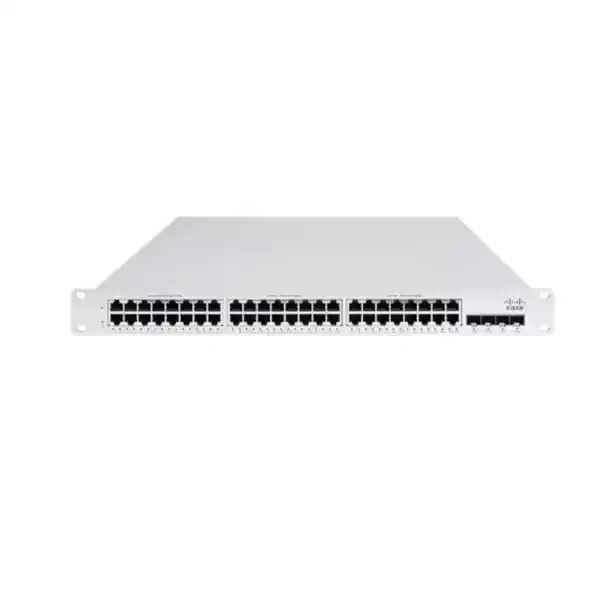
Cisco Meraki MS150-48LP-4G Tanzania
The Cisco Meraki MS150-48LP-4G is a 48-port cloud-managed access switch for organizations that want centralized operations, Power over Ethernet, physical stacking and straightforward 1 GbE fiber uplinks in a single platform. Cisco positions the MS150 family for branch and campus use, with the MS150-48LP-4G providing 48 x 1 GbE RJ45 access ports, four 1 GbE SFP uplinks, a 370 W switch PoE budget, two dedicated stacking ports and static routing. For buyers in Tanzania, the practical value is not simply the number of ports: it is the ability to plan users, wireless access points, IP phones, cameras and other PoE endpoints around a managed architecture that can be monitored through the Meraki cloud platform.
FourTeck Tanzania can help procurement and IT teams translate a switch request into a deployment-ready bill of materials that considers licensing, compatible SFP modules, stacking cables, region-appropriate power cords, rack space, UPS capacity, PoE headroom, VLAN structure and growth. This avoids the common problem of buying the correct switch chassis but missing the licenses or accessories needed to commission it.
What the MS150-48LP-4G solves
This model is aimed at access-layer deployments where a business needs many standard Gigabit Ethernet ports plus PoE, cloud visibility and the option to stack multiple switches. It suits sites that need to power wireless access points, IP phones, cameras and other compatible endpoints while keeping port configuration, monitoring and troubleshooting centrally manageable.
Why PoE planning matters
A 48-port PoE switch does not mean every connected device can draw the maximum available power simultaneously. The MS150-48LP-4G has a 370 W switch PoE budget and supports up to 30 W on a powered port. A proper design therefore totals expected endpoint draw, adds operating headroom and checks whether a higher-budget alternative is necessary.
Cloud-first operations
Meraki switching is designed around cloud management. That can simplify multisite operations because authorized administrators can work from a common management plane for configuration, visibility, firmware workflows and troubleshooting. The operational model is especially useful when branches need consistent standards but do not have full-time network staff at every location.
Cisco Meraki MS150-48LP-4G technical overview
According to Cisco Meraki documentation, the MS150-48LP-4G provides 48 Gigabit Ethernet RJ45 access interfaces and four 1 Gigabit SFP uplinks. It includes a dedicated management interface and two dedicated stacking ports. Cisco lists 80 Gbps stacking bandwidth for the MS150 family and 104 Gbps switching capacity for this 4G model. The switch supports static routing and uses 100–240 VAC input. Cisco also documents a 0°C to 45°C operating temperature range for the model, which makes rack ventilation and environmental control part of sensible deployment planning rather than an afterthought.
| Access ports | 48 × 1 GbE RJ45 |
| Uplinks | 4 × 1 GbE SFP |
| PoE | Up to 30 W per powered port; 370 W switch budget |
| Stacking | 2 dedicated stacking ports; 80 Gbps stacking bandwidth |
| Switching capacity | 104 Gbps |
| Layer 3 | Static routing |
| Management | Cisco Meraki cloud management plus dedicated management interface |
| Power input | 100–240 VAC |
Licensing, accessories and purchase planning
Cisco documents Enterprise and Advanced licensing tiers for the MS150 family, with term options under applicable licensing models, and also documents subscription licensing for the family. Licensing must be planned alongside the hardware rather than added casually after deployment. Organizations using co-termination should pay particular attention to Cisco’s rules around mixing Enterprise and Advanced tiers within an organization. The correct license choice depends on the organization’s existing Meraki estate, licensing model and the features required. FourTeck can help buyers identify the model, term and licensing alignment to request in a quotation, while final entitlement should always follow Cisco’s current ordering rules.
Cisco lists supported 1 GbE SFP transceivers for the 4G variants, including SX, LX10 and copper TX options, and dedicated stacking cables in multiple lengths. The appropriate choice depends on whether the uplink is multimode fiber, single-mode fiber or copper, the link distance and the equipment at the far end. This is particularly important for multi-floor offices, campus links and distributed racks where the physical medium may already exist. The switch is supplied as a rack-mount model, and Cisco notes that region-specific power cords may need to be ordered separately depending on the order region.
Before purchasing, document endpoint count, PoE device types, rack location, uplink medium, required optics, stack size, management organization, license term and expected growth. A small amount of design work before ordering can prevent mismatched optics, inadequate PoE headroom or an unnecessary switch replacement later.
Related FourTeck Tanzania solution areas
A managed access switch normally sits inside a wider architecture. Review FourTeck Tanzania integrated IT infrastructure for the broader project context, including switching, security, servers, collaboration and physical infrastructure. For planning, design and lifecycle work, see FourTeck Tanzania services, which covers business technology implementation and support activities. Buyers preparing a quotation can use the FourTeck Tanzania shop as a product-navigation starting point and the Tanzania contact page to submit project details.
For regional projects, FourTeck also operates specialist and country sites including FourTeck Uganda, FourTeck Kenya, FourTeck UAE, FourTeck Ghana and FourTeck Nigeria. These links are useful for organizations coordinating related infrastructure requirements across multiple markets.
Cisco Meraki MS150-48LP-4G Tanzania
For Tanzanian businesses, the MS150-48LP-4G is most compelling when the access layer needs a high port count, centrally managed configuration and enough PoE capacity for a mixed endpoint environment. A typical office may connect employee desktops, printers, IP phones, wireless access points, cameras, door controllers and meeting-room devices to the same wiring closet. The important design question is how these endpoints are grouped and powered. Forty-eight physical ports provide useful density, but a deployment should still reserve ports for uplinks, spare capacity and growth rather than filling the switch to its last available socket on day one. VLAN planning can separate staff, voice, guest, surveillance and management traffic, while the four SFP uplinks can connect fiber or copper uplink media through compatible modules.
Power conditions also deserve attention. The switch accepts 100–240 VAC input, but reliable deployment in Tanzania should consider the quality of power at the actual site, the UPS strategy and the total runtime needed for critical connectivity. A PoE switch may be supporting phones, cameras and wireless access points that are themselves essential during a short mains interruption. UPS sizing should therefore consider the switch’s own draw plus the expected PoE load rather than only the base chassis. Rack ventilation, ambient temperature and cable organization matter as well, particularly where networking equipment shares a small communications room with servers, NVRs or other heat-generating devices.
Organizations with branches can benefit from cloud-managed consistency. Naming conventions, VLAN templates, switch-port profiles, firmware practices and monitoring standards can be documented centrally and applied with less reliance on ad-hoc local configuration. Before quotation, Tanzanian buyers should provide site count, user count, estimated PoE devices, uplink type, preferred license term and whether the switch will operate alone or in a physical stack. If existing Meraki equipment is already deployed, include the current licensing model and organization structure so compatibility and licensing alignment can be checked. The result is a more accurate bill of materials and a smoother installation path.
Cisco Meraki MS150-48LP-4G Dar es Salaam
Dar es Salaam organizations often need switching that can support dense office floors, commercial buildings, hospitality environments, educational facilities, retail operations and distributed business sites. In these settings, the MS150-48LP-4G can serve as a structured access switch when endpoints are predominantly 1 GbE and the uplink plan is compatible with 1 GbE SFP connectivity. The 370 W PoE budget can power a meaningful mix of compatible devices, but the design team should total actual endpoint requirements. A floor with many wireless access points and surveillance cameras can consume PoE significantly faster than a floor dominated by ordinary desktops and printers.
Dar es Salaam sites can also vary widely in building age and cabling quality. Before installing a managed switch, check the condition and category of copper cabling, patch panels, labeling and rack earthing. Fiber uplinks between floors or buildings should be validated for fiber type, connector presentation and optical distance before transceivers are ordered. This avoids discovering during installation that the switch is correct but the selected optic is wrong for the existing backbone. Where multiple MS150 units are used in the same communications room, physical stacking can simplify management and offer a structured way to expand port density.
For businesses with cloud applications, voice, surveillance and guest Wi-Fi sharing the LAN, logical segmentation is as important as physical connectivity. A well-planned deployment may dedicate VLANs and policies to user data, IP telephony, wireless clients, cameras and network management. Port descriptions, patch-panel references and device names should be documented so troubleshooting remains efficient after handover. Buyers in Dar es Salaam should request a quote that includes the exact switch, required Meraki license, power cord, compatible SFP modules where necessary, stacking cables if a stack is planned and implementation services if configuration is needed.
Cisco Meraki MS150-48LP-4G Mwanza
In Mwanza, organizations considering the Cisco Meraki MS150-48LP-4G may be supporting offices, education, healthcare, hospitality, distribution, finance or operational sites that need a manageable access layer without placing a network specialist at every location. Cloud management can be useful for this branch-oriented model because configuration and visibility are centralized. The local site still needs correct physical installation, internet reachability and power protection, but day-to-day monitoring does not depend on standing in front of the switch.
A Mwanza deployment should start with an endpoint inventory. Count wired users, access points, phones, cameras, printers, security devices and any building systems that will use Ethernet. Mark which endpoints require PoE and note each device’s maximum draw. The MS150-48LP-4G offers a 370 W switch budget and up to 30 W per powered port, which is appropriate for many common endpoints but must be validated against the actual device list. Leave practical margin for startup peaks, future additions and replacement devices that may have different power requirements.
Connectivity between the Mwanza site and other offices should also influence configuration. If the branch uses cloud applications, centralized voice, VPN connectivity or remote infrastructure monitoring, resilient internet and sensible firewall design are part of the solution. At the LAN level, the four 1 GbE SFP uplinks can serve fiber or copper connections through supported modules, while static routing can handle appropriate local routing use cases. Procurement teams should specify whether the site is greenfield or an upgrade, whether existing optics and fiber must be reused, and whether the Meraki organization already exists. Those details help avoid ordering assumptions and support a cleaner implementation.
Cisco Meraki MS150-48LP-4G Arusha
Arusha businesses can use the MS150-48LP-4G as an access-layer platform where cloud management, PoE and a high density of Gigabit Ethernet ports fit the site requirements. Hospitality properties, offices, institutions and multi-building environments often have a broad mix of endpoints, and the switch can form part of a design that connects phones, wireless access points, cameras, staff devices and operational systems. Because the model’s uplinks are 1 GbE SFP, buyers should confirm that this uplink capacity suits the expected aggregate traffic and upstream switch design rather than selecting purely on the number of user ports.
Wireless-heavy environments deserve special attention. Access points may require PoE and can aggregate traffic from many clients into a single wired port. If the organization expects high user density, large media transfers or newer wireless standards, the access-point model and uplink requirements should be reviewed together with the switch. The MS150 family contains other variants with different uplink and multigigabit options, so the 48LP-4G should be chosen when its 1 GbE access and 1 GbE SFP uplink profile genuinely matches the architecture.
For Arusha procurement, provide a simple network diagram or at least identify the firewall, upstream/core switch, existing fiber type and intended stack size. Note whether cameras or phones must remain powered during utility interruptions so UPS capacity can be sized around the actual PoE load. Licensing also belongs in the initial quote: Cisco Meraki switching requires the appropriate license or subscription entitlement according to the selected model. A complete quotation should therefore separate hardware, licensing, transceivers, stack cables, power accessories and implementation tasks, making the purchase easier to evaluate and reducing surprises during commissioning.
Cisco Meraki MS150-48LP-4G Dodoma
For organizations in Dodoma, the Cisco Meraki MS150-48LP-4G can be considered for structured business LANs where centralized administration and PoE simplify the support of multiple endpoint types. Government-related offices, professional services, education, healthcare and expanding private-sector environments may need network standards that are repeatable across departments and branches. Cloud-managed switching can help maintain those standards by keeping port configuration, monitoring and troubleshooting within a consistent management framework.
The switch’s 48 Gigabit access ports make it suitable for dense racks, but port count should still be planned by room, floor and future growth. It is often better to leave a deliberate reserve than to deploy a new switch at full utilization. PoE planning should similarly use device-level data. A 370 W switch budget can be sufficient for a balanced mix of phones, access points and cameras, yet a camera-heavy or wireless-heavy project may need more PoE headroom. Confirm endpoint requirements and compare them with the switch budget before purchase.
Dodoma sites should also define how the switch connects upstream. The MS150-48LP-4G uses four 1 GbE SFP uplinks, and Cisco documents supported transceiver choices for the 4G variants. Fiber distance and fiber type must be matched correctly. If several switches are installed together, dedicated stacking ports and 80 Gbps stacking bandwidth offer a structured expansion path. Add rack layout, UPS design, labeling and documentation to the deployment scope so the network remains serviceable after installation. Buyers should request the exact hardware model, current license entitlement, required uplink modules, stack cables and implementation support as separate line items in the quote.
Cisco Meraki MS150-48LP-4G UAE
In the UAE, the MS150-48LP-4G can fit branch, office, retail, hospitality and multi-site enterprise deployments that prioritize Meraki cloud operations and PoE access switching. Buyers should evaluate the model against their actual uplink strategy. It provides 48 x 1 GbE RJ45 ports and four 1 GbE SFP uplinks, so it is a strong match for conventional Gigabit access designs but may not be the right choice where 10 GbE uplinks or multigigabit access are mandatory. Cisco’s broader MS150 range includes alternative variants for those requirements.
UAE projects often involve structured procurement and detailed bills of materials. The quotation should therefore identify the switch hardware, Meraki licensing tier and term, power cable requirements, SFP transceivers, stacking cables and any installation services. Existing Meraki customers should confirm the organization’s licensing model and feature tier before adding the new switch, because Cisco documents licensing rules that can affect how Enterprise and Advanced entitlements coexist. These details are operational, not administrative trivia: a hardware purchase without the correct licensing plan can delay deployment.
For regional businesses that operate between the UAE and East Africa, configuration standards can be designed once and adapted by site. VLAN naming, port profiles, device naming, monitoring responsibilities and documentation conventions can remain consistent even when branch sizes differ. That simplifies support and creates a clearer audit trail. Buyers coordinating UAE requirements can consult FourTeck UAE for related regional technology projects while maintaining a consistent architecture with Tanzania and other markets.
Cisco Meraki MS150-48LP-4G Uganda
Ugandan organizations evaluating the MS150-48LP-4G should begin with branch topology and support requirements. A cloud-managed switch is especially useful where the IT team is responsible for more than one site and wants a common view of access-layer configuration. Forty-eight Gigabit ports provide useful density, while PoE supports compatible phones, cameras and wireless access points without separate power adapters at every endpoint. The design should still calculate the total load against the documented 370 W PoE budget.
Where branches are distributed, standardization becomes a major benefit. A common switch profile can define management VLANs, user VLANs, voice networks, guest segmentation and port naming. When combined with documented cabling and rack layouts, remote troubleshooting is much easier because the central team knows what each site should look like. Physical stack capability also provides a scalable path for larger locations that need more than 48 access ports in one rack.
Uganda procurement teams should specify whether the installation uses multimode fiber, single-mode fiber or copper for uplinks. The 4G model uses SFP rather than SFP+ uplinks, so transceiver choice and bandwidth expectations must be checked. Licensing should be quoted at the same time as hardware. For broader regional support and project coordination, organizations can also review FourTeck Uganda. A complete scope should include configuration, testing and documentation where these services are required, rather than leaving commissioning tasks undefined.
Cisco Meraki MS150-48LP-4G Kampala
Kampala offices and commercial sites often have dense endpoint requirements: workstations, phones, access points, cameras, meeting-room systems and printers may all converge on the same access layer. The MS150-48LP-4G can consolidate those connections into a cloud-managed platform, but successful deployment depends on mapping endpoint types to VLANs, PoE demand and uplink paths. Treat the switch as part of the architecture rather than as a standalone 48-port commodity.
In a multi-floor Kampala office, the four SFP uplinks can connect fiber backbones where 1 GbE uplink capacity is suitable. Fiber type and distance should be verified before selecting modules. For larger deployments, multiple MS150 units can use the dedicated physical stacking interfaces. This offers a more structured expansion approach than deploying unrelated standalone switches without common design standards. Static routing may support appropriate local routing needs, while broader firewall and WAN policy should remain part of the complete network design.
Kampala buyers should also consider operational ownership. Decide who manages the Meraki organization, who approves configuration changes, how firmware maintenance is handled and where network documentation is stored. Licensing term should align with procurement policy and lifecycle planning. Include power protection, rack ventilation and cable management in the implementation scope. These details improve reliability and make future expansion less disruptive. When requesting a quote, provide port counts, PoE devices, uplink media, existing Meraki environment and desired license term to receive a more accurate configuration.
Cisco Meraki MS150-48LP-4G Arua
For an Arua branch or institutional site, cloud-managed switching can reduce dependence on frequent hands-on configuration. The MS150-48LP-4G provides enough access-port density for a substantial local network and supports PoE for compatible endpoints, enabling a single structured cabling system to serve data and powered devices. The value is highest when the branch is designed with clear documentation and remote support workflows, not simply when hardware is installed.
Remote-site planning should include internet reliability because cloud management depends on connectivity for centralized operations. Local forwarding continues according to the switch design, but administrators need internet access for dashboard-based management. A branch should therefore have sensible WAN resilience where operations justify it. UPS runtime is also important: if the switch powers phones, access points or security devices, a short power interruption can affect several services simultaneously. Size the UPS against the expected chassis and PoE load rather than a nominal low-load figure.
Arua procurement should confirm how uplinks reach the router, firewall or upstream switch and whether fiber transceivers are required. The 48LP-4G provides four 1 GbE SFP uplinks, and supported modules must match the installed medium. Licensing, power cord and stacking accessories should be listed explicitly. For organizations operating several Ugandan sites, using the same configuration and documentation conventions across Arua, Kampala, Mbarara and Gulu can make remote support faster and reduce configuration drift.
Cisco Meraki MS150-48LP-4G Mbarara
Mbarara organizations can consider the MS150-48LP-4G where a business-grade access switch needs to combine port density, PoE and cloud administration. Sites with cameras, wireless access points and phones benefit from centralized power and management, but the endpoint mix should be quantified first. A 370 W PoE budget is shared across the switch, so higher-draw devices reduce the number of simultaneously powered endpoints compared with a deployment made up mostly of low-power phones.
For growth planning, reserve access ports and power headroom rather than building to exact current demand. If a site expects significant expansion, a physical stack can provide an organized way to add switching capacity. The stack design should include the proper stacking cables and rack layout, with consistent switch naming and port documentation. The switch’s dedicated management interface can also support structured operations where out-of-band or dedicated management arrangements are part of the architecture.
Mbarara buyers should check environmental and power conditions in the communications room. Cisco specifies an operating range up to 45°C for the model, so ventilation and equipment spacing matter. UPS and surge protection should be selected for the actual site. When requesting a quotation, list the intended Meraki license term, required uplink optics, number of stack members and any configuration services. This produces a more useful commercial comparison than looking at switch hardware prices alone because it captures the components needed to deploy the network successfully.
Cisco Meraki MS150-48LP-4G Gulu
Gulu sites that require standardized networking can use the MS150-48LP-4G as a branch access switch when 48 Gigabit ports, PoE and 1 GbE SFP uplinks align with their traffic profile. The cloud-managed design is attractive for organizations whose central IT team supports remote offices because monitoring and configuration can be performed from a common dashboard. Local installation quality remains critical, however, including rack mounting, patching, labeling, power protection and cabling tests.
A common branch design might segment corporate users, voice, guest wireless and security devices. Each VLAN can be associated with appropriate switch ports and upstream policies. PoE can simplify installation of IP phones and access points by removing the need for separate local adapters, but total power demand must fit within the 370 W budget. Endpoint schedules and redundancy requirements should be considered where powered devices are operationally important.
For Gulu, logistics planning should include every accessory needed at commissioning. Confirm rack space, power cord, uplink transceivers, patch leads and any stack cables. Document who will claim and manage the device in the Meraki organization, and ensure the selected license matches the organization’s licensing structure. If the site connects back to Kampala or another central location, align VLAN, IP addressing and monitoring standards. Consistency reduces troubleshooting time and helps new branches come online with fewer one-off decisions.
Cisco Meraki MS150-48LP-4G Kenya
Kenyan businesses comparing cloud-managed access switches can consider the MS150-48LP-4G for branch and campus environments requiring 48 Gigabit access ports and a moderate PoE budget. The model is well suited to conventional access designs where endpoints use 1 GbE and uplinks can operate at 1 GbE SFP rates. Projects that require multigigabit access or 10 GbE uplinks should evaluate other MS150 variants rather than assuming every model in the family has the same interfaces.
Kenya deployments often involve multiple offices, retail locations or operational sites. Cloud management can support a common configuration standard across these locations, but network policy should still reflect local application and security requirements. A branch with many cameras may have a different PoE and bandwidth profile from a professional office dominated by users and phones. The model selection should therefore come after endpoint inventory and traffic planning.
Procurement should include the applicable Meraki licensing entitlement, compatible optics and stacking accessories where required. Organizations already running Meraki should identify the current organization and license model before ordering. For local project coordination, buyers can review FourTeck Kenya. For cross-border standards with Tanzania or Uganda, keep device naming, VLAN design and documentation practices consistent while adapting capacity to each site.
Cisco Meraki MS150-48LP-4G Kuwait
In Kuwait, the Cisco Meraki MS150-48LP-4G can support business access networks that value centralized management and PoE connectivity. The model should be selected when 48 x 1 GbE access ports and 4 x 1 GbE SFP uplinks meet the expected performance envelope. For designs with high-speed server access or large aggregation requirements, uplink capacity should be reviewed carefully and a 10 GbE-capable variant may be more appropriate.
Environmental control is particularly relevant in hot-climate deployments. The switch is intended for indoor rack installation within Cisco’s documented operating conditions, so communications rooms should be cooled and ventilated appropriately. Power quality, UPS capacity and rack organization contribute directly to service stability. If PoE devices such as access points and cameras are connected, include their power draw in UPS calculations.
Kuwait procurement teams should request a line-item bill of materials that includes hardware, licensing, power cord, optics and stacking cables. Meraki’s cloud management model also means that operational ownership and account access should be defined during handover. Decide which administrators can make changes, how configuration backups or documentation are maintained and how firmware workflows are approved. Those governance details matter in regulated or process-driven organizations and should form part of the deployment plan rather than being left to individual engineers.
Cisco Meraki MS150-48LP-4G Ghana
Ghanaian organizations looking for a cloud-managed PoE access switch can evaluate the MS150-48LP-4G for offices, campuses, hospitality, retail and distributed branches. Its 48 Gigabit Ethernet access ports provide useful density and the 370 W PoE budget can support a mixed set of compatible endpoints. The correct design starts with port and power demand, followed by uplink bandwidth and resilience requirements. It should not be chosen simply because 48 ports appear sufficient on paper.
Where fiber connects floors or buildings, the four SFP uplinks can use supported modules matched to the installed fiber type. Confirm whether the backbone is multimode or single-mode and measure the expected distance before ordering transceivers. For larger access layers, dedicated stacking supports a cleaner multi-switch architecture. Document switch member order, port assignments and uplink paths so later maintenance does not depend on visual guesswork.
Licensing is part of the purchase. Buyers should choose the appropriate Meraki entitlement and term according to the current Cisco licensing model and organizational requirements. For regional project coordination, FourTeck Ghana can support related discussions. If the organization operates sites in Tanzania or Nigeria as well, consistent cloud-management practices can simplify administration while still allowing each site to have a locally appropriate port count, PoE budget and uplink design.
Cisco Meraki MS150-48LP-4G Nigeria
Nigeria presents a broad range of enterprise networking environments, from corporate offices and retail estates to education, healthcare, hospitality and distributed branches. The MS150-48LP-4G can fit deployments where centralized Meraki management and PoE access switching are priorities. Its 48 Gigabit ports support substantial endpoint density, but the design must account for the 370 W shared PoE budget, especially in camera-rich or wireless-heavy installations.
Power strategy is particularly important for network continuity. A UPS should be sized around the switch plus realistic PoE load, and organizations that depend on phones, wireless and surveillance during power transitions should determine the runtime they actually need. The communications room should provide adequate airflow and rack organization. These infrastructure details often have more impact on long-term reliability than an isolated hardware specification.
For Nigerian branches connected to a central data center or cloud services, configuration consistency helps support. Use standardized VLAN names, port profiles, management access and documentation across sites. Confirm that 1 GbE SFP uplinks are adequate for aggregate traffic. If not, compare an MS150 variant with faster uplinks. Procurement and implementation support can be coordinated through FourTeck Nigeria, while regional organizations can align the same operational model with Tanzania and other markets.
Cisco Meraki MS150-48LP-4G Seychelles
For Seychelles businesses, hospitality properties and distributed operational sites, the Cisco Meraki MS150-48LP-4G can provide a centrally managed access layer when 48 Gigabit ports and PoE match the site profile. Cloud management can be especially helpful where technical resources are centralized and remote monitoring reduces the need for routine on-site configuration. The physical network must still be carefully planned, including rack environment, cabling, power and internet reachability.
Hospitality and multi-building environments may connect many wireless access points, phones, cameras and back-office devices. PoE demand should be calculated from the actual endpoint list, and switch capacity should include headroom for changes. The 4 x 1 GbE SFP uplinks can connect fiber links where the bandwidth is suitable. If traffic from many access points or surveillance devices concentrates on a single uplink, assess aggregate usage rather than assuming Gigabit capacity is automatically sufficient.
Island logistics also make complete bills of materials valuable. A missing optic, stacking cable or power accessory can delay commissioning disproportionately. Include licensing, transceivers, stack cables, patching and rack accessories in the purchase plan. Document the Meraki organization, administrator ownership and branch configuration before installation. If the network is part of a multi-country business, use standardized templates but keep local capacity decisions tied to actual site demand. This approach reduces support complexity while avoiding a one-size-fits-all architecture.
Selection and deployment guidance
Choose this model when
Your access layer needs up to 48 standard Gigabit Ethernet user/device ports, PoE with a 370 W shared budget, four 1 GbE SFP uplinks, Meraki cloud management and physical stacking. It is particularly sensible where the upstream architecture is designed around Gigabit SFP rather than 10 GbE SFP+.
Consider another variant when
You need 10 GbE SFP+ uplinks, multigigabit access ports, 60 W PoE++ endpoints or a 740 W PoE budget. Cisco offers other MS150 models with different interface and power combinations, so model selection should follow technical demand rather than family name alone.
Plan the full bill of materials
Include the switch, current license entitlement, correct regional power cord, required SFPs, stacking cables, rack accessories, UPS capacity, patching and implementation services. Confirm every accessory against the current Cisco ordering information before procurement.
Common use cases
In a professional office, the MS150-48LP-4G can connect employee devices, IP phones, printers, wireless access points and meeting-room systems. The design can separate voice from user traffic and reserve ports for expansion. In a school or training environment, the switch can support classroom access points, staff systems and security devices while allowing central visibility. In retail or hospitality, PoE can simplify wireless and surveillance deployments, provided that total power and uplink traffic are calculated. In a branch network, the cloud-managed model can reduce configuration inconsistency across sites and support standardized troubleshooting workflows.
The switch can also participate in a larger layered network. Access switches connect endpoints, while an upstream firewall or core/distribution layer handles broader routing, security and WAN connectivity. The MS150-48LP-4G includes static routing, but architecture should determine where routing functions reside. For environments carrying cameras, voice, guest Wi-Fi and business applications simultaneously, careful VLAN and uplink design helps prevent one workload from creating avoidable congestion for another.
Quotation checklist for Cisco Meraki MS150-48LP-4G
Cisco Meraki MS150-48LP-4G FAQ
How many ports does the MS150-48LP-4G have?
It has 48 x 1 GbE RJ45 access ports plus four 1 GbE SFP uplink ports. It also includes a dedicated management interface and two dedicated stacking ports.
What is the PoE budget?
Cisco documents a 370 W total switch PoE budget for the MS150-48LP-4G, with up to 30 W available on a powered port. Actual designs should total endpoint requirements and leave sensible headroom.
Does it support 10 GbE uplinks?
No. The 48LP-4G variant uses four 1 GbE SFP uplinks. Other MS150 variants use SFP+ and should be evaluated when 10 GbE uplinks are required.
Can multiple MS150 switches be stacked?
Yes. Cisco documents two dedicated stacking ports and 80 Gbps stacking bandwidth for the MS150 family. Compatible stacking cables should be included in the bill of materials.
Does the MS150-48LP-4G require a Meraki license?
The MS150 family is sold with Cisco Meraki licensing or subscription entitlements according to the applicable licensing model. Buyers should confirm the current tier, term and organization compatibility at the time of order.
Which SFP modules should I order?
The correct module depends on whether the link uses multimode fiber, single-mode fiber or copper and on the required distance. Cisco lists supported SFP options for the 4G variants; the transceiver at each end must be compatible with the link design.
Is this switch suitable for cameras and Wi-Fi access points?
It can power compatible PoE endpoints such as cameras, phones and wireless access points, subject to per-port and total switch PoE limits. High-power or high-bandwidth endpoints should be validated individually before purchase.
What information should I send FourTeck for a quote?
Provide location, quantity, endpoint count, PoE device list, uplink medium and distance, stack requirements, current Meraki environment, preferred licensing term and whether configuration or installation services are required.
Decision recap
Choose the Cisco Meraki MS150-48LP-4G when your project needs forty-eight standard Gigabit access ports, cloud management, physical stacking and a 370 W PoE budget with 1 GbE SFP uplinks. Validate the endpoint power requirement, uplink capacity and licensing model before ordering. If your architecture needs multigigabit access, 10 GbE uplinks, 60 W PoE++ or a larger total PoE budget, compare another MS150 variant rather than forcing this model into a design it was not selected for.
A complete procurement package should combine the chassis with the correct license, optics, stacking cables, power accessories, rack and UPS planning, configuration and documentation. FourTeck Tanzania can help convert those technical requirements into a quotation-ready scope for Tanzania and coordinate related requirements across regional markets.
Talk to FourTeck Tanzania about your MS150 deployment
Share your site count, number of wired users, PoE endpoints, uplink media, existing Meraki environment and preferred license term. FourTeck can help you review whether the MS150-48LP-4G is the right fit, identify required accessories and prepare a clearer bill of materials for procurement.




Reviews
There are no reviews yet.