
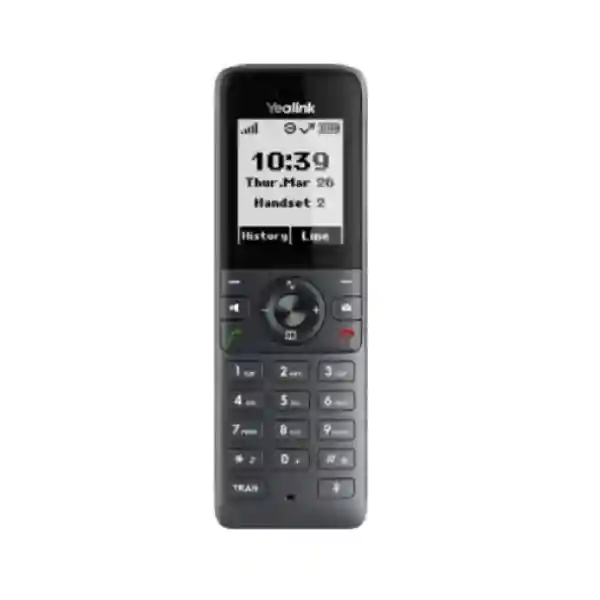
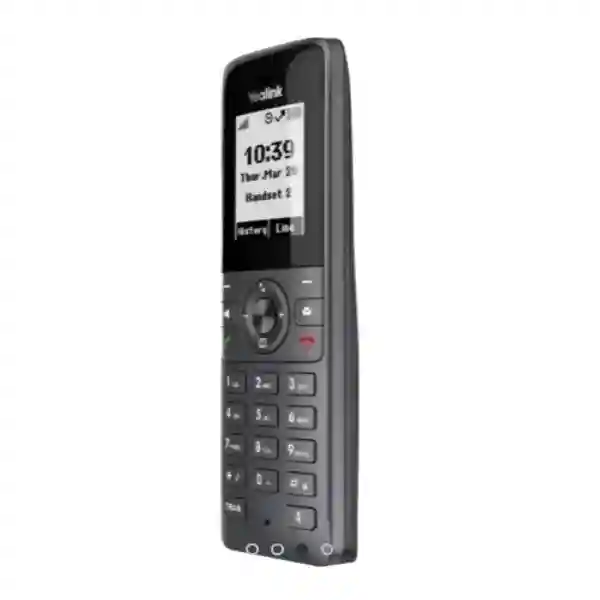
Yealink W71H DECT Handset
The Yealink W71H is a modern cordless DECT handset for organizations that want employees to stay reachable while moving away from a desk. It combines business calling features with HD audio, noise reduction, long battery life and compatibility with Yealink DECT infrastructure. For Tanzania buyers, the practical value is straightforward: the W71H can serve mobile office users, supervisors, reception support staff, retail teams, healthcare personnel and operational employees who need an extension that moves with them.
*Battery and range figures are manufacturer ratings under ideal conditions; real performance varies with use, radio environment, configuration and deployment conditions.
Carry a business extension around the workplace instead of being tied to a fixed desk phone.
Supports functions such as hold, transfer, call waiting, DND, redial, speed dial and three-way conferencing.
The handset is designed to be easy to carry and can be added to a compatible Yealink DECT environment after capacity is checked.
What is the Yealink W71H?
The W71H is a Yealink DECT handset intended for business voice mobility. It is not a complete standalone IP phone system by itself; it is a cordless endpoint that registers to compatible Yealink DECT infrastructure. Yealink lists the W71H as compatible with the W70B, and the W71P system can support up to ten handsets, ten SIP accounts and twenty simultaneous calls, with up to two simultaneous calls per handset. Yealink also lists compatibility with wider DECT infrastructure in its handset comparison information, so organizations planning expansion should validate the exact base or multi-cell system, firmware and handset mix before purchase.
For buyers comparing a cordless business phone with a desk phone, the key difference is mobility. A desk phone is normally fixed to one workstation. A W71H user can move within the DECT coverage area while keeping access to a business extension. That is useful in environments where the person answering calls may spend time at a reception counter, stock room, service desk, clinic room, warehouse aisle or shared work area.
FourTeck Tanzania can help buyers evaluate the handset in the context of the complete voice environment: base-station capacity, SIP/PBX compatibility, building layout, expected call volume, coverage, charging locations, handset quantity, user roles and future growth. See the FourTeck Tanzania business technology shop for broader purchasing context, or review technology services and integration support when the requirement includes configuration or network readiness.
Verified Yealink W71H features
| Display | 1.8-inch 90 × 65 black-and-white screen with icons, soft keys, caller ID, notification light, date/time, screen saver and multilingual interface. |
| Audio | HD audio, full-duplex speakerphone, hearing-aid compatibility, flexible noise reduction/noise cancellation and 100 Hz–7 kHz frequency response. |
| Calls | Up to two simultaneous calls per handset plus common business controls including transfer, hold, call waiting, DND, forwarding, redial and three-way conference. |
| Battery | Up to 30 hours talk time and up to 340 hours standby in ideal conditions; Yealink also specifies 10-minute quick charging for up to two hours of talk time. |
| Range | Manufacturer-rated DECT range up to 50 metres indoors and up to 300 metres outdoors in ideal conditions. Walls, shelving, interference and building construction can reduce practical coverage. |
| Physical | Approx. 144.5 × 48 × 21 mm, 112 g, space gray, with backlit keypad and dedicated call-function keys. |
Compatibility matters before ordering
A handset purchase should not be approved only from the model name. Confirm the Yealink DECT base or multi-cell system already installed, firmware version, available handset registrations, SIP account capacity, number of concurrent calls, PBX or hosted-voice platform, charging requirement and expected radio coverage. For a new deployment, evaluate the complete DECT system rather than treating the handset as an isolated device. If the business also needs desk endpoints, review the FourTeck Tanzania IP telephony and integrated IT portfolio so cordless and fixed endpoints can be planned together.
Business use cases for the Yealink W71H
Reception and front office
Give reception support staff a portable extension when they need to leave the main counter, escort visitors, collect documents or coordinate with other areas. The handset can help retain continuity without forwarding every call to a mobile network.
Retail and service counters
Employees can move between customer areas and back-office locations while remaining connected to the business voice system, provided DECT coverage has been verified for the site.
Warehousing and operations
Supervisors who move between desks, storage zones and dispatch areas may benefit from a cordless extension. For harsh environments, compare the W71H with ruggedized Yealink options rather than assuming a basic handset is appropriate.
Clinics and professional services
Mobile staff can receive internal and external calls as they move between rooms. Buyers should define privacy, call-routing and charging procedures as part of the deployment.
Yealink W71H Tanzania
Organizations searching for the Yealink W71H in Tanzania are usually solving one of two problems: they want to add a cordless user to an existing Yealink DECT installation, or they are building a new voice system for employees who move around the workplace. In both cases, procurement should begin with compatibility and capacity rather than price alone. Confirm whether the site already uses a W70B or another supported Yealink DECT platform, how many registrations are available, how many calls can be active at once and whether the PBX or hosted SIP service is ready for the additional extension. A quotation should distinguish clearly between the handset, charger, base station if required, PBX or SIP services, installation and any network work.
Tanzanian businesses often deploy voice endpoints alongside switching, Wi-Fi, firewall and structured cabling. The W71H does not connect to the LAN in the same way as a typical Ethernet desk phone; the DECT base is the network-facing component. That makes base location particularly important. Radio coverage inside offices can be reduced by reinforced walls, metal partitions, shelving, plant rooms and floor separation. The manufacturer’s ideal indoor range should therefore be treated as a planning reference, not a guaranteed site result. A coverage assessment is sensible for larger buildings.
For procurement teams, request the exact model, quantity, intended base, required accessories and delivery scope. FourTeck can also help align the handset with wider voice requirements such as IP PBX, SIP extensions, call routing, voice VLAN planning and network resilience. Use the Tanzania contact page to share the site, quantity and existing phone-system details before asking for a final quote.
Yealink W71H Dar es Salaam
In Dar es Salaam, the W71H can fit offices, retail premises, clinics, hospitality environments and service businesses where employees need a business extension while moving between rooms or customer-facing areas. A central business district office may have relatively compact coverage requirements, while a warehouse, showroom or multi-floor property can need more deliberate radio planning. Buyers should map where the user actually needs to answer calls, where the handset will charge and whether the existing base can provide dependable signal across those paths.
For an existing Yealink deployment, check base model and firmware before adding handsets. For a new system, clarify the number of mobile users, simultaneous calls, SIP accounts, reception workflow and PBX platform. The W71H supports common call functions that suit normal business users, but a receptionist handling heavy multi-line traffic may be better served by a desk phone or a mixed endpoint strategy. Likewise, operational areas with dust, moisture or drop risk may require a ruggedized handset rather than the W71H.
A Dar es Salaam quotation is more useful when it contains the complete requirement: handset quantity, base stations, chargers, PBX integration, configuration, voice-network dependencies and any expansion expectation. Avoid assuming that advertised DECT range equals guaranteed coverage in a real building. Furniture, walls, glass, metal and nearby radio sources all influence performance. FourTeck can review these variables together with the wider communications environment so that procurement is based on the actual site rather than only on a catalog specification.
Yealink W71H Mwanza
Businesses in Mwanza considering the Yealink W71H may include offices, distribution operations, healthcare facilities, shops, education sites and organizations with staff who move between work zones. The handset is most valuable when mobility is part of the job. Before purchase, identify whether users need to walk between rooms, counters, storage areas or outdoor-adjacent workspaces while keeping the same business extension. This helps determine whether one base is sufficient or whether a larger DECT design should be investigated.
Power and network planning also matter because the handset depends on its charger and the voice service depends on the DECT base, LAN, PBX or hosted SIP platform. If continuity is important, assess UPS protection for the network, base station and internet or PBX infrastructure. The long manufacturer-rated standby time of the handset is useful operationally, but it does not preserve calling if the base or network path is unavailable. Treat resilience as a system requirement rather than a handset feature.
For purchasing, provide the existing telephony platform, number of users, expected call volume, coverage area and any future expansion. Ask for confirmation of included accessories and verify whether additional bases or other handsets are required. This disciplined approach helps Mwanza buyers compare quotations on equivalent scope instead of comparing a handset-only price against a complete deployed solution.
Yealink W71H Arusha
Arusha organizations in tourism support, professional services, healthcare, education, retail and administration can use the W71H where staff need to stay reachable while circulating through a property. Hotels and guest-service environments, for example, may have operational users who move between reception, offices and service spaces. The correct DECT design depends on building shape, wall materials and the areas where calls must remain stable. The W71H’s ideal range figures should therefore guide initial planning but should not replace an actual site assessment for larger or segmented premises.
A buyer adding W71H units to an existing system should check the current base capacity and handset registrations before ordering. A buyer starting from zero should consider the W71P/W70B family or other compatible Yealink DECT architecture according to scale. It is also useful to decide whether every mobile user needs the same handset. Some environments may justify ruggedized models, while executives or specialist users may prefer premium handsets with other features. Standardizing user profiles can improve both cost control and support.
When requesting a quote in Arusha, state the number of handsets, deployment location, PBX or SIP provider, desired extension numbering and coverage expectations. Include whether configuration, testing and training are needed. The resulting proposal can then separate equipment from deployment work and avoid ambiguity about what is included.
Yealink W71H Dodoma
The Yealink W71H can suit Dodoma offices, institutions, professional services and operational teams that require internal mobility without moving business calling entirely to cellular phones. A cordless DECT extension can keep users on the organization’s PBX numbering and call-routing rules while allowing movement within the radio coverage area. This can be useful for supervisors, administrative staff and shared-service teams who are frequently away from a single workstation.
For public-sector and structured procurement environments, technical scope should be written precisely. Specify the handset model, compatible base requirement, quantity, charger inclusion, SIP extension requirements and any configuration or installation services. Avoid writing broad requirements such as “wireless phone” when compatibility with an existing Yealink system is essential. If the deployment is new, include the base station and voice platform in the design rather than procuring handsets independently.
A site with several floors or separated departments may need a broader DECT strategy. Assess coverage, concurrent-call capacity and future growth before final approval. If voice is business-critical, also consider network resilience, UPS protection and backup connectivity for the PBX or SIP service. FourTeck can help connect the handset requirement with the wider telecom and IT environment rather than treating it as an isolated accessory.
Yealink W71H UAE
For UAE businesses sourcing the Yealink W71H, the same buying principles apply: verify the precise DECT system, firmware, SIP platform, base capacity and coverage requirement before ordering. Offices, clinics, hospitality sites, shops and warehouses may use cordless extensions to keep mobile employees reachable without assigning every call to a cellular device. In large or high-density properties, evaluate whether a single-base architecture is sufficient or whether a multi-cell solution is more suitable.
Regional projects can also involve mixed endpoint fleets. A reception desk may use a feature-rich desk phone, managers may use executive SIP phones, meeting rooms may use conferencing endpoints and mobile staff may use DECT handsets. Designing these user profiles together makes provisioning and support easier. For broader UAE telecom and infrastructure requirements, organizations can review FourTeck UAE technology solutions and coordinate cross-region standards where the same organization operates in Tanzania.
When comparing UAE quotations, confirm whether the W71H is offered as handset-only or as part of a DECT package, which accessories are included, and whether configuration, installation, warranty and support are separate. This avoids comparing unlike scopes and helps procurement teams build a more accurate total project cost.
Yealink W71H Uganda
Ugandan organizations looking for the W71H may be expanding an existing Yealink phone system or creating mobile extensions for staff in offices, retail, clinics, warehouses and service operations. The handset’s long ideal-condition battery ratings and compact design are helpful for people who spend much of the day away from a desk, but radio planning remains essential. Verify where users move, the walls or structures between those areas and the likely base-station position.
Businesses operating across Uganda and Tanzania can benefit from standardizing phone models and configuration practices where practical. A common handset fleet can simplify spares, user training and support, but only when local PBX, SIP and regulatory requirements are accounted for. For Uganda-specific sourcing and broader infrastructure, see FourTeck Uganda.
Before ordering, confirm whether the requirement is handset-only, handset plus base, or a complete voice deployment. Include the number of users, simultaneous calls, extension plan, network readiness and any branch integration. If an existing base is already near its registration or call limit, buying additional handsets without capacity planning can create avoidable rework.
Yealink W71H Kampala
Kampala buyers often need cordless business phones for busy commercial environments where staff move between offices, customer areas and operational spaces. The W71H can provide a portable SIP extension through compatible Yealink DECT infrastructure, supporting everyday functions such as transfer, hold, forwarding, DND, call waiting and three-way conferencing. These capabilities are useful for general office users who need mobility without the complexity of a premium endpoint.
In multi-floor Kampala offices or properties with dense internal walls, do not plan solely from theoretical range. A base placed in a server room or at one extreme of the building may not provide the same practical result as a more central location. Where mobility is business-critical, test the walking paths users actually follow. Also verify that the LAN and PBX are stable, because a cordless handset cannot compensate for poor voice-network performance.
Procurement teams should ask vendors to identify the exact included components and supported base system. If several branches will use the same platform, define a standard naming, extension and provisioning method. This creates a cleaner operational model and makes later expansion easier.
Yealink W71H Arua
For organizations in Arua, a cordless DECT handset can be especially practical where staff must move between a main office, service points, stores or adjacent operational areas. The W71H offers business calling without tying the user to a desk, but the overall solution depends on the base station and IP voice platform. Start by defining the physical area that needs coverage and the number of people who may call at the same time.
If the organization already uses Yealink DECT, confirm the precise installed base model, firmware and available registration capacity. If it does not, compare a new W70B-based setup with larger multi-cell options according to the size and growth of the site. This is important because a handset purchase can look inexpensive initially but require additional infrastructure if coverage or capacity was underestimated.
When requesting an Arua quotation, include quantities, user roles, PBX or SIP service, base-station requirements, installation scope and support expectations. Ask whether spare batteries, extra chargers or rugged handsets are needed for specific users. A mixed approach can often be more appropriate than assigning the same device to every employee.
Yealink W71H Mbarara
Mbarara businesses can consider the W71H for mobile office and operational users who need to remain part of the company’s SIP or PBX calling environment while moving through the premises. The handset is lightweight and designed for normal business use, with HD audio and noise-reduction features that can improve clarity in typical workplace conditions. For noisier or physically demanding environments, evaluate whether a ruggedized Yealink handset is a better match.
A dependable deployment starts with the base. Place it according to radio coverage rather than convenience alone, and verify the LAN connection, PBX registration and power. If the site depends heavily on voice, consider backup power for the network equipment and base station. The handset’s own battery life does not maintain service if upstream voice infrastructure is down.
For procurement, compare complete scope: handset, charger, base where required, PBX configuration, SIP account, network setup and deployment services. This prevents the common mistake of treating a cordless endpoint as a complete phone system. Clear scope also makes it easier to compare different vendor quotations fairly.
Yealink W71H Gulu
In Gulu, the W71H may suit organizations that need simple business mobility for administrators, supervisors, clinic staff, hospitality teams or retail employees. Its core strength is not a long list of premium features; it is the ability to deliver familiar business calling in a compact cordless format. That makes it useful for users who need to answer, transfer and manage calls while moving within the workplace.
Before purchase, distinguish between handset range and full-system availability. DECT radio coverage depends on the base location and building, while call completion also depends on the PBX, LAN and upstream service. A coverage plan should identify critical call zones and any dead spots. In larger compounds, a multi-cell architecture may be a better long-term fit than stretching a single-base deployment beyond its practical role.
A useful Gulu quotation should document models, quantities, compatible bases, included accessories, configuration and testing. If future growth is likely, ask how additional handsets and calls will be accommodated. Planning the next expansion stage now can prevent replacement of newly purchased infrastructure later.
Yealink W71H Kenya
Kenyan businesses can deploy the W71H in offices, retail, healthcare, hospitality and operational environments where mobile staff need access to a business extension. For organizations with regional operations, standardizing on Yealink DECT can help reduce training and support differences between sites, but each site still requires its own coverage and capacity review. Building size, wall construction and base placement can change practical results significantly.
Procurement teams should confirm whether they are adding handsets to an installed system or buying a complete DECT solution. For a new deployment, define user count, simultaneous calls, PBX/SIP platform and expected growth. For an extension project, verify the base station’s remaining registration capacity and firmware compatibility. See FourTeck Kenya for Kenya-focused technology sourcing and deployment context.
When comparing quotes, check charger inclusion, base requirements, configuration and support rather than comparing only unit price. Where workers face harsh physical conditions, consider ruggedized handsets for those roles instead of forcing a basic office handset into an unsuitable environment.
Yealink W71H Kuwait
Organizations in Kuwait can use the W71H for office mobility where employees need a cordless extension linked to a business SIP or PBX platform. Common scenarios include clinics, stores, service counters, offices and hospitality properties. The handset’s quick-charge capability can be useful for shift-based use, although charging discipline and spare-unit planning should still be part of an operational policy.
Large commercial properties should verify radio coverage and consider whether a multi-cell DECT deployment is more appropriate than a single base. Dense construction, service corridors and multiple floors can all affect signal. Organizations operating across countries may also want common dial-plan and handset standards so users see similar behavior at each branch. For Kuwait-focused requirements, FourTeck Kuwait provides regional technology context.
A strong quotation should include the exact handset and base architecture, quantities, PBX integration, SIP licensing where applicable, accessories, configuration and testing. Ask for the assumptions behind the design so procurement can compare complete solutions rather than isolated equipment prices.
Yealink W71H Ghana
Ghanaian organizations evaluating the W71H can focus on practical mobility: who needs to move, where they move and how important it is to remain reachable on the business extension. That user journey determines base placement and whether one radio cell is enough. The W71H can serve normal office mobility well, while environments with physical abuse, outdoor exposure or specialist requirements may justify another handset class.
For existing Yealink systems, confirm supported base hardware and available capacity. For new installations, plan the full DECT and voice architecture, including SIP accounts, PBX routing, LAN connection and backup power. A well-scoped design also identifies who will provision handsets, manage firmware and maintain configuration records after installation. Regional organizations can consult FourTeck Ghana when coordinating local requirements.
Procurement teams should compare quotations using the same bill of requirements. Include handsets, chargers, bases, configuration, deployment, support and any telephony licensing. This makes the commercial comparison clearer and reduces unexpected additions during installation.
Yealink W71H Nigeria
Nigerian businesses looking for the W71H may be supporting mobile users in offices, healthcare, retail, hospitality, logistics and professional services. The handset can keep staff connected to the corporate voice platform as they move around a site, provided the DECT design is suitable for the property. For large offices or operational facilities, survey likely coverage zones instead of relying on maximum range figures.
Voice continuity may depend on backup power and resilient connectivity, so include the base station, switch, router, PBX and internet path in resilience planning where required. A handset with a charged battery cannot make calls if the network-side infrastructure is unavailable. Businesses operating multiple branches may also benefit from standardized extension numbering and handset naming conventions. See FourTeck Nigeria for Nigeria-focused sourcing and technology support context.
For quotations, state user quantity, base architecture, PBX/SIP platform, coverage expectations and installation scope. If users operate in rough physical environments, compare ruggedized Yealink DECT alternatives for those roles rather than assuming the W71H is suitable for every user.
Yealink W71H Seychelles
In Seychelles, hospitality, administration, professional services and other businesses may use a cordless DECT handset to keep staff connected across reception, offices and service areas. The W71H is compact and focused on business calling, making it appropriate where a user needs mobility but does not require a ruggedized or feature-heavy premium handset. Properties spread across multiple structures should pay particular attention to coverage architecture.
A resort, office complex or property with several buildings may exceed the practical role of one base station. Where calls must continue while users move across larger areas, assess compatible multi-cell Yealink options and network connectivity between the required locations. Also plan charging points around work shifts so handsets remain available without disrupting operations.
For procurement, request clear scope covering the handset, compatible base infrastructure, PBX or SIP integration, installation, testing and support. If importing or coordinating regionally, confirm power accessories, frequency/regulatory suitability and model availability for the destination market. Avoid assumptions based on a product listing from another country.
How to choose the right Yealink DECT option
Choose the W71H when the priority is straightforward business mobility with HD audio and essential call controls. Consider other Yealink handsets when requirements change. Ruggedized models can be better for warehouses, workshops and physically demanding environments. Premium models may add features such as larger displays, vibration or Bluetooth depending on the exact model. The right handset mix is therefore driven by job role rather than by choosing one device for every employee.
The same principle applies to DECT infrastructure. Small sites may fit a simple base architecture, while larger campuses, multi-floor offices and roaming-intensive deployments may require multi-cell design. Confirm compatibility from current Yealink documentation before combining handsets and bases, particularly in mixed-generation environments.
Quotation checklist
How many handsets are needed now, and what growth is expected?
Provide the exact base model and firmware if adding to an installed system.
State the PBX, hosted voice provider and extension requirements.
Describe floors, walls, outdoor-adjacent areas and walking routes that require voice service.
Confirm chargers, batteries and any spares or alternative handset requirements.
Specify whether configuration, deployment, testing, documentation or user handover is required.
Yealink W71H FAQs
Does the Yealink W71H work by itself?
No. It is a DECT handset that must register to compatible Yealink DECT infrastructure. Confirm the base system and PBX/SIP environment before ordering.
Is the W71H compatible with the Yealink W70B?
Yes. Yealink officially lists W70B compatibility for the W71H. Capacity and firmware should still be checked for the specific deployment.
What is the Yealink W71H battery life?
Yealink rates it for up to 30 hours of talk time and up to 340 hours of standby time in ideal conditions. Real-world results vary with use, battery condition and environment.
What range does the W71H provide?
Yealink specifies up to 50 metres indoors and up to 300 metres outdoors in ideal conditions. Actual coverage depends strongly on walls, metal, interference and base placement.
Does the W71H support speakerphone?
Yes. Yealink specifies a full-duplex speakerphone along with HD audio and noise-reduction functions.
What information should I send for a quotation?
Send quantity, location, existing base model if any, PBX/SIP platform, required coverage, user roles and whether configuration or deployment services are needed.
Decision recap
The Yealink W71H is a strong fit for normal business users who need a portable extension, HD audio, essential call controls and long manufacturer-rated battery life. It is best purchased as part of a verified DECT design. Confirm the compatible base, capacity, PBX/SIP platform, coverage and accessories before procurement.
For cross-regional organizations, FourTeck can help align endpoint selection with broader voice, network and infrastructure needs through the regional FourTeck network. For general group capabilities, visit FourTeck.
Talk to FourTeck about your Yealink W71H requirement
Share the handset quantity, your existing Yealink base or PBX if applicable, the building layout and the areas where users need cordless coverage. FourTeck can help turn those details into a clearer bill of materials and quotation scope without assuming that one handset or one base design fits every site.



Reviews
There are no reviews yet.