
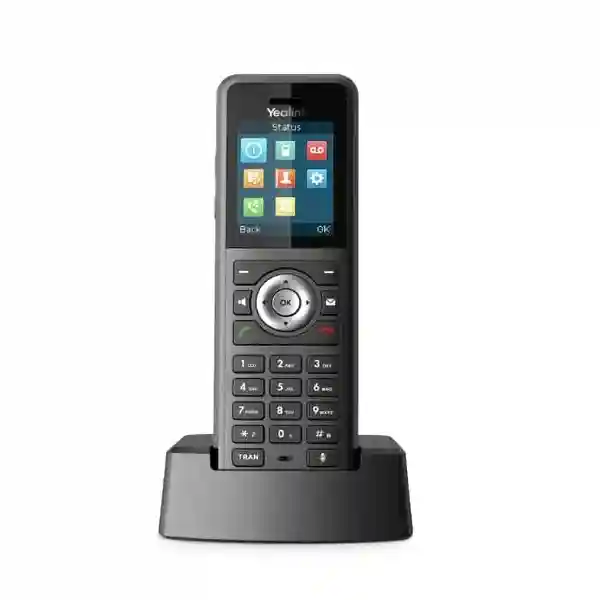

Yealink W59R Rugged DECT Handset Tanzania
The Yealink W59R Rugged DECT Handset is built for organisations that need mobile voice communication in places where an ordinary cordless phone may be too delicate. Its IP67 protection rating, tough rubberised construction, resistance to dust and water, drop protection up to 2.5 metres, vibration alert, Bluetooth 4.2 and dedicated worker-safety alarms make it well suited to warehouses, production facilities, workshops, service yards, hospitality back-of-house areas, utilities, construction support environments and other operational sites. For Tanzania buyers, the key purchasing question is not simply whether the handset is rugged; it is whether the complete DECT design provides the coverage, roaming, call handling and integration required by the site. The W59R is designed to work with Yealink DECT infrastructure, including the W70B single-cell platform and W75/W80/W90 multi-cell systems, allowing buyers to plan from a single handset requirement through to broader roaming deployments.
Designed to resist dust, splashes and water exposure, with a rugged surface intended for demanding workplaces.
Push-button, no-movement, man-down and running alarms can support safety-oriented workflows when correctly configured.
Supports seamless roaming and handover with compatible Yealink DECT systems for users who move across operational zones.
Up to 28 hours of talk time and up to 360 hours of standby time under the vendor’s stated ideal operating conditions.
What makes the Yealink W59R different?
The W59R is not simply a standard office DECT handset with a protective shell. Yealink positions it as a professional ruggedized model for environments that may be dusty, humid, noisy or physically demanding. The handset carries an IP67 rating, and Yealink states that it can withstand a fall of up to 2.5 metres and immersion in water up to one metre for up to 30 minutes. The exterior is also described as scratch resistant and disinfectant resistant. These characteristics can be particularly valuable when handsets are shared between shifts, clipped to workwear, used around loading areas, carried through service corridors or exposed to environments where accidental drops and routine cleaning are expected.
For communication quality, the handset combines HD audio, full-duplex speakerphone operation and Yealink Flexible Noise Reduction. This is relevant where background sound from machinery, fans, loading activity, service counters or busy public environments can make ordinary cordless calls difficult to follow. A vibration alert offers another notification method for noisy spaces. Bluetooth 4.2 permits connection to compatible Bluetooth headsets, helping users who need hands-free mobility. The W59R also includes a 1.8-inch 128 × 160 TFT colour display, illuminated keypad, keypad lock, three-way conferencing, call transfer, hold, call waiting, DND, voicemail access and remote phonebook functions supported through the Yealink DECT ecosystem.
Safety functions are an important reason organisations evaluate this model. The W59R supports push-button alarm, no-movement alarm, man-down alarm and running alarm functions. These capabilities should be treated as part of a wider site safety process rather than as a substitute for formal safety systems. When planning a deployment, confirm how alarms will be configured, which users need them, how emergency calls or notifications are routed, and how the organisation will test and maintain the procedure. This makes the handset more useful as an operational communication device rather than purchasing it solely for its rugged appearance.
Verified technical highlights
| Protection | IP67 ruggedized design; vendor states drop resistance up to 2.5 m and water immersion up to 1 m for up to 30 minutes |
| Display | 1.8-inch 128 × 160 TFT colour screen |
| Audio | HD audio, full-duplex speakerphone, FNR, HAC compliance |
| Wireless accessories | Bluetooth 4.2 for compatible Bluetooth headsets |
| Alerts | Vibration alert plus push-button, no-movement, man-down and running alarms |
| Battery | 1460 mAh Li-ion; up to 28 hours talk / 360 hours standby; Bluetooth-headset figures are lower |
| DECT range | Up to 50 m indoors and up to 300 m outdoors in ideal conditions |
| Compatible Yealink systems | W70B single-cell and W75/W80/W90 multi-cell systems; current Yealink comparison material also lists W60B/W75B/W80B/W90B/VIM compatibility |
| Handset size / weight | 157 × 51 × 24 mm; 183 g |
Deployment and buying guidance
A strong W59R deployment starts with coverage and system design. A single-cell Yealink base can be appropriate for a smaller site where one DECT coverage area is sufficient. Larger premises, multi-floor buildings or sites where staff walk between production, storage and administration areas may require a multi-cell architecture so calls can roam and hand over across coverage zones. Actual range is affected by walls, metal shelving, machinery, reinforced concrete, building layout and radio conditions, so the vendor’s ideal-range figures should be treated as planning references rather than guaranteed site coverage.
Procurement teams should also distinguish between the handset and the complete telephony solution. The W59R is an endpoint and normally needs compatible Yealink DECT infrastructure and a SIP/VoIP service or PBX configuration behind it. Before requesting a quote, identify the number of users, number of simultaneous calls, required roaming areas, expected indoor and outdoor coverage, existing PBX or SIP platform, Bluetooth headset needs and any emergency-alarm workflow. For multi-cell designs, provide a basic floor plan and indicate heavy walls, warehouses, lifts, plant rooms and external work areas. Those details are more useful than simply ordering a handset quantity without understanding how users move around the site.
For Tanzania enquiries, FourTeck’s Tanzania contact page can be used to provide model quantity, site type, user count and telephony requirements. Organisations with connected requirements in neighbouring markets can also review FourTeck Uganda communication solutions and FourTeck Kenya IT and VoIP solutions. Broader regional projects may use FourTeck Africa, while buyers researching specialist IP telephony can review FourTeck IP phone solutions.
Yealink W59R Rugged DECT Handset Tanzania
In Tanzania, the W59R is especially relevant to organisations that operate beyond conventional desk-based offices. Warehouses, distribution centres, manufacturing facilities, hospitality properties, utilities, transport operations, workshops and campuses often need employees to remain reachable while moving between work zones. A rugged handset changes the buying discussion from simply providing cordless calling to designing a dependable mobile voice layer for operational staff. The IP67 rating helps where dust, moisture or frequent handling are realistic concerns, while the vibration alert is useful in environments where audible ringing may be missed. Bluetooth support can assist supervisors, technicians and warehouse staff who need hands-free communication while carrying out tasks.
Tanzania buyers should assess the complete DECT footprint before ordering. For a compact office or small facility, a compatible single-cell base may be enough. Larger warehouses, industrial compounds, hotels or multi-building sites should evaluate Yealink multi-cell options and plan coverage around physical obstructions. Metal racking, concrete, service shafts, dense partitions and outdoor transitions can all affect real-world radio performance. A coverage survey or structured placement plan may therefore be more valuable than relying on the maximum ideal distance in a datasheet. If uninterrupted calling while walking between areas is important, the roaming and handover design should be included in the requirement from the beginning.
The safety alarms also deserve a clear operational policy. A man-down or no-movement feature is only useful when the organisation knows who receives the alert, which number is called and how the response is escalated. Businesses should document those workflows, test them and train users. Procurement requests should specify whether the alarms are a core requirement or an additional benefit, because that affects configuration and acceptance testing. For shared handsets, consider charging routines, device allocation, sanitisation and spare units. The handset is described by Yealink as disinfectant resistant, which can be useful for shift-based environments, but organisations should still follow appropriate cleaning instructions.
When requesting a Tanzania quotation, include handset quantity, existing PBX or SIP service, base-station model if already installed, required coverage areas, number of concurrent calls and any headset requirement. If the site is new, include a floor plan or approximate dimensions and explain where staff spend most of their time. This allows the discussion to focus on the correct DECT architecture rather than treating the W59R as an isolated device.
Yealink W59R Rugged DECT Handset Dar es Salaam
Dar es Salaam organisations frequently combine administration, logistics, retail, hospitality and industrial operations across busy sites. The W59R can suit teams that move between offices, loading zones, storerooms, service corridors or workshops and still need dependable extension-based calling. Rather than issuing a desk phone to staff who are rarely at a desk, a DECT handset keeps the communication endpoint with the employee. Its rugged casing and IP67 rating are relevant for sites where dust, humidity, accidental drops and regular handling are normal. Vibration alerts can complement the audible ringer in noisy areas, while Bluetooth 4.2 can support compatible wireless headsets for hands-free tasks.
For a Dar es Salaam warehouse or industrial facility, radio planning is critical. High metal shelving and machinery can produce very different DECT behaviour from an open office. If users must walk from storage to dispatch, from workshop to reception or between floors without losing a call, consider a compatible Yealink multi-cell system rather than sizing solely on straight-line distance. Identify critical calling zones first, then position base stations to deliver overlapping coverage where handover is required. The W59R supports seamless roaming and handover with Yealink’s compatible single-cell and multi-cell systems, but that capability depends on the underlying system being designed correctly.
Hospitality and service organisations may value the compact 183 g handset, belt clip, vibration and long stated battery endurance because employees can carry the device through a shift. Facilities teams may also appreciate the worker-safety alarms, particularly in plant, maintenance or isolated work areas. Those alarms should be configured around an agreed response process, not enabled without testing. Make sure emergency numbers, alarm types and escalation procedures are validated during commissioning.
A useful quotation request for Dar es Salaam should state the exact W59R quantity, whether the project requires new W70B or W75/W80/W90 infrastructure, the number of SIP accounts or extensions, expected simultaneous calls, building type and any difficult coverage areas. Existing Yealink installations should include the current base models and software environment. Buyers should also confirm that the required regional DECT frequency and power accessories are appropriate for the deployment before purchase.
Yealink W59R Rugged DECT Handset Mwanza
For Mwanza businesses, the W59R can be considered where staff communication has to remain mobile across operations rather than concentrated at desks. Distribution sites, warehouses, engineering workshops, hospitality properties, healthcare support areas and service facilities may all have users who move frequently and need immediate access to voice calls. The handset’s IP67 protection, rubberised construction, drop resistance and vibration alert make it a more purposeful choice than a general office handset when equipment is exposed to rougher handling. HD audio and Flexible Noise Reduction are also relevant when users work around fans, loading activity, tools or public areas where background sound can interfere with conversations.
A Mwanza deployment should be sized according to movement paths. Start by mapping where the user takes and receives calls: receiving bays, racks, kitchens, maintenance spaces, security positions, offices and external service zones. Do not assume one base will cover every location simply because the site seems geographically small. Building materials and obstructions affect DECT propagation. If staff require call continuity while moving between zones, specify roaming and handover as a design requirement. Yealink’s W75/W80/W90 multi-cell architecture can support this type of requirement when properly engineered with compatible handsets such as the W59R.
Organisations considering safety features should decide which alarm modes are useful. Man-down and no-movement alarms can be relevant to lone workers or technicians, while the side alarm button can provide a deliberate emergency trigger. The running alarm can support another type of movement-related scenario. These functions are configurable, so procurement should involve operations or health-and-safety stakeholders rather than leaving all decisions to IT. Define what an alarm should do, which endpoint receives it and who is responsible for responding.
When requesting pricing for Mwanza, include the number of handsets plus the complete system context. State whether you already have a Yealink DECT base, whether a PBX or SIP service exists, how many concurrent calls are expected and whether users need Bluetooth headsets. If the requirement covers a new facility, provide approximate dimensions and note major obstacles. This makes it easier to distinguish a handset purchase from a full DECT coverage project.
Yealink W59R Rugged DECT Handset Arusha
Arusha buyers may find the W59R useful for hotels, lodges, service businesses, warehouses, workshops, tourism-support operations and institutional sites where teams move across back-of-house or operational spaces. The key advantage is that the handset combines standard business calling with a rugged physical design. Staff can access features such as transfer, hold, call waiting, voicemail, speed dial and three-way conferencing without remaining beside a desk extension. The IP67 rating, drop resistance and vibration function add practical value for employees who work in areas where ordinary cordless endpoints may be more vulnerable to dust, moisture or accidental impacts.
Hospitality properties should plan coverage according to staff routes rather than guest Wi-Fi boundaries. DECT is a separate radio environment, and the best base placement depends on walls, service corridors, stairwells, kitchens, back offices and external utility areas. Housekeeping, maintenance, security and operations teams may all use the same handset model but need different calling groups or alarm settings. A multi-cell system can be considered when staff must move over a wider property and retain active calls during those movements.
The W59R’s battery rating is useful for shift work, but charging routines still matter. Yealink states up to 28 hours of talk time and up to 360 hours of standby under ideal conditions, with lower figures when a Bluetooth headset is used. A practical deployment should provide charging locations that match shift turnover and decide whether spare handsets or batteries are required for critical functions. Shared devices should be clearly assigned and maintained so that a depleted battery does not become an operational problem.
For Arusha quotations, identify which teams will use the devices, the quantity per role and whether there is an existing Yealink base. If the deployment includes worker-safety alarms, describe the desired emergency-call workflow. For properties with multiple buildings, outdoor links or large grounds, provide a simple map or floor plan. Those details allow a supplier to discuss whether the requirement is best served by single-cell coverage, multi-cell DECT or a mixed communication design.
Yealink W59R Rugged DECT Handset Dodoma
In Dodoma, organisations evaluating the W59R may include government-support facilities, enterprises, warehouses, service companies, construction-related operations and institutions that require mobile internal communication. The handset can function as a durable endpoint for staff who spend much of the day away from a fixed desk. Its IP67 rating and drop resistance are valuable where devices are carried between work areas, while vibration notification helps users notice calls in noisy surroundings. The 1.8-inch colour display and illuminated keypad keep the interface straightforward for everyday calling rather than turning the handset into a complex smart device.
Network planners should remember that DECT deployment is part of the voice infrastructure. The handset needs a compatible Yealink DECT base and SIP/PBX integration. For a small office, W70B single-cell coverage may satisfy the requirement. For larger institutional buildings, storage sites or compounds, W75/W80/W90 multi-cell deployment can provide a framework for roaming and handover. The number and placement of bases should be based on the actual building and radio environment, especially where reinforced walls or separated blocks can reduce coverage.
Safety-oriented teams may use the W59R alarms as an additional communication mechanism. Procurement should involve the operational owners who will respond to an alarm. The push-button, no-movement, man-down and running alerts should be configured, documented and tested. It is also sensible to create a periodic test routine, particularly if the feature is being used for remote or isolated workers. The handset supports the workflow, but organisational response procedures determine whether the feature delivers practical value.
For an accurate Dodoma request, state the handset count, coverage requirement, PBX platform, base-station requirement and user roles. Mention whether users need Bluetooth headsets and whether the site operates multiple shifts. If the requirement is a replacement project, include the current Yealink or third-party equipment. Yealink notes that its DECT technology is not intended to interoperate with third-party DECT base stations and handsets, so compatibility should be confirmed rather than assumed.
Yealink W59R Rugged DECT Handset UAE
UAE buyers often evaluate rugged DECT handsets for logistics centres, warehouses, hospitality, retail back-of-house operations, manufacturing, maintenance teams and large commercial facilities. The W59R is particularly relevant where a conventional office handset may face dust, drops or frequent cleaning. Its IP67 protection rating, rugged rubberised housing, vibration alert, Bluetooth 4.2 and safety alarms create a feature set aimed at operational mobility. Users still receive familiar business-telephony functions, so the device can fit into an extension-based communication design rather than becoming a separate radio system with its own user experience.
Large UAE warehouses should pay particular attention to base layout because tall racking, dense stock and metal infrastructure can alter radio coverage. The advertised DECT range is measured in ideal conditions and should not be used as a guaranteed design radius. A multi-cell plan should focus on overlapping coverage and the routes users actually take. If staff move between receiving, storage, dispatch and office areas while remaining on calls, make seamless handover part of the acceptance criteria.
For hospitality or facilities-management teams, Bluetooth headsets and belt clips can support hands-free communication. The vibration alarm helps in noisy mechanical spaces, service corridors or public venues. Safety alarms may also be useful for maintenance or lone-working scenarios, but the organisation should define response procedures and test alarm routing. Battery management matters in 24-hour operations; although the vendor quotes long talk and standby times, charging and device rotation should be planned around real shift patterns.
A UAE procurement request should distinguish the handset from the system around it. Specify whether W70B or a W75/W80/W90 multi-cell environment already exists, the number of extensions, expected simultaneous calls and any PBX or hosted-SIP platform. For new systems, include floor plans and coverage priorities. This information supports a more reliable system design and helps avoid ordering handsets before confirming the required base infrastructure.
Yealink W59R Rugged DECT Handset Uganda
Uganda organisations can use the W59R as part of a Yealink DECT voice environment where employees need to move across facilities while staying connected to the business telephone system. Warehouses, hotels, distribution companies, factories, workshops, institutions and service operations are natural use cases because the handset is designed for dustier, wetter and rougher conditions than a conventional office endpoint. IP67 protection, vibration notification and drop resistance address the physical environment, while HD audio, Flexible Noise Reduction and familiar call controls address communication quality and usability.
The handset should be evaluated with the correct base architecture. A single-cell installation can be appropriate for smaller premises, but a larger Ugandan warehouse, hotel or campus may need multi-cell coverage. Mapping user movement is important: employees may take calls from receiving to storage, from security to maintenance or between different floors. Where live calls must continue across those zones, multi-cell roaming and handover should be tested in the actual building.
Uganda buyers should also confirm whether safety alarms have a defined business need. The W59R includes push-button, no-movement, man-down and running alarms. These can be useful for selected roles, but successful deployment requires configuration and a response process. IT teams can configure the feature, while operational managers should define who is alerted and what action follows. Treating this as a joint IT-and-operations requirement produces a more meaningful result than simply enabling every alarm by default.
For regional projects, buyers can reference FourTeck Uganda alongside the Tanzania deployment when requirements span multiple countries. A practical request should include handset counts by site, the PBX or SIP platform, base requirements, user groups and any difficult radio zones. Cross-border standardisation can simplify training and spares, but each site still needs its own coverage assessment because building layouts and operational patterns differ.
Yealink W59R Rugged DECT Handset Kampala
Kampala businesses looking for rugged cordless telephony may consider the W59R for warehouses, retail operations, hotels, facilities-management teams and commercial sites where users are frequently away from fixed phones. The W59R keeps extension-based calling mobile while adding features that suit operational environments. Its vibration alert can make incoming calls easier to notice in busy locations, and its Bluetooth interface can connect compatible wireless headsets. The rugged IP67 construction helps protect the handset from dust and water exposure and is designed to tolerate more demanding day-to-day handling.
Coverage planning should reflect Kampala building conditions. Multi-floor concrete structures, underground service areas, storage racks and separated blocks can all affect radio propagation. Rather than calculating coverage from the maximum ideal distance, identify the most important communication zones and plan a base layout that supports them. For single-floor offices or smaller sites, W70B may be sufficient; for more complex sites, Yealink multi-cell infrastructure can create a roaming environment for W59R users.
Kampala customers should consider whether users will share handsets. Shared devices need clear ownership rules, charging points and a cleaning routine. The W59R is described as scratch resistant and disinfectant resistant, which can help in shift-based environments, but proper handling remains important. If Bluetooth headsets are used, factor those devices into charging, allocation and hygiene planning as well. The vendor’s battery figures should be treated as ideal maximums, with actual endurance influenced by use patterns and radio conditions.
When obtaining a quote, state whether the request is for handsets only or a complete DECT solution. Provide extension count, concurrent call expectations, PBX type, floor plan, working zones and any safety-alarm requirements. This level of detail helps the proposed solution reflect the real communications workflow instead of focusing only on the unit price of the handset.
Yealink W59R Rugged DECT Handset Arua
Arua organisations may consider the W59R where field-support, warehouse, institutional, hospitality or service staff need a more durable cordless endpoint than a normal office handset. The combination of IP67 protection, vibration alerts, ruggedised construction and DECT mobility makes it suitable for users who move repeatedly between operational areas. The handset remains focused on voice, which can be an advantage where simple, reliable communication is more important than deploying general-purpose smartphones for every role.
Smaller Arua sites may prefer a straightforward single-cell setup, provided coverage is validated. Warehouses or facilities with multiple buildings should investigate multi-cell DECT. DECT range depends on the physical environment, so walls, storage materials, metal structures and outdoor transitions need attention. If staff must retain an active call while walking between zones, the design should support seamless handover and be tested during commissioning. Coverage should be measured where employees actually work rather than only in corridors or offices.
The W59R safety alarms can add another dimension for workers who operate alone or in less visible areas. A side alarm button allows a deliberate trigger, while movement-based alarms can support defined safety procedures. These functions should be configured carefully to avoid unnecessary alerts and to ensure real alarms are routed to people who can respond. The feature is best treated as part of operational planning and training rather than as a checkbox on a product specification.
Arua procurement teams can improve quotation accuracy by stating handset quantity, whether base stations are already installed, the PBX or SIP platform, the number of users and expected call load. Include any desired Bluetooth headsets and note whether devices will be shared between shifts. For new deployments, even a simple sketch showing buildings and key working zones can help determine whether the project needs one base, repeat coverage or a planned multi-cell architecture.
Yealink W59R Rugged DECT Handset Mbarara
Mbarara businesses with warehouses, hotels, workshops, healthcare-support operations or distribution activities may find a rugged DECT handset more practical than a desk-only phone for mobile staff. The W59R combines business calling with an IP67 enclosure and 2.5-metre stated drop resistance, making it better aligned with environments where devices are clipped to clothing, carried between work areas and exposed to greater physical risk. The vibration feature can assist users in noisy spaces, while HD audio and Flexible Noise Reduction are intended to improve speech quality.
The decision should include the underlying DECT network. A handset does not create coverage on its own. For a compact facility, compatible single-cell infrastructure may provide the required service. If users move through multiple floors, wings or buildings, a multi-cell design may be more appropriate. The W59R can roam and hand over between compatible Yealink cells, making it possible to keep the same handset and extension while moving through the site. Radio design should consider wall construction and operational obstacles before base locations are finalised.
Mbarara sites that operate extended hours should also plan charging. The W59R’s stated endurance is generous for a DECT handset, but real operation depends on talk volume, Bluetooth use, signal conditions and user behaviour. Provide accessible chargers and determine whether each user has an assigned handset or takes one from a shared pool. For critical roles, consider spare capacity so communication is not interrupted by charging or maintenance.
For procurement, list the exact quantity, current PBX, base stations, expected simultaneous calls and areas that need coverage. If alarms are required, identify which roles need them and what response workflow is expected. This allows the quotation to address both equipment and the configuration required to turn the W59R into a useful operational communication tool.
Yealink W59R Rugged DECT Handset Gulu
In Gulu, the Yealink W59R can support organisations where employees need dependable internal calling across practical work environments. Warehouses, service centres, institutions, accommodation properties and logistics operations often have staff who cannot remain near a desktop phone. A rugged DECT handset keeps the user reachable while maintaining access to PBX features such as transfer, hold, conference and voicemail. IP67 protection and drop resistance make the endpoint suitable for more demanding use than a standard office cordless handset.
Coverage should be planned around the real site. For a small building, one compatible Yealink base may be enough, but larger facilities can require multiple cells. Staff routes are the most useful starting point: where does a user answer a call, and where do they need to walk while keeping that call active? If those routes cross coverage zones, multi-cell roaming and handover are important. Physical barriers should be included in the design because ideal-range specifications do not represent every building.
Safety alerts can be attractive for users working alone or in isolated sections of a site. The W59R supports four alarm types, but organisations should avoid assuming that owning the handset automatically creates an emergency-response system. Define alert recipients, escalation procedures and test frequency. User training should cover both normal calling and alarm behaviour so accidental activations are reduced and genuine alarms are understood.
A Gulu quote request should specify whether the project is handset-only or includes base stations and PBX integration. Include existing Yealink equipment, handset quantity, desired headset use, shift pattern and challenging coverage areas. Where several Ugandan branches are involved, use a consistent equipment standard where practical but validate coverage separately at each site. This balances standardisation with the reality that every building has different radio characteristics.
Yealink W59R Rugged DECT Handset Kenya
Kenya organisations can deploy the W59R in logistics, warehousing, hospitality, manufacturing, healthcare support, retail and facilities-management environments where users require mobile business calling and a durable endpoint. The handset’s IP67 rating and rugged surface can reduce concern about dust, splashes and accidental impacts, while vibration notification provides a useful alert mode in busy work areas. Bluetooth 4.2 can support compatible headsets, giving employees more freedom when handling goods, tools or documentation.
Large Kenyan sites should treat the project as a DECT coverage design rather than a handset purchase. Yealink’s compatible multi-cell systems allow the W59R to roam between cells and hand over ongoing calls, but the base topology determines the user experience. Warehouses with high racks, multi-floor offices and campuses with separated buildings may require carefully positioned cells. The theoretical indoor and outdoor ranges are useful references, yet actual measurements or a site-aware plan should guide deployment.
For organisations standardising across Kenya and Tanzania, the same handset model can simplify training, accessory planning and user procedures. However, local system requirements may still differ because PBX platforms, building layouts and call volumes vary by branch. Document each site’s extension counts, concurrency, coverage priorities and user roles. If emergency alarms are part of the design, define and test them in each location rather than assuming identical behaviour across systems.
A useful Kenya quotation request should include the exact W59R quantity, compatible base requirements, PBX details, floor plan and Bluetooth-headset needs. If the project is an expansion of an existing Yealink DECT environment, provide the base models and current handset mix. Compatibility should always be checked before ordering, particularly where older infrastructure is involved.
Yealink W59R Rugged DECT Handset Kuwait
Kuwait businesses may consider the W59R for warehouses, distribution centres, industrial support, hospitality and facilities-management operations where ordinary cordless handsets can be exposed to dust, repeated handling or accidental drops. IP67 protection, the rubberised exterior and vibration alert make the device a practical operational endpoint. Bluetooth 4.2 can connect compatible headsets for hands-free work, while HD audio and FNR can help employees communicate in acoustically challenging locations.
Warehousing and logistics projects should focus on coverage around racking and enclosed work areas. Metal environments can reduce or reflect radio signals, so a straightforward distance calculation is not enough. Multi-cell systems can provide roaming and handover when staff move between receiving, storage and dispatch, but success depends on correct base placement. Commissioning should include real walking tests with active calls through the routes employees use most frequently.
Kuwait operations that run multiple shifts should plan charging and assignment carefully. The vendor’s long talk and standby figures provide useful capacity, yet Bluetooth use and intensive calling can reduce runtime. Shared handset pools should have clearly labelled devices and chargers. Safety alarms can be assigned to selected users, with defined emergency recipients and response procedures. This turns the feature into an operational workflow rather than an unused menu option.
For quotation preparation, specify handset count, existing DECT or PBX infrastructure, required roaming zones, user roles and headset needs. Confirm the correct regional radio version and power accessories for the intended market before purchase. If the system will integrate with a hosted or on-premises SIP platform, include that information so extension provisioning, codec choices and calling features can be considered alongside hardware.
Yealink W59R Rugged DECT Handset Ghana
Ghanaian organisations looking for a rugged business handset can evaluate the W59R for logistics, warehouses, hospitality, manufacturing and other sites where users move continuously while remaining part of the company PBX. A DECT handset provides a dedicated communication device with familiar telephone functions, while the W59R adds IP67 physical protection and drop resistance. This can be valuable for roles where a standard office cordless handset may be too exposed to dust, moisture or physical impact.
For a Ghana deployment, begin with user movement and call concurrency. A small site might need one base and a few handsets; a larger operation can require multiple cells and many extensions. The W59R supports up to two simultaneous calls per handset, while the wider system capacity depends on the chosen base architecture. If users must carry active calls across a large warehouse or between floors, specify seamless roaming and handover and validate coverage before final acceptance.
The worker-safety alarms deserve practical planning. Identify whether the emergency button, no-movement, man-down or running alarm is suitable for a role, and decide what call destination or response action should follow. Testing should form part of deployment because false alarms and missed alarms can both undermine confidence. Staff should know how to trigger an alarm deliberately and how automated movement-related alarms behave.
For Ghana quotations, include the W59R quantity, existing PBX or SIP service, desired Yealink base platform, coverage zones and shift patterns. State whether Bluetooth headsets are required and whether devices will be personally assigned or shared. These details help size chargers, accessories and base infrastructure rather than focusing only on the handset line item.
Yealink W59R Rugged DECT Handset Nigeria
Nigeria’s logistics, manufacturing, retail, hospitality and facilities sectors often require communication tools that can handle larger sites and demanding daily use. The Yealink W59R can fit these environments as a rugged DECT extension for mobile employees. Its IP67 rating, 2.5-metre stated drop resistance, vibration alert, Bluetooth connectivity and safety alarms target practical workplace needs, while HD voice and Flexible Noise Reduction maintain a focus on clear business calling.
On large Nigerian sites, design the DECT layer with the same discipline used for other wireless systems. Identify high-priority calling areas, movement paths, dense storage, plant rooms, stairwells and external zones. Multi-cell infrastructure can support roaming and handover, but cell placement and overlap must be correct. A coverage plan should be tested with live handsets and active calls, especially in areas with heavy concrete or metal structures.
Procurement teams should also plan system resilience and operations. Decide how handsets will be charged, whether spares are required, which teams use Bluetooth headsets and how devices are tracked between shifts. If alarms are part of the safety procedure, assign responsibilities for receiving and escalating them. The W59R supports the feature technically, but operational effectiveness depends on a documented response workflow and regular testing.
A Nigeria quotation request should clearly state whether the need is for standalone replacement handsets or a complete Yealink DECT system. Include current base models, PBX platform, extension count, simultaneous call expectations and floor plans for complex sites. This reduces the risk of buying endpoints that do not match the installed DECT infrastructure and supports a more accurate estimate of total project components.
Yealink W59R Rugged DECT Handset Seychelles
Seychelles hospitality, facilities, resort, logistics and service operations can benefit from a rugged handset where staff communication needs to move with the employee. The W59R is relevant to back-of-house teams, engineering, security, housekeeping, stores and maintenance because it combines business telephony with a durable IP67 design. Moisture resistance, vibration alerts and a belt clip can be practical in operational settings, while Bluetooth support enables compatible headsets for hands-free work.
Resort and multi-building environments require thoughtful DECT design. Guest Wi-Fi coverage does not automatically indicate DECT coverage, so the voice system should be planned independently. Map staff service routes, engineering areas, kitchens, stores, administration blocks and any outdoor transitions. If employees need uninterrupted calls across those areas, a compatible Yealink multi-cell platform may be appropriate. Building construction and separation between structures can affect the number of required cells.
Battery and operational routines matter where properties run around the clock. Chargers should be positioned for shift changes, and critical users may need spare handsets. The W59R’s vendor-rated endurance provides useful headroom, although Bluetooth use and high call volume can reduce runtime. If devices are shared, establish cleaning and assignment procedures. Yealink describes the handset as disinfectant resistant, which can help with routine shared-device care when appropriate cleaning methods are followed.
Seychelles buyers should request a quote with handset quantities by department, existing PBX information, coverage plans, expected simultaneous calls and any safety-alarm requirement. For remote or isolated maintenance roles, explain the intended alarm response path so configuration can be discussed. The aim should be a complete communication workflow, not simply a rugged handset purchase.
Compatibility, integration and system selection
The W59R is designed for Yealink’s DECT ecosystem rather than generic third-party DECT interoperability. Yealink’s current support information lists compatibility with W70B and W75/W80/W90 systems, and its handset comparison material also lists W60B, W70B, W75B, W80B, W90B and VIM. Because installed firmware and platform generations can matter, confirm the exact existing base model and software before using the W59R as a replacement or expansion handset. This is especially important when a site has older equipment or a mixed fleet.
For SIP integration, the base system—not the handset alone—connects the DECT environment to the IP telephony platform. Procurement should therefore document the PBX, hosted SIP provider or call-control system, as well as extension count, authentication requirements and desired calling features. The W59R supports common handset functions such as call transfer, forward, hold, call waiting, DND, speed dial, voicemail and three-way conferencing, but the final user experience can also depend on the PBX and provisioning configuration.
If the deployment is expected to grow, choose a base architecture with future handset and call capacity in mind. A small initial requirement can become a larger roaming system as a warehouse expands or new buildings open. Planning the long-term topology can reduce the need to redesign the voice layer later.
Frequently asked questions
Is the Yealink W59R waterproof?
The W59R has an IP67 ingress-protection rating. Yealink states that it can resist dust and water and can withstand immersion in water up to one metre deep for up to 30 minutes. This does not mean the handset should be intentionally used underwater or outside the vendor’s operating instructions.
How far can the W59R work from a base?
Yealink lists ideal DECT ranges of up to 50 metres indoors and up to 300 metres outdoors. Real coverage can be lower because of walls, metal racks, machinery and other obstacles. Multi-cell design is usually the better approach when a large site needs reliable roaming.
Does the W59R work with Bluetooth headsets?
Yes. The W59R includes Bluetooth 4.2 for compatible Bluetooth headsets. Yealink states lower talk and standby figures when a Bluetooth headset is used, so charging plans should reflect the intended accessory use.
Which Yealink base stations are compatible?
Current Yealink materials identify compatibility with W70B single-cell and W75/W80/W90 multi-cell systems. Yealink’s comparison information also lists W60B, W70B, W75B, W80B, W90B and VIM. Confirm the precise base and firmware before ordering for an existing installation.
What safety alarms does the W59R support?
The handset supports push-button, no-movement, man-down and running alarms. The value of these features depends on correct configuration and a defined organisational response process.
Can the W59R be used in a warehouse?
Yes, warehouses are a strong use case because the handset is rugged, portable and supports vibration and Bluetooth. Coverage should be surveyed or designed carefully because metal racking can change radio performance.
How long does the battery last?
Yealink states up to 28 hours of talk time and up to 360 hours of standby time under ideal conditions. With a Bluetooth headset, Yealink lists up to 18 hours of talk and up to 200 hours of standby.
Can I buy just the handset?
Yes, when you already have compatible Yealink DECT infrastructure. For a new deployment, you will generally need a compatible base system and SIP/PBX configuration as well. Confirm the complete bill of materials before purchase.
Quotation checklist
Include the number of W59R handsets, number of users and extensions, existing Yealink base models, PBX or SIP platform, expected simultaneous calls, building or site layout, priority coverage zones, roaming requirement, Bluetooth headset requirement, shift pattern, safety-alarm workflow and any desired spare handsets or chargers. For large deployments, attach a floor plan and mark locations where calls must remain active while users move.
Decision recap
Choose the W59R when you need a rugged Yealink DECT endpoint with IP67 protection, strong drop resistance, Bluetooth, vibration, long battery endurance and configurable worker-safety alarms. The best results come from pairing the handset with the correct Yealink base architecture and validating coverage for the real site rather than purchasing on handset specifications alone.
Talk to FourTeck about your Yealink W59R requirement
For product selection, compatibility questions or a quotation, provide the handset quantity, site type and current telephony environment. The more clearly you describe the communication zones and user movement, the easier it is to identify whether the request is a simple handset supply or a complete DECT coverage design.


Reviews
There are no reviews yet.