
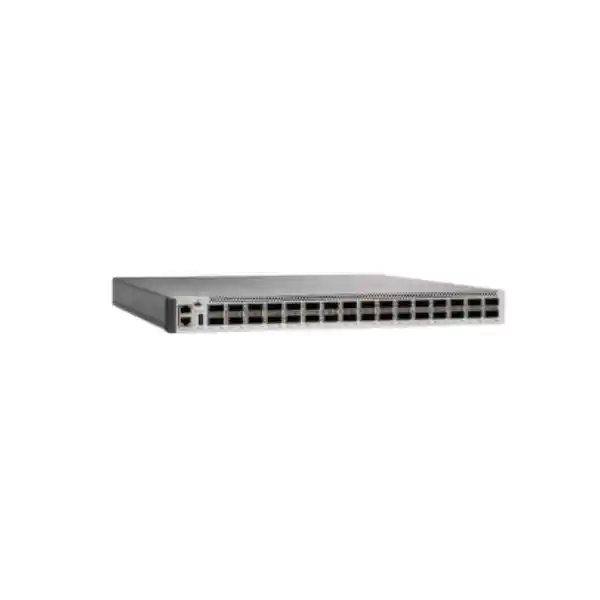
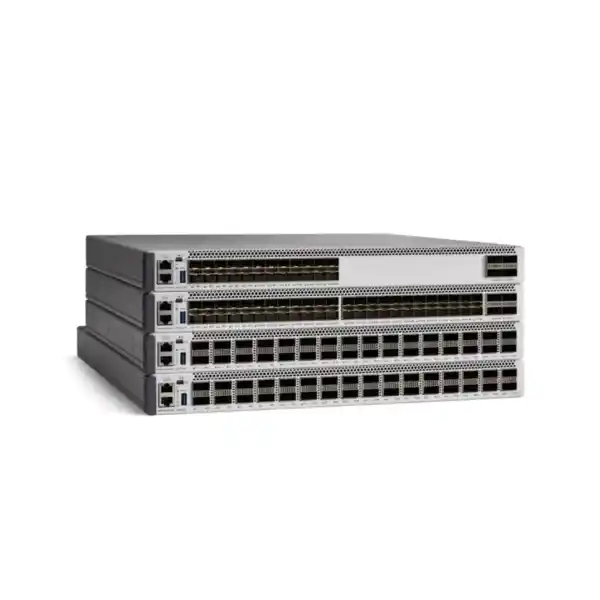
C9500-32QC
40G / 100G campus core
High-density Cisco core switching for organizations planning 40G and 100G growth
The Cisco Catalyst C9500-32QC is built for enterprise campus core and distribution roles where high fiber density, predictable forwarding performance, routing scale, and resilient design are more important than simple access-port count. It gives network teams a platform that can operate with up to 32 40 Gigabit Ethernet interfaces or up to 16 100 Gigabit Ethernet interfaces, depending on the selected port mode and supported optics. That makes it particularly relevant for organizations replacing older 10G or 40G aggregation layers, consolidating multiple distribution blocks, or preparing a campus backbone for higher-speed uplinks.
For a Tanzania deployment, the right purchase decision is not only the chassis model. The complete design should also confirm fiber type, optical reach, 40G versus 100G port mapping, Cisco IOS XE release, software entitlement, redundancy goals, airflow direction, power supply type, rack depth, and the exact transceivers or direct-attach cables needed. This page focuses on those practical decisions so buyers can specify the switch correctly before quotation and deployment.
Why buyers shortlist the C9500-32QC
Dense 40G core connectivity
The platform is designed around high-speed fiber interfaces rather than copper access ports. Cisco lists up to 32 40G ports, making the model useful when many distribution switches, data-center links, building uplinks, or routed aggregation connections converge in one core device.
100G migration path
The C9500-32QC can be configured for up to 16 100G ports on supported positions. That can reduce the need to replace the entire chassis when selected backbone links move from 40G to 100G, although port-mode and optical-compatibility checks remain essential.
Core-class forwarding
Cisco specifies up to 3.2 Tbps of switching capacity and up to 1 billion packets per second of forwarding performance for this platform, backed by the programmable UADP 3.0 architecture for scalable Layer 2 and Layer 3 services.
Resilient campus design
Support for StackWise Virtual, redundant power options, and multiple field-replaceable fan trays helps architects build a core with fewer operational single points of failure, provided the high-availability design follows Cisco software and topology requirements.
Verified platform snapshot
| Model | Cisco Catalyst C9500-32QC |
|---|---|
| Primary role | High-performance enterprise campus core and distribution switching |
| Port density | Up to 32 x 40G or up to 16 x 100G, subject to supported port mode, port position, optics and software configuration |
| ASIC | Cisco UADP 3.0 |
| Switching capacity | Up to 3.2 Tbps |
| Forwarding rate | Up to 1 Bpps |
| Form factor | 1RU rack-mount switch |
| Approximate chassis size | 1.73 x 17.5 x 18.0 in. (about 4.4 x 44.5 x 45.7 cm) |
| Approximate weight | 21.85 lb (9.91 kg) for the documented chassis configuration with two power supplies and built-in fans |
| Minimum documented software | Cisco IOS XE 16.8.1a for the C9500-32QC platform; specific features can require later releases |
Understanding the 32 x 40G and 16 x 100G design
The most important specification to understand before buying a C9500-32QC is that 40G and 100G operation are not simply interchangeable on every physical position. Cisco describes the system as a high-performance 32-port 40G platform with up to 16 100G ports. The hardware guide also distinguishes native 40G and native 100G logical port numbering, and Cisco documentation explains that interface-speed changes are controlled through configuration. In practice, that means a network architect should map the intended uplinks before ordering optics rather than assuming every cage can become an independent 100G interface.
For a campus core that is predominantly 40G today, the 32QC can provide a dense termination point for many aggregation or distribution links. A typical reason to choose it over a lower-density platform is the ability to centralize more high-speed fiber without consuming multiple rack units. Where selected backbone paths need 100G, the design can be adjusted around the supported 100G positions. The commercial advantage is not automatic, however: if the requirement is 32 independent 100G ports, the C9500-32C is the more natural member of the same family because Cisco positions that model for 32-port 100G/40G operation.
The buying checklist should therefore start with a port map. Identify every current link, its speed, fiber pair or parallel-fiber requirement, distance, remote device, expected growth speed, and whether the link participates in a port-channel, StackWise Virtual link, routed connection, or Layer 2 trunk. Once that map is clear, the switch can be quoted with compatible optics and fewer surprises during installation.
Important 100G planning note
Do not treat the phrase “up to 16 x 100G” as permission to populate any sixteen front-panel positions without checking Cisco’s current port-mode guidance. The C9500-32QC has hardware-specific port mapping, and the selected optical module must also be supported on the intended port and IOS XE release. A correct bill of materials should therefore match the front-panel mode, transceiver product ID, fiber type, connector, reach, and software release as one design.
Performance and forwarding architecture
Cisco’s UADP 3.0 architecture is a central reason the C9500-32QC fits core and distribution work. The platform is designed to handle high-bandwidth switching while also supporting rich enterprise services such as routing, policy, quality of service, security features, telemetry, and programmable resource allocation. Cisco publishes up to 3.2 Tbps switching capacity and up to 1 Bpps forwarding performance for the 32QC. Those are platform maximums, not a promise that every real network workload will consume the same resources in the same way.
Resource allocation matters because campus cores often need a combination of MAC addresses, IPv4 and IPv6 routes, multicast entries, security-group information, ACLs, QoS entries, NetFlow resources, and tunnel scale. Cisco supports standard SDM templates on the high-performance Catalyst 9500 family, including profiles intended for core, distribution, NAT, and SD-Access roles. Later IOS XE releases also support custom SDM allocation. This lets an engineer tune forwarding resources for the actual deployment instead of treating the switch as a fixed table-size appliance.
For buyers, the practical point is that “maximum route scale” should never be copied into a design without context. The selected SDM template, enabled services, software release, address-family mix, and feature combination affect usable scale. A large enterprise with extensive BGP, multicast, policy, and segmentation requirements should validate the intended feature set against Cisco’s current release documentation before migration.
Where the C9500-32QC fits in a campus network
Collapsed core
A pair of high-performance switches can combine core and distribution responsibilities in a campus where separate layers would add cost or complexity. The exact design should consider routed links, first-hop redundancy, StackWise Virtual, failure domains, and maintenance procedures.
Distribution aggregation
The dense 40G profile is useful when many access or distribution blocks need high-capacity uplinks. It can reduce chassis count in environments where aggregation links are already beyond 10G and where future 100G expansion is planned.
High-bandwidth campus backbone
Sites with large east-west traffic flows, research workloads, video, virtualization, storage movement, or many high-speed building uplinks can use 40G and 100G backbone links to remove bottlenecks between network blocks.
Routed aggregation
Organizations moving toward routed access or Layer 3 distribution can use the C9500 family for dynamic routing, policy, and high-speed point-to-point aggregation, subject to the selected license and IOS XE feature support.
High availability with StackWise Virtual
A campus core is normally designed around failure tolerance, not only port speed. Cisco supports StackWise Virtual on the high-performance Catalyst 9500 models, including the C9500-32QC. StackWise Virtual allows two physical switches to operate as one logical system for selected control and forwarding functions, which can simplify topology and enable multichassis EtherChannel designs. Cisco documentation also describes Dual Active Detection as part of the architecture for detecting split-control conditions.
For the 32QC specifically, Cisco documents StackWise Virtual links on supported 40G/100G ports in the platform’s default mode. Support was introduced for the high-performance 9500 family in IOS XE 16.10, so an installation using StackWise Virtual should be planned around a release that supports the intended configuration and has been validated for the organization’s operational standards. The StackWise Virtual links themselves consume front-panel bandwidth and ports, which should be included in the port-count calculation.
A resilient design also needs more than two chassis. Power feeds, upstream and downstream port-channels, optical paths, fiber routes, maintenance procedures, software-upgrade strategy, and failure-domain separation all matter. In Tanzania, where a site may have different power and connectivity conditions from another site, the network team should size UPS capacity and power redundancy based on the complete rack load rather than the switch nameplate alone.
Optics, fiber and cabling: specify these before ordering
The C9500-32QC is an optical aggregation platform, so the transceiver and cabling design is part of the switch design. Cisco’s compatibility matrix includes multiple 40G QSFP+ and 100G QSFP28 choices for this model, with options intended for different media, connector types, and distances. Examples in Cisco’s matrix include short-reach multimode, single-mode CWDM, parallel single-mode, and long-reach 100G modules, but the correct product ID depends on the exact link.
Before quotation, record five items for each fiber link: required data rate, distance, fiber type, connector type, and the remote transceiver or device. A link using existing OM3 or OM4 multimode plant can require a different optic and connector arrangement from a single-mode inter-building link. A direct-attach copper cable or active optical cable has different reach and installation constraints again. The fact that two modules share a “100G” label does not make them interchangeable.
Cisco updates optics support over time, and support can depend on IOS XE release. For that reason, the final bill of materials should be validated against Cisco’s current optics-to-device matrix at the time of order. This avoids a common procurement error: buying the chassis first and treating transceivers as generic accessories later.
Cisco IOS XE, licensing and feature planning
The C9500-32QC runs Cisco IOS XE. Cisco’s current product documentation lists IOS XE 16.8.1a as the minimum platform release, while specific technologies and operational improvements can require later releases. In production, the target software should be selected based on the features required, lifecycle policy, security guidance, interoperability, and the organization’s upgrade standard rather than by choosing the minimum bootable version.
Catalyst 9500 licensing has evolved across IOS XE releases and Cisco ordering models. Cisco documentation references Network Essentials and Network Advantage capabilities, along with Cisco DNA Essentials and DNA Advantage subscription tiers in ordering and licensing material. More recent licensing guidance can change which base and add-on combinations are orderable or how entitlements are represented. The safe procurement approach is to define the features first, then map those features to the license bundle that Cisco currently supports for the exact quote.
Features that often drive the licensing conversation include advanced routing, segmentation, telemetry, automation, SD-Access functions, assurance, and policy services. Buyers should also decide whether they need centralized management or automation integration, because software subscriptions can be commercially significant even when the hardware requirement appears straightforward.
FourTeck should therefore quote the hardware and software as a coordinated solution rather than presenting the base chassis as a complete feature entitlement. The request should state the required routing protocols, high-availability design, management platform, segmentation requirements, software term if applicable, and whether the switch is replacing an existing licensed Catalyst environment.
Routing, segmentation and policy capabilities
Core switching is increasingly a routing and policy function rather than a simple Layer 2 bridge. The Catalyst 9500 family supports scalable IPv4 and IPv6 forwarding, multicast functions, policy controls, and programmable hardware resources. Depending on software and license, the platform can participate in enterprise routing designs, segmented campus architectures, and SD-Access roles. Cisco’s standard SDM profiles for the high-performance models include core, distribution, NAT, and SD-Access-oriented resource allocations, which reflects the variety of use cases the hardware is intended to serve.
For a conventional campus, the 32QC may sit at the routed core and exchange prefixes with distribution switches, firewalls, WAN routers, or data-center gateways. In a larger environment, routing scale and convergence behavior should be tested against the actual protocol mix. A network using many VRFs, BGP peers, multicast groups, policy entries, or security-group tags has a different resource profile from a simple OSPF core with a modest number of VLAN interfaces.
If the project includes SD-Access, EVPN/VXLAN, MPLS, NAT, MACsec, or another advanced function, confirm feature availability on the planned IOS XE release and license before approval. The value of UADP programmability is that the platform can support sophisticated services, but the design still needs explicit validation. It is better to document those requirements before purchase than to discover a feature or scale dependency after the switch is installed.
Security and encrypted-link considerations
Cisco positions the Catalyst 9500 family with security capabilities that can help protect campus infrastructure, including access control, segmentation functions, trustworthy-system features, and MACsec support on appropriate hardware and software combinations. For organizations carrying sensitive traffic between buildings or across shared fiber infrastructure, link encryption can be an important design requirement. The relevant question is not simply whether “MACsec” appears in a feature list, but whether the intended link speed, interface, peer device, software release, license, and key-management method support the desired design.
Security policy also affects routing scale and ACL resources. If the core will enforce large access-control lists or security-group policies, the resource template should be reviewed alongside route and multicast requirements. Cisco’s UADP architecture allows hardware resources to be allocated for different deployment profiles, but every environment should be sized against the real policy count rather than a marketing maximum.
Operational security is equally important. Management interfaces should be placed in a controlled network, administrative access should use current secure protocols, logging and telemetry should be integrated with the organization’s monitoring systems, and software maintenance should follow an approved lifecycle. These practices do not depend on a particular country, but they are especially important for a core switch because compromise or misconfiguration can affect a large portion of the network.
Power, cooling and rack planning
The C9500-32QC is a 1RU system, which makes it relatively compact for the amount of high-speed bandwidth it can aggregate. Cisco documents approximate dimensions of 1.73 x 17.5 x 18.0 inches and an approximate weight of 21.85 pounds for the chassis configuration with two power supplies and fans. The 18-inch depth is useful for rack planning, but the actual installation must also allow space for cable bends, optical connectors, power cords, airflow, and service access.
Cisco’s power-supply matrix lists 650W AC options and a 930W DC option for the C9500-32QC family. The switch has two power-supply slots, allowing a redundant design when the appropriate supported supplies are installed. The correct supply selection should be based on the site’s available input, redundancy requirement, power-feed architecture, and current Cisco ordering options. When dual AC feeds are available, the two supplies are normally more valuable if they are connected to independent protected sources rather than the same single point of failure.
Cooling is also part of the bill of materials. Cisco documents four C9K-T1 fan trays for the 32QC platform and supports airflow choices in the Catalyst 9500 family. Front-to-back and back-to-front conventions must match the rack and data-room cooling plan. Mixing airflow directions or placing the switch in a cabinet with poor hot-air extraction can undermine an otherwise sound core design.
For a Tanzania installation, the UPS should be sized against the complete protected load and required runtime, including both core switches, optics, upstream routers or firewalls, management devices, and any associated console or monitoring equipment. Do not size continuity only from a nominal switch wattage. The facility’s temperature, power quality, generator transfer behavior, and maintenance practices should also be considered.
Environmental specifications to check
Cisco specifies an operating temperature range of 0°C to 40°C up to 10,000 feet for the documented Catalyst 9500 models, with operating relative humidity of 5% to 90% noncondensing. Storage limits are wider. These values are useful for equipment-room design, but network teams should not interpret them as a substitute for controlled cooling. A switch running near the upper environmental limit has less margin for blocked airflow, failed fans, dirty filters elsewhere in the room, or an air-conditioning outage.
High-speed optics also generate heat, and dense transceiver populations can materially affect the thermal profile of a 1RU switch. The number and type of QSFP modules, ambient temperature, and airflow direction should therefore be considered together. Keep front-panel fiber organized so patch leads do not obstruct ventilation or make it difficult to replace an optic.
Where the switch will be installed outside a conventional climate-controlled data room, buyers should validate environmental suitability carefully. Dust, humidity, unstable cooling, or cabinet restrictions can shorten component life even when the headline specification appears acceptable. If the site environment is uncertain, include those conditions in the pre-sales requirement rather than assuming a standard office deployment.
A practical Tanzania deployment checklist
Record remote device, speed, distance, fiber type, connector, VLAN or routed role, redundancy group, and expected future speed.
Confirm which links truly need 100G and validate that the required front-panel positions support the intended mode.
Match Cisco-supported transceiver IDs to distance, media, connector and software release. Include patch cords or MPO assemblies where required.
Choose standalone, dual-core, StackWise Virtual, and multichassis EtherChannel requirements before reserving ports.
List protocols, VRFs, multicast, ACLs, segmentation, telemetry, SD-Access or other services that can affect software and resource planning.
Align the planned IOS XE train and current Cisco license bundle with the actual features required.
Confirm AC or DC requirement, redundancy, PDU outlets, UPS capacity, airflow direction and rack cooling.
Document addressing, routing adjacencies, port-channels, optics swaps, maintenance window, validation tests and a rollback path.
C9500-32QC versus C9500-32C: which is the better fit?
The C9500-32QC and C9500-32C are easy to confuse because both are high-performance Catalyst 9500 models with QSFP-class interfaces. Their ideal use is different. Cisco positions the C9500-32QC around 32-port 40G density with up to 16 100G ports, while the C9500-32C is designed for 32 ports of 40G/100G capability. The 32C also has a higher published switching capacity, up to 6.4 Tbps, because it is designed around a denser 100G profile.
Choose the 32QC when the network has many 40G uplinks and only a subset needs to become 100G, or when the port-density and cost structure of the 32QC better matches the intended architecture. Choose the 32C when the design genuinely needs a large number of independent 100G links or when 100G density is expected to dominate during the hardware lifecycle.
This comparison should happen before optics are ordered. A buyer who selects the 32QC because “it supports 100G” but later expects thirty-two 100G interfaces has chosen the wrong hardware profile. Conversely, a campus with thirty or more 40G aggregation links may not need the full 100G density of a 32C. The correct model follows the port map, not the highest number in the product family.
C9500-32QC versus 25G-oriented distribution models
Cisco also offers Catalyst 9500 high-performance models such as the C9500-48Y4C and C9500-24Y4C, which are oriented toward dense 1/10/25G SFP28 connectivity plus high-speed fixed uplinks. Those models can be a better fit when a distribution layer needs to aggregate many 10G or 25G links directly. The C9500-32QC, by contrast, is centered on 40G and 100G QSFP connectivity.
If the remote switches predominantly offer 10G or 25G uplinks, selecting a 32QC may force unnecessary breakout or adapter decisions and can reduce design simplicity. If the remote layer already uses 40G or 100G, the 32QC aligns naturally with that bandwidth profile. Buyers should therefore list the physical interface and speed on both ends of every connection before comparing chassis prices.
This is also why “port count” by itself is not a useful comparison across the Catalyst 9500 family. Forty-eight 25G ports serve a different topology from thirty-two 40G ports. The architecture should be selected around link speed, oversubscription target, fiber plant, growth plan, and resilience rather than the largest numerical port count.
Migration from an older campus core
Replacing a campus core affects far more than the switch itself. Existing uplinks may use older transceivers, different fiber connectors, legacy port-channel settings, spanning-tree dependencies, static routes, first-hop redundancy, multicast, QoS, or security policy. A good migration begins with an inventory of the existing control plane and every attached link, then identifies what will remain unchanged and what will be redesigned.
Where possible, use routed parallel links or staged port-channel migration to reduce the size of the maintenance event. Validate routing neighbors, MTU, VLAN trunking, LACP, optical power, error counters, and application reachability after each major move. If StackWise Virtual is being introduced, treat it as an architecture change rather than only a chassis replacement because the logical topology and failure behavior may differ from the existing design.
Optics deserve a separate migration check. A QSFP module that worked in an older platform may not be supported in the new switch or may require a particular IOS XE version. Existing fiber can also impose reach or connector limitations. Testing critical fiber paths before the change window reduces the risk of discovering dirty connectors, excessive loss, or incompatible polarity during cutover.
Finally, plan rollback. Preserve the old configuration, label every fiber, document patch-panel positions, maintain console access, and define the threshold at which the team will return to the previous core. A migration is safer when success criteria and rollback criteria are explicit before the first cable is moved.
Operations, monitoring and lifecycle discipline
A core switch should be purchased with its operating model in mind. Decide how configurations will be backed up, how software images will be staged, how logs and telemetry will be collected, and how interface health will be monitored. High-speed links can hide developing physical problems until traffic grows, so optical receive and transmit levels, CRC errors, discards, buffer events, and port-channel state should be visible to the operations team.
Cisco IOS XE provides modern automation and programmability options across the Catalyst 9000 family. Whether those capabilities are used through APIs, centralized management, configuration tools, or conventional CLI processes depends on the organization. The important point is consistency: a network with two core switches and dozens of downstream devices benefits from repeatable configuration, version control, change review, and automated validation.
Lifecycle management should include periodic review of Cisco software maintenance releases, security advisories, optics support, license status, and hardware notices. The C9500-32QC remains present in current Cisco Catalyst 9500 documentation, but no enterprise platform should be treated as timeless. The procurement record should include the exact hardware PID, power supplies, fans, optics, licenses, support entitlement if purchased, and the software release accepted for production.
Keeping this information together makes future troubleshooting and refresh planning much easier. It also prevents a common problem in long-lived networks: the core chassis remains documented, while the transceivers, subscriptions, and software dependencies that make the design work are forgotten.
What to include in your request for quotation
A useful quotation request for the Cisco Catalyst C9500-32QC should describe the complete requirement, not only the chassis name. Include the number of switches, whether they will run as standalone units or a redundant pair, the desired 40G and 100G port count, and every required optical reach. State whether power is AC or DC, whether dual supplies are required, and which airflow direction matches the rack.
For software, list the planned routing and segmentation functions, any StackWise Virtual requirement, automation or management platform, desired support or subscription term, and any need to integrate with an existing Cisco Smart Account or enterprise agreement. If this is a replacement project, provide the current core model and IOS XE or IOS version, plus the key uplink speeds and transceiver types. This helps identify migration dependencies early.
Do not send only a generic request such as “32-port 100G switch” when the intended product is the 32QC. That wording can imply a capability profile closer to the C9500-32C. A precise RFQ should say whether the design needs 32 x 40G, up to 16 x 100G, or a mixed migration plan so the proposed configuration can be checked against the actual hardware port model.
Frequently asked questions
Is the C9500-32QC a 40G switch or a 100G switch?
It is best understood as a high-density 40G Catalyst 9500 platform with supported 100G operation on specific positions and modes. Cisco lists up to 32 x 40G ports or up to 16 x 100G ports. The exact 100G layout must follow Cisco’s port-mode and hardware guidance.
Can all 32 ports run at 100G?
No. Buyers who need 32 independent 100G interfaces should evaluate the C9500-32C rather than assuming the 32QC provides the same port capability. The 32QC is documented for up to 16 100G ports.
Does the switch include optics?
The chassis model should not be assumed to include the transceivers needed for a specific network. Optics, direct-attach cables, active optical cables, patch cords, and fiber assemblies must be selected according to the link design and current ordering configuration.
Which 100G optics can be used?
Cisco’s current compatibility matrix lists multiple supported QSFP28 options for the C9500-32QC, including modules for multimode and single-mode applications at different reaches. The exact transceiver should be validated by product ID, port, fiber, connector, distance, and IOS XE release at the time of order.
Does the C9500-32QC support StackWise Virtual?
Yes. Cisco documents StackWise Virtual support for the high-performance Catalyst 9500 family, including C9500-32QC. The design must reserve supported links, follow Dual Active Detection guidance where applicable, and use a suitable IOS XE release.
What switching capacity does the C9500-32QC provide?
Cisco specifies up to 3.2 Tbps of switching capacity and up to 1 Bpps forwarding performance for this model. Real deployment scale depends on configuration, enabled services, packet mix, software, and resource allocation.
Is it suitable for a campus core?
Yes. Cisco positions the Catalyst 9500 high-performance models for enterprise campus core and distribution. The 32QC is especially appropriate where the backbone is dominated by 40G and selected links are moving to 100G.
Can it be used in a collapsed-core design?
Yes, when the port count, routing scale, redundancy model, software features, and failure domains fit the site. A collapsed core should still be designed as a resilient system, normally with dual switches and diverse downstream connectivity rather than a single chassis.
What power supplies are supported?
Cisco’s current power matrix lists supported 650W AC supply options and a 930W DC option for the C9500-32QC family. Exact orderability and the correct redundant combination should be confirmed during quotation.
How many rack units does it use?
The C9500-32QC is a 1RU switch. Rack planning should still allow sufficient depth, cable bend radius, front-panel access, rear power access, and unobstructed airflow.
What IOS XE release is required?
Cisco lists IOS XE 16.8.1a as the platform minimum for the C9500-32QC. Specific features can require later releases, and a production deployment should normally use a release selected for feature support, security, interoperability, and lifecycle policy rather than the minimum.
Which license should I buy?
The correct license depends on the required features and current Cisco ordering model. Define routing, segmentation, automation, assurance, SD-Access, telemetry, and management requirements first, then map them to the currently supported Network and Cisco DNA entitlement combination during quotation.
Can existing 40G optics be reused?
Possibly, but reuse should never be assumed. Validate the exact optic product ID against Cisco’s compatibility matrix for the C9500-32QC and planned IOS XE release. Also verify the existing fiber, connector, polarity, and optical-loss budget.
Is a price shown for Tanzania?
No unverified local price is stated here. Enterprise switch pricing can depend on hardware bundle, power supplies, optics, software licenses, support terms, taxes, and project configuration. Request a configuration-based quotation for the exact requirement.
Request a configuration-based C9500-32QC quote
For the most useful quotation, provide the number of switches, required 40G and 100G links, fiber type and distance, desired redundancy model, AC or DC power preference, airflow direction, routing and segmentation features, and the software or management environment you plan to use. If the project replaces an existing core, include the current switch model and uplink optics where possible.
FourTeck can then prepare the request around the correct chassis, supported optics, power architecture, licensing requirement, and migration objective without assuming stock, price, warranty term, or entitlement that has not been verified for the final order.


Reviews
There are no reviews yet.