
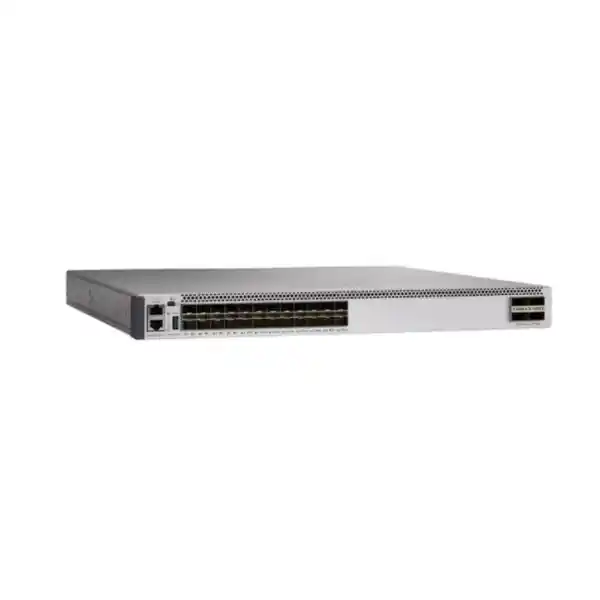
Cisco Catalyst C9500-24Y4C High-Performance Network Switch
The Cisco Catalyst C9500-24Y4C is designed for organisations that need a compact, high-performance Layer 3 switching platform at the enterprise campus core or distribution layer. It combines twenty-four native SFP28 interfaces that can operate at 1, 10, or 25 Gigabit Ethernet with four fixed QSFP28 uplink interfaces supporting 40 or 100 Gigabit Ethernet. That port mix makes the platform particularly useful when a network is moving beyond traditional 10G aggregation but is not ready to standardise every connection on 100G.
For buyers evaluating the Cisco C9500-24Y4C in Tanzania, the important decision is not simply whether the chassis has enough ports. The correct design also depends on fibre type, transceiver support, uplink speeds, routing scale, high-availability requirements, software entitlement, rack and power conditions, and the way the switch will connect to access switches, servers, firewalls, wireless infrastructure, or upstream network services. FourTeck can use those details to prepare a model, licence, optics, accessory, and redundancy review before quotation.
4 × 40/100G QSFP28
Up to 2.0 Tbps
Up to 1 Bpps
Cisco IOS XE
1 RU
Quick Product Information
| Model | Cisco Catalyst C9500-24Y4C |
|---|---|
| Primary role | Fixed enterprise core and aggregation switching |
| Downlink / service ports | 24 × 1/10/25 Gigabit Ethernet SFP28 |
| Fixed uplinks | 4 × 40/100 Gigabit Ethernet QSFP28 |
| Switching capacity | Up to 2.0 Tbps |
| Forwarding rate | Up to 1 billion packets per second |
| High availability | StackWise Virtual, Stateful Switchover support, redundant power capability |
| Operating system | Cisco IOS XE; minimum release for this model is IOS XE 16.8.1a |
| Rack format | 1 RU fixed switch |
| Licensing | Current Cisco switching licensing options and feature entitlements must be confirmed for the intended deployment and software release. |
These headline specifications identify the hardware platform, but they do not replace a bill-of-materials review. Optics, cables, redundant power, software entitlement, support, and any management subscription should be confirmed against the network design and the exact order configuration.
Where the C9500-24Y4C Fits
The C9500-24Y4C sits in Cisco’s Catalyst 9500 family, which Cisco positions as a lead fixed enterprise core and aggregation platform. That role is different from a typical office access switch. An access switch is usually selected around endpoint port count, PoE requirements, and user or device connectivity. The C9500-24Y4C is more commonly considered where multiple access blocks, high-speed fibre links, network services, or routed segments need to converge onto a resilient, high-throughput platform.
Its twenty-four multi-rate SFP28 ports are valuable in mixed-generation networks. Existing 10G fibre links can remain useful while selected servers, distribution switches, storage-facing systems, or newer access layers move to 25G. The four QSFP28 interfaces can then provide 40G or 100G connections for core interconnects, upstream links, high-availability designs, or other bandwidth-intensive paths. The practical advantage is migration flexibility: the organisation can increase backbone speed without forcing every connected system to change interface rate at the same time.
This platform is most appropriate when the design team already understands why it needs a core or aggregation switch. If the requirement is only to connect desktops, phones, cameras, or access points over copper Ethernet, another Catalyst family may be a better fit. Similarly, projects requiring much higher native 100G density or 400G interfaces should be reviewed against other current Catalyst 9500 or Catalyst 9500X configurations rather than assuming this 24-port model is the correct choice.
Port Architecture: 25G Where You Need It, 100G Where It Matters
The front-panel architecture is one of the clearest reasons to select this model. Ports 1 through 24 are native 25G interfaces and support SFP28-family connectivity, while the four fixed uplink interfaces are native 40G or 100G ports using QSFP-class optics. In practical terms, that gives the network architect a compact way to aggregate many 10G or 25G fibre connections while retaining higher-speed paths for northbound connectivity.
Port speed alone does not determine whether a transceiver will work. Before ordering, confirm the supported Cisco optic or cable type, the required data rate, fibre mode, connector, wavelength, distance, and the exact interface at both ends. A 25G link between buildings may require a different optical design from a short in-rack 25G connection. A 100G uplink between core switches may use different optics from a 100G connection to another network device. The fibre plant therefore belongs in the procurement conversation, not as an accessory decision after the chassis arrives.
For migration projects, document every existing uplink and its present optic. Identify which connections are 1G, 10G, 25G, 40G, or 100G and whether they use single-mode fibre, multimode fibre, or direct-attach cabling. This prevents a common project problem: purchasing a high-speed core switch but discovering that the installed fibre type, patching, transceiver reach, or connector format does not support the planned interface.
The fixed nature of the C9500-24Y4C is also a planning consideration. Cisco does not list the optional C9500-NM-8X or C9500-NM-2Q network modules for this model. The twenty-four SFP28 and four QSFP28 interfaces are therefore the core physical port architecture you should size around. If future growth is likely to exceed this density, compare the design with the higher-density C9500-48Y4C or other Catalyst 9500 family options before standardising.
Performance for Core and Distribution Workloads
Cisco specifies the C9500-24Y4C at up to 2.0 Tbps of switching capacity and up to 1 Bpps of forwarding performance. These figures are appropriate to a high-performance fixed switch intended for aggregation and core roles, but capacity should still be evaluated against the real traffic pattern. A campus carrying user applications, cloud access, voice, video, wireless traffic, server flows, backups, security services, and inter-VLAN routing can generate very different peak conditions from a simple sum of port speeds.
The platform uses Cisco’s UADP architecture and supports flexible allocation of Layer 2 and Layer 3 forwarding resources, ACLs, QoS, and related hardware tables. Cisco also supports standard and custom SDM templates on the high-performance C9500 models so system resources can be allocated according to deployment needs. This matters when a network has unusually large routing, MAC, multicast, policy, or telemetry requirements. The correct template should be planned as part of the configuration rather than changed casually after production traffic is established.
For most buyers, the key question is whether the switch has enough interface bandwidth and forwarding scale for the intended architecture with reasonable growth. For larger routed environments, record the expected IPv4 and IPv6 routes, VRFs, multicast groups, ACL scale, NetFlow needs, and segmentation requirements. This gives the technical team enough information to validate the platform and software configuration instead of relying only on the headline throughput number.
Layer 3 Routing and Advanced Network Services
The Catalyst 9500 family supports enterprise routing capabilities suited to campus core and distribution designs. Cisco documents support across the platform for IPv4 and IPv6 routing, OSPF, EIGRP, IS-IS, BGP, multicast routing, Layer 3 subinterfaces, MPLS services, EVPN/VXLAN capabilities, and Software-Defined Access functions. The exact feature available in a production deployment depends on the software release, licence tier, design mode, and configuration, so advanced requirements should be mapped to entitlement before purchase.
This is important when the switch is being purchased to replace a legacy core. A like-for-like port count does not guarantee a like-for-like feature set. The migration plan should identify dynamic routing protocols, route redistribution, VRFs, first-hop gateway design, multicast applications, QoS policies, policy-based routing, NAT use, MPLS dependencies, and any fabric technologies already in use. The new platform can then be assessed against the existing configuration and the target architecture.
If the environment is primarily Layer 2 today, a core refresh is also an opportunity to decide whether routing should remain centralised or move closer to the distribution or access layer. The C9500-24Y4C can participate in more advanced routed campus designs, but that flexibility should be used deliberately. Good network design keeps failure domains understandable, documents routing adjacencies, protects the control plane, and makes recovery procedures clear to the operations team.
For a quotation review, provide the existing core configuration or a summary of the routing protocols and segmentation requirements. That information is more useful than a generic request for an “enterprise switch” because it exposes dependencies that may affect licensing, optics, software version, deployment method, and acceptance testing.
StackWise Virtual
High-performance Catalyst 9500 models, including the C9500-24Y4C, support StackWise Virtual. Two switches can operate with a virtualised system design, enabling multichassis EtherChannel and simplifying resilient connectivity when deployed according to Cisco requirements.
Redundant Power
The Catalyst 9500 platform supports dual 1+1 redundant power supplies. A second compatible power supply can be used for resilience. Power-source diversity and UPS design must still be planned at site level.
Service Continuity
Cisco documents features including Stateful Switchover and ISSU in StackWise Virtual designs. Actual maintenance behaviour depends on the software release, topology, feature set, and upgrade path, so operational procedures should be tested before production change windows.
Designing for High Availability
A core switch becomes valuable only when the complete design is resilient. StackWise Virtual allows supported Catalyst 9500 switches to be combined into a virtual switching architecture, and Cisco supports multichassis EtherChannel across the members. For the C9500-24Y4C, Cisco documents StackWise Virtual on high-performance C9500 models and permits supported 10G, 25G, 40G, or 100G interfaces for virtual links, subject to the current configuration guide and restrictions. This can reduce dependence on a single chassis and make downstream devices dual-home across the pair.
However, a resilient design is more than buying two switches. The virtual links, dual-active detection, downstream port channels, upstream connectivity, routing adjacencies, management access, and power feeds all need deliberate placement. If both switches depend on the same UPS, the same upstream fibre route, or the same physical cable tray, the logical redundancy may still have a common failure point.
Power planning deserves the same attention. Cisco supports dual 1+1 redundant power supplies on the Catalyst 9500 family, with compatible AC or DC options by platform. If redundancy is required, confirm the second supply in the bill of materials and decide whether each supply will be fed from an independent protected source. The switch also uses field-replaceable fan-tray units, which helps serviceability but does not remove the need for suitable rack airflow and environmental control.
For Tanzanian enterprise deployments, the practical checklist is straightforward: document the required uptime, the acceptable maintenance window, the available protected power, the number of independent upstream paths, and the recovery process if one chassis or one link fails. The platform provides high-availability tools, while the network design determines whether those tools translate into business continuity.
Security Features for the Enterprise Backbone
Core and distribution switches carry traffic between major parts of the organisation, so infrastructure security should be part of platform selection. Cisco documents Catalyst 9500 support for secure boot, image signing, the Cisco Trust Anchor Module, object-group ACLs, and 256-bit MACsec encryption on the Catalyst 9500 platform. MACsec can protect suitable Ethernet links against unauthorised observation or modification when the surrounding design, keys, optics, and software configuration support the required use case.
Security also includes control-plane and operational discipline. Management interfaces should be placed in an appropriate management network, access should use strong authentication and role-based controls, unused services should be disabled, logging should be centralised, time should be synchronised, and configuration backups should be tested. Software versions should be maintained according to the organisation’s patch and change-management process rather than remaining indefinitely on the factory image.
If the switch will participate in segmentation, SD-Access, EVPN/VXLAN, MPLS, or a security policy architecture, confirm the required licence tier and software support before ordering. A security feature that exists in the broader platform portfolio may still depend on entitlement or release. FourTeck can use the requested feature list as part of configuration validation so the quotation reflects the intended outcome rather than only the chassis.
Automation, Telemetry, and Day-2 Operations
Cisco IOS XE is designed for programmable enterprise networks. On the Catalyst 9500 family, Cisco documents APIs and model-driven interfaces including NETCONF, RESTCONF, gNMI, and YANG models, together with streaming telemetry, Zero-Touch Provisioning, Plug and Play capabilities, and on-box automation options. These features can reduce repetitive manual work when they are integrated into a controlled operations process.
The practical value depends on the maturity of the IT team. A small organisation may use the embedded management interface and standard CLI workflows. A larger enterprise may integrate the switch with centralised management, monitoring, source-controlled configurations, API-based provisioning, or telemetry collectors. The same hardware can therefore support different operating models, but the chosen model should be consistent across the network so engineers are not forced to maintain several unrelated management methods.
Cisco also documents Catalyst 9500 options for management through Cisco platforms, including Catalyst Center and supported Meraki cloud monitoring or management scenarios. Those choices have their own software, entitlement, and architecture considerations. Buyers should decide whether they need local management, enterprise controller integration, cloud visibility, or a combination before the bill of materials is finalised.
For operations teams, ask three questions before deployment: how will the switch be provisioned, how will health and interface telemetry be monitored, and how will software be upgraded with minimal risk? Answering these questions early often prevents a technically successful installation from becoming difficult to operate later.
Licensing: Confirm the Entitlement Before You Order
Licensing is a key buying decision for the C9500-24Y4C. Cisco’s current documentation describes unified switching licensing through Cisco Networking Subscription as well as Cisco DNA licensing models, with Essentials and Advantage tiers. Cisco also lists order variants for this hardware with Network Essentials and Network Advantage. The precise capabilities depend on licence tier, software release, and management platform, so the correct entitlement should be selected from the required features rather than from the product name alone.
A buyer planning basic enterprise switching and routing may have different licensing needs from an organisation using advanced routing, segmentation, analytics, assurance, fabric functions, or advanced management. If the project includes Cisco Catalyst Center, Software-Defined Access, EVPN/VXLAN, complex routing, or other advanced services, those requirements should be written into the quote request. This makes it possible to validate hardware and software together.
Existing Cisco customers should also record their current Smart Account arrangements, licence ownership process, renewal owner, and any installed Catalyst management platform. The procurement team should know which subscriptions renew, when they renew, and who is responsible for them. A switch can remain physically installed for many years, while subscriptions and software entitlements may follow different commercial timelines.
FourTeck does not treat a base switch model as proof of a complete licence package. The final quotation should state the exact hardware order code, applicable licence tier, term where required, power configuration, optics, cables, and support options. This gives technical and procurement teams a common reference and reduces the chance of discovering missing entitlements during commissioning.
Optics, Fibre, and Bill-of-Materials Planning
The C9500-24Y4C is a fibre-oriented enterprise switch, so the chassis should not be quoted in isolation. Each active link needs a compatible physical interface at both ends. Start with a port map showing the connected device, required speed, fibre type, distance, connector, redundancy path, and expected traffic class. From that map, the optics and patching requirements can be selected and validated.
For 1G, 10G, and 25G connections, confirm the supported SFP or SFP28 transceiver for the exact distance and medium. For 40G and 100G connections, confirm the supported QSFP-class optic or cable and whether the remote device supports the same speed and optical standard. Do not assume that an optic used in an older switch will automatically be supported in the new platform. Vendor support matrices, software releases, and interface capabilities matter.
The fibre plant can also limit the upgrade. Multimode fibre installed for a short 10G connection may or may not suit a planned higher-speed link at the same distance. Single-mode links require the correct wavelength and optical budget. Building-to-building fibre should be documented carefully, including patch panels and any intermediate cross-connects. A clean optical plan makes commissioning faster because engineers know what link budget and interface state to expect.
Beyond optics, a complete bill of materials can include the second power supply if redundancy is required, appropriate power cords, rack-mount accessories, supported storage options when relevant, patch leads, fibre management, console or management connectivity, and any required software entitlement. Spare optics may also be appropriate for critical sites, but the number should be based on operational policy rather than a generic percentage.
When requesting a quotation, attach the existing network diagram or at least list the number of 1G, 10G, 25G, 40G, and 100G connections. This allows the chassis, optics, cabling, redundancy, and licensing to be reviewed as one system instead of as separate purchases.
Deployment Considerations for Tanzania
For enterprise networks in Tanzania, the switch should be specified together with the site environment. Core infrastructure normally sits in a rack or data-room setting where power quality, UPS runtime, earthing, cooling, dust control, cable management, and physical security affect long-term reliability. A high-performance switch cannot compensate for an undersized UPS, overloaded power distribution, blocked airflow, or undocumented fibre paths.
Power continuity is especially important for a core or aggregation layer because many downstream services can depend on a single switching pair. If the design uses two C9500 switches for high availability, consider whether their power supplies can be connected to independent protected sources. Record the expected runtime requirement and include upstream routers, firewalls, controllers, and other critical equipment in the UPS calculation. The target is continuity for the complete service path, not simply keeping one switch powered.
Fibre planning should account for present and future site topology. If the network connects multiple equipment rooms, buildings, or high-speed server areas, document the existing fibre type and strand availability before selecting 25G or 100G optics. Where new fibre is being installed, design the backbone with a clear capacity plan rather than selecting cable only for today’s link speed. Labelling, patch-panel records, and tested fibre results are valuable operational assets after the project team leaves.
Procurement should also separate technical fit from commercial availability. Stock position, lead time, support entitlement, warranty terms, and delivery arrangements can vary by exact order code and quantity. These items should be confirmed at quotation stage for the required destination. The product page should be treated as a technical selection guide, not as a guarantee of local stock or a fixed delivery date.
A useful Tanzania project brief therefore includes the network role, site count, current core or distribution equipment, required port speeds, fibre distances, redundancy design, routing protocols, management platform, licence requirements, rack conditions, and expected project date. With that information, the proposed switch can be reviewed against the real deployment instead of a generic specification.
Common Business Scenarios
Campus Core Refresh
Replace an older core with a platform that supports a mix of 10G and 25G aggregation links while introducing 40G or 100G uplinks. Validate routing protocols, VLANs, redundancy, optics, and migration sequencing before cutover.
Distribution Aggregation
Aggregate fibre uplinks from multiple access switches or network blocks into a high-performance Layer 3 distribution layer. Use the multi-rate SFP28 ports to support a staged transition from 10G toward 25G.
Resilient Core Pair
Deploy two supported Catalyst 9500 switches using a validated StackWise Virtual design, redundant uplinks, diverse power, and multichassis EtherChannel to reduce single-device dependency.
25G Server or Service Aggregation
Use selected 25G interfaces for systems that need more than 10G while retaining other ports at lower supported rates. Confirm server NIC, transceiver, fibre, and routing requirements end to end.
Segmentation and Routed Campus
Support an architecture using dynamic routing, VRFs, policy controls, multicast, or fabric technologies. Confirm software entitlement and scale based on the exact design.
Operations Modernisation
Introduce model-driven telemetry, APIs, centralised management, or automated provisioning as part of a network refresh. Define the operating model before deployment so tools and licensing align.
How to Decide Whether This Model Is the Right Size
The C9500-24Y4C is a strong fit when twenty-four multi-rate SFP28 ports provide enough aggregation density and four high-speed uplinks satisfy the backbone design. It can be a particularly efficient choice when the network has a moderate number of fibre-facing distribution or service connections but needs substantial forwarding capacity and enterprise routing features.
If twenty-four 1/10/25G interfaces are likely to be consumed quickly, the C9500-48Y4C offers the same general style of high-performance port mix with forty-eight 1/10/25G SFP28 interfaces and four 40/100G uplinks. That can reduce the need to add another chassis solely for port count. If the architecture instead needs dense 40G or 100G interfaces, the C9500-32C or C9500-32QC may be more appropriate to evaluate. Requirements moving toward 400G should be reviewed against the Catalyst 9500X family.
Do not choose the larger model automatically. Additional ports have cost, power, optics, and design implications, and a pair of smaller switches may sometimes fit a resilient architecture better than one larger chassis. Conversely, choosing a switch with almost no spare capacity can create an early replacement or expansion problem. The decision should use a realistic three- to five-year view of access-switch uplinks, service connections, server links, and network growth.
A simple sizing exercise can prevent over- or under-buying: count required ports by speed, reserve interfaces for high availability, identify growth ports, record expected traffic concentration, and document every special feature. Then compare the shortlisted models on total design fit rather than headline port count alone.
Implementation and Migration Checklist
Capture interfaces, optics, VLANs, trunks, routing, VRFs, ACLs, multicast, QoS, management, monitoring, and dependencies.
Assign every planned 1G, 10G, 25G, 40G, and 100G link, including redundant paths and growth capacity.
Check supported transceivers, fibre mode, distance, connector type, optical budget, and compatibility at both ends.
Map routing, segmentation, management, assurance, fabric, or automation requirements to the appropriate Cisco entitlement.
Plan StackWise Virtual where applicable, diverse uplinks, dual power, UPS feeds, routing convergence, and failure testing.
Verify rack units, depth, airflow, cable routing, protected power, grounding, and service access before installation.
Use a release appropriate for required features and lifecycle policy, then review upgrade prerequisites and compatibility.
Load configuration, validate interfaces and routing, test management and monitoring, and simulate expected failover before production cutover.
Define the point at which a migration will be reversed, preserve the old configuration, and keep physical patching records available.
Record serialised assets, interface descriptions, optics, software, licences, diagrams, passwords through approved systems, and support contacts.
What to Include in a Quote Request
A detailed request helps avoid a quote that includes the switch but misses the items needed to deploy it. Include the required quantity, intended role, current network model, desired port speeds, fibre type and distances, expected routing protocols, redundancy design, management platform, and target deployment window.
Also state whether you require redundant power supplies, specific optics, spare transceivers, rack accessories, software subscriptions, or support services. If the design is replacing an existing core, share the old model and a sanitised configuration summary. If it is a new build, provide a logical network diagram or port schedule. For multi-site projects, identify whether all sites use the same standard or whether different site classes require different hardware.
FourTeck can then review the requested C9500-24Y4C against the project rather than treating the part number as the only requirement. Availability, commercial terms, support, delivery, and final configuration should be confirmed in the quotation for the exact order code and destination.
Frequently Asked Questions
Is the C9500-24Y4C an access switch or a core switch?
Cisco positions the Catalyst 9500 Series as a fixed enterprise core and aggregation switching platform. The C9500-24Y4C is therefore commonly suited to core or distribution roles where high-speed fibre, advanced Layer 3 services, and resilient backbone connectivity are required. It is not a typical copper PoE access switch for directly connecting large numbers of phones, cameras, desktops, or access points.
How many 25G ports does the C9500-24Y4C have?
The model provides twenty-four SFP28 interfaces that support 1, 10, or 25 Gigabit Ethernet. This multi-rate design is useful when a network needs to retain some existing 10G links while introducing 25G connections. The exact transceiver or cable must be selected for the speed, distance, fibre type, and remote device.
Does it have 100G uplinks?
Yes. The C9500-24Y4C has four fixed QSFP28 uplink interfaces that support 40 or 100 Gigabit Ethernet. These can be used for high-capacity core, upstream, peer, or other backbone connections according to the network design and supported optics.
What is the switching capacity?
Cisco specifies up to 2.0 Tbps switching capacity and up to 1 Bpps forwarding for the C9500-24Y4C. Performance should still be reviewed together with the interface plan, routing scale, feature set, traffic pattern, and redundancy architecture rather than treated as the only sizing metric.
Does the C9500-24Y4C support StackWise Virtual?
Yes. Cisco documents StackWise Virtual support for the Catalyst 9500 high-performance models, including the C9500-24Y4C. A production design should follow the requirements and restrictions of the selected IOS XE release, including supported virtual-link and dual-active-detection configurations.
Can the switch use redundant power supplies?
Yes. Cisco Catalyst 9500 switches support dual 1+1 redundant power supplies, with compatible power options varying by platform. If power redundancy is required, make sure the second supply is included in the final bill of materials and, where possible, feed the supplies from appropriately designed protected sources.
Which licence should I choose?
The correct licence depends on required features and the management model. Cisco documents Essentials and Advantage tiers under current switching and Cisco DNA licensing approaches, and Cisco lists C9500-24Y4C order variants associated with Network Essentials or Network Advantage. Advanced routing, segmentation, assurance, fabric, or management requirements should be checked against the current licensing matrix before ordering.
Can I reuse existing 10G optics?
Possibly, but it should not be assumed. The C9500-24Y4C supports 10G operation on its SFP28 interfaces, yet the exact optic must be supported by Cisco for the platform and software release and must match the fibre and remote interface. Provide existing optic part numbers during the design review so compatibility can be checked.
Is this model suitable for a network moving from 10G to 25G?
Yes, that is one of the practical strengths of its interface mix. The twenty-four SFP28 ports support 1G, 10G, and 25G, which can allow a staged migration. The migration still requires compatible optics, fibre, remote interfaces, and capacity planning, and not every existing link should be upgraded simply because a higher speed is available.
Can FourTeck confirm price and availability in Tanzania?
Price, stock position, delivery timing, support terms, and final configuration can change according to the exact order code, licence, quantity, accessories, supplier status, and destination. Request a current quotation with the project requirements so these commercial details can be confirmed for the intended purchase rather than inferred from a general product page.
Request a C9500-24Y4C Configuration Review
Send the required quantity, network role, current equipment, port-speed plan, fibre distances, redundancy requirements, routing protocols, management approach, and desired licence features. FourTeck can use those details to review whether the Cisco Catalyst C9500-24Y4C is the right fit and identify the optics, power, software, and accessory items that should be included in the quotation.
A complete requirement produces a more useful commercial response and reduces the risk of ordering an enterprise switch without the interfaces, entitlement, or resilience components needed for deployment.



Reviews
There are no reviews yet.