
Hanwha Vision | Industrial network surveillance
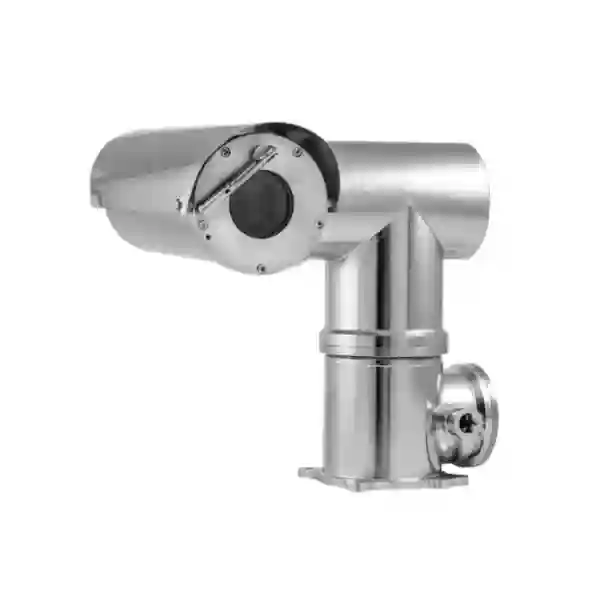
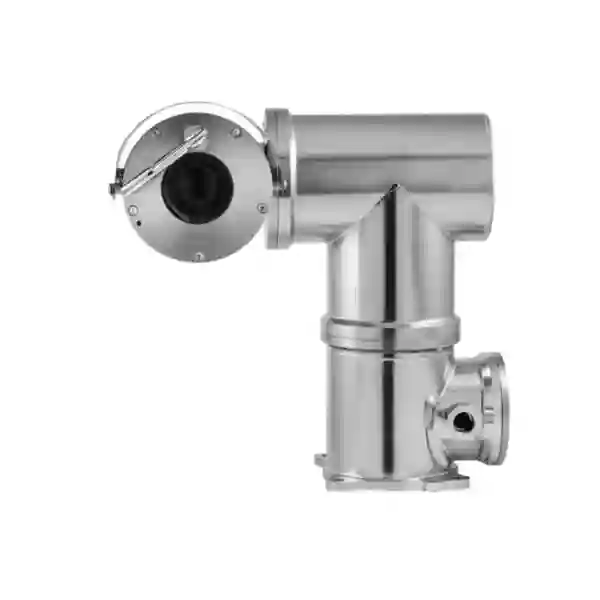
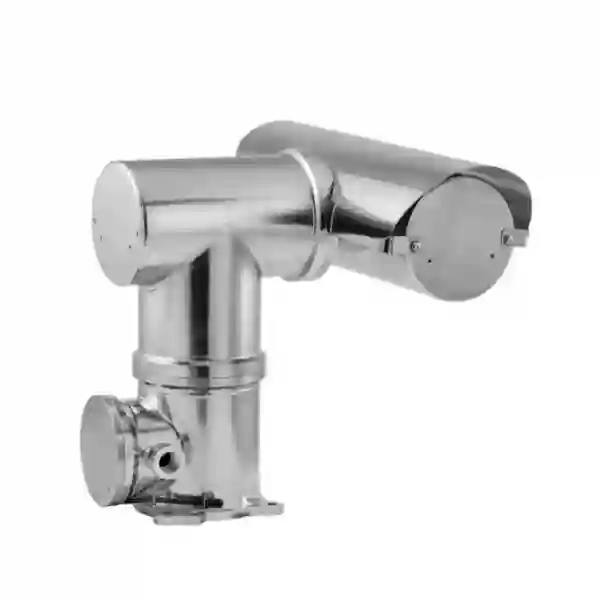
TNU-X6320A1WT1-M: Explosion-Proof PTZ Camera
Choose this specialised 24VAC industrial PTZ camera when you need remotely controlled Full HD observation and a camera station whose published hazardous-area documentation can be checked against your specific installation. The decision should combine video requirements, verified certification scope, environmental conditions, cabling and safe maintenance access—not just zoom or picture quality.
32x optical zoom
316L stainless steel
IP66 / IP67
Essential specifications at a glance
These figures are for the exact TNU-X6320A1WT1-M model as described in the Hanwha Vision product information. Verify current documentation and the complete technical scope before commissioning. No Tanzania price, stock level, delivery schedule or local regulatory approval is represented by this summary.
Built for surveillance decisions in hazardous industrial areas
The Hanwha TNU-X6320A1WT1-M explosion-proof PTZ camera is designed for projects where a conventional exposed camera may not be appropriate. It combines a remotely controlled positioning camera with a robust hazardous-area camera station, enabling operators to view plant approaches, working areas, equipment corridors and distant activity from a central security or operations environment. The main purchasing question is not simply whether the image looks sharp. It is whether the exact camera configuration, hazardous-location marking, mounting design, power arrangement and network architecture meet the conditions of the proposed installation.
For a Tanzania-based industrial project, begin with the site survey and hazardous-area documentation rather than treating the word explosion-proof as a universal authorization. This model offers Full HD video, a 32x optical zoom, a wiper and corrosion-conscious stainless-steel construction. Its advertised approvals are specific and should be assessed by the project’s qualified electrical and safety teams. Before requesting a quotation, identify the installation zone or division, anticipated viewing distances, power source, monitoring platform and access arrangements for safe installation and servicing. These details determine whether this exact model is the correct choice.
Understand the hazardous-area rating before you buy
An explosion-protected camera station is selected against a defined industrial hazard; it is not a device that detects a coming explosion or prevents every ignition source at a facility. Hanwha lists cLCus Class I, Division 1 and INMETRO certifications for this exact variant. Those markings describe particular certification frameworks and scopes. They do not by themselves establish approval under every country’s rules or prove suitability for every gas group, ambient-temperature restriction, dust hazard, offshore location or installation method. Ask the responsible engineer to check the actual certification documentation and the nameplate against the site’s classification.
Your technical submittal should distinguish gas or vapour risk from combustible dust conditions, identify the applicable electrical code, and specify required cable glands, entries, barriers, bonding and installation practices. A hazardous-area drawing is a better starting point than a catalogue category. If your project uses IEC/ATEX zone terminology, do not automatically translate a North American Division designation into an equivalent zone. Verify the exact certificate scope with the manufacturer and competent authority. Where documentation cannot demonstrate compliance, consider a configuration explicitly certified for the site’s classification instead of assuming that any explosion-proof enclosure will be acceptable.
Why the 316L stainless-steel station matters
Hanwha specifies electro-polished 316L stainless steel on welded assemblies, a toughened-glass viewing window and a substantial positioning-camera assembly. These are practical considerations in industrial sites where airborne moisture, aggressive cleaning conditions or corrosive atmospheres may shorten the life of ordinary external equipment. Stainless steel helps address material exposure, but its presence does not remove the need to assess the particular chemicals, salt deposition, temperature and mechanical loads at the mounting point. Corrosion resistance must be considered for the complete installation, including external brackets and fixings.
The manufacturer gives physical dimensions of approximately 418 by 457 by 401 millimetres and a weight of 33 kilograms for the camera assembly. Allow for that mass during lift planning, bracket specification and structural calculations. Consider the projected loads from wind and moving equipment, the stability of the mounting substrate and the maintenance space around the enclosure. The housing material is one part of a safe installation; nearby metallic components, earthing arrangements and weather-exposed connection points deserve equal attention. Have an approved engineer select the support rather than relying on a generic lightweight CCTV mount.
Weather exposure, sealing and the viewing window
The published IP66 and IP67 ingress-protection ratings are valuable when designing outdoor surveillance in rain-exposed or washdown-prone positions. They describe environmental protection under specified test conditions, rather than unrestricted resistance to every cleaning method or a blanket guarantee against water entry after incorrect installation. The final assembly must preserve the intended protection at cable entries and all installation interfaces. Suitable glands, seals, conduit arrangements and ongoing inspection are particularly important when a camera is exposed to persistent humidity or harsh industrial cleaning.
Hanwha also includes a toughened-glass camera-station window and an integrated wiper. For operators, the practical benefit is the ability to address water on the viewing surface without immediately dispatching a technician to the mounting position. A wiper does not replace cleaning for accumulated dust, oily residue, salt or chemical deposits; the site should still plan inspections and appropriate cleaning methods. Check whether a separate washer system is required for your environment and whether any optional components are included in the project quotation. Do not assume that the camera ships with every accessory pictured in general series material.
The 32x lens: flexible inspection, not unlimited identification
The camera uses a 4.44–142.6 mm motorised lens with 32x optical zoom and a specified 16x digital zoom. At the wide end it can show a broad working area; at longer focal lengths it can narrow attention onto a pump line, access route, platform or other distant location. Optical magnification and digital enlargement are different. Optical zoom changes the captured field of view, whereas digital zoom enlarges existing image information. The latter is useful for viewing but cannot create detail the sensor never recorded.
Hanwha lists a horizontal viewing angle of approximately 64.44 degrees at wide angle and 2.29 degrees at telephoto. In real deployment, usable identification detail depends on target size, distance, lighting, atmospheric conditions, camera movement and the recording settings. Ask the integrator for a pixel-density or scene-design assessment instead of taking a zoom number as a guaranteed recognition range. Consider whether the camera must survey an entire route or deliver close observations of a single high-value point. A narrower field of view may improve detail while showing less of the surrounding scene, so preset planning is essential.
Pan and tilt positioning for operational viewpoints
The specified pan movement covers 0–360 degrees, with tilt from minus 90 to plus 90 degrees. Maximum listed preset movement speeds are 45 degrees per second for pan and 24 degrees per second for tilt. This gives control-room personnel useful flexibility for repositioning from one defined viewpoint to another. The operational value comes from well-designed positions: a broad overview of the area, tighter views of equipment, selected entry points and a clear process for responding to events. A PTZ does not record every direction at full detail simultaneously.
When planning a patrol, prioritise safety-critical viewpoints and understand what will not be on screen while the camera looks elsewhere. Specify who is allowed to move the unit, whether operator commands override automated movement, and how the camera should return after an event. Check clearance around the housing throughout its permitted movement envelope. If continuous observation of several independent areas is mandatory, supplement the PTZ with appropriately rated fixed cameras rather than making one device responsible for multiple simultaneous views. This approach helps prevent blind spots and conflicting control-room priorities.
Full HD capture and realistic image expectations
The imaging system provides 1920 x 1080 video using a 1/2.8-inch CMOS sensor. The manufacturer lists H.265 and H.264 capture at up to 60 frames per second in 60 Hz configurations or 50 frames per second in 50 Hz configurations, subject to the chosen operating settings. The maximum frame rate is not necessarily the best setting for every link or recorder. A facility may reasonably prioritise stable recording, an appropriate shutter speed and sustainable retention over the highest possible frame count.
Two-megapixel imaging can be well suited to operator-controlled observation where the zoom lens helps bring selected subjects into view. It is not equivalent to a 4K sensor or a specialised thermal imaging system. If the required task is long-distance forensic identification, read a licence plate under difficult lighting or temperature-based leak detection, define that task explicitly and test whether a different camera or sensor is needed. An acceptance test using the actual mounting height, lens angle and representative scene is more informative than a nominal resolution alone.
Low light, daylight transitions and dynamic range
Hanwha lists minimum illuminance figures of 0.05 lux in colour and 0.005 lux in black-and-white under defined test conditions, with automatic day/night operation using an infrared-cut filter. Those values indicate the imaging system’s low-light behaviour; they do not mean every distant subject will be recognisable under those illuminance levels. Movement, lens position, shutter time, noise and scene contrast still affect usable detail. The manufacturer’s page does not establish an integrated infrared illuminator for this exact model, so specify separate lighting if required rather than assuming night illumination is built in.
The specified 120 dB wide dynamic range can help when a scene contains strongly illuminated and darker areas, such as a doorway facing bright outdoors or a lit platform adjacent to shadowed equipment. Built-in gyro-assisted digital image stabilisation and defog processing are additional image-management tools. They can improve the viewing experience under certain conditions, but they are not substitutes for a rigid mounting structure or sufficient lighting. Review representative day, dusk and night footage at the planned focal lengths before signing off the deployment.
Built-in analytics and alarm handling
The model supports motion detection and additional analytics, including tampering, fog detection, face detection, shock detection, virtual-area events and virtual-line crossings. These features are useful starting points for operator alerts, event bookmarks and controlled escalation. They should not be presented as guaranteed intrusion prevention, certified safety shutdown or error-free recognition of every event. Video analytics are sensitive to scene design, environmental conditions and settings. A moving shadow, rain, changing lighting or maintenance vehicle can affect performance.
Define the purpose of each alert before enabling it. For example, a line-crossing event may support review of an access approach, while tamper detection may help flag a change in camera viewpoint. Record which events should create an operator notification, which deserve an incident clip, and how alarm volume will be monitored. Hanwha lists event actions such as email notifications, file uploads, recording triggers and PTZ preset handover. Verify support in the selected recorder or VMS and test alerts at the site. Facial detection is not the same as identity verification, and privacy and data-handling obligations remain with the operator.
Streaming formats, bandwidth and recorder planning
The device supports H.265, H.264 and MJPEG compression, with Hanwha’s WiseStream II technology. The manufacturer also lists multiple streaming profiles and ONVIF Profiles S and G alongside SUNAPI integration. These interfaces give integrators practical options when connecting a network camera to a management platform. However, an ONVIF label does not establish that every advanced analytic, preset control, event or security feature will work identically with every recorder. Confirm compatibility against the exact platform, version and firmware configuration.
Choose stream profiles around operational roles. A control-room live view may use different resolution or frame-rate requirements from evidence recording or a low-bandwidth remote viewer. Compression settings also affect scene clarity, storage use and bandwidth. As a result, the right design requires a recording-retention calculation based on motion, frame rate, quality and operating hours. If a remote industrial facility uses a constrained uplink, avoid assuming one constant bitrate applies in all scenes. Test performance under realistic movement, weather and lighting, and reserve network capacity for management traffic and incident viewing.
Local edge storage and continuity planning
Hanwha specifies two microSD/SDHC/SDXC storage slots, each supporting up to 256 GB, for a combined maximum of 512 GB. This is an edge-recording feature that may be helpful when designing event capture or resilience within a wider video system. It does not prove that cards are supplied, that recording can continue indefinitely, or that every network outage automatically results in seamless recovery. The exact recording behaviour depends on configuration, supported card type, firmware and VMS capabilities.
Plan how recorded data will be accessed, secured and retained. For surveillance applications where footage must be reviewed after an event, the project should establish its central recording design, edge-storage role and permitted retention period. Check card suitability for continuous or event-driven workloads and verify how the camera handles a full or failed card. A formal commissioning test should include network interruption, restored connectivity, event retrieval and time synchronisation. Do not assume that theoretical maximum card capacity directly translates into a guaranteed number of recording days.
Network security, permissions and audit records
The manufacturer lists HTTPS, SRTP, 802.1X network authentication, IP-based access control and access, system and event logs among the platform’s security capabilities. These are useful building blocks for a managed industrial CCTV network. They are not automatic proof that a deployed system is secure. Device security depends on credentials, firmware maintenance, network segmentation, approved remote access, management-server protection and how privileges are administered across staff and contractors.
An industrial installation should define separate roles for administrators, live-view operators and personnel allowed to reposition the camera. Decide whether the surveillance network is isolated from operational-control networks and how remote support will be authorised. Use secure transport where supported by the whole system, disable unneeded services and document firmware versions and configuration backups. A password change at handover is only one step. The operations team also needs a controlled process for removing departed users, reviewing logs, applying tested updates and investigating unexpected camera movement or network events.
Power requirements: 24VAC rather than ordinary PoE
This exact model is specified for a 24VAC input with maximum power consumption of 80 W. That is an important distinction from many conventional IP cameras powered directly through an Ethernet switch. Do not design the installation on the assumption that a standard PoE port can power the positioning station. Select the electrical supply and associated installation components according to the manufacturer’s instructions, hazardous-location requirements, cable distance and measured voltage at the equipment under operating load.
Include power continuity in the design. A live network connection alone is not useful if the camera’s dedicated supply is unavailable during a process disturbance or site power event. Evaluate appropriately engineered backup power where continuous surveillance is required, while keeping all hazardous-area electrical interfaces within their approval scope. Protect cables and terminations against mechanical damage and moisture. The final electrical schedule should state source voltage, load allowance, protection devices, earthing and isolation arrangements. Only qualified personnel should install or service power systems in classified areas.
Cabling, network connection and entry protection
Hanwha identifies a 10/100BASE-T RJ-45 Ethernet interface for the standard network connection; optional single-mode fibre configurations belong to other suffix variants and must not be assumed for this model. For the specified camera, verify the required network route, surge protection strategy, maximum cable length and termination arrangement before procurement. Industrial environments can be difficult for copper cabling because of long runs, interference, mechanical exposure and equipment movement. The design should respect electrical separation and all site requirements.
Check the enclosure’s entry provisions and the correct manufacturer-approved fittings rather than selecting glands solely by nominal thread size. Cable entries can be critical to both ingress protection and hazardous-area integrity. An otherwise suitable camera can become unsuitable if terminated with the wrong gland, seal, conduit practice or barrier. Document any intermediate cabinets or media-conversion equipment separately; their own certifications and locations matter. Where a longer run or galvanic isolation is necessary, evaluate a complete network architecture, not an unverified adapter attached to the camera. Include a tested cable schedule in the site documentation.
Mounting, structural loading and safe access
A unit weighing 33 kilograms requires a deliberate installation plan. Confirm the structural capacity of the wall, pole, platform or other support, including attachment points and expected environmental loading. Check that the full pan-and-tilt envelope remains clear of nearby equipment and that the operator can see intended areas without obstruction. Mechanical strength and image stability are connected: movement in the support can reduce the value of a powerful zoom lens, especially when the operator inspects distant targets.
Maintainability should influence placement just as much as field of view. Plan a safe access method for inspection of the viewing window, wiper, cable entries and fasteners. In process facilities, maintenance may require permits, isolation and coordination with plant operations. Agree on the access procedure before lifting and energising the camera. Consider the direction of normal spray, exhaust discharge, heat and vibration so that an apparently convenient bracket does not create recurring visibility problems. Use project-approved mounting accessories after confirming that they match the specific camera assembly and environmental load.
Commissioning that proves more than a live picture
A complete commissioning process should confirm the physical installation, applicable hazardous-area documentation, input voltage, network addressing, firmware, time synchronisation, user permissions and camera orientation. It should then demonstrate video performance at the actual viewpoints. Verify wide-angle coverage, telephoto detail, focus behaviour, pan and tilt movement, preset recall and operation of the wiper. Include backlit, evening and low-light scenes where those conditions matter to the risk assessment.
Check the recording chain rather than relying only on a successful browser preview. Confirm central recording, playback, event triggers and export permissions; test connection loss and restoration if edge recording is part of the design. Operators should be trained on what the camera can and cannot do, including the effect of zoom on situational awareness. Hand over final camera identifiers, network settings, preset names, safety documentation, test results and maintenance responsibilities. If any claimed compatibility or approval cannot be demonstrated, record it as an open item instead of accepting an assumption as evidence.
Applications in oil, gas and process facilities
The camera’s combination of position control, optical zoom and explosion-protected construction makes it relevant to surveillance planning around selected oil and gas processing assets, tank-farm approaches and industrial transfer points where suitable hazardous-area equipment is required. In such settings, operators may need a broad view of a working area followed by closer visual confirmation of a specific position. The value of a PTZ can be especially clear when the monitored activity is not fixed at one small location.
Design teams should still distinguish security surveillance from process measurement and safety protection. The device does not replace gas detection, fire alarms, interlocks, pressure instruments or formal operating procedures. If visual monitoring contributes to emergency response, document its reliability expectations and the independent safeguards that remain in place when the picture is unavailable. A project should also decide how many fixed views are necessary to maintain continuous awareness while the PTZ is redirected by an operator. The appropriate quantity and location of cameras are outputs of the risk assessment, not properties of the model number.
Applications in chemical, marine and heavy industry
Chemical processing, port-related industrial assets, marine facilities and heavy manufacturing can expose surveillance equipment to a mixture of atmospheric, mechanical and operational challenges. Where the site’s classification and the product certificates align, this Hanwha camera may be considered for controlled observation of process-adjacent pathways, equipment areas and access movements. Its stainless-steel assembly and integrated wiper are relevant to locations with demanding outdoor maintenance conditions, while the optical zoom supports changing observation tasks.
These environments are not interchangeable. A coastal site may require special attention to salt accumulation and support corrosion, while a chemical area may place greater emphasis on compatible cleaning procedures and gas classification. A vibrating machinery platform may challenge zoom stability. A high-temperature location may exceed the product’s stated ambient limits even when the broader region has a moderate climate. The correct engineering response is to assess exposure at the exact mounting point and to verify the safety marking against the local hazard documentation. Treat the application examples as possibilities, not a blanket installation approval.
Tanzania project considerations without assumptions about stock
For projects in Tanzania, the most useful early information is the actual facility context: site classification, environmental exposure, communications infrastructure, power availability, access restrictions and the surveillance objective. Coastal and inland industrial facilities can have very different exposure profiles, so a country label alone is not enough to size or approve equipment. Provide the project location and mounting environment in a quote request so that suitability can be assessed accurately without implying a particular office, service area, local certification or delivery promise.
Hanwha’s published manufacturer specifications provide the technical starting point; they do not establish the camera’s import status, stock position, installed price, local warranty terms or permission for every regulated hazardous location in Tanzania. Obtain the applicable documentation from the responsible suppliers and project authorities before ordering. Ask which accessories, storage media, power components and installation services are included in the proposed scope. Where a site operates under particular owner standards, make those requirements explicit during technical review. This prevents an otherwise impressive equipment specification from being mistaken for a complete and approved surveillance solution.
How to decide whether this variant is the right one
The model suffix matters. This is the 24VAC, wiper-equipped TNU-X6320A1WT1-M configuration, not a generic placeholder for every member of the TNU-X6320A family. Hanwha’s wider series includes variants with different supply-voltage, connectivity and temperature or certification characteristics. A product image or family datasheet is therefore insufficient evidence when ordering a particular variant. Confirm the complete model string on the quotation, submittal and procurement documents, and make sure the physical nameplate matches at delivery.
If your project specifically requires a fibre interface, an alternative power source, a different hazardous-area certification scheme or a different temperature envelope, ask for an engineering comparison before substituting models. If continuous views of multiple points are required, multiple fixed hazardous-area cameras may be operationally preferable to a single moving camera. If thermal detection, thermal imaging or extremely high resolution is mandatory, this visible-light Full HD product may not meet the measurement objective. Focus the comparison on the actual task, not only the number of headline features.
Prepare a useful request for quotation
A strong equipment enquiry should include the complete Hanwha model, quantity, facility type, exact hazardous-area classification, approximate installation height, typical target distances, intended monitoring tasks, network design and the planned power source. If available, attach a simple layout showing the desired viewpoints and current cable routes. State whether the project already uses a VMS, whether edge recording is required, and who will review certification and electrical installation documents. These inputs allow a more meaningful technical response than asking for a camera price alone.
Request a clear bill of materials that separates the camera assembly from mounting hardware, approved glands, power equipment, storage cards, washer accessories, recording licences and installation labour where applicable. Seek confirmation of the latest exact-model datasheet, certification package, lead time, commercial terms and after-sales arrangements without assuming any of them in advance. The buyer should understand what is included and excluded before comparing offers. Where the installation is safety-critical, require technical approval and documented site acceptance criteria before a purchasing decision.
Ongoing cleaning, inspection and lifecycle care
Industrial cameras remain useful only while the picture, movement mechanisms, enclosures and supporting systems are maintained. Establish an inspection schedule appropriate to environmental exposure, operating criticality and the manufacturer’s instructions. Examine the viewing window for residue, check the wiper’s performance, review housing and mounting condition, and monitor for changes in image stability or preset accuracy. Inspection of hazardous-area fittings and enclosure integrity must follow approved procedures; staff should not open or modify equipment casually in a classified location.
Digital maintenance deserves similar planning. Monitor recorder health, time alignment, access logs, storage alerts and camera connectivity. Keep a documented firmware baseline and evaluate updates through the site’s change-control process. Test that required events are still recorded after network or software changes. Where a component reaches end of support, compare replacement options using the original hazardous-area classification and updated operational requirements. Finally, retain installation, certification and maintenance records so that future operators can distinguish proven configuration details from assumptions made during procurement.
Frequently asked questions
Is the TNU-X6320A1WT1-M suitable for every explosive atmosphere?
No. Hanwha lists specific cLCus Class I, Division 1 and INMETRO certifications for the model, but those markings do not authorise installation in every gas, dust or area classification. A qualified engineer should compare the actual certificate and nameplate with the site’s hazardous-area documentation and installation rules. The project must also select compatible cable entries, power arrangements and mounting accessories. Obtain written technical approval for the specific location rather than relying on a general product category.
What resolution and optical zoom does this camera provide?
It delivers 2MP Full HD video at 1920 by 1080 pixels and uses a 4.44–142.6 mm lens with 32x optical zoom. Hanwha also specifies 16x digital zoom. Optical zoom alters the field of view; digital zoom enlarges recorded pixels. Useful target detail depends on the scene, distance, lighting and recording settings. An integrator should demonstrate representative wide and close-up views at the proposed mounting point before you approve the system.
Does the camera include an integrated wiper?
Yes. Hanwha lists an integrated wiper for the exact TNU-X6320A1WT1-M model. This can help clear water from the camera’s viewing window and reduce interruptions to observation during poor weather. It does not remove all industrial contamination, replace a planned cleaning programme or establish that a washer tank is included. Confirm any additional cleaning accessories and their hazardous-area suitability as separate items in the project specification.
Can this model run from a PoE network switch?
Do not assume so. The published power requirement for this exact variant is 24VAC, with maximum consumption of 80 W. Ordinary Power over Ethernet is therefore not the stated power method. Specify a suitable dedicated electrical supply and any backup arrangements with the site’s qualified electrical designer. The Ethernet connection carries network communication; it should not be treated as a substitute for the required electrical input.
Is it a thermal camera or an infrared night-vision illuminator?
No thermal imaging capability is specified. The unit is a visible-light 2MP network PTZ camera with automatic day/night operation. Hanwha publishes low-light sensitivity values, but does not list a built-in infrared illuminator for this exact configuration on its product page. If the intended task requires temperature measurement, operation in complete darkness without separate lighting, or thermal alarm analytics, compare a purpose-designed thermal system instead of assuming these features are included.
How does the camera integrate with existing recorders?
Hanwha lists H.265, H.264 and MJPEG streaming, ONVIF Profiles S and G and its SUNAPI interface. These capabilities can assist interoperability, but support for PTZ functions, analytics, events and recording features varies by recorder and software version. Before purchase, verify the actual VMS release, desired functions, firmware and licences. A practical test should confirm live viewing, movement controls, alerts, recording and playback rather than relying on a protocol logo alone.
Can recordings be stored inside the camera?
The manufacturer specifies two microSD, microSDHC or microSDXC card slots, each rated up to 256 GB, providing a listed total maximum of 512 GB. Cards and recording capacity should be treated as configuration items, not automatic inclusions or guaranteed retention periods. Confirm approved media, recording mode, event handling and retrieval procedures. For critical surveillance, determine whether central recording and a documented backup or export process are also required.
What environmental protection does it offer?
Hanwha publishes IP66 and IP67 ingress-protection ratings, a 316L stainless-steel construction and an operating-temperature range from minus 40 to plus 60 degrees Celsius. These are meaningful parameters, but they do not prove that every cable termination, bracket or accessory provides the same protection. The exposure at the actual mounting point, cleaning chemicals, corrosion risks, safe installation method and maintenance procedure all need review before the camera is accepted.
Does the manufacturer approval automatically cover Tanzania?
No. The published certification marks must be evaluated under the standards and approval process applicable to the specific Tanzania installation. Manufacturer documentation can support an engineering review, but does not on its own establish a local regulatory approval, import clearance or blanket authorization for every facility. The project owner and responsible competent professionals should confirm the required evidence before procurement, energisation or use in a classified area.
What information is needed for a quotation?
Provide the exact full model number, quantity, facility context, hazardous-area classification, approximate mounting height, desired viewing distances, planned 24VAC source, Ethernet route and recording platform. State whether mounting hardware, approved cable entries, local storage, accessories, installation, commissioning and documentation are required. Ask the supplier to confirm configuration, technical submittals, commercial availability and inclusions rather than assuming a price or delivery date from a general catalogue.
Is one PTZ enough to monitor an entire site?
Not necessarily. A PTZ can aim at different points, but a single moving camera cannot continuously capture full detail in all directions at once. If operators zoom into one piece of equipment, activity elsewhere may be outside the current scene. Where continuous evidence is important, combine the PTZ with enough properly selected fixed viewpoints. Base camera count on coverage objectives, sightlines, incident-response procedures and the facility’s risk assessment.
What should be verified during site acceptance?
Test safe installation documentation, supply voltage, network connectivity, image quality at planned focal lengths, pan and tilt clearances, presets, wiper operation, low-light performance, time synchronisation, video recording and alarm handling. Verify user permissions and how the system responds to a network interruption. Capture evidence of the completed tests in a handover pack. Outstanding certification, mounting or integration questions should remain open until the responsible engineer signs them off.
Request a project-specific technical quotation
For the Hanwha TNU-X6320A1WT1-M explosion-proof PTZ camera, prepare your hazardous-area classification, intended views, power and network details, recording requirements and required accessories. Ask FourTeck Tanzania to review the enquiry and provide a quotation subject to technical and commercial confirmation. Any certification, installation, availability and warranty conditions must be confirmed for your exact project.
Contact FourTeck Tanzania to discuss your requirements and request a quote.




Reviews
There are no reviews yet.