
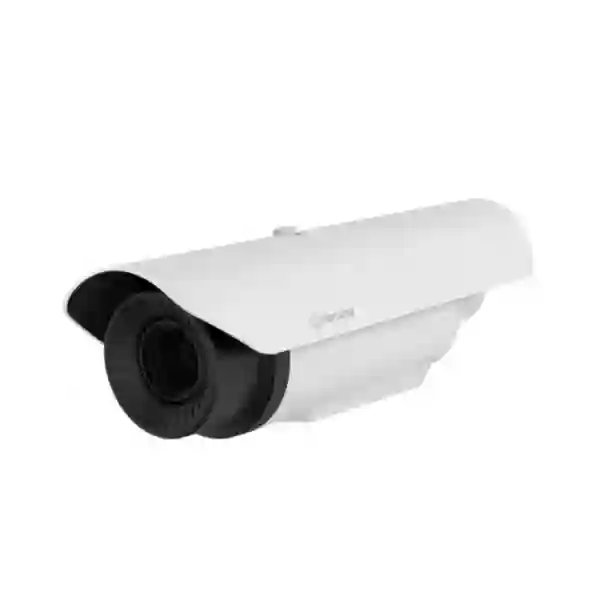
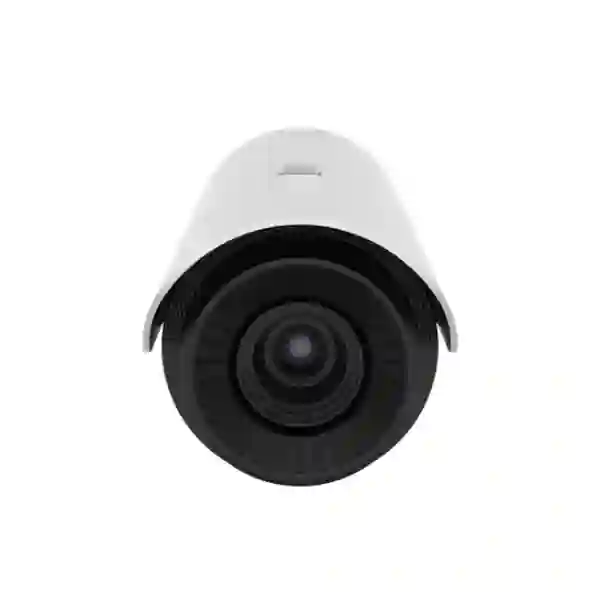
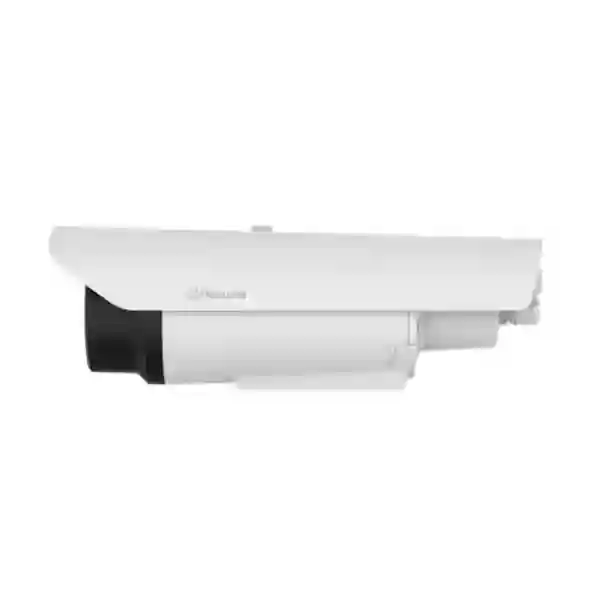
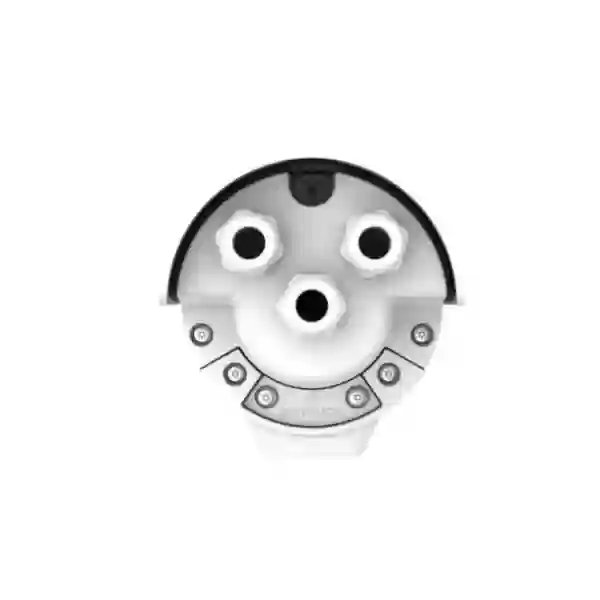
Hanwha TNO-4041TR Radiometric Thermal Camera
Evaluate a 640 × 480 thermal network camera designed for outdoor heat-based observation, temperature monitoring and event-led security. The TNO-4041TR combines a 19 mm fixed lens, radiometric readings and configurable video analytics to help teams understand activity when visible-light cameras alone do not meet the application.
Procurement note: Hanwha Vision support documentation labels this model discontinued. Request confirmation of sourcing, firmware support, integration needs and suitable current alternatives before specifying it for a new project in Tanzania.
At a glance: what you are evaluating
The Hanwha TNO-4041TR radiometric thermal camera is designed to convert differences in infrared energy into a picture and provide temperature-related measurements within its published operating envelope. It is particularly relevant when a site needs repeatable monitoring of thermal activity, a more useful image during darkness, or an event stream that an operator can correlate with other surveillance cameras. It does not produce a conventional full-colour identification image, and it should not be mistaken for a high-precision industrial thermometer.
The model’s combination of a 640 × 480 microbolometer, 19 mm F1.0 fixed lens and approximately 32-degree horizontal field of view is worth assessing against the dimensions of the actual scene. For perimeter security, the key question is whether a person or vehicle will occupy enough pixels at the desired distance. For temperature supervision, the more important questions are target size, emissivity, reflective surfaces, environmental changes and whether its stated accuracy is good enough for the decision being made.
For a Tanzanian facility planning a purchase or replacement, define the operational outcome first. Specify which event must be detected, which response must follow, who will review the alert, how the unit will be powered and how recordings will be retained. Once those details are clear, it becomes possible to determine whether this particular legacy model is suitable or whether a newer supported camera offers a better long-term route.
Technical specification overview
The following is a selection of published Hanwha Vision specifications for the exact TNO-4041TR model, arranged for purchase and engineering discussions. Confirm the documentation and firmware relevant to the actual unit, since product documentation can be updated or vary by market. These figures describe the camera; they are not a promise of availability, working range at your site or compatibility with untested hardware.
For a responsible specification, read the values as constraints. The field of view guides lens placement; the temperature accuracy guides permissible alert thresholds; the power data guides switch and backup planning; and the ingress ratings guide housing assessment. The numbers become useful only when matched to a clear monitoring outcome and properly commissioned conditions.
| Attribute | Published detail |
|---|---|
| Camera type | Outdoor IP radiometric thermal camera |
| Imager and resolution | Uncooled microbolometer; up to 640 × 480 pixels |
| Lens and viewing angle | 19 mm fixed F1.0; approximately 32° horizontal and 24.3° vertical |
| Temperature reading range | -20°C to +130°C |
| Specified temperature accuracy | ±5°C at or below 100°C; ±20% above 100°C |
| Temperature regions | Up to six quadrilateral regions of interest |
| Video | H.265 / H.264 / MJPEG; up to 30 fps at 60 Hz or 25 fps at 50 Hz for H.265 / H.264 |
| Network | RJ-45 10/100 Ethernet; ONVIF profiles S, G and T listed in the manufacturer specifications |
| Local storage | One microSD/SDHC/SDXC slot, up to 256 GB |
| Power | IEEE 802.3af PoE Class 3, 12 V DC or 24 V AC |
| Environmental ratings | IP66, IK10 and NEMA 4X housing ratings |
| Operating ambient temperature | -40°C to +60°C |
| PT head connection | RS-485/422 interface for compatible pan/tilt head integration |
| Lifecycle note | Hanwha Vision support material identifies TNO-4041TR as discontinued; current Tanzania supply requires confirmation |
Practical application scenarios
Perimeter and restricted-area access
A property boundary may require reliable awareness of motion in darkness while guards or operators use separate cameras to confirm identity. Map the direction of interest and the intended patrol or response procedure. Test what happens when more than one warm target enters a scene and when the thermal background approaches the target’s apparent temperature. Treat this as detection support rather than an all-weather guarantee.
Equipment temperature observation
The radiometric mode may be useful where a consistent surface or process region is visible and broad changes are operationally meaningful. Define the permitted range, measurement tolerance and response ownership. Test under normal workload, startup, shutdown and expected weather conditions. A small, reflective or very hot object may require a different measurement method, especially beyond the model’s stated temperature and accuracy limits.
Yards, gates and vehicle routes
Thermal imagery can supplement visible security views in dark yards, but the camera is not a substitute for readable licence plates or colour evidence. Establish vehicle movement directions, permitted crossing periods and secure zones. Avoid placing a single camera where large vehicles repeatedly hide people or smaller machinery. Coordinate video event rules with existing gate procedures so that alarms prompt practical, proportionate action.
Remote infrastructure monitoring
At an isolated compound, a camera with thermal video, local storage and network alarm functions may contribute to a layered protection concept. Assess communications uptime, battery or generator backup, mounting security and remote service access. Do not assume a camera can alert personnel while the communications path is unavailable. Record what information can be buffered locally and how the site detects prolonged system faults.
Legacy system extension
A site already operating TNO-4041TR units may seek consistent images or spare parts. Verify the exact firmware and event requirements before adding another unit. A discontinued designation raises legitimate support questions even when the deployed system is stable. Compare the operational cost of one more legacy unit with a staged migration to a supported platform, including the work needed to re-test analytics and recorders.
Radiometric thermal monitoring: the important distinction
Thermal imaging and radiometry answer related but different questions. A thermal image helps an operator see contrasts in the scene, such as a warmer person against cooler surroundings. A radiometric camera adds temperature-value functions so thresholds can be associated with monitored areas. The TNO-4041TR belongs to the radiometric category, which is why it can be evaluated for certain temperature-alerting applications as well as conventional security observation.
Hanwha Vision differentiates radiometric TR-suffix models from thermal-image-only T-suffix models in its support guidance. This distinction matters during procurement because a camera that merely shows brighter or darker heat patterns cannot automatically be assumed to report a meaningful numerical temperature. The TNO-4041TR provides a specified reading range and accuracy, but that does not turn it into an accredited process instrument or a certified life-safety system.
The manufacturer’s published range is -20°C to +130°C. Temperature accuracy is stated as ±5°C for temperatures up to 100°C and ±20% above 100°C. Those values are broad relative to precision measurement tasks. A reading near a set threshold therefore needs an engineering tolerance, a suitable safety margin and a clear operating procedure. Avoid using a single camera reading as the sole basis for a hazardous shutdown or critical protection decision.
Up to six quadrilateral temperature-detection regions of interest are described in the specification, with spot temperature reading and a hybrid palette function. These tools can make it easier to watch defined pieces of equipment or zones rather than treating every part of the image equally. A successful design still depends on where the camera sits, whether the monitored object remains in the field of view and how the measured surface behaves under different conditions.
Thermal optics, coverage and image interpretation
The built-in 19 mm fixed F1.0 lens provides a stated horizontal field of view of 32 degrees, vertical field of view of 24.3 degrees and diagonal field of view of 39.2 degrees. This is neither an extreme wide-angle view nor a variable zoom lens. A fixed-angle camera is easier to define in an engineered drawing, but it also requires careful positioning because a poor mounting position cannot be corrected afterward by zooming optically.
Thermal pixel count tells only part of the story. A 640 × 480 thermal sensor creates substantially more sampling points than lower-resolution thermal formats, but useful detection depends on the distance to the target, lens field of view, target orientation, air conditions and background contrast. Ask an integrator to demonstrate the actual detection requirement in a comparable scene before promising recognition, identification or an alarm distance. Manufacturer resolution is not itself a guaranteed detection range.
The minimum object distance is specified as 11 metres. This warrants particular attention when the application involves nearby machinery, a compact equipment enclosure or an indoor area. A client seeking a close-up temperature view of small components should not assume a thermal camera intended for broader outdoor observation will resolve them sufficiently. The camera should be positioned to see enough target area for both video analytics and any radiometric readings.
Because infrared appearance is not the same as visible colour or shape, heat signatures may need confirmation from a conventional optical camera. A warm exhaust outlet, sun-heated sheet metal, a reflective roof or a vehicle engine can appear prominent in the thermal image without being the event you intended to detect. Good installations use context, zones, thresholds, event rules and operator verification rather than relying on image brightness alone.
Analytics and response workflows
Hanwha specifies motion detection, tampering, loitering, directional or virtual-line events, entry and exit events, appear/disappear detection, sound classification, shock detection and temperature detection among this model’s analytics. These functions make the camera relevant to alarm-led workflows. They do not mean that every analytic is suitable in every scene. Configure and test individual rules against the real movement patterns, access arrangements and environmental conditions.
A perimeter example is a virtual line set across a restricted approach route. The aim may be to inform an operator when heat-bearing activity crosses in the specified direction. The geometry must avoid public paths, vegetation movement and busy vehicle lanes unless those events are wanted. Even with thermal sensing, false or missed alerts are possible. A site acceptance test should record representative daytime, nighttime and weather scenarios.
The camera’s alarm architecture includes one input and two outputs, plus supported network event functions. Manufacturer material describes event actions such as notifications, storage, PTZ preset handover and MQTT publication. These can support a coordinated response, but each downstream device or software platform must be checked for exact feature-level compatibility. An ONVIF video connection alone does not guarantee that every proprietary event or temperature value will pass through a third-party VMS.
Sound classification and bidirectional audio need careful interpretation. The specification provides selectable audio and line connections, but buyers should not assume every deployment has an integrated microphone or speaker ready to use. Audio surveillance may introduce privacy and operational considerations. Where sound adds no verified benefit, leave it out of the design and focus on the thermal image, event rules and recording requirements.
Where this model may fit in Tanzania
For an industrial yard, the value is often activity awareness after daylight fades. A thermal camera can provide an additional view of moving heat-bearing targets, while a visible-light camera supplies colours, clothing, registration plates or other details that thermal imagery cannot reliably provide. The two technologies complement one another. Choose the required coverage area and alarm zones from site drawings rather than assuming one camera will monitor a whole perimeter.
At a utility compound or equipment area, an operator might want to observe a surface or zone that changes temperature during normal operation. The radiometric range can support a basic alert concept when the expected temperatures and required accuracy fit the published limits. It cannot replace maintenance inspections, electrical test procedures or a more accurate thermal instrument where those are required. Agree on escalation thresholds with the responsible engineer.
For warehouses and logistics yards, fixed thermal observation may help distinguish moving warm targets in difficult lighting. The proposal should make clear where camera views are obstructed by containers, parked trailers, tall shelving or building corners. Thermal sensing does not see through solid walls, roofs or vehicles. Cameras used at gates should be coordinated with access-control procedures and any optical cameras needed for evidential detail.
In a water-treatment or infrastructure site, thermal video can supplement security monitoring of remote approaches while temperature regions are considered for a separate, clearly bounded observation task. The site should decide whether one camera doing both jobs compromises either. A viewing direction optimised for a wide boundary might not be the right orientation for a small critical asset. Separate cameras are sometimes the more dependable choice.
At an installation with high incident consequences, such as a hazardous industrial process, the TNO-4041TR should be assessed only as a supporting monitoring device unless a suitably qualified system designer establishes an appropriate application. No life-safety certification or precision process-control claim is made here. Fire alarms, gas detectors, equipment protection and emergency shutdown systems must meet their own requirements independently of this camera.
Video, compression, streaming and retention
The camera supports H.265, H.264 and MJPEG. For H.265 and H.264, the official specification lists up to 30 frames per second at 60 Hz or 25 frames per second at 50 Hz; MJPEG is also listed at 30 fps. The practical stream configuration will depend on recorder capabilities, the chosen profile, network bandwidth and the visual detail the operator needs. Do not design storage solely from the maximum frame-rate figure.
Hanwha’s WiseStream II is a codec optimisation feature intended to help manage video bandwidth. Actual savings vary with scene movement, thermal image variation, compression settings and the selected stream. A quiet equipment room and a busy vehicle entrance are different workloads. Benchmark the intended scene with the actual codec and bitrate policy before estimating a network or archive budget, rather than repeating a promotional best-case percentage.
The device lists up to ten streaming profiles and up to twenty unicast users, as well as multicast support. These are product capabilities, not a recommendation to connect twenty unplanned viewers. In a larger installation, it is usually more manageable to have the video management system distribute operator views while maintaining a controlled recording stream. Test remote access and event delivery without exposing camera services unnecessarily to the public internet.
A single microSD/SDHC/SDXC slot supports cards up to 256 GB, giving an edge-recording option for a suitable storage policy. Card capacity does not equal a guaranteed retention period. Continuous recording duration depends on frame rate, resolution, quality, event rate, encoding, overwriting policy and card condition. Decide whether edge storage is a primary archive, an outage buffer or a secondary evidential copy, then validate playback and export.
Network features include 10/100 Ethernet, HTTPS, secure streaming options, and ONVIF profiles S, G and T in the published specification. For a mixed-vendor project, confirm the actual firmware version, device discovery, stream access, time synchronization, event subscription and user permissions on the chosen VMS. A successful live-picture test is only the first compatibility checkpoint; alert handling and recorded-video retrieval also matter.
Power, cabling and environmental protection
The stated power options are IEEE 802.3af Class 3 PoE, 12 V DC and 24 V AC. This flexibility helps an integrator compare existing infrastructure with a new network drop. Do not connect multiple supplies casually or assume every power source is interchangeable for field wiring. Confirm the permitted wiring arrangement, appropriate connectors, protective measures and power budget against the manufacturer’s installation documentation.
Official figures list a maximum of 10 W over PoE, 9 W on 12 V DC and 10.5 W on 24 V AC, with different typical values. Size the switch, UPS and backup power for the engineered system rather than multiplying only typical camera consumption. Include network switches, recorders, communications equipment, any externally powered audio accessories and the power requirements of a separate pan/tilt head where one is used.
The housing is listed as IP66, IK10 and NEMA 4X. These ratings indicate specified resistance to ingress, impact and defined environmental exposure for the product housing; they do not guarantee that poorly sealed cable joints, exposed connectors or a weak mounting structure will survive outdoors. Use appropriate glands and junction protection, route water away from terminations and follow approved installation practices for corrosion-prone conditions.
The manufacturer’s ambient operating range is -40°C to +60°C, with non-condensing relative humidity from zero to 90 percent. Before installing in a coastal, dusty, humid or hot location, assess direct solar loading, enclosure conditions, airflow, moisture entry and the surrounding mounting structure. A stated temperature range is not permission to ignore lens contamination, cable degradation or excessive heat at an unventilated mounting position.
Planning the view before installation
Start with a survey drawing that marks the intended monitoring line or equipment area, known obstructions, potential false-alarm sources and routes used by staff or contractors. The drawing should show approximate target distances and elevations. A thermal camera may reveal moving objects in darkness, but it still depends on clear line of sight. Hedges, walls, parked machinery and a solid gate can block the relevant infrared view.
Next define what constitutes success. For example, ‘raise an alarm when a person crosses the restricted boundary’ is a better starting requirement than ‘see everything at night’. For radiometry, define the object surface, expected temperature range, maximum tolerable uncertainty and required response. If the demanded precision exceeds ±5°C within the camera’s main range, look for a purpose-built measurement method instead.
Check the 32-degree horizontal angle against a scaled plan and verify that the most important targets remain inside the image during foreseeable activities. A simulated field of view is a starting aid, not proof of pixel-level identification. Reassess the choice if a target is too small in the frame, if its location changes frequently or if a narrow view causes blind spots across the approach route.
Identify the correct mount or compatible pan/tilt head. The TNO-4041TR is described by the manufacturer as suitable for pan/tilt head integration with RS-485/422, but that does not make it a self-contained motorised PTZ camera. Mechanical supports, controller compatibility, safe cabling, exposure and maintenance access need separate confirmation. Include any required mounting parts explicitly in the bill of materials.
Commissioning checklist: from delivery to acceptance
First, check the exact model identification on the supplied unit and purchase documentation. A similar-looking T-suffix thermal camera or a different focal-length variant can change the application significantly. Record the firmware build, serial number in the private asset register and condition of the housing. Because the model has a discontinued reference, confirm what firmware, spares and lifecycle assistance can actually be provided for the supplied unit.
Second, establish approved power and a controlled network connection. Apply the site’s camera addressing scheme, time source and naming convention before connecting the unit to production monitoring. Separate administrative access from operator use and document which device or service is allowed to communicate with it. An initial successful video picture does not prove that the network can sustain recording, alerts and later software updates.
Third, align the camera carefully, then validate the expected scene at the most demanding distance. Observe the image after sunset and under at least one representative daytime condition. If the lens view is too tight or the target occupies too few useful pixels, change the proposed mounting position or product selection. Do not leave coverage defects to be ‘fixed in software’ when the optical geometry is wrong.
Fourth, configure and validate each permitted temperature region. Inspect reference surfaces and note whether sunlight, reflections, wetness or unusual operating conditions alter apparent thermal readings. Treat thresholds as engineering settings derived from a real use case, not arbitrary round numbers. Include a procedure for checking alarms after maintenance or equipment changes that alter the thermal scene.
Fifth, configure security analytics on a scene-by-scene basis. Walk or drive representative routes as appropriate, and confirm both intended detections and expected non-events. Document alarm boundaries, scheduling, delays and who receives notifications. A line-crossing rule that detects every person on a public footpath is not a successful security configuration, even if the analytic itself is technically working.
Sixth, exercise the full path from sensor to response: camera alarm, network transport, recorder event, operator display, optional PTZ handover and the agreed acknowledgment procedure. Test disconnection and restoration, not only steady-state operation. Include loss of power, interrupted network links and exhausted or faulty local storage in the acceptance checklist so the site understands how faults appear.
Finally, hand over user roles, a configuration record, selected screenshots of coverage, a maintenance plan and a clear list of limitations. The operator should know which events are automatic, which need human confirmation and what the temperature readings can and cannot justify. A documented acceptance result gives future technicians a baseline when the scene or equipment changes.
Security, privacy and maintainability
An IP thermal camera is part of the security network and deserves the same care as other connected devices. Change default credentials where relevant, allocate least-privilege accounts, restrict management access and use secure communication modes supported by the installed firmware. Hanwha lists encrypted firmware, digest authentication, IEEE 802.1X options, HTTPS, SRTP and access logs among the available security mechanisms. Which controls are appropriate depends on the overall system.
Maintain an equipment inventory recording model, firmware, network address, responsible administrator, installation position and backup procedure. If the unit has been discontinued, confirm the available maintenance path rather than assuming ongoing firmware releases. A legacy device may remain useful in a properly controlled environment, but procurement needs to account for replacement lead times, cybersecurity obligations and spares strategy.
Thermal imagery can still show people, movement patterns and operational activity, even if it does not reveal familiar facial detail. Apply relevant organisational privacy rules, access restrictions and retention limits. Where audio is enabled, assess whether collecting it is necessary and permitted. Inform authorised site personnel about the monitoring purpose and ensure event exports are handled as controlled records.
Set a periodic inspection plan for lens condition, mounting stability, cable seals, storage health, clock accuracy and false-alarm history. Compare current performance with commissioning records. A change in background temperature, new reflective cladding, a relocated machine or a newly installed fence can alter the scene enough to invalidate assumptions made during initial installation.
Selection trade-offs and alternatives
Choose a radiometric thermal model for a requirement that genuinely needs temperature-related events. If the objective is solely to notice movement in darkness, a non-radiometric thermal camera may be sufficient, depending on the scene. If visible identity, uniforms, cargo labels or vehicle plates matter, a suitable optical camera is normally required in parallel. One sensor type rarely answers every security question well.
The TNO-4041TR’s 19 mm fixed lens and 32-degree horizontal angle may suit a defined view, but it cannot optically zoom to inspect a distant incident. A different focal length changes the trade-off between scene width and target pixel size. A wider view makes more surroundings visible while reducing the detail available for a given distant target. Compare candidate cameras using the same distances and target definitions.
Radiometric accuracy is another decisive trade-off. The published ±5°C band up to 100°C and ±20% value above 100°C may be adequate for certain broad alarm strategies but insufficient for temperature-critical quality control or precise electrical diagnostics. Where measurement is central to a safety or maintenance decision, consider a specialised thermal measurement instrument and an appropriate calibration and validation process.
Finally, assess lifecycle risk. Hanwha Vision support materials identify the TNO-4041TR as discontinued, and a commercial seller also lists it as end of life. That is a reason to verify current support and replacement options, not a reason to assume every installed unit is unusable. For a new Tanzanian project, evaluate a current camera against the same technical brief and compare total ownership implications.
A replacement should not be selected by megapixel count or catalogue position alone. Compare thermal versus visible sensor type, whether temperature values are supported, the measurement range and accuracy, field of view, interface compatibility, mounting design, local environmental requirements and service arrangements. Make an explicit decision on whether existing VMS events, recorder profiles or mounting hardware can be reused.
Procurement questions for a Tanzania project
Before requesting a quote, provide the project type, number of required camera positions, approximate distances, monitored area dimensions and primary outcome: perimeter detection, general thermal observation or temperature event monitoring. Add a site sketch or non-sensitive representative view when possible. These details allow a supplier to recommend a camera and mounting concept rather than quoting a model number without understanding whether it will work.
State what recorder or VMS is already deployed, which stream codecs and event integrations are needed, and whether the network has PoE capacity. Note the available supply voltage, backup power expectations and preferred local storage policy. Include whether a compatible pan/tilt platform is part of the design or whether the camera needs a fixed mounting approach. The manufacturer’s RS-485/422 capability is not itself a complete PTZ assembly.
Ask the seller to confirm the exact commercial status for Tanzania in writing, including sourcing, product condition, documentation, firmware availability, repair options and any proposed successor. Prices, stock, warranty terms, delivery time and taxes have not been verified for this page, so none is promised. Obtain those terms through a current, itemised commercial offer before approving expenditure.
Specify who will install, configure, test and support the equipment, without assuming any particular service coverage. The best proposal will include acceptance criteria tied to your actual detection or measurement outcome. Ask for a worked-up demonstration of scene coverage and a clear statement of known limitations. The decision should follow the engineering requirement rather than the apparent visual quality of a brochure image.
Common mistakes to avoid
A frequent mistake is treating thermal video as though it can see through any obstacle. It cannot see through ordinary solid walls or opaque barriers. It measures infrared radiation arriving at its sensor from what is visible in the optical path. A person hidden behind a container, heavy vegetation or solid gate may simply be outside the camera’s effective view, even when the camera is functioning perfectly.
Another mistake is confusing the heat pattern with a laboratory-grade temperature measurement. The apparent reading depends on the surface, surroundings and the measurement setup. Reflective metal, changing weather and a small target can complicate interpretation. Never promise a precision that is better than the manufacturer’s stated limits, and never treat a single threshold as proof of impending equipment failure.
A third mistake is using a broad feature list as a substitute for compatibility testing. An ONVIF stream can work while vendor-specific event details do not. A PTZ handover demonstration can work with one supported device but require further integration with another. Likewise, a 256 GB card does not prove a specified number of recording days. Require checks based on the real system, not an assumption that every advertised feature is universal.
Finally, do not ignore the lifecycle of a discontinued unit. New-build decisions should factor in support horizons, firmware policy, compatible replacements and the cost of future substitution. If a legacy installation must be extended, document how an additional camera fits the existing estate and what happens if a unit later fails. This reduces the risk of buying hardware that solves today’s problem but creates an avoidable support issue.
Thermal camera or visible-light camera?
A standard visible-light camera captures surface appearance and can be appropriate for facial detail, clothing colours, inventory labels and vehicle markings when its optics and lighting support the task. A thermal camera forms an image from detected infrared energy and is useful for heat contrast, including in complete darkness. Thermal images are not naturally suited to the same identification tasks, even when their sensitivity is valuable for detecting activity.
In some scenes, the strongest architecture is a paired system: thermal sensing helps highlight activity while optical video provides contextual evidence. A separately integrated pan/tilt camera may be directed toward an alarm zone if supported equipment and VMS rules are configured correctly. Confirm field-of-view overlap, mounting alignment and event-to-camera mapping. The presence of a handover feature in the datasheet does not guarantee any arbitrary PTZ will work.
If a temperature threshold is central to the project, keep the radiometric requirement explicit in the request for quotation. If a broad area needs coverage with detail at multiple distances, consider other thermal focal lengths, positioning arrangements or multiple cameras. If the project demands high-accuracy condition monitoring, evaluate specialist instrumentation instead of stretching the TNO-4041TR beyond its specified measurement capabilities.
Frequently asked questions
Is the Hanwha TNO-4041TR a thermal camera or a normal CCTV camera?
It is a radiometric thermal network camera. Its 640 × 480 microbolometer produces images based on infrared energy rather than ordinary visible-light colour. It can support thermal event monitoring, but it cannot replace a conventional optical camera for every recognition or identification task. Many projects benefit from using both types together.
Can it measure actual temperatures?
Yes, it supports radiometric temperature functions within a published -20°C to +130°C range. Hanwha states ±5°C accuracy at or below 100°C and ±20% above 100°C. Those limitations matter. It is not appropriate to assume a precise temperature from every surface or use the reading as a certified safety measurement without independent engineering validation.
How many temperature zones can I configure?
The manufacturer lists six quadrilateral temperature-detection regions of interest. Their usefulness depends on mounting angle, image coverage, target size and stable scene conditions. Define zones around the objects actually being observed and test alarm thresholds during commissioning. A region configuration is not a guarantee of accurate readings from shiny, distant or partially obscured surfaces.
Can the camera operate in complete darkness?
Thermal imaging does not depend on visible illumination in the same way as an ordinary colour camera, so it can create thermal contrast in darkness. Detection still depends on temperature difference, target size, environmental conditions and an unobstructed line of sight. Confirm performance against the specific scene rather than treating darkness capability as an unlimited visibility guarantee.
What is the lens and field of view?
The TNO-4041TR has a fixed 19 mm F1.0 lens and a published horizontal viewing angle of approximately 32 degrees. The vertical angle is 24.3 degrees. Because the lens is fixed, the site needs an appropriate mounting location. A drawing and field test are advisable when the project depends on detecting a small target at distance.
Does it support PoE and an NVR?
Hanwha lists IEEE 802.3af Class 3 PoE, along with 12 V DC and 24 V AC power options. It offers standard IP video formats and ONVIF profiles S, G and T in the published specification. Actual NVR, VMS, recording, event and temperature-data interoperability should be tested for the specific product versions involved.
Can it record to a memory card?
Yes. There is one microSD/SDHC/SDXC slot with a published maximum capacity of 256 GB. This may help with local recording or network-outage scenarios, subject to configuration. Recording duration cannot be promised without bitrate, recording mode and event activity assumptions. Include card condition, playback testing and data-retention policy in the maintenance plan.
Can I use it with a pan/tilt head?
The manufacturer describes this camera as intended for pan/tilt head integration and lists an RS-485/422 interface. It is not described as a complete, self-motorised PTZ camera. Confirm mechanical compatibility, control protocol, mounting parts, separate head power and VMS operations before ordering. Do not assume every pan/tilt unit will interoperate.
Is it appropriate for industrial safety or fire detection?
It may provide supporting thermal observations, but its radiometric accuracy and application limits must be respected. No claim is made here that this model is certified as a fire detector, gas detector or primary safety instrument. Where lives, critical machinery or regulated processes depend on the outcome, use the appropriate independently specified detection and protection systems.
Is the TNO-4041TR still available in Tanzania?
Current stock, pricing and sourcing in Tanzania have not been verified. Hanwha Vision support material marks the model as discontinued, so a new order needs explicit availability and support confirmation. Request a written offer and evaluate compatible current alternatives. A discontinued model can still appear in legacy projects, but its status should be addressed before a new purchase.
Does the camera work in rain, heat and dusty outdoor areas?
Hanwha specifies IP66, IK10 and NEMA 4X enclosure ratings and an operating ambient temperature range of -40°C to +60°C. Actual deployment still requires suitable cable sealing, structural mounting, drainage and maintenance. Weather can affect target contrast and measurement conditions, so a rated housing does not automatically guarantee uniform thermal performance in every outdoor scene.
What information should I send for a quote?
Provide the exact model, intended quantity, application, camera-to-target distances, existing VMS or recorder, available network and power, environmental conditions and required alarm functions. Explain whether numerical temperature readings are essential and what accuracy is acceptable. Because this is a discontinued model, also request support, sourcing and alternative-model information before making a decision.
Request a technical suitability review
Share your scene dimensions, monitoring objective, existing equipment and required alarm behaviour to evaluate the Hanwha TNO-4041TR against your project. Ask specifically for current sourcing and support confirmation because Hanwha Vision documentation identifies the model as discontinued. If a new supported camera is more appropriate, request an alternative proposal based on the same coverage, radiometric and integration requirements.




Reviews
There are no reviews yet.