
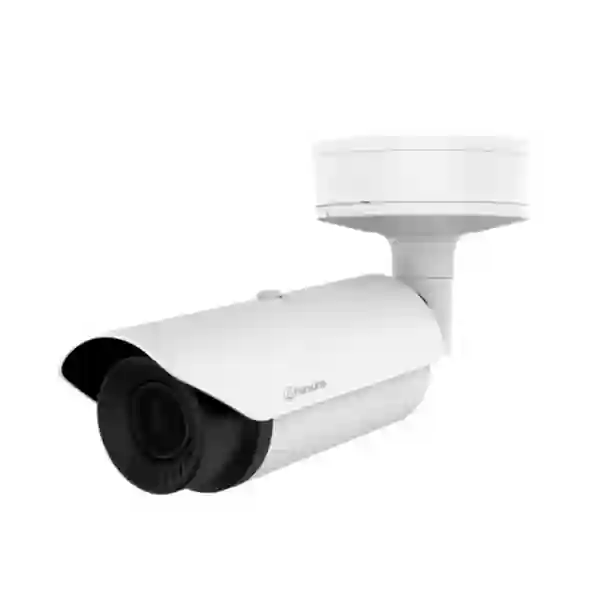
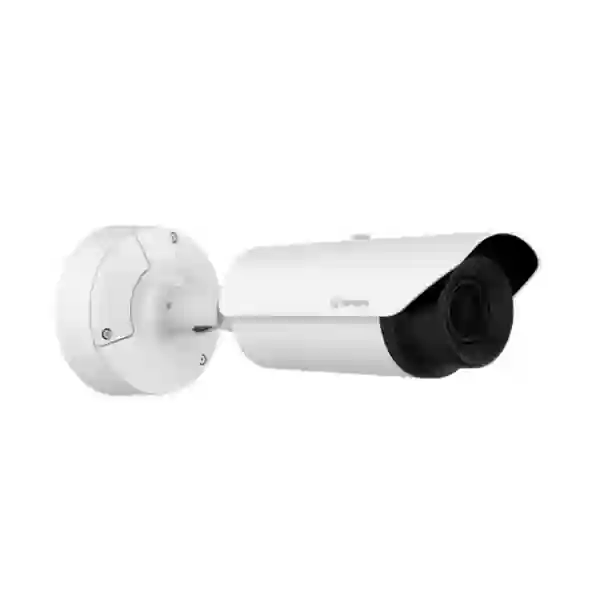
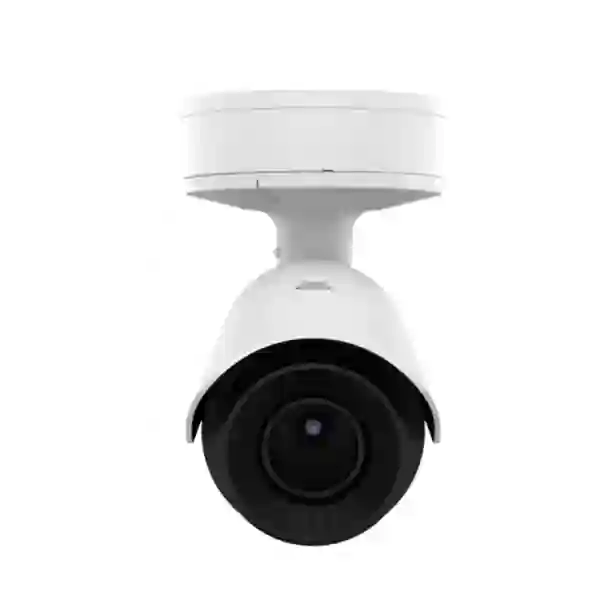
Hanwha Vision • Wisenet T series • Thermal network camera
Hanwha TNO-4050T Thermal Camera — 35 mm VGA IP Bullet for Perimeter Security
The Hanwha TNO-4050T thermal camera is designed for security teams that need to detect activity in defined outdoor zones without depending on visible illumination. Its 640 × 480 thermal sensor, fixed 35 mm lens, event analytics and network interfaces make it a candidate for planned perimeter and approach monitoring in Tanzania. Choose this model when the narrow viewing angle matches the actual scene; review camera position, target size and recording integration before requesting a project quotation.
Quick answer: who is this camera for?
Choose the 35 mm TNO-4050T when the project involves a defined outdoor viewing sector, an early-warning requirement and a need to send video or events into a managed security network. It is not automatically the best choice for a wide yard, a subject close to the lens, facial identification or precision temperature measurement. The manufacturer specifies a 36 m minimum object distance and a 17.2-degree horizontal field of view, making viewing geometry essential. A sensible next step is to supply a site sketch, desired target types and alarm response plan for a model and lens suitability review.
Buying checkpoint: verify detection objectives, line of sight, target size, recording platform and power before ordering.
Verified technical specifications
| Parameter | Hanwha Vision specification |
|---|---|
| Sensor | Uncooled microbolometer; 640 × 480 |
| Thermal spectrum | 8–14 μm; NETD ≤50 mK; 17 μm pixel size |
| Lens and field of view | 35 mm fixed, F1.0; H 17.2°, V 13°, D 22° |
| Minimum object distance | 36 m (manufacturer specification) |
| Streaming | H.265, H.264, MJPEG; up to 30 fps (60 Hz modes) |
| Connectivity | 10/100BASE-T RJ-45; ONVIF S, G, T; SUNAPI |
| Analytics | Motion, tampering, loitering, virtual-area/line, direction, audio, shock and temperature-change events |
| Recording | 1 × microSD/SDHC/SDXC slot, max 256 GB |
| Power | IEEE 802.3af Class 3 PoE, 12 V DC or 24 V AC |
| Operating environment | −40°C to +60°C; 0–90% RH non-condensing; IP66 / NEMA 4X |
| Physical | White aluminium body; approx. 3.175 kg; 101.97 × 401.8 mm stated size |
Specifications are subject to manufacturer revisions. The electrical rating, installed firmware and integration details should be confirmed for the actual supplied unit. A listed feature does not establish Tanzania-specific stock, pricing, local approval or support terms.
What makes this a thermal security camera?
The Hanwha TNO-4050T thermal camera observes differences in emitted infrared energy rather than relying on visible colours and ordinary scene illumination. That changes the security question from ‘Can the camera see enough light?’ to ‘Can the target be separated from its thermal background?’ For a perimeter, this can help staff recognise the presence or movement of people and vehicles when visible-light footage is difficult because the location is dark. It is designed for situational detection, not a promise that every subject will always be identified or that the image will resemble a daylight CCTV picture.
The detector is an uncooled microbolometer with a native 640 × 480 thermal image. The stated spectral range is 8–14 micrometres and the thermal sensitivity is at or below 50 mK NETD, as specified by Hanwha Vision. In practical terms, sensitivity concerns the ability to distinguish small temperature differences in suitable conditions; it is not the same as a guarantee of accurate surface-temperature measurement. The resulting picture can make a thermal target stand out against its surroundings, but contrast changes with weather, background materials, distance, target size and how much of the person or object remains visible.
A conventional colour or infrared-illuminated camera may show clothing colour, writing, facial details and the appearance of a delivery vehicle when conditions allow. A thermal camera instead emphasises the heat pattern of a scene. This makes the two technologies complementary rather than interchangeable. Many well-designed sites use thermal devices as early-warning sensors and visible-light cameras for visual verification. Buyers should specify whether the objective is detection, recognition, identification, documentation or all four, because a solution optimized for one objective may not satisfy another.
Thermal imaging is particularly useful where adding floodlights would be difficult, disruptive or undesirable. That does not make it independent of every environmental factor. Dense fog, heavy rain, atmospheric effects, hot backgrounds and obstructions can reduce practical performance; glass is not a transparent viewing window for long-wave thermal imaging in the same way it is for visible light. A camera should therefore be assessed on an actual view of the security area. A site test or representative design review is more reliable than an unqualified detection-distance claim.
Understand the 35 mm lens before selecting a mounting position
The TNO-4050T uses a fixed 35 mm lens with an F1.0 maximum aperture ratio. Hanwha Vision specifies approximately 17.2 degrees horizontal, 13 degrees vertical and 22 degrees diagonal angular field of view. This is a comparatively narrow framing choice within the manufacturer’s thermal bullet family, suited to directing attention into a defined zone rather than surveying a very wide courtyard from one position. It is valuable when a buyer wants a concentrated view along a boundary segment, access corridor or open approach, provided that the chosen coverage area fits within the lens.
Lens choice is one of the largest determinants of deployment success. A narrow view can give a distant target more pixels within the scene, yet it also leaves more territory outside the frame. If one camera must observe a wide gate apron or an area close to a building, an alternative focal length or a multi-camera layout may be more appropriate. The correct answer depends on target dimensions, distance, mounting height, intended detection rules and sightline obstacles. Product comparisons should therefore begin with a site drawing rather than with sensor resolution alone.
The manufacturer states a 36 m minimum object distance for this exact 35 mm configuration. That specification deserves attention where a proposed unit would face a short setback, compact loading yard or near-field access point. It is not appropriate to assume the camera is equally suited to very close targets and more distant boundary areas. When the most important activity happens close to the mounting location, examine a wider-angle model and verify both optical coverage and analytics behaviour instead of assuming the 35 mm unit will perform like a standard short-range CCTV camera.
The lens is fixed-focus rather than a remotely adjustable zoom. Plan the final installation position, rotation and field of view before drilling brackets or committing to cable routes. A survey should record the expected path of an intruder, obstacles such as trees and walls, likely vehicle movements and background surfaces that heat up during the day. Where the mounting position must move after installation, the whole detection zone can change. Photograph or sketch the intended scene and review it with the security team responsible for responding to alerts.
How thermal performance supports perimeter operations
Night-time visibility is often the first reason to consider thermal monitoring, but the more useful design goal is actionable warning. A guard may need to know that a person has crossed a defined boundary, which direction they travelled and which adjacent camera should show a follow-up image. The camera’s virtual-line and virtual-area functions can contribute to that workflow when configured for the site. They still require realistic target size, an unobstructed view and careful rule placement. Thermal video does not by itself decide whether an event is authorized, suspicious or harmless.
Background conditions should influence design. A dark fence line against cooler open ground may offer different contrast from a sun-heated wall, metal roof or machinery area. The thermal image can also change as the ground releases heat after sunset. For this reason, test alert rules during representative daytime and night-time periods where possible. Watch for moving foliage, reflective or heat-retaining surfaces, parked vehicles and authorized pedestrian routes. Tuning a scene is a normal commissioning task, not evidence that the camera has failed.
Weather resistance and dependable image interpretation are separate considerations. The camera carries an IP66 enclosure rating and NEMA 4X environmental designation, which address the enclosure’s resistance to specified exposure conditions. Neither rating guarantees clear thermal imagery through severe rain or every other visibility obstacle. On an outdoor site, also consider physical placement, structural stability, safe access for maintenance, suitable mounting hardware and properly protected network or power cabling. The camera can be robust while the surrounding installation still requires careful engineering.
A useful perimeter design often divides a large boundary into zones with clearly named alert locations. Instead of a single generic message, a monitoring operator could receive a zone label linked to the relevant live stream and nearby visible-light view. This workflow depends on the chosen recorder, software and configuration, not simply on owning this thermal model. Decide in advance who will receive alerts, what constitutes an event and how operators will verify and escalate it. Those practical requirements have as much influence on security outcomes as the headline sensor specification.
Where a 35 mm thermal bullet may add practical value
The following examples are planning scenarios, not promises of specific detection range or guaranteed performance. Each application requires a surveyed viewing geometry, target assessment and tested alert workflow. The same camera can work well in one physical layout yet miss essential activity in a second layout. Use the examples to explain the desired outcome to a system designer, then check the actual scene before selecting final quantities.
Long perimeter boundaries
A boundary with a clearly defined crossing zone may benefit from a thermal detector that alerts staff to motion without depending on visible floodlighting. The 35 mm lens can be considered where its field of view matches the intended stretch. Map likely crossing paths, fence bends and blind spots first; a distant camera that sees the main line but misses a side access route will not satisfy the protection objective. Confirm appropriate operator response and video verification for each zone.
Warehouse and yard approaches
Outdoor storage and distribution sites often combine legitimate vehicle movement with restricted access after hours. Thermal monitoring can help highlight an approach to a protected sector, but the analytics must distinguish expected activity from an actionable event through scheduling and zone design. Mounting position should avoid unnecessary interference from parked vehicles and heated walls. A visible-light camera may still be needed to capture the appearance of people, cargo and vehicle markings.
Utility and equipment compounds
A critical equipment perimeter may require early indication that someone has entered an area rather than detailed identification in a single thermal frame. The camera’s virtual-area and directional functions can support an alert strategy when carefully configured. Review the thermal background created by operating machinery, vents and electrical installations, and avoid promising temperature-based diagnostics. Security monitoring and equipment-condition monitoring are different tasks that may require different products and measurements.
Agricultural or remote properties
At properties with limited lighting, thermal imaging may be useful for observing movement into a selected secured zone. Vegetation, animals, irregular terrain and changing heat patterns are important challenges to test, not problems that software automatically removes. A practical design should identify where human response is possible and how alerts will be received when connectivity is intermittent. Verify available power and backhaul before assuming continuous central video recording can be maintained.
Controlled gate approaches
A gate approach can be monitored for movement across a meaningful line, but its mixture of authorized arrivals and departures makes careless alarm placement ineffective. Position the view so that the actual controlled boundary is visible while allowing for the fixed 35 mm framing. If the task also needs faces, credentials or number plates, add suitable optical or access-control equipment. A thermal alert should supplement a gate process rather than substitute for positive identity verification.
Waterfront or open-ground monitoring
Hanwha identifies people, vehicles and vessels as potential thermal detection subjects, which can inform consideration of open approach areas. Actual feasibility depends on target size, distance, background contrast, horizon geometry, environmental conditions and permissions for the monitored zone. Do not infer a vessel detection distance or performance guarantee from that feature category. Review the intended sector with a camera-design specialist and test representative traffic and weather conditions before setting operating expectations.
Analytics and events: turn video into a usable warning
Hanwha Vision lists motion detection, tampering, intrusion-related virtual areas, entering and exiting, appearing and disappearing, loitering, virtual-line crossing and direction-based events among supported analytics. The camera also lists shock detection, audio detection, sound classification and temperature-related change detection. These are useful tools for defining monitoring behaviour, but they should not be presented as automatic guarantees of correct classification. Event reliability varies with scene composition and rule configuration. Ask which alerts are genuinely needed, then tune those rules to avoid overwhelming operators with irrelevant notifications.
For a line-crossing rule, placement matters more than a dramatic on-screen boundary. A rule across an authorized vehicle route may create frequent expected events. A line placed where a moving person is only a tiny thermal shape may underperform. Instead, choose a location that corresponds to a meaningful security threshold and that provides enough observable movement before and after crossing. Adjust directions, schedules and zones to the site’s operating pattern. Review recorded events after commissioning so that the alerts reflect a real-world security decision rather than an arbitrary pixel change.
Virtual areas can help distinguish a protected boundary from the surrounding scene. The model supports eight motion detection zones with polygon shapes, and its other analytics expose separate event types. The exact rules available in a particular user interface may depend on firmware and the connected system. Map a zone to a plain-language name, and keep known public paths or authorized activity outside restricted event areas where feasible. Test a range of target trajectories, including entry, exit and diagonal movement. A successful design creates fewer but more meaningful signals, not simply the most alerts possible.
The manufacturer also describes handover functions, including triggering a preset on a compatible PTZ camera. This can be useful when thermal detection provides early warning and a second camera is positioned to inspect the event in more detail. Handover is an integration workflow that needs compatible equipment, communications and configured presets; it should not be described as a self-contained automatic tracking feature of the TNO-4050T. Specify the required response path, confirm compatibility with each proposed device and conduct a live end-to-end test before treating the feature as operational.
Video streams, image presentation and recording choices
The model supports H.265, H.264 and MJPEG video compression with a maximum frame rate of 30 fps in 60 Hz operation for the listed modes; Hanwha Vision specifies 25 fps for H.265 and H.264 in 50 Hz operation. The camera also supports the manufacturer’s WiseStream II functionality. Codec support provides flexibility when integrating with a recorder or video management system, but actual storage demand depends on bitrate, scene motion, frame rate, selected codec, event frequency and retention policy. A specification sheet does not tell a buyer how many days of footage their project will retain.
The available stream resolutions include 640 × 480, 640 × 360 and 320 × 240. Multiple streams can support different monitoring and recording requirements, subject to the camera and VMS settings. An operator might view a lower-bandwidth stream remotely while a recorder saves a higher-detail thermal feed, if the selected system supports that arrangement. Design settings should prioritise the use case: a permanent recording policy differs from event-only capture, and a fast-moving perimeter scene may need different choices from a largely static industrial fence line.
Thermal palettes are interpretation aids rather than changes to the heat data being observed. The camera lists White Hot, Black Hot, Rainbow, Sepia, Red, Iron and a custom palette. One palette may make a warm target visually clearer to a particular operator, while another may be more comfortable for long monitoring shifts. Compare palettes with the team that will use the system and standardise an appropriate display choice. This avoids confusion when several operators interpret thermal images differently. Do not treat palette colour as a calibrated temperature reading or diagnostic result.
Built-in digital image stabilisation with a gyro sensor can be valuable for reducing the effect of camera movement, but it does not remove the requirement for solid brackets and a stable mounting structure. Hanwha also provides flip, mirror and Hallway View rotation settings. These are configuration options rather than reasons to mount the camera in a poor location. The final live composition should show the needed ground coverage with an understandable orientation, and the system’s event snapshots should preserve enough context for a person reviewing them.
Connectivity, VMS compatibility and cybersecurity
The camera uses a 10/100BASE-T RJ-45 Ethernet connection and supports ONVIF Profiles S, G and T according to the manufacturer. Hanwha also lists SUNAPI and its Open Platform interface. These standards and interfaces can facilitate integration, but they do not prove that every feature works identically on every third-party NVR, VMS or analytics platform. A buyer should check the exact recorder firmware, available driver or integration profile, licence requirements and support for thermal event metadata. Confirm video, recording, time synchronization and alarm actions separately instead of assuming that a displayed image equals full interoperability.
Network design should identify whether the unit will connect through an isolated security VLAN, a dedicated recorder network or another managed topology. Allow only required traffic and maintain clear responsibility for camera addressing, DNS, NTP time synchronization and remote access. Segmentation is particularly useful where security equipment shares a site network with offices, machinery or guest services. Ethernet cable distance and protection should follow the selected network infrastructure and applicable installation practices. A workable design includes both the device and the switch, cabling, power protection and monitoring paths around it.
Hanwha lists HTTPS, secure streaming options, digest authentication, IP-based access control, IEEE 802.1X support and audit logs among the model’s network security features. Their value depends on proper configuration: change default or inherited credentials, allocate named administrator accounts where supported, use least-privilege permissions and retain access records according to site policy. Do not leave a camera openly reachable from the public internet merely to make mobile viewing convenient. Select an approved, secured remote-access approach and verify it against the organisation’s risk requirements.
Firmware maintenance should form part of the project handover. Hanwha Vision warns that cameras running older 1.00–1.2X firmware require an intermediate bridge firmware step before upgrading to the latest version. Treat this as a model-specific procedure that needs the current manufacturer’s instructions, a maintenance window and a rollback or recovery plan. Do not apply firmware packages merely because their version number is higher. Record the installed firmware, configuration backup location and compatibility checks so that a future technician can service the system without guessing how it was originally set up.
Power, enclosure and mounting considerations
Power options include IEEE 802.3af Class 3 PoE, 12 V DC and 24 V AC. The manufacturer lists a maximum PoE draw of 10 W, a maximum 12 V DC draw of 9 W and a maximum 24 V AC draw of 10.5 W. These figures help with power budgets, but an installer must also allow for switch capacity, supply losses, cable routing and any associated equipment. Do not assume that an available network port supplies power simply because it has an RJ-45 socket. Confirm the switch’s actual PoE standard and remaining budget before installation.
The specified operating temperature is -40°C to +60°C and the operating humidity range is 0–90% relative humidity, non-condensing. For Tanzania deployments, the actual microclimate at the installation point matters more than a generic national climate assumption. An unshaded metal structure, dusty loading zone or site near spray and moisture may create conditions that demand extra planning around cable termination, junction boxes and maintenance access. Avoid placing the camera where direct physical obstruction or avoidable vibration can compromise the useful scene. Environmental limits should be checked against the intended application, not used as a blanket promise.
The camera body is aluminium and the manufacturer specifies approximately 3.175 kg weight and dimensions of about 101.97 mm in body diameter by 401.8 mm long. That is a substantial outdoor bullet assembly, not a small indoor fixed camera. Confirm the load rating, fixing method and corrosion suitability of the actual bracket and substrate. A wall-mounted camera may need different support from a pole-mounted installation, especially where maintenance access and cable strain matter. Suitable mounting accessories must be verified against the exact camera, surface and site conditions.
Installation planning should also provide a route for alarms and supporting equipment. The unit has one alarm input and two alarm outputs and offers audio input/output interfaces, but those interfaces only become useful in a designed system. Decide whether the site needs a contact sensor, external annunciator, local recording or simply a software-generated event. Confirm cable types and signal requirements using the relevant manufacturer manuals. Include clear labels in commissioning records so future technicians can identify which port supports which security function without interrupting unrelated services.
Storage, evidence management and operational continuity
Local edge recording is supported through one microSD, SDHC or SDXC memory card slot with a stated maximum capacity of 256 GB. This is useful for selected recording arrangements, especially event capture or supporting resilience when network communication is interrupted. However, a card is not automatically an enterprise evidence archive. Retention depends on recording mode, bitrate, the number and length of events and media endurance. Organisations should choose suitable media, review health indicators where available and decide how evidence will be exported and protected from accidental loss.
For a multi-camera perimeter, central recording may be more manageable than collecting separate cards after every incident. The camera’s available streams and event functions can be integrated with suitable recording infrastructure, but the recorders, licences and storage devices are separate system decisions. Estimate retention from expected bitrate and operating profile, then validate with real footage. Determine who can export clips, whether exported events preserve timestamps and what the organisation’s access and retention policy requires. Security teams should test evidence retrieval before the day they urgently need a recording.
Power continuity also needs a deliberate plan. A PoE camera can remain supported by a backed-up switch if the switch, recorder, network equipment and relevant communications are included in the backup design. A camera connected to an unprotected switch may stop even when its local electronics are healthy. Document what happens during a power interruption, what recording continues locally and how operators know that a feed has become unavailable. The camera’s network disconnect alarm capability may help within a suitable system, but the wider fault-monitoring workflow should be verified.
Long-term ownership includes maintenance of the thermal viewing path, not merely checking a status light. Follow the manufacturer’s approved cleaning and servicing instructions; avoid abrasive treatment or inappropriate chemicals on the lens assembly. Inspect brackets, cable seals, nearby vegetation and the view for newly installed structures or vehicles. Review analytics performance after significant changes to the property layout. Maintain a simple commissioning baseline image so teams can recognise when the field of view has shifted or a heat source has altered the scene over time.
Planning a Tanzania deployment without overpromising performance
For a Tanzanian warehouse, logistics facility, agricultural property, utility compound or other security-sensitive site, start with the actual protection goal rather than a general request for ‘thermal CCTV’. Is the main concern a person crossing a remote boundary after hours, movement near high-value equipment, or an approach route to a controlled gate? Each scenario implies different viewpoints, operator actions and evidence needs. Site location can affect weather exposure, power reliability and network arrangements, but it does not by itself establish camera coverage, stock status or installation service availability.
Survey the proposed detection area in daylight and, where practical, at night. Record the boundary length, ground slope, vegetation, road traffic, mounting opportunities and major heated surfaces. Mark any public footpath, authorized access route or animal movement that could influence alarm rules. Agree on the event response required from the security team. If the view includes multiple boundaries, ask whether one narrow 35 mm camera can cover them or whether separate sensors would provide more defensible coverage. More devices are not always better; better-defined zones often are.
A project specification should distinguish measured physical quantities from operational goals. The 640 × 480 pixel resolution, 35 mm focal length and 17.2-degree horizontal field of view are defined product characteristics. Detection distance for a particular person or vehicle, by contrast, is a site-design result affected by target size, contrast, weather, scene angle and required probability of detection. Avoid promising a single universal range from the lens number alone. For higher-consequence sites, request a design review using the manufacturer’s planning methodology and verify representative conditions.
Think about how the camera will fit into the rest of the protection plan. Fences, lighting, signage, access controls, audible alerts, radio procedures and human verification all play distinct roles. Thermal video may reduce dependence on visible lighting for detection, yet it cannot replace a physical boundary or a trained response process. Where a camera sees across an adjacent property or public area, assess privacy and applicable site policies before enabling recording or analytics. The right deployment is the one that detects relevant events and supports an appropriate response.
A practical commissioning sequence
First, agree on a written acceptance scenario: who or what should be detected, which boundary counts, what time periods matter and what an operator should see after an alert. These statements are more testable than adjectives such as ‘excellent range’. They also reveal whether thermal detection should be paired with a visible-light camera or another sensor. Make sure the team approving the design includes someone who understands daily site operations. Otherwise an event configuration may unintentionally classify ordinary deliveries or scheduled security patrols as intrusions.
Second, confirm the exact model and hardware configuration. The TNO-4050T is the 35 mm thermal camera discussed here, and other similar T-series products use different focal lengths or feature combinations. Check the purchase quotation and product markings rather than equating a series name with an exact item. Confirm intended mounting accessories, brackets, seals, power supply and necessary network devices. If the site requires an alternative optical angle, decide before ordering rather than expecting a fixed lens to behave like a zoom lens after the equipment arrives.
Third, review power and network infrastructure. Calculate the PoE budget, verify any alternative DC or AC supply and document the preferred switching and recording path. Plan surge protection and grounding as required for the local installation, together with appropriate cable handling. Identify the network segment and access policy, then reserve reliable addressing and time synchronization arrangements. Check the recorder or VMS against the actual ONVIF and vendor integration features needed. Integration should be tested in the laboratory or during staging where possible.
Fourth, establish a safe mounting position and protect the optical path. Confirm that the mounting surface supports the device and that brackets allow the camera to face the intended scene without excessive obstruction. Consider sun-heated objects, moving vegetation, reflections from site machinery and heavy traffic in the edge of the view. Route and protect cables so that routine maintenance will not disturb the seal. Do not mount the camera behind ordinary glazing expecting the same long-wave thermal performance as an unobstructed outdoor view.
Fifth, configure the video stream and event behaviour. Begin with a useful native-resolution image and choose codec, frame rate and bitrate settings that align with recording requirements. Select a thermal palette that operators can interpret consistently. Name the stream and its physical location. Then configure the necessary crossing, direction or protected-area rules using the surveyed geometry. Limit alarms to events with a plausible response. Keep a written explanation of rule purposes so adjustments are traceable when the site layout changes.
Sixth, validate under representative conditions. Walk or drive the intended test route only with site permission and safe procedures. Check that alerts appear when expected and that common authorized movement does not generate an unacceptable volume of false notifications. Review the appearance of a target at different positions in the scene. Test daytime and night-time if possible, because thermal contrast may change substantially. Confirm that the operator sees a useful image and that any paired visible-light camera or handover workflow activates correctly.
Seventh, test retention, interruptions and escalation. Check how the recorder captures a thermal event, how long footage is kept and who can export it. Test an authorized access method for retrieving evidence. Where practicable, simulate a network or power fault within an approved maintenance window and confirm the system’s monitoring response. Record any edge-storage behaviour and whether footage is recovered afterward. Verify that the chosen alarm output or notification route reaches the intended people rather than ending at a dashboard that nobody watches.
Eighth, hand over a sustainable operating procedure. Provide the as-built camera view, network and power notes, firmware version, event configuration and basic maintenance responsibilities. Explain what thermal images can and cannot establish; a bright outline should not automatically be treated as proof of identity or intent. Schedule periodic checks of the view, storage, credentials and alert logs. Agree on change control for the site as vegetation, vehicle parking and physical boundaries evolve. A properly maintained security workflow delivers more lasting value than an impressive installation-day demonstration.
Choosing between thermal and conventional IP surveillance
A daylight or low-light optical camera remains important when colour, clothing detail, number plates or other recognizable visual characteristics are required. Thermal imaging is stronger as a complementary detection tool where illumination is unreliable or an unusual temperature contrast is useful. The TNO-4050T should not be sold as an all-purpose replacement for identification cameras. Define the desired evidence standard, then combine technologies where appropriate. A guard may need a thermal alert to notice a crossing and an optical view to understand who or what caused it.
Compared with a wider-angle thermal lens, the 35 mm model offers a narrower scene that may better suit a selected distant approach, but it leaves more of the surrounding environment outside its view. The manufacturer’s T-series portfolio includes different focal lengths; specifications must be checked for each exact alternative. A 19 mm or 13 mm option should not be recommended merely because it sounds wider. Evaluate required scene width, target scale and minimum object distance. Selection is a geometric and operational decision, not a hierarchy where one focal length is universally superior.
A purchase decision should include the full project rather than the standalone device. Price the appropriate mount, PoE equipment or power supply, cabling, protected switching, recording capacity, software integration and commissioning effort. Ask for the exact commercial terms and proposed equipment list before comparing quotations. No Tanzania stock level, installation coverage, price, warranty or delivery commitment is established by this product description. Such details must be confirmed separately through a current, project-specific offer. That is especially important for security projects where spare units or ongoing maintenance may be consequential.
Frequently asked questions
Does the Hanwha TNO-4050T work in complete darkness?
It forms a thermal image from long-wave infrared energy rather than ordinary scene illumination, so it does not require visible light in the same way as a conventional camera. Darkness alone is not the determining performance limit. Background temperature, weather, target size, obstructions and placement still matter. For recognition or identification, pair it with suitable visible-light coverage where the security plan requires that level of detail.
What is the camera’s actual thermal resolution?
The manufacturer lists a 640 × 480 uncooled microbolometer as the core imaging device. Other supported output sizes include 640 × 360 and 320 × 240. An output size is not a substitute for understanding scene coverage: how many useful pixels a target occupies depends on distance and lens choice. Review an actual planning view rather than assuming the native pixel count provides a guaranteed detection range.
Why does a fixed 35 mm lens matter?
The 35 mm lens produces a specified horizontal field of view of 17.2 degrees, which is narrower than some other thermal lens options. This can be suitable for concentrating the view on a selected zone but is less convenient for very wide scenes. The lens is fixed, so a camera cannot simply zoom out to recover an area that was missed in the original installation plan.
What does NETD at or below 50 mK mean?
NETD describes thermal sensitivity under defined measurement conditions: smaller values generally indicate an ability to distinguish finer temperature contrast. It does not provide a straightforward accuracy figure for the temperature of an object and does not guarantee that every target will be detectable. Operational performance depends on environmental conditions, optics and target presentation as well as this sensor characteristic.
Can this thermal camera measure a person’s temperature?
Do not assume so. The manufacturer lists temperature-related change detection as an analytics function, but this description does not establish a calibrated body-temperature measurement function or suitability for medical screening. Temperature change events and accurate radiometric measurement are different capabilities. Buyers needing certified measurement, fire safety or process diagnostics should verify the exact dedicated requirements and equipment separately.
Is the TNO-4050T suitable for outdoor mounting?
The manufacturer lists an IP66 rating, NEMA 4X designation and an operating temperature range from -40°C to +60°C. These are useful environmental characteristics, but field reliability also depends on installation details such as seals, mounting strength, cable protection, access for cleaning and site exposure. A weather rating should not be interpreted as permission for submersion or careless installation.
Does it support standard IP camera recording systems?
The camera provides an Ethernet interface, ONVIF Profiles S, G and T and manufacturer integration interfaces. That is a strong starting point for interoperability, but exact alarm features, recording behaviour and support can differ across recorders, VMS software and firmware. Verify the specific equipment combination before purchase, especially if the project depends on analytics events or handover to a PTZ camera.
How is the camera powered?
Options specified by Hanwha are PoE compliant with IEEE 802.3af Class 3, 12 V DC and 24 V AC. For PoE the listed maximum power consumption is 10 W. An installer should confirm the actual power delivery mode, remaining switch budget and protection method for the chosen site. The camera is not described as a battery-operated or standalone wireless device.
Can it record to a memory card?
Yes. One microSD, SDHC or SDXC slot is specified, supporting cards up to 256 GB. Recording duration cannot be stated from capacity alone, because frame rate, bitrate, codec and event frequency all affect usage. Card health, evidence export and backup policies also matter. For a multi-camera site, a central recorder may be the primary retention system even when edge storage is enabled.
Will it automatically follow an intruder?
The model can generate certain analytics events and the manufacturer lists a handover capability that can trigger a compatible PTZ preset. That is not the same as a guarantee that this fixed-lens thermal bullet camera mechanically tracks people. A complete handover solution needs selected companion equipment, configured software, network connectivity and end-to-end testing.
Is it a replacement for a visible-light security camera?
Usually it is better assessed as complementary. Thermal video helps reveal heat contrast and movement in darkness, while visible-light cameras can provide details such as clothing colour, signage and other identifying features in appropriate conditions. If a security incident requires both early warning and visual confirmation, specify a combination rather than expecting one imaging technology to cover all needs.
How can I compare the 35 mm model with other focal lengths?
Start with the physical width of the area, mounting distance, target dimensions and the minimum distance at which useful observation is required. Compare the official field-of-view and minimum-object-distance specifications for each exact product. A wider lens covers more area but can show a target with fewer pixels; a narrower lens concentrates the view. The choice should be supported by a scene plan and representative testing.
What should a Tanzania quotation include?
Request the exact TNO-4050T model, intended quantity, mounting equipment, power and network materials, recording or VMS requirements and the planned alarm workflow. Ask the supplier to confirm current price, taxes if relevant, lead time, warranty terms and any installation or support commitments in writing. None of those project-specific commercial details should be inferred from general camera specifications.
Can I rely on one camera to protect a very long fence?
Not without a scene plan. The fixed field of view narrows the observable sector, and effective detection depends on target size, geometry, obstructions and environmental contrast. Boundaries with turns, gates, slopes or heavy vegetation may need several carefully positioned views. Define an acceptable detection objective and conduct a design review before deciding quantity or spacing.
What needs checking before final acceptance?
Confirm the field of view, named detection zones, operator alerts, representative day and night behaviour, VMS recording, retention, network security, power interruption response and handover documentation. Test actual intruder paths only with permission and appropriate safety controls. The completed system should help security staff respond correctly, not simply produce an image on an installation laptop.
Request a model-fit and quotation review for Tanzania
Tell the FourTeck team the intended site type, approximate boundary or approach geometry, available mounting points, required monitoring hours, existing recorder or VMS, and whether a visible-light companion camera is needed. Ask for confirmation of the exact TNO-4050T specification, commercial availability and project terms. A useful quotation should address the complete operational system, not just the thermal camera body. No price, lead time, installation service, warranty or coverage commitment is implied until confirmed in a current written offer.
Next step: Request a technical suitability check and project quotation.




Reviews
There are no reviews yet.