
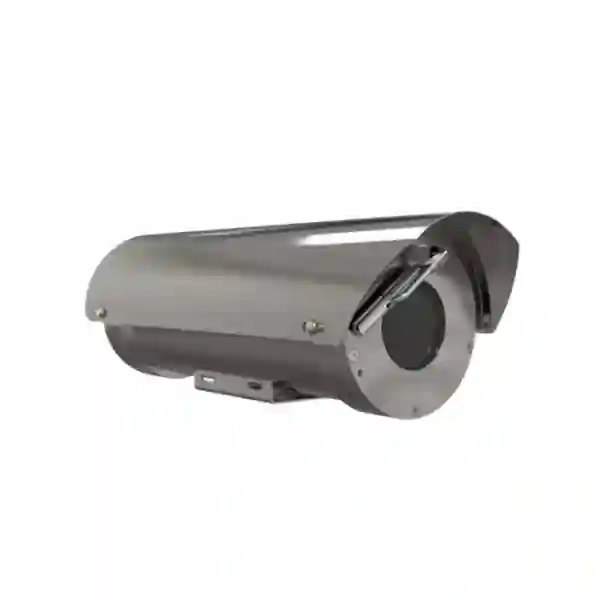
Hanwha TNO-6070E1W-Z Explosion-Proof Fixed Network Camera
Evaluate a 2MP fixed camera station with a 2.8–9 mm lens, 24 VAC power and an integrated window wiper for an appropriately classified industrial installation. Confirm the exact hazardous-area approval, lifecycle position and complete installation scope before specifying the unit in Tanzania.
Before you request a quote
The Hanwha TNO-6070E1W-Z is a specialised, legacy camera model. Verify the exact certificate variant and site classification, 24 VAC power, required lens coverage, local sourcing position, and lifecycle support. Ask for a technical comparison if a newer model is proposed; alternative products can differ materially in wiper, power and approval details.
Verified feature and specification overview
| Brand | Hanwha Vision |
|---|---|
| Exact model | TNO-6070E1W-Z |
| Product type | Explosion-proof fixed network camera |
| Resolution | 2MP; 1920 × 1080 Full HD |
| Maximum listed video frame rate | Up to 60 fps at 1080p |
| Lens | 2.8–9 mm varifocal |
| Wide dynamic range | 120 dB at the specified 2MP / 30 fps mode |
| Day/night and image processing | True day/night (ICR), defog, digital image stabilisation |
| Window cleaning | Integrated wiper; separate washer accessory may be specified |
| Housing | Electro-polished 316L stainless steel; toughened-glass window |
| Ingress protection | IP66 / IP67 / IP68; IP68 stated test: 1.5 m for 24 hours |
| Listed operating temperature | -40°C to +60°C |
| Power | 24 VAC; model-family datasheet states 37 W maximum |
| Cable entries | Three M20 entries described in model-family documentation |
| Network | Network video; ONVIF Profile S stated in model-family documentation |
| Recording media | Built-in SD/SDHC/SDXC slot listed by manufacturer |
| Certification suffix | -Z: cLCus Class I/II Division 1 variant; confirm exact certificate |
| Product lifecycle | Legacy; confirm current support and supply position |
Published specifications describe the model or the identified model family; verify the exact delivered unit and revision against its manufacturer documents. Certification and supply availability require project-specific confirmation.
Built for surveillance where ordinary camera selection is not enough
A refinery boundary, chemical-processing skid, fuel-handling platform, or dusty industrial process can call for much more than a weatherproof camera. An engineer must understand what substances may be present, where potentially explosive atmospheres could arise, and which equipment protection concept the site’s hazardous-area classification requires. The Hanwha TNO-6070E1W-Z addresses a particular part of that problem: it combines a fixed network video camera with an explosion-proof camera station built for demanding industrial conditions. It is not a substitute for hazardous-area engineering, but it gives buyers a defined model and certification variant to assess instead of trying to adapt a general-purpose CCTV camera after the project has begun.
This product page is intended for Tanzanian plant owners, safety and security teams, engineering contractors, consultants, and procurement specialists reviewing existing camera schedules or designing a suitable replacement. The quickest buying decision starts with three questions: does the exact -Z certification match the classified location, can the existing site deliver 24 VAC and the required data connection, and will a fixed 2MP image meet the actual monitoring task? If any answer is unclear, the right next step is a technical review, not an assumed match based on an explosion-proof product name alone.
What the exact model provides
Hanwha Vision describes this model as a 2MP explosion-proof fixed camera. Its listed imaging specification is 1920 × 1080 Full HD, with a 2.8–9 mm varifocal lens and up to 60 frames per second at 1080p. The manufacturer also identifies true day/night switching using an infrared-cut filter, defog, digital image stabilisation, simple focus, wide dynamic range, a built-in removable-memory slot, and a mechanical window wiper. These are practical features, but each contributes to a different objective. Higher frame rates can help a reviewer follow movement, while WDR is useful where a bright outdoor opening and a shaded work area occupy the same image.
Importantly, a fixed camera does not become a pan-tilt-zoom unit because its lens is varifocal. The viewing direction is established mechanically during installation, and the lens allows field-of-view adjustment within its stated focal range. It is best specified for a defined target such as a doorway, valve manifold, loading point, equipment bay, or process observation area. A project needing continuous remote repositioning, high optical zoom, thermal temperature measurement, or a built-in infrared illuminator should have those needs specified separately rather than inferred from this model’s name or family.
Understand Full HD resolution and frame-rate trade-offs
The 2MP sensor produces a 1920 × 1080 image, which can be sufficient for observing defined operational events when the camera is correctly positioned. Resolution alone does not prove that an operator will identify a face, read a label, or see a small pressure indication at a particular distance. Image usefulness depends on the width of the scene, lens setting, subject movement, lighting, compression, recording quality, and the display or export process. For safety-related observation, teams should document the actual feature they expect to see and verify it at the real mounting location.
The manufacturer’s feature list distinguishes up to 60 fps at Full HD from 120 dB WDR at 30 fps in its specified 2MP mode. Do not assume maximum frame rate and the stated WDR performance apply simultaneously under every configuration. A fast-moving conveyor or vehicle approach may favour frame rate, whereas a strongly backlit gate may favour a wide dynamic range setting. During commissioning, record the selected settings and inspect representative footage in daytime, at night, and in changing weather. This avoids discovering after handover that a technically correct camera was optimised for the wrong scene.
Choosing the 2.8–9 mm lens position
The 2.8–9 mm varifocal lens offers a useful range for setting a fixed field of view. A shorter focal length generally captures a wider scene while making distant objects occupy fewer pixels. A longer focal length narrows coverage and makes a chosen target larger in the recorded image, but it also reduces the area visible to operators. Neither setting should be chosen from the lens number alone. Installers should measure the mounting height, viewing distance, target width, line of sight, obstruction risk, and the viewing task before deciding where the lens should be set.
Consider a fuel-transfer area where the security team wants an overview of the access platform and the operations team wants to check a connection point. One wide view may be convenient but may not resolve sufficient detail at the connection. A narrowly framed view may show the work area well yet miss approaches from the side. In that situation, separate cameras or a deliberately designed multi-camera arrangement may be more effective than stretching one fixed view beyond its intended purpose. Specify the image objective first, test the lens setting against it, and document the accepted scene for future maintenance checks.
Visibility in difficult light and weather
Industrial images often combine direct sun, deep shadows, reflected light from metal surfaces, and sudden transitions between indoor and outdoor areas. The TNO-6070E1W-Z includes wide dynamic range and image-processing functions intended to assist with such scenes. Its true day/night feature changes the camera’s imaging mode by moving an infrared-cut filter. Defog and digital image stabilisation are also identified in the manufacturer’s materials. These features improve the choices available to an installer, but they do not guarantee useful footage through every condition, and they cannot compensate for a blocked or incorrectly aimed camera.
During a site survey, look for flare glare, vehicle headlights, bright work lights, precipitation, vibration, heat haze, and surfaces that could reflect illumination into the lens. A clear demonstration should include the actual shift changes and lighting scenarios that matter to the operators. Avoid representing day/night capability as proof of built-in IR illumination: no such illuminator is established for this exact configuration. If the site requires external lighting, its own equipment selection, power arrangement, location, and hazardous-area approvals must be assessed separately.
Integrated wiper: useful, but not self-cleaning
The camera station includes a window wiper, an important distinction from variants that are supplied without one. On a process site, a clear enclosure window can determine whether the operator sees a valve, vehicle, loading connection, or person at the right moment. The manufacturer identifies a silicone wiper blade and a toughened-glass camera window. A wiper can help remove some moisture or surface contamination, but it cannot remove every deposit, and it should not be treated as a permanent substitute for inspection or cleaning. Abrasive deposits and chemical residues require procedures appropriate to the local environment.
A washer tank is a separate accessory decision, not something to assume is integrated into every camera package. Hanwha Vision identifies the HT-E-XWP10UL washer tank as compatible with this model, but compatibility does not establish that the item is included, available locally, or appropriate for every mounting arrangement. Ask the supplier to identify the complete cleaning arrangement, any needed tubing and control components, maintenance access, and the site-approved cleaning fluid. Document who will check the wiper and how a visibility fault will be reported, particularly when the camera supports an operational rather than purely perimeter-security task.
316L stainless steel construction and environmental ratings
A camera stationed around outdoor industrial structures may encounter rain, saline air, dust, washdown, and temperature swings. Published model-family technical documentation identifies electro-polished 316L stainless steel for welded enclosure assemblies, A4 stainless fixings, a toughened-glass viewing window, and a stainless sunshield. These choices are useful for a mechanically robust installation, although they do not establish resistance to every chemical, corrosive atmosphere, cleaning agent, or site-specific exposure. A materials review remains appropriate where aggressive substances or unusual washdown practices are present.
The camera station is listed with IP66, IP67, and IP68 ingress ratings; the published IP68 test condition is 1.5 metres for 24 hours. These are enclosure-ingress statements under defined tests, not a promise of indefinite underwater operation. Equally, an ingress rating is not interchangeable with an explosion-protection approval. The general operating-temperature range listed in model-family documentation is -40°C to +60°C. Engineers should check the maximum and minimum temperatures at the installed position, including local radiant heat sources and how the enclosure will be mounted. Treat every rating as part of a complete design review, rather than as a blanket assurance that any difficult site is acceptable.
Hazardous-area approvals: read the suffix, not just the product family
The -Z suffix matters. Hanwha’s published model-family identification associates -Z with the cLCus Class I/II Division 1 certification variant. Other suffixes identify different certification versions, so a general family brochure or image of a similar enclosure should not be used to establish approval for the supplied item. The underlying documents list classifications for specified gas and dust groups and temperature classes, but the exact markings, permitted ambient limits, and conditions of use must be read from the nameplate and current certificate package for the unit offered. An installation must follow the governing design and inspection requirements.
Tanzania projects may use their own site area-classification drawings, client specifications, and applicable electrical and hazardous-area standards. A North American Division rating should not be silently presented as automatic approval for an IEC Zone-designated location or as confirmation of a Tanzanian regulatory acceptance. Require the engineering reviewer to compare the actual gas or dust group, zone or division, temperature class, ambient temperature, wiring method, glands, and mounting details against the certificate. If the project requires a different marking or certification scheme, request a variant or alternative formally evaluated for that requirement. This is especially important when replacing an existing camera with a visually similar enclosure.
24 VAC is a design constraint, not a minor accessory detail
Hanwha’s product page specifies 24 VAC power for the TNO-6070E1W-Z. Model-family technical material lists a maximum consumption of 37 W. These facts should be carried into cable design, transformer sizing, panel schedules, and commissioning records. Do not assume the camera receives power through the Ethernet cable merely because it is a network camera. A site designed around PoE switches may need a different power approach or an alternative certified camera model. The power arrangement itself must also respect the classified location’s electrical protection and wiring rules.
Before purchase, obtain the proposed cable lengths, supply location, protective devices, voltage-drop calculation, and the means of safely isolating the camera for service. Confirm whether existing infrastructure can provide a suitable 24 VAC supply under expected load, particularly during start-up and operation of any ancillary components. The enclosure documentation identifies three M20 rear cable entries, but final glands, stopping plugs, seals, and cable-entry practices must be selected to match the certified assembly and site rules. An ordinary weatherproof gland is not automatically suitable for a hazardous-area enclosure.
Networking, video streams, and recorder integration
The camera uses network video, and published model-family specifications identify H.264 and MJPEG streaming and ONVIF Profile S. That can help an integrator plan compatibility with an existing network video recorder or video management system. However, an ONVIF label does not validate every required function, firmware version, alarm event, or recording feature with every third-party platform. Compatibility should be checked against the intended recorder or VMS version, supported stream profiles, time synchronisation, and the customer’s security requirements. Where event metadata matters, a practical demonstration is more valuable than an assumed interoperability claim.
Calculate network requirements around the actual camera settings. Frame rate, compression, scene complexity, the number of simultaneous streams, and recording duration all affect bandwidth and storage consumption. Separate the high-quality recording stream from a lower-bandwidth live-view stream when the deployment design allows it. Confirm the route from hazardous location to the nearest suitable network switch, the permitted media and cable path, the switch’s environmental conditions, and any surge-protection or grounding requirements. Fibre-based alternatives in the wider product family should not be confused with a fibre interface on this exact 24 VAC model without model-specific evidence.
Recording, removable media, and the evidence workflow
Hanwha lists a built-in SD, SDHC, or SDXC memory slot for the TNO-6070E1W-Z. This can be relevant to an architecture that needs local media support, but the product page does not establish an acceptable card capacity, retention duration, industrial endurance class, or a complete failover process. Those decisions require the correct device documentation and recorder design. A removable card should not be described as guaranteed long-term archival storage, especially where video may support an incident investigation, audit, or operational process review.
For each intended use, identify who needs video, how soon they need it, which events must be retained, and how an authorised person retrieves footage. The recording plan should address clock accuracy, video integrity, access permissions, backup, and the handling of storage faults. If operators monitor a hazardous process, define the boundaries between situational awareness and actual safety control: this camera is a video observation device, not a certified safety-instrumented protective function. A sensible design records both the technical settings and the practical response when a camera, link, or recorder becomes unavailable.
Cybersecurity and long-service-life planning
Industrial cameras often remain in position longer than ordinary office IT devices, making cybersecurity and vendor support significant purchasing considerations. Model-family materials include network protocols such as HTTPS and SNMP, but merely listing a protocol does not prove that every modern security control or firmware update is available on an older device. An integrator should verify the firmware branch, supported cryptographic configuration, password management, access logging, network segmentation, and any relevant current product security notices before connecting the unit to a production network.
Keep management traffic within an appropriately controlled network, minimise unnecessary services, assign role-based credentials, and document how firmware and configuration backups are handled. Avoid unrestricted internet exposure. The product’s legacy status makes this review more important: a camera that can still produce good video may not be the best long-term choice if replacement parts, security patches, or integration support cannot be confirmed. Request a documented lifecycle assessment when evaluating a new installation, and maintain an inventory of camera models and installed firmware for future upgrade planning.
Where this fixed camera may be a reasonable fit
Potential applications include observing fixed fuel-handling interfaces, access paths at processing equipment, defined pump or valve areas, and industrial loading points where a hazardous-area assessment requires a suitable protected camera station. These are examples of monitoring tasks, not assertions that the model is automatically approved for every refinery, chemical plant, mine, or fuel depot. The correct model depends on the exact substances present, site classification, working temperatures, camera position, and the function the operations team expects the image to support.
For a valve station, for instance, the camera may help an authorised operator see whether personnel are present or whether an obvious visual change has occurred. It does not measure pressure or prove valve position if the indicator cannot be resolved. At a vehicle-loading area, a fixed frame can show a designated working zone, but it may not capture the approach route or every blind spot. At a remote asset, network reliability and power continuity may be more decisive than the camera’s picture specification. A useful procurement brief explains the task in measurable operational terms before naming the preferred hardware.
A site survey that prevents costly specification mistakes
Start with the hazardous-area drawing and the actual camera location, not a generic outdoor CCTV checklist. Record the mounting structure, required field of view, access for safe maintenance, expected ambient range, potential sources of vibration, and any unusual cleaning or corrosive exposure. Confirm the distance to the nearest authorised electrical supply and network termination point. Site pictures can help during design, but do not use them as substitutes for verified drawings, cable schedules, and engineering sign-off.
Next, define the acceptance test. State what image detail must be visible, when it must be visible, and from which operator workstation. Test the intended scene in bright and low light, examine sun and headlight glare, and decide whether the integrated wiper is sufficient for the area’s contamination. Review installation access for safe lifting and maintenance: published materials list a camera-station weight of up to approximately 15 kg. Validate the support structure and mounting accessories with the actual enclosure and load case. This up-front work is often less expensive than relocating a specialised camera after commissioning.
Mounting, cable entries, and installation coordination
A hazardous-area camera is a system of approved components and installation methods, not simply a camera body fixed to a bracket. Before work begins, align the enclosure documentation, mounting method, power design, network layout, cable gland selection, earth continuity, and inspection procedure. The model-family dimensional drawing and approved accessory information should be reviewed by the installer rather than inferred from a catalogue image. If a wall or pole bracket is proposed, obtain confirmation of exact model compatibility and mechanical capacity; not every accessory in a manufacturer’s wider explosion-proof range fits every housing.
During installation, preserve the integrity of the certified assembly and comply with the instructions for opening, closing, cable entry, torque, seals, and inspection. Confirm that the camera is aimed correctly before final acceptance and that the window wiper has adequate clearance through its movement. Keep safe access in mind: a device installed high over live process equipment may be difficult to inspect or clean later. Record serial numbers, actual certificate markings, power readings, network settings, accessories fitted, accepted footage, and all deviations approved by the responsible engineer.
Commissioning should prove the operational outcome
An installation can pass a basic network ping and still fail the buyer’s purpose. A complete commissioning sequence should confirm power, connection stability, live and recorded image quality, day/night transition, wide dynamic range settings, the selected frame rate, focus, and the full intended field of view. If the project specifies a wiper or optional washer arrangement, verify it under the approved procedure. Where the site’s camera-management system expects event reporting, test those specific events instead of assuming that generic ONVIF support covers every integration requirement.
Choose representative scenarios and record pass or fail observations. Can the operator distinguish an authorised access event from ordinary process activity? Is the defined work point visible at the chosen mounting distance? Does the scene remain intelligible when lighting changes? Can the recorder retrieve a clip with a usable timestamp? If these questions cannot be answered with real footage, the handover is incomplete. Commissioning documents should state the boundaries of the system, particularly that surveillance images supplement but do not replace process alarms, gas detection, emergency shutdown systems, or certified safety procedures.
Routine maintenance and operational accountability
The wiper and stainless enclosure reduce some practical challenges, but the camera still needs a maintenance plan. Periodic checks should examine window cleanliness, wiper condition, visible physical damage, attachment security, signs of corrosion, cable-entry integrity, and image quality at the workstation. Frequency should reflect exposure and site policy rather than an invented universal interval. Any access to an explosion-protected enclosure must follow site isolation and competent-person procedures and the actual manufacturer’s instructions; routine cleaning must not undermine the equipment’s approval.
An operator-facing process is just as important. Define how users report blurred images, a frozen stream, lost recordings, or an obstructed view. Assign responsibility for diagnosing network and power faults, obtaining authorised replacement parts, and escalating conditions affecting security or operations. Keep a record of the last successful image-quality check and any changes in lens aim. At legacy installations, establish a spares and replacement strategy so that a failed specialised component does not leave a critical view unavailable while an alternative is being evaluated.
Legacy lifecycle and replacement decisions
This model should be evaluated as a legacy product rather than presented as an unrestricted current-stock item. A Hanwha Vision America lifecycle list identifies the TNO-6070E1W-Z as end-of-life in that market, with a listed end-of-life date of 1 December 2020. That information is relevant to long-term procurement, but it does not establish what an authorised supplier can presently source for a project in Tanzania. Confirm exact-model availability, condition, support eligibility, documentation, service parts, and delivery terms before committing to a design.
The same regional list identifies TNO-X6072EPT1-Z as a replacement reference. It is not automatically a drop-in substitute: published specifications for that alternative describe PoE power and no built-in wiper, whereas this original camera uses 24 VAC and includes a wiper. A change may affect power distribution, cleaning arrangements, mounting, hazardous-area markings, network configuration, and acceptance testing. For an existing installed base, compare the complete certified systems rather than swapping model numbers in a bill of materials. For a new installation, ask for a supported, certification-appropriate proposal alongside any request for the original model.
Considerations for Tanzanian industrial projects
For projects in Tanzania, the key local questions are practical and contractual: what does the site’s hazardous-area schedule require, which electrical and technical standards govern the work, who is responsible for engineering approval, and what support is needed after commissioning? The country name on a quotation does not by itself confirm local conformity, import eligibility, site acceptance, or product availability. Engineering teams should review the certificate pack, importer or supplier documents, and any project-specific approval requirements before purchase. Do not rely on a foreign product-listing description as the final authority for Tanzanian compliance.
Where facilities have challenging outdoor exposure, consider wet-season visibility, sun angles, airborne residue, safe maintenance access, lightning and surge environment, and dependable network routes. These are design prompts, not claims of a universal climate or service condition. Where a site is isolated, agree how camera failures will be detected and how replacement equipment will reach the facility. A well-defined request for quotation should invite the supplier to confirm the exact delivered variant, accessories, certification documents, lifecycle position, and integration responsibilities rather than assuming they are all included.
What to provide when requesting a technical quotation
A useful enquiry identifies the required model as TNO-6070E1W-Z and states whether the project is a like-for-like replacement or a new installation. Include the classified area designation and relevant gas or dust information, the requested certificate scheme, anticipated ambient and cleaning conditions, and the intended view. Provide mounting height, target distance, existing network equipment, 24 VAC supply details, and any site rules governing cable entries or enclosure installation. Where appropriate, include the existing camera schedule and a clearly annotated view plan.
Ask the responder to distinguish supplied camera hardware from optional mounting and cleaning accessories, and request current model-specific literature. Confirm whether the offered unit is new, supported, approved for the stated installation, and accompanied by the needed certificate records. A complete commercial response should clarify availability and applicable terms instead of making an unsupported on-page stock or warranty promise. For a replacement proposal, require a feature-by-feature comparison covering field of view, video functions, supply voltage, wiper, environmental limits, classifications, recorder integration, commissioning, and the effect on existing drawings.
How to judge total project value
The lowest apparent hardware price may not be the lowest installed cost in a classified industrial area. Power distribution, certified cable entries, mechanical access, installation labour, inspection, system integration, cleaning accessories, engineering review, and long-term support can outweigh a narrow purchase-price comparison. A product that reduces enclosure-maintenance difficulties may be attractive, but a legacy unit without dependable spares may create a different cost exposure. Evaluate the complete scope using technical risk and operational continuity, not only camera resolution and a catalogue description.
When comparing offers, request the same information from each candidate supplier: exact equipment and certificate variant, the delivered accessory list, certified ambient limits, network and power requirements, current lifecycle status, documentation quality, and agreed acceptance tests. Confirm what happens if the selected model cannot be sourced and who approves any substitution. This turns a difficult specialist-camera purchase into a traceable decision that security, operations, engineering, and procurement can review together.
Practical purchasing checklist
Safety and suitability
Obtain the exact approval markings, area-classification requirements, ambient limits and installation instructions.
Image objective
Record the target scene, viewing distance, lighting conditions, required detail and acceptance test.
Site infrastructure
Verify 24 VAC supply, networking, cable entries, enclosure mounting and maintainable access.
Lifecycle and scope
Confirm model supply, certification pack, wiper or washer accessories, spares and supported alternatives.
Frequently asked questions
Is the TNO-6070E1W-Z an explosion-proof camera or merely an outdoor camera?
Hanwha identifies it as an explosion-proof fixed camera, and the -Z suffix denotes a specific North American hazardous-location certification variant. That is different from an ordinary weather-resistant enclosure. The installation still requires review of the exact certificate and nameplate markings, assessed gas or dust hazard, temperature classification, and approved wiring method. Its IP ratings address ingress protection and do not independently establish suitability for a classified location.
Does the camera record 1080p video at 60 fps?
The manufacturer lists Full HD 1920 × 1080 capture at up to 60 fps. It separately lists 120 dB WDR at 30 fps for the specified 2MP mode. An integrator should test the selected combination of frame rate, WDR, streams, and recorder settings, because performance specifications do not imply every maximum can be used simultaneously.
Can it run directly from a PoE network switch?
Do not plan it as a PoE-powered device. Hanwha specifies 24 VAC for this exact model, and published model-family material gives a maximum power consumption of 37 W. Network data and electrical power must be designed as separate requirements. Have the installer confirm the supply, cable arrangement, protective devices, and classified-area installation method before ordering.
What is the use of the built-in wiper?
The wiper helps maintain a clearer view through the camera-station window when moisture or surface contamination affects visibility. It does not eliminate the need for safe periodic cleaning or guarantee that sticky or abrasive deposits will be removed. A separate compatible washer-tank accessory is identified by the manufacturer; check whether a complete washer system is needed and included in the proposal.
Does the camera have night vision or thermal measurement?
It has true day/night switching through a mechanical infrared-cut filter and imaging adjustments for changing light. That does not establish an integrated infrared illuminator, nor is this model described as a thermal or radiometric temperature-measuring camera. If the requirement is to see in complete darkness without external lighting, or to monitor equipment temperature, specify those needs separately.
Will it work with an existing NVR or video management system?
Published model-family material identifies network video streaming and ONVIF Profile S, which can assist with interoperability planning. Actual compatibility depends on the recorder or VMS version and on the required functions. Ask the integrator to check live viewing, recording, time synchronisation, events, credentials, supported codecs, and recovery after a network interruption using the intended configuration.
Does IP68 mean the camera can stay underwater indefinitely?
No. The model-family documentation specifies a particular IP68 immersion test condition of 1.5 metres for 24 hours. IP66 and IP67 are also listed. These ratings should be interpreted according to their defined tests and the complete installed assembly. They are not a claim that the unit is suited to indefinite immersion, nor do they replace hazardous-area approval.
Is the -Z variant automatically accepted for any Tanzanian hazardous area?
No. The -Z suffix identifies a particular certification version rather than a universal authorisation. The site’s own area-classification schedule, applicable standards, engineering sign-off, gas or dust group, temperature class, and official certificate information must govern selection. A purchaser should explicitly ask which variant and supporting documentation are appropriate to the intended installation.
Is this model still available to purchase?
A Hanwha Vision America lifecycle list identifies the model as end-of-life in that regional market. This does not prove present stock or non-availability in Tanzania. Before making a commitment, request confirmation of exact-model supply, condition, certificate pack, support position, spare parts, and acceptable alternatives. Do not rely on a historical overseas price or lead time for a local quotation.
Can the listed replacement be installed without changes?
Not necessarily. The replacement reference identified in the regional lifecycle material is TNO-X6072EPT1-Z, but its publicly listed power and window-cleaning characteristics differ from this legacy 24 VAC wiper-equipped model. Re-check hazardous-location markings, mounting, power design, field of view, network integration, and inspection requirements before approving a substitution. The correct alternative is the one that meets the complete site specification.
Request a hazardous-area camera specification review
Tell FourTeck Tanzania what the camera must show, where it will be mounted, and what hazardous-area certificate your project requires. Include the model TNO-6070E1W-Z, current power and recording arrangement, and whether you need its integral wiper. Request confirmation of exact supply, documentation and any technically suitable supported replacement before proceeding.
Next step: Request a written quote and technical compatibility review.




Reviews
There are no reviews yet.