
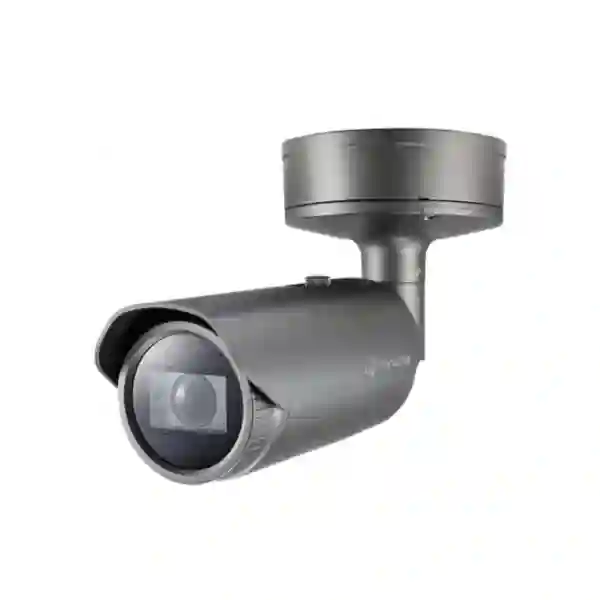
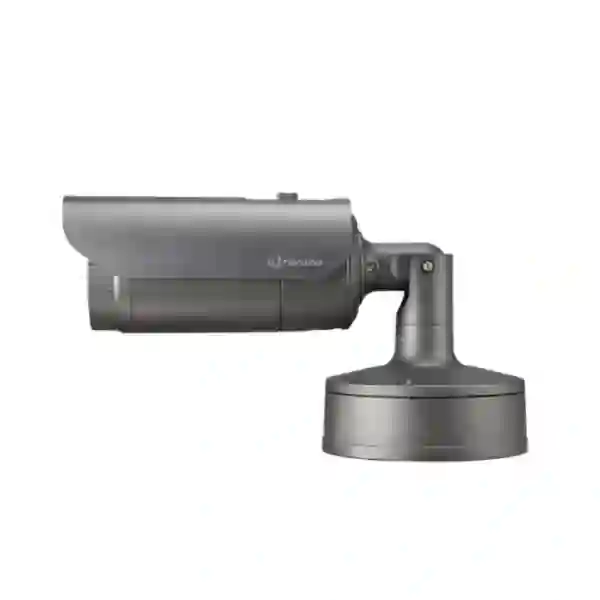
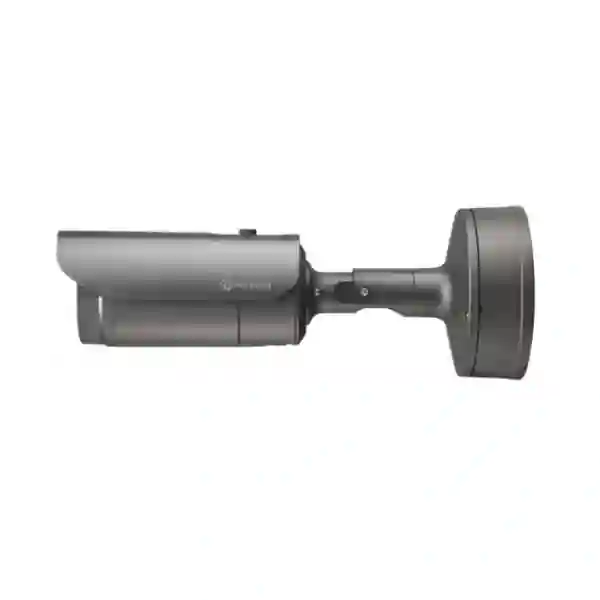
Hanwha TNO-6081RLP 2MP Licence-Plate Recognition Bullet Camera
The Hanwha TNO-6081RLP is a 2MP IP bullet camera with dedicated licence-plate-recognition capability for a planned single-lane capture point. Hanwha Vision publishes recognition figures of up to 10 m and 50 km/h, subject to installation conditions. For procurement in Tanzania, confirm the supported plate formats and regional warranty or service position before specifying this model: the available Korean manufacturer manual marks its unit for Korea use.
Important regional compatibility notice
The available Korean-language Hanwha Vision user manual states that this Korea-standard unit was made for use in the Republic of Korea and does not provide an overseas quality guarantee. This is a material procurement issue for Tanzania, not an assertion that every international supply arrangement is prohibited. Confirm in writing whether the exact model and supplied firmware support Tanzania-issued registration plates, can be supplied and serviced for this country, and can satisfy an agreed field test. Until those points are proven, treat this page as a technical assessment rather than confirmation of a Tanzania-ready product.
Technical specifications at a glance
| Manufacturer / model | Hanwha Vision · TNO-6081RLP |
|---|---|
| Camera type | Network bullet camera for licence-plate recognition |
| Sensor and image | 1/2-inch CMOS · 2MP · 1920 × 1080 option |
| Published plate recognition | Up to 10 m; vehicle speed up to 50 km/h; one lane |
| Lens | 4.38–9.33 mm · 2.13x optical zoom |
| Horizontal view | Approximately 103.1° to 44.5° |
| Imaging and codecs | Day/night, 120 dB WDR, H.265 / H.264 / MJPEG |
| Illumination | Built-in IR imaging distance listed as 40 m; dedicated SPI-2060 / SPI-1260 options sold separately for LPR |
| Power | PoE+ (802.3at Class 4) or 12 V DC |
| Max camera power | 19.5 W PoE+; 17 W DC |
| Outdoor enclosure | IP66 / IP67 / IK10 / NEMA 4X |
| Tanzania OCR and regional support | Not verified; obtain written manufacturer / authorised-channel confirmation |
Figures are taken from the manufacturer’s published product information. Model revisions, accessory requirements and recognition performance must be confirmed against the specific item offered. No Tanzania price, inventory, warranty or regional approval is asserted here.
Who should consider the Hanwha TNO-6081RLP?
The Hanwha TNO-6081RLP is a 2MP network bullet camera with integrated licence-plate recognition functionality, intended to capture and analyse vehicle plates in a controlled single-lane scene. It is relevant to a facilities team investigating vehicle-entry monitoring, a systems designer selecting a camera for a barrier approach, or an integrator reviewing replacement equipment for an existing Hanwha installation. The key attraction is a purpose-built plate-oriented camera rather than a general CCTV lens pointed at traffic. Its practical value depends on the plate format it can interpret, the condition of the scene, compatible illumination and a properly configured recording or management system.
For a Tanzania project, this is an evaluation candidate rather than a guaranteed ready-to-install ANPR solution. The manufacturer’s available Korean-language manual labels the unit for Korea use and says quality is not guaranteed overseas. Before ordering, establish whether the exact firmware, recognition application and intended plate character set have been explicitly approved for Tanzanian registration plates. Ask for written confirmation of regional supply and support, obtain test evidence using representative local vehicles, and check the requirements of the chosen parking, security or access-control platform. A useful quotation should make these uncertainties visible instead of hiding them behind a megapixel figure.
What the published recognition figures actually mean
Hanwha Vision describes recognition of number plates at distances up to 10 metres and vehicle speeds up to 50 kilometres per hour, with support for a maximum of one recognition lane. These are published application limits, not a guarantee of correct reads in every environment. Geometry, camera alignment, lighting, vehicle direction, plate size and software support can make a practical installation more demanding than a laboratory setup. A buyer should avoid interpreting the 10-metre recognition figure as a general 10-metre security detection limit, or using the stated speed ceiling to justify a fast multilane roadside application.
The camera is therefore best evaluated at a specific capture point where lane width and approaching direction are reasonably controlled. Identify the intended reading line before selecting the pole or wall position. Measure the distance from lens to target plate rather than to the barrier housing. Record anticipated maximum approach speed and whether vehicles stop, crawl or pass without stopping. Check whether the dedicated IR illuminator required for the stated plate-reading arrangement is included in the proposed bill of materials. If the project spans two or more independent lanes, design separate validated capture channels rather than assuming one camera can read all plates.
Tanzania compatibility is a procurement gate, not a footnote
Vehicle-registration formats differ by country, and automatic number-plate recognition is not simply ordinary optical zoom. A camera may produce a sharp, useful image yet still fail to convert the characters into reliable text when its recognition engine expects a different alphabet, layout, spacing or plate appearance. The TNO-6081RLP manufacturer’s public material reviewed for this page does not establish successful recognition of Tanzania-issued plates. The Korean-language manual also contains a country-specific restriction statement. Neither an international networking interface nor general HD imaging establishes Tanzanian recognition support.
Request the exact supported plate countries or regions from the manufacturer or authorised channel, identifying the software build and revision. Test private vehicles and relevant commercial fleets; include clean, dirty, reflective, damaged and differently mounted plates where representative. Record complete and partial reads, false characters, missed events and the time needed to produce an event. Confirm whether regional recognition can be enabled through official firmware or licensing, and do not assume another Hanwha Road AI model’s regional list applies to this model. If suitable Tanzania support cannot be documented, consider a region-supported ANPR platform instead.
One lane, one planned capture zone
The one-lane specification matters at the planning stage. A two-lane driveway can create overlap where a single camera sees several vehicles but does not have a defensible plate-read angle for either one. Even within one lane, a raised truck plate, a motorcycle registration or an offset car can occupy a different part of the image. Use a physical site plan to identify expected travel paths, vehicle categories, the plate-read line and any barriers, kerbs or turn movements that constrain the scene. A narrow and consistent read zone generally simplifies commissioning and acceptance testing.
Keep the camera’s main view clear of columns, foliage, swinging gate arms and parked vehicles. Avoid combining an extremely wide surveillance scene with the expectation of strong plate recognition at the edge of the image. If both an evidential overview and a readable plate are needed, two cameras with different viewing priorities may provide a more dependable result. The product’s 4.38–9.33 mm variable focal-length lens is useful for composing a known approach zone, but focal length alone does not solve an obstructed scene or a mismatch between optical geometry and recognition software.
Lens choice, framing and field of view
The manufacturer’s published focal-length range is 4.38 to 9.33 mm with 2.13x optical zoom. Its horizontal field of view runs approximately from 103.1 degrees at the wide end to 44.5 degrees toward telephoto. These values describe image framing; they do not prove that a licence plate remains large enough in pixels at a particular installation distance. A very wide view may be attractive for contextual video, but can make the plate too small for consistent text reading. A tighter crop may improve detail while giving less warning of an approaching vehicle.
During site commissioning, frame the plate capture zone rather than an aesthetically pleasing view of the whole driveway. Photograph or record several vehicle classes at the expected read position and inspect the plate dimensions in the native recorded footage. Adjust focus, zoom and camera angle together, then repeat day and night checks. If the lane geometry forces an oblique angle, verify the resulting capture accuracy instead of relying on a generic installation sketch. Treat any design-stage field-of-view calculation as a starting estimate to be validated on location.
Speed, shutter and motion blur
A 50 km/h published plate-recognition speed is a boundary condition, not permission to ignore shutter settings or actual site behaviour. At a moving driveway, headlights, vibration, low ambient light and an unsuitable exposure can turn legible characters into streaks. Camera frame rate and plate recognition success are related but not interchangeable: recording more frames does not automatically recover detail lost from motion blur. The manufacturer lists H.265 and H.264 streaming with frame-rate limits that depend on operating mode, including lower values when the AI engine is active.
Define the real operating speed range and design the scene to minimise unpredictable acceleration or weaving. A barrier entrance with deliberate slowing may be easier to validate than a public-road shoulder. Evaluate daytime and night-time reads, with vehicles approaching and exiting if both directions are needed. Inspect event timestamps against the recorded frame and check how the recognition output behaves when a vehicle pauses, reverses or follows another closely. Ask the system integrator to document the chosen exposure and recognition settings for later maintenance.
Low-light imaging and separate IR functions
Hanwha Vision lists colour operation down to 0.007 lux and monochrome operation down to 0.0007 lux under its stated measurement conditions. Its product page also identifies 40 metres as the camera’s built-in IR illumination distance. These figures describe imaging or illuminator characteristics and must not be confused with the shorter published plate-recognition distance. A readable vehicle silhouette at 40 metres does not mean characters can be recognised at 40 metres. Retroreflective plates, headlight flare and exposure settings can produce a very different result from general night surveillance.
The manufacturer specifically identifies SPI-2060 and SPI-1260 IR illuminator accessories as separately sold for the licence-plate-recognition arrangement. Confirm which model, quantity, mounting offset and power provision the intended installation needs. Obtain the full accessory list in the quote rather than assuming the camera’s onboard IR fulfils every plate-reading scenario. Consider how the external beam falls on plates of different heights and how glare from a neighbouring lane might affect captures. Night acceptance testing should use the exact illuminator and field position proposed for the project.
Day, night, rain and reflective surfaces
Real driveways change throughout the day. A clear image at noon can look substantially different in a shaded morning approach, during a wet evening or when bright headlights point into the camera. Hanwha lists wide dynamic range of 120 dB, backlight compensation and day/night operation, which are helpful camera functions, yet they do not remove the need for site-specific evaluation. Wet, dirty or tilted plates may reflect light unevenly. Dust on a protective cover can produce flare or blur, while occasional tall vehicles can block the view of cars behind them.
Commission the system across representative lighting conditions, not solely in the daylight hour when installation is completed. Look for black or washed-out characters, repeated wrong reads, truncated plates and plate reflections. Keep a log that pairs each failed read with the weather, vehicle type and image settings. Such a log helps distinguish a focus problem from unsuitable illumination or an unsupported recognition format. If the site has challenging headlight glare, confirm that any compensating settings still leave sufficient detail in the plate itself.
Outdoor durability and physical mounting
The published housing ratings include IP66, IP67, IK10 and NEMA 4X, and Hanwha specifies an operating temperature range of -50 to +55 degrees Celsius under stated conditions. These are enclosure and environmental capabilities, not a guarantee against any installation failure. An exposed mounting bracket, unsealed cable entry, inadequate grounding or poorly placed junction box can compromise an otherwise rugged device. Outdoor work in Tanzania may also involve dust, driving rain, insects, heat and intermittent power, all of which should be accounted for by the installation plan.
Choose a mount with sufficient stability to keep the plate field aligned over time. Allow for service access, safe working height and a clear route for protected network or power cable. Use correct outdoor cable glands, surge-protection and earthing practices appropriate to the site, and follow the hardware installation manual. Verify the actual startup requirements, particularly when the camera may be powered from a backup system after an outage. Weather-resistance ratings do not mean the device should be submerged, exposed to arbitrary cleaning chemicals or installed without appropriate cable protection.
Power design: PoE+ or 12 V DC
The manufacturer lists two camera power options: PoE+ to IEEE 802.3at Class 4 and 12 V DC. Its current published maximum consumption is 19.5 W through PoE+ or 17 W through 12 V DC, with typical figures of 16 W and 13.5 W respectively. These specifications are useful for power-budget planning but do not establish the load of external IR accessories, switches, network recorders or control equipment. Budget the full system separately and do not treat a nominal PoE switch port count as proof of adequate electrical capacity.
Check the effective PoE budget of every switch, including other connected cameras, before assigning the installation to a port. Confirm cable category, length, termination, surge protection and local installation practices. If an external IR unit uses a separate supply, include its actual draw and backup requirement. Define what should continue working during a mains outage: live preview, local recording, recognition metadata, barrier interface and network uplink may depend on different components. Test the complete chain while connected to the intended uninterruptible power arrangement.
Recording, compression and retention planning
The TNO-6081RLP supports H.265, H.264 and MJPEG video formats in the manufacturer specification, along with WiseStream III smart compression. These options can help a designer balance image quality, network capacity and storage, but savings depend on scene complexity and configuration. A crowded driveway with headlights at night is not the same storage workload as a calm indoor corridor. Determine whether the buyer needs continuous video, event clips, still plate images, recognised text, or a combination. Each has a different storage and retrieval purpose.
Hanwha’s current online specification lists microSD edge-storage support, while some earlier published materials present differing slot or capacity figures. For a purchase, verify the hardware revision, firmware and supported card configuration with the supplier instead of promising a fixed capacity from mixed documents. Calculate retention using measured bitrate and event counts, not only headline compression terminology. Include the recorders’ own operating space, backups, secure deletion and network interruption behaviour in the plan. If recognition metadata must survive an outage, confirm exactly where it is held and how it is re-synchronised.
VMS, ONVIF and integration boundaries
The manufacturer identifies ONVIF profiles and its SUNAPI and Open Platform interfaces for the TNO-6081RLP. Such interfaces can be useful when an integrator needs to connect video streams or device events with a wider security architecture. However, support for ONVIF video does not by itself prove that every third-party video-management system can ingest plate text, search an ANPR history or trigger an access-control relay from a plate whitelist. Those are application-level functions that must be tested against exact device firmware and server software versions.
Ask the proposed VMS supplier to demonstrate native video, recorded playback, alarm delivery and recognised-plate metadata separately. If an event is meant to open a gate, determine which component makes the access decision and what happens when it cannot be reached. Confirm API authentication, event schema, time synchronisation, retry handling and audit logs before treating integration as complete. A meaningful demonstration should use the exact TNO-6081RLP model and project software, rather than a successful integration video from a related Hanwha camera family.
Access control and barrier automation
A licence-plate camera can be one input into a vehicle access workflow, but the entire workflow includes safety devices, rules, auditability and fallback procedures. An accurate read still needs to be matched against authorised access data, and the barrier controller must decide whether to raise the gate. Keep ANPR read confidence, access permission and physical barrier operation as separate design questions. Use an appropriate intercom, credential or guard process for exceptions such as a damaged plate or a visiting vehicle whose registration is not yet in the database.
Specify who maintains vehicle permissions, whether access expires automatically and what happens during a site network outage. Provide an override for authorised personnel that does not depend on an unverified plate read. Barrier safety loops and obstruction detection should operate independently of camera analytics. If vehicles queue at the gate, measure the time from capture to a decision and decide what the operator should see when a read is delayed. Only describe automated opening as available once the exact camera, software and controller combination has been tested.
Cybersecurity features and deployment discipline
Hanwha Vision lists several security mechanisms for the product family, including encrypted communication options, secure boot, firmware signing, access controls and protected storage functions. Such mechanisms help an administrator design a more defensible IP-camera deployment, but their effectiveness depends on enabling and maintaining them correctly. A factory setup that leaves the device accessible from an unrestricted business network is not equivalent to a managed security architecture. Cybersecurity choices are especially important when a camera can observe vehicles and connect to a gate-control workflow.
Use named administrative accounts where available, strong unique credentials, least-privilege access and appropriate network segmentation. Restrict remote management through an approved access path and avoid exposing camera login pages directly to the public internet. Review firmware advisories and maintain a documented patch process, with a rollback and testing plan because application behaviour may change after an update. Verify NTP time synchronisation, backup configurations and event-log retention. Obtain confirmation that the quoted device is supported by appropriate firmware and a regional maintenance channel before depending on it operationally.
Privacy, notice and responsible data handling
A licence plate can be associated with people, businesses and vehicle movements. Even when a project has a valid security reason for collecting that information, it should consider notice, access control, retention, data sharing and deletion in advance. The requirements applicable to a Tanzania deployment depend on the actual controller, purpose, data categories and prevailing law. This page does not certify that a particular collection or retention arrangement is legally compliant; the buyer should obtain appropriate local privacy and regulatory advice for the planned use.
Write a data-handling plan that states which fields are stored: video clips, plate crops, OCR text, timestamps, user annotations and access decisions may have different sensitivity and usefulness. Decide who may search events, export records or alter authorisation lists, and log significant actions. Keep retention tied to a legitimate operational purpose rather than saving records indefinitely by default. If records are sent to a cloud service or another organisation, map those flows and assess the relevant agreements and restrictions. Include incident-response and correction procedures for incorrect plate matches.
Selecting a location and designing the approach
Start with a drawing of the real driveway or site approach. Record the normal direction of travel, road width, turns, camera fixing points, electrical distribution, fibre or copper uplink, lighting columns and gate-control room. Identify whether the plate is mounted at the front, rear or both of the vehicles likely to use the site. A camera looking at the wrong side of a departing vehicle may produce excellent video but no readable plate. At a busy facility, confirm that waiting vehicles do not repeatedly block the capture point.
Place the initial viewing position where lane geometry is predictable and there is an unobstructed path to the target plate. Survey mounting heights and lateral offsets rather than selecting a pole solely for convenience. If pedestrians and vehicle traffic share a driveway, design the field and safety arrangements so commissioning does not create a hazard. Include nearby reflective signs, headlights, existing CCTV beams and traffic-management equipment in the observation notes. The final position should be chosen using trial footage and a recognition test, not only a plan drawn at desk level.
Network topology and system dependencies
IP-camera projects are often priced as if the camera is the entire solution. The actual system may also require PoE power, switching, secure local cabling, fibre between buildings, an NVR or VMS server, network time service, storage, backup power and access-control components. These items can be necessary even when the camera itself carries a recognition application. Separate each dependency in the bill of materials so the client understands where video is recorded, where plate text is processed and where the access decision is executed.
For a multi-building campus, examine the network route during normal operation and during failure of a switch or uplink. Check expected camera bitrate, event frequency and security segmentation. If the installation crosses an outdoor exposed route, plan appropriate lightning protection and qualified electrical work. Document IP addressing, DNS, time source, device names and admin ownership. A straightforward topology diagram helps future operators troubleshoot a missing read without confusing a network outage with a recognition failure. Do not assume wireless backhaul or cloud availability unless the project has verified it.
Step-by-step site commissioning
A good commissioning process begins before the camera is permanently mounted. Confirm hardware identity, firmware version, approved application build, local recognition support and delivered accessories. Assemble the device and IR components according to manufacturer instructions, check its power budget and validate basic network access on a controlled setup. Then align the lens to the defined plate-read zone and collect short video samples with representative vehicles. This sequence allows major incompatibilities to be detected before substantial civil or electrical work is committed.
On site, record the final mounting position, aim, focal setting, imaging configuration and any time-of-day schedules. Validate recognised text against actual plates, inspect snapshots for visibility and ensure events reach the approved recorder or management platform. Test restart, temporary uplink loss, full power failure and recovery where these events matter to the business. If gate automation is involved, test both correct permits and deliberate rejection cases with independent safety systems active. Finish with operator instruction and a signed list of configuration settings rather than leaving only a working live picture.
Acceptance test: measure usefulness, not slogans
An acceptance plan should begin with the exact outcome the customer needs. For example, an industrial facility may require a searchable vehicle arrival history, while a managed gate may need timely identification that is safe to use in an authorised-access decision. Those outcomes require different evidence. Define a sample set that covers daylight, dusk, darkness, dust or rain when feasible, plate variations and vehicle types. Include intended approach speeds and both direction-of-travel cases if applicable. Test recognition and delivery of the result, not simply a stored image.
For each pass, record the ground-truth plate text, the camera-reported text, the recorded frame, timestamp, observed speed and any relevant failure note. Report correct reads, partial reads, no-reads and false reads separately. Note that a false positive can be more consequential than an ordinary miss if it is connected to an automated barrier. No invented accuracy rate should appear in a proposal; establish the project’s pass thresholds with stakeholders before tests begin and use actual field results. If Tanzania plates cannot be reliably processed, mark the acceptance requirement unmet and explore a suitable alternative.
Ongoing maintenance and support responsibilities
Reliability depends on more than the device’s original specification. After installation, dust, insects, vibration, landscaping and changing vehicle patterns can affect the recognition zone. Plan periodic lens cleaning using approved methods, an inspection of mounts and cable seals, and a review of read failures. Camera direction can shift slightly during repairs to a nearby pole or after a vehicle collision. A small framing change may have a disproportionate effect on the number of pixels available for plate recognition.
Assign responsibility for firmware updates, password rotation, stored-event access and recognition-data backup. Establish who troubleshoots the camera, external IR unit, network switch, recorder and gate controller, since faults can look identical to an end user. Keep a baseline capture from the initial acceptance test so technicians can compare today’s images with a known good reference. Most importantly for this model, obtain written clarity on regional support and firmware entitlement before designing a long-term maintenance agreement. A Korea-labelled manual should not be mistaken for proof of Tanzania coverage.
Use case: a gated workplace or compound
A controlled workplace entrance is a plausible setting to evaluate single-lane ANPR because the approach can sometimes be slowed and physically guided. The business question might be whether gate staff need a faster way to locate a vehicle arrival record, not whether every vehicle must automatically be admitted. In such a design, live plate footage, a searchable event record and a manual exception workflow can be useful without granting the camera authority over the barrier. This distinction reduces dependence on a single automated decision.
Before selecting equipment, count lanes and note how delivery trucks, visitors and staff vehicles approach differently. Check if drivers queue at an angle or whether guards need to view supporting overview footage. Test the actual plate formats used by those vehicle groups. If the intended camera cannot prove acceptable Tanzania recognition support, its other specifications do not justify describing it as a deployable local ANPR solution. Ask for a complete demonstration and price quotation based on the site’s traffic pattern and intended security workflow.
Use case: visitor parking and facility management
Parking teams may want to associate entries with visitor passes, investigate misplaced parking permits or produce a record of vehicle movements. The TNO-6081RLP has published plate-recognition capabilities, but a parking solution also needs a database, user interface, event search, retention policy and a procedure to correct misreads. The camera itself should not be marketed as a complete parking-management platform. Depending on the site, a general overview camera may be needed to retain evidence of vehicle type, position and context beyond the tight plate crop.
Clarify the workflow for visitors who arrive without preregistration, vehicles with obscured plates and sites where one lane serves both incoming and outgoing traffic. Decide whether the camera is meant to support manual verification, automatic logging or authorisation. Each level increases the importance of recognition compatibility and system integration. A pilot should measure the staff time saved and the operational impact of incorrect events, as well as the quality of the images. Do not promise local availability or a bundled parking application without a verified offer.
Use case: warehouses and delivery checkpoints
Warehouses and depots may need vehicle traceability at delivery gates. A 2MP plate-oriented camera can be part of an evaluation where a vehicle passes a predictable checkpoint, but it cannot independently verify a delivery order, trailer number, driver identity or cargo condition. Those functions require workflow design and often additional cameras or business software. Trucks also create special geometry issues: plate positions vary, vehicles may turn sharply, and one truck may block another vehicle during a busy period.
A project team should sample the actual fleet and visitor categories rather than relying only on passenger cars in a demonstration. Check expected plate heights and offsets, the speed of entry, headlight performance and safe access for cleaning. If events are integrated with a logistics platform, prove that timestamp, camera identifier and plate result travel correctly into a test database. Keep a manual reconciliation option for mismatches. The central question is whether the verified device-and-software combination serves the depot’s audit requirement with acceptable effort and risk.
How this differs from ordinary CCTV
General surveillance cameras are normally selected to provide broad situational awareness: who approached a gate, what happened and which direction someone travelled. Plate-recognition cameras concentrate on a narrower question: can a particular vehicle’s registration be captured and interpreted at a defined point? A wide-angle overview can be excellent evidence while producing too few pixels on the plate. Conversely, a dedicated plate view can yield useful characters while showing little context for an incident investigation. The best design often assigns these two objectives to separate views.
Do not replace a panoramic security view merely because an ANPR model advertises analytics. Ask stakeholders to define the useful output of each camera: image evidence, searchable plate text, event automation, vehicle-count statistics or a combination. Review whether a high-quality conventional camera plus a region-supported OCR service might better fit the actual requirement. The answer depends on local plate support, software costs, server needs, available infrastructure and operator workflow. The published camera model name is only one part of a complete engineering choice.
Questions to include in a supplier quotation
Request a quote that identifies the exact TNO-6081RLP hardware and firmware revision, quantity, power method, mounting accessories, dedicated IR illuminators, switching, recording capacity and labour assumptions. Ask the supplier to distinguish equipment that is included from accessories that are optional. Require explicit answers about Tanzania plate recognition, support territory, manufacturer-backed servicing and software entitlements. Because the available Korean manual limits its unit standard to Korea, a written regional clarification is particularly important; a verbal assurance that the camera is ‘international’ is not enough.
Also ask for a site-survey summary, proposed capture distance, expected speed envelope, acceptance-test plan and responsibility for integrating plate events into any existing security application. The quote should say whether the solution handles one lane only, how an extra lane is priced and whether any external system is required for a searchable history. Include handover documentation, network credentials transfer, operator training and post-installation support scope. Confirm commercial details such as price, shipping, availability, payment terms and warranty only through a current, authorised offer; none are asserted by this page.
Decision checklist before committing budget
First, identify the business outcome and whether an image, recognised text or automatic access decision is necessary. Second, measure the lane: width, speed, viewing distance, plate location and expected traffic. Third, confirm that the model’s recognition software supports the country’s plate format and has a legitimate regional supply path. Fourth, verify that separate illumination and supporting software have been costed. Fifth, agree on a field trial that includes the difficult vehicles and conditions your facility actually experiences.
Finally, check resilience, privacy and ownership. Name the person who can grant access to the event history, define retention, ensure the network is secured and document what happens when a read fails. A viable purchase combines verified camera performance with an operating process the staff can sustain. If any vital condition is unproven, keep the decision open and compare alternative ANPR options with confirmed Tanzania plate support. FourTeck Tanzania can be asked to review the requirement and request technical confirmation before a purchase decision, without this page asserting inventory, price, regional authorisation or deployment guarantees.
Comparing the TNO-6081RLP with other ANPR proposals
Compare offers by the evidence they provide, not only by the price of the camera body. A higher-megapixel camera can still fail the project if it cannot recognise the country’s number-plate syntax. Likewise, a lower-cost device may be expensive to operate if it needs an unplanned server, subscription, illuminator, network upgrade or replacement after a failed pilot. Require each bidder to identify its supported countries and software licences, the number of lanes, tested approach speed, night-time requirements and required integration endpoints. Compare the whole installed and supported solution under the same site assumptions.
Ask whether the alternative has a documented path for future firmware updates, whether it records full video and events locally, and how the vendor handles a software failure or false match. Consider replacement and maintenance cost, not just initial purchase. Where the work involves a gate, inspect independent safety and manual fallback controls. A transparent comparison may identify a region-supported alternative even when the TNO-6081RLP camera’s optical and enclosure specifications appear attractive. The best choice is the one that passes a clearly defined operational acceptance test.
Why a pilot installation is especially valuable
A short pilot can prevent an unsuitable design from becoming embedded in concrete, conduit and recurring software commitments. For this model, it can establish three separate facts: whether the correct product is regionally supported, whether the recognition engine understands the registration plates that actually use the facility, and whether the physical scene provides useful images. These are independent questions. An acceptable picture on the monitor cannot substitute for successful text recognition, and a successful isolated plate test cannot substitute for a dependable production workflow.
Use a controlled pilot with the proposed illuminator, lens position, camera firmware, power supply, network path and software endpoint. Capture enough representative passes to reveal patterns rather than showcasing only selected success cases. Ask the supplier to explain how missed, duplicate and false reads will be displayed to the operator. Preserve pilot results and configuration details so the final installed solution can be compared with them. If support territory remains unresolved, do not represent the pilot as evidence of warranty eligibility or ongoing regional service.
Training operators and managing exceptions
Even a carefully commissioned system needs human procedures. Operators should understand the distinction between a captured image, recognised text and a verified access decision. They need to know how to search for an event, identify an incorrect character, retrieve associated footage, escalate an incident and record a manual exception. Where the camera feeds a barrier, the operator should also know how to handle an obstructed plate without disabling the barrier’s independent safety functions. Written workflows reduce avoidable confusion when staff change.
Agree on a clear escalation path for repeated misreads or a lost video feed. The network administrator may own connectivity, while a security supervisor owns the permission list and the integrator owns optical re-commissioning. Keep those roles distinct. Teach staff which information must not be exported or shared outside authorised procedures, and who can correct an event record. Run a realistic exercise with a damaged plate and a network interruption to verify that the human fallback is safe, accountable and usable at the expected traffic volume.
Planning for future expansion
A single-lane deployment may later become a two-gate campus or be connected to an upgraded parking platform. Record the original architecture so additional capture points can be added deliberately. Consider how device naming, network capacity, time synchronisation, security policy and central event search would scale. Do not assume the TNO-6081RLP supports extra lanes merely because a larger recorder or faster switch is installed. Recognition coverage remains tied to field geometry and manufacturer application limits.
If the buyer expects future expansion, request a roadmap from each bidder showing how many independent cameras and licences would be required, what additional power and storage would be needed and whether plate records can be searched across locations. Check how regional language and plate-format support will be maintained after software changes. A well-documented design allows later procurement to be compared using objective requirements. It also leaves room to change camera models if a better Tanzania-supported ANPR solution becomes available.
A practical procurement handover
Before equipment is accepted, the customer should receive the approved camera list, firmware and application versions, mounting drawings, final lens settings, power inventory, network diagram, device configuration backup and event-integration notes. A readable as-built pack helps a future engineer find the recognition line, service the IR lamp or diagnose missing metadata without repeating the entire installation. Include the owner of each password or account, and make sure a secure handover mechanism is used rather than putting passwords into an ordinary shared document.
Attach the field-test report, test plate samples where lawfully handled, pass and fail totals, agreed thresholds and unresolved issues. Record any regional supply, warranty and localisation confirmations in the same pack. If the camera is rejected following a compatibility test, preserve the lessons and apply them to the replacement selection. The aim is a supportable vehicle-recognition function, not merely a device bolted to a pole. FourTeck Tanzania can evaluate the requirement and request the evidence needed for a responsible quotation.
Frequently asked questions
Is the Hanwha TNO-6081RLP a 2MP camera?
Yes. Hanwha Vision identifies it as a 2MP network bullet camera with a 1/2-inch CMOS sensor and a 1920 × 1080 video option. The pixel count describes the image, not the correctness of number-plate text recognition. A plate must be suitably framed, sharp and compatible with the OCR application. Evaluate real captured results in the planned lane rather than judging the solution by megapixels alone.
Will it read Tanzanian vehicle registration plates?
That has not been established by the public manufacturer information reviewed for this page. The available Korean-language manual marks the unit for Korea use, and the published general specification does not confirm Tanzanian plate-country recognition. Request exact firmware and plate-format confirmation in writing and run a representative local test before purchase. Do not rely on compatibility of other Hanwha ANPR models.
What is the maximum published plate-recognition distance?
Hanwha Vision publishes a distance of up to 10 metres for number-plate recognition, subject to its stated product use. That figure must not be confused with the separate 40-metre IR imaging distance. A field installation needs the target plate to be clearly visible in the configured recognition zone, at the intended speed and lighting conditions. Site acceptance tests should determine usable performance, not a brochure number alone.
Can one camera monitor two vehicle lanes?
The manufacturer specifies a maximum of one recognition lane for this model. A larger field of view does not increase the rated recognition-lane count. Where two lanes require independent automated reads, assess separate camera positions or another suitable solution, subject to regional support and integration requirements. A design survey should also account for vehicles that cross a lane marking or obscure each other.
Does the camera include the specialist IR accessories?
The manufacturer lists SPI-2060 and SPI-1260 IR illuminator accessories separately for the plate-recognition arrangement. Do not assume they are supplied with the camera or that the built-in IR light substitutes for the recommended accessory in every scenario. Ask the seller for an itemised bill of materials and test the exact lighting assembly at night. The final illuminator choice should follow manufacturer guidance for the actual installation.
What power does the camera require?
The manufacturer lists IEEE 802.3at PoE+ and 12 V DC as camera power options. Published maximum draw is approximately 19.5 W on PoE+ or 17 W on DC for the camera. The external IR illuminator, switch, storage equipment and access-control devices may require separate power capacity. A designer should calculate the complete system load and any backup arrangement before specifying a switch or UPS.
Does ONVIF support guarantee plate-text integration?
No. ONVIF can help a compatible system exchange video or certain device events, but it is not an automatic guarantee that the target VMS understands this model’s recognised number-plate metadata. Validate video viewing, recording, searchable OCR text, alarms and gate-control actions as separate functions. The exact firmware and VMS software version should be part of the integration test.
Is the camera suitable for outdoor installation?
Hanwha publishes IP66, IP67, IK10 and NEMA 4X enclosure ratings and a defined operating-temperature range. These indicate specified environmental protection for the camera housing, not immunity to every site risk. Installation still requires proper cabling, seals, grounding, structural mounting, service access and maintenance. Outdoor suitability also does not establish a supported Tanzania ANPR application.
Can it work as a stand-alone parking system?
It can form part of a plate-capture design, but a complete parking operation usually requires event storage, permissions, searches, operator controls, safety processes and possibly barrier integration. Which of those functions are available depends on the exact system supplied. The camera should not be represented as including a full parking-management service or a compatible local plate database without verification.
What happens if a plate is dirty or unreadable?
The image or recognition process may miss a plate or return incomplete or incorrect characters. Plan for a controlled exception workflow rather than assuming every registration will be identified. Depending on the business requirement, that may mean a guard review, intercom, credential or manual entry. Acceptance testing should explicitly record missed and false reads so the buyer understands the risk of relying on automation.
Can the camera stream to existing recording software?
The manufacturer lists standard video formats and application interfaces, which make integration worth investigating. Actual compatibility depends on the recording system, required events and licensing. Confirm live preview, playback, time synchronisation, encryption and required plate data in a controlled test. The existence of a network video stream is not proof that ANPR data will be searchable in the existing application.
How do I request a responsible quotation in Tanzania?
Share the proposed site type, number of lanes, read distance, expected vehicle speed, power and network availability, plate examples and desired workflow. Request confirmation of Tanzania plate compatibility and regional support for the exact TNO-6081RLP revision before asking for a final equipment specification. A responsible quotation should separately list illuminators, storage, integration, installation, testing and support, with no unverified promises about stock or price.
Request a Tanzania suitability and project review
To assess the Hanwha TNO-6081RLP responsibly, provide the lane count, typical vehicle speed, proposed camera distance, representative plate examples, lighting conditions, integration requirements and expected recording workflow. Ask FourTeck Tanzania to seek written confirmation of regional plate compatibility, supply and support before an order is considered. If those conditions are not met, request an alternative solution with documented Tanzania suitability.
Next step: Request a technical suitability assessment and an itemised quotation after compatibility is confirmed.




Reviews
There are no reviews yet.