
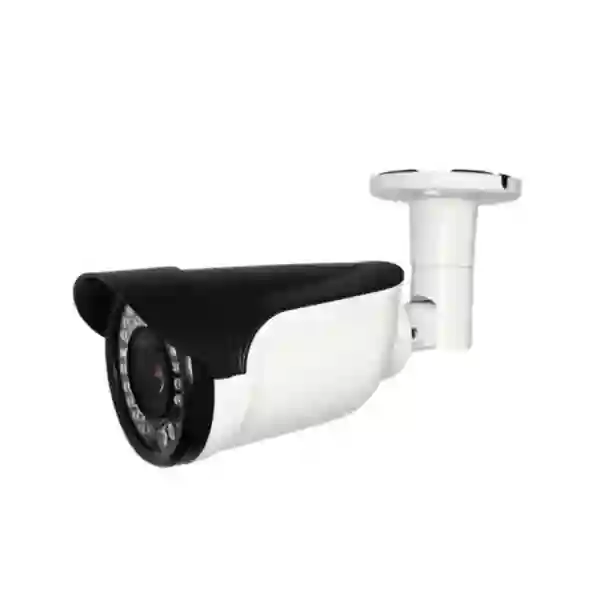
Hanwha TNO-F6070R 2MP Flame Detection IR Bullet Camera
Add a dedicated visible-flame detection signal and a useful video view to a planned monitoring zone. The Hanwha Vision TNO-F6070R combines 2MP network video with a flame-detection sensor rated by the manufacturer for up to 30 metres and a 100-degree detection angle. It is a specialist supplement for properly designed fire-warning and surveillance systems, not a stand-alone certified building fire alarm or temperature-measuring thermal camera.
Specification snapshot
| Product type | 2MP flame-detection IR bullet network camera |
|---|---|
| Flame sensing | Dedicated flame-detection sensor |
| Quoted flame coverage | 30 m distance; 100° flame-detection angle |
| Video lens | 2.7–12 mm varifocal lens, per manufacturer line-up literature |
| Frame rate | Up to 30 fps at 2MP, per manufacturer line-up literature |
| Video & image processing | H.264 / MJPEG; 3D-DNR; WDR / BLC / HLC; True Day & Night (ICR) |
| Integration | ONVIF support; external smoke-detector integration described |
| Power | 12 V DC or IEEE 802.3af PoE |
| Enclosure information | IP66-class protection; verify installation suitability |
| Published operating range | -10°C to +45°C; relative humidity up to 80% (manufacturer line-up) |
Specifications are based on Hanwha Vision’s published model page and product-line information. They do not establish local stock, price, certification for a particular Tanzanian project or guaranteed field detection under every condition.
What this camera is designed to do
The Hanwha TNO-F6070R is intended for sites that want a video view of a monitored area together with a dedicated means of detecting visible flame signatures. That combination matters because a general surveillance camera may show a developing incident without raising a purpose-built flame alert. Here, the buyer is considering a network camera with a separate flame-detection function. A reviewer can use the associated image to understand where an event is occurring, while the detection system supplies an additional signal for investigation. The exact notification method depends on how the device and surrounding system are configured.
This is not a thermal imaging instrument or a camera that reports calibrated temperatures. A flame detection sensor and a temperature-measuring thermal sensor solve different problems. It is also not an all-in-one fire alarm system. Buildings still need the fire detection, alarm, suppression, evacuation and emergency procedures appropriate to their risk and applicable requirements. For facilities in Tanzania, the useful procurement question is how this camera could complement the existing safety strategy, not whether one device could replace it.
Verified product specifications
The manufacturer identifies this model as a 2MP flame-detection infrared bullet network camera. Its published highlights include a dedicated flame sensor, a quoted flame detection distance of 30 metres, a 100-degree flame detection angle, True Day and Night with an infrared-cut filter, 3D digital noise reduction, and WDR, BLC and HLC image processing options. Hanwha Vision also specifies ONVIF, Power over Ethernet and H.264 and MJPEG video encoding. The product line-up literature lists a 2.7–12 mm varifocal lens, up to 30 frames per second at 2MP, and 12 V DC or IEEE 802.3af PoE power.
The published weather-protection information identifies an IP66-class housing, while a Hanwha Vision product-line specification states an operating temperature from minus 10 to plus 45 degrees Celsius and humidity up to 80 percent relative humidity. These are product specifications, not promises that any proposed mounting location will be suitable. Before procurement, an installer should check the actual manufacturer document revision, mounting hardware, electrical conditions, and ambient conditions for the installed enclosure. Importantly, the 30-metre figure describes a quoted detection capability, not an unconditional guarantee for every flame, fuel, angle, obstruction or weather condition.
How to interpret the 30-metre flame detection distance
Buyers sometimes read a quoted detection range as a radius in which any fire will always be detected. It is safer to treat 30 metres as a planning specification that needs to be tested against the real hazard. Flame size and intensity, viewing angle, intervening materials, distance, contamination on the window and the nature of the background can all affect a field installation. A small flame behind stacked goods is not equivalent to an unobstructed flame in an open demonstration area. The purpose of a site survey is to identify what the camera can actually see and which ignition scenarios the project needs to address.
For a warehouse, for example, the survey should distinguish aisle views from shelf-level blind spots. At a loading yard, it should distinguish open ground from containers, parked vehicles and changing stacks of materials. The final installation should be accepted through a controlled commissioning test under the manufacturer’s instructions and the site’s safety rules. Never stage an uncontrolled fire to test detection. Where risk assessment shows that the camera cannot cover a hazard adequately, use additional detection technologies or relocate the device rather than stretching the published distance figure.
Understanding the 100-degree detection angle
The stated 100-degree flame-detection angle is useful when planning coverage across a bay, yard or room, but it should not be confused with the adjustable viewing angle of the video lens. An installer needs to consider the detection sensor’s coverage and the optical image together. A camera may produce an acceptable picture of an area without every part of that picture falling within the specified detection geometry. Conversely, a wide detection angle does not make opaque obstacles disappear. A site drawing that shows the intended detection zone is more helpful than a simple count of cameras.
Begin with a floor or yard plan and mark the hazard, camera mounting position, expected obstructions, areas used for maintenance, and any moving vehicles. Evaluate the apparent size of the target at the furthest point and whether equipment or inventory could block it later. Walk the site from the proposed camera position before committing to conduit and cabling. Review any areas outside the detection cone and decide how another device or a different mounting arrangement will address them. This approach turns a headline specification into a defensible coverage decision.
Video quality and night-time monitoring
The 2MP video feed is intended to provide context around events rather than compete with higher-resolution forensic cameras for distant identification tasks. The camera uses day and night switching with an infrared-cut filter, and Hanwha lists image adjustments such as WDR, backlight compensation, highlight compensation and noise reduction. Those controls can be valuable when a door opens onto bright daylight, when lighting changes through a shift or when highly illuminated equipment occupies part of the frame. Their effectiveness must still be assessed at the actual installation site.
The device is also described as an IR bullet camera. Infrared illumination assists video observation under low light, but darkness, rain, dirt, reflections and camera placement can still affect scene interpretation. Do not assume that the IR video illumination range is identical to the flame sensor’s 30-metre specification. Plan lighting, camera aim and the position of reflective surfaces separately from detection geometry. During acceptance testing, obtain sample daytime, night-time and transition images, and confirm that operators can recognize the monitored area when an event arrives.
Lens, focus and framing decisions
The published 2.7–12 mm varifocal lens gives an installer flexibility to frame the operational scene. A broad view helps operators see the layout of a collection area; a tighter view can reveal more detail around a specific point. However, changing optical framing does not automatically change the dedicated flame sensor’s stated 100-degree coverage. This distinction is especially important when a camera is positioned high above a site or when an operator wants to zoom closer to a risk point without leaving adjacent hazards uncovered.
Before final tightening of the mount, adjust the view around the intended operational question: where should a responder look, what reference points will help identify the location, and which physical barriers are present? Verify focus in low light and after the housing is closed or serviced. Save representative commissioning images for future comparison. If identification, licence-plate recognition or detailed tracking is part of the project, assess whether a separate security camera is needed. This model’s specialist value is flame monitoring accompanied by visual context, not every possible surveillance feature.
Network integration and video formats
Hanwha Vision lists ONVIF support along with H.264 and MJPEG video formats. These features can help when the proposed camera must work within a network video monitoring environment, but protocol support is only a starting point for compatibility. The recording platform, supported ONVIF profiles, firmware versions, event-handling behaviour and user permissions all need to be checked for the exact combination. It is possible for a system to display live video yet fail to receive a particular event or fail to perform the desired automated action.
Ask the system designer to test live viewing, playback, time synchronization, connectivity loss, event display and operator acknowledgement. Confirm any required recording retention and storage capacity through actual bit-rate measurements or a documented calculation rather than a generic number of days. If the site already uses an NVR or video management system, request a practical proof of concept before assuming every integration feature is available. Keep a record of the tested software versions, network settings and event mappings. That record is valuable when cameras, recorders or software are updated later.
Power options and cabling
The manufacturer’s line-up literature identifies 12 V DC and IEEE 802.3af Power over Ethernet power options. PoE can simplify network camera deployment by carrying network data and electrical power along a suitably specified Ethernet run, reducing the need for a separate local power adapter at the camera position. That convenience does not remove the need to check the PoE switch’s total power budget, cable quality, cable route, connector sealing and the electrical protection scheme appropriate to the site.
For a facility with long cable runs or exposed outdoor routes, the survey should address network design limits, surge exposure, earthing arrangements and safe routing near power machinery. A critical monitoring point may also need a suitable UPS-backed network path so that a mains interruption does not immediately disable observation. Where 12 V DC is used instead, confirm an approved compatible supply and the cable voltage drop. Do not use both power methods indiscriminately or improvise wiring. The approved installation instructions and qualified electrical design should control the final connection.
Combining flame video with smoke detection
Hanwha identifies integration with a smoke detector as a way to build a dual-detection arrangement. The two technologies can contribute different information: a smoke detector responds to its designated smoke conditions, while a flame detection camera is aimed at observable flame signatures. In some environments, this combination gives operators more context than either source on its own. Whether an event should trigger evacuation, dispatch a response team, close equipment or inform a fire panel must be determined by the facility’s approved safety design.
Do not interpret the phrase dual detection as proof that the camera contains a smoke sensor. The external detector, interface equipment, alarm logic, supervision and any mandatory certification are separate design matters. Request a wiring and signal-flow diagram that identifies where each event begins, how it is transmitted and what happens on a cable or device failure. Check who will receive and acknowledge alarms during working hours and overnight. A useful architecture is one that remains understandable during an emergency, not merely one that looks sophisticated in a sales presentation.
A practical alarm and response workflow
A monitoring product becomes useful only when someone knows what to do with its alert. A sound implementation begins by defining the event path: detection at the camera, transport across the network or approved interface, presentation to the operator, verification using the associated video view, and escalation under the site’s emergency plan. Record the assigned roles for security staff, maintenance teams, safety officers and emergency responders. Clarify whether the alarm must reach an attended desk, a monitored control room or another approved destination.
Test the workflow under normal operation and during plausible failures, such as lost network connectivity, a switched-off monitor, an unanswered alert or a change of shift. Configure time synchronization so recorded clips can be matched to the incident log. Agree on what evidence should be preserved after an incident and who can access it. Staff should not delay evacuation or emergency action while trying to obtain video confirmation when the approved fire procedure requires immediate response. The camera is one information source within a larger emergency system.
Warehouse and distribution applications
Warehouses can contain a mixture of packed goods, cardboard, plastic wrap, loading equipment and variable lighting. For a buyer considering flame-detection video, the central question is whether a camera can see the higher-risk locations without a shelf, vehicle or stacked pallet obscuring the field. Potential positions may include the entrance to a storage bay, a loading area or a designated handling zone, provided the risk assessment supports those choices. There is no universal camera spacing rule that works for every layout.
Request a coverage plan that accounts for the maximum intended storage height rather than only the empty building. Consider whether seasonal stock arrangements change sight lines. Identify sources of nuisance signals, such as nearby hot work or moving reflective equipment, for review with a qualified designer. Plan routes to the area so that an operator can communicate the location of an event quickly. This camera may add visibility and an alert source, but fixed building fire detection and the site’s other protection systems remain essential.
Waste collection, recycling and service yards
Waste-handling areas are a particularly understandable application for visual flame detection because ignition may begin among material that is moved, sorted or stored outdoors. Hanwha Vision has illustrated this product family in a waste collection setting. A camera with a view across a designated collection point may help staff identify the part of the site requiring inspection when an event is reported. The value is strongest when the monitored hazard is within clear line of sight and the operator understands the site layout.
For a Tanzania deployment, assess exposed cabling, water spray, airborne dust, vehicle movements, cleaning practices and the possibility that stored material will grow taller than the planned view. Mounting positions need to remain accessible for maintenance while avoiding damage by vehicles or lifting equipment. A yard that changes shape throughout the week should be surveyed in its normal busy state, not only when empty. Do not assume outdoor suitability in every climate solely from the IP rating: the stated temperature and humidity limits still apply.
Production areas and workshops
Industrial workshops may include cutting, welding, heated processes, machinery and changing traffic patterns. These conditions make the distinction between real hazards and potential nuisance sources especially important. The camera should be evaluated by a competent safety and systems team before installation near processes that deliberately generate bright light, hot surfaces or other radiant energy. The team should review the manufacturer’s site-specific installation advice and determine whether this is the appropriate detector technology for the planned risk.
Use a drawing to separate normal operating activity from spaces where unintended flames must be detected. If a risk cannot be reliably viewed or the environment exceeds the product limits, select a different detector or add appropriate protective measures. Never change alarm thresholds or suppress alerts merely to make a problematic installation quiet without a formal risk review. Assign responsibility for cleaning, periodic tests and the management of temporary work. Operational discipline is as important as the camera’s published specifications.
Site conditions in Tanzania
A Tanzania-based project may involve outdoor heat, covered industrial bays, humid coastal conditions or dusty working spaces, depending on the actual location. These examples are survey questions rather than claims about one installation. The manufacturer’s line-up specification for this model states a maximum operating temperature of plus 45 degrees Celsius and a relative humidity limit of 80 percent. A sun-exposed enclosure can experience conditions different from the nearest weather report or office temperature reading. That is why measurements and equipment placement matter.
Before ordering, check the expected temperature inside the installed environment, rainfall exposure, spray direction, humidity, corrosion risk and access for cleaning. Consider whether an awning or mounting adjustment can reduce direct sun without obstructing the detector. Do not assume that IP66 implies suitability for immersion, every chemical atmosphere or an explosive hazardous area. Site-specific approvals and an appropriately rated enclosure or different product may be required. A qualified local designer should confirm the complete installation, not just the camera body.
Mounting, orientation and physical protection
Physical installation should begin with a documented field-of-view and hazard assessment. Choose a structurally sound mount that remains stable under expected service conditions. The bracket should permit the necessary aim while allowing technicians to inspect the camera without unsafe access arrangements. Route and seal wiring so rainwater does not track into connectors or junction boxes. Where the device is exposed to cleaning operations or vehicle routes, evaluate impact protection without covering its sensing face or introducing a new blind spot.
After installation, capture a reference image, mark the area on the site plan and record the camera identification used in the video platform. Look for reflections, glass barriers, mesh, vegetation and temporary signage that could alter the detection path. A device hidden behind an attractive architectural feature may also be hidden from the hazard it is intended to observe. The final position should be signed off by the people responsible for both safety and surveillance, because each team evaluates the scene for different reasons.
Commissioning and acceptance testing
A good acceptance procedure is more than checking that the device powers on. Confirm the correct model and firmware, electrical supply, network address, authorized access, image quality, time setting and event routing. Confirm that the operator sees the right camera name and can identify the monitored location. Verify any connection to recording or safety-related interfaces according to the approved design. Document the normal operating conditions during the test so future changes can be understood.
Where detection performance must be demonstrated, use the manufacturer-approved procedure and a competent technician. Agree in advance on the safe test method, witness, acceptance criteria and records. Do not create an uncontrolled flame or use ad hoc hazardous test materials. Record how the system behaves when the link or power supply is interrupted and how those failures will be noticed. Keep commissioning results with the asset register. A signed acceptance record provides a practical baseline against which to judge subsequent servicing, relocation or equipment replacement.
Managing nuisance alarms and missed events
No optical flame detection system should be assessed only on its ability to trigger during a demonstration. A project also needs to understand conditions that could create unwanted alerts or prevent a true event from being observed. Radiant energy sources, reflections, a dirty viewing window, intervening stock or a different operating process may require attention. The response is not to assume that any one camera can distinguish every situation perfectly; it is to design the monitoring coverage around the real environment.
Maintain an incident log that separates confirmed fires, test events, unexplained alarms and suspected environmental causes. Review these with the installer and safety lead before making controlled changes. Never silence a required alarm simply because it is inconvenient. Where the site includes continuous hot work, specialist process equipment or obstructed hazards, ask whether a different flame detector, smoke detector, heat detector or other approved technology is more suitable. Good design treats both false positives and false negatives as practical operational risks.
Recording, playback and incident evidence
The live picture can help a responder orient themselves, but the recording workflow deserves equal attention. Confirm whether the selected NVR or video management system can store the feed, retain pre-event and post-event material, and provide reliable time stamps. The availability of these functions depends on the wider system rather than on the camera model name alone. Storage calculations should consider selected stream parameters, recording schedules, other cameras sharing the recorder and the organization’s retention policy.
Decide who may export video, how exports are logged, and how incident material is safeguarded. A camera mounted over a work area can capture employees, visitors and operations, so access and retention should respect applicable privacy and workplace requirements. Test playback after a planned network outage and confirm how failures are reported. If evidence is needed for investigations, avoid relying on a monitor screenshot alone when the recorder can preserve the original sequence. Clear procedures help prevent important footage from being lost through routine overwriting.
Cybersecurity and device administration
Because the TNO-F6070R is a networked camera, its security depends partly on the surrounding network. The site should use unique authorized credentials, an appropriate change-control process, restricted management access and a documented method for reviewing firmware advisories. Keep monitoring devices on a managed network segment where appropriate, and permit only the connectivity needed for the chosen VMS and operator workflow. Remote access should be planned by the organization’s IT security team rather than enabled casually for convenience.
Record who owns administrator credentials, who approves configuration changes and how devices are recovered after hardware replacement. Before applying firmware, confirm the exact model, image source and compatibility with integrations, then follow the manufacturer’s guidance. Periodically verify that the camera’s event path still works after network changes. This model should not be described as having advanced AI detection, automatic cloud archiving or particular encryption features unless those functions are verified for the exact release. A secure, simple configuration is preferable to an undocumented collection of assumptions.
Choosing between flame, smoke and thermal technologies
A buyer searching for a fire detection camera may actually be comparing three different needs. A dedicated flame-detection camera is considered when there is a relevant line of sight to the ignition hazard and value in a related video view. Smoke detection responds to different physical evidence and may be appropriate in spaces where flames are not directly visible. A radiometric thermal camera is intended for temperature-measurement applications when specified and installed accordingly. These technologies are not interchangeable, and selection must be based on the fire risk assessment.
For the TNO-F6070R, the verified claim is dedicated flame detection, not calibrated temperature monitoring. The right combination might include ordinary CCTV for general surveillance, conventional building detection and this model for additional observation of selected hazards. In another environment, it may not be suitable at all. Explain the intended outcome to the designer before asking for a model recommendation: faster awareness of a visible flame, confirmation of a nuisance source, temperature trends, indoor smoke response or another requirement. The answer determines the equipment category and the acceptance test.
Procurement questions before requesting a quotation
An accurate quotation should reflect more than the camera body. Provide the monitored area dimensions, an annotated plan, likely mounting heights, photos taken from proposed locations, expected operating temperature and humidity, current network platform, available PoE capacity and the intended alarm recipients. State whether the project requires recording, remote viewing, smoke detector integration, UPS-backed operation, a new switch, cabling, mounting accessories or commissioning services. These details help separate a comparable complete proposal from a camera-only price.
Ask the supplier to confirm the exact model designation TNO-F6070R, supply status for Tanzania, compatibility of the proposed hardware and firmware, the source of warranty terms, and any project-specific documents. Do not assume a price shown in another market is a Tanzania price. Similarly, a published manufacturer specification does not confirm local stock, a delivery date or a regulatory approval for the intended installation. Request written clarification of the system boundaries, test responsibilities and after-installation service arrangements. A good quotation makes those dependencies visible before purchase.
Ownership and maintenance planning
Routine care should be part of the purchase decision. An exposed camera window can collect dust, grease, insect residue or water marks, and any obstruction can affect the useful view or detection path. Agree on a safe inspection frequency based on local conditions and the manufacturer’s instructions. Record the baseline image, check mount integrity, inspect seals and connectors, and verify that event signals still reach the intended operator. Do not clean sensing surfaces using unapproved chemicals or abrasive materials.
A maintenance record should show who visited, what was inspected, which faults were corrected and when the next check is due. If the camera is temporarily removed, shielded or powered down during construction, ensure there is an approved compensating safety arrangement. Recommission after significant changes to stock layout, lighting, building structure, network equipment or alarm software. Consider spare-part availability and replacement planning, especially where a site has limited access windows. Monitoring quality depends on continuing care, not merely a successful installation day.
Cost of ownership and system boundaries
Project cost depends on the number and placement of cameras, support infrastructure, recording capacity, alarm interface, survey work, commissioning and ongoing maintenance. A single device at an accessible wall may be straightforward to install, while an exposed structure requiring long cable routes and protective measures is a different scope. The price of the camera alone does not show the cost of a reliable monitored solution. Request separate line items for optional versus essential components so purchasing staff can compare proposals fairly.
A design should make responsibilities clear: who provides network addresses, who configures the recorder, who tests the smoke detector interface, and who receives alarms. Clarify whether a monitoring desk is staffed around the clock or only during operating shifts. Confirm the consequences of an internet outage if any remote service is proposed. Avoid paying for unverified features or assuming that a generic ONVIF label guarantees a particular fire event workflow. A concise acceptance plan is often more valuable than an elaborate feature list.
Questions to share with the site safety team
Before approving a flame detection camera, ask the safety lead to identify the likely ignition points, the physical fuel or material risks and the locations where a line-of-sight detector would not be effective. Ask the facilities team about working temperatures, moisture and cleaning chemicals. Ask IT about networking, recording and remote-access rules. Ask operators whether an alert contains enough information to find the right location. These conversations reveal design problems before hardware is fixed in place.
Document whether the camera supplements an existing detector, fills a visibility gap or is part of a new monitored zone. Agree on how a legitimate alarm is distinguished from testing in the incident log. Identify any activity that will temporarily block the view and create a procedure for those periods. Finally, have the responsible specialists approve the deployment concept and field tests. The TNO-F6070R is best evaluated as one component in a managed safety and surveillance workflow rather than as an isolated product with a headline range.
An example design brief for a supplier
A useful brief might read as follows: We are evaluating the Hanwha Vision TNO-F6070R for visible flame monitoring at a defined material-handling location. Please survey the planned zone, document the detection coverage and any obstructions, and confirm environmental suitability. Include the camera, approved mounting provisions, network and power arrangements, event routing, recorder compatibility where required, and a safe commissioning procedure. Explain how the design works with existing fire safety equipment and identify the limitations it cannot address.
The brief should also ask for written assumptions on camera count, event recipients, power backup, user access, maintenance frequency and training. Request evidence of the exact firmware and integration functions proposed rather than a promise based on general product-family compatibility. Ask for Tanzania-specific commercial terms only in the supplier’s written quotation. This style of brief helps buyers and integrators discuss the same practical outcome: a monitored hazard with an understood detection path and a clear response process.
Frequently asked questions
Is the TNO-F6070R a thermal camera?
No. It is a 2MP network bullet camera with a dedicated flame-detection sensor. It is not marketed by Hanwha Vision as a radiometric device for measuring and reporting object temperature. Buyers who need quantitative temperature monitoring should evaluate the manufacturer’s specific radiometric thermal products and their measurement accuracy, range and mounting requirements. This difference matters when an application involves overheating equipment rather than visible flames.
What is the stated flame detection range?
Hanwha Vision quotes a detection distance of 30 metres. That figure should be used as a reference for planning, not as a guarantee of detection in every scene. Actual performance must be assessed against flame characteristics, distance, line of sight, environmental conditions and the manufacturer’s prescribed test criteria. Ask for a coverage study and a safe acceptance test at the location where the camera will be installed.
Does it detect across a wide area?
The manufacturer publishes a 100-degree flame detection angle. Coverage still depends on where the device is aimed and whether material, equipment or a wall obscures the hazard. A broad detection angle is not the same as unrestricted coverage of an entire building. The video lens and flame detection sensor also have distinct roles, so a carefully framed live image should not be treated as proof of detection coverage.
Can it be used outdoors?
Hanwha documentation describes IP66-class protection, but an outdoor site must still stay within the specified operating conditions and receive suitable installation protection. The published product-line specification gives an operating range of minus 10 to plus 45 degrees Celsius and relative humidity up to 80 percent. Examine sun exposure, coastal moisture, dust, rain, connector sealing, surge risk and access for maintenance before approving an outdoor installation.
Can a PoE switch power the camera?
The manufacturer lists IEEE 802.3af Power over Ethernet and 12 V DC options. A compatible PoE switch may provide power and connectivity through a properly installed Ethernet link, but an installer must confirm the switch budget, cable type and length, appropriate surge protection and any requirements for backup power. Confirm wiring against the device manual rather than inferring connections from another Hanwha model with a similar name.
Will it connect to an existing NVR?
The product is listed with ONVIF and H.264/MJPEG support, which are relevant to network video integration. However, live viewing, event messages, recording and playback are separate compatibility questions. Verify the exact recorder, firmware, ONVIF behaviour and alarm mapping in a proof of concept. Do not assume that displaying video proves that the recorder will receive or act on the flame event.
Does it include a smoke detector?
No integrated smoke detector is established by the manufacturer’s product highlights. Hanwha describes the ability to integrate with an external smoke detector as part of a dual-detection approach. The detector, interface, any safety alarm panel and the relevant wiring are design choices that need separate verification. An installer should explain what each device senses and how an event reaches operators without bypassing required safety procedures.
Can it replace building fire alarm detectors?
It should not be presented as a universal replacement. A flame-detection video camera provides a specialist monitored capability and visual context, whereas a complete fire protection design may need approved smoke, heat, flame or other detectors, notification devices, emergency procedures and suppression arrangements. The relevant safety professionals must determine the required systems and any local approval obligations. The camera is a potential supplement within that design.
Is local stock or a Tanzania price confirmed?
No Tanzania stock position, price or delivery period is confirmed by the model specification. Manufacturer information also notes that availability may vary by region. Request a formal Tanzania quotation for the exact TNO-F6070R model and the project accessories. Ask the supplier to confirm lead time, warranty terms, support arrangements and whether a suitable alternative is needed if the model cannot be supplied.
What should an installer check before handover?
The handover should cover mounting and line of sight, correct power supply, weatherproof cable termination, live and recorded image quality, authorized network access, time synchronization, event receipt, operator acknowledgement, failure reporting and the manufacturer-approved detection test. Obtain a marked site plan, configuration record and test results. Include a maintenance and escalation plan so the installation remains useful as the site changes.
Request a TNO-F6070R project quotation
Tell FourTeck Tanzania the intended monitored area, installation environment, expected camera count and existing NVR or alarm equipment. Request confirmation of model availability, compatible accessories, project design, warranty terms and local pricing before purchase. A site-specific coverage and integration review is recommended.
Ask for a quotation and deployment review for Hanwha Vision TNO-F6070R.




Reviews
There are no reviews yet.