
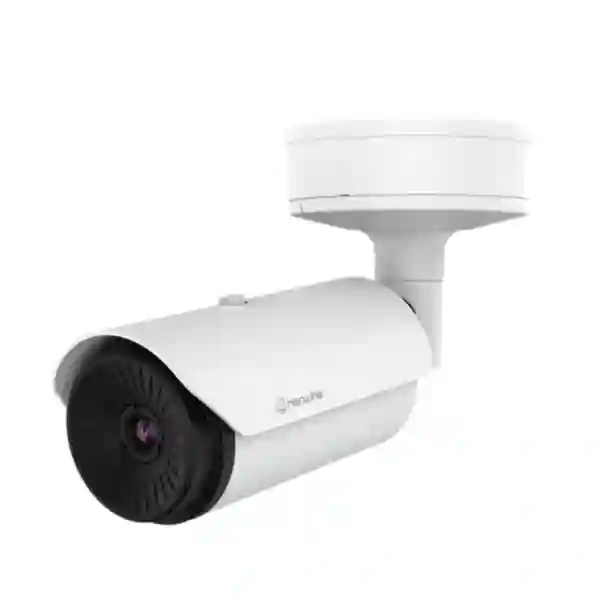
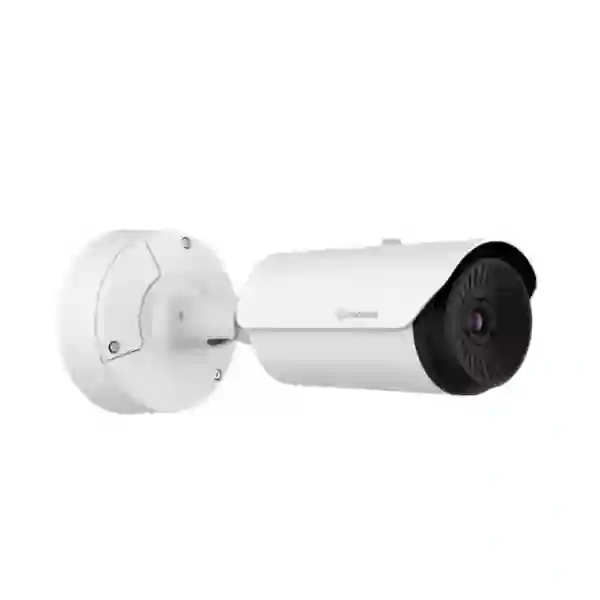
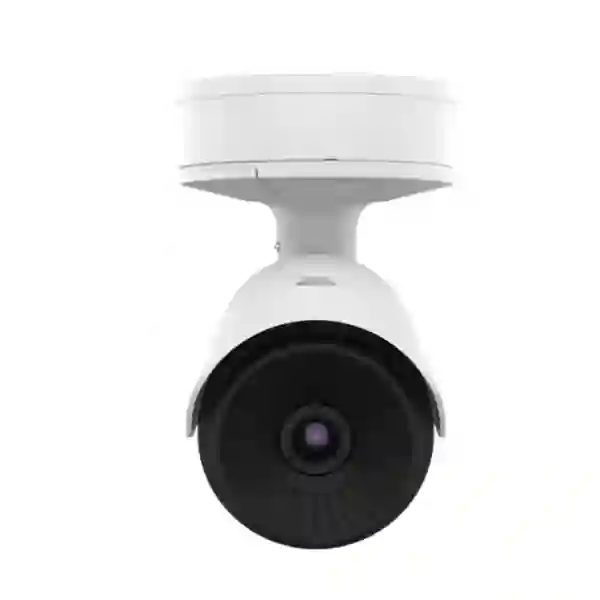
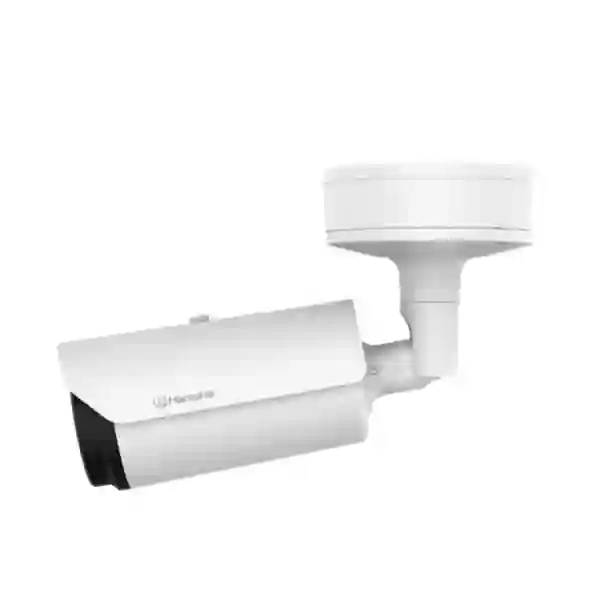
Hanwha TNO-L3030T QVGA Thermal Bullet Camera
Plan a focused thermal view for perimeter and site monitoring in Tanzania. The TNO-L3030T combines a 320 × 240 thermal sensor, 13.7 mm fixed lens and 8 fps streaming with event analytics and outdoor-rated housing. Ask for a suitability review and lifecycle confirmation before ordering.
Verified technical specifications
| Thermal detector | Uncooled microbolometer; 320 × 240 |
|---|---|
| Maximum frame rate | 8 fps, H.265/H.264/MJPEG |
| Spectral sensitivity | 8–14 µm; NETD ≤60 mK |
| Pixel pitch | 12 µm |
| Lens / aperture | 13.7 mm fixed; F1.0 |
| Angular field of view | 16° H × 12° V; 20° diagonal |
| Minimum object distance | 8 m |
| Ethernet | RJ-45, 10/100BASE-T |
| Interfaces | ONVIF S/G/T; SUNAPI; alarm input × 1, outputs × 2 |
| Storage | microSD/SDHC/SDXC, 1 slot, maximum 256 GB |
| Power | PoE 802.3af Class 3; 12 VDC; 24 VAC |
| Max power draw | 8.7 W PoE; 7.8 W DC; 9.2 W AC |
| Operating conditions | −40°C to +60°C; 0–90% RH, non-condensing |
| Protection | IP66, IK10, NEMA Type 4X |
| Size and weight | Diameter 147.51 × 375.3 mm; about 2.512 kg |
These values apply to model TNO-L3030T, not TNO-3030T. Manufacturer specifications are subject to revision. Confirm firmware and installation details for the exact supplied unit.
What the TNO-L3030T is designed to do
The Hanwha TNO-L3030T is a network-connected thermal bullet camera for observing differences in emitted heat within a scene. Rather than relying on light reflected from faces, clothing, vehicles or buildings, its uncooled microbolometer produces thermal imagery. That makes it relevant for perimeter observation where ordinary cameras may be compromised by darkness or strong backlighting. It is not a substitute for every visible-light camera: the better design often uses thermal detection for an initial event and a suitable optical camera for visual assessment.
For a Tanzania security project, the buying decision should start with the task, not a specification headline. Define what must be detected, the area to be covered, who will assess an alert and what action will follow. An industrial boundary, storage yard or restricted gate can have very different requirements even if they use the same camera. Ask for a field-of-view plan and a trial against the proposed scene before committing to a quantity.
Quick answer: when this thermal camera makes sense
Choose this camera for an appropriately designed fixed-view thermal monitoring task where day-and-night visibility is important, where supported event rules are useful and where an 8 frames-per-second stream is acceptable. The 13.7 mm fixed lens and relatively narrow 16-degree horizontal view can suit a focused approach, fence segment or defined inspection corridor. Because the lens does not offer optical zoom, installation distance and mounting direction should be established before procurement.
Do not choose it simply because a site is large or because thermal imaging sounds more advanced than conventional CCTV. A wide open yard may require multiple viewpoints; fine object detail may require a different detector resolution; and evidential identification generally needs an optical camera. Buyers should also confirm lifecycle, local availability, recording platform compatibility and required installation accessories before a purchasing decision.
Thermal detection versus visible-light identification
A thermal image illustrates apparent heat differences, not the familiar colors and textures of an ordinary photograph. People, moving equipment and other objects may stand out against a background when thermal contrast is sufficient. However, the amount of distinguishable detail depends on target size, target-background contrast, distance, focus, weather and the display or analytics settings. Thermal video should not be described as guaranteed detection in every climate or at every distance.
Think of two separate operational questions: can an operator notice a possible person or vehicle in the monitored zone, and can that operator positively identify the person or read a plate? A fixed thermal camera may help answer the first question, but it is not designed to replace a correctly specified optical camera for the second. For security incident response, plan the thermal view alongside lighting, optical coverage, appropriate recording and a clear response procedure.
Understanding the 320 × 240 thermal sensor
The camera uses an uncooled microbolometer with 320 by 240 thermal pixels. That is a QVGA thermal resolution, not a 320 by 240 conventional visible-light image with equivalent facial detail. A thermal sensor samples infrared energy from the scene, and the available pixels must be distributed across the entire field of view. The same human target occupies fewer pixels at greater distance, which changes what an operator or analytics rule can reasonably distinguish.
Resolution alone does not establish a detection range. Ask the system designer to calculate target pixel coverage at the actual placement distance and to validate the result in the intended operating environment. Important questions include the height and width of the target, the path it takes, the angle of approach and whether obstructions interrupt the view. Where the task requires small-target discrimination, a different focal length, a higher-resolution thermal sensor or more than one camera may be needed.
13.7 mm fixed lens and 16-degree horizontal view
The supplied lens has a 13.7 mm fixed focal length, an F1.0 maximum aperture ratio and a stated 16-degree horizontal, 12-degree vertical and 20-degree diagonal field of view. Hanwha specifies a minimum object distance of 8 metres. Those details matter because the camera is intended to observe a defined portion of a scene rather than digitally cover every direction from a single position. Adjusting the viewing direction can change what is covered; it cannot change the physical fixed focal length.
Before installation, mark the planned mounting point on a site drawing and sketch the thermal viewing wedge. Check whether the near end of the scene is within the minimum object distance, whether the far end provides adequate target pixels and whether a fence corner or equipment bay creates blind spots. Roof lines, hot machinery, vegetation and gates can all change the useful view. A camera aimed along a boundary performs a different role from one aimed across the same boundary.
Why the 8 fps maximum must be considered
The TNO-L3030T supports up to 8 frames per second for H.265, H.264 and MJPEG according to the exact-model manufacturer specifications. This is an important model-specific limit. Do not confuse it with the similarly named TNO-3030T, for which Hanwha lists a higher frame rate. The distinction changes expectations for rapidly moving subjects and the amount of visual motion detail shown during playback.
Eight frames per second can suit some steady perimeter observation and event assessment workflows, but fast activity should be evaluated with representative footage. A moving person or vehicle may change position significantly between successive frames, and a short event can contain relatively few recorded images. If a safety investigation or license-plate task requires smooth high-frame-rate video, this camera should not be the only capture device. Test the desired analytics and operator workflow against actual movement speeds.
Thermal sensitivity, palettes and display decisions
Hanwha specifies a thermal spectral range of 8–14 micrometres, 12-micrometre detector pixels and NETD of 60 millikelvin or less for this model. NETD describes thermal sensitivity under specified test conditions; it is not a promise that an object can be accurately identified or measured at a particular distance. Scene contrast, humidity, rain, intervening material and the chosen image processing settings can be more decisive than a single quoted sensitivity number.
The selectable palettes include white-hot, black-hot and several colored options. A palette can make a thermal difference easier for an operator to interpret, but it does not create additional sensor resolution or alter the physical detection range. Agree on a standard display palette for normal operation, document any operator-specific changes and retain sample recordings from contrasting conditions. When alerts are escalated between teams, consistent display conventions reduce confusion.
Analytics for defined areas and event workflows
The camera’s documented analytics include motion and tampering detection, virtual-area events such as loitering, intrusion, entry, exit and appearance or disappearance, virtual-line crossing and direction, and other supported events. The manufacturer also lists temperature-change, shock, audio and sound-classification capabilities. These functions offer useful building blocks, but they still require careful zone setup and operational testing. An alert rule is not automatically equivalent to a reliable real-world security outcome.
Start with a small number of meaningful zones and thresholds. Identify whether crossing a boundary, entering a restricted area or remaining near a gate is the event that matters. Test normal deliveries, authorized movement, wind-driven vegetation and other non-threat activity to understand false-alarm behavior. Assign who receives the notification, whether a video management system stores the clip and how an operator confirms the event. Regularly review event logs after changes in site operations.
Temperature change alerts are not a calibrated thermometer
Hanwha lists temperature-change detection within the camera analytics, but the exact-model material reviewed does not establish a calibrated absolute-temperature measurement range or accuracy specification for industrial process control. Therefore, this page does not market the TNO-L3030T as a precision thermographic instrument, fever-screening device or fire-detection system. A visible temperature-related alert does not prove compliance with safety instrumentation standards or provide an independently verified absolute measurement.
If a project needs quantitative measurements of bearings, transformers, electrical connections, furnaces or critical process equipment, ask separately for documented measurement accuracy, calibration workflow, emissivity considerations, supported measurement ranges and applicable certifications. A security thermal camera may provide useful context, but an industrial radiometric system or another dedicated sensor may be appropriate. For any life-safety purpose, use a separately engineered and approved detection arrangement.
Outdoor housing and practical environmental limits
The manufacturer’s declared environmental protections include IP66, IK10 and NEMA Type 4X, and its operating-temperature specification is minus 40 to plus 60 degrees Celsius with 0–90% non-condensing relative humidity. IP66 concerns ingress protection under defined testing, while IK10 concerns impact resistance; neither designation eliminates the need for correct sealing, mechanical support, lightning protection or maintenance. A robust enclosure is only one component of a durable installed camera system.
For exposed Tanzanian premises, check roof heat, rain direction, dust accumulation, salt exposure where relevant, pole vibration and the likelihood of a wet or obstructed lens window. Water entering a junction box, an unprotected connector or a poorly terminated cable can disable a nominally weather-rated camera. Specify the mount, gland, conduit route and suitable external enclosure as part of the system, then inspect the result rather than assuming the camera rating covers every accessory.
Power options and electrical planning
The camera supports IEEE 802.3af Class 3 Power over Ethernet, 12 V DC and 24 V AC. Hanwha lists maximum consumption of 8.7 watts with PoE, 7.8 watts on 12 V DC and 9.2 watts on 24 V AC. These figures support an initial electrical design, but the installed power budget must also account for switch capacity, cable route, other powered devices and the chosen backup-power architecture.
A PoE installation can simplify a camera point because data and power share a suitable network cable. It is not a reason to disregard the distance budget, switch loading or surge exposure. For a site vulnerable to interruptions, consider the operational requirement for UPS coverage at the camera network, recording server and communications equipment. A camera that remains powered while its recorder, switch or alarm gateway shuts down will not deliver the intended complete service.
Network streaming and recording format
The camera supports H.265, H.264 and MJPEG, with WiseStream II and selectable bitrate behavior described by the manufacturer. It uses a 10/100BASE-T Ethernet connection and supports multiple streaming profiles. These capabilities allow a systems integrator to consider different profiles for live viewing, recording and remote monitoring, subject to validation with the actual VMS and network design. Available bandwidth is not unlimited simply because multiple profiles can be created.
For a project quote, decide the retention period, continuous versus event recording policy, expected activity level, required picture settings and the number of simultaneous viewers. Then estimate storage and bandwidth with field-appropriate assumptions. Compression efficiency changes with scene content and configuration, so do not copy a generic storage number without testing. Remote viewing across constrained connections may benefit from separate lower-bandwidth live profiles while the local recorder retains the intended evidence quality.
Edge storage and resilience choices
The TNO-L3030T has one microSD, SDHC or SDXC memory slot with a stated maximum of 256 GB. Local storage can be useful in a properly configured recording design, including event-triggered use described by Hanwha, but its existence does not by itself establish continuous retention for a particular number of days. Card endurance, recording mode, bitrate, environmental conditions and failure handling all matter.
Decide whether the card provides primary local evidence, temporary resilience when the network is interrupted or only an event cache. Establish how recordings will be retrieved and protected, how storage faults will be reported and how the card will be replaced if necessary. For multi-camera security, a central recorder or VMS may still be the better operational source of truth. Verify supported recording and recovery behavior in the chosen firmware and software versions before deployment.
VMS, ONVIF and integration planning
Hanwha documents ONVIF Profiles S, G and T, SUNAPI and an open-platform interface for this model. Those interfaces offer integration possibilities, not a blanket guarantee that every third-party VMS or recorder supports every alarm, audio feature, profile setting or camera function. Core live video may work while proprietary analytics or metadata require additional configuration. The practical acceptance test is the exact camera firmware and the exact target software version.
Ask an integrator to demonstrate live streaming, event reception, recording playback, time synchronization, user permissions and recovery after network failure. Test whether ONVIF covers the required feature or a vendor-specific method is needed. If the organization already operates Hanwha-compatible systems, review what must change in licensing and recording capacity. Avoid buying based on a list of standards alone when site operations depend on specific event handoff behavior.
Cybersecurity and access governance
The manufacturer’s feature list includes encrypted firmware, HTTPS, secure streaming protocols, user authentication, IEEE 802.1X, IP-based access control, logs and a device certificate. These are meaningful building blocks, but security depends on configuration and maintenance. No single camera specification guarantees that a finished network will be secure. A strong design separates surveillance equipment from general office or guest traffic and limits who can administer the device.
During commissioning, replace default credentials if present, use unique authorized accounts, disable unneeded services, synchronize time with an approved source and document the firmware baseline. Restrict external exposure, preferably using an approved secure access architecture rather than publishing camera services to the internet. Establish a process for reviewing manufacturer advisories and applying validated updates. Retain a controlled administrator handover package so the system can be managed without relying on an installer’s undocumented account.
Mounting, aiming and site survey
A useful site survey records proposed camera coordinates, mounting height, orientation, cable path, access for maintenance, alarm zones, expected targets and potential obstructions. The device measures approximately 147.51 millimetres in diameter by 375.3 millimetres long and weighs about 2.512 kilograms according to Hanwha. That size and mass should be considered in the mount and supporting structure rather than treated as a small lightweight indoor unit.
The camera includes digital image stabilization with a gyro sensor, but mechanical stability remains important. A flexing pole or repeatedly vibrating arm can affect scene interpretation and long-term alignment. Check that technicians can safely reach the location, that the view is not routinely blocked by parked equipment and that no wall or roof absorbs most of the viewing angle. Verify the installation preview method and any accessory requirements from the applicable Hanwha guide.
Tanzania project conditions to review
For installations in Tanzania, assess the actual location rather than assuming uniform conditions across the country. A coastal yard can raise questions about corrosion and moisture; a dusty industrial boundary raises cleaning and enclosure questions; and an exposed open site raises lightning and power-continuity questions. These are engineering considerations, not assertions that this camera is certified for a particular Tanzanian installation or that FourTeck provides nationwide installation services.
Local project planning should also check the available electrical supply, reliability of the site’s internet or private network, preferred recording location, privacy procedures and maintenance access. Ask the supplier to specify any additional surge devices, outdoor-rated cable, poles, cabinets, UPS equipment or network equipment required. Verify any applicable local procurement or import requirement independently for the actual transaction. No local price, stock, approval or delivery commitment is implied by this product description.
A practical perimeter-security scenario
Consider a secured facility with a fence and a controlled service gate. The objective may be to detect an object approaching a restricted line after normal hours. The thermal camera can be positioned to observe the defined approach zone, while visible-light cameras cover the gate for familiar scene details and identification. A virtual-line rule can be evaluated as a candidate trigger, with the security operator using the associated views to decide what happened.
The designer should then walk typical routes through the scene in representative conditions. Check whether the thermal target remains sufficiently distinct, whether the rule fires at the expected boundary and whether normal activity creates nuisance alerts. Include authorized staff, vehicles and deliveries in testing so that the alarm procedure reflects actual site operations. The useful outcome is not merely a camera image; it is an assessed event with a documented response.
Storage yards and loading areas
Open yards often present a combination of moving vehicles, stacked materials, variable lighting and changing backgrounds. The TNO-L3030T may be suitable for monitoring a focused thermal corridor or vulnerable edge, but it should not be assumed to identify goods, read labels or replace yard-operation video. A truck parked in front of the monitored zone can conceal activity, while a changed container layout can introduce an unexpected blind spot.
Mark the areas requiring detection independently of the areas requiring evidential identification. Where the layout changes, nominate a site owner to approve new camera aiming and analytics zones. Consider whether vehicle motion at the chosen distance is compatible with the 8 fps feed. Keep a reference image and zone map in the maintenance file so a later contractor can understand what the original design was expected to accomplish.
Industrial boundaries and equipment areas
Facilities with hot process equipment or exposed metal surfaces can produce complex thermal scenes. Temperature contrasts may change as equipment starts, stops or heats under the sun. A camera aimed near machinery may see both legitimate process changes and moving targets. This is a good reason to agree on the security use case and reject overambitious alarm promises. Test the camera in the presence of normal operations rather than only during a quiet demonstration.
Where staff need alerts about people approaching hazardous boundaries, treat the camera as one security or situational-awareness input within a broader safety plan. Do not claim that a general-purpose thermal security analytics event is a certified protective interlock. Define which alarm destinations must receive events, who has authority to act and what evidence must be stored. For condition monitoring of equipment temperatures, procure dedicated measurement capabilities when quantitative accuracy is required.
What thermal cameras cannot see
Thermal imaging does not see through solid walls, dense obstructions or ordinary window glass as if those materials were transparent. A surface can block or modify infrared energy and may reflect surrounding heat in ways that surprise operators. Rain, fog, dust, high humidity and small temperature differences can also affect scene quality. Outdoor performance therefore needs realistic qualification, even though thermal technology can operate without ordinary visible illumination.
Ask a provider to show an example from a comparable environment and, for important coverage, conduct an on-site proof of concept. Look for false confidence caused by a visually dramatic palette, poor target separation or an idealized sample clip. The correct metric is whether a defined event can be reliably detected and assessed in the conditions that matter to your operations, not whether the thermal image looks impressive on a display.
Comparison: TNO-L3030T and TNO-3030T
The model names are close, but they must not be merged. Hanwha lists the TNO-L3030T with a maximum frame rate of 8 fps. The distinct TNO-3030T is documented at up to 30 fps or 25 fps depending on video frequency. Both have published 320 by 240 sensor resolution and 13.7 mm focal length, but a matching lens description does not erase frame-rate and lifecycle differences. Always write the complete model code on the quotation, drawing and acceptance sheet.
For a buyer, this means selecting an alternative requires more than comparing a price. Review frame rate, supported firmware, scene geometry, recording expectations, supply status and migration implications. A higher frame-rate model may be preferable for motion assessment, yet that alone does not guarantee better target recognition. A suitable thermal-camera choice is based on performance for the proposed monitoring area, the supported software ecosystem and the project’s long-term service requirements.
Product lifecycle and availability confirmation
Some independent distributor listings checked in November 2026 describe the TNO-L3030T as discontinued or end-of-life. The manufacturer support portal still provides technical documentation, but that fact by itself does not confirm ongoing sales, production, regional supply or future support dates. Accordingly, request written confirmation of the exact model’s current orderability and lifecycle before placing a new project order. This is especially important when replacement cameras might need to match an existing installation.
Where the model is no longer orderable, ask for a manufacturer-supported replacement comparison instead of assuming a superficially similar part is a drop-in substitute. Compare viewing angle, thermal resolution, max frame rate, mount, power, alarm integration, firmware, recording platform compatibility and cost implications. For existing devices, obtain support and maintenance guidance appropriate to the actual serial numbers and deployment. Neither price nor stock is represented as verified here.
Commissioning and operational acceptance
A good commissioning test proves that the camera does what the project requires at the actual installed position. Begin with network address, time settings, stream configuration, recording target and user permissions. Confirm physical pointing, image clarity, mechanical security and the agreed zone map. Test at least one approved alarm path from camera to monitoring operator and one playback or export path from recorded event to reviewer.
Then test representative normal and abnormal events without creating unsafe situations. Measure false alarms over an agreed observation period and adjust rules with traceable change records. Review a sample clip at the selected 8 fps maximum to ensure that decision makers understand its playback characteristics. Document final firmware, camera configuration backup method, storage card policy, power path and a list of outstanding site limitations before the acceptance sign-off.
Maintenance and long-term reliability
Schedule periodic inspection of the visible housing, thermal window, mount and cable terminations. Clean only using methods approved for the camera’s optical window and enclosure; an unsuitable cleaner or abrasive procedure can damage surfaces. Review camera clock accuracy, available recording capacity, firmware updates and whether the live stream remains reachable from the authorized monitoring system. Test a known alarm path instead of treating absence of alarms as evidence that everything is functioning.
Site layouts change. New fencing, stacked goods, construction, trees or lighting structures can alter the thermal corridor or obstruct the view. Record approved configuration changes and re-check each analytics zone after physical work near the camera. If the device is at or near the end of its sales lifecycle, keep a documented replacement plan and confirm spare-parts and support options rather than assuming that an identical unit will always be available.
Privacy and responsible surveillance
Thermal imaging may show fewer familiar facial details than an optical camera, but it can still collect information about people and their movements. Decide who may view recordings, how long data will be retained, how incidents may be exported and when access logs should be audited. These are governance questions for the actual operating organization and its legal advisers. The presence of privacy-mask settings does not remove the need for a defensible surveillance policy.
Use relevant privacy zones, least-privilege accounts and a documented retention schedule. Avoid pointing cameras beyond the operational area without a clear reason and review whether staff, visitors or contractors require notice under applicable rules. When designing a combined thermal and optical system, coordinate both data streams within the same security and privacy plan. Do not infer Tanzanian legal compliance or a specific statutory approval merely from device marketing descriptions.
How to compare quotations fairly
A credible quote should clearly identify the exact TNO-L3030T model, quantity, lifecycle status, applicable support position and each required accessory. Separate camera cost from mounting hardware, cabling, power supplies, networking, storage, commissioning, training and ongoing maintenance. An apparently lower equipment price can hide expenses if the intended camera location has a difficult cable run or requires a new recording server.
Ask the vendor for a simple coverage drawing, assumptions about the target and distance, example video or demonstration plan, relevant VMS compatibility result and a list of exclusions. If an alternative camera is proposed, require a side-by-side statement of differences rather than an unqualified ‘equivalent’ label. Obtain terms for local delivery and warranty in the actual quotation; no terms, prices or availability are asserted on this general information page.
A buyer-led decision checklist
Before requesting a quote, specify the security outcome in plain language: detect a person near a gate, observe a vehicle approach, watch a restricted boundary or provide thermal situational awareness. Record approximate mounting location and scene dimensions, desired recording duration, existing cameras and recorder, power and network availability, viewing responsibility, and whether there are seasonal or weather-related concerns. These facts are more helpful than a request for a certain number of megapixels.
Then ask for written responses on viewing geometry, target-pixel adequacy, integration and alert handling, lifecycle and support, installation materials, commissioning tests and ownership of future maintenance. If the proposed project needs precise thermal measurements, high-frame-rate evidence, face recognition or plate reading, state those requirements explicitly so the supplier can recommend complementary or different equipment. The product should be specified for an outcome it can credibly deliver.
Frequently asked questions
Can it work in complete darkness?
Yes, the thermal detector does not rely on visible scene illumination. Useful contrast still depends on the target and surrounding materials. Conditions such as weather, obstructions and background temperature can affect what appears in the picture. Consider an optical camera as well when incident identification is needed.
Is this a 30 fps thermal camera?
No. The exact TNO-L3030T has an official maximum of 8 fps across the listed compression modes. Hanwha’s separately named TNO-3030T is different. Confirm the full code rather than relying on a shortened model name in a quote or product photograph.
Can it identify faces or read number plates?
Do not assume so. This is a thermal security camera with 320 × 240 detector resolution, not a specialist facial-identification or plate-recognition unit. Use a suitably designed visible-light camera when evidential detail or vehicle identification is a stated requirement.
Does temperature-change detection measure an exact temperature?
Not necessarily. The reviewed exact-model specifications describe temperature-change analytics but do not establish a calibrated absolute measurement accuracy for industrial thermography. Request a dedicated radiometric specification if the project involves quantitative measurement, equipment diagnostics or life-safety monitoring.
What lens is fitted?
Hanwha specifies a fixed 13.7 mm lens with a 16-degree horizontal field of view, 12-degree vertical field and minimum object distance of 8 metres. The right fit depends on mounting position and target size. A physical site plan is more reliable than assuming one unit covers an entire compound.
Which power supply can be used?
The published options are IEEE 802.3af Class 3 PoE, 12 V DC and 24 V AC. Design a compatible supply and account for network switch load, cable distance, protection and power backup. Do not connect an unspecified supply without checking the applicable installation guide.
Is the camera suitable for outdoor use?
The enclosure carries stated IP66, IK10 and NEMA Type 4X environmental ratings. These ratings support a robust outdoor design but do not replace suitable connectors, cabling, drainage, mounting or periodic inspection. Assess the actual climate exposure and installation details.
How much memory card storage is supported?
Hanwha lists a single microSD, SDHC or SDXC slot supporting up to 256 GB. Actual retention time depends on codec, bitrate, frame rate, scene complexity and recording mode. Choose an appropriate card and decide how local recordings relate to central recording or backups.
Will it connect to an existing VMS?
The camera advertises ONVIF Profiles S, G and T as well as Hanwha interfaces. Basic stream support does not guarantee all analytics, audio and alarm features work in every third-party software version. Confirm compatibility with the specific platform and camera firmware during a practical test.
Can it replace every other perimeter camera?
Usually that is not a safe assumption. It may provide useful thermal detection on a defined approach, but optical cameras can be important for visual assessment and identification. Several viewpoints may be necessary to avoid blind spots, and the required coverage should be established by survey.
Does it provide guaranteed detection distance?
No universal distance guarantee is stated here. Detection depends on target dimensions, thermal contrast, lens geometry, weather, mounting angle and the desired classification task. Request an application-specific calculation and validation with representative targets rather than using an unsupported distance claim.
Is TNO-L3030T still available to buy?
Current Tanzania stock and orderability have not been verified. Some independent distributor catalogues mark this exact model as discontinued, while technical documentation remains available from Hanwha. Ask for written confirmation of current lifecycle, procurement options and a suitable successor before ordering.
Does IP66 mean it can be installed without protection?
No. The enclosure has a published ingress-protection rating, but real-world reliability also depends on cable terminations, surge management, the mounting structure, seals and proper maintenance. An engineer should assess the complete installation, particularly if the site is exposed to heavy rain, dust or lightning.
What information should I send for a quotation?
Provide the site use case, camera quantity, approximate mounting height, viewing distance, scene dimensions, existing recorder model, power and network conditions, recording period and monitoring workflow. State whether a demonstration or replacement option is acceptable. The quote should explicitly confirm orderability and support for the exact model.
Request a suitability and availability quotation
Share your intended thermal monitoring area, camera mounting distance, existing CCTV platform and operational requirements with FourTeck Tanzania. Request written confirmation that the exact TNO-L3030T can be supplied and supported; if not, ask for a technically assessed manufacturer-supported alternative. Include required integration, mounting, power, recording and commissioning work in the same scope. No price, stock or local delivery commitment is made on this page.




Reviews
There are no reviews yet.