
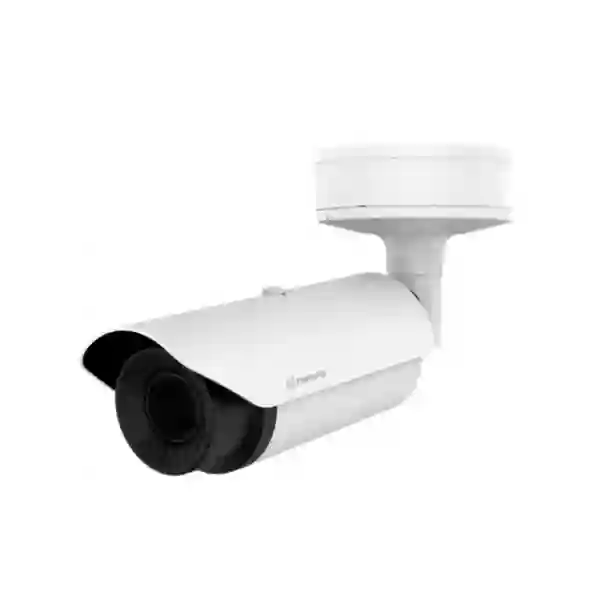
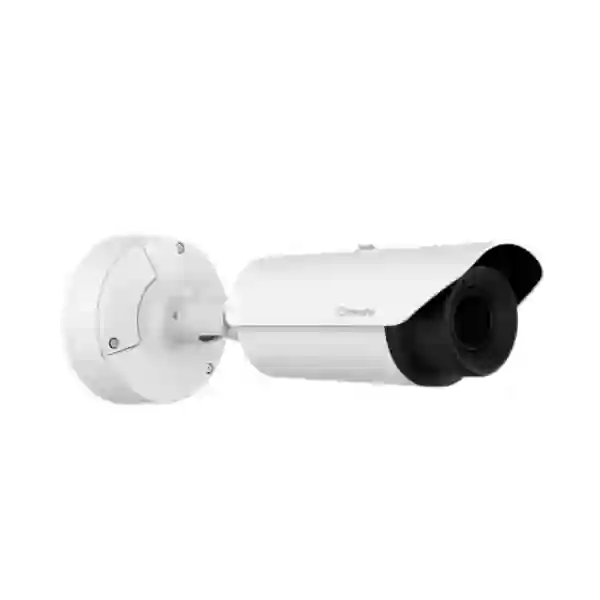
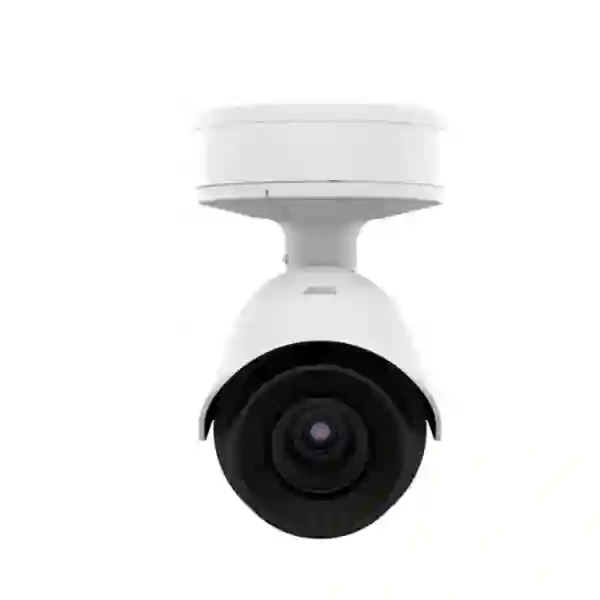
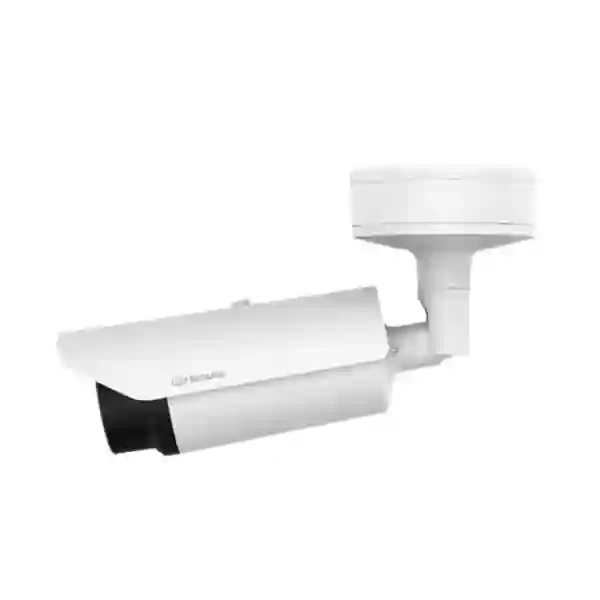
Hanwha TNO-L4040T Thermal Bullet Camera
The Hanwha TNO-L4040T thermal camera is a 640 × 480 outdoor IP model with an 8 fps maximum stream, a fixed 19 mm lens and a 32° horizontal view. It is intended for heat-contrast detection and perimeter monitoring, with configurable analytics, ONVIF connectivity and several power options.
Planning a system in Tanzania? Start with the target distance, required alerts, recorder compatibility and ongoing support. A Hanwha Vision regional listing marks this model discontinued; request confirmation of exact-model sourcing and current alternatives before ordering.
At a glance: is it a fit?
Consider this camera for
Defined perimeter sectors, darkness-resistant thermal scene awareness, and integration with a compatible IP recording and alert workflow.
Specify another view as well when
The project needs facial recognition, colour evidence, readable number plates or detailed footage of rapid motion.
Check before buying
8 fps acceptance, fixed 19 mm lens coverage, discontinued-model status, firmware support, correct alarm rules, and local project costs.
Verified technical specifications
| Type | Outdoor network thermal bullet; uncooled microbolometer |
|---|---|
| Imaging resolution | 640 × 480; additional 640 × 360 and 320 × 240 modes |
| Frame rate | Maximum 8 fps |
| Lens / aperture | 19 mm fixed focal; F1.0 |
| Angular field of view | 32° horizontal; 24.3° vertical; 39.2° diagonal |
| Minimum object distance | 11 m (manufacturer specification) |
| Thermal spectral range | 8–14 µm |
| Thermal sensitivity | NETD at or below 50 mK |
| Video coding | H.265, H.264 and MJPEG; WiseStream II |
| Video analytics | Motion, virtual line/area, tampering, directional and other events |
| Recording storage | One microSD/SDHC/SDXC slot, maximum 256 GB |
| Interoperability | ONVIF Profiles S, G and T; SUNAPI |
| Power options | IEEE 802.3af Class 3 PoE; 12 V DC; 24 V AC |
| Protection | IP66, IK10, NEMA 4X |
| Operating ambient | −40°C to +60°C; non-condensing humidity limitations |
| Dimensions / mass | Approximately Ø102 × 402 mm; 3.124 kg |
Figures reflect the exact TNO-L4040T product information, not a similarly named 30 fps or radiometric variant. Confirm the applicable hardware revision and configuration during procurement.
What this thermal bullet camera solves
A conventional security camera needs enough usable light and scene contrast to show objects clearly. Outdoor yards, compound boundaries and exposed industrial spaces may have dark sections, intense backlighting or variable illumination that make conventional video difficult to interpret. The Hanwha TNO-L4040T thermal camera observes differences in emitted infrared energy rather than relying on ordinary visible light. It can therefore add an independent detection view to a security design, especially when the operator needs to notice a person or moving object against a darker or differently heated background. Its purpose is to improve situational awareness, not to replace every visual camera on a site.
For a prospective buyer in Tanzania, the central question is whether the camera can cover the intended approach path at a practical mounting angle and help an operator make the right decision. A successful solution begins with the boundary, typical movement direction, required alarm response, distance to the target and existing recording equipment. The thermal image should be assessed alongside any necessary colour overview, face-identification or vehicle-identification cameras. If the main requirement is a clear visual record of faces, uniforms, number plates or colours, another imaging technology will still be needed. Ask for a site-led specification instead of selecting only by sensor resolution.
Exact model identity and buying status
The model suffix matters. TNO-L4040T is the 8 frames-per-second version with a 19 mm fixed thermal lens. The similarly named TNO-4040T is a different model specified by its manufacturer at substantially higher frame rates; it should not be substituted in a proposal without noting that distinction. Likewise, model variants with an additional R in the suffix are associated with radiometric capabilities that must not be assumed for this unit. Always quote the complete manufacturer’s part number and have the supplier confirm the label, hardware revision and applicable documentation before a purchase decision.
Hanwha Vision’s regional product information lists TNO-L4040T as discontinued. That is a manufacturer lifecycle indicator, not proof that a specific unit is or is not physically available from a seller in Tanzania. Buyers should seek written confirmation of the exact equipment offered, whether it is new or previously used, what support remains available, and whether software updates and replacement parts are obtainable. Existing owners may still have a valid integration or expansion requirement. For new projects, evaluating a current alternative at the same time helps avoid designing a long-lived security installation around an uncertain supply chain.
How uncooled thermal imaging works
At the centre of the camera is an uncooled microbolometer operating in the long-wave infrared range of approximately 8 to 14 micrometres. Its sensing array responds to thermal differences in the scene and builds a video image from that contrast. Unlike an ordinary colour camera, this does not produce a faithful picture of the visible colours of a surface. A person, vehicle or other warm object can appear noticeably different from its surroundings, but the appearance changes with weather, object temperature, surface material, distance and background conditions. The result is valuable for detection while remaining different from a photographic view.
Thermal performance should be tested in realistic operating conditions. Sun-heated roofs, dark surfaces, machinery, wet pavement and vegetation can alter apparent temperature patterns during a day. A target may blend into its surroundings when their thermal contrast is small, and some obstructions still block the line of sight. A thermal camera does not see through a solid wall or guarantee detection through any amount of smoke, rain or mist. Buyers should define what must be noticed, when it must be noticed and the acceptable missed-event and nuisance-alarm rates. This makes the trial meaningful rather than relying on an ideal demonstration image.
What 640 × 480 resolution means
The thermal sensor’s native imaging resolution is 640 by 480 pixels. The camera also lists stream sizes of 640 by 360 and 320 by 240. These choices allow a designer to balance detail, bandwidth and the needs of a recording or monitoring system. Pixel count, however, is only one element of useful detection. How many pixels a person occupies at the furthest point, whether movement crosses the scene, environmental contrast and image-processing settings all affect the result. A large subject close to the camera may be easy to distinguish while a small distant subject may be represented by only a few pixels.
Do not interpret the resolution as a promise of a particular identification distance. The correct question is whether a person-sized or vehicle-sized target can be consistently discovered at each critical zone. At the design stage, map the near and far boundary, place a target at representative points and evaluate both live display and recorded evidence. Review small targets on the operator’s actual monitor rather than a magnified sales graphic. If the brief asks for reading markings or identifying faces, specify a complementary visible-light camera and define its own optical requirements separately. Thermal detection and forensic identification are distinct outcomes.
The 19 mm fixed lens and viewing angle
The built-in 19 mm focal-length lens has a horizontal angle of view of about 32 degrees, a vertical angle of 24.3 degrees and a diagonal angle of 39.2 degrees. Its fixed-focus design makes lens selection part of the initial product decision. A relatively narrow sector can help concentrate pixels on a distant approach compared with a wide panoramic view, but it cannot cover every gate, wall and corner from one position. The manufacturer’s minimum object distance is approximately 11 metres; near-field coverage should therefore be handled explicitly in any layout. A larger sensor does not remove the practical limits imposed by lens geometry.
Draw the intended field of view over a plan or representative photograph before installation. Mark the areas hidden by buildings, stacked goods, trees, poles, fencing and turns in a wall. Check whether the chosen mounting height leaves an undesired blind spot immediately beneath the camera. A fixed-lens thermal unit also needs careful orientation: a small angular change can shift the effective coverage a long distance at the far end. Where the site needs both a wide overview and narrow long-range observation, consider separate cameras or a coordinated PTZ solution. The aim is predictable detection coverage, not an impressive-looking camera count.
Why the 8 fps specification matters
The maximum published video rate is 8 frames per second for the TNO-L4040T. That figure is a key constraint and must remain visible in any specification or quotation. Eight frames per second may be adequate for certain slowly developing perimeter events, but rapid motion, closely spaced objects and detailed movement analysis can be harder to interpret than on a higher-frame-rate device. Video smoothness is different from thermal sensitivity or resolution. Changing from H.265 to H.264 does not turn this exact model into a 30 fps unit, and a recorder cannot create genuine additional source frames.
When assessing an 8 fps camera, test the movement pattern the installation actually needs to follow. Someone crossing a monitored line slowly poses a different challenge from a speeding vehicle or a subject moving close to the lens. Check how alarms are generated, how long each event lasts and whether recorded clips contain sufficient frames for an operator to understand the sequence. Pairing thermal analytics with a separately specified faster visible camera may offer a better combined result. If smooth tracking or detailed fast-action evidence is a primary acceptance criterion, a higher-frame-rate thermal model should be considered instead.
Detection, recognition and identification are different
A thermal image can suggest that a warm object is present, but presence detection does not automatically mean an operator can recognise its activity or identify an individual. Detection asks whether an object is there. Recognition asks whether it can be classified sufficiently for a given purpose. Identification asks who or precisely what it is, often requiring a much more detailed visible-light view. These stages should not be presented as interchangeable. The thermal sensor and narrow lens may assist perimeter alerting, yet the usable range for any particular target cannot be guaranteed from model specifications alone.
In a security requirement, define each zone with a measurable task. For example, the outside boundary may need an alert when someone crosses a selected line, while the gate needs a separate view that can capture a person’s appearance. A loading area may require evidence of vehicle direction rather than an individual’s identity. Write these outcomes into the design and make the acceptance test reproduce them under representative conditions. This approach prevents misunderstandings between a supplier’s phrase such as long-range detection and a customer’s expectation of courtroom-quality image detail. The two objectives frequently need different camera positions or camera types.
Video analytics and alarm rules
Hanwha Vision specifies analytics that include motion detection, directional detection, virtual-line crossing, virtual-area entry and exit, loitering, tampering, audio-related events, sound classification, shock detection and temperature-change detection. Which event types are practical will depend on configuration, scene conditions and the monitoring platform. A well-placed virtual line can convert a broad camera view into a purposeful perimeter alert. Zone geometry and direction rules should reflect actual access routes rather than simply marking the entire frame. The camera can produce alarm events, but an event is not proof of a security incident.
Configure analytics to reduce nuisance alerts while preserving important detections. Vegetation, animals, changing temperature patterns, distant machinery and other moving scene elements deserve attention during tuning. Review both day and night performance, then test after significant weather changes. An alarm should have a clear destination: an operator screen, authorised monitoring platform, event log or connected response workflow. Define notification priority, acknowledgement, escalation and retention. If staff cannot act on an alert, the analytics feature may add noise rather than value. Regularly review false positives and missed targets and document adjustments to rules or boundaries.
Temperature change is not calibrated thermometry
The TNO-L4040T can analyse changes in thermal imagery, and the product information mentions temperature-change detection among its analytics. That does not establish calibrated numerical temperature measurement, radiometric accuracy or an industrial process-monitoring function. It should not be sold as a temperature-measuring camera for equipment condition monitoring simply because its picture is thermal. Models described as radiometric are a separate category, and their ranges, accuracy, alarm areas and applicable use cases need independent verification. This distinction matters when an organisation is evaluating early warning around heat-producing equipment.
If the requirement concerns an overheating motor, electrical panel, kiln or industrial process, ask for the exact temperature range, measurement accuracy, emissivity handling and alarm methodology required. Confirm whether the application needs calibrated readings or only a visual indication of an unusual warm object. Similarly, thermal scene awareness is not a substitute for a certified fire-detection or life-safety system. A correct product recommendation may therefore be this thermal security camera, a radiometric thermal instrument, a certified detection system or a combination. The buyer should specify the required outcome before choosing hardware based on the word temperature.
PTZ handover and operator workflow
The manufacturer’s feature list includes PTZ handover, which can support a coordinated arrangement where an alert from a fixed thermal view prompts a compatible pan-tilt-zoom camera to look toward a relevant area. This can combine broad, persistent detection with a closer or more recognisable visible image, subject to the actual equipment and system configuration. It does not mean that the thermal unit itself mechanically pans or zooms. The TNO-L4040T uses a fixed 19 mm lens. PTZ presets, integration interfaces, camera locations and the selected recording software determine how useful any handover will be.
A good handover design aligns the fixed thermal zone with the PTZ camera’s real view. Check that poles, walls or vegetation do not block one device while leaving the other unobstructed. Test the time between an alarm and the PTZ’s arrival at its preset, along with the operator’s ability to override the automation. If multiple alarms are generated at once, set a sensible priority so a single PTZ is not constantly redirected. Where facial evidence is required, confirm adequate lighting and optical magnification on the companion camera. The final configuration must be demonstrated rather than assumed from an advertised feature name.
Network video formats and bandwidth planning
The camera supports H.265, H.264 and MJPEG video compression, plus Hanwha Vision’s WiseStream II technology. These options help fit its streams into different surveillance platforms. H.265 may improve storage efficiency when supported by the receiving recorder, but compatibility with older software or operator workstations must be confirmed. The published configuration includes multiple streams and profiles, so designers can separate a full-quality recording stream from a lower-bandwidth monitoring stream where the equipment permits. This flexibility is useful, but it does not change the sensor’s maximum 8 fps output.
Bandwidth estimates should come from the intended codec, frame rate, selected image size, bitrate mode, scene activity and recording policy. A fixed number quoted without those conditions can be misleading. Run a controlled test with the expected image complexity and monitor actual traffic over time. Allow for alert bursts, remote viewing and other cameras sharing the switch and uplink. In Tanzania, remote monitoring locations may have uneven connectivity, so confirm upload capacity and the reliability of the route to the operations centre. Local recording and alarm behaviour during disconnection are just as important as normal network throughput.
Recorder and software compatibility
The manufacturer lists ONVIF Profiles S, G and T, RTSP-related network support, SUNAPI and an open platform interface. These are useful indicators when evaluating recording and video-management systems, but they do not guarantee that every manufacturer’s recorder exposes every analytics event, playback function or device setting. A basic stream may work while advanced triggers remain unavailable. Integration should be checked against the exact NVR or VMS version, camera firmware, licensed channels and selected storage policy. ONVIF support is a starting point for testing rather than the end of a compatibility review.
Before purchase, ask the integrator to demonstrate adding the device to the target management platform. Confirm the live view, codec selection, authentication, alarm event ingestion, synchronised time, recording, export and recovery after network interruption. Where PTZ handover is intended, test that workflow end to end. If the camera will be accessed by multiple operators, verify permissions and any stream limits at the intended scale. Documentation should include the installed firmware version and configuration backup arrangements. A practical acceptance test avoids the common problem of a technically reachable camera whose most valuable functions are not usable by the security team.
Edge storage and evidence retention
A single microSD, microSDHC or microSDXC slot supports cards with capacities up to 256 GB. Edge storage can provide local recording capability and may offer a useful buffer for some network disruptions when configured accordingly. It should not be mistaken for an automatically redundant archive or a guarantee that all events will be retained. Available duration depends on codec, bitrate, schedule, resolution, the frequency of alarms and whether recording is continuous or event-based. Storage media also experiences write wear, especially in systems operating throughout the day and night.
Build a retention policy around operational and legal needs rather than simply selecting the largest compatible card. Decide which footage must be held centrally, who may export it and how long it should remain accessible. Confirm time synchronisation, event metadata and the recovery process after card or recorder failure. Where evidential continuity matters, use a tested central recording architecture and document backup procedures. Schedule inspection of edge-storage health and perform a sample export before commissioning. For an existing installation being extended, ensure the new camera’s 8 fps recording style is acceptable alongside footage from the rest of the system.
Power choices, PoE and electrical design
The published power options are IEEE 802.3af Class 3 PoE, 12 V DC and 24 V AC. Manufacturer information specifies a maximum draw of approximately 10 W over PoE, with different maxima for the two separate supply methods. Confirm the actual supply arrangement for the proposed unit; these are options, not an instruction to connect multiple sources indiscriminately. A PoE switch needs sufficient per-port and total power budget for all connected devices. The cabling route, connector protection, surge design and outdoor enclosure requirements should be defined before equipment is mounted.
For a Tanzanian facility, power continuity should be considered as part of the entire surveillance path. Keeping the camera energised is not enough if the PoE switch, recorder, network link or operator display also stops during an interruption. Evaluate a suitable UPS or other engineered backup approach for critical components and confirm how long the security function must continue. Outdoor cables may need lightning and surge precautions suited to the site. Have qualified personnel assess earthing, equipment protection and the applicable installation rules. No claim about local regulatory approval or grid compatibility is made for a particular installation without separate verification.
Outdoor enclosure and mechanical planning
The TNO-L4040T carries IP66 ingress-protection and IK10 impact-resistance ratings, and the manufacturer also lists NEMA 4X. These are meaningful enclosure characteristics for exposed installations, but they do not remove the need for correct cable entry, mounting hardware and weather-resistant connections. The published operating ambient range is approximately minus 40°C to plus 60°C, with non-condensing humidity constraints. Real site conditions may also involve strong sun, salt-laden air, airborne dust, cleaning chemicals or deliberate interference. Mounting decisions should take the environment and maintenance access into account.
The camera’s body is roughly 102 mm in diameter and 402 mm long, with a weight of about 3.1 kg. That size affects the choice of a stable bracket, pole or wall mount and the clearance needed for adjustment. Confirm the manufacturer’s mounting instructions and approved accessories for the actual mounting surface. A poorly supported pole can vibrate and degrade video despite the camera’s gyro-assisted digital stabilisation. Avoid positioning the lens behind an ordinary glass window, as common glass does not transmit the relevant long-wave thermal scene in the same way as specialised thermal optics. Preserve a clear unobstructed view and safe service access.
Thermal viewing through different conditions
A major advantage of thermal security video is that it can remain useful in darkness without relying on a visible-light floodlamp. It can also offer contrast in some backlit or visually confusing scenes. These capabilities are valuable where a facility wants to avoid adding illumination to every perimeter section. Nevertheless, actual range and contrast remain affected by rainfall intensity, fog, humidity, hot backgrounds, reflections and physical occlusion. Marketing statements about seeing in any condition should not be interpreted as a guarantee. The operator needs representative examples from the intended environment.
Plan testing at different times rather than accepting a single daytime demonstration. Observe how the scene changes after prolonged sunshine, in heavy cloud, after rainfall and at night. Check whether the target crosses areas with similar apparent temperature, and review how the analytics react to local animals or moving equipment. Clean and inspect the housing according to manufacturer guidance; a dirty or obstructed front element can make any sophisticated sensor ineffective. If the scene includes crucial colour-coded signs, vehicle markings or faces, supplement thermal video with visible-spectrum cameras. A balanced surveillance design uses each sensor for the task it performs best.
Tanzania deployment scenario: industrial perimeter
An industrial site with warehouses, fenced boundaries and service roads may need alerts from long stretches that are not consistently illuminated. A fixed thermal bullet camera can be evaluated for watching selected approach sectors and feeding events to a monitoring platform. The benefit is early awareness of movement along a defined boundary. Before installing, review the site plan for warm machinery, loading equipment, exhaust outlets and other sources of thermal variation that may interfere with the image or alerts. Define the required target size and expected crossing direction at the far end of the protected sector.
The thermal unit can be paired with a conventional overview camera and, where justified, a zoom camera aimed at access points. Operators can then use the thermal view to notice an event and the other views to understand what happened. Such a design should be tailored to actual risk rather than advertised as universally suitable for factories or warehouses. Existing poles and fibre or Ethernet routes may limit placement, and a narrow field of view can leave blind spots near the camera. Confirm physical security, backup power, recording integration and staff procedures as part of the same survey.
Tanzania deployment scenario: yard and compound monitoring
Large storage yards and commercial compounds often contain open spaces, vehicle routes and shadowed corners. A fixed 32-degree horizontal view can be useful for a chosen corridor of observation, especially where the task is detecting movement across an approach rather than surveying the whole site at once. Thermal contrast can make subjects more noticeable without requiring the same lighting conditions as visible colour video. However, stacked materials, parked trucks and site renovations may change the view over time. Coverage must be designed for the normal operating layout and reviewed when obstacles are moved.
Use the camera as one layer within a documented security process. Set meaningful line-crossing or area rules, confirm that alerts reach the person responsible for response and record enough context to review each event. Where a yard is shared by staff, drivers and contractors, expected access should be reflected in the operating schedule and alarm rules. A thermal alert alone should not automatically identify someone as an intruder. If the project needs gate transaction records, person identification or number plate recognition, assign those requirements to appropriate complementary cameras and access-control systems.
Tanzania deployment scenario: remote or exposed locations
Remote infrastructure sites can face limited on-site staffing and variable power or communication conditions. A thermal view may support an operator who needs to know whether there is movement in a selected area after dark. Before choosing the TNO-L4040T, investigate whether a reliable IP connection, monitored recording path and stable power budget can be provided. The camera has network interfaces and a local storage option, but neither feature alone solves intermittent connectivity. Remote equipment also needs a practical physical-maintenance plan and secure access to configuration controls.
Document how the system behaves during a communication outage. Determine whether footage is stored locally, how it can later be retrieved and what happens to notifications that cannot reach the operations centre immediately. Protect switches and power equipment from the site environment, and ensure the chosen mounting arrangement can be accessed safely for cleaning or replacement. Evaluate the business cost of a missed alert against the value of redundant communications or additional sensing. Rather than promising that this camera will cover any remote site, request an engineering review of the exact location and deployment conditions.
Cybersecurity and access control
The camera’s manufacturer specifications include HTTPS, secure transport options, network authentication features and event or access logging. These capabilities are useful in a managed IP surveillance system, but security depends heavily on how the device is configured. Default credentials, unrestricted internet exposure, old firmware and shared administrator accounts can undermine an otherwise capable camera. Assign unique credentials, limit administrative access to authorised personnel and place surveillance equipment on appropriately controlled network segments. Use encrypted management paths when supported by the deployed platform.
The product’s lifecycle status makes a support review especially important. Before putting a discontinued model on a critical network, verify what firmware remains available for the exact variant and assess the organisation’s vulnerability management requirements. Record the baseline software version, preserve authorised configuration backups and test restoration. Keep operator permissions separate from installer privileges and review logs after significant configuration changes. Avoid publicly exposing camera streams or embedding credentials in shared documentation. An integrator should be able to explain both the normal monitoring workflow and how security updates, account changes and device replacement will be handled over the life of the project.
Survey questions before specifying the camera
A site survey should start with a short statement of the security event the customer needs to detect. Record the distance to the nearest and farthest relevant target, scene width, expected subject size, height and direction of movement. Note walls, trees, reflective surfaces, machinery, lighting conditions and seasonal changes that may affect thermal contrast. Ask whether the alarm needs to detect a human-sized target, a vehicle, an object left behind or another event. Then specify what the monitoring staff should see and how quickly a response is needed.
The second part of the survey covers infrastructure and ownership. Identify a suitable mounting position and load-bearing structure, estimate cable length, confirm available power, determine recorder and switch capacity and check network connectivity. Ask who manages firmware, permissions and event review. Clarify retention, privacy, incident escalation and maintenance responsibilities. Finally, compare the proposed equipment with alternatives against the stated acceptance criteria. This process may reveal that the site needs more than one sensor type, or that an existing camera can be repositioned to improve coverage. The right outcome is a defensible equipment selection, not merely an equipment list.
Installation, configuration and acceptance tests
Installers should follow the current manufacturer guidance for the exact hardware and ensure the bracket is mechanically secure before final alignment. Commission the network identity, access accounts, time settings, stream profiles, recording destinations and any alarm I/O needed by the project. Check the thermal image on the actual operator monitor and confirm that the intended coverage remains visible under normal operating conditions. Document lens orientation and the relationship between analytics zones and physical landmarks. If a PTZ handover is included, align the companion camera and verify its presets rather than relying on default settings.
Acceptance tests should recreate the site’s important scenarios. Have an authorised person or controlled test target cross the boundary from different directions and distances while staff observe the live alarm and recorded clip. Measure the practical delay, review false alarms and confirm that the chosen 8 fps stream contains enough evidence for the intended decision. Test outages, reboots and the restoration of recording where those events form part of the requirement. Save configuration details and provide simple operating instructions for security staff. A camera that passes a staged demonstration but fails to notify the right operator has not met its business objective.
Operating and maintaining a thermal system
Ongoing performance depends on conditions around the camera as well as the electronics inside it. Trees grow, temporary structures appear, vehicles are parked and thermal backgrounds change with seasons and daily activity. Revisit the field of view after site alterations and investigate shifts in nuisance-alert patterns. Establish safe inspection intervals for mounting hardware, cables, weather seals and the front optical surface using the manufacturer’s care instructions. For facilities with a high consequence of missed events, perform periodic walk tests that verify the entire alarm chain, not merely the live picture.
Retain a concise maintenance log recording alignment changes, firmware versions, card condition, recording failures, access changes and completed tests. When users report weak detection, compare current environmental conditions and configuration with the original acceptance test. Not every problem indicates a defective camera: loss of contrast, incorrectly placed virtual lines, network packet loss and changes in mounting angle can produce similar complaints. For a discontinued unit, document an eventual replacement plan before failure becomes an emergency. A sustainable surveillance programme maintains a record of what the camera is expected to do and checks that it still does it.
Comparing the TNO-L4040T with alternatives
When evaluating alternatives, first separate the lens requirement from the frame-rate requirement. A wider angle can monitor a broader sector but uses fewer pixels on a distant target; a narrower angle concentrates detail while reducing overall scene coverage. A higher-frame-rate camera can improve moving-object context but should still be judged for thermal resolution, sensitivity, analytics and integration. The TNO-L4040T’s specific combination is a 640 by 480 sensor, fixed 19 mm lens and maximum 8 fps. Do not assume another Hanwha model shares those three figures just because its name looks similar.
Also decide whether the requirement is purely thermal security detection or calibrated temperature measurement. A radiometric model may be appropriate for the latter if its documented accuracy and operating range meet the application. A conventional low-light camera may be better for identification, and a combined thermal-plus-optical arrangement may serve both objectives. Compare lifecycle status, availability, supported software, installation cost and maintenance options alongside initial hardware specifications. For new Tanzanian projects, request a written comparison of the exact models offered and an explanation of why each would or would not satisfy the same acceptance test.
What to include in a quotation request
A useful quote request names the exact Hanwha TNO-L4040T thermal camera and describes the intended site rather than listing the model alone. Include the number of monitoring sectors, approximate scene distances, mounting positions, existing recorder brand and software version, expected event types, retention needs and communication environment. Tell the supplier whether the installation is new or an expansion of a known working system. Ask for an explicit statement of whether the quoted unit is the exact model, what is included in the box and what accessories and services are excluded.
Because a regional manufacturer listing marks this model discontinued, request specific confirmation of sourcing and remaining manufacturer support. Clarify alternatives if the exact model cannot be supplied, along with any compatibility differences. Ask about delivery, installation, warranty and price as quote-specific commercial questions rather than relying on generic online statements; no local stock, price or service promise is established here. A complete project cost may include mounts, switches, surge protection, power backup, cabling, storage, configuration and commissioning. The aim is a transparent decision that compares total operational suitability, not just a camera’s nominal unit price.
Buyer decision checklist
Choose this model only if the proposed application genuinely benefits from long-wave infrared scene contrast, the fixed 32-degree horizontal view covers the required sector and an 8 fps recording rate is acceptable. Confirm the required target size at the furthest critical point, and plan an additional visible-light view when identification or colour evidence matters. Verify compatibility with the receiving recorder and any event-management system. Treat weather resistance as a housing characteristic, not a guarantee of uninterrupted image quality or automated detection in every type of weather.
Before committing funds, verify the exact complete model number, product condition, lifecycle status, current support options and realistic replacement route. Ask the supplier to demonstrate the intended alarm workflow with representative scenes and to document site-specific acceptance criteria. Ensure the security team has a clear procedure for acting on events and that storage, access permissions, network security and backup power match the operational risk. If one of these basic checks cannot be met, adjust the design or compare a more suitable current device. Good security buying is a balance of detection capability, evidence quality, system integration and long-term maintainability.
Frequently asked questions
Is the TNO-L4040T a normal colour CCTV camera?
No. It uses an uncooled long-wave infrared thermal sensor to represent differences in heat signatures. This is useful when ordinary lighting is poor, but the image does not show the true visible colours of people, vehicles or objects. If an operator needs face details, clothing colour or number-plate evidence, plan a suitable additional visible-light camera. The two kinds of images serve different purposes and should be assessed separately during a site test.
What is the exact resolution and maximum frame rate?
Hanwha Vision specifies a 640 × 480 thermal sensor and a maximum rate of 8 fps on the TNO-L4040T. The camera also supports lower output resolutions and H.265, H.264 and MJPEG codecs. Do not confuse the model with the TNO-4040T, which is specified differently. Changing compression or using a faster recorder does not increase the actual source-frame rate. Check whether 8 fps is suitable for the subject movement expected at your site.
Can this thermal camera identify a person at night?
A thermal image may help detect a human-sized heat signature in darkness, but that is not the same as reliably identifying who the person is. Identification depends on the required evidence, target distance, number of useful pixels, scene conditions and complementary imaging equipment. Do not treat thermal VGA resolution as a promise of facial identification. For an identification requirement, specify a separate suitable visible-light camera with an appropriate lens, lighting plan and recording quality.
Does the camera accurately measure equipment temperature?
The product lists temperature-change detection as an analytic capability, but it is not documented here as a calibrated radiometric thermometer with a specified absolute measurement accuracy. For equipment overheating, a process temperature alarm or a safety-critical application, specify the required range, accuracy and measurement method first. Then evaluate an appropriately documented radiometric solution or certified safety system. Thermal scene contrast is valuable, but it should not be described as guaranteed numerical thermometry.
Can the TNO-L4040T be used outdoors in Tanzania?
Its manufacturer lists IP66 ingress protection, IK10 impact resistance and an outdoor operating-temperature specification. These are relevant to exposed mounting, but correct installation is still essential. Assess direct sun, mounting stability, cable sealing, surge protection, site humidity, access for cleaning and electrical backup. A site-specific design must also establish whether the camera’s field of view and thermal contrast are useful under the local operating conditions. No particular site approval, stock level or installation service is implied.
Does it support PoE and an NVR?
Yes. The published electrical options include IEEE 802.3af Class 3 PoE as well as 12 V DC and 24 V AC. The camera lists network streaming and ONVIF Profiles S, G and T, which can help integration with suitable recording platforms. Nevertheless, event compatibility and management features should be tested on the exact recorder, software version and firmware. Ensure the switch has a proper PoE budget and confirm that the monitoring and recording system remains functional during power interruptions.
Does it record to an SD card?
The camera provides one microSD, microSDHC or microSDXC slot with a maximum supported capacity of 256 GB. Actual recording duration varies with bitrate, stream settings, image activity and whether recording runs continuously or only on events. Edge storage can be useful but is not an automatic substitute for a resilient central archive. Determine retention and evidence-export requirements first, then test that local and central recording behave as planned during network and power interruptions.
Can one camera cover an entire perimeter?
Usually the decision depends on perimeter geometry rather than camera category. The fixed 19 mm lens provides approximately a 32-degree horizontal view, so a single unit watches a defined sector, not an unlimited area. Walls, trees, corners and parked equipment may obstruct its thermal line of sight. Survey the perimeter, mark the furthest target positions and consider additional cameras to remove blind spots. A site trial is the appropriate way to establish usable coverage for the required target type.
Is the TNO-L4040T still manufactured or available?
Hanwha Vision’s regional listing currently labels the exact model discontinued. That manufacturer status does not prove the absence or presence of stock with an individual supplier in Tanzania. Request written confirmation of the offered item’s condition, sourcing, support status and warranty terms. For new projects, compare current thermal options so future expansion and replacement can be planned. Do not assume an alternative shares the same frame rate, lens angle, integrations or temperature functionality merely because the product family is similar.
What details should I provide when requesting a quote?
Share the model number, number of units, proposed installation location, nearest and furthest detection distance, existing recorder details, required analytics events, preferred recording period and whether the camera must work during communication outages. Explain if the goal is perimeter alerting, identification, vehicle activity or temperature measurement. These are different requirements. Ask for a confirmed model and lifecycle statement, compatible accessories, an itemised total-cost proposal and an acceptance test tied to the real site.
Request an exact-model sourcing and suitability review
Share the planned application, approximate viewing distances, existing video recorder and alarm requirements. Request confirmation of the TNO-L4040T model, the manufacturer lifecycle position, available support, compatible accessories and current alternatives before approving a quotation.
Ask FourTeck Tanzania for a project-specific quotation and technical review. Pricing, stock, delivery, installation scope and warranty terms require confirmation for the exact proposal.




Reviews
There are no reviews yet.