
Industrial Security • Tanzania Buying Guide
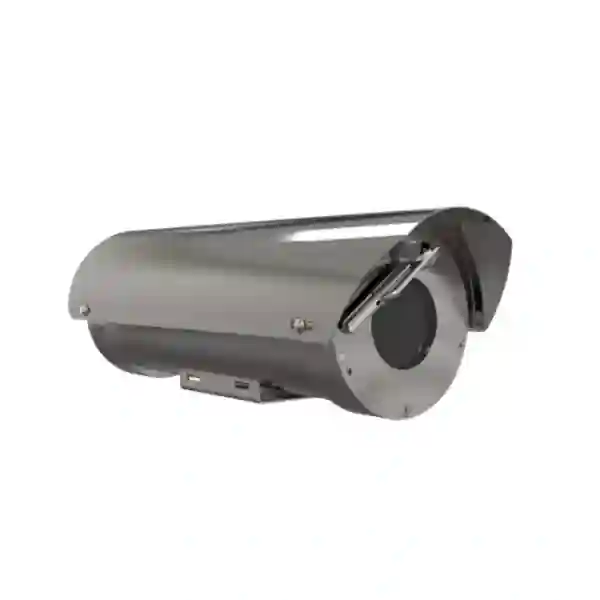
Hanwha TNO-X6320E2F2T1-M Explosion-Proof Zoom Camera
Full HD visible-light industrial monitoring with 32× optical zoom, single-mode fibre and a stainless-steel protective enclosure. Assess this exact configuration against your hazardous-area requirements before purchase.
Key specifications at a glance
| Exact model | TNO-X6320E2F2T1-M |
|---|---|
| Camera | Visible-light, 1/2.8-inch CMOS |
| Resolution / frame rate | 1920 × 1080; up to 60 fps with H.265/H.264 |
| Lens | 4.44–142.6 mm; 32× optical zoom, autofocus |
| Streaming | H.265 / H.264 / MJPEG; multiple streams |
| Network | RJ-45 and integrated single-mode fibre option (F2) |
| Memory | 2 × microSD/SDHC/SDXC slots, up to 256 GB each |
| Power | 110V AC; 37 W maximum listed consumption |
| Housing | 316L stainless steel; approx. 21 kg |
| Ambient operating range | −40°C to +60°C |
| Variant distinction | INMETRO-designated M model; no integrated wiper |
| Environmental ratings | IP66 and IP67 in current official online specification; family documentation also references IP68 |
Specifications refer to manufacturer information for the model and associated family documentation. Exact certification, accessories and the current supplied configuration must be reconfirmed for the project.
What this specialist camera is designed to do
The TNO-X6320E2F2T1-M brings conventional visible-light surveillance into industrial monitoring projects where a standard outdoor camera enclosure may be unsuitable. It combines a remotely adjustable zoom lens with a protective explosion-proof housing. The value is not simply a tougher camera: a project team can review a distant item, then widen the view to understand activity around it without substituting a hand-held inspection for every visual check. The required field of view and the chosen fixed mounting location still determine what can actually be seen.
This is not a thermal camera, a gas detector or a process protection instrument. It records the visible scene within the limits of lighting, weather, perspective and image quality. Industrial safety systems, personnel checks and process instrumentation remain separate controls. Select this product only after an appropriate competent person has assessed the installation area, defined the surveillance objective and determined that this exact housing and certification combination is acceptable for that location.
Best-fit applications and use cases
Potential use cases include visual oversight of process equipment, utility compounds, fuel-handling infrastructure, industrial loading areas, manufacturing facilities, or enclosed production lines, provided each installation’s risk assessment and applicable approvals allow this device. In a facility with long sight lines, optical zoom may be useful for checking a distant valve bank or gate. In a mixed-light environment, image processing can help operators interpret areas with bright and shadowed portions.
The camera does not automatically provide complete coverage of a large plant. A fixed viewing direction leaves blind spots, and high zoom narrows the scene. Designers may need multiple viewpoints, separate overview cameras and lighting. Operators should also distinguish surveillance from safety-critical measurement: an image may show a visible leak or damaged component in some circumstances, but the camera cannot verify the absence of a hazardous release, measure temperature or replace dedicated sensors.
Exact variant selection matters
Hanwha Vision markets several closely named explosion-proof zoom camera variants. The letters and suffixes matter when checking power, fibre hardware, operating temperature, wiper provision and certification scope. For TNO-X6320E2F2T1-M, the manufacturer’s variant descriptions identify 110V AC input, the F2 single-mode fibre configuration, the T1 temperature range and an M variant associated with INMETRO. This particular item is described as a no-wiper configuration.
Do not use a photograph, a generic family brochure or a listing for a model containing an additional W as sufficient proof of what this unit includes. Request the final part-number confirmation, applicable declaration or certificate, current technical sheet and installation instructions for the exact item that will be supplied. Where the schedule specifies an integrated wiper or a different certification, it may require another model.
Full HD video and frame-rate planning
A 1920 × 1080 image can help an operator distinguish relevant visual detail when the lens angle, target size and lighting are appropriate. The manufacturer’s product specifications indicate up to 60 frames per second with H.265 or H.264, subject to the selected frequency and configuration. Higher frame rates can improve the representation of movement, but they may also increase transmission and storage demand, especially when the scene contains detail or motion.
Resolution alone does not guarantee that small labels, vehicle registration characters or distant objects will be readable. The required pixels across a target should be assessed during design with realistic standoff distance, focal length and scene illumination. Compression settings, recording frame rate and the monitor’s display conditions also influence usefulness. Define the surveillance objective first, then select settings that retain the necessary evidence while respecting network and retention constraints.
32× optical zoom for changeable inspection views
The specified 4.44–142.6 mm lens provides 32× optical zoom with autofocus. At the wide end, it presents more of the surroundings; at the telephoto end, it concentrates the camera’s available image detail into a smaller area. That range can be helpful where the same camera must support routine observation and occasional closer visual examination. Autofocus and manual focus options allow different control strategies when the scene makes automatic focusing difficult.
Optical zoom changes framing, but it cannot move the physical camera or see behind structures. It also magnifies vibration, haze, heat shimmer and visibility problems. If a duty requires scanning across different directions, obtain a design review rather than assuming this fixed zoom housing includes motorized pan and tilt. Verify the required view both at full wide angle and at likely operational zoom settings before finalizing mounting height or angle.
Lighting, day/night switching and image visibility
The camera uses a visible-light CMOS imaging sensor with day/night switching through an infrared-cut filter. The official product specifications list minimum illumination figures of 0.05 lux in colour and 0.005 lux in black and white under stated test conditions. These are laboratory reference points, not promises of identification quality under every low-light or high-zoom condition. Real scenes also contain glare, dust, reflections, moving shadows and uneven illumination.
For outdoor industrial sites, identify the darkest operational period, review the available artificial lighting and confirm the expected image during a night trial. Plan supplementary lighting only where the equipment and installation methods are suitable for the classified area. Do not assume that day/night mode gives the camera thermal vision, active infrared illumination or the ability to see through smoke. A good surveillance plan includes realistic lighting and image-performance acceptance tests.
Wide dynamic range and difficult contrast
Loading bays, brightly lit entrances and machinery under roof openings can contain both deep shadows and strong highlights. Wide dynamic range processing helps preserve usable detail across different exposure regions within the same scene. Hanwha’s product material gives differing numeric WDR values between its feature summary and detailed specification; for that reason, this listing describes WDR support without assigning a single unqualified decibel figure.
WDR is an image aid, not a substitute for careful camera aiming, shading, lens cleaning or lighting control. Reflective steelwork and direct light toward the lens may still degrade visibility. Include bright daylight and night lighting in the commissioning test, then confirm whether the camera presents the correct detail in the critical areas. If glare prevents seeing a safety-relevant feature, repositioning the view or adjusting illumination may be more effective than increasing processing strength.
Stabilisation, defog and image adjustments
Hanwha’s specification includes digital image stabilization using a built-in gyro sensor and a defog image-processing function. These functions may help operators handle some vibration or low-contrast viewing conditions. Additional adjustments include backlight compensation, highlight compensation, noise reduction, gain control and privacy masking. Which settings offer the best result depends on the scene, the amount of movement and the specific activity being observed.
Stabilization does not correct an inadequately designed mount, loose fasteners or persistent heavy mechanical vibration. Defog processing does not remove an actual layer of water, thick smoke or physical dirt from the viewing window. The engineering sequence should prioritize a secure structural installation, a clean optical path and appropriate lighting. Use digital corrections as supplementary controls and confirm their effect on recorded as well as live video.
Useful video analytics and what they cannot prove
The listed analytics include motion detection, tampering and shock indications, virtual line crossing, virtual area events and other scene-based notifications. These can assist an operator by highlighting changes in a defined camera view, helping staff find relevant footage and creating events for a compatible management system. The best configuration starts with a clearly described question, such as whether motion crosses a controlled boundary or whether activity appears inside a restricted visual region.
Analytics should not be promoted as certified intrusion prevention, gas alarm equipment or guaranteed human detection. Reflections, steam, animals, machinery, shadows and changes in lighting may affect detection. Each rule needs an acceptance test that includes expected operating conditions, nuisance triggers and missed-event scenarios. Confirm how alerts are delivered, acknowledged and audited, especially if operators work across shifts or network links have intermittent connectivity.
Streaming formats and bandwidth management
The model supports H.265, H.264 and MJPEG video compression, multiple streaming profiles and Hanwha’s WiseStream II functionality. Separate profiles can be useful when a control-room monitor needs a lighter live view while the recording system stores a higher-quality stream. A carefully chosen encoding strategy balances image detail, frame rate, latency, storage and overall network capacity. There is no universal bandwidth figure appropriate for every industrial scene.
Before deployment, calculate demand using representative movement, lighting and compression settings rather than a theoretical minimum. Estimate both average and peak traffic, including simultaneous viewers, remote review and retrieval of recorded evidence. Confirm the recorder accepts the chosen stream type and that changes to image settings do not silently reduce needed detail. Monitor network performance during commissioning and document the approved configuration for future troubleshooting.
Single-mode fibre and network architecture
The F2 designation identifies an integrated single-mode fibre option. Hanwha specifies a duplex single-mode 9/125 μm module for F2 models, alongside an RJ-45 network interface in its technical information. Fibre can be valuable where long cable runs or electrical interference make careful network design important, but compatibility depends on the site’s optical infrastructure, terminations, link characteristics and network equipment. The optical link should be engineered as a system, not assumed plug-and-play.
Verify connector and transceiver details against the current product manual, confirm the required fibre cores and patching arrangements, and test the optical path before handover. Plan cable routing, strain relief, bend radius and segregation in line with project rules. Any transition between hazardous and nonhazardous zones needs an approved installation method. Fibre carries data; it does not eliminate the need for a properly designed power supply, bonding or protective earth.
Ethernet, recording platforms and interoperability
Hanwha lists ONVIF Profiles S, G and T as well as network protocols including RTSP and HTTPS. These specifications can make the camera a candidate for integration with different video management or recording solutions. Actual interoperability must be checked against the recorder’s supported device list, firmware release, chosen video codec and the precise functions the site needs. Compatibility with a standard should not be mistaken for an assurance that every analytics event or camera control will appear in every third-party interface.
For integration, test live view, selected resolution, recording schedules, time synchronization, events, user permissions and retrieval of stored video. If operators need to change zoom or focus from a client application, verify those controls specifically. Document which features depend on a native Hanwha interface and which work through the site’s chosen video management system. Avoid procurement assumptions based solely on the presence of an ONVIF logo.
On-camera storage and evidence continuity
The manufacturer specifies two microSD/SDHC/SDXC memory slots, with a maximum listed capacity of 256 GB per slot and 512 GB in total. Local storage can support a recording strategy when used with the camera’s supported event and storage functions, but a card is not a substitute for an engineered retention plan. Card compatibility, write endurance and the operating temperature of the installed media require separate checks.
Specify what should happen when the connection to the main recorder fails and how any local footage will be recovered. Test interruption and restoration, including clock accuracy and whether the management software behaves as expected. Set retention targets using the organization’s evidentiary needs and applicable privacy requirements. Storage capacity depends on actual bitrate, scene complexity, frame rate and recording policy, so avoid promising a fixed number of days without a verified calculation.
Security configuration for industrial networks
The product documentation lists user authentication, HTTPS, 802.1X network authentication, IP-based access control and event or access logs. These features can contribute to a secure deployment when properly configured within the facility’s wider cybersecurity program. Change default access arrangements, assign distinct permissions for administration and daily viewing, and restrict management interfaces to approved network segments. Confirm the appropriate firmware and security guidance for the exact unit before it is connected to production systems.
A surveillance camera should not provide an unmanaged path into an industrial control network. Define approved remote access, logging, credential rotation, patch processes and responsibility for incident response. Synchronize time with an appropriate trusted source so recordings and alerts can be correlated with other events. Review how the organisation handles exported video, personal information and account access, especially when footage may be reviewed outside the original control room.
Explosion-proof housing and hazardous-area engineering
The protective assembly is intended for specialist hazardous environments, but explosion-proof terminology is not a blanket permission to install the device in any classified zone. Suitability depends on the actual area classification, gas or dust group, temperature class, ambient limits, installation conditions and the precise certificate accepted by the project authority. The choice must be checked by a competent hazardous-area engineer against current documentation for the exact supplied configuration.
Enclosure integrity may depend on cable-entry components, installation methods, seals and maintenance practices. Do not substitute ordinary cable glands or perform unapproved field alterations. Follow the manufacturer’s instructions for lifting, mounting, cable entries, connection and inspection. A compliant camera body paired with an unsuitable cable entry or power arrangement can invalidate the overall installation approach. Procurement and engineering teams should resolve these matters before ordering rather than during field installation.
INMETRO designation and local acceptance
The final M in this model is associated by Hanwha with an INMETRO-designated variant, and the manufacturer’s documentation also lists other certification systems for the wider product family. Those labels describe manufacturer’s product information; they do not establish that the exact camera meets every permit or project requirement in Tanzania. Ask the responsible project authority which certificates, markings and installation records are required for the proposed hazardous location.
Review the exact certificate number, applicable model suffix, permitted ambient range, special conditions and any restrictions in the supporting documents. The buyer should not treat a global marketing list as a substitute for a legally relevant certificate. Where the local project specification calls for a different certification scheme, obtain documented acceptance or select a suitably certified variant. The sale of a device and the formal acceptance of its hazardous-area installation are separate decisions.
Stainless steel enclosure and site exposure
Hanwha lists stainless steel STS316L construction, a silver finish, dimensions of approximately 176 × 154 × 720 mm and a weight of 21 kg. The material can be attractive for many demanding industrial environments, but project suitability still depends on chemical exposure, cleaning methods, mechanical loading and environmental conditions. The listed degree of ingress protection addresses defined test conditions; it should not be interpreted as resistance to every corrosive substance or cleaning process.
Consider whether the mounting structure can safely accommodate the camera weight plus bracket, cable loading and any relevant dynamic forces. Allow space for installation and inspection, not only the outline of the housing. In marine or chemically aggressive locations, obtain project-specific materials advice rather than assuming that stainless steel makes the complete installed assembly maintenance-free. Surface condition, fasteners, glands and supports all contribute to long-term reliability.
IP ratings and environmental limits
The manufacturer’s current online specification lists IP66 and IP67, while related family material also references IP68 under defined conditions. These ratings have different test meanings and should be checked against the precise certificate and current datasheet during design. A protection rating does not grant approval for prolonged submersion, unrestricted pressure washing or operation with damaged seals. Confirm the exact claim applicable to the ordered model rather than treating every family statement as interchangeable.
The published operating temperature range for the T1 variant is −40°C to +60°C with specified non-condensing humidity limits. Ambient temperature at the camera may differ from the nearest weather station, particularly beside hot machinery, roof structures or direct solar exposure. Assess radiant heating, surface temperature, local humidity and the actual mounting position. Environmental margins should reflect the site’s expected conditions and any conditions imposed by hazardous-area certification.
No-wiper configuration: a purchasing decision
This exact TNO-X6320E2F2T1-M variant is identified as a no-wiper model in Hanwha’s model descriptions. Its general family feature summaries mention optional wipers, which can cause confusion when selecting by a headline or generic illustration. Buyers who need mechanical window wiping should request an appropriate different variant and verify that its power, fibre provision, certifications and physical installation requirements also match the project.
Without a wiper, the surveillance plan should account for rain splash, deposits, insects and cleaning access. An operator may find that the image is degraded even though the electronics remain fully operational. Define a safe inspection and cleaning procedure before installation. Do not modify the explosion-proof enclosure to add a third-party wiper or cleaning device without documented manufacturer and hazardous-area approval.
110V AC supply: critical Tanzania check
The camera is specified for 110V AC input with a listed maximum consumption of 37 W. Tanzania’s distribution network includes 400/230V low-voltage supplies, according to TANESCO, so a typical local 230V circuit is not directly suitable for this 110V device. Power compatibility should be treated as an essential design condition and resolved before the product is purchased, wired or energized. Never connect it directly to a higher-voltage supply on the assumption that industrial cameras accept universal input.
A qualified electrical designer should determine whether an approved and properly rated supply conversion arrangement is required, and where it may be installed relative to any classified zones. Account for protection, isolation, earthing, cable length, voltage drop, backup power and safe maintenance. The applicable manual and hazardous-area documentation take precedence over generic installation examples. The conversion equipment itself must be appropriate for its actual location.
Power continuity, resilience and safe shutdown
Industrial sites sometimes require surveillance to remain available during process interruptions or switching events. Determine whether this camera is part of the normal security system, a restricted operations monitoring arrangement or a higher-resilience observing service. That decision shapes the need for backup power, network redundancy and recording continuity. The camera’s power input and its connection to external conversion equipment must be accounted for when sizing any backup arrangement.
Document the maximum intended power budget rather than counting only typical draw, and include losses from approved power-conversion devices. A 37 W camera specification does not describe the demand of switches, recorders or fibre equipment elsewhere on the route. Test the restoration of service after interruption: camera startup, link establishment, recorder reconnection, time synchronization and alerts may all need validation. Backup power improves availability but does not replace the safety requirements of a certified electrical installation.
Camera location and physical coverage planning
A good location should offer a stable structure, a clear optical path and safe access for initial mounting and later inspection. Start by marking the exact process equipment or approach routes that must be seen. Review likely visual obstructions such as pipes, gantries, tanks, vehicles and seasonal vegetation, then consider illumination and sun direction. Mounting the camera higher may improve the overview but can make small identifying details harder to resolve.
At the 32× telephoto setting, small changes in direction produce large changes in the observed scene. Confirm the camera’s likely operational framing before approving the mount. A fixed-position zoom camera should not be treated as a substitute for a moving positioning system. If the task requires both an overall context view and a persistent close-up of another location, determine whether multiple cameras or a different camera type is required.
Designing for clear evidence rather than impressive specifications
Buyers often compare megapixels and zoom ratios first, but the useful measure is whether the system can answer the site’s actual operational questions. A camera may show that an operator approached a gate yet fail to capture the identifying details required for a separate investigation. Specify whether the task is observation, recognition or visual inspection, then calculate realistic target size and image quality at each relevant position. Include the effect of the chosen recording compression and frame rate.
During commissioning, capture sample footage in normal and challenging conditions and review it at the workstation used by operators. Test live viewing and playback; network or recording settings can create differences between the two. Agree on pass/fail examples with the project team. Retain reference scenes and the final configuration so subsequent maintenance can identify whether the camera has shifted, become dirty or been reconfigured.
Mounting and cabling work sequence
Before installation, obtain the approved layout, area classification, site method statement, structural design and exact manufacturer instructions. Inspect the delivered camera for the correct model number, physical damage and required accessories. Confirm approved mounting hardware, lifting arrangements and cable-entry components. A 21 kg enclosure requires deliberate handling and support; do not rely on a light-duty CCTV bracket simply because a conventional camera would fit there.
Complete electrical and fibre checks according to the facility’s procedures, then close and inspect the enclosure as instructed. Maintain records of cable entries, earthing, equipment labels and commissioning tests. Work in a hazardous area must follow the permit and isolation controls set by the site. The installation should not proceed if the certificate, supply arrangement or component compatibility is unclear; resolve those issues through the responsible engineer and product documentation first.
Network and fibre commissioning checklist
A practical commissioning plan verifies the physical link, logical network and recorded application behaviour separately. Start with the fibre path and all installed terminations, then confirm the camera’s network identity, addressing, time settings and authorized management access. Validate the planned video streams at the expected monitoring station and recorder. Record actual traffic when the scene is active, not only while the area is empty or static.
Where the system relies on a shared industrial backbone, assess available capacity and approved routing. Confirm alarms and event metadata arrive at the intended destination and that operators understand their meaning. Include simulated link interruption and restoration. Keep the final network diagram, addressing records and configuration backup in the site’s controlled handover documentation. Network integration should be done with the responsible IT and operational technology teams, not through ad hoc connections to production networks.
Recording and retention choices
Recording requirements should be set by operational policy, investigation needs and any applicable legal or contractual obligations. A continuous high-quality stream may suit some projects, whereas event-supported or scheduled recording may be appropriate elsewhere. The choice influences storage, bandwidth and review workload. The camera’s dual card slots can contribute to the design, but the system still needs a clear policy for what happens when media is full or a central recorder becomes unavailable.
During an acceptance test, check date and time display, playback navigation, export permissions, retention expiry and the image detail retained in actual saved footage. Decide who may access recordings and how access is audited. Recording policy should also consider privacy and proportionality where people can be identified. Do not estimate retention days from card capacity alone without calculating the selected compression, movement, frame rate and recording pattern.
Operator workflow and event response
A well-equipped camera is useful only when the operating team knows what to look for and what to do next. Define the normal live view, the situations that justify a closer zoom and the controls that must remain visible during routine supervision. If video events are used, determine who receives notifications and what constitutes an actionable event. Train users to distinguish a camera alert from an independently verified site condition.
Use agreed procedures for preserving footage and escalating suspected incidents. Operators should know the practical limits of zoom, low light and weather visibility. Avoid designing a workflow in which an operator must continuously zoom away from a critical overview to inspect routine details. Where several views are important at the same time, the camera layout should provide them independently. Document which system is authoritative for alarms, especially where surveillance runs beside safety or process controls.
Maintenance and inspection over the equipment life
Maintenance planning should cover more than firmware updates. Include checks of the enclosure condition, mounting integrity, window clarity, approved seals and cable entries, as well as network reliability and recorded image quality. The inspection schedule should reflect the site’s environment and hazardous-area procedures. Where cleaning is needed, the method and materials must be compatible with the enclosure and manufacturer guidance.
Review image samples periodically against the commissioning baseline. Investigate a changed field of view, repeated connection loss, unstable power, card faults or rising false alerts. Firmware changes should follow documented compatibility, cybersecurity and rollback processes. Do not open or modify an explosion-proof assembly in an unsafe condition or outside approved service procedures. Preserve the relevant certification and service records so future equipment replacement does not introduce a nonmatching variant.
Choosing between related Hanwha versions
This M version is not interchangeable with every TNO-X6320-series product. Other catalogue variants differ in certification designation, temperature range, power input, fibre provision or wiper equipment. A model ending in T2 may be specified for a different ambient range, while W-designated options can change the window-cleaning arrangement. The important step is to compare exact part numbers and official model tables rather than infer features from a family name.
For every proposed substitute, reconfirm the camera optics, housing dimensions, voltage, fibre interface, accepted certification and installed accessories. Replacement also affects mounting, cable interfaces and commissioning documents. A formally approved substitution should identify what changed and why it remains suitable. A lower price or shorter availability estimate is not by itself an engineering justification for swapping hazardous-area equipment.
Procurement information to provide for a quotation
To request a useful, model-specific quotation, share the exact part number TNO-X6320E2F2T1-M; the required quantity; project location within Tanzania; intended use; and expected order timing. Include the hazardous-area classification, required certificate or marking, supply-voltage details, available network connectivity and preferred recording platform. If the camera must be mounted on an existing structure, provide relevant dimensions and photographs through an agreed project channel.
Also describe whether an integrated wiper is mandatory, whether the 110V supply arrangement has been designed and whether installation or commissioning services are being separately requested. The quotation should identify the manufacturer configuration and any accessories explicitly included. Do not assume stock, shipping, local support, warranty coverage, import costs or site services until confirmed in writing for the actual offer.
Pre-purchase engineering questions worth answering
Before approval, ask: Is the selected certificate accepted for the exact classified zone and surrounding conditions? What is the defined visual objective at the most distant target? Is the camera physically fixed, and will a fixed field of direction meet the task? Are single-mode fibre interfaces and terminations compatible with the planned infrastructure? Where will the 110V supply be obtained safely? Are brackets, cable entries and earthing details approved?
Then review operational details: What recorder and firmware combination will be tested? Which event types are required? Who manages user accounts and security updates? What are the footage retention and privacy requirements? How will the viewing window be cleaned without a wiper? Who will inspect and maintain the enclosure? A clear set of answers prevents expensive rework and gives both purchaser and supplier a sound basis for comparing options.
What a practical acceptance test should demonstrate
A complete acceptance process should prove correct model delivery, approved physical installation and useful video performance. Confirm the nameplate and certificate references against design documents. Check power conversion, bonding, network connectivity and the mechanical assembly under the project’s approved procedures. Then view the intended targets at wide and zoomed settings, including the lighting conditions that matter to the user. Record the selected codec, resolution, frame rate and event configuration.
Verify footage playback, alarm routing, time accuracy, permissions and recovery after planned interruptions. Establish the baseline image that maintenance can later compare against. Document deviations and whether they require a design change or operational adjustment. The successful test is not merely that an image appears on a monitor: it is that the installed surveillance system meets an agreed specification without bypassing the facility’s electrical, hazardous-area or cyber controls.
Buyer summary: suitability and limitations
Choose the Hanwha TNO-X6320E2F2T1-M when a specialist industrial surveillance plan specifically calls for its combination of Full HD visible-light video, remotely adjustable 32× optical zoom, single-mode fibre, heavy stainless-steel enclosure and the relevant certification configuration. It is especially important to verify the exact no-wiper variant and its 110V AC input. The camera’s published specification does not resolve site-specific approval, visibility, cabling or integration decisions for you.
FourTeck Tanzania can be approached for a product-specific quotation and a technical discussion of the requested configuration. Share project details rather than relying on an unverified assumption about price, immediate availability or installation scope. A sound decision considers the hazards, imaging task, power and network design, maintenance access and the full lifecycle of the system together.
Frequently asked questions
Is TNO-X6320E2F2T1-M a thermal camera?
No. Hanwha identifies this model as an explosion-proof visible-light network zoom camera with a CMOS image sensor. It does not measure temperature and should not be used as a thermal or gas detection device. If the project requires temperature alarms or thermal imaging, specify those functions separately and review an appropriate, verified product.
Does this exact model include a wiper?
No. Hanwha’s variant descriptions identify TNO-X6320E2F2T1-M as a fibre-equipped model without an integrated wiper. Some general family feature summaries mention wipers because other versions offer them. If the camera window must be wiped remotely, ask for an exact alternative model and check all other specifications again.
Can it be powered from a Tanzanian 230V circuit?
Not directly. Its specified input is 110V AC, and TANESCO describes 400/230V service at the low-voltage distribution level. A qualified designer must establish an appropriate approved power arrangement. Do not presume the device has a universal power supply or connect it to a 230V circuit without approved conversion.
What resolution and zoom does it provide?
The manufacturer’s detailed specification lists 1920 × 1080 video and a 4.44–142.6 mm lens offering 32× optical zoom, with autofocus options. Practical identification distance depends on target size, lighting, angle, vibration and recorded image settings; optical zoom does not provide a movable pan-and-tilt mounting system.
Does the camera connect by fibre?
Yes, the F2 version lists a single-mode fibre interface using 9/125 μm fibre, and the product documentation also lists RJ-45 Ethernet. The site’s fibre equipment, connector arrangement, network architecture and intended link should be reviewed before ordering. Fibre is for data transport, not a replacement for electrical power.
Does an INMETRO designation mean it is approved for every hazardous area in Tanzania?
No. The M designation is associated with INMETRO in Hanwha’s model descriptions. A qualified project professional must verify certificate scope, classification, special conditions and acceptance by the relevant local project authority. Do not infer unrestricted hazardous-area suitability from a product title or family-level marketing description.
What is the operating temperature range?
Hanwha lists −40°C to +60°C for this T1 variant. Actual equipment conditions can be affected by radiant heat, enclosure positioning and local installation factors. The design must also satisfy any temperature and ambient restrictions in the exact hazardous-area documentation. Avoid assuming all variants in the family have identical limits.
Can the camera record to memory cards?
The manufacturer lists two microSD/SDHC/SDXC slots with a maximum of 256 GB per slot. Confirm approved media, recording modes and the interaction with the chosen video management platform. The number of days of retained recording depends on bitrate, activity, settings and policy, so it cannot be guaranteed from the card capacity alone.
Is the camera compatible with an existing NVR or VMS?
Hanwha lists ONVIF Profiles S, G and T, H.265/H.264/MJPEG and common network protocols. This is a strong starting point for an integration review, but it is not proof that every control, analytic event or archive function will work with a specific recorder. Test the exact software, device and firmware combination.
Does the camera have pan and tilt?
This is described as an explosion-proof zoom camera, not as a motorized pan-and-tilt positioning unit. The lens changes optical framing while the mounted camera direction remains fixed. If surveillance requires remotely changing the viewing direction, confirm a different suitable model or a separately approved positioning solution.
What should an industrial buyer check before placing an order?
Confirm the precise suffix, hazardous-area acceptance, 110V supply design, required view, fibre details, mounting capacity, no-wiper status, recorder interoperability and ongoing maintenance method. Ask for the latest applicable manufacturer documentation and written clarification of exactly what the commercial offer includes. Do not assume Tanzania stock, pricing or lead time.
How do I request a quotation from FourTeck Tanzania?
Provide the exact model name, quantity, project purpose, expected schedule and relevant engineering constraints. Include the area classification, certificate requirements, available voltage and network plan. Ask the supplier to confirm the model configuration, included accessories, commercial conditions and any separately available support services before final purchase approval.
Request a model-specific quotation
Ask FourTeck Tanzania to review the Hanwha TNO-X6320E2F2T1-M against your surveillance objectives, hazardous-area documentation, fibre network and 110V power design. Provide the precise part number and project requirements for written clarification of configuration, price and availability.
Next step: contact FourTeck Tanzania for a technical and commercial review.




Reviews
There are no reviews yet.