
Thermal security / Tanzania buyer guide
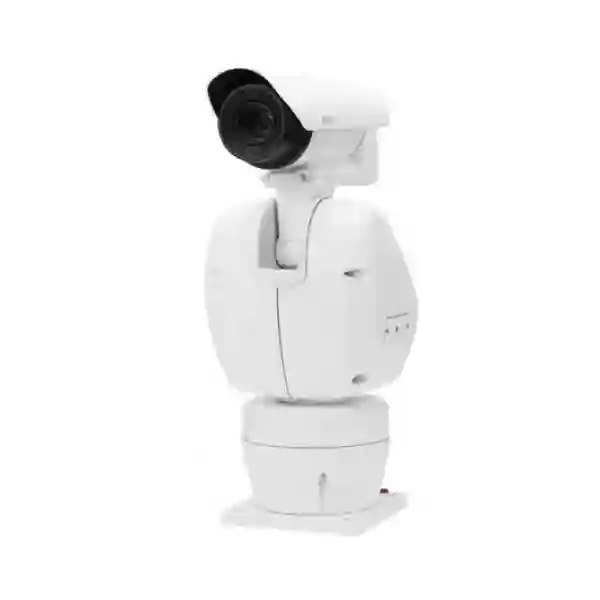
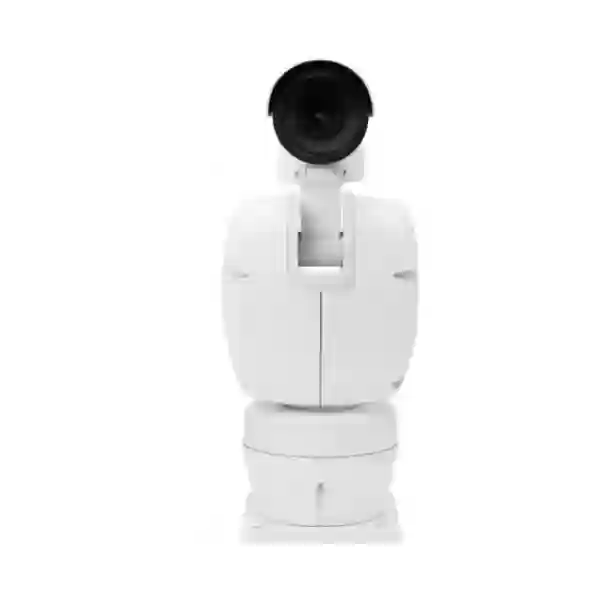
Hanwha TNU-4051T thermal positioning camera
Observe heat signatures across demanding outdoor security areas with a 640 × 480 thermal sensor, a fixed 35 mm lens and motorized 360° continuous panning. The Hanwha TNU-4051T thermal positioning camera suits organizations evaluating remote perimeter detection and monitored industrial sites. It is a thermal detection tool, not a substitute for facial identification, plate reading or calibrated temperature measurement. Review the deployment guidance below before requesting a project-specific quotation.
Specification snapshot
| Product category | VGA thermal positioning network camera |
|---|---|
| Image sensor | Uncooled microbolometer; 640 × 480 pixels |
| Thermal spectral band | 8–14 μm |
| NETD | ≤ 50 mK |
| Lens and field of view | 35 mm fixed, F1.0; H 17.2°, V 13°, D 22° |
| Minimum object distance | 36 m |
| Movement | Endless 360° pan; −90° to +40° tilt |
| Presets | Up to 300; six groups |
| Streaming | H.265, H.264, MJPEG; WiseStream II |
| Connectivity | RJ-45 10/100BASE-T; ONVIF S/G/T; RTSP; SUNAPI |
| Storage | 1 × microSD/SDHC/SDXC slot, maximum 256 GB |
| Electrical | 24 V AC; up to 84 W with heater active |
| Environment | −40 °C to +55 °C; IP66; NEMA 4X |
| Dimensions and mass | 219 × 528 × 335 mm; approximately 11.7 kg |
Values are based on the manufacturer’s published global product specification. Confirm the exact regional configuration, hardware revision and firmware in the quotation and installation documents.
What the TNU-4051T is designed to do
The Hanwha TNU-4051T thermal positioning camera is intended for security teams that need to notice heat signatures over open outdoor areas, even where normal visible-light images are limited by darkness. It combines a 640 × 480 uncooled thermal sensor with a motorized positioning head and a fixed 35 mm lens. The result is a network camera suited to surveying a defined perimeter, a remote boundary, or a collection of distant inspection points. The camera does not need visible illumination to produce its thermal image, although conditions on site still influence how confidently an event can be detected.
For facilities in Tanzania considering this model, the first decision is whether the requirement is early detection or positive identification. The TNU-4051T can help an operator notice a thermal target, understand where it appears in the scene and investigate the event with associated cameras or staff. It does not create ordinary colour footage of clothing, vehicle markings, faces or licence plates. A sensible design therefore pairs thermal detection with a separate visible-light view wherever detailed verification or evidential identification is required.
The most useful first step is to define the physical area, the target sizes, the expected environmental conditions and the operator response. Those inputs matter more than a headline specification on its own. The TNU-4051T should be selected only after a camera plan demonstrates that the 35 mm field of view and achievable target detail match the actual site.
Thermal imaging explained for security buyers
Thermal surveillance works by detecting differences in infrared radiation rather than by relying on reflected visible light. The TNU-4051T uses an uncooled microbolometer operating in the long-wave infrared region, specified at 8–14 μm. The camera converts patterns of thermal contrast into a grayscale or false-colour picture. A warmer object may appear bright in one palette and dark in another. The displayed colour is a visualization choice, not the actual colour of the person, equipment or surface being observed.
This approach is useful where lighting cannot be trusted. A property boundary may have unlit sections, a remote yard may be poorly illuminated, and a floodlight may create strong backlight or glare in a conventional picture. Thermal imagery provides a different form of visual information. It can improve awareness in these settings but is not completely immune to weather, atmospheric effects, hot backgrounds, intervening objects or poor camera placement. Dense material that blocks the camera’s thermal view still blocks the scene.
Buyers should also separate thermal detection from temperature instrumentation. The product documentation lists temperature-change detection among its analytics, which is not the same as documenting an accurate surface-temperature measuring instrument. Do not specify this model for calibrated electrical thermography, process-temperature control or occupational temperature screening without obtaining explicit evidence that the required measurement functionality exists. For ordinary security design, the product is best understood as a thermal observation and event-detection camera.
Why the fixed 35 mm lens matters
The 35 mm fixed lens is a central reason to choose the TNU-4051T rather than a wider-angle thermal model. Its manufacturer-specified horizontal field of view is approximately 17.2 degrees, with 13 degrees vertically and 22 degrees diagonally. This relatively narrow view concentrates the available thermal pixels over a smaller portion of the scene. It can be useful for observing a defined remote approach or perimeter sector, but it also means that the camera sees less width in any single stationary view.
A longer focal length should not be confused with an optical zoom lens. The 35 mm focal length is fixed; moving the positioning head changes where the lens points, not how wide its instantaneous view becomes. An operator can direct the camera to another sector or use saved presets, yet an object outside the current field of view will not appear in that frame. When continuous simultaneous coverage is mandatory, multiple cameras or complementary fixed cameras may be more appropriate than one moving head.
The minimum object distance is specified as 36 m. That matters on compact compounds where a guard position is close to a fence, gate or pedestrian path. Confirm where the nearest area of interest begins, then validate focus and target scale at actual distances. Evaluate a drawing with distances and mounting heights rather than assuming a long-range camera will perform equally well on a nearby entrance.
Positioning coverage, presets and operating behavior
The camera supports 360-degree endless pan movement and a tilt range from −90 degrees to +40 degrees. Manufacturer specifications list preset pan speeds up to 120 degrees per second and preset tilt speeds up to 40 degrees per second. They also identify up to 300 preset positions and six groups, with preset accuracy specified as ±0.3 degrees. These are useful capabilities for a control-room workflow in which a single head is asked to inspect multiple known sectors.
A preset can point the thermal view toward a fence corner, tank area, access road or equipment approach. Operators can return to a familiar view without searching manually each time. A sequence of positions can assist a planned observation pattern, and digital image stabilization using an onboard gyro sensor can reduce visible shaking caused by some vibration. It is still important to verify the mount, the expected movement profile and the actual stability of the deployed system.
Presets do not provide simultaneous observation of every sector. A camera following a tour can miss a short event at a location it is not facing. Security designers should define dwell times, revisit intervals, high-priority views and rules for alarm interruptions. If the requirement is immediate detection everywhere along a long perimeter, consider fixed thermal detection at critical points and use the TNU-4051T for focused investigation or an allocated surveillance sector.
Image quality, thermal sensitivity and frame rate
The native thermal resolution is 640 × 480, with other supported output sizes including 640 × 360 and 320 × 240. The camera uses a 17 μm pixel pitch and the official global technical page states NETD of 50 mK or less. NETD describes the sensor’s ability to distinguish small thermal differences under test conditions; it does not guarantee a particular detection distance, a certain identification result or reliable operation against every background.
Supported H.265 and H.264 streaming can reach 30 frames per second in 60 Hz settings or 25 frames per second in 50 Hz settings, according to the manufacturer. A smooth video stream may make motion easier for an operator to follow. However, frame rate is only part of performance. Target dimensions in pixels, temperature contrast, angle of view, camera motion, background clutter and weather all influence what a person can realistically see.
Ask for sample imagery taken from comparable distances and conditions, ideally during a controlled on-site demonstration. A tiny heat signature that triggers an alert may still be insufficient for determining whether the target is a person, an animal or machinery. The question to settle is not simply whether something can be detected, but what confidence and response are expected at each location.
Security analytics and practical alarm design
The TNU-4051T offers a range of video and audio analytics. Manufacturer-listed events include motion, tampering, loitering, intrusion into an area, entering and exiting a region, object appearance or disappearance, virtual-line crossing, direction, shock, sound classification, audio detection and temperature-change detection. These are potential tools for creating actionable alerts, not promises that every event type will work with identical reliability in every location.
An outer fence may use a virtual line to distinguish movement toward a restricted area. An equipment approach may be configured with a region-of-interest rule and a suitable schedule. Operators can use different rules for a remote after-hours zone and a frequently used service road. Thoughtful zoning prevents routine activity from being treated as an emergency and helps align camera events with a site security procedure.
False or nuisance alarms deserve as much attention as sensitivity. Animals, moving vegetation, hot exhausts, changing backgrounds and unusual weather can affect scene interpretation. Set a commissioning period to tune detection zones and rule conditions while recording both expected and unexpected events. A useful security design includes an operator verification step, responsibility for accepting or rejecting alarms, escalation criteria and a documented method for adjusting analytics after installation.
From camera alert to a real security response
The product provides one alarm input and one alarm output, and supports event actions including email or FTP image upload, email notification, local or network recording and movement to a PTZ preset. A well-designed system uses those capabilities within a complete response chain rather than simply increasing the number of alerts displayed to staff. The goal is to convert a meaningful change in the scene into a timely, understandable instruction for an operator.
For example, a thermal rule might flag movement across a designated outer boundary at night. The system can present the event, preserve video around the incident and direct the operator to check a visible-light camera facing the relevant location. The operator then follows a documented site process for challenge, patrol dispatch or other action. All integrations, triggering rules and event destinations should be verified against the selected firmware and VMS before a project is signed off.
Alarm design must also consider an unattended event. What happens when the local network drops, the recorder is offline, the operator is busy or a preset tour is in progress? Identify which actions can occur locally and which rely on external services. Test alarm timing and handover logic under realistic conditions, then document how security staff will recover missed notifications and review stored footage.
Integration with a network video management system
The TNU-4051T is a network camera with a 10/100BASE-T RJ-45 Ethernet interface. The manufacturer’s product specification lists ONVIF Profiles S, G and T, RTSP-related transport support, SUNAPI and Hanwha Vision Open Platform. These interfaces provide potential paths for viewing, configuring and integrating the camera with other security components. They should not be interpreted as a guarantee that every recorder or third-party VMS will expose every control or analytic event.
A project team should verify the exact VMS version, firmware version, network architecture and required functions before purchase. Basic video discovery and playback are different from controlling a positioning head, subscribing to analytic alarms, handling metadata, retrieving on-device recordings or setting up secure user permissions. Request a compatibility matrix or a pilot test for the functions the operators actually need, rather than relying on the presence of a protocol logo.
Where a separate visible-light PTZ camera is part of the solution, confirm how thermal events hand over the location or preset. A successful integration must put the second camera on the right view, not simply issue a generic alarm. The target location, camera orientation, preset mapping, time synchronization and user interface all need to agree. Keep a record of working settings so future maintenance does not undo a carefully tuned response.
Video codecs, bandwidth and network planning
The camera supports H.265, H.264 and MJPEG, plus Hanwha’s WiseStream II technology. The choice of codec affects how much data must travel from the camera to a recorder or monitoring point. Efficient compression is useful for remote facilities, particularly when backhaul is shared with other services. However, actual bandwidth depends on scene detail, movement, frame rate, resolution, compression settings and the number of streams consumed.
The product offers multiple streaming profiles, with the official specification stating up to ten profiles and up to twenty unicast users. Those figures describe supported configuration features, not a recommendation to connect twenty independent operator workstations directly to the camera. A recorder or VMS often provides a better point for distributing recorded and live views. For reliability, estimate the network load produced by the real operating profile rather than basing capacity on a low-motion demonstration scene.
During design, account for peak events, concurrent users, recording requirements and remote access. Test both live preview and recorded playback over the planned connections. Consider how a reduced-resolution substream may help operator viewing while the recorder retains the configured primary stream. Build in room for additional cameras and avoid promises of fixed storage savings, because compression efficiency changes with conditions.
Edge storage and evidence continuity
A single microSD, SDHC or SDXC slot supports cards up to 256 GB according to the published specifications. Edge storage can be valuable for local event recording or a resilience strategy when a network link is temporarily unavailable. The camera documentation also references event recording to network-attached storage. Storage architecture should nevertheless be checked for the intended firmware, recording mode and VMS workflow.
Storage capacity is not the same as retention time. The number of hours preserved depends on average bitrate, frame rate, scheduled or event-based recording, audio usage, file overhead and how often a scene generates activity. Estimate retention using measured video output and the site’s evidence policy. For sensitive facilities, determine what footage must remain locally, what must be sent to a central system and which recordings are subject to restricted access.
Maintenance teams should test card health, time accuracy, overwrite behavior and the process for exporting evidence. A card is not a substitute for a managed backup policy; storage media can fail, and video may be inaccessible if a camera is damaged. Put failed-recording alerts and periodic playback checks into an operating schedule. The aim is to have usable evidence after an event, not just an icon showing that recording was enabled.
Cybersecurity and access control considerations
The manufacturer’s published security features include HTTPS, digest authentication, IP-based access control, IEEE 802.1X network authentication and event or system logs. These capabilities help security administrators apply disciplined access policies. They do not remove the need to secure the surrounding network, the recorder, the administrator credentials and the remote maintenance process.
Before commissioning, change any initial credentials, assign named responsibilities for accounts and restrict management access to authorized networks. Avoid exposing an IP camera directly to the public internet. Use the organization’s approved secure remote-access architecture, review device permissions, and ensure that the date, time and logging configuration support incident investigations. Document the device address, firmware, installed options and who is allowed to change alarm rules.
Hanwha’s support documentation warns that devices upgrading from some early 1.00–1.2X firmware versions require bridge firmware before moving to the latest release. This matters for any existing installation or warehouse unit with older software. Treat updates as a planned maintenance task: verify exact model and version, review vendor notes, preserve configuration information and test the camera afterward. Do not promise an update process until the actual installed firmware has been inspected.
Outdoor construction and mounting
The TNU-4051T has an aluminium enclosure and published ingress-protection ratings of IP66 and NEMA 4X. The official specification gives approximate dimensions of 219 mm wide, 528 mm high and 335 mm deep, with a weight of 11.7 kg. These details affect structural design, wind exposure, cable routing and installation access. The camera is a substantial motorized device, not a compact fixed bullet that can be mounted to any lightweight bracket.
An outdoor project should use a mount and supporting structure engineered for the camera’s load and the conditions at the selected position. Confirm approved mounting accessories, fasteners, mechanical clearances and movement envelope. The head must be able to pan and tilt without colliding with nearby building features, cables or other equipment. Choose a position that minimizes obstructions and enables service personnel to work safely when future maintenance is needed.
IP66 describes enclosure protection under specified testing conditions; it is not a promise that every installation will resist all site hazards indefinitely. Cable entries, junction boxes, gland sealing, surge protection and the mechanical condition of the mounting structure all matter. Dust, coastal exposure, vibration and intense outdoor use should be part of the project risk review. Use a qualified installation plan suited to the site, not the camera rating alone.
Power, heat and electrical resilience
The global manufacturer support page specifies a 24 V AC input, with a published maximum power consumption of 84 W when the heater is operating and 62 W with the heater off. Power planning must account for the maximum listed load and the design of the actual unit being supplied. Do not assume that standard Ethernet power or a small PoE switch will run this positioning camera. Verify the exact regional configuration and electrical documentation before buying power equipment.
For Tanzania deployments, the design team should plan how the required camera voltage will be provided from a suitably protected supply, how long the cable run will be and what happens during a power interruption. A UPS or other standby arrangement may be appropriate when monitoring must continue during outages. Its rating should consider the camera together with switches, recording devices, wireless links and any other essential components.
The published operating temperature range on the global support specification is −40 °C to +55 °C, with a stated non-condensing humidity range of up to 90 percent. An outdoor enclosure rating does not remove the need for appropriate electrical installation. Confirm earthing, lightning and surge considerations, routing away from hazardous cables and any applicable project electrical requirements through qualified professionals. Never size the supply solely around typical running power if the manufacturer’s maximum is higher.
Planning a practical site survey
A useful survey starts with the map of the actual site. Mark perimeter stretches, roads, entrances, blind corners, elevated structures and zones where people can approach without crossing a clear line of sight. Measure camera-to-target distances, elevations and physical obstructions. Note where the camera will view hot surfaces, machinery, water, vegetation or regularly moving vehicles. These observations explain whether the 35 mm field of view will support the required alarm rules.
Next, define the event to detect at each position. A person entering a restricted zone, an approaching vehicle and an unattended machine displaying an unusual heat pattern are different tasks. They may require different target sizes, camera angles, rule thresholds and human verification. Establish the decision the operator must make from the image, then test whether enough detail appears at the expected distance. Detection is not identification, and a plan should not confuse the two.
Finally, evaluate the network path, mount strength, power route, maintenance access and the system receiving alarms. Record representative screenshots and test cases from day and night, including likely difficult backgrounds. A site survey should produce a set of practical acceptance criteria: the relevant areas, supported target types, trigger behavior, observation gaps and response process. It is a tool for avoiding unsuitable equipment placement before permanent work begins.
Common deployment scenarios
Large perimeter boundaries: A thermal positioning camera can be allocated to a long approach or a collection of strategic views where lighting is unreliable. Its moving head allows an operator to investigate activity at designated points. For a long boundary that requires uninterrupted simultaneous detection, the camera should be part of a broader design rather than the only sensor assigned to every segment.
Industrial yards and storage compounds: Thermal contrast can assist with noticing people or vehicles against a changing outdoor background. The camera’s analytic regions may be mapped to restricted equipment areas, traffic paths and access limits. The design should account for hot engines, exhausts, sun-heated surfaces and normal shift changes so that routine events do not overwhelm staff.
Utilities and remote infrastructure: The camera may support visual awareness around remote structures or facilities that are not continuously staffed. The principal engineering issues often include reliable power, network backhaul, protected mounting and the availability of an operator to verify the event. If a facility needs calibrated thermal readings rather than visual security detection, specify dedicated measurement equipment.
Logistics and transport approaches: A defined road or yard entrance can be monitored for movement at times when visible-light coverage is poor. The camera can complement fixed overview cameras and an identification camera at a gate. Planning should distinguish detection on an approach from reading vehicle registrations or observing driver faces, which calls for a different imaging method.
The role of thermal and visible-light cameras together
Thermal and optical cameras answer different questions. A thermal image can draw attention to a warm target in a dark location without requiring floodlights. A visible-light camera can show familiar visual features when there is sufficient illumination and appropriate image detail. A combined system may let the first camera provide an early signal and the second support recognition or investigation.
Consider an operator monitoring an outdoor yard. The TNU-4051T flags a possible intrusion near a boundary. The operator then checks a nearby visible-light view to understand whether the person is authorized or whether an animal or routine movement explains the alarm. The separate visible camera may need its own lighting strategy and suitable positioning. The thermal feed remains valuable because it can help locate a target before the operator knows where to direct attention.
The two technologies also have different failure modes. Thermal contrast may be poor when the object and background have similar temperatures. A visible-light image may be weakened by darkness, glare or occlusion. Both can be obstructed by solid barriers. An appropriate camera mix should be based on the consequences of missing an event, the necessary quality of proof and the realities of the site. More cameras are not automatically better; the right complementary views matter.
TNU-4051T versus a wider-angle thermal positioning model
The closely related Hanwha TNU-4041T is another VGA thermal positioning model, but its specified fixed focal length is 19 mm and its horizontal field of view is about 32 degrees. The TNU-4051T uses 35 mm and approximately 17.2 degrees. This is a choice between a wider single-frame scene and a narrower single-frame scene, assuming comparable mounting conditions. Both models offer positioning capability, so the difference should be evaluated against actual geometry and required target detail.
The wider 19 mm view can suit comparatively close or broad areas where seeing more context at once is useful. The narrower 35 mm view can suit a more concentrated observation sector when the target is farther away. Neither specification alone establishes the probability of detection at a specified distance, and the manufacturer should be consulted for any formal range assessment.
Draw the field of view over the actual site plan and check near and far limits. Ask whether the camera must monitor a gate width, a remote approach lane, or several locations by preset tour. Consider the minimum object distance, which is 36 m on the TNU-4051T and 11 m on the TNU-4041T according to their respective product pages. This prevents a lens choice from being made purely on a larger focal-length number.
What the camera cannot promise
The TNU-4051T is not a magic all-weather viewing system. Thermal cameras can be affected by dense fog, rain, atmospheric absorption, strong reflections and environments in which thermal contrast is limited. They do not see through walls, metal fences, closed vehicles, thick foliage or opaque barriers merely because the image is thermal. A critical design must account for physical blind spots and the possibility of poor thermal separation between the target and its surroundings.
The camera is also not a replacement for optical identification. Even a sharp thermal silhouette normally lacks the colour and fine visible detail needed to identify a person or read a number plate. Thermal analytics do not establish motive, authorization or criminal activity. They produce signals that people and properly configured systems must interpret. For high-consequence sites, a tested response procedure is essential.
Finally, a temperature-change analytic should not be marketed as a calibrated thermometer. If the project requires a numerical temperature value, precision, traceability or a certified threshold, those requirements must be checked against the documentation of a specifically suitable radiometric device. This distinction protects buyers from purchasing a security camera for a measurement task that the selected model has not been verified to perform.
Network and surveillance architecture choices
A camera may be connected to a local recording network, a monitored security control room or a remote viewing system. The best arrangement depends on the number of cameras, the reliability of connectivity and the site’s operational responsibility. Avoid designing the whole system around direct access from a collection of personal devices. A managed VMS can provide a consistent interface for permissions, recording, alarm review and software maintenance.
If the site uses wireless or mobile backhaul, confirm coverage and usable upload performance at the installation location rather than assuming advertised internet speed will be available continuously. Video streams, remote control commands and alert delivery have different sensitivity to latency and connection loss. Test the intended access path during typical and busy operating periods. Local recording and a defined recovery procedure can reduce the impact of intermittent links.
Think about segmentation and ongoing changes. The camera network should be planned alongside switches, power supplies, recorders, time services and managed remote access. Define who is responsible for restoring configuration after a failure and who reviews recorded alarms. An installation can have a strong camera specification but weak outcomes if the supporting systems are not maintained or if staff cannot conveniently find the right incident footage.
Commissioning tests that matter
Commissioning should prove that the system meets specific operational goals, not only that a video picture appears. Check mounting stability, unobstructed movement, correct power under expected load, video frame rate, network connectivity, time synchronization and the health of local or central recording. Validate the image from every agreed preset and record any field-of-view gaps discovered during the walk-through.
Then conduct controlled tests using representative targets in agreed zones. Record where a person or vehicle is detected, whether a trigger reaches the operator, whether the correct clip is stored and what happens when a patrol or authorized worker crosses the same region. Repeat a selection of tests under different lighting and environmental conditions. Where an alarm handover to another PTZ camera is used, verify that it points to the expected place rather than an outdated preset.
After commissioning, hand over a configuration register, account responsibilities, maintenance instructions and a change-control procedure. Record the baseline firmware and any remaining limitations, including distances or conditions not demonstrated during acceptance. This creates a fair, testable understanding of the system. It also provides the maintenance team with a known good state against which to troubleshoot future alarms, image issues or connectivity faults.
Maintenance and long-term operating practices
Operational reliability depends on routine checks. Schedule inspections of mounting fixings, cable seals, power equipment, network connections and the camera’s clear view. Check for new obstructions such as growing vegetation, temporary storage or construction changes. A previously well-positioned thermal view may become ineffective if the monitored scene changes without the alarm zone being updated.
Review alarm history periodically. A cluster of nuisance triggers may indicate a new heat source, vegetation movement, revised traffic pattern or analytics settings that no longer match the site. A lack of alarms is not automatically proof of good operation; perform controlled test events to confirm that the full notification path still works. Verify that recordings can be played back and exported by authorized staff.
Software maintenance should be deliberate. Consult the current Hanwha Vision support material for the exact model, compare the installed firmware and follow applicable upgrade instructions, including bridge-firmware requirements for identified older versions. Keep a tested rollback or recovery plan where supported. Document changes to network addressing, passwords, preset maps, analytics and external integrations so future technicians do not have to reverse-engineer the installation.
Information to prepare before requesting a quotation
A useful request should describe the surveillance requirement rather than simply listing a model number. Include a site plan, approximate coverage distances, the number of intended mounting locations, important zones and whether the task is detection, recognition, identification or temperature measurement. Explain whether the camera is for an existing CCTV system or a new security design. This helps determine whether the TNU-4051T is appropriate or whether additional devices are needed.
Describe the electrical and networking environment: proposed mounting height, available 24 V AC supply, power-backup expectations, network connection, recording system and desired retention period. State the VMS or NVR manufacturer and version if integration is essential. If alerts must reach an existing control room or trigger another camera, explain the required workflow and what result would be accepted as successful.
Ask for the exact supplied configuration, supported accessories, documented compatibility, commercial terms, installation scope where applicable and any site-specific exclusions. Product availability, pricing, delivery arrangements and warranties should be confirmed through an actual quotation rather than inferred from this description. An informed enquiry gives the supplier a basis for reviewing technical fit and offers the buyer a clearer comparison between solutions.
Frequently asked questions
Does the TNU-4051T work without visible lighting?
Yes. It forms a thermal image from infrared energy rather than relying on ordinary visible illumination. That makes it useful at night and in places where lighting is limited. It does not mean the camera is immune to weather, occlusion or low thermal contrast. Verify performance against the actual targets and environmental conditions before relying on a particular alarm response.
Is the TNU-4051T a PTZ camera with zoom?
It is a positioning camera with 360-degree endless pan and a specified tilt range of −90 to +40 degrees. Its thermal lens is a fixed 35 mm design; it is not specified as an optical zoom lens. You can steer the view toward other areas and use presets, but the instantaneous 17.2-degree horizontal view does not widen merely because the camera moves.
Can it read number plates or identify faces?
Do not choose this model for those tasks. Thermal images represent heat contrast and typically do not contain the fine visible detail needed for reliable face or number-plate identification. A separate visible-light camera with appropriate resolution, lens, positioning and illumination should be evaluated where that level of evidence is required.
Does temperature-change detection mean it measures exact temperatures?
No precise temperature-measurement capability has been established for this model from the verified specification. Temperature-change detection is an analytic feature and should not be equated with calibrated radiometry. A facility that needs monitored temperature values, tolerance limits or traceable measurements should specify an appropriately documented measurement device.
What is the difference between the TNU-4051T and TNU-4041T?
Both are 640 × 480 thermal positioning models, but the TNU-4051T has a 35 mm lens with a narrower 17.2-degree horizontal field of view, while the TNU-4041T uses a 19 mm lens and approximately 32 degrees horizontally. Choose based on the width and distance of the area that must be seen, not simply on which focal length appears larger.
Can it record video without a separate NVR?
It has a microSD-family card slot supporting up to 256 GB, and the published event features reference local or NAS recording. Practical retention depends on stream settings, recording mode and activity. For a larger system or a formal evidence policy, evaluate the recording and backup design rather than treating the card as guaranteed long-term storage.
What electrical supply is needed?
The global manufacturer support specification lists 24 V AC and power consumption up to 84 W with the heater operating. Confirm the exact regional product documentation and use appropriately rated power and protection equipment. Do not assume an ordinary PoE port can power this model. Allow for any required backup power and the equipment supporting the camera.
How far can this thermal camera detect a person?
A dependable distance cannot be stated from resolution and focal length alone. Detection performance depends on target dimensions, required confidence, weather, scene contrast, mounting geometry and chosen analytics. Ask for a site-specific detection assessment or demonstration at the intended distances, and distinguish merely noticing a target from recognizing what it is.
Will it integrate with my existing NVR or VMS?
The manufacturer lists ONVIF Profiles S, G and T, RTSP support and SUNAPI. These provide integration options, but support for positioning, analytic events, recordings and user controls varies between systems and versions. Verify the exact VMS model, camera firmware and required workflows with a compatibility test before purchase.
Is it suitable for outdoor installation in Tanzania?
The specified IP66 and NEMA 4X enclosure ratings and outdoor-oriented design make it a candidate for suitable outdoor security installations. Site suitability still requires checks of mounting, environmental exposure, cable sealing, power, electrical protection and network conditions. Those installation decisions should be based on the particular location rather than the country name alone.
Can one positioning camera cover an entire perimeter all the time?
Not necessarily. The camera can rotate and move among preset views, but one lens records the current direction at any given instant. A moving tour may leave other areas unobserved between visits. Where a continuous watch of every zone is essential, design for simultaneous coverage using enough suitably placed sensors and cameras.
How do I get an accurate Tanzania quotation?
Share the model, approximate quantity, site distances, mounting location, intended VMS, power provision and detection goal with FourTeck Tanzania. Request confirmation of the exact supplied configuration, accessories, availability, applicable commercial terms and any installation or integration scope. No local price, stock position, delivery commitment or warranty promise is asserted on this page.
Discuss the TNU-4051T for your security project
Considering a thermal positioning camera for a facility in Tanzania? Share your site plan, expected observation distances, target type, existing recorder or VMS and electrical constraints. Ask FourTeck Tanzania to confirm the appropriate camera configuration and the commercial details of a proposed solution. A quote should separately state the hardware, relevant mounting accessories, integration scope and any verified availability or delivery terms.
This product guide is intended to support selection and requirements gathering. Final detection performance, compatibility and installation suitability must be established for the specific project.
Request a project-specific product quotation from FourTeck Tanzania.




Reviews
There are no reviews yet.