
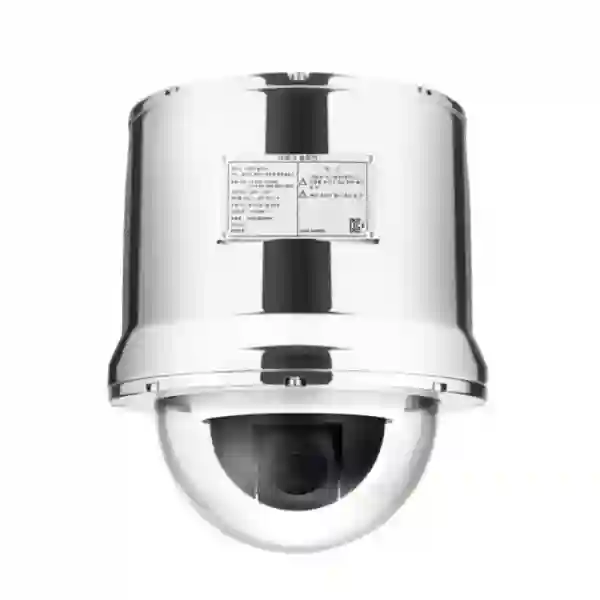
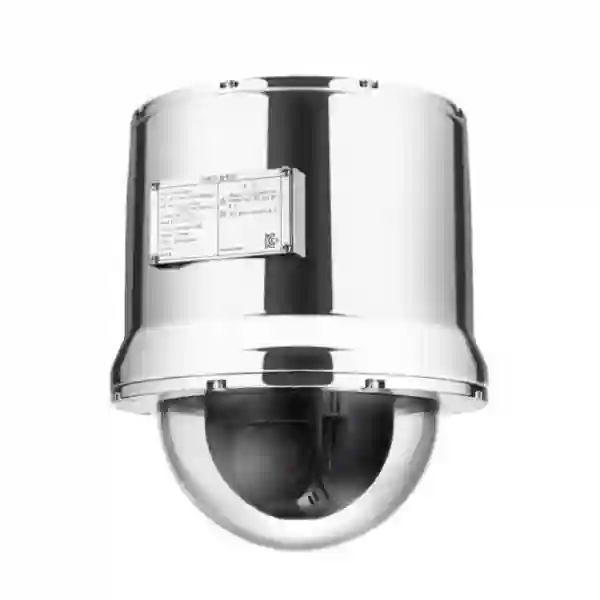
Hanwha Vision TNU-L2320E 2MP 32x Explosion-Protected PTZ Camera
Evaluate a specialised camera with Full HD imaging, 32x optical zoom, stainless-steel construction and manufacturer-documented explosion-protection information. Understand hazardous-area suitability, viewing performance and the engineering details needed for a sound purchasing decision.
Three decisions before ordering
- Confirm the exact unit certification and suitability for the site’s hazardous-area classification.
- Check the real viewing distances, obstructions, lighting and continuous-coverage needs.
- Verify power, installation accessories, VMS interoperability and written commercial terms.
Hanwha TNU-L2320E: industrial camera overview
The Hanwha Vision TNU-L2320E is a 2MP explosion-protected pan-tilt-zoom network camera designed for specialist surveillance systems where the installation environment may be hazardous. Its 32x optical zoom gives security operators a remotely adjustable view of selected equipment, industrial access routes and process surroundings. Polished SUS316L stainless steel, IP68 ingress protection and manufacturer-listed IECEx and ATEX documentation distinguish it from an ordinary weather-resistant camera. Correct application still requires an engineering check of the exact equipment and site.
A camera quotation should start with the surveillance objective and the location classification. Ask whether the camera needs to observe a distant gate, provide flexible visual awareness or inspect parts of a compound at different times. Establish whether all critical positions need continuous coverage. In Tanzania, verify the site requirements, intended mounting conditions and commercial scope before ordering. This is an optical camera for visual observation, not a gas detector, thermal imager or certified fire-detection device.
What explosion protection means for the buyer
A camera labelled IP68 may resist water and dust under defined conditions, but that alone does not make it suitable for an atmosphere containing flammable gas or combustible dust. Explosion protection relates to the equipment’s certified design and the conditions in which it can be safely installed. For a classified location, the complete installation may need properly selected cable glands, plugs, joints and supporting electrical equipment, not only a certified camera enclosure.
Hanwha Vision documentation identifies explosion-protection markings for this model family, including Ex db IIC T6 Gb and Ex tb IIIC T85°C Db. These should be checked against the exact supplied unit, certificate revision, permitted environment and the site’s classification drawing. A qualified responsible engineer must establish whether the chosen camera and accessory arrangement is suitable. The presence of international certificates is not a universal guarantee of approval for every Tanzanian facility.
32x optical zoom and real viewing distances
The lens spans 4.44–142.6 mm with 32x optical zoom. A short focal length can provide broad context, whereas a longer focal length frames a smaller area and makes a distant object occupy more of the picture. Optical zoom differs from digital enlargement because the lens itself changes the view. For industrial operators, this flexibility can make it easier to examine a remote entrance or an equipment approach without accessing the camera’s mounting location.
Zoom is not a fixed-distance identification guarantee. Dust, smoke, steam, heat shimmer, rain, glare and even small mounting vibrations can make a long-distance image less useful. Set realistic goals for what must be seen, measure the target distances and check the angle of view. Request an optical field-of-view assessment or demonstration before selecting the final mounting point. A higher zoom number cannot remove a physical obstruction or replace adequate lighting.
Full HD resolution and image expectations
The manufacturer specifies up to 1920 x 1080 resolution, commonly called 2MP Full HD. This provides a familiar digital video format that may suit industrial observation, but image detail is also determined by the number of pixels covering the target. A small subject occupying only a tiny portion of a broad image will be harder to study than the same subject tightly framed through the lens.
Agree on the use case first: general situational awareness, recognition of activity, access observation or close visual examination of a distant piece of equipment. Each may require a different field of view and camera position. Test video quality in representative conditions and inspect the recorded stream rather than relying on an attractive live preview. Avoid assuming that the resolution alone guarantees facial identification, number-plate capture or diagnosis of a mechanical fault.
PTZ operation and the limits of a moving viewpoint
A PTZ camera allows the operator to change the viewed direction remotely. Depending on system configuration, useful operating methods may include saved viewpoints and planned patrols. This can be valuable at industrial facilities where reaching a camera requires access permits, elevated work or interruption to operations. A single movable view is versatile, but it does not record every direction simultaneously.
Divide the monitoring plan into positions needing continuous video and positions acceptable for occasional inspection. Use fixed cameras to maintain uninterrupted coverage of the first group, with the PTZ helping operators examine other scenes as required. Consider who has control rights, whether a patrol can be interrupted, the time spent on each view and the desired default position. A wide range of movement is not a substitute for a complete coverage design.
Day/Night function and site illumination
Hanwha Vision lists Day/Night imaging for the TNU-L2320E. Industrial surveillance may involve a bright entrance, shaded process equipment, external floodlighting or night operations. Each environment needs a practical image-quality test. A visible-light camera depends on the available scene conditions and its configured exposure behavior. The statement Day/Night does not alone confirm an infrared illuminator or a usable image with no light.
If supplemental illumination is needed, plan it with the site’s electrical and hazardous-area specialists. A normal light fixture placed in a classified area can create its own engineering problem. Test the required subject positions at the lowest expected illumination, and assess motion blur, contrast and reflections. For critical views, it may be more effective to improve the lighting arrangement or viewing angle than to rely entirely on software adjustments.
Wide dynamic range and difficult contrast
Wide dynamic range is among the image capabilities identified by the manufacturer. It is intended to help scenes that contain both light and dark areas, such as a shaded loading structure with bright daylight beyond it. Many industrial surfaces reflect strong light, while pipework and overhead platforms create dense shadows. The practical outcome depends on the exposure settings and the particular scene rather than a feature label alone.
During acceptance testing, observe movement through a bright opening, reflective vehicles, sunlit concrete and the darker portion of the important work area. Review recorded playback as well as live video. If necessary details remain invisible, change the camera position or illumination plan. Even a camera with WDR cannot guarantee useful detail across unlimited contrast or overcome an obstructed line of sight.
Mechanical mounting and image stabilisation
The camera includes manufacturer-described gyro-assisted image stabilisation, a feature that may reduce visible shake. A long optical zoom makes even small physical movements easier to notice, so the structural mounting design remains critical. Wind, vehicle movement, motor vibration and flexible steelwork can affect a view from a pole or platform. Stabilisation cannot reliably solve every mechanical problem at the camera support.
Inspect the mounting arrangement, fasteners, bracket, cable support and access for servicing. Compare video quality at the widest useful view and the narrowest view required for the project. Perform that test while nearby machinery is operating where safe and appropriate. Resolve mounting vibration where possible. The equipment should be installed using compatible components and methods that preserve the required explosion-protection conditions.
Analytics for industrial surveillance
Hanwha Vision documents intelligent video functions associated with movement, tampering and virtual area or boundary events. Such features may help an operator review activity or receive alerts, subject to the chosen firmware and software integration. They are surveillance capabilities, not safety-rated controls. The camera must not replace industrial fire detection, gas detection, process interlocks or emergency shutdown equipment.
Working machinery, airborne dust, steam, shadows, lighting changes and reflections may produce unwanted events or make genuine activity harder to detect. Test the intended rules with a realistic operating scene, not only a quiet installation area. Define the action expected after each alert and who will receive it. Maintain a human-reviewed response workflow for important notifications, and never promise perfect detection from an untested combination of camera, scene and analytics settings.
Video codecs, recording and bandwidth
The TNU-L2320E supports H.265, H.264 and MJPEG encoding. The codec selected influences compatibility, available image quality, network requirements and storage consumption. Actual video bitrate varies with motion, exposure noise, scene complexity and chosen settings. A quiet fixed view may use different resources from a busy industrial yard where vehicles, people or moving materials repeatedly change the image.
Storage should be sized to a documented recording policy rather than an assumed universal bitrate. Agree on required quality, streams, frame rate and retention duration. Use representative test footage to check whether compressed details remain useful. Confirm that the NVR or video management system can record, play and export the selected stream. If the site needs resilience to network interruption, specify recovery and buffering requirements separately and verify actual device support.
VMS integration and network planning
An IP surveillance system depends on the network route between camera, recorder and operators. Identify switching equipment, transmission media, uplink capacity, time synchronisation and access controls at the design stage. Hanwha Vision documentation describes network integration capabilities for this model family, but that does not establish compatibility with every feature of every third-party recorder or software version.
Conduct a practical integration trial when the existing system is important. Confirm live video, PTZ movement, preset recall, recording, playback, event handling and restart recovery in the selected environment. Document any unsupported controls rather than assuming every advertised function will work automatically. The industrial-network design should also address authentication, segmentation, remote access and responsibility for maintaining camera firmware.
SUS316L and IP68 enclosure considerations
Hanwha Vision identifies polished SUS316L stainless steel and an IP68 ingress-protection rating. These are useful considerations when equipment is exposed to moisture, dust or challenging industrial surroundings. However, stainless steel is not immune to all corrosion conditions, and IP68 should not be treated as unlimited immersion tolerance or approval for every high-pressure cleaning process. Check the manufacturer’s actual environmental and maintenance instructions.
Assess the complete installed assembly, including any mounting structure, fasteners, cable entries, seals and ancillary housings. A durable camera can still fail to provide reliable video if its viewing surface becomes dirty or its support corrodes. Establish inspection intervals suited to the site and train the maintenance team on permitted cleaning methods. A material specification is a useful engineering input, not permission to neglect the assembly.
Gas and dust classifications: verify the exact location
At a complex facility, several hazardous-area classifications may exist close together, or some nearby positions may be unclassified. Flammable gas or vapour and combustible dust require distinct equipment checks. The camera’s exact mounting point and relevant electrical accessories must be evaluated against the site classification. Do not infer approval merely because an overseas retailer mentions Zones 1, 2, 21 or 22.
The project engineer should use the actual classification drawings, certificate documents, nameplate and installation standard to identify any constraints. Where the zone, substance group, temperature classification or permitted ambient conditions are uncertain, pause equipment approval until these are resolved. Preserve the assessment record with the technical submittal. A documented selection is stronger than a generic claim that the product is suitable for hazardous factories.
Cable glands, connections and safe installation
Explosion-protected equipment can be compromised by inappropriate installation accessories. Cable glands, conduits, plugs, entry threads and other components must match the certified equipment and the relevant installation rules. Merely fitting a connector into an enclosure opening does not establish its suitability. Ask the installer to provide the proposed connection details and the documentation needed for an engineering inspection.
Plan where network equipment, fibre conversion, power units and junction boxes will be placed. Each component may have different environmental or hazardous-area requirements. Document cable routes, sealing arrangements, support methods and earthing as applicable. The responsible specialist must determine the inspection and commissioning steps before the camera is energised. Later maintenance should not substitute ordinary parts for accessories that form part of the approved protection method.
Power configuration and backup requirements
The exact TNU-L2320E power requirements must be confirmed from the current manual for the supplied unit. Do not assume that any PoE switch, injector or generic camera supply will be compatible because a seller uses broad networking terminology. Verify power input, operating demand, cable design and any conditions imposed by the approved installation before purchasing electrical accessories.
For continuous surveillance, consider not just the camera but also its switch, network links, recorder and operator workstation. A powered camera cannot provide a useful stream when its connecting equipment is unavailable. Where backup power is needed, size and test the complete relevant path. After a planned controlled interruption, check video recovery, correct system time, PTZ operation and recording. Keep the tested arrangement in the handover file.
Camera location and viewing survey
Before selecting an installation point, record the intended subject distances, typical activities, lighting and physical obstructions. A high mounting position may show the general compound but provide limited detail at a gate or equipment entrance. Pipe racks, tanks, railings, parked vehicles and temporary maintenance structures may block important views. The 32x lens cannot see through an obstruction or eliminate atmospheric interference.
Choose positions based on the actual security task and the facility’s permitted installation locations. Determine whether safe access for inspection is possible, how the structural support behaves and whether later plant changes could affect coverage. Mark important views on a drawing and test them at the target distances. Integrators should also consider privacy requirements and appropriate operator controls when work areas are observed.
Fuel-handling and process-plant examples
One potential application is remote visual monitoring of a fuel-handling or chemical-process area where a competent safety study has identified a suitably classified installation location. Operators might need to inspect access routes, equipment approaches or a distant transfer area without visiting the camera. A PTZ view can provide useful flexibility, while fixed cameras may remain necessary for continuous coverage of safety-sensitive boundaries.
These examples are not a claim that the product is approved for every fuel or chemical location. Examine the site’s specific hazards, equipment marking, environmental conditions and installation plan. Reflective surfaces, bright lighting and movement may limit the scene. Video does not serve as a process safety instrument. The design must distinguish visual surveillance from the independent detection and response systems required by plant safety procedures.
Dusty processing and material handling
Industrial handling areas can generate airborne particles and deposits that affect both image quality and maintenance. A safety assessment must determine whether combustible dust is present at the mounting location and whether an appropriate dust-protected equipment design is required. IP68 ingress resistance and certified explosion protection are different checks and must not be conflated.
Dust may reduce contrast, collect on the viewing surface and cause analytics alerts unrelated to security incidents. Place the camera where cleaning and inspection can be carried out under appropriate site procedures. Test video during representative operating activity, not only when material movement has stopped. Consider whether multiple fixed viewpoints offer better uninterrupted observation than a single PTZ that must move from one process section to another.
Compare shorter-zoom and fixed alternatives
The TNU-L2320E is especially relevant when a project combines classified-area installation requirements with the need for long-range optical framing. Hanwha Vision also lists TNU-L2120E and TNU-L2040E in the lightweight explosion-protected family, with shorter zoom capabilities in manufacturer literature. A full comparison still requires current exact-model certificates, imaging features, installation instructions and compatibility information.
A fixed explosion-protected camera may provide a more dependable continuous record of one critical entrance. A shorter-zoom PTZ may be adequate for a small plant area. Choose among them using the intended image objective, distance, lighting, coverage continuity and lifetime support needs. The largest zoom range is not always the best solution, particularly where fixed views are the primary security requirement.
Cybersecurity and recording access
Every networked camera should be treated as an asset with an accountable owner, recorded configuration and controlled accounts. Distinguish administrators who may change firmware or networking from operators who only need the permitted viewing functions. Avoid unnecessary direct internet exposure and use the organisation’s approved secure remote-access design.
Check whether the selected firmware and management platform support the cybersecurity controls required by the facility. Record camera identifiers, installed locations, approved access arrangements and update responsibility. Include the device in backup and replacement planning. Appropriate technical governance supports a reliable surveillance operation and helps prevent a correctly installed industrial camera from becoming a poorly managed network endpoint.
Tanzania buying and quotation checklist
For a Tanzania enquiry, give the proposed quantity, exact model, installation environment, hazardous-area drawing, target viewing distances, network and recorder details and any required certificates. Ask the supplier to state precisely what equipment and accessories are included. A unit-only quotation should not be compared directly with one covering engineered cable entries, mounting, integration, inspection and commissioning.
Current target-listing SKU, stock, price, local warranty, delivery time, installation coverage and service commitments have not been verified. Do not infer them from overseas sellers or translate foreign prices into an unsupported local quote. Request commercial terms in writing and confirm the exact product variant. The manufacturer notes that regional product availability can differ, so documented supply confirmation is particularly important.
Commissioning and handover
Before energising equipment installed in a classified area, competent authorised personnel should complete the applicable technical and safety inspections. Verify supplied equipment identity, markings, approved accessories, connections and installation records. After safe energisation, test video and zoom at the actual subject distances, including representative challenging light conditions and the relevant range of movement.
Check VMS controls, expected recording operation, playback and exported footage, notification behavior and recovery after a controlled restart. Handover should include configuration, firmware, responsible contacts, documented acceptance results and permitted maintenance methods. A good commissioning record makes future faults easier to diagnose and establishes whether the surveillance solution meets the agreed operational objective.
Maintenance and long-term suitability
Industrial environments and camera duties can change after installation. Set regular inspections for the enclosure, seals, mounting structure, viewing surface, cable interfaces, network connection and recording health. Look for vibration, obstructed views, focus changes, corrosion or recurring false alerts. The frequency and procedure should reflect the actual environment and the manufacturer’s instructions.
Changes to a certified enclosure, cable entry or related component require appropriate engineering control. Keep replacement parts and maintenance records traceable. Firmware updates and recorder changes may also require integration tests. A camera that performs well at handover still needs authorised servicing and periodic functional review to remain useful throughout its operational life.
How to define useful surveillance performance
Write down what success means for each intended view before assessing hardware. A security team may need to notice activity at a gate, determine the direction of a vehicle or verify whether a worker entered a restricted route. A maintenance team might want a general look at a remote piece of equipment. Each task sets a different need for pixels on target, viewing angle, lighting and time spent observing the scene.
Use these tasks to set a realistic acceptance plan. Choose test targets at the farthest relevant distance and check recorded video under the expected activity. Some needs call for fixed continuous observation; others benefit from optical zoom and operator control. Avoid purchasing solely by comparing camera specifications without a defined operational outcome.
Presets, patrols and operator permissions
A PTZ installation often benefits from carefully chosen positions that correspond to work areas. When supported by the selected system, presets can help an operator return to a familiar gate, loading area or equipment approach. A patrol pattern can also introduce periods when the camera looks elsewhere. If a critical event lasts only a moment, it may be missed while the camera is travelling between views.
Decide who may control the camera, whether an operator can override an automated movement and what should happen after an interrupted session. Confirm the selected VMS or recorder handles those controls reliably. The agreed operating procedure is part of the camera design, not just an informal preference left for the control room.
Operational conditions can change over a day
Daytime commissioning alone may hide a weak viewing design. Sunlight changes direction, vehicle headlights create glare and security lighting casts shadows. Equipment can release vapour or stir up dust at particular operating periods. A long-zoom image that looks sharp on a quiet afternoon may become less useful when machinery runs and vibration increases.
Schedule tests around the conditions that matter to the site. Check the wide view and the narrow inspection view, evaluate recordings in low light and confirm that movement-related alerts are not dominated by harmless process activity. If performance differs from the requirement, investigate placement, lighting, mounting or configuration instead of simply accepting a feature-name claim.
Safe access and planned service interruptions
An industrial camera may be mounted in a location that cannot be reached during normal operations. Before ordering, identify how authorised personnel will inspect or maintain it, what access equipment is required and whether work must take place during a shutdown. A camera that is easy to control remotely can still be physically difficult to clean or repair.
Document the safe access method and retain approved component information. Where a hazardous-area enclosure must be opened, site rules and manufacturer requirements govern the work. Procurement teams should consider these lifetime costs alongside the purchase quotation. Good maintenance planning can reduce avoidable downtime and prevent unauthorised changes to the certified assembly.
Evidence quality is more than disk capacity
A surveillance system can store many days of video while still failing to preserve useful evidence. Heavy compression may conceal fine details and an incorrect time setting can confuse incident review. A moving PTZ may also be looking in a different direction when a short event occurs. These issues cannot be fixed merely by adding a larger hard drive.
Agree on recording quality, clock synchronisation, required views and a practical retrieval procedure. During handover, ask an operator to locate and export a known test event. Confirm that the clip plays on the intended review device and that access to evidence follows the organisation’s permissions. This provides a meaningful operational test of the complete system.
Scope boundaries for an industrial security quote
The camera body is only part of an installed security solution. Depending on the site, a complete scope may also involve approved mounting hardware, hazardous-area cable-entry parts, protective electrical equipment, network transmission, recording software, operator training and engineering inspections. It is important to state which elements are included in the supplier’s quotation.
Ask the proposer to list exclusions, configuration assumptions and documentation deliverables. Ensure engineering approval and installation responsibilities are clear between contractor, facility and system integrator. When two quotes use different assumptions, price alone can be misleading. A defined scope prevents late surprises and supports fair technical evaluation.
Selecting between surveillance and safety functions
Video may support operational awareness, but it is not a substitute for the instruments and procedures used to maintain process safety. A camera does not establish the presence or absence of flammable gas, prove a vessel temperature or certify that a hazardous process is safe. A movement alert should not be presented as a protective safety function without an appropriate independent assessment.
Keep visual surveillance requirements separate from gas detection, fire monitoring and emergency response specifications. If the facility wishes to correlate video with other alarms, the integration should be designed and validated through the responsible safety and control specialists. This distinction protects buyers from attributing functions to the camera that the manufacturer has not substantiated.
Technical specifications summary
This quick reference includes confirmed manufacturer characteristics and essential qualifications. Obtain the current exact-model datasheet and certification instructions before final engineering approval.
| Manufacturer / model | Hanwha Vision / TNU-L2320E |
|---|---|
| Camera type | Explosion-protected network PTZ |
| Imaging | 2MP Full HD, 1920 × 1080 |
| Image sensor | 1/2.8-inch CMOS |
| Lens | 4.44–142.6 mm |
| Optical zoom | 32x |
| Video features | Day/Night, WDR, gyro-based stabilisation |
| Compression | H.265 / H.264 / MJPEG |
| Housing | Polished SUS316L stainless steel |
| Ingress protection | IP68 |
| Hazardous-area documentation | IECEx and ATEX documents listed; check exact marking and conditions |
| Tanzania SKU, price, stock | Unverified for target listing; do not assume availability |
Frequently asked questions
Is this a thermal camera?
No. The TNU-L2320E is an optical Full HD PTZ network camera. It does not become a temperature sensor simply because it belongs to an industrial camera range. Thermal imaging, gas detection and flame detection must be procured and validated as separate requirements.
What optical zoom does the camera have?
The specified lens spans 4.44–142.6 mm and provides 32x optical zoom. This can give a closer view of distant equipment while narrowing the area shown. Useful identification distance still depends on subject size, lighting, obstruction, atmosphere and mounting stability.
Does IP68 prove explosion protection?
No. IP68 concerns ingress of water and dust under defined test conditions. Explosion-protection design, certification and installation are different matters. The exact hazardous-area equipment markings and conditions must be checked against the actual classified installation location.
Does it have IECEx and ATEX documents?
The manufacturer lists IECEx and ATEX documents for the model family. Request the exact current certificate set and verify nameplate, conditions and installed accessories. Those documents do not automatically establish acceptance under every national or site-specific requirement.
Is the camera suitable for any gas or dust zone?
No. A responsible qualified engineer must compare the exact certification marking, protection type, temperature conditions and accessories with the facility’s formal classification. A generic supplier description or the name of an industrial sector is insufficient.
Can one PTZ record all directions at the same time?
No. The camera records the scene in which it is pointed. Movement or zoom changes what remains in the frame. If specific locations must be continuously recorded, combine it with suitable fixed cameras or another multi-camera design.
Does Day/Night guarantee visibility in total darkness?
No. Do not assume integrated infrared illumination or a stated zero-light performance without confirmation for this model. Evaluate the actual lighting and use appropriately assessed supplementary equipment where needed, especially inside classified areas.
Can the model work with our existing NVR?
Potential compatibility depends on the exact recorder, software and firmware. Test live streaming, zoom control, presets, recordings, playback and selected notifications before a major purchase. Common network-video standards do not guarantee all functions on every platform.
Can its analytics replace safety detection?
No. Camera analytics can support surveillance but are not a substitute for a dedicated certified gas, fire or process protection system. Industrial safety systems require separate engineering and validation.
Will the stainless-steel enclosure need cleaning?
Yes, inspection and cleaning may still be necessary. Dust, process deposits, chemical exposure and damaged interfaces can reduce performance. Follow manufacturer guidance and authorised site procedures for any work involving an explosion-protected assembly.
Should we choose a fixed or PTZ camera?
Use a fixed camera where uninterrupted observation of one location matters most. Use a PTZ where operators need flexible direction and optical zoom. The right system may combine both approaches, subject to the area’s equipment requirements.
What details should a Tanzania quotation include?
Provide the exact model and quantity, area-classification drawings, installation location, viewing distances, lighting, network system and required documentation. Request written confirmation of current supply, compatible accessories, commercial terms and any services included.
Request a Hanwha TNU-L2320E quotation
For a Tanzania industrial project, contact FourTeck Tanzania with the proposed quantity, use case, hazardous-area classification, camera positions and recorder requirements. Ask for the exact supplied model specifications, appropriate certificates, compatible installation accessories and a written technical and commercial offer. Procurement or installation should not proceed without the site’s required qualified hazardous-area assessment.
Availability, stock, local price, warranty, freight, delivery and installation services are not verified for this listing and must be confirmed directly. A strong design connects appropriate equipment selection with practical image quality, reliable recording and safe long-term maintenance. The Hanwha TNU-L2320E explosion-proof PTZ camera should be reviewed as part of that complete industrial surveillance system.




Reviews
There are no reviews yet.