
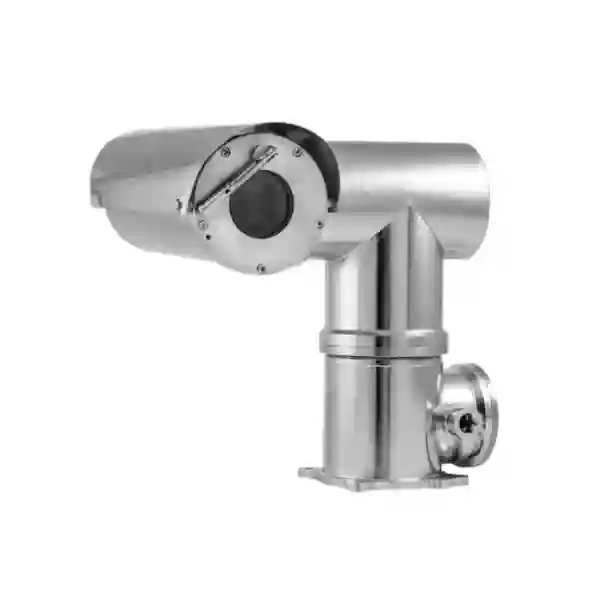
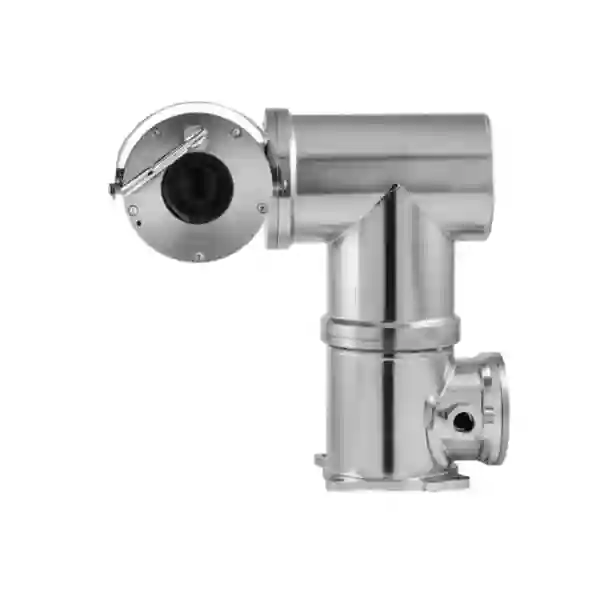
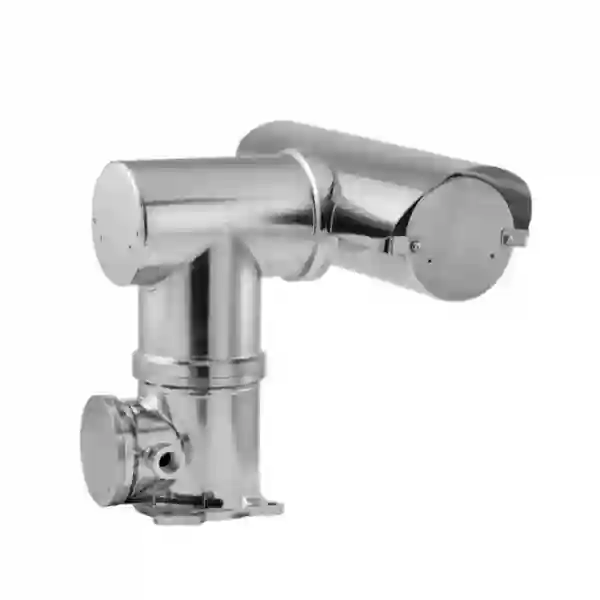
Hanwha TNU-X6320A1F2WT1-Z Explosion-Proof PTZ Camera
A 2MP full-HD explosion-protected positioning camera with 32× optical zoom, single-mode fibre networking, integrated wiper, stainless-steel construction and a 24VAC power requirement. Select it through a qualified site-specific engineering review.
Verified specifications at a glance
| Exact model | TNU-X6320A1F2WT1-Z |
|---|---|
| Camera | 2MP, 1920 × 1080; 1/2.8-inch CMOS |
| Lens | 4.44–142.6 mm; 32× optical / 16× digital zoom |
| PTZ movement | 360° pan, −90° to +90° tilt |
| Imaging | 120 dB WDR, day/night ICR, gyro-assisted digital stabilisation |
| Streaming | H.265, H.264, MJPEG, WiseStream II |
| Network | F2 duplex single-mode 9/125 µm optical module; 10/100 Mbps |
| Local memory | Two microSD-type slots, up to 256 GB each |
| Housing | 316L stainless steel, toughened-glass viewing window, integrated wiper |
| Electrical supply | 24VAC, maximum 80W |
| Environmental limits | IP66/IP67; −40°C to +60°C |
| Size and weight | 418 × 457 × 401 mm; approximately 33 kg |
| Published hazardous certification | cLCus Class I, Division 1; confirm site and local acceptance |
Exact-model specifications are based on published Hanwha Vision information. Always confirm current drawings, certificate conditions, hardware revision and project compatibility.
For Tanzania industrial project enquiries
Request a quotation and technical review against the complete model code. Include the required viewing tasks, classification drawings, fibre connections, power design and installation location. Prices, stock, warranty, local certification acceptance and service coverage require individual confirmation.
What this explosion-protected PTZ camera is for
The Hanwha TNU-X6320A1F2WT1-Z is intended for surveillance design in demanding industrial environments where both a useful camera view and a carefully selected protected enclosure matter. Instead of treating a camera as a generic outdoor accessory, an engineer must review the hazards at the installation point, the viewing distance, structural conditions, electrical supply and network infrastructure. This model combines 2MP network imaging with motorised positioning, 32× optical zoom, industrial construction and single-mode fibre connectivity. It is relevant to projects that need to inspect multiple process or security targets from one controllable viewpoint.
That does not mean every industrial site needs this product. A fixed conventional camera may better serve a continuous single view, while a different protected camera may be required by another hazardous-area scheme. The correct starting point is the site’s camera schedule and classification drawings. Define what users must see, when they must see it, and the installation conditions before deciding that a highly specialised PTZ is the right investment.
Exact model code: avoid costly substitutions
The complete model number is not optional detail in an engineering purchase order. TNU-X6320A1F2WT1-Z identifies a particular combination of power, fibre interface, wiper, temperature range and certification variant. The manufacturer’s exact-model information lists 24VAC input, the F2 single-mode fibre option, an integrated wiper, a −40°C to +60°C operating range and cLCus Class I, Division 1 certification. Neighbouring products in the TNU-X6320A family can use different voltage arrangements or certification versions.
Ask a supplier to repeat the exact model code on the quotation, order acknowledgement and delivery documentation. Compare that designation against the project bill of materials and applicable certificate schedule. A change to a nearly identical part number should trigger a technical review rather than automatic acceptance. This is especially important for classified locations because communications, power and approval markings can be more important than the apparent similarity of the camera housing.
Understanding the hazardous-area requirement
Explosion-proof is a useful product category, but hazardous-area selection needs a specific engineering decision. The manufacturer identifies this Z version with cLCus Class I, Division 1 certification. That statement describes its published approval configuration; it is not a promise that the camera is automatically accepted for every country, zone classification, gas environment or site-owner standard. A qualified specialist should review the exact equipment marking and certificate conditions against the proposed installation point.
The project also needs compatible cable entries, appropriate terminations and an installation method that preserves the required protection concept. Do not confuse a camera’s IP rating with explosion protection, because ingress tests and hazardous-area approvals address different concerns. Even the correct camera may be unsuitable if an enclosure is connected with unapproved accessories or located where its certificate conditions are not met. Ask for the current certificate and installation documents during technical evaluation.
Full-HD imaging and the right level of detail
The camera uses a 1/2.8-inch CMOS image sensor and supports 1920 × 1080 full-HD video. Its 2MP resolution may be sufficient for many industrial monitoring tasks, including general process observation and selected close views when the lens is aimed appropriately. The resolution alone does not determine whether an operator can identify a person, read a label or distinguish a small component. Target size, distance, mounting angle and illumination all influence how many useful pixels reach the image.
For each required view, establish the task in practical terms. Observing whether a gate is open has a different detail requirement from reading an instrument display. An engineer should calculate or test pixel density at the intended distance and optical setting. A camera demonstration using an unrelated scene is not a substitute for checking the real target. If a project has a strict 4K requirement, this full-HD camera should not be represented as a 4K product.
32× optical zoom: framing near and distant targets
Hanwha specifies a 4.44–142.6 mm motorised lens with 32× optical zoom and an additional 16× digital zoom capability. The published horizontal field of view changes from about 64.44 degrees at the wide setting to approximately 2.29 degrees at full telephoto. This range helps an operator alternate between understanding a broader industrial scene and examining a particular point of interest. Optical zoom changes the way the lens captures the image rather than merely magnifying recorded pixels.
The narrow telephoto view is useful for distant details, but it also magnifies vibration and makes it easier to lose context. Digital zoom enlarges the available pixels without adding new optical information. Evaluate required targets at their actual distances, taking into account motion, lighting and line-of-sight obstructions. The design should document both a broad overview position and named detail presets when these are important to the operator’s workflow.
Pan, tilt and preset-based monitoring
The published mechanical range includes 360-degree pan and tilt from −90 to +90 degrees. Maximum preset pan speed is listed as 45 degrees per second and tilt speed as 24 degrees per second. These capabilities allow a control-room operator to direct the camera among known targets, such as equipment groups, pathways and access points. Configured presets can make routine inspection more consistent because the operator does not need to recreate a viewing angle every time.
However, one moving PTZ cannot maintain a detailed view of several directions simultaneously. Where permanent coverage is essential, complement the camera with fixed units or additional viewpoints. Establish who may operate the PTZ, how automated tours are scheduled and what should happen when an event redirects its view. Before handover, check the actual coverage of each preset and verify that moving machinery or nearby structures do not block the intended target.
Day-and-night monitoring and minimum illumination
The model supports automatic day-and-night switching using an infrared-cut filter. Hanwha publishes minimum illumination values of 0.05 lux for colour and 0.005 lux for black-and-white under its specified test conditions. These values are useful for comparing candidate equipment, but they do not guarantee clear images in every unlit industrial environment. A moving subject, long focal length, dirty window or exposure setting can materially change the usefulness of recorded video.
Do not infer that this model is a thermal imager or includes an infrared floodlight. Neither capability is established by the manufacturer’s exact-model feature summary. Survey lighting at the proposed mounting position and consider changes between shifts, weather patterns and maintenance outages. Where additional illumination is needed, its suitability for the environment and hazardous-area requirements must be assessed independently. Test night views at both wide and zoomed framing before acceptance.
120 dB WDR for challenging contrast
Wide dynamic range is listed at 120 dB for this model, alongside backlight and highlight compensation, noise-reduction controls and day-and-night processing. WDR is relevant where bright work lighting appears close to shadowed machinery, or where an entrance alternates between intense daylight and a covered interior. Used appropriately, processing can help preserve information from different parts of a high-contrast scene and make an operator’s view more readable.
Image processing still needs realistic configuration. Glare from reflective pipework, lamps shining into the lens and fast movement can reduce visible detail despite a strong published WDR figure. Inspect the scene at the hours when glare is most likely and examine both the highlights and the dark areas. The performance requirement should be expressed as a useful visual result, not simply the presence of a WDR feature on a specification sheet.
Stabilisation, defog and visible image quality
The camera includes digital image stabilisation with a built-in gyro sensor and a defog function. These features may improve the usability of images from industrial structures that experience vibration or from scenes affected by atmospheric haze. The effect is particularly noticeable during long-range observation because a small movement of the mounting point can produce a large apparent movement of a distant target. The camera also provides focus and exposure controls for tuning image quality.
Neither electronic stabilisation nor defog can correct every physical problem. Significant vibration, heavy smoke, dense fog, contaminated glass or complete obstruction can still prevent useful observation. Review structural movement at the chosen mounting height and test picture quality under representative plant operating conditions. Image enhancement should be treated as a useful supporting capability, not as a substitute for a rigid support, sensible camera placement and adequate visibility.
Integrated wiper and toughened-glass window
The product has an integrated wiper and a camera station window described as toughened glass. This is a meaningful feature for exposed locations where water on the window could prevent an operator from checking an important scene. Clearing the window remotely may reduce interruptions caused by ordinary rainfall. In some industrial workflows it also avoids a needless visit merely to recover a usable picture after wet weather.
The presence of a wiper does not imply that every contaminant is removed. Salt deposits, sticky residues, fine dust and chemical splashes can require special cleaning procedures. A washer tank or related optional equipment should not be assumed to be included in the standard camera supply. Confirm any accessories by exact part and assess how they would be powered and mounted. Maintenance personnel should follow the manufacturer’s instructions and the applicable safety procedures for the installation area.
316L stainless-steel enclosure construction
Hanwha identifies the enclosure material as STS316L and specifies electro-polished 316L stainless steel on welded assemblies. This makes the camera relevant where an ordinary painted housing may be a weak fit for demanding industrial exposure. Its substantial construction is part of the station’s specialist character. The material can be a useful selection factor in coastal or moisture-exposed projects, subject to a review of the actual chemicals and environmental conditions.
The rest of the installation also matters. Mounting brackets, fasteners, glands and nearby metalwork may have different corrosion properties from the camera body. Dissimilar materials, damaged seals or unsuitable cleaning chemicals can undermine the intended durability of an otherwise appropriate assembly. Ask the design team to evaluate the full mounting system and its maintenance requirements. Do not assume that a stainless-steel product is universally immune to corrosion or needs no inspection.
IP66/IP67 protection and environmental limits
The camera is listed with IP66 and IP67 ratings under IEC 60529, along with an operating temperature range of −40°C to +60°C. Hanwha’s environmental information also specifies operating humidity up to 90 percent relative humidity under non-condensing conditions. These details support initial environmental screening, especially for exposed industrial monitoring positions. They do not remove the need to consider actual local temperatures, direct solar heating, process heat, water exposure and condensation risks.
IP ratings are linked to defined test conditions and correct installation. They should not be interpreted as permission for any cleaning method, unlimited immersion or poorly sealed cable entry. The project’s engineer should review the manufacturer’s installation instructions and the relevant certificate conditions. Maintain appropriate inspection and sealing procedures after service work. The mounting site’s local microclimate can differ materially from a published weather reading, so design decisions should use realistic conditions at the equipment.
Single-mode fibre network connectivity
The F2 variant incorporates a duplex single-mode 9/125 µm fibre network interface. This is an important distinction for plants that already rely on optical backbones or need to connect a camera station to more distant switching equipment. The manufacturer’s networking information lists an RJ-45 Ethernet interface and a single-mode module for F2 versions, with 10/100 Mbps communication. The final design must reflect the physical connections and hardware actually supplied with this exact revision.
Do not infer a guaranteed fibre distance from the term single-mode. Optical reach depends on the selected optics, network endpoint, attenuation, splices, connectors and fibre plant. Confirm the termination requirements and network compatibility through the current installation documentation. The optical connection carries data; a separate electrical supply is still required. Network engineering and electrical engineering should therefore be coordinated rather than treating the fibre selection as an all-in-one wiring solution.
24VAC power and maximum 80W consumption
Hanwha lists 24VAC as the input voltage for this exact part number and a maximum power consumption of 80W. This camera should not be specified as if it were a conventional PoE-powered office PTZ. A network switch cannot be assumed to provide the required supply through the fibre link. The electrical scope must separately address an appropriate power source, cable routing, protection, bonding and any necessary isolation at the site.
A qualified designer should establish how voltage is maintained at the equipment under operating conditions and whether additional approved accessories affect the electrical design. Cable sizing, protection and supply selection require more than simply copying the maximum wattage into a parts list. Consider system behaviour after an outage and the consequences for monitoring continuity. The final arrangement must be reviewed against the manufacturer’s instructions and the hazardous-area design.
Codec selection: H.265, H.264 and MJPEG
The camera supports H.265, H.264 and MJPEG encoding, with WiseStream II among its stated processing features. The specification lists up to 60 frames per second for H.265 or H.264 under the 60 Hz configuration and 50 frames per second under 50 Hz operation, while MJPEG is listed at up to 30 frames per second. These capabilities allow a project to balance fluid live viewing, bandwidth and recording requirements.
An efficient codec does not automatically make every scene low-bandwidth. Industrial movement, low-light noise, changing weather and image-detail settings can increase bitrate. Specify the chosen resolution, frame rate, encoding, bitrate control and retention period before sizing recording storage. Use representative video samples rather than relying entirely on a nominal bitrate estimate. Verify recorder compatibility with the selected stream formats, especially where older equipment or third-party software is already installed.
Multiple streams for control rooms and recorders
Hanwha lists up to ten video profiles and support for multicast, together with a maximum of twenty unicast users. These functions are useful when a camera must provide a high-quality stream for recording while offering a smaller or lower-bandwidth view on an operator dashboard. The network can be designed around distinct needs instead of sending the same stream to every consumer of video.
Published streaming limits are not a promise that every profile can run at its maximum settings simultaneously in any combination. Performance depends on configuration and the supporting network. Document the intended viewers, software connections and recording paths. Test remote viewing, operator control and simultaneous recording during commissioning. Also establish which users may change the PTZ direction; access rights and control-room procedures are needed to prevent different users from competing for control of the same viewpoint.
Recorder and VMS integration planning
The manufacturer lists ONVIF Profiles S and G, RTSP and Hanwha SUNAPI among the interfaces associated with this model. These are useful integration options for IP surveillance systems, but they are not an unrestricted compatibility guarantee. A video management system might support live viewing yet offer only partial access to presets, event handling, recording search or edge-storage functions depending on its software and drivers.
Before purchasing for an existing site, identify the exact recorder, VMS version and functions that matter to operators. Test live video, PTZ movement, presets, event notifications, recording, playback and time synchronisation using an approved configuration. If the system relies on a specific camera feature, make that capability a stated acceptance item. Avoid treating protocol logos as proof that every specialised integration requirement has been resolved.
Cybersecurity controls and network segmentation
The model specifications describe HTTPS, SRTP, IEEE 802.1X authentication options, IP-based access control and system or event logging. These features support a managed surveillance endpoint when configured correctly. The operating organisation still needs a cybersecurity design covering credentials, firmware maintenance, administration rights, time sources, network segmentation and documented recovery procedures.
Where cameras connect to an industrial operations network, the project should define which systems can communicate with the camera and which users can change settings. Restrict unnecessary services and review event logs in accordance with site policy. Protect configuration backups and document the approved firmware baseline. No camera should be described as immune to cyberattack. Security features have value only when deployed, tested and maintained within a wider access-control and monitoring process.
Video analytics and their practical limitations
Hanwha lists motion detection, tampering, fog detection, face detection, shock detection, virtual lines and virtual areas among the camera’s analytics functions. These can support operational awareness by directing attention to movement or changes within a chosen image region. For example, a virtual line may be configured to create an event when a subject crosses an area that is consistently visible from the current camera position.
Detection accuracy depends on the scene, mounting height, lighting, object size, occlusion and the selected settings. An analytic event is not a certified safety alarm or a guarantee that an operator has identified a hazard. Test likely false alarms and missed events, and define an operator response that makes sense for the location. Do not represent the camera as a replacement for fire detection, gas monitoring or an independent process-safety system.
Event handling and PTZ response
The published operational features include analytic and network-disconnection triggers, with actions such as notifications, selected recordings and movement to PTZ presets. These options may be valuable when a control room must investigate an unexpected change at a known location. A well-designed workflow determines which events are important and which staff members should receive them rather than automatically alerting everyone about every type of motion.
Event configurations should be tested under realistic conditions. Establish how footage is retained before and after an event, how time is synchronised and whether alerts remain useful during a temporary network failure. Consider what happens if the camera is already looking at another safety-relevant scene when a preset command arrives. Analytics and automation should support defined human procedures, not replace the organisation’s approved safety and incident-response systems.
Two microSD slots and edge recording
The camera is specified with two microSD, SDHC or SDXC slots supporting up to 256 GB per slot, a total published capacity of 512 GB. Edge storage can assist selected event recording and may be useful in a network-resilience strategy. The actual retention period depends on bitrate, recording schedule, video quality, activity and the storage media used. An engineer should verify current supported card types and recommended usage through the manufacturer.
Memory cards have finite endurance and are not a complete substitute for a central evidence-management system. Decide how recordings will be recovered, reviewed and protected. If the project requires continuous retention or strict audit procedures, design the recorder and storage infrastructure accordingly. Because this is a specialist enclosed camera, physical access for media service must follow the manufacturer’s maintenance instructions and hazardous-area procedures.
Mechanical size and a 33 kg installation load
Hanwha gives approximate dimensions of 418 × 457 × 401 mm and a weight of 33 kg for the model. These are substantial figures that affect brackets, wall fixings, poles, mast capacity and installation access. A location suitable for a lightweight dome may not be structurally or operationally appropriate for this equipment. The support structure should be assessed for the camera, its accessories and the environmental loads expected at the site.
Obtain the current dimension drawing and approved mounting instructions before committing to a fixing point. Consider vibration, clearances, movement envelopes, access for inspection and the route for cable termination. Plan safe lifting and handling for installation personnel. A rigid mount is also important for useful images at long zoom settings, where apparently small movements of the support may create visible picture instability.
Cable entries, glands and connection design
Hanwha’s TNU-X6320A family literature describes dual NPT cable entries intended to support equipment termination. On a hazardous-area project, the type and installation of glands, seals and other connection accessories can be critical to maintaining the required protection concept. The project must follow the exact model’s current manual and certificate conditions rather than selecting ordinary outdoor fittings by appearance.
Coordinate optical fibre and electrical power routes before ordering the bracket or preparing the installation site. Check conduit approach, bending space, safe termination access and appropriate protection of exposed cables. Determine exactly which fittings are supplied with the camera and which must be sourced separately. Small omissions in this area can prevent commissioning even when the camera itself is correctly specified, so document the entire interface schedule in the technical quotation.
Industrial site survey: views, risks and infrastructure
A useful survey begins by naming the actual observation tasks. Mark the target areas, expected distances, moving obstructions and desired visual detail on a drawing. Decide which views need continuous attention and which may be checked periodically with PTZ presets. Examine daylight, night lighting, glare, moisture and vibration at the proposed camera position. A camera chosen only from a catalogue may look impressive yet provide poor coverage of the operational task.
The same survey should capture hazardous-area classification, temperature and corrosion exposure, mounting constraints, power availability and the fibre network route. Identify the proposed recorder and control-room software. Ask site personnel how the view will be used in normal shifts and during an incident. The result should be a documented set of selection criteria, not just a point on a site plan.
Use case: fuel-transfer and loading operations
A fuel-transfer facility might want an operator to check several valve areas, transfer points or vehicle positions without approaching every item for routine visual observation. A protected PTZ with optical zoom and a wiper may be relevant to that design. It can help the operator switch between a wider scene and selected details, provided the view remains clear and the installation location is suitable for the exact camera certification.
Do not assume every part of a terminal has the same hazardous classification. A competent engineer must check the specific mounting point. The design should also identify any views that cannot be lost while the PTZ moves. Fixed surveillance or dedicated process instruments may still be required. Video provides supporting awareness; it does not replace leak detection, shutdown systems or approved operational procedures.
Use case: outdoor equipment yards
An outdoor industrial yard may contain pumps, service routes, access points and assets at different distances. The 32× lens and wide PTZ movement range can help staff inspect selected locations from an elevated camera position. Named presets can simplify repeat viewing of equipment groups, especially when control-room personnel change between shifts. The stainless enclosure and environmental protection are useful considerations for an exposed installation.
An elevated camera also introduces blind spots below the support or behind large equipment. High zoom settings may make a vibration problem more obvious. Survey all critical targets and verify image detail using realistic distances and light. If any location requires continuous observation, use another suitable fixed viewpoint rather than relying on a touring PTZ. The mounting environment, not simply the site’s industrial label, determines the needed hazardous-area approval.
Use case: marine-exposed industrial assets
Coastal industrial facilities may give special attention to corrosion, rainfall, wind and maintenance access. The camera’s 316L stainless construction and integrated wiper can be meaningful selection factors in such environments. Fibre networking may also fit a design that brings video from a distant industrial structure to a central operations room. These are reasons to investigate the model, not assurances that it will be suitable for every marine site.
Review the complete installation assembly, including fasteners, brackets, glands and associated materials. Assess local contaminants, salt accumulation, vibration and the feasibility of safe cleaning. Confirm the applicable hazardous-area requirements and installation documentation. A product with a corrosion-resistant body still requires compatible accessories and planned maintenance. The engineering team should explicitly approve the combination rather than relying on the camera housing material alone.
Use case: access routes and perimeter observation
A controllable PTZ can provide broad observation of an industrial access route, gate or perimeter sector and allow a closer view when an event needs investigation. Day-and-night operation, WDR and selected analytics may support this workflow where the scene is suitable. A control-room design can use preset names that refer to actual gate positions, service routes or equipment zones so that different operators work consistently.
Privacy and operational responsibilities require attention. Configure access rights and relevant masks, and test whether preset movement still provides acceptable views. Tune virtual-line or motion events against real traffic and lighting changes to avoid low-value alert volumes. The camera should not be represented as an automatic guarantee of perimeter detection, and a fixed overview camera may be appropriate where constant coverage cannot be interrupted by PTZ movement.
Use case: remote visual inspection
Some assets can be difficult or inconvenient to approach while a plant is operating. A long-range optical zoom camera may allow authorised staff to review a visible condition from the control room before deciding whether further investigation is necessary. Its pan-and-tilt capabilities let a single station face several inspection points, while presets help reproduce the same view for routine checks.
The camera is not an instrument for measuring process values by itself. Small gauges, reflective surfaces and distant labels may not be readable at a given location. Specify the intended target and test the achievable detail. Important measurements should remain with suitable dedicated instrumentation and procedures. Remote video is best treated as contextual information that complements, rather than substitutes for, safe physical inspection and approved process monitoring.
Compare fibre, power and certification variants
Within this product family, similar model numbers may represent different choices for fibre communication, electrical supply, temperature range and certification. The F2 part of this exact model identifies the optical-network option, while the manufacturer specifies 24VAC for the A1 power variant. A superficially similar unit should not be substituted for the specified product without confirming that the same infrastructure and hazardous-area conditions are supported.
An earlier Hanwha model, the TNU-X6320E1F2WT1-Z, is identified by the manufacturer as having this A1F2 version as its replacement. That replacement relationship does not automatically establish that every existing mount, cable or approval will transfer without change. For an upgrade, compare the current dimensional drawing, electrical connections, certifications and VMS integration. Record any differences in a formal technical review before ordering equipment.
When a different camera would be preferable
A specialist protected PTZ is not always the most economical or operationally sound surveillance choice. A fixed camera may be better when one target must be recorded continuously. A conventional outdoor PTZ may fit a non-classified location where hazardous-area certification is not needed. Thermal equipment may be required for heat-related observations that a visible-light camera cannot provide. A different certification version may be essential when the site uses a separate approval framework.
Start with the safety and viewing requirements instead of comparing product names alone. Evaluate image quality, field of view, power, network infrastructure, enclosure suitability, mounting weight, maintenance access and integration. A lower-priced camera is not a bargain if it cannot legally or technically be installed, but a heavily protected model also brings unnecessary complexity when the location does not call for it.
Tanzania purchasing considerations
For an industrial project in Tanzania, the equipment schedule should state the complete model number, quantity, intended location and site classification. The buyer should request the current manufacturer certificate and installation instructions for review by the responsible engineering team. Acceptance of a cLCus-marked product under an applicable local requirement must be verified rather than assumed. This listing does not establish a Tanzania-specific regulatory approval or authorisation.
Ask for a quotation that distinguishes the camera from mounting accessories, certified cable-entry materials, power provision, fibre termination, recording equipment, configuration and commissioning. Confirm commercial availability, local pricing, delivery terms, warranty details and service scope with the actual supplier. None of those market-specific details should be fabricated from an overseas listing. Clear documentation of what is included reduces uncertainty for both the purchaser and the engineering contractor.
Installation and commissioning acceptance
Before installation, verify the received model designation, enclosure condition, mounting design, cable-entry components and required documentation. Qualified personnel must ensure that the electrical and hazardous-area installation follows the approved design and manufacturer’s instructions. Confirm that the support structure is suitable for the camera’s weight and movement envelope. Record the installation configuration so later service work does not depend on incomplete recollection.
Once the camera is safely commissioned, test image quality at wide and telephoto settings, selected PTZ presets, wiper operation, recording profiles, access rights and network connection. Verify that events, time settings and operator controls behave as intended with the actual monitoring platform. Document results in an acceptance checklist and train the team responsible for operating the camera. A successful power-on test alone is not proof of complete system readiness.
Maintenance and operational continuity
A planned maintenance programme should address the condition of the enclosure, window, mounting, cable entries and network connection in accordance with current manufacturer instructions. Exposure to dust, water or corrosive residues may require an inspection schedule suited to the site. Monitor image quality, repeated connection faults and abnormal movement so defects can be addressed before they become major surveillance interruptions.
For classified areas, maintenance access, isolation, opening procedures and replacement components require attention to site safety rules and certification requirements. Do not use generic CCTV practices in place of the exact equipment instructions. Keep an approved configuration record and document firmware changes. If a camera view supports an important workflow, decide in advance what operators should do when the unit is unavailable or directed toward another target.
How to request an accurate quotation
An effective enquiry includes the full TNU-X6320A1F2WT1-Z designation, the required quantity, the use case and the target project’s location in Tanzania. Include classification information where available, the intended mounting structure, expected viewing distances, single-mode fibre arrangement, 24VAC supply plan and the recorder or VMS already in use. If some details are unknown, identify them as pending engineering decisions rather than inventing specifications.
Request the applicable technical documentation, certificate details and a clear breakdown of any additional mounting, connection, power or commissioning items. Ask the supplier to confirm lead time and commercial terms for the exact model. FourTeck Tanzania can use this information to discuss the requested configuration and a project-specific quotation. The page intentionally makes no claims of current stock, fixed price or guaranteed installation coverage.
Frequently asked questions
Is it a 4K camera?
No. This is a 2MP full-HD model with a maximum published resolution of 1920 × 1080. Optical zoom changes framing but does not increase the sensor’s native pixel count. Check that the resolution and chosen lens setting satisfy your actual target-detail requirement.
What does F2 mean in the model code?
F2 identifies the single-mode fibre configuration. The manufacturer describes a duplex 9/125 µm optical module. Check the required optical termination, network equipment and fibre link design before ordering; the name alone does not guarantee a particular connection distance.
Can it be powered by PoE?
Do not plan for standard PoE. Hanwha specifies 24VAC power with maximum consumption of 80W for this exact model. Electrical supply and protection need an approved design separate from the fibre communication link.
Is the camera automatically certified for Tanzania?
No Tanzania-specific acceptance has been verified. The product lists cLCus Class I, Division 1 certification, but local and project-specific requirements must be checked against the exact certificates and equipment marking by competent personnel.
Does IP67 mean every hazardous location is covered?
No. IP66/IP67 concerns defined ingress-protection tests. Explosion-protection certification addresses separate hazards. Both sets of requirements may matter, and neither should be used as a substitute for the other.
How far does the zoom reach?
The specified lens is 4.44–142.6 mm with 32× optical zoom. A meaningful distance for recognising a target cannot be promised from the zoom ratio alone. Verify target size, field of view, resolution and local lighting at the proposed installation.
Can it record at the edge?
Yes. It includes two microSD-type slots with a published maximum of 256 GB per slot, or 512 GB combined. Recording duration varies with bitrate, compression and schedule. Check approved media and central recording needs.
Does it have a window wiper?
Yes, the integrated wiper is a documented feature. Do not assume a separate washer tank or associated fittings are included. Request an exact accessory list in the quotation and follow authorised cleaning procedures.
Will it work with my NVR?
The camera lists ONVIF Profiles S and G, RTSP and SUNAPI. These support integration options, but exact PTZ, event and playback functionality should be verified with your NVR or VMS version during a compatibility test.
What is the working temperature?
The published operating range is −40°C to +60°C, with humidity limits and conditions noted by the manufacturer. Evaluate heat, condensation, direct exposure and certificate restrictions at the actual mounting location.
How heavy is it?
The manufacturer specifies approximately 33 kg, with dimensions of 418 × 457 × 401 mm. The support, lifting plan and mounting accessories must be engineered for a substantial industrial camera station.
Is this suitable for a fuel terminal?
It may be relevant to an appropriately designed industrial surveillance installation, but terminal location alone cannot determine suitability. A hazardous-area engineer must verify the exact mounting point, classification and applicable certification requirements.
Is the older E1F2 model identical?
No. Hanwha identifies this A1F2 version as the replacement for the older E1F2 version, but mounting, connections, approvals and software behaviour should still be reviewed before a retrofit or substitution.
What should be included in a quote request?
Provide the exact model, quantity, viewing objectives, site environment, classification, mounting position, fibre network, 24VAC supply and preferred recording platform. Request clear pricing and scope for the camera plus any necessary accessories or services.
Request a quote for the exact camera configuration
Tell FourTeck Tanzania about your site, hazardous-area requirements, intended quantity, camera positions, existing network and recording system. Request the applicable certification documents, accessory scope and pricing for the complete Hanwha TNU-X6320A1F2WT1-Z configuration.
Next step: Contact FourTeck Tanzania for a project-specific quotation and technical suitability review.




Reviews
There are no reviews yet.