
Industrial video surveillance | Tanzania project planning
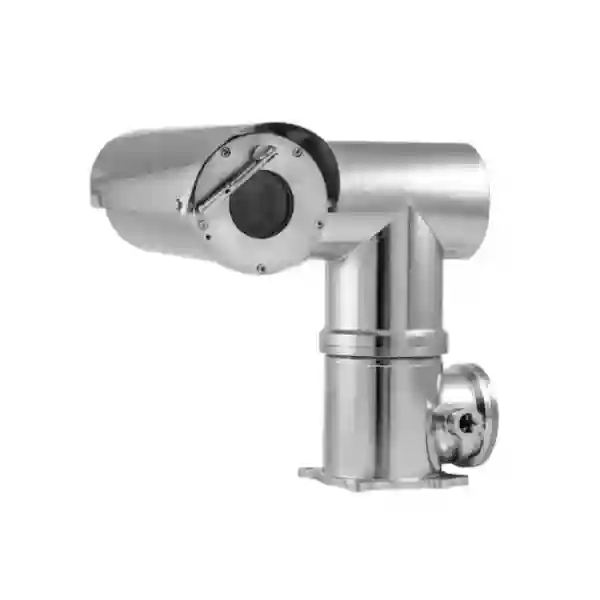
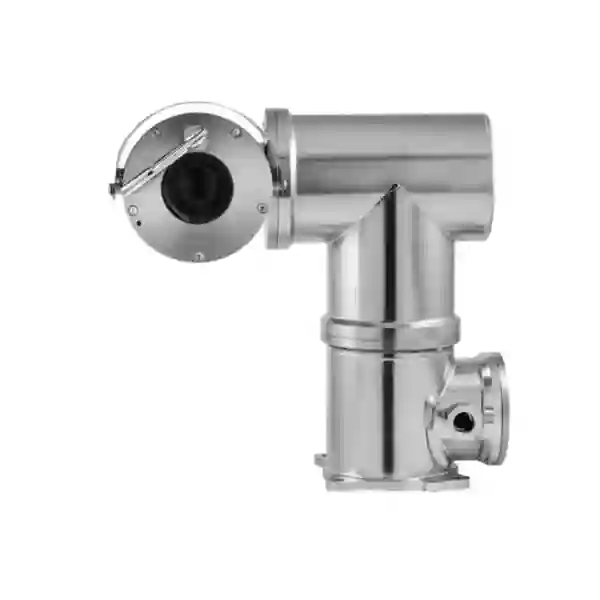
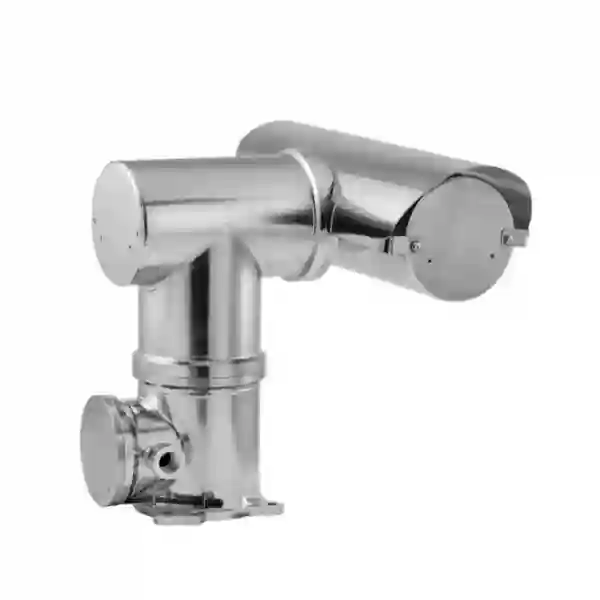
Hanwha Vision TNU-X6320A2WT1-Z Explosion-Proof PTZ Camera
The Hanwha TNU-X6320A2WT1-Z explosion-proof PTZ camera offers full-HD positioning video, long-range optical inspection and a corrosion-resistant explosion-protected assembly for appropriately assessed industrial hazardous areas. Review the site classification, power design and communications plan before requesting a project quotation.
Verified specifications at a glance
These figures relate to the specified model rather than every member of the TNU-X6320A family. Verify the current model-specific documents during procurement because similar suffixes can indicate different power, fibre, temperature and certification options.
| Video | 2 MP, 1920 × 1080; H.265/H.264 up to 60 fps at 60 Hz or 50 fps at 50 Hz |
|---|---|
| Lens | 4.44–142.6 mm; 32× optical zoom and 16× digital zoom |
| PTZ movement | 360° pan; −90° to +90° tilt; preset speeds up to 45°/s pan and 24°/s tilt |
| Image functions | Day/night ICR, 120 dB WDR, gyro-based digital image stabilisation, defog |
| Housing | Electro-polished 316L stainless steel; toughened-glass camera window; wiper |
| Ingress rating | IP66 and IP67 |
| Hazardous-area marking | cLCus Class I Division 1, as listed by Hanwha for this exact model |
| Power | 110 VAC input; maximum power consumption 80 W |
| Temperature | −40°C to +60°C operating ambient; 0–90% RH, non-condensing |
| Network | RJ-45 10/100BASE-T; ONVIF Profiles S and G; RTSP and SUNAPI |
| Storage | Two microSD/SDHC/SDXC slots, up to 256 GB each |
| Physical | 418 × 457 × 401 mm; approximately 33 kg |
Who this industrial camera is designed for
This is a specialist positioning camera for organisations evaluating video surveillance in hazardous industrial locations. Likely project environments include oil and gas installations, process plants, chemical handling facilities, marine facilities and other demanding sites where a competent engineer has identified the need for appropriately certified equipment. The objective is not merely to obtain a better picture. Buyers need an enclosure and installation method suited to the identified atmosphere, a reliable view of operational assets, and an integration route into their security or process-monitoring architecture. A conventional weatherproof PTZ cannot be assumed to meet those requirements.
The model is relevant when a camera operator must turn toward different assets, assess activity across a substantial area, or inspect a distant detail without approaching a restricted location. A 32× optical lens helps with flexible framing, while the pan-and-tilt mechanism enables an operator to position the camera rather than rely on one fixed scene. It should still be evaluated against the distances, lighting, obstructions and detail requirements in the project’s camera schedule. An optical zoom number alone does not prove face identification, licence-plate capture or detection at a stated distance.
For Tanzanian buyers, the most productive first step is to share the hazardous-area drawing, proposed camera positions, power availability, communications topology and the required recording system. Those inputs expose critical suitability questions early, particularly because this exact product uses 110 VAC rather than an assumed local mains voltage. A properly evaluated quotation should identify the exact suffix and project-specific accessories, not simply repeat the headline features.
The practical value of a positioning camera
Industrial surveillance must often cover operating equipment that cannot easily be moved into view. Pipework, vessel approaches, transfer points, service routes, fence lines and structural obstructions may call for a camera that can pan, tilt and zoom. The TNU-X6320A2WT1-Z offers a full 360-degree pan range and tilt movement from −90 degrees to +90 degrees. Hanwha lists maximum preset pan and tilt speeds of 45 and 24 degrees per second respectively. These are positioning capabilities; they do not make a single PTZ equivalent to several permanently recording fixed views.
A sensible design identifies which scenes require uninterrupted evidence and which can be observed intermittently through PTZ movement. If two distant locations must be monitored at the same time, a single steerable camera cannot look at both simultaneously. An additional fixed camera, another PTZ or a broader site architecture may be necessary. Preset positions can help with repeatable views, but the actual coverage plan should be tested at site rather than treated as complete because a camera supports presets.
The positioning assembly also imposes physical and maintenance considerations. Designers must account for the approximately 33 kg weight, mounting geometry, service clearance, cable routes and safe access. These costs and constraints are often more important than minor differences in camera specifications. In a hazardous location, a well-chosen mount and compliant electrical installation are part of the solution, not optional finishing details.
What the 32× optical zoom changes
The built-in 4.44–142.6 mm lens spans wide contextual views and narrow telephoto framing. At its wide end, the published horizontal field of view is approximately 64.44 degrees; at its telephoto end it narrows to about 2.29 degrees. This matters in practical design: the broad view helps establish what is happening around an industrial asset, while the narrow view can isolate a much smaller part of a scene. Operators should understand that zooming in reduces how much surroundings they can see at one time.
Optical zoom uses lens movement to frame distant detail. The published 16× digital zoom is a separate electronic enlargement feature and should not be presented as equivalent to added optical resolution. The camera’s output remains a maximum of 1920 by 1080 pixels; real identification performance depends on subject size in the image, lens position, atmospheric conditions, lighting, motion and compression. For contractual identification tasks, ask the system designer to calculate the appropriate pixel density rather than promising a universal distance.
A good demonstration uses representative site imagery: an overall view of the process area, the narrow view of a target component, and a moving subject under realistic lighting. Pay attention to the speed of reframing, autofocus behaviour and how readily an operator can return to a useful wide view. A camera may be technically capable of extreme magnification yet still need other cameras for full-site awareness.
Full HD, frame rate and realistic image quality
The specified 2 MP resolution is 1920 × 1080. Hanwha lists H.265 and H.264 operation up to 60 frames per second on a 60 Hz system or 50 frames per second on a 50 Hz system, while MJPEG is listed up to 30 frames per second. Recording settings, lighting and the viewing system will influence the final output. A high configured frame rate can be useful for observing movement, but it also affects bandwidth and storage planning. The best setting balances the events that matter with the resources available.
Buyers should distinguish resolution from image usefulness. When visibility is reduced by glare, dirt, mist, vibration, poor focus or inadequate light, additional frames do not automatically recover lost information. The strongest commissioning process is to validate priority scenes in daylight and darkness, with realistic movement and the actual recording profile. Verify whether required details remain visible after encoding, network transmission and playback on the chosen workstation.
Use a camera schedule that records the objective for each view: general observation, activity confirmation, asset inspection, evidence collection or another defined purpose. Those objectives determine image quality acceptance criteria. Do not infer thermal imaging, automatic recognition of particular objects or a guaranteed detection range from the manufacturer’s Full HD specification. This model is a visible-light day/night network camera, and applications demanding other sensing technologies need separate evaluation.
Day/night imaging, WDR and stabilisation
Hanwha specifies automatic day/night operation with an infrared-cut filter mechanism, 120 dB wide dynamic range, digital noise reduction and defog processing. These features address difficult scenes such as bright outdoor backgrounds, shaded equipment and changing weather. WDR can help expose detail across bright and dark parts of the image; it is not a substitute for correct camera placement or adequate illumination. In particular, a backlit target may still be unsuitable if the scene is poorly framed or an obstruction blocks the lens.
The camera includes digital image stabilisation supported by a built-in gyro sensor. This can be valuable where vibration affects perceived image steadiness, including exposed equipment locations. It should not be interpreted as approval to mount the assembly on an unstable structure or ignore structural vibration limits. Mount rigidity, secure fastening and real-world telephoto testing remain essential because small movements become more obvious at narrow fields of view.
The published minimum illumination is 0.05 lux in colour and 0.005 lux in black-and-white under stated test conditions. These are manufacturer measurements, not a guarantee of useful recognition at every site. A designer should test actual lighting, reflections, rain and night-time operating conditions. If a site requires dedicated illuminators, specify and assess them separately for the environment. Never assume the camera includes built-in infrared lighting merely because it supports day/night operation.
Why 316L stainless steel matters
The assembly uses electro-polished 316L stainless steel for its welded construction and a toughened-glass camera window. These materials are relevant to sites where airborne contaminants, moisture and aggressive outdoor exposure challenge ordinary housings. The published IP66 and IP67 ratings describe protection against ingress under defined test conditions. Together, these features help explain why the product is positioned for heavy industry, marine and other exposed environments.
Neither a stainless-steel designation nor an IP rating makes a site maintenance-free. Corrosion resistance depends on the chemical exposure, temperature, cleaning regime and installation details. A specific atmosphere may require material compatibility review by the site engineer. Seals, windows, cable entries, bolts and protective interfaces can have service requirements that differ from the main housing. The design should identify inspection intervals and whether any component is vulnerable to deposits, spray or mechanical damage.
The integrated wiper is particularly useful when water or contamination obscures the lens window. It provides an operational method to clear the viewing area, but cannot be assumed to remove every residue or replace manual cleaning. An optional washer arrangement may be considered as a separate accessory. Keep claims about washdown and chemical compatibility within the limits documented for the exact product and installation.
Explosion-protected is a precise engineering requirement
The designation explosion-proof requires careful interpretation. Hanwha lists cLCus Class I Division 1 certification for TNU-X6320A2WT1-Z. This is an important model-specific fact, but a certificate from one scheme is not an automatic statement of suitability for every country’s installation rules, every gas or dust atmosphere, or every hazardous-area classification. A competent specialist must confirm the site’s classified area, applicable scheme, permitted equipment marking, temperature class, gas or dust group and any conditions attached to certification.
For a project using Zone classifications, do not simply equate a Class I Division 1 label with a Zone 1 approval. The definitions, applicable standards and exact certification scope need an engineering assessment. Likewise, an IP67 rating is not evidence of explosion protection: it addresses ingress, not ignition risk. A contractor should obtain the current certificate and equipment nameplate details for the exact ordered variant and compare them to the project’s hazardous-area register.
Explosion protection also depends on installation quality. Incorrect cable glands, unapproved alterations, unsuitable conduit interfaces or compromised enclosure integrity may invalidate the intended protection concept. Every component on the hazardous side of an installation boundary must be assessed as part of the design. Project teams should avoid selecting a camera solely on the strength of a catalogue label or marketing photograph.
Hazardous-area documentation to request
Before a purchase order is raised, gather the hazardous-area classification drawings, the facility’s applicable engineering standards and the planned installation location for each camera. Note whether the atmosphere involves gases, vapours, combustible dust or other hazards. Provide the ambient temperature envelope, any identified temperature-class requirement and material exposure concerns. Ask the supplier to furnish the exact model’s current certification documentation and installation instructions for comparison.
Document the interfaces between hazardous and non-hazardous areas. Include cable-entry hardware, barriers or isolation where required by the applicable design, junction arrangements, earthing and bonding provisions, and any maintenance isolation procedure. These considerations should be reviewed by the authorised installation and safety team. The camera’s physical ability to fit a bracket is not enough to establish that the full assembly is compliant or safe.
A useful approval record identifies who reviewed the equipment marking and site classification, what documents were used and which conditions remain open. Where acceptance by a Tanzanian authority, project owner or inspector is required, seek that confirmation explicitly; do not assume a North American marking alone establishes local approval. This avoids late-stage changes to the camera suffix, enclosure accessories or electrical design.
The critical 110 VAC question in Tanzania
This exact model is specified for a 110 VAC input, with a maximum power consumption of 80 W. That is a central procurement checkpoint, not a small footnote. TANESCO describes its low-voltage distribution system as 400/230 V for residential, commercial and light industrial customers. Therefore a buyer must not assume that an available 230 V phase-to-neutral circuit can be connected directly to the TNU-X6320A2WT1-Z.
The electrical engineer should define an approved 110 VAC supply arrangement for the installed equipment, accounting for site power quality, frequency, protection, isolation, earthing and the applicable hazardous-area design. Any voltage conversion equipment needs to be correctly located and assessed for its own environmental and certification requirements. The camera is not specified as a universal-input device, and no ordinary plug-in adapter should be presumed adequate for an industrial hazardous-area installation.
Before ordering, confirm the electrical single-line diagram, actual circuit voltage under site conditions and compatibility with the camera’s current manufacturer documentation. If the site strongly prefers a different supply voltage, check whether a different manufacturer’s variant has the right input and equivalent certification rather than silently substituting a model. Include backup supply and outage-recovery requirements in the overall design, especially where video evidence forms part of incident response procedures.
Networking and the difference between copper and fibre
The published interface for this exact non-F2 model is RJ-45 10/100BASE-T Ethernet. Hanwha’s family documentation also describes duplex single-mode fibre modules on variants marked F2, but the suffix TNU-X6320A2WT1-Z does not contain that fibre designation. It would be incorrect to promise built-in fibre on this product based only on a family brochure. If the project’s topology depends on direct fibre connectivity, evaluate the separately coded F2 model and verify its power and certification.
Industrial sites need more than an Ethernet connection on a drawing. Confirm the cable route, practical distance, surge exposure, protective routing, hazardous-area boundary and the location of network equipment. Define what should happen during a network interruption: can video be buffered locally, can alarms be recovered, and how will service personnel diagnose a fault? Fibre can be useful for isolation and long links in some designs, but it changes the selected model and should be treated as a deliberate engineering decision.
Document IP addressing, network segmentation, permitted protocols, time synchronisation and whether management traffic uses the same path as video. Plan capacity for simultaneous operators, recording and any remote monitoring functions. A camera that works during a short bench test may still require more robust switching, surge protection, power continuity and operational monitoring to succeed at an exposed industrial installation.
Recording, edge storage and bandwidth
The model supports H.265, H.264 and MJPEG compression, along with Hanwha’s WiseStream II technology. These capabilities give integrators options for matching image quality to available network and recording resources. H.265 may reduce required bitrate in suitable workflows, but actual savings depend on motion, scene complexity, codec settings and compatibility of the receiving recorder. Avoid asserting a fixed storage saving without testing the chosen profiles.
Hanwha specifies two microSD/SDHC/SDXC card slots with a maximum of 256 GB per slot, or 512 GB combined. This enables local edge-storage planning but does not by itself guarantee a specific number of recording days. Retention depends on bitrate, resolution, frame rate, motion, recording schedule and overhead. Industrial systems may also use central network video recording or other approved storage architecture. Confirm the intended use of local storage, fault response and retrieval procedures before deciding the role of SD cards.
For evidence retention, record a sample stream under realistic site activity and calculate capacity from measured bitrate and the chosen retention policy. Include any requirement for continuous recording while the PTZ is moving. Define how clocks stay synchronised with other cameras and event systems so investigators can correlate incidents. Test how operators recover footage after a brief power failure, a network interruption or a full device restart.
Integration with monitoring and control systems
Hanwha lists ONVIF Profiles S and G and its SUNAPI interface, along with standard network streaming protocols such as RTSP. These published interfaces give a starting point for evaluating interoperability with a video management system or recorder. They should not be translated into a guarantee that every third-party platform supports every feature. Basic viewing, pan/tilt control, recording, event reception and user management may have different integration requirements.
A proper proof of concept should test the precise device firmware, intended video management software version and configured network architecture. Confirm that PTZ movement is smooth, presets return accurately, recorders can use the necessary profiles and events appear with usable descriptions. Verify whether edge-recording search and recovery are supported in the chosen platform rather than assuming feature parity merely because the product advertises a standard.
Where surveillance is used alongside process control, separate observation from safety-critical command and alarm functions. The camera should not be presented as a certified safety instrument or as a replacement for a process shutdown system. Establish ownership of alarms and review who is authorised to reposition the camera, change recording quality or modify event rules. These governance details directly affect the usefulness of the installed system.
Network cybersecurity and access control
Industrial IP cameras are networked computers as well as imaging devices. The official specification lists HTTPS, secure real-time transport support, IEEE 802.1X options, IP-based access control and audit logs. These features can contribute to a controlled deployment when correctly configured. Their presence is not the same as a secure system by default. A site security policy should define account roles, authentication settings, firmware management, permitted traffic and the processes for removing access when personnel change.
Design the camera network so that only required services are reachable. Avoid exposing camera administration directly to the public internet. Use the enterprise’s approved remote-access architecture, maintain a record of device addresses and keep credentials in controlled administration systems. Review unused protocols and disable them where compatible with the recording environment and security policy. Support staff should be able to diagnose a problem without relying on shared permanent administrator credentials.
Firmware and lifecycle processes deserve attention during procurement. Confirm current support documentation for the exact model and test updates with the selected management system before production roll-out. Plan for backups of critical configuration, controlled change windows and recovery if an update is interrupted. These are general system-engineering practices rather than promises of any particular manufacturer service or update interval.
Video analytics: useful signals, not automatic certainty
The published analytics include motion detection, tampering, fog detection, face detection, shock detection, virtual-line functions and virtual-area events including loitering, intrusion and entry or exit. In an industrial setting these functions can help direct an operator’s attention to movement or changes in a defined scene. They are best treated as event signals that need appropriate configuration, review and response procedures rather than guaranteed identification of a person, vehicle or hazardous condition.
Environmental activity may affect results. Spray, rain, wind-driven debris, shadows, plant movement, vibration and night lighting can introduce unwanted events. A PTZ changing its viewpoint can also alter the meaning of a detection zone. During commissioning, record how analytic rules relate to presets and which operating conditions require manual verification. Evaluate false-positive and missed-event behaviour under representative scenarios instead of relying on the fact that a named analytic appears in a feature list.
Create an event-handling plan that identifies priority events, the operator response and the expected retained footage. Verify that notifications are delivered through the chosen VMS or communications method, that timestamping is correct and that alarm actions do not conflict with necessary manual PTZ control. Do not market this camera as having AI object classification or predictive safety functions that are not explicitly documented for this exact model.
Window cleaning and visual availability
An integrated wiper is a meaningful feature where moisture or deposits interfere with the camera’s window. In an exposed industrial position, even excellent optics provide little value when the viewing surface is obscured. The wiper can support a maintenance strategy designed around the expected contamination. It should be tested with the actual control interface and included in operator instructions, especially if the camera is mounted where manual cleaning is difficult.
The wiper is not a guarantee of clear video in every weather event. Heavy deposits, chemical films, scratches or persistent spray may require a separate wash arrangement or scheduled manual intervention. Hanwha identifies an optional washer tank accessory in its family information; compatibility, routing and environmental suitability need confirmation for the project. Never assume optional components are included with the base camera or that their installation automatically inherits the camera’s certification.
Define how operators will recognise degraded image quality and whom they should contact. The preventive-maintenance plan should cover the window, wiper condition, housing exterior, cable-entry integrity and mount hardware. In restricted industrial locations, maintenance access may require permits and shutdown coordination. Planning those interventions before mounting the camera can reduce future downtime and operational disruption.
Mounting, dimensions and structural design
At approximately 33 kg and 418 × 457 × 401 mm, this is a substantial industrial camera assembly. The selected support structure must accommodate the camera, any mounting hardware and environmental loads. Review reach, service access, vibration, corrosion and protection from mechanical impact. A location that appears ideal from the security plan may prove difficult to support safely or may obstruct routine maintenance. Structural suitability should be verified by a qualified person using approved drawings.
Hanwha references an optional explosion-proof PTZ wall-mount accessory, but the purchase scope and compatibility must be confirmed for the exact assembly. The base design incorporates cable-entry arrangements described by the manufacturer; installers should follow the current model-specific manual rather than relying on generic dimensions or third-party diagrams. A suitable cable gland and sealing approach depend on the applicable hazardous-area design and cannot be selected from camera specifications alone.
Before fabrication, validate the field of view from the proposed mounting height and confirm that the camera can move through the needed positions without collisions. Check the support’s access for testing, safe lifting, inspection and eventual replacement. Document the orientation and planned home position so maintenance teams understand how the camera should return to service. These steps are especially valuable where crane or scaffold access is costly.
Environmental planning beyond an IP number
The camera’s published operating range is −40°C to +60°C, with non-condensing relative humidity between zero and ninety percent. This supports evaluation for demanding outdoor operation, but the local site assessment still matters. Temperature near process equipment may differ significantly from a general weather forecast. Radiant heat, high sun exposure, exhaust streams and enclosed mounting recesses can change the camera’s actual thermal conditions.
IP66 and IP67 describe resistance to ingress under defined tests. They do not establish chemical compatibility, indefinite immersion capability or immunity to every cleaning process. The choice of location should consider rainfall paths, washdown, airborne dust, corrosive contaminants and the likelihood of physical damage. The material and ingress ratings should be compared with actual exposure, including what happens when seals or cables require servicing.
Include lightning and surge risks in the wider site network and electrical engineering review, especially for tall or exposed structures. Avoid attributing an unverified surge-protection feature to the camera. A complete design should identify appropriate protective measures for the installed system, document grounding arrangements and provide maintainable routes for power and data.
A practical pre-installation site survey
Start with the reason for each camera. Record which equipment, access route or area the operator needs to see and what a successful image must show. Map obstructions and determine whether a moving camera can provide adequate coverage or whether fixed cameras are also needed. Record estimated viewing distances, relevant lighting conditions and any unusual contamination sources. The result should be a documented imaging requirement, not merely a dot on a plan.
Next collect engineering constraints. Obtain the hazardous-area classification plan, approved electrical drawings, cable routes, available supply voltage, network topology and potential mounting points. Identify who approves each interface and whether the installation requires work permits or specialist contractors. Confirm that the exact TNU-X6320A2WT1-Z model is the version being assessed, because a slight change in suffix can modify power, transmission or certification details.
Finally review operations and maintenance. Establish who will control PTZ movement, who needs recorded footage, expected retention and how outages are handled. Arrange appropriate acceptance tests before handover. A good survey ends with a short list of verified requirements, unresolved technical questions and responsibility for closing them. This is much more useful for procurement than an open-ended request for an ‘explosion-proof camera’ with no site information.
Commissioning tests that actually demonstrate suitability
After installation by appropriately qualified personnel, commissioning should test the system against its design. Begin with documentary checks: confirm model code, equipment marking, installation approvals, cable termination records, power verification and completed inspection documents. These checks are particularly important when the equipment is used in an area with ignition hazards. A camera producing a picture is not proof that its enclosure or wiring has been installed correctly.
Then test viewing functions under the intended recording configuration. Check pan and tilt movement, wide and telephoto focus, the expected preset positions, day/night behaviour, WDR in difficult lighting and the wiper control. Capture representative footage and review it at the recorder, not only in a live web view. Confirm the presence of timestamps, correct user permissions and the practical usability of playback and footage export.
Test failure and recovery deliberately, within an approved safe procedure. Examples include a brief network outage, controlled restart, loss of a central recorder and restoration of the intended power supply. Verify whether required local recording operates as designed and whether notifications reach the correct team. Record the final camera settings, approved firmware and acceptance images. A signed handover package should make the system supportable after the installation contractor leaves site.
Operational workflow after handover
A PTZ system is most valuable when operators know how to use it consistently. Agree on a normal overview position, priority presets and the circumstances when staff may take manual control. If a camera is directed toward a temporary event, establish how it returns to the required monitoring position. Without an agreed operating method, one operator can inadvertently leave a critical area unobserved for an extended period.
Define daily or periodic checks that verify a usable live view, current time, storage health and accessible recordings. Establish a fault procedure for blurred imagery, jammed movement, failed wiper operation or lost connectivity. Record the distinction between a camera fault and a wider network or power issue. The aim is to avoid troubleshooting the wrong component and to protect the integrity of incident evidence.
Review the system when process equipment changes, new structures obstruct a view or the site hazard classification is updated. This does not necessarily require replacing the camera, but it does require checking that the original assumptions remain valid. User access, recording policy and remote connectivity should be included in regular security audits.
How to compare nearby model variants
The TNU-X6320A family contains variants whose codes indicate meaningful differences. In manufacturer material, the power designation differentiates 24 VAC and 110 VAC versions, an F2 marker identifies a single-mode fibre option, and other suffix elements address temperature and certification arrangements. Do not substitute a similar-looking model on the assumption that every specification is the same. The exact requested version here is TNU-X6320A2WT1-Z, listed with 110 VAC, a wiper and a cLCus Class I Division 1 designation.
Where the intended site requires fibre transmission, seek the relevant F2 configuration and compare its exact datasheet, marking and delivery scope. Where the supply design requires 24 VAC, check a specifically coded alternative rather than adapting specifications from the base family. Where the hazardous-area regime differs, the certification suffix deserves separate scrutiny. Model comparisons should be documented against the project requirements, not performed on the basis of pricing alone.
Older Hanwha TNU-X6320E series products may appear in search results. Their feature lists and documents are not interchangeable with the current A-series model. For example, don’t carry a WDR value from a discontinued predecessor into this product description. Use the current exact-model information for procurement and confirm any proposed replacement with the responsible design authority.
When this model may not be the right choice
This specialist product is unlikely to be the efficient choice for an ordinary office corridor, warehouse aisle or other location that has no hazardous-area requirement. A conventional camera may offer a simpler installation and a lower total project cost, depending on the imaging objective. Even on an industrial site, some scenes require continuous fixed coverage instead of a steerable view. The right camera architecture depends on risk, evidence requirements and operator workflow, not the complexity of the enclosure.
It may also be inappropriate where an existing site design cannot provide an approved 110 VAC supply arrangement, where the certification does not match the classified area or where direct integrated fibre is mandatory. These are reasons to consider another exact variant or another product, not minor limitations to overlook. Likewise, full-HD video may not satisfy an application that demands very high pixel density across a large scene simultaneously.
If thermal imaging, temperature measurement, automatic number-plate recognition or a dedicated safety-instrument function is required, specify and verify those needs separately. The manufacturer’s listed analytics and image-processing features do not establish these additional capabilities. Clear exclusions help buyers avoid expensive variation orders after equipment arrives at site.
Information to include in a quotation request
A useful enquiry names the full model code and quantity, the installation environment, and the project location within Tanzania at a level appropriate for planning. It attaches the hazardous-area classification and explains which approval scheme the site requires. State any required operating temperatures, exposure to corrosive materials, camera mounting position, support structure and proposed service-access method. Provide the intended electrical supply and flag that the camera requires 110 VAC.
Include communication requirements such as copper Ethernet or an approved alternative, cable distance, VMS or recorder make and version, number of viewing users and footage retention policy. Identify whether the integrated wiper alone is sufficient or whether the system designer needs to review a separate washer accessory. If the site requires equipment inspection, training, spare parts or detailed test documentation, specify these as deliverables for pricing rather than treating them as assumed inclusions.
Ask for a quotation that clearly identifies model suffix, included accessories, documentation, installation scope if any, applicable exclusions and confirmed commercial conditions. Availability, shipping arrangements, price, warranty and delivery dates must be verified for the actual Tanzania transaction; they are not established by generic manufacturer product information. The purpose of the quotation process is to produce a technically correct and commercially clear scope that can be reviewed before procurement.
Ownership cost and service planning
Specialist surveillance equipment should be evaluated by total installed cost rather than unit cost alone. Relevant expenses may include the support structure, engineered power supply, compliant cables and glands, network infrastructure, engineering review, installation permits, lifting access, commissioning and documentation. These items are site-specific. Omitting them from the initial budget can make a seemingly low device price misleading, especially where work must be coordinated with industrial operations.
Long-term costs also matter. Consider window cleaning, access equipment, periodic inspection of the enclosure and cable-entry system, storage-media replacement where applicable, firmware administration and troubleshooting responsibilities. Ask which optional accessories are included and which remain separate. Plan how a defective device could be isolated, removed and recommissioned without creating an unsafe condition or disrupting the surveillance programme unnecessarily.
Do not calculate a service lifetime or guaranteed maintenance interval from the IP rating, stainless-steel construction or operating-temperature specification alone. Those characteristics inform the design, but actual durability depends on exposure, quality of installation and operating practice. The most defensible ownership analysis uses site history, engineering estimates and a supplier quotation with clearly stated assumptions.
A responsible Tanzania procurement decision
For industrial facilities in Tanzania, the key issue is whether the complete system can meet the site classification and operate reliably within the local electrical and network environment. The Hanwha TNU-X6320A2WT1-Z explosion-proof PTZ camera supplies a distinctive combination of optical reach, directional control, hardened materials and a specific hazardous-area certification. It should be selected only when those features fit an engineering design backed by the required documentation.
Before approving a purchase, ask the project engineer to sign off the full model code, hazardous-area compliance route, 110 VAC supply design, support structure, recording architecture and maintainability. If one element remains unresolved, keep it visible in the procurement checklist rather than assuming a contractor will correct it later. This approach helps distinguish a technically suitable camera from a product that merely sounds suitable in a catalogue.
The next step is a specification-led discussion. Share the site classification, required views, proposed mounting positions and existing electrical/network arrangements. A project quotation can then identify the correct camera variant and the items requiring separate confirmation, without inventing current stock, regional certification acceptance or a guaranteed delivery schedule.
Frequently asked questions
Is the TNU-X6320A2WT1-Z an explosion-proof camera?
Hanwha describes the exact model as explosion-protected and lists cLCus Class I Division 1 certification. Whether it is suitable for a particular hazardous area depends on the installation classification, equipment marking, current certificate conditions and the applicable approval requirements. Qualified personnel must verify the whole installed system.
What resolution and zoom does it provide?
The specified maximum video resolution is 1920 × 1080, or 2 MP. The lens provides 32× optical zoom from 4.44 to 142.6 mm. Its 16× digital zoom is an additional electronic enlargement and should not be confused with more optical image detail.
Can this 110 VAC model connect directly to Tanzania’s 230 V supply?
Do not connect it directly on that assumption. Hanwha specifies 110 VAC for this exact version, while TANESCO describes 230 V phase-to-neutral distribution. An authorised electrical engineer must confirm an appropriate supply design and all associated hazardous-area and protection requirements.
Is fibre optic connectivity built in?
Not on the exact non-F2 model specified here. The manufacturer’s family information identifies fibre capability on separately designated F2 versions. If direct fibre is essential, confirm the appropriate exact part number and its complete specifications before ordering.
Does it include a windscreen or lens-window wiper?
Yes. The specified assembly has an integrated wiper for the camera window. A separate washer system is an optional accessory in the family documentation, not something that should be assumed to come with the camera.
Will it work with a third-party video management platform?
The camera lists ONVIF Profiles S and G, RTSP and SUNAPI support. These provide useful integration paths, but practical compatibility depends on the VMS version, driver, firmware and the specific functions required. Test PTZ, presets, recording, analytics and edge playback before project approval.
How much local storage can be installed?
Hanwha specifies two microSD/SDHC/SDXC slots of up to 256 GB each, for a total of 512 GB. The recording duration is not fixed; it depends on bitrate, resolution, frame rate and the chosen recording schedule.
Does IP67 mean the camera is approved for any hazardous zone?
No. IP66/IP67 concerns protection from water and dust ingress under defined test conditions. Hazardous-area suitability is a separate matter that must be verified against exact certification and installation requirements.
Is the camera suitable for coastal or corrosive outdoor sites?
Its electro-polished 316L stainless steel construction and IP66/IP67 rating support consideration for demanding conditions. Actual suitability still requires a review of chemical exposure, temperature, seals, cable-entry hardware, mounting components and the maintenance plan.
What must be supplied to request a quotation in Tanzania?
Provide the full model number, quantity, hazardous-area classification, camera positions, power design, Ethernet or fibre requirements, recording system details and any needed accessories. Request confirmed commercial terms, documentation and availability for the actual project rather than relying on generic claims.
Can the camera identify people or vehicles at a guaranteed long distance?
No universal identification range follows from the 32× zoom specification. Detail depends on field of view, target size, lighting, atmospheric visibility, motion and required pixel density. Ask the designer to calculate and test the actual surveillance objective.
What local approvals are already confirmed?
The manufacturer’s exact-model information lists a cLCus Class I Division 1 designation; no Tanzania-specific approval, project-owner acceptance or local regulatory endorsement has been verified for this listing. Confirm requirements with the responsible engineering and approval authorities before installation.
Request a technical quotation
For a project involving Hanwha TNU-X6320A2WT1-Z explosion-proof PTZ camera, request a specification review that includes the exact equipment marking, 110 VAC power provision, location plan, recording platform, mounting arrangement and relevant approvals. Share your site documentation so the intended variant and required accessories can be assessed before quotation.
Contact FourTeck Tanzania through its established business enquiry channel. Pricing, stock, warranty and delivery conditions are subject to individual quotation and verification.




Reviews
There are no reviews yet.