
Industrial video surveillance · Tanzania
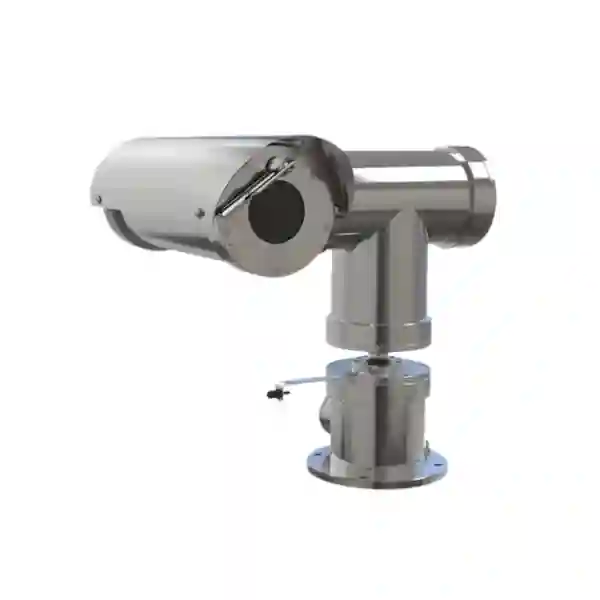
Hanwha Vision TNU-X6320E2WT1-C Explosion-Proof PTZ Camera
A specialist Full HD industrial positioning camera featuring 32x optical zoom, remote pan and tilt, a 316L stainless-steel enclosure and an integrated wiper. Evaluate it for a properly assessed hazardous-area surveillance design, with exact certification, electrical input and supportability confirmed before ordering.
Important: discontinued product
Hanwha Vision lists the TNU-X6320E2WT1-C as discontinued and identifies TNU-X6320A2WT2-C as its replacement. This listing is intended for informed legacy-model evaluation, replacement planning and quotation enquiries. No claim is made that the legacy product is in stock, currently manufactured or directly interchangeable with its successor.
Who this legacy explosion-proof PTZ camera is for
The Hanwha Vision TNU-X6320E2WT1-C is a specialist Full HD network positioning camera designed for projects that need remotely adjustable surveillance in a demanding industrial environment. It combines a stainless-steel explosion-proof camera station, optical zoom, motorised pan and tilt, a built-in window wiper and IP video functions. A buyer evaluating a refinery perimeter, petrochemical process area, storage installation or other potentially hazardous location should begin with the location’s documented hazard classification rather than with camera resolution alone.
Unlike a conventional outdoor dome, this equipment brings together mechanical positioning, a substantial protective enclosure and electronic camera functions. Those elements have to be assessed as one installed system. The enclosure and nameplate must suit the precise hazardous-area requirements, while the network, power, mounting and video system must also be engineered. The result can be useful when operators need to inspect changing points of interest instead of relying only on one unchanging field of view.
This exact model is listed as discontinued by Hanwha Vision, which names the TNU-X6320A2WT2-C as its replacement. That status matters for a new project in Tanzania: do not assume that the legacy unit is available for immediate purchase, that historical parts remain available, or that the replacement is a drop-in equivalent. Ask for the exact offered model, lifecycle status and current documentation as part of a technical quotation.
A quick buying decision before you specify the model
The first question is whether the site needs an explosion-proof camera station at all. A risk assessment and area-classification drawing should identify whether the proposed mounting position is within a classified zone and which protections are required. An industrial-looking enclosure is not a substitute for this assessment. If the proposed position is not classified, a different outdoor PTZ might offer a more suitable size, cost or maintenance profile, subject to the customer’s risk and operating requirements.
The second question is the task. Decide whether the camera will primarily survey a yard, look along a pipeline corridor, inspect valves from a safe viewing distance or follow operator-selected activity around a plant. The 32x lens and positioning mechanism are useful where a field of view must be changed deliberately. If simultaneous, continuous evidence from every direction is essential, one movable camera cannot replace appropriately positioned fixed cameras.
The third question is procurement. For this discontinued model, a quote should identify whether the item is legacy inventory, an approved replacement proposal or an alternative design. It should include a full bill of materials, model suffixes and certification evidence. A clear comparison of the old and new choices helps avoid a situation in which a project is approved on one model number but delivered with a materially different configuration.
Verified imaging and camera capabilities
The camera uses a 1/2.8-inch CMOS image sensor and provides a maximum resolution of 1920 by 1080 pixels. Hanwha Vision specifies a maximum 60 frames per second at 60 Hz, or 50 frames per second at 50 Hz, with H.265 or H.264 video compression. MJPEG operation is specified at up to 30 frames per second. Actual performance will depend on the chosen resolution, streaming configuration, recording path and system settings.
The manufacturer specifies a 4.44–142.6 mm zoom lens, 32x optical magnification and 16x digital zoom, with automatic and manual focusing options. Optical magnification changes the camera’s captured perspective, whereas digital enlargement does not create new physical detail. The wide-to-telephoto horizontal angle of view is approximately 61.8 to 2.19 degrees in the published technical information. This gives engineers a practical starting point for identifying near-field context and distant points of interest.
Imaging features include automatic day-and-night switching with an infrared-cut filter, 150 dB Wide Dynamic Range, backlight and highlight compensation, digital noise reduction, defog and stabilisation using a built-in gyro sensor. These functions offer options for challenging lighting and vibration, but no feature guarantees readable footage through smoke, heavy rain, dirty glass, extreme distances or badly positioned illumination. Validate critical tasks using actual scene geometry and site conditions.
What 32x optical zoom means for real inspection work
Wide views help a control-room operator understand how an activity fits into its surroundings. A narrow view can concentrate available image pixels on a valve bank, loading point or distant section of fencing. On this model, the 32x optical zoom range permits a meaningful transition between those viewpoints without moving the mounting location. It is especially relevant when the security or operations team must inspect several different areas over a shift.
A zoom figure alone is not a detection, observation, recognition or identification distance. The useful result depends on target dimensions, lighting, atmospheric conditions, the distance to the subject, obstructions, camera shake and the number of pixels reaching the recorder. Before approving a camera location, define a measurable task for each critical target and test the expected image at the relevant zoom position. Retain a wide-view reference where incident context must not be lost.
Operators should also consider what happens when the camera is zoomed tightly. They may see detailed activity inside the narrow frame but miss something happening beyond it. This is a planning trade-off, not a defect. Use presets, operator procedures and strategically selected fixed cameras to balance situational awareness with detailed inspection. For an evidential system, document which scenes must remain continuously covered even while the PTZ is aimed elsewhere.
Pan, tilt and preset operation
Hanwha Vision states a pan range of 0 to 360 degrees and a tilt range of minus 90 to plus 90 degrees for this unit. Maximum preset-positioning speeds are stated as 45 degrees per second horizontally and 24 degrees per second vertically. Together with the zoom lens, those movements make the camera a remotely steerable viewing point rather than a passive fixed lens. The practical effect is faster inspection of separate viewpoints where site layout allows an unobstructed line of sight.
Before installing a PTZ, define the operating modes that the video management system or control room will use. Presets may identify an entrance, pump station, access stair, equipment bay or fence sector. Each preset should be named clearly and checked in daylight and darkness. Confirm that the positioning paths do not create unexpected blind periods, that mechanical clearance is sufficient and that the camera does not look into areas where privacy restrictions apply.
Do not assume automatic object tracking, a specific tour schedule or advanced AI classification merely because a PTZ offers video analytics. Confirm every required behaviour for the exact firmware and video management integration. Also establish who can control the PTZ during an alarm, how conflicting commands are handled and what default scene the camera should return to after manual inspection. Those operating details directly affect whether the equipment delivers the intended security outcome.
Explosion-proof suitability is a site-specific engineering decision
The words explosion-proof describe a specialised equipment protection approach, not universal approval for every hazardous environment. Hanwha’s technical listing includes hazardous-location certification information, and the C suffix is associated in manufacturer product literature with a cLC CSA configuration. Nevertheless, the project’s responsible electrical or hazardous-area engineer must verify the exact unit nameplate, approved protection method, gas or dust group, temperature class, installation conditions and accepted certification regime.
A buyer in Tanzania should not infer local regulatory approval from a North American or other regional marking alone. Acceptance of the equipment and its installation depends on the actual project, the applicable Tanzanian requirements, the industry authority where relevant and the standards specified by the owner or engineer. The manufacturer’s certificate and instructions should be reviewed before purchase; the certification must cover the proposed location and configuration, not simply an adjacent model in the same family.
Cable entry systems, seals, junction boxes, glands, supports and maintenance procedures must also be compatible with the hazardous area. A correctly designed enclosure can be compromised by an inappropriate field modification or accessory. Installation and servicing should be undertaken only by suitably competent personnel in accordance with the applicable equipment instructions and site permit procedures. Never treat a camera product page as a substitute for engineering approval.
316L stainless-steel housing and environmental protection
The specified enclosure material is stainless steel grade 316L, finished in silver. Hanwha Vision lists IEC 60529 ingress-protection classifications IP66 and IP67 for the camera station. These describe defined test conditions for dust and water entry; they do not mean that the assembly is immune to every chemical, pressure-washing practice, abrasive atmosphere or long-term corrosion mechanism. Material choice should be checked against the actual exposure at the intended site.
For an industrial buyer, housing construction influences both reliability and maintenance. Stainless steel may be valuable where washdown, moisture or corrosion risks make standard painted camera enclosures less suitable. However, local airborne chemicals, deposits, contact with dissimilar metals and cleaning chemicals may still affect the assembly. A documented maintenance plan should include inspection of surfaces, fasteners, seals, cable entries and the viewing window without altering certified construction.
Consider the mechanical scale as well. The published dimensions are approximately 480 by 512 by 475 millimetres and the product weight is about 53 kilograms. This is a substantial item, not a compact lightweight wall camera. The mounting design must allow for dead load, wind and vibration, maintenance access, movement clearances and an appropriate factor of safety as defined by the structural engineer. Do not size anchors from product weight alone.
Integrated wiper and visibility through the window
The TNU-X6320E2WT1-C includes a window wiper. On a site exposed to rain, spray, windblown deposits or condensation-related visibility problems, the ability to clear the external viewing window can be useful. The wiper supports a more maintainable viewing surface, but it is not a guarantee of perfect visibility. Grease, persistent dirt, heavy contamination or damaged blades may require a controlled cleaning and maintenance procedure.
Hanwha lists an optional explosion-proof washer tank accessory and a PTZ wall-mount accessory within the wider product family. Do not assume that either accessory is supplied with this camera or that a legacy accessory will automatically fit a replacement housing. When requesting a quote, specify whether a washer function is actually required, identify the intended wash fluid and seek confirmation of compatibility with the exact model and any hazardous-location restrictions.
The wiper should be included in operational acceptance testing. Confirm that it can operate without obstructing lens movement, damaging the window or failing to clear critical viewing areas. Establish a safe inspection frequency and approved blade-replacement method. For locations where dust or sticky deposits are frequent, compare the likely cleaning burden with alternative camera positions. A better site position can reduce maintenance even before accessories are considered.
Operating temperature and environmental design
Hanwha Vision specifies an operating temperature range of minus 40 to plus 60 degrees Celsius and non-condensing relative humidity from zero to 90 percent. The storage-temperature range is separately listed as minus 50 to plus 60 degrees Celsius. These are equipment limits, not a promise that the camera will perform identically at every point under every combination of sunlight, load and environmental exposure.
For Tanzania projects, examine measured or expected temperatures at the actual mounting position rather than assuming the ambient air temperature represents the enclosure’s operating environment. Equipment mounted over hot process plant, near exhaust paths or on a sun-exposed structure may experience different thermal conditions. Extreme heat combined with contamination and restricted airflow deserves particular attention. Review the manufacturer’s installation guidance before choosing a final mounting place.
Humidity and condensation should be considered alongside temperature. Cable routes and junction arrangements must avoid introducing moisture into the electrical system. Maintenance personnel should be able to inspect relevant seals and report damage without compromising the hazardous-area protection concept. Where environmental conditions exceed this model’s validated specifications, select a better-suited arrangement rather than relying on optimistic assumptions about the equipment’s margin.
Power design: confirm the 110 VAC requirement
The manufacturer’s current product specification lists a 110 VAC input and a maximum power consumption of 80 watts. This is an important procurement detail. It should not be treated as a universal-input camera, nor should a designer simply connect it to whatever mains circuit is available on site. The project’s electrical engineer must provide a correctly rated and compliant supply arrangement, with protection, isolation, earthing and associated hazardous-area precautions.
Power design also affects continuity of surveillance. Decide whether the system should remain operational during a normal utility outage, what backup duration is required and whether the entire chain—including network equipment, storage and operator workstations—will remain powered. A camera with power but no network or recording path may fail the operational requirement. Budget for the complete solution, not only the power needed by the camera itself.
When comparing the discontinued item with the named replacement, check input requirements using the replacement’s own current datasheet and exact suffix. Similar-looking model names do not establish electrical interchangeability. Confirm voltage, maximum consumption, cable and protective-device design before authorising any substitution. The approved project drawing and the purchasing bill of materials should refer to the same electrical specification.
Ethernet networking, fibre variants and system integration
Hanwha lists an RJ-45 10/100BASE-T interface for the base network arrangement, while its specification identifies duplex single-mode fibre modules in F2 models. The exact TNU-X6320E2WT1-C model should therefore not be advertised as including a fibre interface merely because the family overview mentions fibre. If a site requires long-distance optical transport, verify the appropriate F2 variant or an engineered media-conversion solution and its hazardous-area suitability.
The camera supports network video protocols and integrations including ONVIF Profiles S and G and Hanwha’s SUNAPI interface. These provide integration options, but exact interoperability still depends on the video management platform, software versions and enabled features. Test live viewing, recorded playback, PTZ commands, event delivery and user permissions in the intended recording system. A successful generic network connection alone does not prove that every operational feature works.
Industrial network architecture should take into account physical distance, electromagnetic interference, fibre or copper topology, switch capacity, routing, network segmentation and secure access for maintenance. Document where each interface terminates and who owns that equipment. Avoid unnecessary internet exposure. For remote industrial facilities, a secure and resilient connection path may be more important than adding extra camera features that the operator will not use.
Video compression, bandwidth and evidence retention
The TNU-X6320E2WT1-C supports H.265, H.264 and MJPEG video formats, together with multiple streaming profiles. The manufacturer specifies up to ten profiles and includes WiseStream II codec optimisation. These capabilities give integrators options for separating a high-quality recording stream from a lighter live-view or mobile-monitoring stream. The actual bandwidth must be measured or calculated from configured resolution, frame rate, codec, quality target and scene activity.
At an industrial site, recording design should distinguish live-monitoring needs from evidential storage. Fast motion, rain and detailed moving machinery can change compression demand. A storage estimate based on a calm test scene may not represent heavy activity. Decide how many days of footage are required, whether recording is continuous or event-triggered, and what image quality must be preserved. Then test the recorder with the actual camera settings and realistic movement.
The model also has two microSD, SDHC or SDXC card slots, with manufacturer-listed capacity up to 256 GB per slot, or 512 GB total. Local edge recording can be part of a resilient design, but card endurance, retention policy, temperature limits and the recovery procedure still require planning. Do not describe card recording as a replacement for a centrally managed evidence policy unless that architecture has been formally accepted and tested.
Wide Dynamic Range, low light and difficult scenes
The manufacturer’s 150 dB WDR figure is relevant where bright and dark areas share the same field of view, such as a shaded process area with sunlit sky behind it. The camera also provides BLC, HLC and other image controls. Their value depends on the scene; WDR is not an automatic cure for reflection, glare, fog or severe backlighting. The operator should assess whether critical detail remains visible in both bright and shaded parts of the image.
Published minimum illumination values are approximately 0.05 lux for colour and 0.005 lux for black-and-white under stated measurement conditions. These numbers do not prove useful identification performance at those light levels. The page does not claim a built-in infrared illuminator for the exact model. Where night-time surveillance is essential, confirm available lighting, target contrast and the safe use of any supplementary illumination under the site’s operating constraints.
Day-and-night commissioning should include each important preset, not only the default view. Review headlights, reflective surfaces, sudden lighting changes, vibration and periods of rain or dust. Adjust exposure and noise-reduction settings with the recording objective in mind. Excessive processing may make a picture appear smoother without preserving the detail needed for an investigation. Save accepted settings and document how changes are approved.
Video analytics: useful triggers with practical limits
Hanwha’s listed analytics for this platform include motion detection, tampering, fog detection, face detection, shock detection, virtual-area events and virtual-line events. The named virtual-area functions include loitering, intrusion and entering or leaving a defined area, among other categories. Availability and behaviour should be confirmed against the exact firmware and integration. These functions are conventional event capabilities, not evidence that every modern AI classification feature is present.
An alarm should result in a defined action. For instance, a line-crossing rule may prompt an operator to inspect a perimeter sector, while tamper detection may help flag a viewing obstruction. Sensitivity, geometry, environmental noise and operational procedures determine whether the alert is useful. Rain, shadows, moving foliage, steam or machinery can cause nuisance events if detection zones are poorly chosen. Pilot testing should use typical as well as difficult conditions.
Plan how alerts enter the wider system. The published camera information includes event-related notification and recording options, and PTZ preset handover. Ask the integrator to demonstrate the precise event flow—from trigger through recorder or video management system to operator acknowledgement. Document false-alarm handling and response ownership. Analytics should assist an agreed security process rather than substitute for human assessment or physical safety instrumentation.
Cybersecurity and access management
The specified security functions include HTTPS communications, digest user authentication, IEEE 802.1X network authentication options, IP-based access control and access or event logs. These capabilities support a managed deployment, but they do not automatically make a camera secure. Installation should begin with an agreed network security baseline, controlled credentials and access rights appropriate to the site. Determine whether maintenance access requires a dedicated secured path or management network.
Separate everyday viewing permissions from administrative and engineering functions. A control-room operator may need PTZ operation and playback without needing to modify the firmware, accounts or network settings. Keep an inventory of authorised users, approved software versions, password and certificate procedures, and any integration accounts. Make sure equipment retirement or replacement includes revocation of old credentials and correct handling of recordings or storage media.
Because the model is discontinued, security lifecycle questions are especially important. Confirm the latest relevant vendor advisories, supported firmware and ability to meet the owner’s update policy before adopting this camera into a new project. A product that can still display video may nevertheless be unsuitable for a programme requiring active long-term maintenance support. Treat product lifecycle as an operational security factor and record any exceptions explicitly.
Designing coverage in refineries and processing facilities
A refinery or chemical processing facility may contain distinct observation tasks: gate security, perimeter monitoring, vehicle movements, equipment access points and remote inspections of permitted operating areas. The TNU-X6320E2WT1-C may be worth evaluating for a task that calls for a movable viewpoint inside a suitably classified location. It should not be presented as a process sensor, fire detector or safety shutdown instrument. Video inspection and safety-critical measurement are different system functions.
Create a camera-position schedule that names every required view and the reason for it. For each view, identify the subject size, approximate range, expected lighting and any intervening pipework, structures or steam. If the camera cannot obtain the required image without moving away from another critical scene, consider adding fixed coverage. The ideal location is usually a compromise among sight lines, mounting access, structural strength, cable routes and maintenance safety.
A useful field trial checks more than a still image. Test the operator’s ability to find the right preset under time pressure, zoom to a relevant point and return the camera to a general view. Validate recording quality while the mechanism moves. Confirm that staff can reach maintenance positions with approved access arrangements. These practical details turn a capable camera specification into an effective industrial surveillance design.
Storage yards, terminals and industrial perimeters
At a tank farm, loading terminal, industrial storage yard or large perimeter, an operator may want to watch several separated locations using one steerable camera. A 32x optical lens can help inspect a distant gate or asset while retaining the option to zoom out for general context. Whether this precise model is justified depends on the area’s classification and the life-cycle assessment. Do not select an explosion-proof unit merely because a location has industrial equipment nearby.
Consider the distance between the camera and the subject, the presence of heat haze, poles, walls, fencing and frequent vehicle traffic. Long viewing distances can make a nominally high optical zoom ratio seem impressive while still producing inadequate detail through the local environment. Ask the system designer to show sample images, calculated target pixel densities or a site test based on the desired task. Separate what the camera can see from what an operator can reliably interpret.
Operational procedures should cover who is entitled to move the camera and which views have priority during incidents. If a site relies on a PTZ for perimeter monitoring, a preset left aimed at an equipment bay may create a blind sector. Set a documented normal position or tour policy and supplement it with fixed cameras where continuous observation is required. Reliability comes from the complete coverage strategy, not a single headline zoom figure.
Site survey: facts the integrator should collect
A productive survey begins with the customer’s drawings, not a generic camera catalogue. Gather the area-classification plan, asset layout, structural drawings, approximate mounting elevations and the operational reason for each camera. Record the required viewing distances, acceptable blind spots and any access restrictions. This information will determine whether the camera is suitable before cable schedules and purchase orders are prepared.
The survey should include electrical supply voltage and protection, backup power strategy, network termination, available switch ports and whether fibre is required. For the discontinued C variant, ensure that the design does not accidentally substitute an F2 fibre option or a different hazardous-location suffix without a formal review. Make a separate note of the 53 kg mass and the installation envelope so the structural and maintenance teams can assess their responsibilities.
Ask the site owner about lighting, washdown practices, local atmospheric conditions and the maintenance access route. Confirm whether the camera may be serviced only during planned shutdowns or through special permits. Identify the recording system, its retention policy and the control-room roles that will use PTZ functions. Conclude the survey with an exceptions register so each unresolved hazard, equipment or integration point has a named owner.
Mounting, access and structural considerations
Camera placement is constrained by both the desired image and the practical means of supporting a substantial moving assembly. The TNU-X6320E2WT1-C’s published size and approximately 53 kg weight must be reflected in an engineered mounting arrangement. Depending on the site, wind loading, vibration, corrosion and access restrictions may be decisive. The designer should check the complete installed system, including brackets, anchors, cable routing and any optional accessories.
An optional family wall mount is identified in Hanwha product information, but it is not sensible to assume a particular accessory is included, universally compatible or approved for every hazardous location. Request the complete part numbers and mounting drawings from the supplier. The chosen support should allow the camera to move freely through all intended pan and tilt positions without contact with structural members, other services or maintenance equipment.
Safe service access matters throughout the project life. If cleaning the window or inspecting a cable entry requires a difficult or hazardous lift, maintenance may be deferred and visibility may deteriorate. Discuss access before the mount is fixed. Any intervention affecting certified housings should follow the equipment instructions and the owner’s safety procedures. Avoid undocumented modifications intended merely to make a bracket or gland fit.
Commissioning and acceptance testing
Commissioning should begin with a comparison of the delivered nameplate, order description, certificates and approved design. Confirm exact suffix, electrical input, housing condition and accessories before energising the camera. The responsible installer must complete the required electrical, mechanical and hazardous-area checks. A network engineer should then confirm addressing, access control and the intended recording path. These are separate acceptance steps; a live picture alone is not proof of full readiness.
Exercise the full pan and tilt range and confirm each accepted preset. Check optical zoom, autofocus, manual focus, wiper operation and image quality under representative lighting. Observe any vibration at high magnification, because small movement can become distracting in a narrow view. Test primary and backup power behaviours, network interruption and reconnection, and playback from the chosen recording system. Record the results so future faults can be compared against a baseline.
Finally, run through actual alarm and operator scenarios. Trigger an appropriate analytics event under controlled conditions, check whether it is delivered and acknowledged correctly, and verify the recorded evidence. Review the handover package for drawings, credentials, firmware notes, certificate copies, maintenance instructions and training. Any failed or untested item should be listed explicitly rather than hidden behind a generic ‘commissioned’ statement.
Maintenance, inspection and service planning
Maintenance planning should match the environment and the site’s safety regime. Routine work can involve checking the viewing window, wiper condition, housing surface, fasteners, connections, positioning behaviour and recorded image quality. The correct frequency depends on dust, chemical exposure, vibration and the criticality of the monitored scene. Use manufacturer-approved methods and maintain the explosion-proof integrity of the equipment during any intervention.
A condition-based approach can help operators spot problems early. Compare familiar presets over time, investigate sudden image softness, review recurring network errors and note unusual pan or tilt behaviour. A dirty window may look like a camera focus problem; a poor network connection can resemble a recording problem. Clear fault classification reduces unnecessary equipment replacement. Retain a record of inspections and any changes to settings or firmware.
Legacy-product maintenance requires an additional check: supportability. The manufacturer labels this model discontinued, so confirm spare-part access, repair options, approved replacement procedures and the system’s planned service life before purchasing. A project with a long operating horizon may benefit from designing around the manufacturer’s identified successor instead. Do not assume a replacement housing, mount or accessory can be exchanged without new drawings and approval.
Discontinued model versus the stated replacement
Hanwha Vision identifies TNU-X6320A2WT2-C as the replacement for TNU-X6320E2WT1-C. That is valuable purchasing information, but a successor designation is not an engineering equivalence certificate. The current published replacement specifications describe a different mechanical envelope and weight, as well as the same general industrial PTZ category. The site engineer should compare every requirement that mattered in the original installation rather than judging only by product appearance.
Create a side-by-side equipment schedule that checks the exact certification, operating range, electrical input and power requirement, mechanical dimensions, weight, mounting and cable interfaces, optics, codec support, VMS functionality and lifecycle. Confirm whether the replacement’s own documentation and accessories are acceptable for the designated classified area. If a legacy site already has infrastructure in place, verify fit and commissioning impacts before a purchase is approved.
For an expansion or a new installation, request a current-model recommendation alongside any remaining legacy availability information. For an existing system, explain whether the requirement is a like-for-like repair, one camera replacement or a larger upgrade. Those are different procurement problems. The quotation should specify the offered item clearly and should never silently substitute a model suffix on the assumption that it means the same configuration.
How to build a technically complete quotation
A useful quote request includes the precise legacy model number, quantity, project industry, intended location, current hazardous-area classification and applicable approval requirements. It also states whether the requirement is new construction, an expansion or a replacement for an existing installation. The supplier can then identify technical gaps and propose a current alternative when appropriate. Without this context, a price alone may be misleading.
Include a summary of the proposed mounting height, viewing targets, distances, weather exposure, available power and network topology. Specify whether the job requires on-camera storage, central recording, PTZ presets, alerts, optional wash equipment or particular integrations. Attach the relevant approved drawings where possible. Request separate identification of the camera, mount, cable-entry components, power arrangement and any optional accessories, rather than accepting an unexplained single-line equipment description.
Because this unit is discontinued, ask the supplier to state product status and the basis of any availability claim. Request the model-specific documentation needed by the project and the commercial terms that can be verified for the actual offer. Do not assume pricing in Tanzanian shillings, stock, warranty, shipping or commissioning services until those items are confirmed. A disciplined quote comparison should weigh suitability, lifecycle and installation risk alongside purchase cost.
Cost of ownership and operational trade-offs
The acquisition cost is only one part of an industrial camera’s total cost. A project may also require engineering review, a rated support structure, specialist cable entry, a compliant electrical supply, managed network connectivity, storage capacity, recording licences, commissioning tests and safe maintenance access. Some costs apply regardless of camera brand; others depend on exact equipment weight, power and protection requirements. Build the commercial comparison using the full installed system.
A PTZ offers flexible inspection but introduces operational decisions. Staff must know which scenes matter, how to use presets and how to preserve evidence. If one unit is expected to cover too many tasks, blind periods or conflicting operator demands can increase. In some projects, multiple fixed cameras may be a better core monitoring system with one PTZ added for active investigation. The appropriate mix depends on the site security plan.
Lifecycle cost is particularly important for a discontinued product. Consider how a failure would affect monitoring and how quickly an approved replacement could be engineered and procured, without assuming a particular lead time. Spare parts, mounting compatibility, firmware support and service access deserve explicit review. Paying for the right current configuration at the design stage can be less disruptive than making an unplanned substitution during future maintenance.
Common specification mistakes to avoid
One frequent mistake is treating the words ‘explosion-proof’ as a complete hazardous-location specification. It is not enough to recognise a product family or a single certificate acronym. The complete exact-model marking and installation conditions must align with the site classification and relevant acceptance rules. Another mistake is mixing the C, Z, M or F2 suffixes while copying specifications from another member of the family. Each proposed variant needs independent checking.
A second group of mistakes concerns infrastructure. The legacy C model’s official specification calls for 110 VAC power, and the fibre interface reference relates to F2 variants rather than automatically to every model. Incorrect assumptions about voltage, cabling, network distance or backup operation can lead to expensive redesign. Confirm power and signal paths before ordering, and reconcile the bill of materials with the approved drawings.
Finally, avoid treating a 32x lens as a guarantee of face identification at a distant gate, or treating video analytics as a substitute for a verified alarm process. Test the camera’s view at realistic distances and in actual lighting. Do not omit mounting load checks, cleaning access or system security planning. The strongest specification is not the one with the longest feature list; it is the one that produces measurable results under the site’s actual conditions.
What a well-scoped Tanzania project should deliver
For a Tanzania-based industrial project, the deliverable should be more than a camera carton. It should include a verified equipment schedule, a reasoned hazardous-area suitability assessment, a mounting and supply design, a network and recording plan, and accepted operational views. Local implementation details such as site access, supply conditions and acceptance procedures need to be established for the specific customer. This page makes no claim of local stock, offices, guaranteed service coverage or regulatory endorsement.
The buyer should be able to describe in plain terms what the system is expected to do. Examples include inspecting a defined equipment cluster from a remote control room, providing contextual video of a loading zone or enabling operators to zoom onto an authorised inspection point. Every outcome should correspond to a measurable acceptance test. Where fixed coverage remains essential, the design should say which other cameras provide it.
Request an evaluation of the named legacy model and Hanwha’s stated replacement before committing. Share the area classification, camera schedule, target views and network constraints through FourTeck Tanzania’s verified enquiry process. Ask for a response identifying outstanding technical and commercial questions. This supports a defensible purchasing decision without assuming that a discontinued unit is currently stocked, supported or automatically suitable for the installation.
Practical quote checklist
For a useful technical response, prepare the site area-classification drawings, the precise model number and suffix, quantity, intended mounting position, approximate viewing distances, available 110 VAC supply plan, network path, recorder or VMS details, required recording period and any special cleaning or access arrangements. Ask for explicit confirmation of the proposed item, its lifecycle, compatible accessories and certification documentation.
Frequently asked questions
Is the Hanwha TNU-X6320E2WT1-C still a current product?
No. Hanwha Vision’s product information labels this exact model discontinued and identifies the TNU-X6320A2WT2-C as its replacement. Buyers should verify the current item being offered, its documentation and its suitability for the project before placing an order.
What makes this different from an ordinary outdoor PTZ?
It is an industrial explosion-proof positioning-camera design with a 316L stainless-steel housing, environmental ingress-protection ratings and relevant certification information. That does not make it universally approved for every classified area. The site’s responsible engineer must verify the exact certification and installation requirements.
Does it provide 4K resolution?
No. The published maximum image resolution for this model is 1920 by 1080, commonly called Full HD or 2MP. Its strength is a combination of motorised positioning, 32x optical zoom and a purpose-built industrial enclosure, not 4K recording.
Can the camera record at 60 frames per second?
Hanwha specifies up to 60 fps with H.265 or H.264 in the 60 Hz configuration, and up to 50 fps in the 50 Hz configuration. The recording system, stream profile and network must support the selected settings; MJPEG has a lower published maximum frame rate.
Does the exact C model include fibre networking?
The official network specification describes an RJ-45 Ethernet interface and identifies single-mode fibre functionality for F2 models. Do not assume fibre is fitted to the non-F2 TNU-X6320E2WT1-C. Specify the correct variant or an engineered external fibre path if optical networking is needed.
Is it powered by PoE?
The official product page states 110 VAC input power and maximum consumption of 80 W. It does not identify PoE as the required supply for this model. Confirm a suitable protected power arrangement with the electrical engineer instead of relying on a network-switch PoE port.
Does the camera have a window wiper?
Yes. A wiper is listed among the model’s functions. An optional washer-tank accessory is shown in the manufacturer family information, but accessories should be explicitly identified on the quotation and checked for compatibility before purchase.
Can it operate in very hot industrial locations?
The manufacturer gives an operating range from minus 40 to plus 60 degrees Celsius under its specified conditions. Actual mounting temperatures may be influenced by sunlight and nearby process equipment. Confirm the expected enclosure environment and follow the manufacturer’s installation limits.
How much local memory can be installed?
Hanwha lists two microSD, SDHC or SDXC slots with up to 256 GB per slot, for a total published maximum of 512 GB. Capacity is not a promise of a particular retention period; recording duration depends on stream settings and activity.
Can it connect to existing video management software?
The published camera interfaces include ONVIF Profiles S and G and SUNAPI. Those are useful integration options, but the precise camera functions and firmware compatibility need to be tested against the intended VMS, recorder or control-room application.
Does the IP67 rating prove hazardous-area approval?
No. IP66 and IP67 are ingress-protection ratings; hazardous-area suitability is a separate matter involving the exact equipment marking, certification, classification and installation design. The project engineer must verify both sets of requirements.
Can one PTZ cover an entire perimeter continuously?
It can point to different views, but only one view is captured at a given instant. If continuous simultaneous recording of multiple perimeter sectors is essential, additional fixed cameras or another coverage architecture may be required.
Can the stated replacement be installed without redesign?
Not automatically. Hanwha identifies a successor, but differences in housing, weight, dimensions, electrical and certification details must be reviewed against the existing installation. Obtain current exact-model drawings and approved accessory information before a substitution.
What should a Tanzania buyer provide to request a quote?
Provide the precise model or desired replacement, quantity, site classification, mounting and viewing needs, power availability, network requirements and expected VMS integration. Ask the supplier to confirm current model status, certification documents and the exact equipment proposed, without assuming stock or price.
Request a technical evaluation or replacement quotation
Contact FourTeck Tanzania through its verified enquiry channel with your model, area classification and project requirements. Request evaluation of the discontinued TNU-X6320E2WT1-C and the manufacturer-identified successor TNU-X6320A2WT2-C. Ask for exact-model documentation and a clear, itemised proposal before deciding which solution is suitable.
No price, stock, lead time, local installation service or certification acceptance is implied by this product guide.




Reviews
There are no reviews yet.