
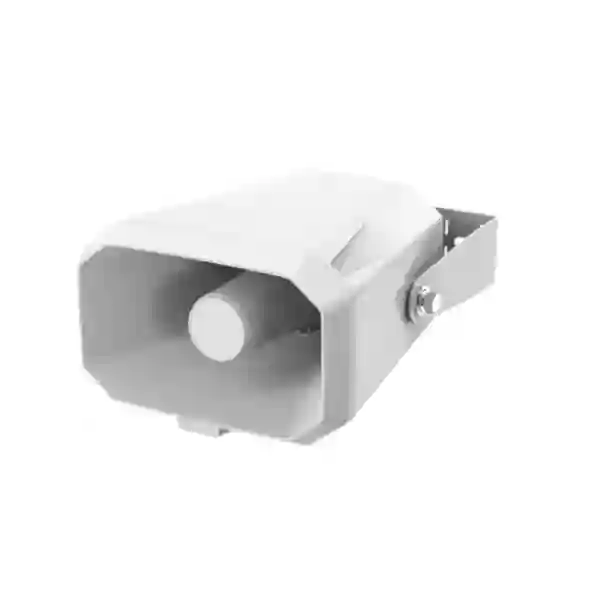
HANWHA VISION · IP AUDIO · WHITE HORN SPEAKER
Hanwha SPA-H200W IP Horn Speaker
A voice-focused network horn speaker with a built-in 10W amplifier, PoE / PoE+ power and an IP66 enclosure. Evaluate it for clear outdoor announcements, controlled paging and compatible security-audio workflows, with a site-specific acoustic plan.
Tanzania buyer advisory: Manufacturer material identifies this as a Korea-market variant. Confirm supply, firmware, supported languages and regional after-sales arrangements before purchasing.
Verified technical specifications
| Type | White IP horn speaker |
|---|---|
| Amplifier | 10W Class D built in |
| SPL | 121 dB on PoE; 124 dB on PoE+ (model-specific product page) |
| Frequency range | 650 Hz to 5.3 kHz (-10 dB) |
| Sensitivity | 111 dB at 1W |
| Power | PoE 802.3af Type 1 Class 3; PoE+ 802.3at Type 2 Class 4 |
| Ethernet | 10/100 Base-T |
| Memory | 1 GB internal |
| Supported formats | WAV and MP3; verify actual playback workflow |
| Integration | SIP, SUNAPI, ONVIF Profile S; verify target platform |
| Contact I/O | 1 dry-contact input, 1 normally open dry-contact output |
| Protection | IP66 enclosure |
| Temperature | -40°C to +55°C (manufacturer specification) |
| Humidity | 10–85% non-condensing RH |
| Dimensions | 241 × 155 × 307 mm |
| Weight | Approx. 3.7 kg |
| Local supply | Not confirmed; verify regional model and support |
Product overview and the buyer’s first question
The Hanwha SPA-H200W is an IP horn speaker designed for sites where clear spoken instructions are more important than rich music reproduction. It is a network device with an integrated amplifier rather than a passive analogue horn that can simply be wired to any existing amplifier. The buying decision should start with a practical problem: who needs to hear a message, from where, and under what conditions? A guarded entrance, industrial yard, logistics compound or campus exterior may be an appropriate setting. The right answer depends on message sources, ambient noise, listener positions, a suitable power and data network and a validated control method.
Specify the actual announcement workflow before choosing the hardware quantity. Include ordinary paging, restricted-area notices, authorisation and how staff will stop an incorrect announcement. The SPA-H200W is one component of a complete communication system, not proof that every required controller, software license, microphone or accessory is included.
Where a horn speaker makes sense
A horn design is worth evaluating when voice messages must carry into outdoor or acoustically demanding areas. Typical scenarios include gate instructions to vehicle drivers, announcements to workers in an open handling yard, operational updates across a compound and guidance at an outdoor entry point. The white enclosure may also be useful where the equipment colour needs to coordinate with the site. The published IP66 rating supports considering it for exposed installations, subject to appropriate mounting and cable protection. A suitability assessment should still account for noise, surrounding buildings, weather and unintended sound spill.
Do not default to a powerful horn for every area. Small offices, reception rooms, classrooms and spaces that need comfortable background music may be better served by other speaker formats. Evaluate a zone-by-zone mix if one loudspeaker type cannot deliver intelligibility and reasonable listening levels throughout the property.
Sound pressure and the exact power mode
Hanwha’s model-specific product page states a maximum sound pressure level of 121 dB when supplied by PoE and 124 dB when supplied by PoE+. Those are published device figures, not a guaranteed listening level or distance in every installation. The manufacturer separately publishes a general lineup figure of 125 dB, so a procurement document should use the exact model page’s power-specific figures and note the difference rather than merging them. Actual intelligibility depends on orientation, distance, obstructions, reflections, local noise and message quality. A high rating should never replace a site test.
The internal amplifier is specified as 10W Class D. Wattage alone cannot predict how a second device will compare acoustically. Ask designers to consider speaker sensitivity, coverage, power source and realistic listening positions, then document the required volume and comfort levels during commissioning.
Why frequency response matters for speech
The SPA-H200W is specified for a 650 Hz to 5.3 kHz speaker range at the stated minus-10-decibel reference. This helps explain its relevance to announcements and warnings rather than full-range entertainment audio. A spoken instruction may remain intelligible through a voice-focused device even when low musical frequencies are not reproduced. However, clarity cannot be inferred from that number alone. Voices, accents, background machinery and the acoustic characteristics of the yard can change what a listener understands. Important numbers, gate names and directions must be tested using examples that reflect the site’s daily operations.
Before accepting an installation, have listeners repeat representative announcements at several named locations while normal work is taking place. If the message is unclear, review aim, placement, level, speaker count and acoustic obstacles. Simply increasing output may make nearby positions uncomfortable without improving distant intelligibility.
PoE versus PoE+
The speaker supports IEEE 802.3af Type 1 Class 3 PoE and IEEE 802.3at Type 2 Class 4 PoE+. A PoE-capable Ethernet connection can deliver both communication and electrical supply when the switch or injector is appropriately specified. This can simplify some installation work, but only if the network’s actual port capability and total power budget are sufficient. Not every switch with a PoE label can supply the intended higher operating class to every connected device at the same time. The higher published sound-pressure value is specifically tied to PoE+ on the manufacturer product page.
List the required power mode in the equipment schedule. Verify switch model, port budgets, cable condition and other connected loads. Where uninterrupted operation matters, include backup power for the switch, controller and message source, not merely the speaker endpoint.
Ethernet installation requirements
Hanwha lists 10/100 Base-T Ethernet for the SPA-H200W. Network cabling must be suitable for the proposed distance, routing, termination and PoE class, with a secure connection to managed infrastructure when required. The site should have an addressing plan and arrangements for device authentication, time services and access by the selected audio or security management application. An IP speaker is a network endpoint requiring configuration and operational ownership. Plugging it into an arbitrary office network does not guarantee that paging will begin working.
Ask the IT team to approve the relevant switch ports, VLAN or subnet, cable route and service responsibilities before installation. Label the physical location and network connection in the asset register. Confirm what happens if the speaker, switch or control server loses connectivity and who is responsible for investigating each type of failure.
Using SIP for telephone-based paging
The manufacturer includes SIP in the supported protocols and describes tests with selected SIP clients and PBX environments. This makes the model relevant where authorised staff want to initiate a page from a phone, desk client or softphone. Yet support for SIP does not mean universal compatibility with every telephone system or cloud communications provider. Registration settings, codecs, dial plans, DTMF handling, security requirements and network routing may all affect the experience. Feature differences can also exist between PBX editions and software releases.
Test the exact proposed PBX, device firmware and paging scenario before purchasing for a large site. The pilot should confirm call establishment, message quality, hang-up behaviour, authorisation, retries and failure reporting. If paging is an essential operational function, include a clear fallback procedure for phone-system outages.
ONVIF and SUNAPI integration
Hanwha documents SUNAPI and ONVIF Profile S in the product’s integration information. Those interfaces may help a system designer connect audio workflows with compatible video-management or security arrangements. The key limitation is that a listed interface is not a guarantee that every event, message or automated sequence is supported by every recorder, camera or software platform. A useful specification identifies the originating event, the component applying the decision rule, the speaker action and the person who may approve or cancel it.
Request an end-to-end demonstration with the exact VMS or controller release intended for the project. Test false alarms and disconnections as carefully as successful events. Operationally sensitive announcements should not be triggered repeatedly by simple motion activity unless that behaviour is explicitly required and validated.
Dry-contact connections
The model-specific details list one dry-contact input and one normally open dry-contact output. Such connections may be relevant when an external device needs to exchange a simple event or control state with the audio workflow. However, the existence of contact terminals does not prove direct electrical compatibility with every alarm panel, button or industrial controller. Circuit design depends on allowed ratings, isolation requirements, the exact firmware and supported logic. Only a qualified integrator should decide how these contacts will be connected.
Document the intended input and output behaviour, including its default and failure states. Validate the electrical interface against current manufacturer instructions. An acceptance test should check that a genuine event produces only the approved response and that a disconnected wire or faulty external controller does not create unsafe or nuisance messages.
Stored messages and file formats
The SPA-H200W has 1 GB of internal memory. The manufacturer lists WAV and MP3 formats, including MP3 bitrates from 64 to 320 kbps and sampling references from 16 kHz to 48 kHz. These specifications can guide a discussion about recorded announcements, but they do not verify that every scheduling, remote upload or audio management function exists in the exact version being offered. Buyers must confirm the controller or management method used to import, update, trigger and remove recordings.
Maintain approved message files with a title, language, owner and review date. Test the actual recordings rather than relying on a generic tone. A useful message should tell listeners who is affected, what action to take and which location applies. Outdated instructions and obsolete site names need a defined replacement procedure.
Text-to-speech and language validation
The manufacturer’s Korean product page contains differing language references for text-to-speech capabilities: its introductory feature summary mentions Korean, while a detailed system-integration section names several other languages. That inconsistency means a buyer should not promise a particular text-to-speech language without testing the offered hardware and firmware. There is no verified evidence here that built-in Swahili text-to-speech is provided. For Tanzania, this matters because many projects need Swahili announcements, English instructions or a consistent combination of both.
Determine whether the project will use live speech, approved audio recordings or verified text-to-speech generation. Validate accent, pronunciation, file management and switching between languages on the exact equipment. The ability to play a recording in Swahili is different from a built-in engine capable of generating Swahili speech.
Speaker zones and message targeting
A useful paging design lets an operator address the intended audience and avoid distracting other zones. A gate warning may need to reach only drivers waiting at the entrance. A site-wide operational announcement may require every relevant outdoor area. Hanwha’s integration details discuss multi-source control and multicast zoning, but achievable capacity and operating behaviour depend on network design and software. Avoid promising the family’s highest published zone count for every controller or configuration. Define physical zones around the activities and acoustic boundaries of the site, not simply around network cable runs.
Create a zone schedule naming each listening area, the people who may page it and the message priorities. Test a single-zone page, a grouped page and the intended all-zone action. Confirm that the interface shows operators clearly which audience will hear a message before they transmit.
IP66 environmental protection
IP66 is the enclosure ingress-protection rating published for this model. It makes the product relevant to exposed locations where dust and strong rain are important design considerations. Nevertheless, IP66 is not an immersion rating, corrosion guarantee or assurance that connected cables, connectors and junction boxes share the same protection. Water can enter through poor terminations even when the main enclosure has a strong rating. The installation design should consider rain direction, drainage, physical impacts, sunlight, dust accumulation and service access.
Choose properly rated accessories and follow the manufacturer’s prescribed mounting and sealing methods. Inspect exposed cable entries after installation and during maintenance. In unusually aggressive environments, request specific advice rather than generalising from IP66. Weather resistance should be considered for the whole assembly, not only the loudspeaker body.
Temperature, humidity and exposure
Hanwha’s model page states an operating temperature range from minus 40°C to plus 55°C and non-condensing relative humidity from 10 to 85 percent. These conditions are useful for technical screening but do not establish that every mounting position stays inside the operating limits. An installation under reflective metal roofing or beside machinery can experience local heat far above a nearby weather report. Wind, shade, standing water, dust and vibration can also affect real equipment life and service demands.
Perform a site survey before selecting a bracket position. Record unusual heat sources, exposed cable paths and potential impacts from vehicles or stored materials. Do not claim universal suitability for all Tanzanian climate conditions based solely on a broad temperature range. Confirm requirements for the actual project location.
Dimensions and physical mounting
The exact model is listed at 241 mm wide, 155 mm high and 307 mm deep, weighing about 3.7 kg. This should be included in the physical design rather than treated as a compact ceiling accessory. Space is needed for the body, bracket, cable routing and future access. The mounting surface also has to withstand the local environment and relevant mechanical loads. A technician may need to aim the horn after the first acoustic test, so the selected location should allow safe and practical adjustment.
Use the relevant manufacturer mounting drawing and qualified installation advice. Check wall or pole suitability, fixing materials, vibration and possible wind loading. Include any access equipment in the project budget. Keep the horn clear of vegetation, shutters, signs and objects that could obstruct the sound path.
Designing outdoor coverage
Audio coverage should be designed around actual listening points. A large yard may contain parked vehicles, shipping containers, walls and temporary storage that block or reflect speech. One horn’s strong maximum output does not establish an even or understandable level throughout the area. Likewise, the closest listener may hear an uncomfortably loud message while a person behind a building receives very little. Direction, quantity and the placement of speakers are often more important than a simplistic maximum distance estimate.
Mark essential listening positions on a plan and conduct field tests during normal site activity. Do not advertise a fixed universal coverage radius unless supported by project-specific evidence. Where one unit leaves acoustic shadows, consider repositioning or multiple zoned devices rather than automatically raising volume.
Speech intelligibility commissioning
Commissioning should measure whether people understand the instruction, not merely whether they notice a loud sound. Use message examples that contain actual numbers, location names and clear action words. If workers operate machinery, test while representative equipment is running. If drivers are intended listeners, include common engine and vehicle movement noise. The frequency profile of a horn speaker can be appropriate for speech, but the recording, gain setting and acoustic environment determine the final result. A single test beep or an online status display is not an adequate handover.
Record who listened, where they stood and whether they repeated the essential message correctly. Check both distant listening points and locations close to the speaker. When speech is unclear, review orientation and zone design before raising the output. Include agreed acceptance criteria in the supplier’s scope.
Sound spill and neighbouring areas
Announcements can be disruptive when they reach people who have no operational reason to hear them. This matters at an industrial gate adjacent to offices, homes or public walkways. A device should be oriented and controlled to provide the necessary message without needless repetition or excessive output. Background noise also changes across shifts, and a setting appropriate during heavy daytime loading may be unnecessarily loud during quieter evening periods. A good system design balances intelligibility, site operations and the reasonable interests of surrounding people.
Define normal and exceptional paging policies and train operators accordingly. Test unintended listening areas as well as the designated zone. If too much sound reaches other locations, consider different placement, lower levels, targeted zones or a different speaker configuration rather than using maximum output as a default.
Building the complete system
A speaker is only the final device in a message path. The project may additionally need a microphone station, approved audio software, an IP server or controller, a PBX, network switches, a message library and suitable backup power. The requirements depend on whether people page live, place SIP calls, play recordings or trigger supported security events. None of those additional components should be assumed to be included in the SPA-H200W package. A complete bill of materials should identify each required component and the team responsible for its operation.
Ask the supplier to draw the path from the operator or event source to the listener. Clarify controller and software versions, licenses, switch ports, message management and future support. A project quote should cover a working audio workflow rather than only hardware delivery.
IT network controls and multicast
Some IP audio systems distribute messages through multicast while others use individually addressed connections. The manufacturer’s integration materials mention related zoning and channel features, but actual performance depends on switches, routes, firewalls and the selected controller. A bench test with one speaker on one switch may hide problems that become visible when announcements pass between buildings or network segments. The network administrator should review packet distribution, permitted connections and the operational impact of switch or routing changes.
Document required VLANs, IP addresses, configuration ownership and recovery procedures. Test intended traffic with the real network protections in place. Ensure that ordinary network maintenance does not accidentally disable paging. For large installations, assess scaling and failure behaviour with the complete system design.
Accounts and cybersecurity
The manufacturer describes password protection, authentication methods and access logging among the speaker’s management capabilities. As a network-connected endpoint, the unit should be included in the organisation’s device administration and security processes. Unauthorised paging can interrupt operations or confuse people, so controlling who may send and edit messages is an important requirement. Security should be designed at the device, controller and network levels rather than assumed from the product name or a single authentication feature.
Change default credentials, assign least-privilege roles and document administrator ownership. Review approved firmware and test upgrades before deployment across all devices. Protect remote administration and keep an inventory of installed endpoints. Ask suppliers how access will be revoked when personnel or service arrangements change.
Power outages and system continuity
PoE operation makes the loudspeaker dependent on a powered network path. During a mains failure, the endpoint cannot keep paging unless the relevant switches, message source, controller and links remain available through an appropriate backup plan. A UPS serving only one part of the chain is not a complete continuity design. If announcements are operationally important, identify exactly which components must work, how long they must work and how staff will communicate when the system is unavailable.
Specify resilience requirements before choosing backup equipment. Test controlled power loss and restoration. Keep a non-network fallback process for critical site communication where needed. Do not represent an ordinary IP horn speaker alone as a certified emergency voice-alarm installation without separate verification of the full system.
Warehouse and logistics use
Loading areas bring variable noise, vehicle movement and temporary obstacles. A network horn speaker can be evaluated for scheduled operational instructions or staff-initiated paging at queue lanes and loading gates. Yet a single high-mounted speaker may not reach personnel behind stacked goods, trailers or heavy equipment. Different bay areas may require separate zones to avoid confusing drivers with directions intended for another part of the site. The audio design should reinforce existing signs, barriers and traffic procedures rather than replace them.
Test actual bay names and driver instructions during representative operations. Agree who may broadcast and which messages are approved. Record all points where words are difficult to understand. A successful warehouse installation depends as much on a workable operating procedure as on the equipment specification.
Gates and controlled entry points
An entry gate is a useful setting for voice communication between authorised staff and waiting drivers or visitors. A horn speaker may support simple directions such as identifying the correct waiting zone or explaining that access is temporarily restricted. If a camera or access-control event participates in the process, the proposed integration must be tested for the exact devices and software. Careless automatic triggers could cause unwanted repetitive warnings when ordinary motion occurs near a gate.
Position the speaker to address the queue rather than every nearby property. Define how staff choose messages, stop a broadcast and respond when the network is down. Use a site demonstration to confirm that visitors can hear instructions clearly and safely.
Campuses and multi-building compounds
Large sites often contain varied acoustic spaces: courtyards, covered walkways, service roads and enclosed rooms. A networked speaker system can be planned around those different zones, but no single device format is best everywhere. The SPA-H200W is more naturally assessed for outdoor speech projection while another model may better serve quiet interiors. For a compound, identify the site-wide messages, the locally targeted messages and the operators authorised to send each type.
Walk the intended route and check for acoustic shadows behind buildings and walls. Use separate groups where a message should not interrupt unrelated operations. Ask for a simple control interface and clear zone labels so occasional users can operate it confidently.
Security operations and operator decisions
A combination of monitoring and audio can give staff a way to address a situation without immediately dispatching personnel. That does not mean every video event should produce an automatic spoken warning. The appropriate workflow might require an operator to view the event, select a predefined message and confirm the audience. Any use of ONVIF Profile S, SUNAPI or a security-management application depends on actual integration features, permissions and firmware versions. A proof of concept should demonstrate both successful and failed event paths.
Define who is authorised, how false positives are handled and which messages are acceptable. Avoid disclosing unnecessary personal information through public announcements. A camera’s detection result is not automatically a verified incident requiring an audio response.
Comparing network audio with conventional PA
Traditional public-address systems may use central amplifiers and long analogue speaker circuits, while IP audio uses network-connected endpoints and compatible software. Either approach can be appropriate depending on existing infrastructure and the management resources available. The SPA-H200W should be considered when its network interfaces, output characteristics and installation design are genuinely helpful. A buyer should not assume that an IP approach is always simpler or cheaper just because it uses a network cable for power and data.
Compare the cost of controllers, switching capacity, accessories, configuration, backup power, training and ongoing support. If an existing analogue system already serves the site reliably, discuss whether replacement or a hybrid design is justified before making a purchase decision.
Comparing indoor speakers and horn speakers
Ceiling, wall and pendant speakers distribute audio differently from a horn intended for projected announcements. Indoor rooms may benefit from several lower-output loudspeakers instead of one powerful directional unit. The SPA-H200W’s published voice-frequency range and high output make it a particular option for more demanding speech situations, but they do not make it the right choice for every room or music programme. Compare the intended acoustic experience, enclosure rating, mounting needs and software compatibility for each model.
For mixed environments, design each zone independently and confirm that the selected devices can be managed together. Avoid substituting another Hanwha model solely because its casing appears similar. Request its own current technical specifications and verify regional support.
Routine maintenance and firmware
A properly commissioned installation should still be inspected and tested regularly. The maintenance programme can include visual checks of brackets, cables, seals, obstruction and signs of corrosion, followed by a known approved audio test. The responsible team should also verify that the speaker remains reachable through the authorised network and management software. Integrations involving a PBX or VMS need an end-to-end check because a healthy speaker does not prove that its upstream systems can still generate a message.
Maintain an asset register with location, model, firmware and network assignments. Document changes to controllers and configuration. When a complaint arises, distinguish audio level, intelligibility, connection failure and wrong-zone selection before replacing hardware. Keep any manufacturer updates under a controlled change process.
Operator training and message governance
Site personnel need a clear procedure for using audio equipment, particularly when announcements are infrequent. Establish who can make routine pages, who approves important messages and who updates recordings. A control screen should display the selected zone clearly before audio is transmitted. If a phone dial code is used, staff should know how to end paging and whom to contact when the call does not connect. Training should include both normal operation and recovery from a wrong or incomplete announcement.
Provide concise scripts and a practical handover session. Rehearse site-specific names, numbers and language choices. Periodically review permissions as employees and service providers change. Good governance reduces nuisance broadcasts and makes the investment more reliable.
Procurement pitfalls
Common mistakes include buying a speaker without a complete audio source, overlooking PoE+ requirements, guessing the number of units from a maximum sound-pressure figure and treating SIP support as a universal PBX compatibility guarantee. Another mistake is applying an ingress rating to unprotected junction boxes or failing to provide safe access for mounting and maintenance. The same risk applies to assuming that a white Korea-market model will have local supply and support in Tanzania simply because its specifications appear in a manufacturer catalogue.
Require an itemised technical offer and a defined acceptance test. Keep pricing, stock, warranty, compliance and import claims out of the listing unless they have been verified for the exact supply arrangement. Ask explicitly what is not included.
Tanzania regional availability review
The SPA-H200W appears in manufacturer material, while a shared Hanwha quick guide labels the H200B and H200W variants as Korea-only. The exact-model page also states that availability may differ by region. This is a substantial purchasing consideration: technical existence is not proof of legitimate supply, local warranty, appropriate firmware or suitability for a Tanzania deployment. Use the model as a subject for a technical enquiry until the proposed supplier has verified the offered version and after-sales arrangements.
Request confirmation of exact hardware, regional status, supported firmware and documentation. If those questions cannot be resolved, evaluate a verified alternative without implying that it has identical specifications. Do not claim local stock or delivery times before receiving a current reliable offer.
A useful quotation request
The most helpful request for quotation includes more than a model number. State the application, the site type, intended number of zones, ambient noise, mounting conditions and the positions from which people will listen. Identify whether announcements come from live staff, a SIP PBX, approved audio files or a tested security event. Mention required languages and any existing switching, power backup or control equipment. Include the desired commissioning and staff-training scope instead of assuming these services are included.
Ask for an itemised list of the exact regional model, supporting equipment, configuration work, practical demonstrations, installation responsibilities and support terms. Request a price only through a verified offer. A compatibility review before ordering is more useful than an unverified claim that the device is ready for immediate deployment.
Installation and final acceptance checklist
A final handover should include identification of the exact device and firmware, confirmation of PoE power mode, network addressing, authentication, approved message source, correct zone selection and real-life speech tests. Where relevant, verify SIP registration, VMS events and dry-contact behaviour. Check what happens during loss and restoration of power or connectivity. Record listening positions and any locations where people cannot understand the message. Keep a copy of the approved configuration and documented operating procedures.
Do not accept a system solely because its status indicator is lit. The business requirement is successful, controlled communication to real people. Sign off when the stated operational workflow has been demonstrated and any limitations are understood.
How to decide whether to proceed
The SPA-H200W can be a credible technical candidate when a project needs a white, outdoor-capable network horn speaker with the specified audio output and integration interfaces. It is not a final purchase recommendation until regional supply, controller interoperability, speech coverage and installation conditions are confirmed. For a Tanzania buyer, the Korea-market designation deserves explicit attention rather than being hidden in fine print. A responsible supplier should separate the documented features from the details that require a project-specific test or commercial confirmation.
Share a site plan and desired audio workflow for technical review. Ask for a demonstration using the proposed power source and management platform, then request confirmed written terms before placing an order. That approach protects the buyer from specification misunderstandings and avoidable deployment delays.
Frequently asked questions
Is the SPA-H200W an IP horn speaker?
Yes. Hanwha Vision identifies it as an IP horn speaker with Ethernet connectivity and a built-in 10W Class D amplifier. It is intended for network audio workflows. The final installation may still require a compatible message source, management platform, suitably powered Ethernet connection and other system components.
What is the maximum output?
The exact-model manufacturer page gives 121 dB on PoE and 124 dB on PoE+. The published values are not a universal coverage radius. Site acoustics, direction, noise and listening position affect whether people understand the message. Commissioning should include realistic spoken instructions.
Does this speaker use PoE+?
It supports both PoE and PoE+ according to Hanwha. A PoE+ source is relevant to the higher published maximum sound pressure level. Check switch port class and total available power, especially where many devices share one switch. The power design should also account for required resilience.
Can it be installed outdoors?
The manufacturer specifies an IP66 enclosure, making outdoor deployment a reasonable design consideration. However, IP66 does not cover every installation accessory or imply immersion protection. Weather exposure, cable terminations, mounting hardware and ongoing maintenance must be considered separately for the particular site.
Can it integrate with SIP systems?
SIP is documented, and the manufacturer describes tests with selected clients and PBX environments. This does not guarantee compatibility with a particular cloud phone service or all paging features. Confirm registration, codecs, call setup, permissions and hang-up behaviour through a test with the exact system proposed.
Does it support ONVIF or SUNAPI?
Hanwha lists ONVIF Profile S and SUNAPI under system integration. These interfaces can be relevant to supported security-audio workflows, but compatibility with particular cameras, recorders or VMS versions needs validation. A proposed automated announcement should be demonstrated with its actual triggering event and control system.
Does it have built-in memory?
Yes. Hanwha specifies 1 GB of internal memory and documents WAV and MP3 audio-format support. Verify the intended software workflow for uploading, organising and triggering messages before assuming that particular scheduling or playback features are available on the offered firmware version.
Can it generate Swahili speech?
Native Swahili text-to-speech has not been verified for this exact model. Hanwha’s regional documentation contains differing language references. If Swahili announcements are essential, test approved audio recordings or another verified source with the actual device and controller. Do not confuse playback of a Swahili recording with built-in text generation.
What are the dimensions?
The manufacturer specifies a 241 mm width, 155 mm height and 307 mm depth with a weight of about 3.7 kg. Mounting accessories, cable bend space, wind load and access for aiming or maintenance need separate consideration. Use the current manufacturer’s mounting instructions and qualified installation advice.
How many speakers do I need?
The number depends on noise, zone geometry, obstacles, mounting locations and speech-intelligibility targets. Maximum sound pressure alone cannot determine a reliable quantity. A site plan and realistic audio test can establish whether one speaker, several zones or another speaker format is the better solution.
Is this exact model available in Tanzania?
Availability and local support have not been verified. Hanwha’s shared installation guide describes the SPA-H200W as a Korea-market model, and its product page warns that availability varies by region. Request written confirmation of the supplied version, legitimate distribution, firmware, warranty route and suitability before ordering.
Does it replace an emergency evacuation system?
Do not assume so. The reviewed sources establish network-audio features, not certification of a complete life-safety voice-alarm installation for an individual building. Projects requiring regulated emergency communication must be designed and assessed against their applicable standards and procedures by qualified professionals.
What should a quote include?
Ask for the exact device and regional model, all switches and message sources, controllers or software, mounting accessories, installation work, compatibility checks, testing, training and support terms. Provide the number of zones, expected noise and operating languages. Unverified local price, stock or warranty claims should not be shown as facts.
How should the completed installation be tested?
Verify the power mode, network connection, access permissions, intended message path, correct zones, spoken-message intelligibility and relevant integrations. Test realistic noise conditions and safe failure recovery. Record listening positions and unresolved issues so the delivered system can be evaluated against its stated operational purpose.
Request an SPA-H200W suitability and supply review
Describe the listening zones, message sources, background noise, power network and required languages. Ask FourTeck to confirm whether this exact Korea-market model can be legitimately supplied and supported for the Tanzania project or whether an appropriate verified alternative should be assessed. Obtain written compatibility findings and commercial terms before ordering.
Contact FourTeck for a project-specific quotation and technical review.




Reviews
There are no reviews yet.