
Hanwha Vision • Network IP Audio • Tanzania
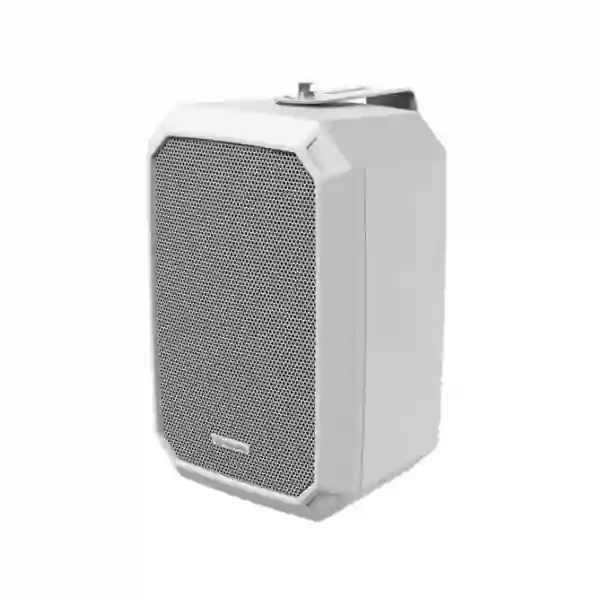
Hanwha SPA-W200W IP Wall Speaker
The white Hanwha SPA-W200W IP wall speaker combines a built-in 10 W Class D amplifier, Ethernet audio connectivity and PoE/PoE+ power for managed announcements and public-address workflows. It is designed for buyers who want clearer zone planning, practical system integration and a professional wall-mounted endpoint rather than a stand-alone home entertainment speaker.
Planning a Tanzanian project? Request a model-specific quotation with the intended site layout, network information and announcement workflow so the right supporting equipment and suitability checks can be identified.
Verified technical snapshot
These are manufacturer-level model details, not claims about Tanzania stock, pricing or compatibility with every third-party controller. Audio coverage must still be tested at the intended location.
| Type | White IP wall speaker |
|---|---|
| Built-in amplifier | 10 W Class D |
| Driver configuration | 2-way: 5-inch low-frequency and 0.5-inch high-frequency |
| Speaker frequency range | 120 Hz to 20 kHz (−10 dB) |
| Maximum SPL with PoE | 97 dB (manufacturer detailed model specification) |
| Maximum SPL with PoE+ | 101 dB (manufacturer detailed model specification) |
| Power support | IEEE 802.3af Type 1 Class 3 / IEEE 802.3at Type 2 Class 4 |
| Ethernet | 10/100 Base-T |
| Built-in storage | 1 GB |
| External media | SDHC microSD up to 32 GB; check manufacturer media compatibility |
| Audio files | WAV and MP3 within manufacturer-supported formats |
| Dry contacts | One input, one normally open output |
| Ingress protection | IP54 |
| Dimensions | 170 × 250 × 134 mm (W × H × D) |
| Weight | Approximately 2.5 kg |
| Temperature | −20 °C to +50 °C |
| Relative humidity | 10–85% RH, non-condensing |
| Integration identifiers | SUNAPI, ONVIF Profile S and SIP-related capabilities; verify application compatibility |
Specification notes: the source overview also prints a 99 dB headline, while the detailed speaker table separates PoE and PoE+ results. The 20 Hz–20 kHz response belongs to the line-output section; it is not the rated loudspeaker acoustic range.
What the SPA-W200W is designed to do
The Hanwha SPA-W200W IP wall speaker is a network-connected public-address endpoint for organisations that need announcements, messages and coordinated audio across a managed site. It combines a speaker enclosure, an internal 10 W Class D amplifier, an Ethernet interface and local media storage in one wall-mounted unit. Instead of routing analogue speaker cable from a conventional central amplifier to every listening point, a designer can place a network audio endpoint close to the audience and connect it to an appropriate network and power source. That is particularly useful where the IT and security teams already manage Ethernet cabling, switches, network segmentation and site monitoring.
The SPA-W200W is the white version of the wall speaker. It is not a CCTV camera, a wireless Bluetooth entertainment speaker or a substitute for an entire emergency communications system. Its value comes from making spoken messages and supported audio playback available at selected locations as part of a properly designed solution. Buyers should evaluate the speaker together with the intended audio controller, microphone or SIP system, the powering arrangement, the mounting surface, the expected background noise and the operating procedures. The correct design depends on how staff will initiate announcements, which zones must hear them and how a failure will be noticed.
At-a-glance specifications and buyer meaning
For quick evaluation, this model has a built-in 10 W Class D amplifier, a two-way driver arrangement consisting of a 5-inch low-frequency driver and a 0.5-inch high-frequency driver, and a stated speaker frequency range of 120 Hz to 20 kHz at the minus-10 dB measurement point. Hanwha’s detailed model specification lists maximum sound pressure levels of 97 dB under standard PoE and 101 dB under PoE+. The distinction matters: an equipment schedule should not treat the larger number as a performance guarantee regardless of power source. Real listening levels depend on distance, placement, room acoustics, competing noise and the audio material.
The manufacturer lists 10/100 Base-T Ethernet, one gigabyte of internal memory, a supported external SDHC microSD option up to 32 GB with the specified media restriction, one dry-contact input and one normally open dry-contact output. The unit measures 170 mm wide by 250 mm high by 134 mm deep, weighs approximately 2.5 kg and is white. It carries an IP54 ingress protection rating and a stated operating temperature range of minus 20 to plus 50 degrees Celsius, with 10 to 85 percent non-condensing relative humidity. These ratings describe equipment limits; they are not a promise that every outdoor wall or exposed coastal position is suitable.
Choosing this speaker for announcements rather than music
An important early question is whether the system primarily carries speech, background music, alerts or a mixture. Announcements need intelligible words at the listener’s position, not merely an impressive sound-pressure figure printed on a product page. The SPA-W200W offers a two-way loudspeaker configuration and a published 120 Hz to 20 kHz speaker frequency range, which gives a designer useful information for assessing voice and general audio reproduction. However, a frequency specification by itself says little about actual intelligibility in a reverberant corridor or a busy loading area. Acoustic design and on-site testing remain necessary.
Music and voice also differ operationally. Background music might run for many hours and may require appropriate content rights, scheduling and level limits. A live announcement needs clear priority rules so that its message is not lost underneath routine playback. A warning tone may need controlled repetition, confirmation and escalation. The speaker can form part of those workflows where the chosen control system supports them; the specific application logic must be verified independently. For a school corridor or reception area, one well-positioned speaker might serve a defined listening zone, while a larger factory or distributed campus may require multiple devices, acoustic modelling and centrally administered zones.
What Power over Ethernet changes for installation
Power over Ethernet allows the same network cable path to carry data and electrical power from compatible infrastructure. Hanwha lists IEEE 802.3af Type 1 Class 3 PoE and IEEE 802.3at Type 2 Class 4 PoE+ support for the SPA-W200W. That creates a cleaner planning process than running a separate local outlet for every loudspeaker, but it does not make electrical design optional. The switch must provide the appropriate standard and sufficient power budget for all attached endpoints, and the cable must meet the network designer’s installation requirements. Confirm switch ports, patch panels, cable lengths and any power-saving settings before procurement.
The manufacturer’s separate maximum-SPL figures for PoE and PoE+ make the choice particularly relevant for this model. If a specification assumes 101 dB, it should identify PoE+ rather than casually naming any PoE port. Where a switch has multiple PoE classes, the commissioning team should verify the negotiated power mode in the installed topology. If an injector is proposed, check compatibility and its own source of protected power. Network availability is also part of audio availability: a cable fault, failed switch, disabled port or exhausted UPS can remove a speaker from service even though the physical device itself is undamaged.
Ethernet and network architecture
The specified 10/100 Base-T interface is suitable for the endpoint’s network-audio role and should be evaluated within the site’s IP address plan. Buyers should identify the management network, audio control traffic, device addressing, time synchronisation, DNS requirements and any routing boundaries. The manufacturer lists IPv4 and common supporting protocols, including DHCP, DNS, NTP, TCP, UDP and other network functions. A successful deployment involves more than assigning an IP address: the speaker must be reachable from the authorised administration service and receive the correct audio traffic without exposing unnecessary management services to users or the public internet.
A practical topology diagram should show each speaker’s switch, VLAN or subnet, the audio or SIP controller, the operator’s workstation and the maintenance access path. If the network is spread across buildings, account for uplink resilience, firewalls, multicast behaviour and inter-building cabling. In an installation with many zones, multicast treatment by switches and routers can be more important than raw endpoint bandwidth. If audio must traverse a WAN, confirm latency, packet-loss tolerance and controller support rather than assuming a campus LAN design will work unchanged over a wide-area link. Obtain the current integrator documentation before turning broad manufacturer feature statements into a final interoperability guarantee.
SIP and VoIP integration considerations
The SPA-W200W lists SIP and VoIP-related capabilities, which can make it relevant to sites that want paging from a compatible communications environment. Hanwha’s model information references testing with selected SIP clients and PBX software, along with named voice codecs and DTMF support. These references are useful starting points, not a universal certification of every PBX release, hosted telephony plan or regional trunk. The specific software version, extension registration approach, SIP authentication, network path and call-flow requirements must be tested with the buyer’s actual equipment.
A buyer should define the operator’s experience before choosing the integration: will a receptionist dial an extension, press a paging button, use a microphone, or trigger an automated event? Will a call reach one zone, a group of zones or all speakers? Should simultaneous requests queue, override or be rejected? What happens when an endpoint is offline? How are volume and announcement completion confirmed? Those are system-level decisions. For a Tanzanian workplace using an existing telephone system, ask the integrator to demonstrate a real call from the intended handset to the target speaker, including voice quality, permissions and recovery after network interruption.
Audio files and the one-gigabyte internal memory
The manufacturer identifies one gigabyte of built-in storage and WAV or MP3 media support, with specified sampling and encoding ranges. Local files can be useful when a message is used repeatedly, such as a closing-time reminder, a scheduled notice or an approved operational instruction. Yet the existence of onboard memory does not by itself establish the scheduling software, trigger logic or retention policy available to every installation. Confirm how media files are uploaded, named, approved, versioned and removed within the actual control environment. Businesses should also check whether locally cached playback continues after a controller or network failure rather than assuming it will.
The model specification also refers to external SDHC microSD media up to 32 GB with a manufacturer-specified compatibility limitation. This should be treated as an optional engineering detail, not a promise that every card type or size will work. Any removable media raises operational questions: who controls access, how is the file content reviewed, what prevents an obsolete evacuation message from being played and how does a maintainer confirm that the correct version is present? In practice, a well-maintained short library of clear, dated messages is often more useful than a large store of unlabeled recordings.
Text-to-speech: verify language before relying on it
Text-to-speech can be useful where an authorised operator needs to turn prepared text into a spoken message without recording audio each time. Hanwha’s published regional material identifies text-to-speech functionality, but the visible model overview and detailed language list are not fully consistent. For that reason, this listing does not promise Swahili output or a particular language package on a Tanzanian shipment. Treat voice language, pronunciation, accent, licensing and firmware behaviour as items to demonstrate before an order is finalised. A system that speaks correctly in an office demonstration may still mispronounce local names, safety terms or abbreviations.
For important announcements, record and review the exact text that listeners must hear. Use short sentences, an intelligible pace, unambiguous times and standard terminology. Ask representative listeners to verify pronunciation under actual acoustic conditions. If the organisation uses English and Swahili, commission each language separately; do not assume automatic translation or universal voice support. A pre-recorded professional message may be more dependable for fixed, critical instructions, while text-to-speech may better serve variable operational notices. The right mix depends on verified software capabilities and the organisation’s own approval procedures.
Speaker coverage and wall-placement decisions
The manufacturer specifies a directional coverage pattern that varies by test frequency, with a broader horizontal spread at 1 kHz than at 4 kHz. That matters because speech consonants occupy higher-frequency regions that can become less intelligible off axis. A speaker that appears loud enough in the centre of a room may not give equally clear words along the edges or beyond a doorway. For larger areas, listeners should be mapped by position, noise exposure and purpose, rather than calculating coverage solely from a rectangular floor-area figure.
Wall mounting should position the enclosure for useful listening without creating avoidable glare from reflective surfaces, damage from trolleys or unsafe access for maintenance. Place it clear of door swings, moving equipment, water jets and areas likely to be obstructed by signage or stored goods. Consider whether staff can hear the message from normal working positions, including behind counters and in adjacent rooms. For high ceilings or long narrow corridors, a ceiling or horn speaker may be a better acoustic choice. A site survey should determine that choice before the final bill of materials, because moving a loudspeaker after cable routing is much more expensive than adjusting a drawing.
Ingress protection and the operating environment
IP54 is a useful enclosure rating, but it is not the same as waterproof or immersion protection. It indicates a degree of resistance to dust ingress and splashing water under the test definition. It does not authorise unrestricted installation in driving rain, direct water cleaning, flooding or an aggressive corrosive atmosphere. For outdoor or partially outdoor work, the installer should inspect mounting orientation, cable entry, shelter, drainage, the manufacturer’s detailed installation guidance and the anticipated severity of the environment. If sustained heavy exposure is expected, a different enclosure class may be appropriate.
Hanwha lists an operating range of minus 20 to plus 50 degrees Celsius and 10 to 85 percent non-condensing humidity. A Tanzanian project team should evaluate solar heat on walls, high humidity, dust and exposure at the actual site rather than using regional climate assumptions as a substitute for measurements. Enclosures installed near kitchen steam, washdown equipment, industrial chemical vapour or coastal corrosion require extra care. Condensation can arise from temperature changes even when average air temperature appears reasonable. Include the surrounding environment in the technical acceptance criteria and seek manufacturer guidance wherever the proposed placement approaches the specified limits.
Dry-contact input and output for event workflows
The model specifies one dry-contact input and one normally open dry-contact output. In a larger system, dry contacts may help connect a physical event or a signalling function with an audio workflow. Examples worth discussing with a qualified integrator include a permitted push-button request, a door-related notification or a relay signal that must be observed by other authorised equipment. Whether any particular event can trigger a chosen recording, zone, schedule or response depends on the controller’s configuration and the electrical interface requirements.
It is especially important not to confuse a generic dry contact with a complete monitored life-safety interface. Determine the contact’s ratings and wiring rules from the manufacturer documentation, provide appropriate isolation and supervision where required, and test the intended behaviour at failure as well as in normal operation. Record who may change an event mapping, how false triggers are investigated, and what happens if two events occur together. A simple contact can be valuable when it is part of a documented and tested sequence; it can create an operational hazard when installers improvise connections or leave an unreviewed automation active.
System integration through supported interfaces
Hanwha lists SUNAPI and ONVIF Profile S in the SPA-W200W system-integration section. Those identifiers are useful to engineers evaluating a wider security and communications environment. They should not be interpreted as proof that every monitoring system, recorder or video-management package will discover, control and report every audio feature. Profile support can differ by feature, software version and implementation. Before a tender promises single-console control, request a written integration matrix or arrange a proof of concept against the proposed server and client versions.
The product information also describes dynamic public-address controls and group or zone concepts. Larger installation limits need careful interpretation: a device-level specification about multicast zones is not necessarily a complete system capacity for hundreds of simultaneously audible areas. The actual topology, controller design, switch configuration, bandwidth handling and operator permissions will determine usable operation. Start with a small test: one operator sends a message to one speaker, then a group, then a more complex zone while another message is active. Check audio precedence, completion, logs, retries and behaviour after a component fails. Expand only after the real workflow has been demonstrated.
Security and responsible administration
An IP speaker belongs on the organisation’s security inventory just like a camera, access-control panel or network printer. It can carry messages that employees and visitors may act upon, so unauthorised use is not merely an inconvenience. The manufacturer lists access protections and common device-management capabilities. During deployment, change default credentials where applicable, define administrator and operator roles, restrict management access, review firmware documentation and keep an approved backup of the configuration. Do not expose the device’s management interface directly to the internet just to make remote administration easier.
A useful site policy assigns ownership of the loudspeaker fleet to a named team, even when audio, network and security functions span different departments. Decide who adds new devices, who may upload recordings, who approves emergency messages and who responds to a failed health check. Protect any logs or account information according to the organisation’s internal policy. For remote sites, use an organisation-approved secure access design rather than unmanaged port forwarding. Security testing must include attempts to play an unauthorised message and to change a zone without permission, as well as the routine functional tests that confirm legitimate operation.
Designing a reliable network path
Audio reliability depends on the supporting network from the source of an announcement to the listener. A solid design considers core switch power, building distribution links, access-switch PoE capacity, cable termination, route diversity and the available recovery procedure. If public address is operationally important, a UPS for selected network switches may be justified, but its runtime must be calculated using the actual attached load. A UPS does not help if the upstream controller or inter-building fibre link has no corresponding resilience. Document the complete signal path rather than purchasing isolated accessories that do not remove the main failure point.
Where a separate VLAN is used, confirm that operator workstations and authorised controllers can still reach the speaker and that any multicast routing or discovery services are explicitly allowed. Monitor port flaps, device availability and unexpected power negotiation. Have a fallback process when the IP system is unavailable, such as a defined manual notification method appropriate to the site’s risk assessment. Test recovery by deliberately disconnecting a non-critical test endpoint, restoring its connection and checking whether it returns to the correct zone. Dependability comes from the combination of sound engineering, documented procedures and recurring testing.
Tanzania project planning without assumptions
For buyers planning an IP paging or announcement system in Tanzania, the most valuable early work is to describe the actual premises. Record the number of buildings, floors, corridors and outdoor transition areas, as well as the languages required, the daily operating hours and the people who need to hear a message. A hospital waiting area, school administration corridor, warehouse packing line and hotel reception each impose different requirements. A generic list of square metres cannot replace information about ambient noise, wall materials, doors, staff movement and the distinction between routine announcements and urgent notices.
The SPA-W200W is described here using manufacturer product information, not an assurance of Tanzanian inventory, shipment time, installation service or local product approval. Before ordering, request confirmation of regional supply, the exact white model, supported firmware and voice functions, the required PoE equipment, any applicable project documentation and the commercial terms of the quote. If the project also depends on an existing PBX, network or emergency procedure, involve the relevant IT and safety decision-makers early. This prevents a technically capable speaker from being selected for a system whose approval workflow, maintenance responsibilities or acoustic demands have not been defined.
Common scenario: offices, reception and meeting areas
An office may need a receptionist to announce visitors, invite a team to a meeting or broadcast a limited notice outside normal working hours. In that setting, the wall-mounted form factor helps place an IP audio point in a corridor or shared area without positioning a traditional amplifier nearby. The system design should clarify whether every floor hears a message or whether reception can select an individual zone. If a meeting is confidential, staff may want only a subtle notification in the adjacent corridor instead of an announcement across a whole workspace.
Good office performance is measured in understandable speech and predictable operation. Select the placement after walking through the intended listener positions. Test speech at a normal presentation level, not only at full volume. Identify the person authorised to adjust the audio after a furniture layout changes, and ensure that routine reminders do not compete with a critical operational message. If the building has an existing SIP platform, test actual paging from the receptionist’s terminal. If it does not, evaluate the additional controller or microphone functions required instead of assuming that a speaker alone provides a complete paging console.
Common scenario: schools and training facilities
A school or training centre may use network audio for class transitions, general notices and location-specific announcements. A wall speaker can suit a defined corridor, reception area or administrative space when the acoustic assessment shows adequate coverage. The implementation team should start with a map of occupied areas and establish which rooms, halls and outdoor spaces require separate solutions. Noise during break periods can be much greater than noise during lessons; a test conducted in an empty building may therefore be misleading.
For a school, message clarity and change control matter as much as hardware. Prepare a small library of approved announcements, identify who may broadcast to students and staff, and review the wording for age appropriateness and multilingual comprehension. Avoid setting the normal volume unnecessarily high. If an existing bell or emergency alert system is present, document the interface and compliance responsibilities before proposing any integration. The SPA-W200W should not automatically be described as a certified evacuation system component for the school without a project-specific engineering and regulatory assessment.
Common scenario: retail, hospitality and shared buildings
Retail and hospitality premises commonly mix low-priority ambient audio with short instructions. A network speaker can contribute to local announcements at an entrance, service desk, hallway or customer waiting zone. The team should agree whether music playback is truly part of the requirement, how commercial audio rights are handled and whether important staff messages must override the routine programme. Zone boundaries should reflect people and operations rather than merely mirror the floor plan. A café area and an adjacent quiet room may need different speaker choices even when they share one network.
In a shared office building or hospitality property, local management permissions need extra attention. An individual tenant should not be able to broadcast unintentionally into another tenant’s space, and a temporary staff member should not have administrator privileges for all zones. Test the volume when the venue is occupied and when mechanical ventilation is running. Record how the operator knows that an announcement was delivered. If the application requires outdoor terrace coverage or washing and cleaning near equipment, check the actual exposure and consider a more suitable device where IP54 is not enough.
Common scenario: warehouses and light industrial areas
A warehouse has moving vehicles, shelving, loading doors and frequently changing acoustic conditions. In quieter packing or administrative zones, a wall-mounted IP speaker may be a reasonable candidate. In a large loading bay or a very loud production area, a horn-type design, additional endpoints or a specialist sound study may be more appropriate. The crucial distinction is audible sound versus intelligible instructions. Staff wearing hearing protection, working inside vehicles or standing behind shelving may not reliably understand ordinary paging, no matter how attractive a published maximum-SPL number appears.
A site walk should identify machinery noise, reverberation, obstacles, mounting hazards and cable protection. The commissioning protocol should evaluate messages during representative operations, not merely during shutdown. If the building already has a safety alarm network, do not substitute an ordinary network announcement for a required alarm without the correct safety design and authorisation. Define the maintenance impact of a failed access switch, since an entire row of connected speakers may be affected simultaneously. Use zone-level health checks and clear fallback instructions when a business process depends on paging.
Wall speaker versus ceiling, horn or pendant
Selecting the SPA-W200W makes most sense when a wall location can place useful sound into a defined space. Ceiling speakers may be visually preferable and distribute audio differently across low-ceiling rooms. Horn speakers generally address a different coverage and voice-projection need in demanding acoustic settings. Pendant units can be practical in some open-ceiling layouts. None is automatically better: the correct form is the one that fits the acoustic target, architectural constraints, mounting access, environmental exposure and control design. Appearance should be considered, but not at the expense of intelligibility or safe installation.
Hanwha has other IP audio form factors, yet the existence of a family of products does not prove identical features, firmware, power consumption or integration across every model. A buyer comparing options should request a model-specific specification for each candidate. Evaluate coverage under representative noise, PoE budgets, local mounting accessories, the relevant ingress-protection rating and any integration differences. If the site spans indoor corridors and exposed outdoor yards, a mixed-speaker design can be more effective than standardising on the white wall enclosure everywhere. This decision should be made before the cable plan and equipment quantities are fixed.
Planning a complete bill of materials
A meaningful quotation for the SPA-W200W should describe the complete route from a live or scheduled audio source to the listener. That may include one or more speakers, mounting materials, compliant structured cabling, compatible PoE or PoE+ switch capacity, patch-panel space, a controller or SIP endpoint arrangement, an operator interface, network configuration and professional commissioning. Some installations also require protected power, cabinet space, a microphone, a site survey and support for future configuration changes. These are project considerations, not a claim that all such items are included with the product.
Ask for an itemised plan that distinguishes speaker quantity from infrastructure and software requirements. Identify which parts are already owned and which parts require procurement. Check whether optional removable storage is actually needed; adding it automatically to every item can complicate maintenance without improving the chosen workflow. Ensure the design accounts for a spare port or growth allowance without promising capacity that has not been calculated. Most importantly, request a written acceptance plan. A purchase order that lists only device model numbers cannot tell the customer whether critical announcements will be intelligible in every designated listening area.
Installation steps the contractor should document
Begin with a survey and mark the proposed mounting location, cable route and listening zone. Confirm that the wall can safely support the approximately 2.5 kg enclosure and that installers can access the point with appropriate working equipment. Follow the model-specific installation documentation for mounting hardware, orientation, cable entry and clearances. Route data cable according to accepted structured-cabling practice and the site’s electrical and fire-protection rules. Ensure that the connection is labelled at both ends and appears correctly in the network schedule.
At the network cabinet, provision the intended switch port and verify its PoE or PoE+ configuration. Record the endpoint identifier and assigned network settings without placing credentials in public project drawings. Apply the approved firmware and access policy after reviewing compatibility and change procedures. Only then should the installation team configure zones, upload approved media and test the live audio path. Photograph the installed position, document the final configuration and hand over a record of who owns the passwords and updates. A tidy physical installation is valuable, but the handover is incomplete until the operating staff can demonstrate the actual announcement workflow.
Commissioning: prove the result in the occupied space
Commissioning should test the user’s intended task, not just confirm that a test tone can be heard. Use a standard script spoken from the real operator interface, followed by any approved recorded message. Listen from the furthest and noisiest expected positions at normal operating times. Check for clipped speech, echoes, buzzing, wrong-zone announcements, confusing delays or unexpectedly low volume. Measure or document sound levels when the project demands it, while recognising that a level reading alone does not establish intelligibility. Adjust placement, zones and sound processing within the verified configuration options, then repeat the test.
Next, verify the infrastructure: restart a non-critical speaker, interrupt a test cable, change a scheduled recording, restore power and confirm the device returns to the correct group. Test simultaneous announcement requests and the permissions of at least two user roles. Record exceptions rather than quietly treating them as expected behaviour. Ask a representative operator to carry out a complete announcement unaided and confirm that any written instructions are understandable. The acceptance record should include a zone map, firmware information, switch-port mapping, approved file library, responsible contact roles and the agreed procedure for testing after future network changes.
Ongoing care and maintenance
A wall-mounted network speaker normally needs both a physical and a digital maintenance programme. Physically, inspect mounting security, grille condition, cable strain, dust buildup and any signs of moisture or impact. Clean only in the manner permitted by the manufacturer’s care instructions. Digitally, review endpoint reachability, firmware notices, configuration backups and user access. When a new firmware version is available, follow change-management steps and test the chosen integration before rolling it out across an entire site. The newest version is not automatically suitable for every controller or project without validation.
Schedule periodic listening tests using the same approved message so changes in volume, distortion or routing can be noticed. Audit stored recordings for obsolete names, instructions and staff references. Remove unused privileges when employees change roles. Confirm that any network or cabinet work has not changed PoE budgets or multicast settings. For organisations with multiple branches, standardise a simple checklist so the results can be compared consistently without claiming that different buildings share the same acoustics. A small recurring verification routine is generally more useful than waiting until a critical announcement fails before discovering a damaged speaker or misconfigured switch.
Cost, availability and quote questions
The correct purchasing question is not simply the price of one white network speaker. Buyers should compare the total cost of creating a working, maintainable announcement service. That includes engineering time, cable routing, network ports, protected power where needed, system controls, configuration, testing and the support model. A low device-only price can be misleading if the proposed project still lacks a source for messages or usable network coverage. Conversely, an existing well-managed Ethernet environment may reduce the need for separate analogue audio infrastructure, subject to a realistic site assessment.
No Tanzania price, local stock position, shipping promise, warranty period or installation service is asserted in this product description. Those details must be established in an actual written offer. When requesting a quotation, provide the exact model SPA-W200W, quantity, site type, target locations, expected audio source, current switch standards, planned languages and any required integration. Ask the supplier to state what has been verified and what remains a site-survey assumption. This gives procurement and technical teams a clearer basis for comparison than an unsupported claim that a device will solve every announcement requirement out of the box.
Responsible use in safety-related communications
Announcements may support incident response, but a general-purpose IP audio device should not be represented as a compliant emergency voice-alarm or evacuation system without the required design review and evidence. A safety-critical installation may need specified redundancy, supervision, battery backup, fault indication, controlled access, acoustic performance, certification and integration with other building systems. The exact obligations depend on the facility and the applicable project requirements. The SPA-W200W’s network and dry-contact features do not independently establish that the complete installation satisfies those obligations.
Project owners should define message priority, authorisation, approved language, fallback methods and the relationship between routine paging and emergency processes. Determine who can start and stop a message, what happens when the IP network fails and how an incomplete announcement is detected. Involve relevant fire, safety and regulatory specialists before specifying any life-safety function. For routine business communication, the speaker can still provide meaningful value, but clearly separating routine paging from formal emergency systems makes the design more trustworthy and easier to operate.
Questions to take into a demonstration
A useful product demonstration should use the exact SPA-W200W or a representative unit with the same confirmed firmware and power arrangement, not a convenient substitute with different features. Ask to see a live announcement from the intended controller, targeted playback to a small group, stored-file selection and the process for enrolling a replacement speaker. If text-to-speech is important, test the actual sentences in the required languages. If a SIP phone must initiate paging, ask for a completed call using the target server release and selected endpoint rather than a theoretical interoperability claim.
Listen to the speaker from several positions, including off-axis areas and noisy spots. Ask what PoE class is active and whether the system has changed its output under a different power source. Review the administration screen, permission boundaries, device-health information and configuration export. Confirm how software and firmware updates are controlled. Finally, request a written list of functions demonstrated, functions that need more integration work and functions not supported in the proposed arrangement. A short evidence-based demonstration is the best way to prevent a good individual product from becoming a poor system purchase.
Frequently asked questions
Answers below address the most common selection, installation and integration questions for the exact model. Project-level performance should always be confirmed during design and commissioning.
Is the SPA-W200W a wired network speaker or a wireless speaker?
It is a wired IP wall speaker with 10/100 Base-T Ethernet. Its specified PoE and PoE+ modes deliver network power through suitable wired infrastructure. Do not confuse the final W in the model code, which identifies the white variant in this family, with a claim of Wi-Fi operation. A quote should include the required network cabling and the source of audio or paging commands.
Does the Hanwha SPA-W200W need a separate amplifier?
Hanwha specifies an integrated 10 W Class D amplifier, so the speaker itself does not require the same separate local amplifier arrangement as a passive conventional installation. It still needs compatible power, network connectivity and an appropriate source or controller for the intended audio. The built-in amplifier does not mean that every microphone, scheduling function or integration comes included with a device-only purchase.
Can it work with standard PoE instead of PoE+?
The manufacturer lists both IEEE 802.3af PoE Class 3 and IEEE 802.3at PoE+ Class 4. However, the detailed product figures give different maximum sound-pressure levels: 97 dB for PoE and 101 dB for PoE+. Specify the desired power arrangement in the network plan, verify the negotiated power mode during commissioning and assess sound coverage under the selected condition.
What is the difference between the 20 Hz and 120 Hz frequency figures?
The product sheet gives 20 Hz to 20 kHz for the line-output response while the speaker’s acoustic frequency range is specified as 120 Hz to 20 kHz at minus 10 dB. These are not interchangeable measurements. For the sound that people will hear from the wall enclosure, use the speaker performance specification and an acoustic test, not the line-output figure alone.
What is the loudest this speaker can produce?
Hanwha’s detailed listing specifies maximum sound pressure of 97 dB on PoE and 101 dB on PoE+. The short manufacturer overview separately contains a 99 dB headline, which is why this description uses the power-mode-specific specification rather than presenting 99 dB as a universal site result. None of these figures guarantees speech intelligibility at a particular distance or amid background machinery.
Is the white enclosure waterproof enough for outdoors?
The unit has an IP54 enclosure rating and stated temperature and non-condensing humidity limits. IP54 is not the same as fully weatherproof. Consider exposure to driving rain, washing, corrosion, solar heat, cable entries and mounting orientation. For an exposed site, have the environment assessed against the detailed installation instructions and consider a different device if the risks exceed the rating.
Can the SPA-W200W play messages from its own memory?
The manufacturer lists one gigabyte of internal storage and WAV or MP3 audio support. Actual file loading, scheduling, remote triggering and continued playback during an outage depend on the software design and configuration. Ask the integrator to show how a specific approved recording is uploaded, triggered and replaced, then test the process after a device restart.
Does it take an external microSD card?
The detailed product specification references an external SDHC microSD option up to 32 GB with a specific supported-media restriction. Treat that as a compatibility limit to check with current documentation, not an invitation to insert any high-capacity card. Many projects do not need external storage at all if the planned approved file library fits the available supported arrangement.
Can it connect to a SIP telephone or PBX?
The manufacturer identifies SIP-related capabilities and selected tested clients or PBX software. Integration depends on the exact call flow, registration, authentication, codecs, controller firmware and network topology. Before ordering for a telephony project, demonstrate a call from the intended handset or paging interface to the exact target zone and check how simultaneous calls and failed registrations are handled.
Does the product speak Swahili automatically?
Do not assume Swahili text-to-speech support or translation. Manufacturer materials reference text-to-speech but the visible language information differs between summary and detailed specifications. Language packs and pronunciation must be confirmed for the specific software version and supply region. Where Swahili announcements are required, ask to hear the exact proposed messages or use an approved recorded-language workflow.
Can one device cover an entire floor?
Coverage is not defined by floor area alone. The result depends on wall height, listener positions, background noise, room shape, partitions, reflections and target speech clarity. A small open room and a long corridor of the same area behave differently. Arrange a survey and listening test; a properly zoned design may require several endpoints or another speaker form factor.
Can this speaker replace a certified fire evacuation system?
Not on the basis of the published product features alone. Formal life-safety systems may require special supervision, redundancy, approvals and documented acoustic acceptance. Seek an appropriately qualified designer and check project-specific obligations before making any safety-critical claim. The SPA-W200W can be evaluated for routine announcements without portraying it as an automatically compliant emergency system.
How should this speaker be secured on a business network?
Keep the endpoint on an approved managed network, limit administrator access, change default credentials where applicable, review firmware and save secure configuration backups. Avoid exposing management interfaces directly to the public internet. Set clear permissions for message creation and zone control, and include the device in normal IT inventory, logging and maintenance procedures.
What should a Tanzania buyer request with a quote?
Provide the model SPA-W200W, proposed quantity, building layout, expected announcement source, network switch information, target areas, language requirements and any PBX or security-system integration. Request written confirmation of Tanzania supply, current firmware and functions, the required PoE arrangement, the complete bill of materials and the proposed acceptance test. Price, lead time, warranty and local services require confirmation in an actual quotation.
Does the speaker work without an internet connection?
An IP endpoint can be designed for an internal network, but the actual system may rely on local or external controllers and services. Do not assume that the whole announcement workflow remains functional when the internet, WAN, controller or switch loses service. Ask the integrator to identify every dependency and demonstrate the agreed failure and fallback behaviour.
Which product details should be checked before purchasing?
Confirm the exact white model, compatible mounting arrangement, 170 by 250 by 134 mm envelope, approximately 2.5 kg weight, power class, 10/100 Ethernet port, IP54 environment, speaker quantity, and all software or integration prerequisites. Most importantly, confirm the expected listening zones and arrange a test. A verified product specification is a starting point; the required outcome is a usable announcement service.
Request a project-specific SPA-W200W quote
Share the required number of speakers, a basic floor plan, the intended announcement source, existing PoE or PoE+ infrastructure and your language and integration needs. Ask for confirmation of product supply, compatible firmware, any controller or microphone requirements and the scope of commissioning. A well-scoped request makes it easier to evaluate the full solution rather than one device in isolation.
Contact FourTeck Tanzania to discuss the SPA-W200W requirements and request an itemised quotation. No local price, availability or response time is implied.




Reviews
There are no reviews yet.