
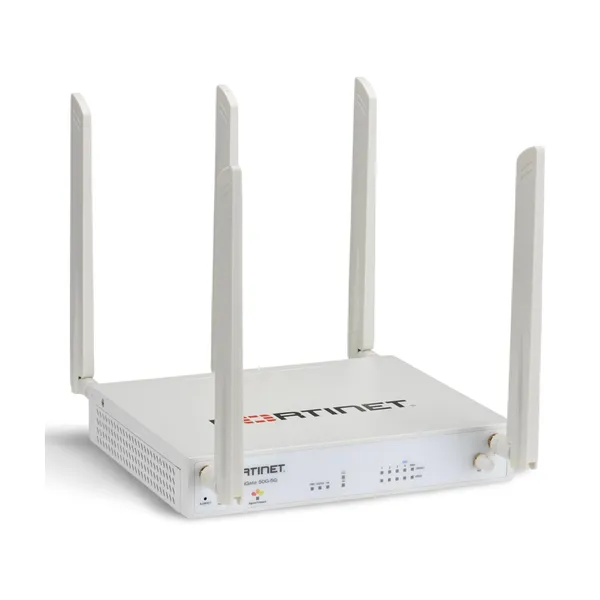
FortiGate 50G 5G (FG-50G-5G) Tanzania
The FortiGate 50G 5G (FG-50G-5G) is a compact Fortinet next-generation firewall built for distributed business locations that need security, SD-WAN and cellular WAN flexibility in one branch platform. Fortinet lists this model with five Gigabit Ethernet RJ45 ports, including four internal ports and one WAN port, plus an embedded 3G/4G/LTE/5G wireless WAN module and five external SMA WWAN antennas. That combination makes the appliance relevant to offices, retail locations, professional practices, service branches, project sites and other environments where a wired internet circuit may be complemented by mobile connectivity.
For buyers in Tanzania, the key purchasing question is not simply whether a firewall supports 5G. The useful question is how the appliance will fit the site’s WAN design, security policy, VPN requirements, application mix, expected user count and FortiGuard subscription plan. FourTeck can help customers prepare those requirements before quotation so that hardware, services and deployment expectations are aligned.
Integrated 3G/4G/LTE/5G wireless WAN supports flexible branch connectivity planning without requiring the cellular function to be treated as a separate firewall.
FortiOS brings firewall, SD-WAN, VPN, policy control and security services into a unified operating environment for distributed sites.
The 50G family is positioned by Fortinet for distributed enterprise sites and secure WAN transformation, making sizing and service selection central to procurement.
Verified FG-50G-5G Hardware and Platform Facts
Fortinet’s FortiGate/FortiWiFi 50G Series documentation identifies the ordering SKU as FG-50G-5G. The model provides five GE RJ45 ports, arranged as four internal ports and one WAN port, and integrates a 3G/4G/LTE/5G wireless WAN module with five external SMA WWAN antennas. Fortinet positions the wider 50G series as a converged next-generation firewall and SD-WAN platform for distributed enterprise locations. FortiOS provides the operating foundation, while FortiGuard security services can add threat-focused capabilities according to the purchased service bundle and entitlement.
Fortinet currently publishes 1.1 Gbps threat-protection performance for the FortiGate 50G family. Published performance figures are laboratory values and should not be treated as a guarantee of application throughput at every customer site. Real deployments vary with inspection profiles, traffic mix, VPN use, enabled security services, packet sizes, firmware, routing design and other conditions. Procurement teams should therefore size the appliance against actual requirements rather than choosing solely from a headline throughput number.
The embedded cellular interface is especially useful where a branch design benefits from WAN diversity. A business may plan 5G as a primary connection where fixed-line options are limited, as a secondary path alongside a wired ISP, or as part of an SD-WAN policy that steers selected traffic based on configured health and performance rules. Cellular service itself depends on the chosen mobile operator, SIM or service plan, local coverage, radio conditions and compatible bands, so these items should be checked during deployment planning.
What the FortiGate 50G 5G Helps Solve
Distributed businesses often have to solve several network problems at the same time: protect internet access, connect a branch securely to headquarters or cloud services, segment users and devices, maintain policy consistency, and keep a workable WAN path when the preferred circuit is unavailable. The FG-50G-5G brings these functions into a compact security platform with integrated cellular capability. It can therefore simplify a design that might otherwise require a firewall plus a separate cellular gateway, although the best architecture still depends on the site’s resilience, antenna placement, carrier and management requirements.
For VPN planning, customers should verify the FortiOS release and supported remote-access method for this entry-level G-series platform. Fortinet documentation notes important SSL-VPN limitations on 30G and 50G-class models in newer FortiOS releases, so buyers should not assume that a legacy SSL-VPN design can be copied unchanged. IPsec-based remote access and site-to-site VPN designs should be evaluated against the required firmware and client architecture.
FortiGate 50G 5G Tanzania
Organizations searching for FortiGate 50G 5G in Tanzania are commonly trying to combine branch cybersecurity with practical WAN resilience. Tanzania has a varied connectivity landscape: a site may have fibre or another fixed service, while a second path over a mobile network can add operational flexibility. The FG-50G-5G is relevant to this requirement because the cellular WAN capability is integrated into the appliance. Procurement teams should begin by documenting the primary circuit, intended mobile carrier, expected application traffic, VPN topology, number of local network segments and the security services that need inspection. This produces a more useful quotation than requesting firewall hardware without a deployment context.
A Tanzanian deployment may serve a head-office satellite location, retail branch, logistics point, education office, hospitality site, healthcare administration location or professional-services branch. In each case, the firewall policy should reflect the business workflow. Guest traffic may need separation from internal systems; cloud applications may need reliable direct internet access; point-of-sale or operational devices may require tightly scoped rules; and administrators may require secure management access. FortiOS can bring routing, firewall policy, SD-WAN and security inspection into the same platform, reducing the need to manage each function as an isolated appliance.
For cellular planning, antenna position and signal quality deserve attention. The FG-50G-5G uses five external SMA WWAN antennas, but effective service still depends on the mobile network, subscription, building construction and radio environment. A strong procurement process should therefore separate appliance capability from carrier availability. Customers should also decide whether cellular connectivity is intended as the normal production path, a failover path, or a policy-controlled secondary link. That decision influences data-plan sizing and SD-WAN configuration.
FourTeck Tanzania can support the pre-sales conversation by helping customers define the firewall role, WAN topology, FortiGuard subscription requirement and related network components. Buyers can also review FourTeck Tanzania technology solutions and use the consultation process to confirm current product and service options. No stock, delivery time or carrier coverage should be assumed until it is confirmed for the specific request.
FortiGate 50G 5G Dar es Salaam
Dar es Salaam buyers evaluating the FG-50G-5G often have branch-density and continuity requirements that make dual-path internet design attractive. Offices, retail operations, professional firms and service locations may rely on SaaS platforms, cloud telephony, payment services and remote access throughout the business day. A firewall selection should therefore account for both security inspection and the effect of WAN interruption on revenue-generating or customer-facing workflows. The embedded 5G-capable modem gives network designers another WAN option without changing the fundamental FortiGate security platform.
A practical Dar es Salaam design can start with a wired WAN as the preferred route and cellular service as an alternate path. SD-WAN rules can then be planned around business priorities, health checks and application requirements. Alternatively, a site with suitable mobile coverage may consider cellular connectivity as its primary WAN. Neither approach should be chosen automatically: signal conditions, carrier plans, data allowances, latency-sensitive applications and the expected duration of failover all matter. Where the firewall protects several VLANs, the administrator should also define which segments may use cellular data during a failover event.
Security subscriptions are another important buying decision. FortiGate hardware provides the platform, while the exact FortiGuard services available depend on the purchased subscription or bundle. Buyers should identify whether their policy requires functions such as intrusion prevention, web security, malware protection or other FortiGuard capabilities and request a quotation that clearly states the entitlement period. This is especially useful for organizations budgeting security costs over multiple years.
For a Dar es Salaam quotation, prepare the expected number of users and devices, internet speeds, required VPN connections, wired switching design, wireless architecture, public IP needs, mobile carrier plan and desired support term. That information helps determine whether FG-50G-5G is appropriately sized or whether another FortiGate model should be considered. For wider regional Fortinet planning, FourTeck Africa provides an additional regional technology reference.
FortiGate 50G 5G Mwanza
For Mwanza organizations, the FortiGate 50G 5G can be considered where a compact branch needs both secure network control and a cellular WAN option. The value of the embedded modem is clearest when the business treats connectivity as part of continuity planning rather than as a single ISP choice. A branch can be designed around a fixed internet connection with mobile failover, or around mobile connectivity where that is operationally appropriate. The decision should be based on measured service availability and application requirements rather than a generic assumption about 5G coverage.
Mwanza businesses may need to connect branch applications to systems hosted elsewhere in Tanzania, in a private data centre or in public cloud platforms. Site-to-site IPsec VPN can be part of that architecture, while SD-WAN can help administrators define how traffic uses available paths. Before configuration, document subnets, VLANs, DNS requirements, routing, remote networks and failover expectations. This avoids a common deployment problem where hardware is purchased first and the network design is left until installation day.
The five GE RJ45 ports on FG-50G-5G provide four internal interfaces and one wired WAN interface according to Fortinet’s ordering information. Customers should map those interfaces against their switching and segmentation plan. Larger environments may use a managed switch behind the firewall to provide additional access ports and VLAN distribution. If wireless LAN is required, that should also be planned as a separate requirement because FG-50G-5G is the FortiGate cellular variant, not a statement that Wi-Fi access-point functionality is included.
A useful Mwanza procurement brief should specify internet capacity, the mobile operator to be evaluated, security subscription term, number of protected networks, VPN needs and whether centralized management or logging is required. FourTeck can use that information to discuss an appropriate Fortinet configuration and quotation. Customers should confirm current licensing, firmware support and accessory requirements at the time of purchase because product software and service offerings can change over time.
FortiGate 50G 5G Arusha
Arusha has a diverse business environment that can include hospitality, travel operations, professional offices, NGOs, education and branch operations. For these buyers, the FG-50G-5G can be evaluated as a secure edge platform where internet reliability and centralized policy matter. The embedded cellular module can provide an additional connectivity option, while FortiOS supplies the firewall and SD-WAN framework used to control traffic. The design goal should be to protect business applications without creating unnecessary complexity for local staff.
Hospitality or customer-facing environments may require strict separation between guest traffic and administrative systems. Offices may need separate networks for staff, voice, servers, cameras or IoT devices. The firewall can enforce policy between those segments when the switching design and VLAN plan are prepared correctly. Buyers should therefore include their LAN topology in the pre-sales discussion, not only the internet speed. A compact firewall can still sit at the centre of a structured network if downstream switching is sized appropriately.
Cellular backup is particularly useful when the organization has identified which applications must continue during a fixed-line outage. Instead of allowing every device to consume the failover link, administrators can plan policy around essential cloud services, VPN traffic or business systems. Data-plan limits, mobile signal, antenna location and expected failover duration should be part of the design. Where remote users need access, confirm the supported VPN architecture for the intended FortiOS version; do not assume an older SSL-VPN workflow applies unchanged to this entry-level G-series platform.
For an Arusha quote, provide a simple network diagram, approximate concurrent user count, WAN details, required security services, branch-to-branch connectivity needs and preferred subscription term. This lets the solution conversation focus on fit rather than model name alone. Fortinet’s integrated approach can be extended with related switching, wireless and security components when the customer needs a broader branch architecture.
FortiGate 50G 5G Dodoma
Dodoma organizations considering the FortiGate 50G 5G may be planning a new office, upgrading an existing perimeter firewall or adding resilient connectivity to a branch. The integrated cellular WAN option makes the model useful to discuss when a second physical internet circuit is impractical or when mobile connectivity is desired as part of a continuity plan. The appliance should still be sized from the complete traffic and security profile, because enabling inspection and VPN services changes the workload compared with basic routing.
Government-related contractors, professional organizations, education facilities and distributed businesses often need predictable network policy across locations. FortiOS supports a common security and networking environment that can simplify standardization when multiple FortiGate sites are used. The exact management approach should be selected according to the number of devices, operational team and licensing plan. Centralized logging and management requirements should be included early in procurement rather than treated as an afterthought.
For 5G connectivity, confirm the SIM arrangement, supported service from the chosen carrier, signal at the installation location and antenna positioning. The five external SMA WWAN antennas are part of the hardware design, but the firewall cannot create mobile coverage where the network does not provide it. A pre-installation signal assessment is therefore valuable for sites that intend to depend heavily on cellular connectivity. Where 5G is used only for failover, administrators should also consider how software updates, backups and other high-volume traffic behave when the alternate link is active.
A Dodoma purchasing request should distinguish hardware from FortiGuard subscriptions and support services, state the required term, and list any deployment assistance needed. FourTeck can then discuss the requested configuration without making unsupported assumptions about stock or delivery. Customers can use FourTeck Tanzania contact and quotation to provide the project details.
FortiGate 50G 5G UAE
UAE organizations evaluating the FG-50G-5G may use it for small branches, retail sites, temporary project offices and distributed business locations where cellular WAN can complement fixed connectivity. The model’s integrated 5G capability can simplify the edge design when compared with adding a separate mobile gateway, while the FortiGate platform keeps security policy, routing and SD-WAN in the same operating environment. As with any cellular deployment, the carrier plan, supported bands, indoor signal and data allowance must be confirmed for the specific site.
A common UAE branch requirement is maintaining access to cloud applications and centralized systems when the preferred WAN path has a problem. An SD-WAN design can monitor links and steer traffic according to configured policy. The customer should identify which applications are business-critical, which can tolerate interruption and which should be restricted on a metered cellular path. This application-aware planning can reduce unnecessary mobile data consumption during failover and make continuity behaviour more predictable.
Security service selection should be documented alongside the hardware. FortiGuard subscriptions can extend the firewall with threat-focused services, but the exact functions and entitlement depend on the bundle purchased. Buyers should request a clear line-item quotation covering the appliance, service term, support and any required implementation. If a site is replacing another firewall, migration requirements should include current rules, objects, NAT policies, VPNs, routing and dependencies so that cutover planning is realistic.
For UAE-focused Fortinet projects, customers can also review FourTeck Fortinet UAE resources and FourTeck firewall solutions in Dubai. These regional resources complement the Tanzania page for organizations managing sites across multiple markets.
FortiGate 50G 5G Uganda
Uganda businesses with distributed branches can evaluate the FortiGate 50G 5G where secure edge connectivity and mobile WAN flexibility need to be combined. A branch may have a fixed connection for normal operations and use cellular service as a backup, or may use mobile connectivity more extensively where the site design supports it. The FG-50G-5G integrates the modem into the FortiGate appliance, reducing the number of separate edge devices that need to be configured and monitored.
The right deployment begins with requirements. Record the number of users, expected internet speed, cloud applications, internal VLANs, site-to-site VPN destinations and remote-access needs. Then define the security controls that are required and select a FortiGuard service term accordingly. This approach helps avoid under-specifying the security subscription or buying services that are not aligned with policy. Organizations with multiple sites should also decide whether centralized configuration and logging are required.
Mobile WAN planning requires carrier-specific validation. Signal quality can differ between buildings and even between rooms, and 5G availability should never be inferred simply because the firewall supports 5G. The five external SMA WWAN antennas provide the radio interface hardware, while service availability comes from the selected network operator. For a resilient design, test the actual service and define how the firewall should respond when the primary path fails or recovers.
Ugandan customers and organizations with Tanzania-Uganda operations can review FourTeck Uganda technology solutions for regional context. A cross-border deployment can benefit from a standardized FortiGate policy framework while still respecting different ISP, carrier and operational conditions at each location.
FortiGate 50G 5G Kampala
Kampala branches often depend on cloud software, online communication and centralized business systems, making WAN continuity a practical security and operations issue. The FG-50G-5G can be assessed for smaller distributed locations that need a FortiGate NGFW plus an integrated cellular option. Instead of viewing 5G only as a speed feature, network teams can treat it as another transport that can be governed by firewall and SD-WAN policy.
For example, a branch can prioritize its wired ISP under normal conditions and use the mobile interface when health checks indicate a problem. The failover policy can be designed to preserve essential business applications while limiting nonessential high-bandwidth traffic. That matters when the cellular service has a different cost structure or data allowance. Conversely, where a suitable mobile service is the primary WAN, the wired interface can be planned for another available connection. The correct topology depends on site conditions.
Security policy should be built around users and systems, not around the WAN alone. Segment staff, guest, voice, server and IoT traffic where appropriate; define outbound rules with least-necessary access; plan DNS and web controls; and establish VPN connectivity based on the supported FortiOS release. Buyers upgrading from older FortiGate appliances should specifically validate remote-access design because SSL-VPN support expectations on newer entry-level G-series platforms differ from some earlier products and firmware releases.
A Kampala quotation request is more effective when it includes the desired subscription term, current firewall model if replacing one, WAN details, VPN count, switch and access-point dependencies and implementation scope. This allows the supplier to discuss the complete branch edge rather than quote an isolated box without context.
FortiGate 50G 5G Arua
Arua organizations may value the FG-50G-5G for a different reason than a large metropolitan office: integrated cellular connectivity can make branch design more flexible when connectivity options vary by location. The firewall can provide the security edge while the embedded modem supplies an additional WAN path, subject to actual operator coverage and service quality. This is useful for businesses, NGOs, service points and project offices that need to maintain controlled access to centralized applications.
Before purchasing, teams should test the intended carrier at the actual installation site. Building materials, antenna placement and network conditions influence performance. A strong signal outside a building does not guarantee the same result at the equipment rack. The five external SMA WWAN antennas should be installed according to Fortinet guidance, and the network plan should account for the physical placement needed to obtain a reliable cellular connection.
The security architecture should also identify what happens when the mobile path is active. Administrators can choose whether all traffic, only selected VLANs or only critical applications are permitted to use that link. Site-to-site VPNs may need to re-establish across the alternate WAN, and cloud applications may react differently when public addressing changes. These behaviours should be tested as part of acceptance rather than assumed from the hardware specification.
For procurement in Arua, provide a clear description of the branch: users, devices, LAN segments, preferred ISP, mobile operator, VPN peers, security services and desired support period. If the site is part of a larger East African network, standardizing FortiGate configuration conventions can simplify administration while still allowing each branch to use the connectivity that is appropriate locally.
FortiGate 50G 5G Mbarara
Mbarara customers searching for a FortiGate 50G 5G supplier are often best served by starting with the network requirement rather than the model alone. FG-50G-5G is designed as a compact FortiGate with integrated cellular WAN, but the appliance must still match the site’s traffic and inspection load. Document internet speed, number of concurrent users, VPN traffic and the FortiGuard services to be enabled so that the platform can be assessed against real operational demand.
A branch can use the embedded mobile interface to improve connectivity options. For a retail or service site, that may mean keeping payment, ERP or communication services reachable during a primary-circuit outage. For an office, it may mean maintaining VPN access to centralized systems. For a temporary project location, cellular service may be useful while a permanent circuit is being arranged. These scenarios have different data consumption and reliability requirements, so the mobile plan should be chosen accordingly.
Network segmentation remains important even in a small branch. The firewall’s internal interfaces can connect directly to selected networks, while managed switching can extend VLANs when more ports are required. Keep guest and untrusted device traffic separated from sensitive business systems, and make inter-VLAN access explicit. Where wireless LAN is needed, include access points and their management architecture in the design rather than assuming cellular WAN also provides client Wi-Fi.
A Mbarara procurement request should include the required license term and any implementation services. Ask for clarity on what is included in the quoted FortiGuard bundle, how renewals will be handled, and what configuration responsibilities belong to the customer or implementation partner. This creates a cleaner handover and reduces ambiguity after hardware arrival.
FortiGate 50G 5G Gulu
Gulu branch deployments can benefit from a security platform that supports more than one approach to WAN connectivity. FG-50G-5G combines the FortiGate firewall platform with embedded 3G/4G/LTE/5G capability, allowing designers to incorporate cellular connectivity without relying on a separate external modem as the default architecture. The mobile service itself remains carrier-dependent, so a site survey and service check should precede any business-continuity assumption.
For organizations connecting Gulu to another office, IPsec VPN can form part of the secure site-to-site design. The routing and SD-WAN configuration should define how tunnels behave across the preferred and alternate links. If centralized applications use allowlists based on public IP addresses, the team should understand how failover affects those controls. DNS, NAT and monitoring should also be tested under both normal and backup conditions.
Security subscriptions should reflect the organization’s risk and compliance needs. FortiGuard services are not a generic single feature; the exact entitlement depends on the selected bundle and term. Procurement teams should compare quotation line items carefully and ensure that renewal dates are recorded. This is particularly important for distributed organizations where several branch firewalls may be purchased at different times and later need coordinated lifecycle management.
When requesting FG-50G-5G for Gulu, include the branch network diagram, expected WAN capacity, mobile carrier preference, VPN topology, security profiles and management requirements. A technically complete request helps distinguish whether the 50G 5G is the right fit or whether a larger model is justified by throughput, interface or scale requirements. Model selection should follow the workload, not the other way around.
FortiGate 50G 5G Kenya
Kenyan businesses operating branches across cities or across East Africa can evaluate the FG-50G-5G as a standardized secure edge for smaller locations. The integrated cellular module can complement fibre, broadband or other fixed connectivity, while FortiOS provides consistent firewall and SD-WAN policy. This can be valuable for organizations that want similar operational processes across many sites without requiring every branch to have identical WAN services.
A multi-site design should define a repeatable baseline: interface naming, VLAN numbering, address plans, security policies, logging, VPN standards and SD-WAN rules. Individual sites can then adapt carrier details and local addressing while preserving the security model. The FG-50G-5G’s embedded 5G capability is useful where cellular is part of that standard, but carrier coverage and data plans must be validated separately at every location.
Kenya-based buyers should also consider lifecycle management. Decide who will manage firmware updates, configuration backups, security-policy changes and FortiGuard renewals. If centralized management is needed, include that requirement in the architecture and licensing discussion. For remote access, confirm the supported VPN approach for the selected FortiOS version rather than relying on configuration guides written for older FortiGate generations.
Organizations can review FourTeck Kenya technology solutions when planning Kenyan deployments. For a quotation, provide the number of sites, desired subscription term, approximate user count per site, internet speeds, cellular requirements and whether rollout services are required. A fleet purchase may need different operational planning from a single branch even when the hardware model is the same.
FortiGate 50G 5G Kuwait
Kuwait organizations can consider FG-50G-5G for compact branch environments where an integrated cellular WAN option adds value to the security edge. Retail, service, project and professional-office sites may use cellular connectivity as an alternate path or as part of a temporary deployment. The FortiGate platform allows that transport to sit under the same policy and SD-WAN framework as the wired WAN rather than being treated as an unmanaged emergency connection.
The deployment should begin with carrier validation and antenna planning. 5G capability on the appliance does not guarantee a specific speed, latency or indoor signal level. Those outcomes depend on the operator, plan, spectrum, location, network loading and building conditions. If continuity is the goal, test failover under realistic application load and verify that essential VPN and cloud sessions recover as expected.
Cybersecurity requirements should be translated into specific FortiGate policies and FortiGuard services. Buyers should decide which traffic requires inspection, whether web or application controls are needed, how branch devices will be segmented and where logs will be retained. If the site connects to a headquarters firewall, document the IPsec parameters and routing design before implementation. This reduces the risk of a last-minute mismatch between sites.
For Kuwait procurement, clarify the appliance, subscription duration, support, accessories and implementation as separate items. Organizations with regional operations can use a common configuration standard while purchasing locally appropriate connectivity. The most useful quote is therefore one tied to a deployment brief, not merely the FG-50G-5G part number.
FortiGate 50G 5G Ghana
Ghanaian branches that need secure internet access plus cellular WAN resilience can evaluate the FortiGate 50G 5G as part of a broader branch-network design. The model integrates the mobile WAN module into the FortiGate chassis and supports the same FortiOS environment used for security policy and SD-WAN. This can simplify operations for organizations already using Fortinet at headquarters or other locations.
A resilient branch should define the purpose of each WAN path. If cellular is a backup, determine which traffic is allowed during failover and how long the mobile plan is expected to sustain normal business. If cellular is primary, test application performance and consider what alternate path is available if the mobile network is impaired. The firewall’s capabilities are only one part of resilience; power, carrier service, DNS, upstream systems and application dependencies also affect continuity.
FortiGuard subscription planning should be done at purchase time. Buyers should ask which security services are included, how long they are licensed and what renewal process will apply. The correct bundle depends on the organization’s security policy and operational needs. Likewise, remote-access requirements should be matched to current FortiOS support for the model, especially when migrating from an older SSL-VPN deployment.
Ghana customers can review FourTeck Ghana solutions for regional context. A complete quotation request should state users, WAN speed, cellular operator, VLANs, VPN peers, subscription term and deployment scope. That information supports a more accurate technical discussion than an isolated request for firewall price.
FortiGate 50G 5G Nigeria
Nigeria’s large and varied business environment creates many branch-network scenarios in which integrated cellular WAN can be useful. The FG-50G-5G can serve as a compact security edge for an appropriately sized location while providing 3G/4G/LTE/5G connectivity as another WAN option. Organizations should treat the cellular capability as part of an engineered network design, with operator validation, antenna placement, data-plan selection and failover policy all documented.
For retail and service branches, continuity planning may prioritize payment, ERP, CRM, voice or collaboration applications. For professional offices, VPN access to centralized systems may be the critical dependency. Administrators can use SD-WAN policy to determine how links are selected, but the desired application behaviour should be specified before rules are created. Testing should include loss of the primary WAN, recovery of the primary WAN and the behaviour of long-lived sessions.
Security design should also consider segmentation and logging. Keep untrusted or guest devices away from sensitive business networks, restrict management access, and ensure logs are available for troubleshooting and security review. The exact FortiGuard capabilities depend on the subscription selected, so procurement teams should compare service bundles and entitlement periods rather than treating all FG-50G-5G quotations as equivalent.
Nigeria-based customers can consult FourTeck Nigeria solutions for regional project context. When several Nigerian sites are involved, include the site count, expected rollout sequence and central-management requirements in the request. A standardized template can make deployment and ongoing support more consistent across branches.
FortiGate 50G 5G Seychelles
Seychelles businesses, hospitality operations and distributed service locations may consider FG-50G-5G where secure branch connectivity and WAN diversity are priorities. The appliance integrates cellular WAN into the FortiGate platform, giving designers an additional transport option alongside a wired connection. For island environments, however, the complete upstream path matters: mobile coverage, provider backhaul and application hosting location can all affect user experience, so appliance capability should not be confused with end-to-end service performance.
Hospitality and guest-facing sites should pay particular attention to segmentation. Guest internet, staff systems, property-management applications, voice, cameras and building devices may require different trust levels. A managed switching and VLAN design can extend the firewall’s policy model across the site. If Wi-Fi access is required, include access points and wireless management in the architecture; the FG-50G-5G’s 5G designation refers to cellular WAN rather than client Wi-Fi service.
Where cellular is used for backup, define the applications that should remain active and consider mobile data consumption. A backup path can be technically available yet become expensive or congested if unrestricted software updates, media traffic or guest use consume the link. SD-WAN and firewall policy should therefore reflect the continuity objective. VPN behaviour and public-IP dependencies should also be tested during failover.
For Seychelles procurement, provide WAN information, user and device estimates, network segments, VPN needs, security-service requirements and desired support term. Ask for a clear quotation that separates hardware and subscription components and confirms the current product configuration. This supports both technical review and lifecycle budgeting.
Compatibility, Integration and Deployment Planning
FG-50G-5G should be planned as part of the complete branch. The four internal GE RJ45 ports can connect local networks directly, but many business deployments will place a managed switch behind the firewall for additional ports and VLAN distribution. Fortinet’s wider secure-branch ecosystem can include FortiSwitch, FortiAP and FortiExtender products, but compatibility, software versions and licensing should be confirmed for the proposed design. Fortinet documentation states that the 50G family can manage up to two FortiExtenders in WAN-extension scenarios in the referenced FortiExtender release, while LAN-extension support differs by platform.
For VPNs, site-to-site IPsec is a common design option for connecting branches to headquarters or cloud gateways. Remote access requires extra attention because Fortinet has changed SSL-VPN availability on entry-level G-series models in newer FortiOS releases. A customer migrating from an older FortiGate should therefore document the existing remote-access method and verify the supported replacement architecture before cutover. Firmware choice should follow Fortinet guidance and the organization’s change-management policy.
Cellular deployment also requires practical checks: SIM provisioning, carrier APN settings where applicable, signal quality, antenna placement, data-plan limits and the intended role of the cellular interface. If the 5G path is used for failover, simulate failure of the wired WAN before go-live. Verify routing, DNS, VPN recovery, application access and return to the preferred link. A successful link-status indicator is not the same as a successful business-continuity test.
FortiGuard Licensing and Renewal Guidance
A FortiGate purchase can include different FortiGuard service bundles and support terms. The firewall hardware should therefore not be evaluated independently from the security services expected by the organization’s policy. During quotation, ask for the exact bundle name, included services, entitlement period and support level. Record the renewal date in the asset-management process so that subscription continuity is managed deliberately rather than discovered after expiry.
Security profiles can add inspection workload, which is another reason to size from the intended configuration. Fortinet’s published 50G-family performance numbers are useful comparison references, but production throughput varies. If the site has high encrypted-traffic volumes, multiple VPNs or extensive security inspection, provide those details during sizing. Organizations expecting substantial growth should include a reasonable capacity margin or compare the next FortiGate tier rather than purchasing only for today’s minimum requirement.
FG-50G-5G Quotation Checklist
Provide approximate users, devices, VLANs, internet speed, critical applications and expected growth.
State the primary ISP, intended mobile carrier, whether cellular is primary or backup, and any public-IP requirements.
List required FortiGuard functions and preferred subscription/support term so quotation items are comparable.
Identify site-to-site peers, remote users, central management, logging and configuration-migration needs.
FortiGate 50G 5G FAQs
Does FG-50G-5G have built-in 5G connectivity?
Yes. Fortinet lists FG-50G-5G with an embedded 3G/4G/LTE/5G wireless WAN module and five external SMA WWAN antennas. Actual service depends on carrier compatibility, coverage, subscription and site radio conditions.
How many Ethernet ports does FortiGate 50G 5G have?
Fortinet’s ordering information specifies five Gigabit Ethernet RJ45 ports: four internal ports and one WAN port.
Can the 5G link be used as backup internet?
It can be designed as an alternate WAN path, with routing or SD-WAN policy controlling how traffic uses available links. The exact failover design should be tested with the selected carrier and business applications.
Does the 5G name mean it provides Wi-Fi 5 GHz to users?
No. In FG-50G-5G, 5G refers to cellular WAN capability. Organizations that need client Wi-Fi should include suitable wireless access points or evaluate the appropriate FortiWiFi architecture separately.
Should I buy hardware only or a FortiGuard bundle?
That depends on the security controls and support required. Ask for the exact subscription bundle, included services and term so the quotation matches the intended protection and lifecycle plan.
Can I use SSL VPN on FG-50G-5G?
Do not assume a legacy SSL-VPN design is supported. Fortinet documents SSL-VPN limitations for entry-level G-series models, including the 50G family, in newer FortiOS releases. Confirm the intended firmware and supported remote-access architecture, including IPsec options, before migration.
Decision Recap and Consultation
FortiGate 50G 5G (FG-50G-5G) is most compelling when a smaller distributed site needs FortiGate security and SD-WAN together with integrated cellular WAN. Its verified hardware includes five GE RJ45 ports and an embedded 3G/4G/LTE/5G modem with five external SMA antennas. The purchasing decision should still be based on workload, inspection requirements, VPN design, subscription term, carrier conditions and growth expectations.
Before requesting a quote, prepare your site count, users, internet speed, VLANs, VPN peers, mobile carrier, FortiGuard requirements and deployment scope. FourTeck can then discuss a configuration aligned with the project instead of treating the firewall as a standalone part number. Product availability, lead time, service coverage and commercial terms should be confirmed during quotation.



Reviews
There are no reviews yet.