
FORTINET SECURE NETWORKING FOR TANZANIA
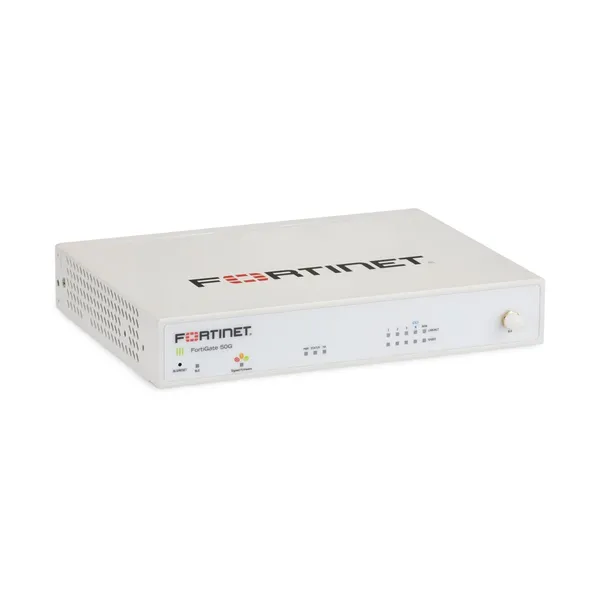
FortiGate 50G DSL (FG-50G-DSL)
A compact next-generation firewall for organizations that want security, routing, VPN, Secure SD-WAN and integrated DSL connectivity at the branch edge. The FG-50G-DSL combines a dedicated DSL RJ11 interface with one hardware-accelerated GE WAN port, three hardware-accelerated GE RJ45 ports and one default hardware-accelerated GE RJ45 FortiLink port.
FortiGate 50G DSL Overview
Fortinet positions the FortiGate 50G family as a converged next-generation firewall and SD-WAN platform for distributed enterprise sites. For a branch, retail location, professional office, service point or other compact deployment, that convergence can reduce the number of separate devices and management planes involved at the internet edge. The DSL variant is particularly relevant where a DSL circuit remains part of the connectivity design, whether as the primary access method or as one element of a broader WAN strategy.
The FG-50G-DSL hardware provides one DSL RJ11 port, one accelerated GE WAN port, three accelerated GE RJ45 ports, one accelerated GE RJ45 FortiLink port by default, one USB port and one RJ45 console port. Fortinet also lists Trusted Platform Module support, Bluetooth Low Energy and a signed-firmware hardware switch. It has no integrated Wi-Fi interface; organizations needing wireless access should plan suitable access points or evaluate the corresponding FortiWiFi option where appropriate.
Published 50G-series performance figures include firewall throughput up to 5/5/4 Gbps for 1518/512/64-byte UDP packets, 2.25 Gbps IPS throughput, 1.25 Gbps NGFW throughput and 1.1 Gbps threat-protection throughput under Fortinet’s documented test conditions. Real deployment performance depends on configuration, traffic profile, enabled security services, firmware and network design, so procurement should be based on the expected security workload rather than headline firewall throughput alone.
Integrated DSL
A dedicated RJ11 DSL interface helps consolidate suitable DSL access into the security appliance instead of relying solely on a separate edge modem architecture.
Secure SD-WAN
FortiOS combines networking and security, allowing organizations to build policy-led WAN connectivity and application-aware path selection where multiple links are deployed.
Branch Security
FortiGuard security services can add capabilities such as intrusion prevention and threat protection when the appropriate services and subscriptions are selected.
VPN Connectivity
The platform supports secure connectivity use cases for branches and remote access, helping organizations extend controlled access between sites, users and business resources.
Verified Hardware and Performance Highlights
| GE WAN | 1 hardware-accelerated GE WAN port |
| GE RJ45 | 3 hardware-accelerated GE RJ45 ports |
| FortiLink | 1 hardware-accelerated GE RJ45 FortiLink port by default |
| DSL | 1 DSL RJ11 port |
| Management / expansion | 1 USB port and 1 RJ45 console port |
| Firewall throughput | 5 / 5 / 4 Gbps (1518 / 512 / 64 byte UDP packets) |
| IPS throughput | 2.25 Gbps under published Fortinet test methodology |
| NGFW throughput | 1.25 Gbps under published Fortinet test methodology |
| Threat protection | 1.1 Gbps under published Fortinet test methodology |
Buying and Sizing Guidance
Before requesting a FortiGate 50G DSL quotation, document the internet circuit type and speed, expected number of users and devices, VPN requirements, security inspection features, segmentation plan, wireless requirements, number of branches and anticipated growth. A firewall should be selected against the traffic it will inspect with the services you intend to enable, not only against raw forwarding performance.
Also identify the required FortiGuard and FortiCare term. Hardware and service bundles can vary, so the quote should state the exact appliance, subscription package and duration rather than assuming that every FG-50G-DSL order includes the same services. For wider Fortinet and firewall planning, organizations can also review FourTeck Fortinet UAE resources, FourTeck firewall solutions, FourTeck Uganda and FourTeck Kenya for related regional technology context.
FortiGate 50G DSL (FG-50G-DSL) Tanzania
For organizations evaluating FortiGate 50G DSL in Tanzania, the key purchasing question is whether the appliance fits both the security workload and the available WAN services. Businesses may operate with fiber, Ethernet handoff, fixed wireless, DSL or combinations of links depending on site and provider. The FG-50G-DSL is useful to evaluate when DSL remains relevant because it adds a dedicated RJ11 DSL interface while retaining Gigabit Ethernet WAN and LAN connectivity. This allows a network design to treat connectivity and security as one coordinated edge rather than viewing the firewall as an isolated box.
A Tanzanian deployment should start with an inventory of users, cloud applications, voice systems, servers, cameras, guest networks, payment or business systems and remote-access requirements. Those details help define VLANs, security policies, VPNs and bandwidth priorities. A branch using Microsoft 365, cloud ERP, video meetings and IP telephony may have very different traffic characteristics from a warehouse using scanners, CCTV and a small number of office PCs. The same model can therefore behave differently depending on inspection features and traffic mix.
Procurement teams should request an exact bill of materials. Confirm the FG-50G-DSL appliance, required FortiGuard security services, FortiCare support term and any complementary switches or access points. Because the FG-50G-DSL does not provide integrated Wi-Fi, wireless coverage should be designed separately. If several sites are being connected, include the number of branches, WAN circuits and VPN topology in the request so the solution can be assessed as a system. Avoid assuming stock, delivery time or subscription entitlement until these are stated on a current quotation.
For Tanzania, the strongest reason to consider this platform is consolidation: firewalling, secure networking, VPN and SD-WAN capabilities operate through FortiOS, while the DSL interface can suit sites that still depend on compatible DSL access. This can simplify policy consistency across distributed offices. The final design should still account for provider handoff details, public addressing, failover expectations, power protection, rack or desktop placement and administrative access. A clear requirement document makes it easier to compare the 50G DSL with other FortiGate models without overbuying or undersizing.
FortiGate 50G DSL (FG-50G-DSL) Dar es Salaam
Dar es Salaam organizations often need an edge security platform that can support busy commercial offices, retail branches, logistics operations, professional services and distributed teams. When assessing the FG-50G-DSL, begin with the actual internet handoff at the premises. Its DSL RJ11 interface can be relevant to compatible DSL services, while the accelerated GE WAN interface provides an Ethernet path for other service designs. In a multi-link architecture, FortiGate Secure SD-WAN can help administrators apply business rules to WAN usage rather than treating every circuit as an independent router connection.
For a head office or branch in Dar es Salaam, segmentation deserves early attention. Finance systems, staff workstations, guest Wi-Fi, IP phones, CCTV and servers should not automatically share one unrestricted network. The firewall can form part of a VLAN and policy architecture that limits unnecessary communication between groups. If FortiSwitch and FortiAP components are being considered, the default FortiLink interface can also be relevant to an integrated Fortinet design. Exact switch and access-point sizing should be based on ports, PoE demand, wireless coverage and user density.
Bandwidth planning should reflect security inspection. Fortinet publishes 1.25 Gbps NGFW throughput and 1.1 Gbps threat-protection throughput for the 50G DSL under its documented test methodology, which is more useful for security sizing than looking only at the 5 Gbps headline firewall figure. Organizations with heavy encrypted traffic, extensive VPN use or rapid growth should discuss those workloads before choosing a model. The objective is stable performance with the required controls enabled, not simply achieving the highest laboratory forwarding number.
A useful quotation request for Dar es Salaam should state ISP connection types, line speeds, approximate users, remote users, site-to-site VPNs, security-service requirements and expected expansion. Include whether the appliance will replace an existing firewall and whether configuration migration is needed. For a new office, also identify switching, Wi-Fi, structured cabling and UPS requirements. This approach produces a more meaningful procurement comparison than requesting only a unit price for FG-50G-DSL.
FortiGate 50G DSL (FG-50G-DSL) Mwanza
In Mwanza, a FortiGate 50G DSL deployment can be considered for offices, trading businesses, hospitality operations, healthcare facilities, education sites and distributed branches that need controlled internet access and secure connectivity to other locations. The integrated DSL port is most valuable where a compatible DSL circuit is genuinely part of the WAN plan. Where the primary service is Ethernet-based, the GE WAN port remains available, and the DSL interface may still be evaluated as part of a resilience design if the service environment supports it.
Resilience planning should go beyond having two cables. Define what should happen when a primary link fails, which applications receive priority and how sessions should behave when paths change. Secure SD-WAN policies can help align path choice with application and business requirements. For example, business applications and voice traffic may deserve different handling from software downloads or guest browsing. The exact policy should reflect measured link quality and the organization’s priorities rather than generic templates.
Security policy design is equally important. A firewall is most useful when rules are specific, administration is protected and network zones reflect business functions. Mwanza sites with cameras, guest wireless, operational equipment and office systems should consider separation between these device classes. Remote management should use secure methods, and administrator access should be limited to authorized personnel. Subscription-based security functions should be selected according to risk and procurement requirements, with renewal dates documented so protection does not silently lapse.
When requesting an FG-50G-DSL proposal for Mwanza, provide the existing topology and identify whether the project is hardware supply only or includes design, migration and configuration. State the number of users, internet links, VPN peers and important applications. If wireless is required, remember that this FG model has no integrated wireless radio; separate access points or a FortiWiFi model may be more appropriate. A requirement-led quote reduces ambiguity and helps determine whether the 50G DSL is correctly sized.
FortiGate 50G DSL (FG-50G-DSL) Arusha
Arusha businesses evaluating the FG-50G-DSL may include hospitality operators, tour companies, professional offices, schools, NGOs and branch operations that depend on reliable internet and secure access to cloud services. These environments often mix staff systems with guest or visitor connectivity, making segmentation a central design issue. The firewall can enforce boundaries between trusted business devices and less-trusted networks while supporting VPN connectivity and application-aware WAN policies.
For hospitality and customer-facing sites, the firewall should be designed together with the wireless network rather than after Wi-Fi is installed. The FG-50G-DSL itself is not a wireless model, so access-point quantity, placement, PoE switching and guest-network separation should be planned separately. FortiLink can be relevant when integrating compatible Fortinet switching, but the overall design should be based on the site layout and device count. Guest traffic should not receive unnecessary access to management systems, cameras or staff resources.
Organizations with remote staff or multiple locations should document the VPN use case before purchase. Site-to-site connectivity, remote-user access and cloud application traffic each create different requirements. Fortinet publishes strong IPsec performance for the 50G family, but practical capacity depends on packet sizes, encryption, security inspection and concurrent activity. If a deployment has sustained high VPN demand, sizing should consider realistic traffic rather than relying on a single maximum number.
For an Arusha quotation, identify the WAN provider handoff, whether DSL is currently used, backup-link expectations, user count, important SaaS applications, required security services and support term. Include planned growth over the next few years. This is particularly important for organizations adding branches or expanding guest connectivity. A properly scoped request allows the appliance, licences, switching and wireless components to be evaluated together, helping avoid a situation where the firewall is capable but the surrounding network becomes the bottleneck.
FortiGate 50G DSL (FG-50G-DSL) Dodoma
For Dodoma offices and institutions, the FortiGate 50G DSL can provide a compact security edge where controlled internet access, VPN and WAN policy are required. Government-adjacent organizations, professional services, education environments and growing enterprises may need clear separation between departments, guest users and infrastructure systems. The appliance’s combination of Gigabit Ethernet and DSL connectivity makes it worth evaluating where the site has mixed or changing access technologies.
A strong deployment begins with policy objectives. Identify which systems need inbound or outbound internet access, which departments can communicate, which services require VPN access and what should be logged. Network security becomes easier to operate when rules are based on named business purposes rather than broad any-to-any access. Where sensitive systems exist, dedicated VLANs and tightly scoped firewall policies can reduce unnecessary exposure. Logging and reporting requirements should also be defined before deployment so administrators know what evidence they expect to retain.
The FortiGate 50G platform is designed around FortiOS and can participate in Fortinet’s broader Security Fabric approach. That is useful for organizations seeking consistent controls across sites, but it does not remove the need for disciplined configuration and lifecycle management. Firmware maintenance, administrator authentication, configuration backups and subscription renewals should be included in the operating plan. If a managed service is required, define responsibilities for changes, incident response and routine maintenance in the service scope.
Dodoma buyers should ask for the exact appliance and service bundle, not a generic “FortiGate 50G” quote, because the DSL variant has a specific interface configuration. Confirm FG-50G-DSL on the proposal and identify the desired subscription duration. Include any requirements for FortiSwitch, FortiAP, UPS or migration. Clear procurement specifications help suppliers quote comparable solutions and reduce the chance of receiving a model that lacks the required DSL interface.
FortiGate 50G DSL (FG-50G-DSL) UAE
UAE organizations considering the FG-50G-DSL should evaluate it as a compact branch security platform rather than only as a DSL firewall. The 50G series combines FortiOS networking and security, allowing businesses to use NGFW controls, VPN and Secure SD-WAN within one appliance. The DSL interface can serve environments where compatible DSL remains relevant, while the GE WAN port supports Ethernet handoffs. This flexibility can be useful for small branches, service locations and distributed enterprise sites.
In a UAE branch architecture, high-speed fiber may be the main circuit, so buyers should first confirm whether the DSL variant is necessary. If DSL is not part of the current or backup design, another 50G configuration may be more appropriate. If it is required, document DSL standards and provider requirements during design. Avoid buying a specific interface variant simply because it is available; select it because the physical WAN interfaces match the site.
Organizations operating across Emirates or connecting UAE sites to international offices should also define SD-WAN and VPN policy. Business-critical SaaS, voice, remote desktop and ERP traffic can have different latency and loss sensitivity. Application-aware routing can help use available links intelligently, while IPsec VPNs can protect traffic between sites. Security subscriptions should be chosen based on the threat controls required by policy and compliance obligations.
For UAE procurement, the quote should clearly list appliance SKU, FortiCare term, FortiGuard package and implementation scope. Ask whether configuration, migration, testing and documentation are included. Related Fortinet planning resources are available through FourTeck’s regional network, but current price, stock and delivery should always be confirmed at quotation time rather than inferred from a web page.
FortiGate 50G DSL (FG-50G-DSL) Uganda
Ugandan organizations can evaluate the FG-50G-DSL for branches that require an integrated security edge with flexible WAN options. The dedicated DSL interface is useful only where a compatible service exists, so the first step is confirming the carrier handoff. The separate GE WAN port also enables Ethernet-based connectivity and can contribute to a multi-link strategy. For distributed businesses, combining firewall policy and WAN steering on one platform can simplify operational consistency.
Branch sizing should account for users, devices and inspected traffic. A small office with cloud email and web applications may place a different load on the firewall than a site carrying CCTV viewing, large backups, voice, VPN and software updates. Security features such as IPS and threat protection also consume processing capacity. Use Fortinet’s published security-throughput figures as planning references and add reasonable headroom for growth rather than sizing only to today’s average traffic.
For multi-site Uganda deployments, define a repeatable configuration standard. Consistent VLAN names, addressing, firewall objects, VPN conventions and administrator controls make support easier as sites grow. Secure SD-WAN can help apply common link-selection policies while still accounting for different provider conditions at each location. Configuration backups and change records should form part of the operational process.
A procurement request should specify FG-50G-DSL, service term, security bundle, number of locations and whether installation or migration is required. If FortiAP wireless or FortiSwitch switching is planned, include those requirements so ports, PoE and management architecture can be reviewed together. Current commercial terms should be confirmed in a live quotation.
FortiGate 50G DSL (FG-50G-DSL) Kampala
Kampala has a wide range of business environments, from compact offices and retail branches to financial, healthcare and service operations. For these sites, the FG-50G-DSL can be assessed where organizations need a next-generation firewall with VPN, Secure SD-WAN and a physical DSL option. The correct design depends on internet service, traffic profile and security policy, not simply on employee count.
Busy Kampala offices may rely heavily on SaaS platforms, video meetings and cloud storage. These applications make WAN quality important as well as raw bandwidth. With multiple links, SD-WAN policy can prioritize paths based on business requirements. A DSL circuit could potentially play a different role from a primary Ethernet service, but exact failover behavior should be designed and tested. Organizations should define whether backup connectivity is intended for all users or only critical applications.
Security segmentation is especially useful in mixed-device environments. Separate employee, guest, voice, camera and management networks can reduce lateral exposure. The firewall policy should then allow only required flows. For remote access, use appropriate authentication and least-privilege access rather than exposing internal services directly. Logging should be enabled according to operational and compliance needs.
When seeking a Kampala quote, provide circuit details, user count, VPN requirements, security services, wireless needs and current network equipment. Confirm whether the project includes migration from another firewall. A staged implementation with testing and rollback planning is preferable for sites where internet downtime affects transactions or customer service.
FortiGate 50G DSL (FG-50G-DSL) Arua
For organizations in Arua, connectivity resilience can be as important as advanced security functionality. The FG-50G-DSL offers a dedicated DSL port alongside Ethernet interfaces, creating options where compatible DSL service forms part of the available connectivity mix. The appliance can also provide firewalling, VPN and SD-WAN functions within FortiOS, helping a branch use a consistent security platform even when WAN access differs from larger city sites.
A practical design should document the primary and secondary internet paths and define how critical applications behave during degradation. Rather than sending all traffic over any available connection, SD-WAN policies can be designed around business priorities. For example, transactional systems and voice may require different treatment from guest browsing. Testing failover under realistic conditions is important because provider routing, DNS and application sessions can affect the user experience.
Power and physical deployment should also be considered. A compact desktop firewall still depends on stable power, suitable ventilation and protected cabling. A UPS can be part of a wider continuity plan where appropriate. Administrative credentials and configuration backups should be securely managed so recovery does not depend on one person or undocumented settings.
For Arua procurement, state whether the DSL interface is required for an existing circuit or future backup plan. Include the number of LAN segments, wireless access points, switches and VPN peers. This makes it easier to assess whether the FG-50G-DSL is sufficient and whether additional networking components are required.
FortiGate 50G DSL (FG-50G-DSL) Mbarara
Mbarara businesses considering the FG-50G-DSL may include retail operations, healthcare, education, hospitality and regional branches. These environments often combine staff applications with guest access, cameras and IP-based devices. A next-generation firewall can act as the policy boundary between those groups while controlling internet access and supporting secure connections to other sites.
The DSL interface should be matched to an actual service requirement. If the location receives internet through Ethernet, the GE WAN interface may be the main connection, while DSL may be unnecessary or used only if a compatible secondary service is planned. Selecting the right physical variant avoids paying for interfaces that do not fit the site. Provider equipment and authentication requirements should be confirmed before deployment.
Security subscriptions deserve careful procurement attention. FortiGate hardware provides the platform, while specific FortiGuard services and support entitlements depend on the purchased package. Organizations should decide which protections they need, how long the subscription should run and who will monitor renewals. The quote should show these items clearly so lifecycle cost is understood beyond the initial appliance purchase.
For Mbarara, include expected growth in the sizing exercise. More users, faster circuits and additional security inspection can increase demand. If a branch is likely to expand significantly, compare the 50G DSL against adjacent models before committing. A well-sized firewall should provide useful headroom without creating unnecessary cost.
FortiGate 50G DSL (FG-50G-DSL) Gulu
Gulu organizations can use the FG-50G-DSL as a candidate for secure branch networking where integrated DSL and Ethernet connectivity align with available services. NGOs, education sites, offices and distributed operations may need encrypted connectivity to headquarters or cloud resources while maintaining local internet access. FortiGate VPN and SD-WAN capabilities can support these architectures when configured around real application requirements.
For a distributed organization, standardization is a major operational benefit. Using consistent firewall policy conventions, VPN templates and administrator practices across sites can reduce troubleshooting time. The branch should still be adapted to local WAN conditions. Link quality, bandwidth and provider characteristics can vary, so SD-WAN thresholds and failover rules should be validated at the actual site.
Local network design should separate systems according to trust and function. Guest Wi-Fi should not automatically reach internal applications. Cameras and IoT devices may warrant their own segments. Management interfaces should be restricted. If access points and switches are part of the project, consider how they will be powered, managed and monitored. The FG-50G-DSL has a default FortiLink port that can support compatible Fortinet integration scenarios.
A Gulu quotation request should include the WAN circuit, number of users, VPN topology, security features, switching and wireless requirements and desired support term. For remote sites, also define whether configuration will be staged before delivery and what information is needed for commissioning. Clear preparation can reduce on-site troubleshooting.
FortiGate 50G DSL (FG-50G-DSL) Kenya
Kenyan businesses evaluating FortiGate 50G DSL should first distinguish between the standard 50G platform and the DSL-specific variant. The FG-50G-DSL adds a dedicated DSL RJ11 interface while retaining accelerated Gigabit Ethernet connectivity. This can suit branches that need DSL integration, but sites with fiber-only designs should compare interface requirements carefully. The goal is to choose a model that matches both current connectivity and realistic future needs.
For Nairobi and other commercial centers, cloud applications and high-speed internet can make security-throughput sizing important. Fortinet’s published NGFW and threat-protection numbers are more representative for inspected traffic than raw firewall throughput. Organizations should estimate peak bandwidth, VPN use and enabled security profiles, then leave headroom for growth. Larger or more demanding branches may be better served by another model even if the 50G can handle basic routing.
Multi-branch businesses can use Secure SD-WAN to create common policy for primary and backup circuits. Application-aware steering can improve use of available connectivity, but it should be configured around measurable service-level expectations. VPN architecture should also consider hub-and-spoke versus direct branch connectivity, cloud destinations and redundancy.
Kenya procurement teams should request the exact FG-50G-DSL hardware and the intended FortiGuard/FortiCare term. Ask for implementation scope separately from hardware so comparisons remain clear. If migrating from another vendor, include policy review, object migration, VPN recreation and testing in the project plan rather than treating replacement as a simple cable swap.
FortiGate 50G DSL (FG-50G-DSL) Kuwait
Kuwait organizations considering the FG-50G-DSL should assess whether DSL connectivity is part of the branch design and whether the 50G performance profile matches the expected security workload. The platform can consolidate firewall, VPN and SD-WAN functions, which is useful for distributed offices seeking a consistent FortiOS operating model. However, interface selection should follow the actual carrier service rather than a generic product preference.
Branch environments using cloud applications, voice and video should define performance expectations for each traffic class. Secure SD-WAN can use multiple WAN paths according to policy, while firewall controls can segment internal networks and inspect traffic. Where guest Wi-Fi or IoT devices are present, separate zones can reduce unnecessary access to business systems.
The appliance is a compact desktop model, but deployment planning should still include secure physical placement, reliable power and appropriate environmental conditions. Administrative access should use strong controls, and configuration changes should be documented. Subscription renewals and firmware maintenance should be part of the operational calendar.
For a Kuwait quote, specify appliance variant, FortiGuard bundle, FortiCare duration, implementation scope and any FortiSwitch or FortiAP requirements. If DSL is intended as backup, provide details of the primary circuit and desired failover behavior. This gives the solution designer enough information to build a coherent branch edge rather than quoting isolated hardware.
FortiGate 50G DSL (FG-50G-DSL) Ghana
Ghanaian businesses can consider the FG-50G-DSL for compact branch security where a DSL interface adds practical value. The platform supports Fortinet’s converged networking and security approach, combining firewall controls, VPN and SD-WAN in FortiOS. Organizations with multiple connectivity types can use this foundation to create policies for how traffic uses available WAN paths.
Before purchase, map the internal network. Count staff devices, phones, cameras, wireless clients, servers and operational systems. Decide which groups require separation and which services must communicate. This exercise often reveals that switch capacity, PoE and Wi-Fi design are just as important as firewall selection. The FG-50G-DSL does not include wireless, so access points must be planned independently.
Security services should reflect risk. Intrusion prevention and threat protection can improve inspection, but enabled profiles affect throughput and require appropriate subscriptions. Fortinet publishes performance under defined test conditions; real traffic varies. Buyers should therefore size against peak inspected traffic and expected growth.
For Ghana procurement, request a transparent bill of materials and avoid assuming a bundle from the model name alone. Specify support and security-service duration, deployment scope and VPN requirements. Organizations can also use the broader FourTeck Ghana technology portfolio to consider firewall deployment alongside switching, Wi-Fi and other infrastructure rather than treating security as a standalone purchase.
FortiGate 50G DSL (FG-50G-DSL) Nigeria
Nigeria’s diverse connectivity environment makes WAN planning an important part of firewall selection. The FG-50G-DSL combines a dedicated DSL interface with Gigabit Ethernet, allowing organizations to evaluate it for branches where DSL is still relevant alongside other access methods. Secure SD-WAN can help manage multiple paths according to application and service requirements when the network is designed with more than one circuit.
For offices in major commercial centers or distributed regional branches, sizing should account for security inspection, VPN and cloud usage. A branch with hundreds of devices or high sustained bandwidth may need a larger appliance, while a compact office may fit comfortably within the 50G profile. Published Fortinet performance numbers are useful baselines, but a design should consider peak conditions and future circuit upgrades.
Network segmentation can improve security for environments that combine business workstations, guest access, CCTV, POS, voice and IoT devices. Policies should allow only necessary communication between zones. Remote administration should be protected, and configuration backups should be stored securely. If multiple branches use FortiGate, consistent standards can simplify ongoing support.
Nigeria buyers should request exact licensing and support terms with the FG-50G-DSL. If the project includes migration, document existing VPNs, public services, NAT rules and application dependencies before changeover. Testing should verify internet access, DNS, business applications, VPNs and failover before the old firewall is retired.
FortiGate 50G DSL (FG-50G-DSL) Seychelles
Seychelles organizations, including hospitality, professional services and distributed business sites, can evaluate the FG-50G-DSL where compact security and flexible WAN connectivity are needed. Island operations may place a premium on reliable connectivity and remote manageability, making careful WAN and failover design important. The DSL interface is relevant only when supported by the local access service, while the GE WAN interface supports Ethernet-based connectivity.
Hospitality environments should pay particular attention to guest segmentation. Visitor devices should be separated from administrative systems, payment environments, cameras and staff networks. The firewall can enforce policy boundaries, while dedicated wireless infrastructure provides coverage. Because the FG-50G-DSL has no integrated Wi-Fi, access-point planning should consider building layout, user density and roaming requirements.
For remote support, secure administrative methods and good documentation are essential. Maintain configuration backups, record WAN settings and define who can authorize policy changes. VPN connectivity can support access to centralized systems, but privileges should be limited to what users or sites actually require. Where multiple internet paths are available, SD-WAN policies can help use them based on quality and business priority.
A Seychelles quotation request should include circuit types, bandwidth, users, guest-network scale, VPN requirements and subscription term. If the site is a hotel or resort, include peak occupancy device counts rather than only employee numbers. This provides a more realistic basis for firewall and wireless sizing and helps determine whether the 50G DSL has sufficient headroom.
Compatibility, Deployment and Integration
The FG-50G-DSL can sit at the edge of a routed or segmented business network and can integrate with the broader Fortinet ecosystem. The default FortiLink interface is relevant to compatible FortiSwitch management scenarios, while FortiAP products can provide wireless connectivity in designs that use Fortinet access points. Exact compatibility should be checked against current Fortinet documentation and the software versions planned for deployment.
Before installation, document WAN addressing and authentication, internal subnets, VLANs, DHCP responsibilities, DNS, NAT requirements, published services, VPN peers and administrator accounts. For a replacement project, export or document the existing firewall configuration and identify rules that are obsolete. Migration is an opportunity to simplify policy rather than reproducing years of unused objects.
After configuration, test ordinary internet access, business applications, DNS, VPNs, inter-VLAN rules and WAN failover. Validate that guest and restricted networks cannot reach protected resources. Confirm logging and time synchronization. Save a known-good configuration after acceptance and document renewal dates for subscribed services.
Quotation Checklist for FG-50G-DSL
✓ Exact model: FortiGate 50G DSL (FG-50G-DSL)
✓ Primary and backup WAN types
✓ Internet bandwidth and expected upgrades
✓ User and device counts
✓ VLAN and segmentation requirements
✓ Site-to-site and remote-access VPN needs
✓ Required FortiGuard services
✓ FortiCare support duration
✓ FortiSwitch / FortiAP requirements
✓ Installation, migration and testing scope
Frequently Asked Questions
What makes FG-50G-DSL different from a standard FortiGate 50G?
The FG-50G-DSL is specifically equipped with a DSL RJ11 interface in addition to its accelerated Gigabit Ethernet interfaces. That makes it relevant where compatible DSL connectivity is required as part of the WAN design.
Does the FortiGate 50G DSL include Wi-Fi?
No. Fortinet lists no wireless interface for the FG-50G-DSL. Organizations needing Wi-Fi should plan separate access points or evaluate an appropriate FortiWiFi variant.
Can FG-50G-DSL be used for Secure SD-WAN?
Yes. Fortinet positions the 50G series as a converged NGFW and Secure SD-WAN platform. The practical design depends on the WAN links, application priorities and policies configured for the site.
Which FortiGuard licence should I buy?
The right subscription depends on the security services, support level and term your organization requires. Request a quote that explicitly identifies the service bundle and duration rather than assuming a standard package.
How should I size the firewall?
Consider peak internet bandwidth, users, devices, VPN traffic, enabled inspection services and growth. Security-throughput figures are generally more useful than raw firewall throughput when the appliance will run NGFW controls.
Decision Recap
FortiGate 50G DSL is most compelling when a compact branch needs Fortinet NGFW, VPN and Secure SD-WAN capabilities and a dedicated DSL interface is genuinely useful. Its interface mix, FortiOS integration and published security performance make it a practical model to evaluate for distributed sites, but final suitability depends on real inspected bandwidth, user count, VPN demand and growth.
For a meaningful quotation, provide your WAN circuit details, user/device count, required security services, VPN topology, switching and wireless needs, and desired support term. FourTeck can then use those requirements to structure a product and implementation discussion without relying on assumptions about stock, price or service entitlement.
Plan Your FortiGate 50G DSL Deployment
Share your current internet connection, number of users, branch topology, security priorities and expected growth. A requirement-led discussion can help determine whether FG-50G-DSL is the appropriate model, what subscription package is needed and which switching, wireless or implementation components should be included in the scope.



Reviews
There are no reviews yet.