
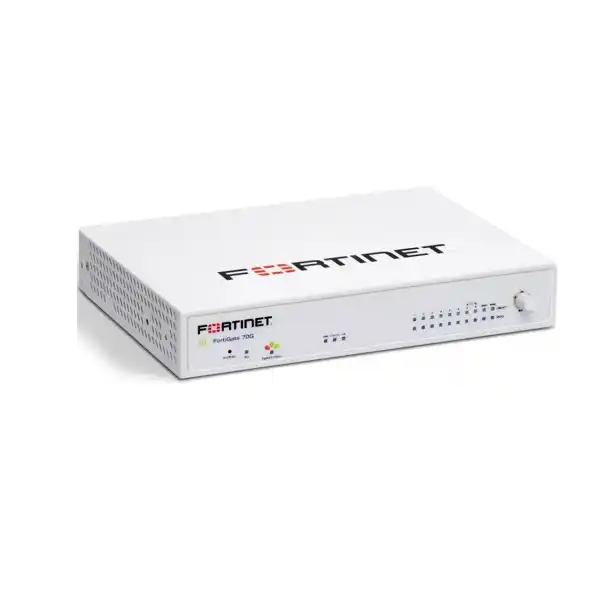
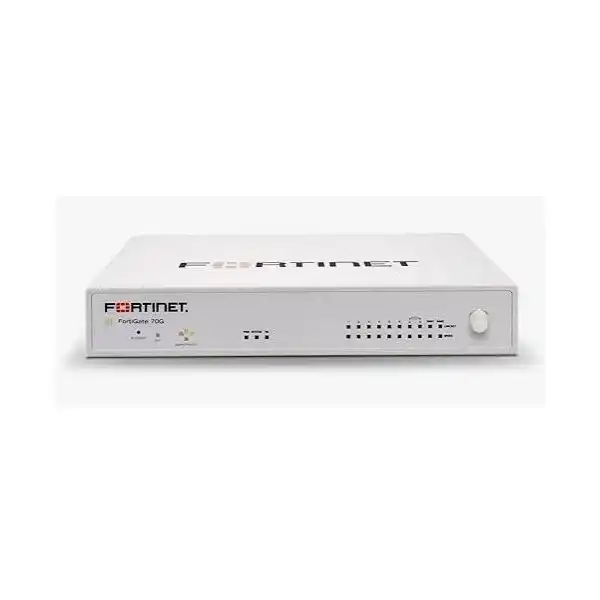
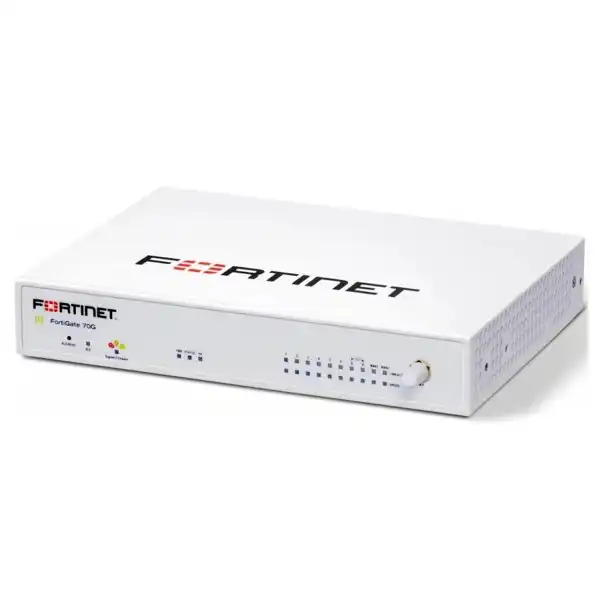
FortiGate 70G (FG-70G) Tanzania
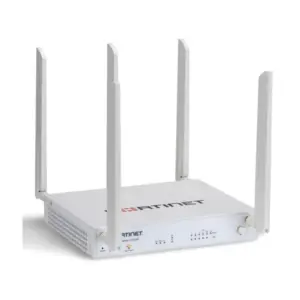
FortiGate 70G is a compact next-generation firewall designed for organizations that want networking and security delivered through the same FortiOS platform. For Tanzanian businesses evaluating a firewall for a branch, professional office, retail site, clinic, school, hospitality property or distributed enterprise location, the FG-70G provides a practical platform for firewall policy enforcement, secure SD-WAN, VPN connectivity and FortiGuard security services. Fortinet positions the 70G family for distributed enterprise sites and WAN transformation, with security and networking functions converged in one appliance.
FG-70G overview
The FortiGate 70G sits in Fortinet’s compact firewall portfolio and is designed for environments where security performance, manageable branch networking and straightforward deployment need to coexist. Fortinet publishes 10 GE RJ45 interfaces for the 70G and identifies threat-protection throughput of 1.3 Gbps. The platform runs FortiOS, which brings firewalling, routing, SD-WAN, VPN and security policy functions into a common operating environment. This matters for buyers that want to reduce the operational friction created by maintaining separate edge-routing and security platforms.
The appliance should be sized against real traffic patterns rather than a single headline throughput figure. Encrypted traffic, security profiles, application mix, number of users, concurrent sessions, VPN demand, internet circuit capacity and future growth all affect an appropriate firewall choice. FourTeck can help procurement teams turn those requirements into a clearer bill of materials and licensing discussion before quotation.
Verified highlights
Platform: FortiOS converged networking and security.
Interfaces: 10 × GE RJ45 according to Fortinet’s current small-business firewall listing.
Threat protection: 1.3 Gbps as published by Fortinet.
Core use: NGFW, secure SD-WAN and distributed-site security.
Security services: Designed to work with FortiGuard AI-powered security services, subject to the selected subscription.

Why businesses consider the FortiGate 70G
Converged edge
FortiOS combines networking and security capabilities, allowing administrators to build policy, routing, VPN and SD-WAN workflows around one security platform rather than treating the firewall as an isolated device.
Branch connectivity
Secure SD-WAN can help organizations steer traffic across available WAN links according to business and network requirements while retaining security inspection at the branch edge.
Security services
FortiGuard services can extend the appliance with threat intelligence and security capabilities. Buyers should specify the subscription bundle and term required rather than assuming every service is included with hardware.
Technical and procurement guidance
A sound FG-70G procurement exercise starts with the internet edge. Document each WAN circuit, expected peak bandwidth, backup links, public IP requirements and any ISP handoff constraints. Next, document internal segmentation: user networks, servers, voice, guest Wi-Fi, CCTV, point-of-sale systems, operational devices and management networks may require different security zones or VLAN policies. Finally, list the security functions that will actually be enabled. Advanced inspection changes the traffic profile and should be considered when sizing.
VPN requirements deserve equal attention. A site connecting to headquarters or cloud environments may require site-to-site IPsec VPNs, while mobile users may require a remote-access design. Authentication, identity sources, multifactor authentication, certificate handling and endpoint posture requirements should be decided as part of the solution rather than after the appliance is purchased. Organizations deploying multiple FortiGate sites should also plan policy consistency, monitoring, logging, configuration backup and change management.
Licensing is not simply an accessory line. FortiGuard security services and FortiCare support options are selected according to the organization’s required protection and support term. Procurement teams should therefore request a quote that clearly identifies hardware, subscription or service bundle, term, support, implementation scope and any complementary products. This makes comparisons more meaningful and helps avoid a hardware-only purchase that does not match the intended security design.
FortiGate 70G Tanzania
For organizations procuring the FortiGate 70G in Tanzania, the most useful starting point is a requirements-led assessment rather than a model-only request. A branch firewall must match the organization’s internet capacity, application mix, number of users, VPN topology, security inspection requirements and expected growth. The FG-70G can be considered by small and midsize organizations as well as distributed enterprises that want a compact FortiOS appliance at the network edge. Its role may include internet firewalling, segmentation between internal networks, secure branch connectivity, policy-based application control and SD-WAN. The exact services available depend on configuration and licensing, so a quotation should state the required FortiGuard and FortiCare components clearly.
Tanzania deployments can vary significantly. A professional office may prioritize reliable access to Microsoft 365, cloud ERP and video meetings. A retail operation may need isolation between point-of-sale, staff and guest traffic. A school may need controlled internet access for administration and learning networks. A hospitality environment may separate business systems from guest connectivity, while a branch network may prioritize encrypted connectivity to headquarters. These scenarios have different policy and bandwidth requirements even when they use the same firewall model.
Before requesting a FortiGate 70G Tanzania quotation, record the primary and backup ISP speeds, approximate active-user count, required VLANs, public-facing services, VPN peers, remote users, expected security profiles and preferred subscription duration. If the site will integrate FortiSwitch, FortiAP, FortiAnalyzer or other Fortinet components, include those requirements in the design conversation. Buyers can also explore the broader FourTeck Tanzania technology portfolio when planning complementary networking and infrastructure.
FortiGate 70G Dar es Salaam
Businesses evaluating the FortiGate 70G in Dar es Salaam often need an edge-security platform that can support a mix of cloud applications, branch connectivity, business internet and segmented local networks. The FG-70G is relevant where the design calls for a compact FortiOS firewall with integrated secure networking functions. Rather than selecting it solely because of office size, IT teams should measure internet throughput and determine how much traffic will be inspected by IPS, application control and other security services. This produces a more defensible sizing decision.
A Dar es Salaam headquarters or branch may also have more than one internet service. In that case, document whether the objective is simple failover, active use of multiple links, application-aware path selection or a broader SD-WAN design. The firewall policy should reflect business priorities: voice and conferencing may need different path behavior from backups or software updates. When connectivity to another office, data centre or cloud environment is required, include VPN topology and routing requirements in the scope.
Procurement teams should request a transparent bill of materials. Specify the exact FG-70G hardware, desired FortiGuard subscription, FortiCare term and any installation or configuration services needed. Avoid comparing quotations that package different service levels under similar product descriptions. For broader Fortinet and firewall planning across the region, the FourTeck Africa technology site provides a regional route for related infrastructure discussions.
FortiGate 70G Mwanza
For a Mwanza organization, the FortiGate 70G can serve as a security and connectivity control point for a branch or independent site. The design question is not merely whether the appliance can connect to the internet; it is how the organization wants to separate users and systems, inspect traffic, connect remote locations and maintain operations when connectivity changes. FortiOS supports the converged approach that Fortinet uses across FortiGate, bringing firewall and SD-WAN capabilities into a common platform.
Organizations with distributed operations should map which applications remain local and which depend on remote data centres, SaaS platforms or headquarters. This map helps define routing and VPN policy. If a backup ISP is available, decide which services must continue during primary-link failure and whether traffic should fail over automatically. For guest Wi-Fi, CCTV, business systems and staff endpoints, separate network zones can reduce unnecessary lateral access when the surrounding switching and VLAN design supports that architecture.
A Mwanza quote request should identify expected user growth, circuit upgrades and any planned new branches so the firewall is assessed against future as well as current demand. The subscription term should match the organization’s security and budgeting plan, and renewal responsibility should be documented. If centralized logs or multi-site visibility are required, include management and analytics requirements early rather than treating them as an afterthought.
FortiGate 70G Arusha
The FortiGate 70G can fit Arusha businesses that require a compact firewall for a controlled, segmented and remotely manageable network edge. Hospitality, tourism, professional services, education and branch operations can all create mixed traffic patterns, and those patterns matter to firewall design. Guest access should not automatically share the same trust level as finance, administration or operational systems. A well-planned deployment therefore begins with network zones and business flows before individual firewall rules are created.
Secure SD-WAN is particularly relevant when an organization wants policy-driven use of multiple WAN connections. Administrators can plan preferred paths for important applications and define resilience behavior, but the effectiveness of that design depends on circuit characteristics, correct monitoring and realistic failover policies. VPN connectivity should likewise be designed around the remote networks and identity model rather than enabled with generic settings.
When requesting an FG-70G Arusha quotation, provide the WAN bandwidth, number of sites, estimated users, segmentation plan, VPN requirements and security-service expectations. Ask for subscription details to be itemized so that hardware and recurring security services are clearly understood. If the environment also requires switching, wireless access or broader infrastructure work, discuss those dependencies together so interface, VLAN and management choices align with the firewall design.
FortiGate 70G Dodoma
Organizations searching for a FortiGate 70G in Dodoma may be planning a new office edge, refreshing an older firewall or standardizing security across multiple sites. The FG-70G offers a FortiOS-based platform for firewalling, secure networking and SD-WAN. A successful refresh should begin by documenting what the existing firewall does today: NAT policies, published services, VPN tunnels, VLAN interfaces, routing, DHCP dependencies, authentication integrations and logging destinations. That inventory reduces migration surprises.
For new deployments, policy design should follow business need. Separate trusted administrative traffic from guest or unmanaged devices; restrict access between network segments to what is necessary; and document outbound application requirements. Where cloud services dominate, WAN reliability and DNS behavior may be as important to user experience as raw firewall throughput. If the organization has remote branches, define which routes and services are exchanged across VPN links and how failover should behave.
Procurement should also consider lifecycle administration. Decide who owns configuration backups, firmware planning, license renewals, alert review and incident response. A firewall is most effective when it is operated as a maintained security system rather than installed once and ignored. A clear quotation and deployment scope can identify which responsibilities belong to the customer and which are included as professional services.
FortiGate 70G UAE
The FortiGate 70G is also relevant to organizations with UAE branches or cross-border operations that want a consistent Fortinet security architecture. A business connecting Tanzania and UAE locations can standardize policy concepts, VPN design and operational processes across FortiOS appliances, while still sizing each site according to local bandwidth and traffic. The FG-70G should be evaluated for the branch role it will perform rather than assumed to fit every office simply because it is compact.
Cross-border networks benefit from clear application and routing documentation. Identify traffic that must move between offices, traffic that should go directly to the internet and applications that are delivered from cloud platforms. Secure SD-WAN can be part of a strategy for steering traffic according to link conditions and business policy. Security profiles and encrypted traffic inspection requirements should be considered when estimating effective capacity.
For UAE-focused Fortinet requirements, buyers can review FourTeck’s Fortinet UAE resource. Organizations with broader UAE IT requirements can also use FourTeck UAE. A quote request should identify the appliance, licensing term, support expectation, deployment scope and any required integration with switching, wireless, authentication or logging systems.
FortiGate 70G Uganda
Ugandan organizations considering the FortiGate 70G can evaluate it for branch security, internet-edge control, VPN connectivity and secure SD-WAN. A multi-site organization should define a repeatable branch template covering VLANs, addressing, VPN parameters, logging, administrator access and baseline security profiles. Standardization can simplify operations, but each location still needs capacity planning based on its users, WAN links and application mix.
When connecting Uganda and Tanzania sites, document which applications require private site-to-site access and which can use direct internet breakout. Consider redundancy requirements at both ends of critical VPN connections. If remote workers are part of the scope, specify the intended remote-access method, authentication requirements and endpoint controls. These choices influence licensing, implementation and operational support.
For Uganda procurement and related technology discussions, visit FourTeck Uganda. A useful procurement request should include current and planned bandwidth, user count, VPN peers, security subscriptions, desired support term and any migration needs. That information helps distinguish a straightforward hardware purchase from a complete security deployment.
FortiGate 70G Kampala
A Kampala branch may use the FG-70G as the point where internet access, internal segmentation and site-to-site connectivity meet. For offices using SaaS heavily, policy design should recognize that business-critical traffic may leave directly for cloud services rather than traverse headquarters. Secure SD-WAN can support link selection strategies, while the firewall enforces security policy at the edge.
The practical design should include guest networks, corporate endpoints, voice systems, printers, servers and management interfaces where applicable. Not every segment needs unrestricted access to every other segment. Define permitted flows and apply least-necessary access. Where a legacy firewall is being replaced, collect its configuration and dependency information before migration so that required services are not missed.
For quotation preparation, specify whether the project requires only hardware and subscription or also configuration, migration and testing. Include any after-hours cutover requirement, VPN reconfiguration at peer sites and post-change validation. Clear scope reduces ambiguity and gives procurement teams a better basis for comparing proposals.
FortiGate 70G Arua
For an Arua site, resilient connectivity may be a central part of firewall planning. If two WAN services are available, define whether the second connection is for emergency failover or active SD-WAN use. Applications such as cloud ERP, communications and remote desktop can have different sensitivity to latency, packet loss and link changes, so routing policy should reflect operational priorities.
The FG-70G provides a FortiOS platform that can bring those connectivity decisions together with security policy. The network should still be designed deliberately: create appropriate VLAN boundaries, restrict management access, document VPN routes and decide where logs will be retained. If the site depends on headquarters for identity or applications, test how those dependencies behave during WAN failover.
An Arua procurement request should therefore describe the connectivity environment as well as the firewall model. State ISP speeds, backup-link expectations, local subnets, remote networks, user count and security-service needs. Include future expansion where known, since adding users, cloud applications or additional sites can change the performance profile over the life of the appliance.
FortiGate 70G Mbarara
Organizations in Mbarara can assess the FortiGate 70G for a secure branch architecture that combines firewall policy, VPN and WAN management. A common planning mistake is to focus only on the internet speed and overlook east-west segmentation. If business systems, guest users, cameras, wireless infrastructure and administrative devices share the site, security zones can help control which systems are allowed to communicate.
VPN planning should specify both topology and purpose. A site-to-site tunnel carrying ERP traffic has different operational importance from occasional administrative access. Define which routes are required, how peers authenticate and what should happen when a WAN path fails. Monitoring should be able to distinguish a failed tunnel from an unavailable application behind a working tunnel.
When seeking a FortiGate 70G Mbarara quote, list any existing Fortinet products and third-party network components that must interoperate. Note the subscription term and support requirements explicitly. This helps create a procurement package that reflects the operational solution instead of presenting the appliance as an isolated line item.
FortiGate 70G Gulu
A Gulu deployment can use the FG-70G as a controlled security boundary for a branch, campus office or distributed operation. The first design step is to identify critical services and trust boundaries. Staff endpoints, administrative systems, public or guest access and infrastructure management should be treated according to their risk and access requirements rather than placed on a flat network by default.
If connectivity resilience is required, secure SD-WAN can be evaluated alongside the available ISP links. Link monitoring, failover thresholds and application priorities should be planned and tested. For branches that depend on headquarters, site-to-site VPN and routing should be documented so that administrators know which services are expected to remain available during partial outages.
Procurement teams should include implementation details in the quote request when assistance is required. Configuration migration, network segmentation, VPN setup, security-policy creation and testing are distinct tasks and should be scoped clearly. Licensing and support terms should likewise be visible so renewal planning can begin from the deployment date.
FortiGate 70G Kenya
Kenyan businesses with Tanzania links may consider the FortiGate 70G as part of a standardized branch-security design. Using a common FortiOS approach across locations can simplify policy concepts and operational training, but hardware sizing remains site-specific. A Nairobi office with high cloud usage and many concurrent users may create a different security workload from a smaller regional branch even if both have similar raw internet bandwidth.
Cross-border site-to-site connectivity should be designed around application flows, addressing and routing. Overlapping subnets between offices can complicate VPN integration, so address planning is worth reviewing before deployment. Where multiple WAN links exist, SD-WAN policies can be developed around business requirements and tested for real failover behavior.
For related Kenyan procurement, buyers can visit FourTeck Kenya. A complete request should state hardware model, required FortiGuard service level, support term, WAN topology, VPN requirements and implementation scope. If the firewall is one element of a larger branch rollout, include switching, wireless and power dependencies in the project plan.
FortiGate 70G Kuwait
For Kuwait branches connected to East African operations, the FG-70G can be evaluated as a compact FortiOS security appliance for internet-edge control and encrypted site connectivity. The decision should be based on expected inspected traffic, user activity, VPN demand and future bandwidth rather than the firewall throughput figure alone. Security services selected in the subscription can materially affect the intended deployment profile.
Organizations should document cloud applications, headquarters dependencies and local services. This allows routing and security policy to be aligned with business traffic. If two circuits are present, define application priorities and failure behavior before creating SD-WAN rules. If the site publishes services to the internet, include those NAT and security requirements in the migration plan.
A Kuwait quotation should clearly identify appliance hardware, security subscription, support duration and implementation services. Buyers should also document renewal dates and ownership so protection does not lapse unnoticed. For multi-country organizations, maintaining a common configuration standard and change-control process can simplify support even when individual sites use different FortiGate models.
FortiGate 70G Ghana
The FortiGate 70G can be considered for Ghana offices that need a compact NGFW and secure branch-networking platform. A distributed enterprise should define the security baseline centrally while allowing for local connectivity differences. Baseline elements may include administrative access restrictions, logging, standard security profiles, VPN conventions, naming and backup procedures.
Sizing should consider the busiest period of the day and the security features expected to process that traffic. The published threat-protection figure is more relevant to security planning than relying only on raw firewall throughput, but even published performance figures are test results rather than guarantees for every production environment. Application mix, packet size, encryption and enabled services matter.
Ghana procurement teams should request itemized licensing and support information, particularly for deployments expected to remain in service for several years. If a site is being migrated from another firewall, inventory existing VPNs, policies, public services and routes. A structured migration checklist makes it easier to validate that business functions remain available after cutover.
FortiGate 70G Nigeria
Nigerian organizations evaluating the FG-70G should begin with workload and topology. A compact branch with cloud applications, local voice, guest Wi-Fi and VPN links can still require careful segmentation and policy design. The firewall can provide the enforcement point, but the surrounding switching, wireless and identity architecture determines how effectively those policies map to real users and systems.
For organizations operating multiple branches, secure SD-WAN can support centralized connectivity strategies while allowing link-specific behavior. Define which applications receive preferred paths, what constitutes a failed or degraded link and how traffic should return when service recovers. Test those behaviors rather than assuming a configuration will react correctly under every outage scenario.
The procurement request should separate hardware, subscriptions, support and professional services. This helps decision makers understand recurring costs and implementation responsibilities. When replacing an existing edge device, include migration and rollback planning, especially where the site hosts public services or critical VPN connections.
FortiGate 70G Seychelles
For Seychelles businesses and hospitality environments, a firewall design often needs to account for a mixture of business, operational and guest connectivity. The FortiGate 70G can be assessed as a compact FortiOS edge appliance where its capacity aligns with the expected security workload. Network segmentation is especially useful when guest access should remain separate from business administration, property systems, payment environments or infrastructure management.
Connectivity resilience should be planned according to the WAN options available at the site. If multiple links are used, SD-WAN policy can prioritize business-critical applications and define failover behavior. Remote administration and site-to-site VPN requirements should be secured with appropriate identity and access controls, and management access should not be exposed more broadly than necessary.
A Seychelles quote request should include internet speeds, user and device estimates, guest-network requirements, VLAN plan, VPN needs, security subscriptions and support expectations. For hospitality deployments, also document any integration dependencies involving property systems, voice, Wi-Fi or centralized IT management so the firewall design supports the broader environment.
Related Fortinet deployment topics
The FG-70G may be only one component of a secure branch. Organizations can consider FortiSwitch integration for wired access, FortiAP for managed wireless, centralized analytics where required, and FortiGuard security services aligned to the threat-protection objectives. For specialist firewall and Fortinet discussions, FourTeck firewall resources provide another reference point within the FourTeck network. Each additional component should be selected from actual project requirements rather than added automatically.
FortiGate 70G buying and sizing checklist
Connectivity
Record primary and backup WAN bandwidth, handoff type, public IP addressing, routing needs and expected growth. Identify applications that need preferential WAN treatment or must survive link failure.
Security
List required inspection services, segmentation boundaries, published services, application controls and any compliance-driven policies. Confirm the FortiGuard subscription needed for the desired protection.
VPN and identity
Count site-to-site peers and remote-access requirements. Document identity sources, multifactor authentication expectations, certificates and any endpoint-access policies.
Operations
Decide how configurations are backed up, logs retained, firmware maintained, alerts reviewed and licenses renewed. Include centralized management or analytics requirements where they are part of the project.
FortiGate 70G FAQs
What is the FortiGate 70G?
The FortiGate 70G is a compact Fortinet next-generation firewall in the 70G family. Fortinet positions the series for secure distributed sites and converged networking and security, with FortiOS providing the common operating platform.
How many network interfaces does the FG-70G have?
Fortinet’s current small-business firewall listing specifies 10 GE RJ45 interfaces for the FortiGate 70G. Port roles should be confirmed against the current official datasheet and deployment design before installation.
What threat-protection performance does Fortinet publish?
Fortinet currently publishes 1.3 Gbps threat-protection throughput for the standard FortiGate 70G. Real deployment performance depends on traffic and configuration, so published figures should be used as sizing inputs rather than guarantees.
Does the FortiGate 70G support SD-WAN?
Yes. Fortinet describes SD-WAN as included in FortiGate appliances through FortiOS. The practical design still requires WAN monitoring, routing, path-selection rules and testing appropriate to the organization.
Do I need a FortiGuard subscription?
The required subscription depends on the security services the organization intends to use. Request an itemized quote showing the hardware, FortiGuard service bundle, FortiCare support term and any implementation services.
Is the FG-70G suitable for every small business?
No firewall model should be selected solely from a company-size label. Internet bandwidth, encrypted traffic, security inspection, users, sessions, VPN requirements and growth should be reviewed before choosing the appliance.
Quotation checklist for FortiGate 70G
For a more useful quotation, provide your location, number of users, internet bandwidth, number of WAN connections, required VLANs, site-to-site VPN peers, remote-access needs, current firewall model if replacing one, preferred subscription term, required security services and whether configuration or migration support is needed. Also mention planned growth, additional branches and complementary Fortinet products. This information helps scope the FG-70G around the actual network rather than treating the purchase as a generic appliance request.
Decision recap
The FortiGate 70G is a compact FortiOS NGFW intended for secure distributed networking. Fortinet currently lists 10 GE RJ45 interfaces and 1.3 Gbps threat-protection throughput, while the broader 70G series combines firewalling, secure SD-WAN and integration with FortiGuard services. It is a candidate for branch and small-business environments when its inspected-traffic capacity, VPN needs and interface requirements fit the project. Buyers should confirm current official specifications and choose licensing according to the security services they actually need.
Talk to FourTeck about your FG-70G requirement
Share your WAN speeds, user count, branch topology, VPN needs and preferred security subscription term so the requirement can be reviewed before quotation. A clear scope is particularly valuable when the project includes migration, SD-WAN, segmentation, remote access or integration with other Fortinet products.


Reviews
There are no reviews yet.