
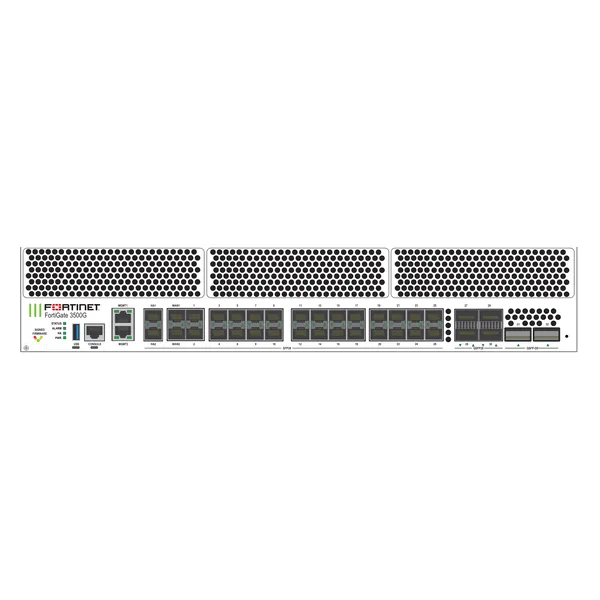
FortiGate 3500G (FG-3500G) Tanzania
FortiGate 3500G is built for organizations that need high-capacity firewalling, encrypted traffic inspection, segmentation and VPN at data-center scale. Fortinet positions the platform for modern data centers where AI workloads, east-west traffic growth and zero-trust requirements increase both throughput and security demands. For Tanzania deployments, the buying decision should be based on measured traffic, security profiles, interface density, redundancy, subscriptions and growth rather than headline bandwidth alone.
FortiGate 3500G overview
The FG-3500G sits in Fortinet’s high-end FortiGate range and is designed for environments where security infrastructure must process very large traffic volumes without forcing network architects to abandon advanced inspection. Official Fortinet documentation identifies two 400/200/100/40 GigE QSFP-DD interfaces, four 100/40 GigE QSFP28 interfaces and thirty 25/10 GigE SFP28 interfaces, alongside two multigigabit RJ45 management ports. This mix makes the appliance relevant to data-center aggregation, high-speed north-south perimeter traffic, east-west segmentation, large campus cores, service-provider security boundaries and consolidated enterprise security designs.
The platform uses purpose-built security processing and FortiOS to combine firewall policy, intrusion prevention, application control, VPN, segmentation and other security functions within one operating environment. Procurement teams should distinguish raw firewall throughput from inspected application traffic. Actual capacity depends on packet sizes, enabled security profiles, logging, TLS inspection, traffic mix and software configuration. FourTeck therefore recommends a sizing exercise that documents peak and sustained throughput, encrypted percentage, concurrent sessions, new sessions per second, VPN requirements, east-west flows, uplink speeds and anticipated three-to-five-year growth.
A mix of 25GE, 100GE and 400GE connectivity supports modern aggregation and data-center designs while reducing dependence on external speed-conversion layers.
Fortinet documents dedicated network and content processors to accelerate supported traffic and security functions while preserving policy visibility.
FortiOS enables teams already operating FortiGate environments to apply familiar policy, routing, VPN and security workflows to a higher-capacity platform.
Verified FG-3500G hardware and platform highlights
| Form factor | 2RU rack mount |
| 400GE interfaces | 2 × 400/200/100/40GE QSFP-DD |
| 100GE interfaces | 4 × 100/40GE QSFP28, with supported breakout options |
| 25GE interfaces | 30 × 25/10GE SFP28 |
| Management | 2 × 10G/5G/2.5G/1G/100M BASE-T RJ45 management ports |
| Power | Dual power supplies |
| Operating platform | FortiOS with FortiGuard security-service integration |
Performance values vary by test method, traffic mix, software release and enabled features. Validate the current Fortinet datasheet and release-specific documentation during final design and procurement.
What the FortiGate 3500G solves
A high-end firewall is often introduced when the security layer becomes the limiting factor in a network upgrade. Organizations may move from 10/25/40/100Gb links toward higher-capacity fabrics, increase TLS inspection, segment data-center workloads, consolidate multiple perimeter devices, or introduce AI and analytics platforms that generate intensive east-west traffic. The FG-3500G addresses this class of requirement by pairing dense high-speed interfaces with Fortinet’s accelerated security architecture.
It can also simplify designs that would otherwise spread routing, VPN termination, segmentation and threat inspection across several independent appliances. Consolidation does not mean every function should automatically be enabled on one box; resilience, failure domains and operational ownership still matter. The useful question is whether a pair or cluster of FG-3500G appliances can satisfy the organization’s security and availability objectives with sufficient capacity remaining during maintenance or a node failure.
For buyers comparing the 3500G with another FortiGate model, examine inspected throughput, interface requirements and session scale before comparing purchase cost. A model that is oversized for raw firewall traffic may still be correctly sized when TLS inspection, IPS, application control, logging, VPN and growth are included. Conversely, an unnecessarily large platform can increase acquisition and subscription costs. FourTeck can help convert network measurements and security objectives into a bill of materials and quotation request.
Deployment, integration and lifecycle planning
High availability
Critical data-center deployments normally require a failure-tolerant design. Plan redundant power, diverse upstream and downstream links, HA synchronization, maintenance procedures and capacity during a member outage. Validate optics, breakout cables and switch compatibility before purchase.
Segmentation
Use security zones, routing domains and policy boundaries to separate application tiers, shared services, management networks and external connectivity. Policy design should be based on required flows rather than broad trust between network segments.
Subscriptions
Hardware procurement and security-service procurement are related but separate decisions. Identify required FortiGuard services, FortiCare support level, term length and renewal ownership before approving a final bill of materials.
Operations
Define logging, alerting, configuration backup, change control and centralized management requirements. Where appropriate, FortiManager and FortiAnalyzer can support broader operational workflows in Fortinet environments.
For related planning, review FourTeck’s Tanzania technology solutions for regional procurement context, the Fortinet UAE specialist resource for Fortinet-focused requirements, FourTeck Uganda for Uganda projects, and FourTeck Kenya for Kenya requirements.
FortiGate 3500G Tanzania
Organizations searching for FortiGate 3500G in Tanzania are typically planning a core security refresh, a data-center expansion, a high-capacity internet edge, a segmentation project or consolidation of several firewall functions. Tanzania buyers should begin with a clear traffic baseline: internet bandwidth, inter-VLAN and east-west flows, data-center replication traffic, encrypted percentage, remote-access demand, site-to-site VPN volume and expected growth. The 3500G’s high-speed interface mix can suit environments moving beyond traditional 10Gb firewall designs, but interface speed alone should not determine the model. Security inspection requirements are equally important because IPS, application control, malware protection and TLS inspection change the effective workload.
For procurement in Tanzania, document the exact hardware model, power requirements, required transceivers, cables, rack space, FortiGuard subscriptions, FortiCare support term and any centralized management or logging components. This avoids quotations that appear similar but contain different service bundles. Organizations replacing an existing firewall should also inventory current policies, address objects, NAT rules, VPNs, routing, certificates and authentication dependencies before migration. A clean rule review often reduces unnecessary legacy policy and makes the cutover easier to test.
Data-center teams should consider redundancy at every dependency: two appliances where availability requires it, redundant power feeds, diverse switching paths and sufficient spare capacity to carry production traffic during maintenance or failure. Where 400GE or 100GE links are planned, verify transceiver and breakout requirements against the connected switches. FourTeck can support the commercial planning process by helping customers define a quotation checklist around the required model, subscription term, connectivity and deployment scope. For Tanzania enquiries, use the verified contact route at the bottom of this page rather than assuming stock or delivery dates before confirmation.
FortiGate 3500G Dar es Salaam
Dar es Salaam enterprises, financial institutions, service providers, large campuses and data-center operators may evaluate the FG-3500G when network growth creates a mismatch between core link capacity and security inspection capacity. A useful design exercise is to map the firewall’s role precisely: internet perimeter, data-center segmentation, inter-zone inspection, VPN aggregation, disaster-recovery interconnect, or a combination. Each role creates a different traffic profile. Internet traffic can be heavily encrypted and application diverse, while east-west data-center traffic may involve very high session counts and large internal flows.
For a Dar es Salaam deployment, rack and facilities planning matters alongside cybersecurity. The 3500G is a 2RU appliance with dual power supplies, so procurement should coordinate with the data-center team on rack allocation, redundant power, cooling, cable routing and port presentation. High-speed optics should be specified with the switching architecture rather than added at the end of procurement. If the design uses 400GE uplinks or 100GE breakout, confirm both ends of each link and the intended redundancy pattern. The same discipline applies to HA: reserve ports and switching capacity for the failure scenario, not just normal operation.
Migration planning should include a controlled policy conversion, VPN validation, routing convergence tests, monitoring integration and a rollback procedure. Security teams can use the refresh to improve segmentation and remove obsolete rules instead of simply cloning years of accumulated configuration. Businesses requesting a FortiGate 3500G quotation in Dar es Salaam should provide current and projected bandwidth, user and workload context, existing firewall model, required security services, HA requirement, interface speeds and subscription duration. These details enable a more comparable quotation and reduce the risk of missing optics, support or security-service components.
FortiGate 3500G Mwanza
For Mwanza organizations operating regional headquarters, industrial networks, logistics systems, healthcare platforms, education infrastructure or distributed branch connectivity, the FortiGate 3500G may be relevant when a central security hub aggregates substantial traffic from many sites or protects a high-capacity private data center. The design should account for WAN topology and not only local internet bandwidth. A central firewall can process traffic from branches, cloud connections, VPN tunnels and internal zones simultaneously, so peak aggregate demand can exceed the capacity suggested by any single circuit.
A Mwanza procurement team should separate mandatory requirements from optional future capacity. Mandatory items might include HA, specific 25GE/100GE interfaces, IPS, application control, secure remote access and logging. Future requirements could include additional data-center segments, higher-speed uplinks, new branches or expanded encrypted inspection. This separation helps determine whether FG-3500G provides appropriate headroom and which subscription bundle aligns with the security policy. It also supports budget planning because support and security subscriptions should be considered over the intended lifecycle rather than only in year one.
Where the firewall will connect Mwanza infrastructure with Dar es Salaam, cloud resources or other regional sites, validate routing, VPN encryption requirements, failover behavior and application sensitivity to path changes. A pre-deployment plan should document interface mapping, VLANs, zones, addressing, BGP or other routing requirements where used, NAT, certificates and monitoring. High-capacity equipment benefits from disciplined change management: define configuration ownership, backup frequency, firmware policy and incident escalation before go-live. FourTeck can use this information to structure an FG-3500G quotation request around hardware, support, subscriptions and connectivity accessories without making unverified assumptions about stock or delivery.
FortiGate 3500G Arusha
Arusha businesses with multi-site operations, hospitality groups, large institutions, regional organizations and enterprise data environments may consider the FortiGate 3500G when they require a central security platform with substantial connectivity and inspection capacity. The first step is to identify whether the appliance is genuinely a data-center-class requirement. If the environment has modest bandwidth and limited internal segmentation, another FortiGate may be more economical. If it aggregates many sites, protects high-speed server networks, terminates significant VPN traffic or must inspect large encrypted flows, the 3500G becomes more relevant.
Connectivity planning in Arusha should include both current carrier handoffs and the internal switching fabric. The appliance’s 25GE, 100GE and 400GE options can support high-capacity architectures, but a design only benefits from these interfaces when the connected network is engineered accordingly. Procurement teams should identify the exact optics and cabling for every link, including HA and management. They should also check power redundancy and rack allocation. These practical items can delay deployment when treated as afterthoughts even when the firewall itself has been selected correctly.
Security architecture should focus on policy outcomes: which workloads need isolation, which applications can communicate, what traffic needs deep inspection, how remote users authenticate, how logs are retained and how changes are approved. A large firewall does not automatically improve security unless policy and operations are well designed. For an Arusha FG-3500G quotation, provide traffic measurements, interface requirements, security-service scope, support term, HA expectations and migration needs. This allows the commercial proposal to reflect the intended architecture and gives technical stakeholders a clear basis for comparing alternatives and planning implementation.
FortiGate 3500G Dodoma
Dodoma organizations evaluating high-end firewall infrastructure may include public-sector environments, large institutions, national service platforms, enterprise headquarters and data centers that need resilient segmentation and secure connectivity. For these deployments, the procurement process should connect technical requirements with governance. Document which systems the firewall protects, the sensitivity of those systems, expected availability, audit requirements, remote connectivity, inter-site dependencies and the operational team responsible for policy changes. This produces a clearer design than selecting a model only from a throughput table.
The FG-3500G can support high-speed network designs, but resilient architecture remains essential. An HA pair should be planned around realistic failure conditions, including power, switch, link and appliance maintenance. If one firewall must temporarily handle the full production workload, capacity calculations should reflect that condition. Security subscriptions and support should also be specified for the required term so the procurement team can understand lifecycle commitments. Where logging or centralized management is required, include those components in the design and estimate log volume based on enabled policies.
For Dodoma projects, migration planning may need formal change windows, acceptance tests and documentation. Build a test plan covering routing, NAT, VPN, application access, failover, logging, authentication and security inspection. Where the firewall is part of a broader modernization project, coordinate switch upgrades and fiber/optics procurement so interface speeds match end to end. FourTeck can help translate these requirements into a structured FortiGate 3500G request for quotation. Buyers should request explicit line items for hardware, subscriptions, support, accessories and implementation scope so competing commercial proposals can be compared on equivalent assumptions.
FortiGate 3500G UAE
UAE data centers and large enterprises often operate dense cloud, colocation, financial, telecom and multi-campus environments where security platforms must keep pace with fast switching fabrics and heavy encrypted traffic. The FortiGate 3500G is positioned for this class of high-end data-center requirement. Its 400GE connectivity can be particularly relevant where network teams are modernizing aggregation layers or introducing AI and analytics workloads that generate substantial east-west traffic. The design still needs workload-specific sizing because firewall, VPN and advanced security inspection are different performance conditions.
UAE buyers should prepare a detailed bill of materials rather than requesting only “FG-3500G price.” Specify whether the project needs one appliance or HA, subscription bundle and term, FortiCare level, transceivers, breakout cables, management and analytics components, professional services and migration. This matters because two quotes for the same hardware model can differ significantly in security coverage and lifecycle support. Where the device is installed in a colocation facility, also confirm rack, power, cross-connect and remote-hands requirements.
Organizations migrating from an older FortiGate can benefit from operational familiarity, but should still review policies and objects instead of importing everything unchanged. Cross-vendor migrations require additional normalization of objects, NAT behavior, VPN parameters and application policies. High availability, routing convergence and failover testing should be completed before production cutover. For regional Fortinet context, the FourTeck Fortinet UAE resource can support commercial discovery. Confirm current availability and project-specific delivery details at quotation time.
FortiGate 3500G Uganda
Uganda enterprises considering FortiGate 3500G may be consolidating security for a central data center, national branch network, financial platform, telecom environment or large institutional network. A central firewall can become a convergence point for internet, private WAN, cloud and site-to-site VPN traffic, so sizing should consider the sum of these workloads. Record both average and peak traffic, encrypted traffic percentage, session counts where available and planned link upgrades. If a network is moving from 10/40/100Gb infrastructure toward denser high-speed connectivity, the 3500G interface mix may provide useful architectural headroom.
Procurement should include subscriptions and support from the start. Determine which FortiGuard services are required by policy, the desired support term and whether centralized management or analytics are part of the environment. For HA, validate redundant power and switching paths as well as the appliances themselves. A pair connected through the same single upstream dependency does not eliminate that dependency. Interface mapping and optic selection should therefore be documented before ordering.
Migration planning for Uganda deployments should cover routing, VPNs, NAT, authentication, certificates, security profiles, monitoring and rollback. If branch connectivity depends on the data-center firewall, test failover from representative remote sites and confirm application behavior during route changes. FourTeck Uganda provides regional context through FourTeck Uganda technology solutions. For the FG-3500G itself, request a line-item quotation that clearly identifies hardware, licensing or subscriptions, support, optics and deployment scope so technical and commercial reviewers can evaluate the same architecture.
FortiGate 3500G Kampala
Kampala is a natural location for centralized enterprise infrastructure serving distributed operations across Uganda. Where a data center or headquarters aggregates many branches, cloud links and remote users, the FortiGate 3500G can be assessed as a high-capacity security gateway. The correct model depends on inspected traffic rather than branch count alone. A small number of high-bandwidth sites can generate more load than hundreds of lightly used branches, while TLS inspection and IPS can materially change the workload compared with basic stateful firewalling.
Kampala network teams should document physical connectivity early. Map each WAN, core, server, HA and management link to the required port speed. Confirm whether connected switches use 25GE, 100GE or 400GE and identify optic types and breakout requirements. The firewall’s 2RU form factor and dual power supplies also need appropriate rack and power planning. If the project is a refresh, capture existing policy counts, routing tables, VPNs and authentication integrations so migration complexity can be estimated before the change window.
A strong procurement request includes the desired FortiGuard services, FortiCare term, availability design and implementation scope. It should also state whether the organization needs configuration migration, policy cleanup, VPN setup, HA commissioning, logging integration or knowledge transfer. This prevents professional services from being assumed or omitted. For high-availability projects, acceptance testing should include member failover, link failure, route convergence and session behavior. FourTeck can use this requirement set to prepare a clearer commercial response for FortiGate 3500G Kampala projects without presenting unverified claims about local stock or guaranteed delivery.
FortiGate 3500G Arua
Arua organizations may encounter the FG-3500G in designs where regional operations connect to a centralized national or cross-border data-center architecture rather than as a typical small-site firewall. The model is a high-end platform, so buyers should validate whether local traffic genuinely requires this capacity or whether the 3500G is intended for a central hub serving many sites. The distinction matters for cost, subscription sizing and operational complexity. A requirements workshop should identify circuit speeds, VPN aggregation, server traffic, segmentation zones and growth.
For distributed networks, resilience depends on more than the central firewall. Consider alternate WAN paths, routing behavior and how remote sites operate if the primary data center is unavailable. If the 3500G terminates site-to-site VPNs, document tunnel counts, encryption requirements, routing design and failover destinations. If it protects application servers, map application dependencies and permitted flows so segmentation policy can be tested before cutover. Logging and alerting should also be designed so security teams can identify both threats and connectivity failures.
Commercially, an Arua project should request the exact appliance configuration, security-service bundle, support duration and any optics or implementation services. Avoid comparing quotations solely on hardware price when one proposal includes broader security services or a longer support term. Where procurement is coordinated nationally, standardize the requested line items so each site and central component fits the same architecture. FourTeck can help organize the requirement for a regional quotation, while actual availability, logistics and implementation scheduling should be confirmed during the formal sales process.
FortiGate 3500G Mbarara
Mbarara enterprises with regional data services, education, healthcare, finance, manufacturing or multi-site operations may assess high-end FortiGate platforms when centralized security infrastructure must support significant growth. The FG-3500G should be evaluated as part of an architecture rather than as an isolated appliance. Identify upstream carriers, core switches, server networks, branch WANs, cloud connectivity and management systems. This reveals whether the firewall requires 25GE access links, 100GE aggregation, 400GE connectivity or a mixture.
Security policy should then be layered onto the traffic model. Determine which flows need IPS, application control, malware protection, web or DNS controls, TLS inspection and detailed logging. Not every traffic class requires identical inspection, and policy design can influence both security outcomes and resource use. Where compliance or internal governance requires segmentation, define zones around business functions and application tiers. Use explicit allow rules and monitor exceptions rather than carrying forward broad legacy trust.
Mbarara procurement teams should also plan lifecycle responsibilities: who owns firmware upgrades, subscription renewals, backups, rule reviews and incident response. High-end equipment is most effective when operations are mature enough to maintain it. For HA deployments, test power, link and appliance failure scenarios. For quotations, include the model, quantity, subscription and support terms, optics, migration, HA setup and training or handover requirements. This produces a more useful total-project view than a hardware-only price request and allows FourTeck to respond against a defined technical scope.
FortiGate 3500G Gulu
Gulu buyers considering FortiGate 3500G are likely planning centralized infrastructure, a major regional hub or participation in a broader national enterprise design. Because the appliance is intended for high-capacity environments, the selection process should verify that expected workloads justify its scale. Start with measured traffic and network topology, then add future projects such as new branches, cloud migration, data-center consolidation, increased TLS inspection or higher-speed WAN services. Capacity planning should include the degraded HA state if a redundant pair is proposed.
The physical design should identify rack location, redundant power, cooling, fiber paths, switch ports and optics. The 3500G provides high-density 25GE plus 100GE and 400GE connectivity, but every selected interface must match the peer device and cabling standard. A pre-installation worksheet reduces surprises and gives operations teams a reference during commissioning. Management access should be separated and protected, with configuration backups and administrative authentication aligned to organizational policy.
For a Gulu-connected multi-site environment, test VPN and routing behavior from representative branches before final acceptance. Validate business applications, DNS, identity services and monitoring during failover. Procurement should specify security subscriptions and support duration explicitly, along with any implementation scope. If the project depends on centralized logging or management, include those systems in the design rather than treating them as later additions. FourTeck can help prepare a structured FG-3500G quotation request, while current pricing, availability and logistics remain subject to confirmation at the time of enquiry.
FortiGate 3500G Kenya
Kenya has a broad mix of data centers, financial platforms, service providers, cloud-connected enterprises and regional headquarters that may require high-end firewall capacity. The FortiGate 3500G is relevant where security infrastructure must connect to high-speed network fabrics while maintaining inspection and segmentation. Buyers should compare requirements against Fortinet’s current model portfolio using real traffic measurements and security profiles. A 400GE interface requirement can narrow the architecture, but advanced security throughput, sessions, VPN and HA capacity remain essential selection factors.
For Kenya procurement, build the bill of materials around the complete deployment. Include appliance quantity, FortiGuard services, FortiCare support, optics, cables, centralized management or analytics where required, and implementation. If deploying in HA, plan independent power and switching paths. If connecting to a data-center fabric, document VLAN or routed interface design and how traffic will traverse the firewall during normal and failure conditions. Network and security teams should jointly approve this design before ordering.
Migration is also an opportunity to simplify policy. Inventory legacy rules, identify owners and remove obsolete entries before cutover. Validate VPNs, NAT, authentication, routing and application access through a formal acceptance plan. For regional commercial context, visit FourTeck Kenya. Organizations requesting FG-3500G pricing should provide the subscription term and deployment scope so proposals are comparable. Current stock, lead time and delivery arrangements should always be confirmed in the quotation rather than inferred from a product page.
FortiGate 3500G Kuwait
Kuwait enterprises and data-center operators may evaluate FortiGate 3500G for high-capacity perimeter security, internal segmentation, VPN concentration and infrastructure modernization. The platform’s dense high-speed interfaces can support environments where server and core networks have moved well beyond traditional 10Gb designs. Selection should still be driven by the intended security stack. Record which traffic requires intrusion prevention, application control, malware inspection and TLS inspection, then compare that workload with current Fortinet performance guidance and appropriate engineering margin.
Facilities planning is especially important for critical deployments. Confirm rack space, redundant power feeds, cooling, fiber management and transceiver compatibility. High availability should remove practical single points of failure around the firewall pair rather than only duplicate the appliances. Document upstream and downstream switch redundancy, routing convergence and management access. If the firewall is used for segmentation, establish zones and application flows before migration so the new environment begins with controlled policy rather than broad legacy permissions.
Kuwait procurement teams should ask for transparent line items covering hardware, FortiGuard subscriptions, FortiCare support, optics and professional services. Security subscription terms can materially affect total lifecycle cost, so compare equivalent terms. Define whether migration, HA setup, VPN configuration, policy optimization and knowledge transfer are included. Where the organization operates across multiple countries, use a consistent security baseline but allow site-specific routing and connectivity. FourTeck can support the quotation process using this requirement set; actual commercial terms and delivery should be confirmed for the specific project.
FortiGate 3500G Ghana
Ghana organizations operating large data centers, financial services, telecom platforms, industrial networks or regional enterprise infrastructure may consider the FG-3500G when security must scale with high-speed network modernization. A useful assessment begins with topology: identify internet edges, private WANs, cloud interconnects, server networks and internal security zones. Then quantify peak traffic across those boundaries. This prevents a common sizing error in which internet bandwidth is treated as the entire firewall workload even though east-west and VPN traffic may be substantial.
For Ghana deployments, resilience and maintainability should be included in the initial architecture. If continuous service is required, evaluate HA, redundant power, diverse switch paths and operational procedures for upgrades. The high-speed interface mix should be matched carefully to core and data-center switches, with optics and breakout components included in the bill of materials. Management interfaces, administrator authentication and logging should be designed as security controls, not left as installation details.
Procurement teams should also decide which FortiGuard security services and FortiCare support term match organizational requirements. Where centralized management and analytics are used, include their capacity and licensing in the project. A migration plan should test routing, NAT, VPN, applications, identity integrations, security profiles and failover. For a Ghana quotation, provide FourTeck with the desired appliance quantity, subscription term, support level, interfaces and implementation scope. This helps separate verified product capability from project-specific assumptions and gives reviewers a clearer total solution to evaluate.
FortiGate 3500G Nigeria
Nigeria’s large financial, telecom, energy, public-sector and enterprise environments can generate the traffic scale that makes high-end data-center firewalls relevant. FortiGate 3500G can be evaluated for high-capacity perimeter security, internal segmentation, VPN aggregation and consolidated security services. Because these networks can have complex east-west flows, sizing should not rely on internet circuit speed alone. Measure or estimate internal data-center traffic, encrypted application traffic, session rates and branch or cloud aggregation alongside external bandwidth.
For resilient Nigerian deployments, design the failure state before the normal state. If one member of an HA pair is unavailable, the remaining infrastructure should have enough processing and link capacity to carry critical traffic. Upstream and downstream switches, power and fiber paths should also be redundant where availability objectives demand it. The 3500G’s 25GE, 100GE and 400GE interfaces allow flexible high-speed integration, but optics and breakout requirements must be validated against the exact peer equipment.
Commercial planning should include security subscriptions, support term and operational tools. A lower hardware-only quotation may not be equivalent to a proposal that includes broader FortiGuard services or longer support. Migration scope should state whether existing policies will be cleaned and converted, whether VPNs and routing will be recreated, and who performs acceptance testing. For Nigeria projects, a structured RFQ should include current firewall details, peak traffic, security features, interface requirements, HA, subscription duration and services. FourTeck can use this information to prepare a project-specific response while confirming current commercial availability separately.
FortiGate 3500G Seychelles
Seychelles organizations may require high-end firewall capacity in central data centers supporting financial services, government, hospitality groups, telecom infrastructure or multi-island enterprise operations. The FG-3500G is a large platform, so a Seychelles project should confirm whether the appliance protects a high-capacity central environment or whether a smaller model would meet the actual workload. This sizing discipline is especially useful where procurement, logistics and lifecycle support need to be planned carefully for critical infrastructure.
For centralized deployments, map all traffic sources: internet, private WAN, cloud connections, site-to-site VPNs, remote users and internal server zones. Determine which flows require advanced inspection and how much encrypted traffic is expected. Then plan high availability, redundant power, switching paths and management. High-speed optics and spare components should be identified during design, not after the appliance arrives. Where remote sites depend on the central firewall, routing and VPN failover should be tested under realistic conditions.
Seychelles procurement teams should request a complete lifecycle quotation including the appliance, FortiGuard services, FortiCare support, transceivers, implementation and any centralized management or logging components. Define responsibility for firmware upgrades, backups, rule reviews and renewals. A documented handover is particularly valuable for environments where local and remote technical teams share operations. FourTeck can help structure the FG-3500G requirement and quotation around verified hardware capability and project-specific needs. Pricing, availability, delivery and on-site scope should be confirmed during the sales process rather than assumed from general regional content.
FortiGate 3500G buying checklist
Provide current peak throughput, encrypted traffic percentage, east-west flows, VPN load and projected growth. Include expected link upgrades.
List every required 25GE, 100GE and 400GE connection, peer switch model where relevant, optic type, breakout and redundancy.
Identify IPS, application control, malware protection, web or DNS security, TLS inspection and other required services, plus subscription duration.
State whether HA is required and document redundant power, switching, routing and the capacity needed during a failure or maintenance event.
Inventory policies, NAT, routing, VPNs, certificates, authentication, logging and monitoring. Define testing and rollback responsibilities.
Define FortiCare support, centralized management, analytics, backups, firmware ownership, renewal ownership and handover requirements.
FortiGate 3500G FAQs
What is the FortiGate 3500G designed for?
Fortinet positions the 3500G for high-end data-center security, including environments with growing encrypted traffic, east-west flows, AI workloads and demanding segmentation requirements. It is appropriate to evaluate when firewall infrastructure must integrate with high-speed data-center networks.
Does FG-3500G support 400Gb connectivity?
Yes. Fortinet documentation identifies two 400/200/100/40GE QSFP-DD interfaces. It also provides four 100/40GE QSFP28 and thirty 25/10GE SFP28 interfaces.
Should I buy one FG-3500G or an HA pair?
That depends on availability requirements. Critical environments commonly evaluate redundant designs, but HA must include adequate capacity, redundant power and switching paths. A technical design should define the required failure tolerance before the quantity is selected.
What information is needed for a FortiGate 3500G quote?
Provide appliance quantity, HA requirement, subscription term, desired FortiGuard services, FortiCare support level, interface and optics requirements, centralized management or analytics needs and any migration or deployment services.
How should FG-3500G be sized?
Use real workload data: peak throughput, encrypted percentage, enabled security inspection, sessions, new sessions, VPN, internal east-west traffic and growth. Do not select solely from raw firewall throughput or internet bandwidth.
Are FortiGuard services included automatically?
Security-service and support entitlements depend on the purchased bundle and term. The quotation should explicitly identify the services and support included rather than assuming all services accompany the hardware.
Decision recap and consultation
FortiGate 3500G is a data-center-class security platform for organizations that need high-speed connectivity, substantial security processing and a scalable FortiOS operating model. Its value is strongest when the network genuinely requires the platform’s 25GE, 100GE and 400GE interface density and when the security design accounts for encrypted inspection, segmentation, VPN and growth. The purchasing decision should therefore combine verified product capability with a workload-specific design.
Before requesting a quotation, gather your current firewall model, peak traffic, security services, link speeds, HA objective, subscription term and migration scope. FourTeck can use those details to structure a commercial discussion around the FG-3500G and related Fortinet components. For broader enterprise technology context, visit FourTeck global solutions. No stock, price, delivery time or authorization status is implied on this page; these should be confirmed in the formal quotation.




Reviews
There are no reviews yet.