
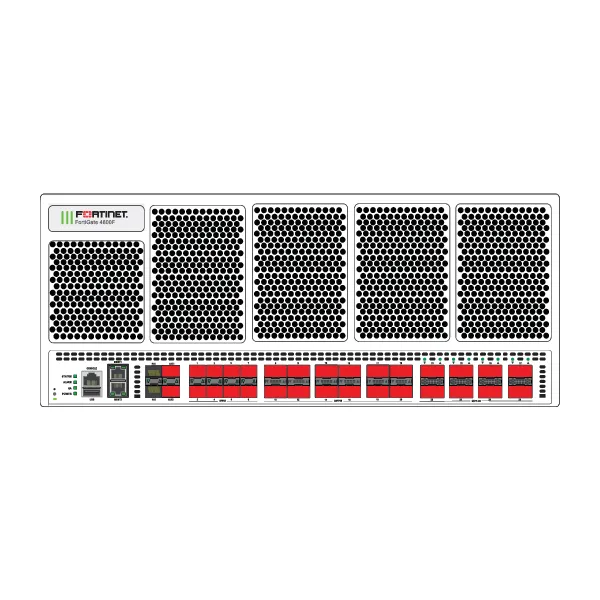
FortiGate 4800F (FG-4800F) Tanzania
FortiGate 4800F is built for organizations whose firewall must operate at data-center, carrier, hyperscale or very large enterprise scale. It combines Fortinet FortiOS, purpose-built security processing, high-density high-speed interfaces, IPsec VPN, intrusion prevention, application control, SSL inspection and FortiGuard security services in a 4RU platform. For Tanzania buyers, the practical procurement question is not simply whether the appliance is fast; it is whether the selected hardware, licensing, optics, power design, HA topology and inspection profile match the real production traffic.
IPv4 firewall throughput for 1518/512-byte UDP traffic; 64-byte performance is up to 0.93 Tbps.
IPsec VPN throughput using Fortinet’s published AES256-SHA256 test methodology.
IPS throughput using the published enterprise traffic mix with logging enabled.
NGFW throughput with firewall, IPS and application control enabled.
Threat protection with firewall, IPS, application control and malware protection enabled.
What the FortiGate 4800F Solves
Large networks often reach a point where a conventional enterprise firewall becomes a bottleneck. Internet edge capacity rises, east-west segmentation grows, encrypted traffic increases, private-cloud and public-cloud connections multiply, and business units expect security controls without accepting avoidable latency. FG-4800F is positioned for that class of requirement. Its architecture is suitable for high-throughput perimeter security, data-center edge protection, service-provider environments, large campus aggregation, inter-data-center connectivity and high-volume VPN termination.
The design uses Fortinet Security Processing Units and FortiOS to converge networking and security functions. Fortinet documentation describes sixteen NP7 processors connected through an integrated switch fabric, allowing supported traffic between front-panel data interfaces to be hardware accelerated. This matters when a design includes multiple high-speed links and must inspect, route, segment or encrypt substantial traffic without treating every packet as general-purpose CPU work.
A sound purchase still starts with workload analysis. Published maximum throughput figures are not a substitute for sizing. Security profiles, packet size, TLS inspection, application mix, logging, VPN cryptography, policy complexity and enabled services all influence production results. FourTeck therefore recommends that buyers share current and projected bandwidth, security services, number of sites, expected concurrent sessions, interface speeds, redundancy requirements and growth assumptions when requesting a quotation.
FortiGate 4800F Verified Specification Highlights
| IPv4 firewall throughput | Up to 3.1 / 3.1 / 0.93 Tbps for 1518 / 512 / 64-byte UDP |
| Firewall latency | 3.6 microseconds for 64-byte UDP |
| Firewall packet rate | Up to 1,396 Mpps |
| IPsec VPN throughput | Up to 800 Gbps |
| IPS / NGFW / threat protection | 87 / 77 / 75 Gbps |
| SSL inspection throughput | Up to 63 Gbps under Fortinet’s published average HTTPS methodology |
| Concurrent TCP sessions | 280 million; higher hyperscale figure requires applicable Hyperscale Firewall licensing |
| Gateway-to-gateway IPsec tunnels | 40,000 |
| Virtual domains | 10 default / 500 maximum |
| High availability | Active-active, active-passive and clustering |
| Form factor | 4RU rack mount |
| Power | Hot-swappable redundant 2+2 AC power supplies |
Performance values are published maximums and vary with configuration and traffic. Confirm the current Fortinet datasheet and required license entitlements during final design and procurement.
High-Speed Interfaces and Data-Center Architecture
The FG-4800F provides a dense mix of high-speed connectivity. Fortinet’s current documentation lists eight hardware-accelerated 400GE/200GE QSFP-DD slots, twelve hardware-accelerated 200GE/100GE/40GE QSFP56/QSFP28-class slots, and eight data SFP56/SFP28/SFP+ slots supporting 50GE/25GE/10GE/GE, plus dedicated HA/AUX connectivity and management interfaces. This interface mix gives architects flexibility when connecting internet routers, core switches, leaf-spine fabrics, WAN systems, peering infrastructure or other high-capacity network layers.
Interface count alone should not determine the bill of materials. The exact optics, breakout requirements, fiber type, peer equipment, cable distances and redundancy plan need validation. Procurement teams should identify whether links require 400GE, 200GE, 100GE, 50GE, 40GE, 25GE or 10GE operation and confirm compatible transceivers before ordering. This avoids the common situation where the firewall arrives before the optical design has been finalized.

Licensing, FortiGuard and Support Planning
FG-4800F hardware is one part of the security platform. The security outcome depends on the FortiOS configuration and the FortiGuard and FortiCare services selected for the project. Buyers should decide which inspection and security services are required, how long the subscription term should run, whether centralized management and analytics are part of the architecture, and whether the project needs special hyperscale functionality. A quote should therefore identify the appliance, support term, security bundle, any additional licenses, optics and implementation scope rather than presenting a bare chassis price as the complete solution.
Renewal planning is equally important. Organizations operating a high-end firewall should align subscription dates, maintenance windows and software lifecycle planning with business change controls. Security subscriptions should be treated as an operational requirement rather than an afterthought. For wider regional Fortinet sourcing and solution context, customers can also review FourTeck Fortinet UAE, while Tanzania requirements can be discussed through the Tanzania team.
Deployment, HA and Migration Guidance
For mission-critical environments, deployment planning should cover more than firewall rules. The project team should document routing, BGP or OSPF requirements where applicable, VLAN and VDOM boundaries, NAT, VPNs, security profiles, TLS inspection, logging destinations, authentication, DNS security, management access, high availability, link monitoring and rollback procedures. Existing policies should be reviewed rather than blindly copied from an older platform because years of incremental changes often leave unused objects and rules.
The platform supports active-active and active-passive HA configurations as well as clustering options. The right topology depends on the network design, maintenance expectations and failure domains. A resilient deployment also considers upstream and downstream switch redundancy, diverse power feeds, rack capacity, cooling and optical paths. Because the appliance is 4RU and has substantial power and airflow requirements, data-center facilities planning should happen before the installation window.
Migration projects should include configuration assessment, policy cleanup, address and service object validation, VPN mapping, route validation, test plans and an agreed cutover sequence. Where encrypted traffic inspection is planned, certificate deployment and application compatibility deserve early testing. For distributed environments, centralized Fortinet management and analytics can reduce operational fragmentation across multiple sites.
FortiGate 4800F Tanzania
Tanzania organizations considering FortiGate 4800F are generally dealing with a very different requirement from a branch-office firewall purchase. The model belongs in conversations about large data centers, telecom or service-provider infrastructure, major enterprise internet edges, high-capacity government or institutional networks, financial infrastructure, cloud connectivity and environments where traffic scale makes inspection performance a design constraint. A Tanzania procurement team should begin with actual peak traffic and three-to-five-year growth rather than selecting the appliance from headline bandwidth alone.
The first design question is the security profile. A network carrying several hundred gigabits of routed traffic may have a different requirement from a network that needs deep IPS, application control, malware protection and TLS inspection across a smaller but still substantial traffic volume. Fortinet publishes separate firewall, IPS, NGFW, threat-protection and SSL-inspection measurements for this reason. The sizing exercise should identify which figure most closely represents the intended production configuration. VPN-heavy environments should separately assess IPsec throughput, tunnel count and cryptographic requirements.
The second question is physical integration. Tanzania data-center teams should document the required 400GE, 200GE, 100GE, 50GE, 40GE, 25GE or 10GE links, optics, fiber standards, breakout design and peer equipment. Rack space, front-to-back airflow, redundant power and facility capacity must be included in the implementation checklist. Where the firewall will replace an existing perimeter or segmentation platform, migration planning should include route tables, NAT, security policies, VPNs, logging, authentication and change-control procedures.
FourTeck can use this information to structure a Tanzania quotation around the actual project rather than an isolated appliance. Buyers can review the broader FourTeck Tanzania technology portfolio for related infrastructure requirements. For a useful quote, provide expected bandwidth, inspection features, interface speeds, HA requirement, subscription term, VPN scope, existing firewall model and target deployment date. Availability, pricing and lead time should be confirmed at quotation time rather than assumed from a web page.
FortiGate 4800F Dar es Salaam
Dar es Salaam is the most natural Tanzania market for an FG-4800F class deployment because many large corporate headquarters, financial operations, telecom environments, hosting facilities, logistics groups and major institutional networks concentrate significant connectivity and digital services in the city. For these buyers, firewall selection should start with the role the device will play: internet perimeter, data-center edge, high-volume segmentation, VPN aggregation, service-provider security or a combination of functions.
A Dar es Salaam enterprise with multiple upstream connections may want to consolidate routing and security while preserving resilient paths. The FG-4800F offers the interface density and performance class needed for very high-speed designs, but architects should map every physical and logical dependency before procurement. That includes upstream carrier handoffs, core switching, BGP relationships where used, VLANs, virtual domains, public address space, NAT behavior, application publishing, DNS dependencies and logging systems. If 100GE or higher links are involved, the exact optics and breakout plan should be validated with both sides of each connection.
Business continuity deserves equal attention. Active-passive or active-active HA can protect against appliance failure, but complete resilience requires independent switch paths, suitable power design and a tested failover process. The change window should include validation for critical applications, internet services, remote access, site-to-site VPNs and monitoring. Organizations moving from another firewall platform should budget time for policy rationalization rather than translating years of obsolete rules into a new system.
For quotation preparation, Dar es Salaam buyers should share peak and average internet traffic, expected growth, security services to be enabled, SSL inspection scope, VPN requirements, interface speeds, HA topology and preferred support duration. This creates a defensible bill of materials covering the FG-4800F, FortiGuard, FortiCare, optics and related services. The objective is a platform sized for the security workload, not merely the raw circuit speed.
FortiGate 4800F Mwanza
Mwanza buyers evaluating FG-4800F are likely to represent large institutions, regional hubs, industrial operations, service providers or organizations consolidating substantial traffic from multiple sites. The procurement process should establish whether the firewall is intended for a local high-capacity facility or as part of a wider Tanzania network architecture. That distinction changes the importance of WAN aggregation, VPN scale, centralized management, routing and redundancy.
For a multi-site organization, one useful design exercise is to separate north-south internet traffic from inter-site and data-center traffic. Security teams can then determine where IPS, application control, malware inspection and SSL inspection are required and where segmentation policies need to be enforced. FortiGate 4800F’s published 87 Gbps IPS, 77 Gbps NGFW and 75 Gbps threat-protection performance provide meaningful reference points, while the 3.1 Tbps headline firewall figure represents a different test profile. Using the appropriate metric prevents under-sizing or unnecessary over-sizing.
Mwanza projects should also consider operational access. If local facilities connect back to centralized security teams, management-plane protection, logging, configuration backups and alerting should be defined before go-live. High availability needs periodic failover testing rather than being treated as a one-time installation feature. Spare optics, documented cabling and current configuration records can materially reduce recovery time during faults.
When requesting a quote, include the number and speed of WAN and LAN links, expected VPN tunnels, routing requirements, security subscriptions, desired support term and whether centralized FortiManager or FortiAnalyzer capabilities are part of the wider design. FourTeck can then help structure the product and licensing discussion around a realistic Mwanza deployment. Pricing, stock and delivery timing should be confirmed for the specific project and date.
FortiGate 4800F Arusha
Arusha organizations may approach FG-4800F for high-capacity institutional, hospitality-group, regional-headquarters, service-provider or data-intensive enterprise environments. At this performance tier, the central question is whether the security architecture needs very high interface capacity and large session scale, not simply whether the organization has many users. A relatively modest user count can still generate demanding workloads when networks carry data-center applications, large backups, cloud traffic, partner links, public services or encrypted inter-site connectivity.
A practical Arusha assessment should inventory critical applications and their paths. Identify which traffic crosses the internet edge, which remains between internal zones, which applications are published externally and which users connect remotely. Map security controls to those paths, including IPS, malware protection, application control, web controls and TLS inspection. Then size against the relevant inspected-throughput figure and expected growth. This approach is more reliable than choosing from raw firewall throughput alone.
The physical design should address rack space, power, cooling and fiber connectivity. FortiGate 4800F is a 4RU system with redundant hot-swappable power supplies and front-to-back forced airflow. Data-center teams should confirm facility compatibility and cable management before installation. High-speed optics can represent an important part of project cost and compatibility, so transceiver requirements should be finalized with the connected switching and routing platforms.
Arusha procurement teams can improve quotation accuracy by supplying a topology diagram, current firewall details, circuit speeds, planned upgrades, required security services, HA expectations, VPN counts and support duration. If the project forms part of a wider East African rollout, common policy standards and centralized management should be considered so that the Tanzania deployment does not become an isolated operational island.
FortiGate 4800F Dodoma
Dodoma projects involving FortiGate 4800F may include large institutional, public-sector, education, infrastructure or enterprise networks where security capacity, segmentation and continuity are central requirements. Because this is a high-end platform, a formal requirements document is valuable. It should state the business services being protected, expected traffic, criticality, recovery objectives, external connectivity, remote-site dependencies and security controls that must remain enabled at peak load.
Security architects should distinguish between perimeter throughput and inspected application traffic. IPS, NGFW, threat protection and SSL inspection each have different published performance values. A design that expects deep inspection of encrypted application traffic should therefore be assessed against those security-service measurements rather than the maximum stateless firewall figure. Similarly, a large VPN aggregation role should consider the 800 Gbps published IPsec result together with tunnel counts and real cryptographic profiles.
Government and institutional environments often have formal change processes. The migration plan should include configuration review, access-control validation, routing tests, logging and audit integration, HA failover tests, rollback procedures and application-owner signoff. Segmentation can be improved during migration by reviewing legacy broad-access rules and creating clearer trust boundaries where business requirements permit.
For procurement, Dodoma buyers should specify the appliance model exactly as FG-4800F, the FortiGuard services required, FortiCare duration, any centralized management or analytics components, optics, rack and power considerations, and implementation scope. A complete quote can then be evaluated on solution fit instead of chassis cost alone. FourTeck can support the requirements discussion without assuming stock, delivery dates or service coverage until those details are confirmed for the project.
FortiGate 4800F UAE
UAE buyers commonly evaluate high-end firewalls for data centers, cloud interconnects, large headquarters, financial networks, telecom environments and regional security hubs. FG-4800F fits projects that need extremely high firewall capacity together with high-speed 400GE/200GE/100GE connectivity and substantial inspected throughput. Procurement teams should distinguish a requirement for a single high-capacity perimeter from a multi-firewall architecture using separate tiers for internet, data-center segmentation and tenant or service-provider functions.
The UAE market also makes logistics and licensing structure important. A quotation should clearly identify FG-4800F hardware, FortiCare, FortiGuard bundle, license term, optics, HA quantity and any professional-services scope. Where the platform will be deployed as a pair, both appliance and transceiver quantities should be checked against the intended topology. Data-center power and rack requirements should be confirmed before delivery.
For organizations operating between the UAE and Africa, a consistent Fortinet architecture can simplify policy management and operational processes. However, each location should still be sized for its own traffic, connectivity and regulatory requirements. Centralized management can help standardize objects, policies and updates while local routing and connectivity remain tailored to each site.
FourTeck’s dedicated Fortinet UAE resource provides additional regional product context. UAE project teams considering FG-4800F should prepare traffic profiles, interface requirements, inspection services, VPN scale, HA design and subscription term before seeking final commercial pricing.
FortiGate 4800F Uganda
Uganda deployments for FG-4800F are most relevant to high-capacity enterprise, carrier, large institutional or data-center environments rather than ordinary branch networks. The platform’s scale makes it suitable when many sites or large traffic volumes converge at a central security point. Organizations should quantify that aggregation carefully, including internet breakout, data-center applications, remote-site VPNs, cloud connectivity and security inspection.
If the Uganda design serves multiple branches, architects should document how traffic reaches the central firewall and whether all branch internet traffic is backhauled or locally broken out. That choice affects bandwidth, VPN sizing, policy design and failure behavior. Secure SD-WAN and IPsec capabilities can form part of a broader Fortinet architecture, while the FG-4800F provides the capacity needed at a large aggregation point.
Operational planning should include logging, centralized management, software lifecycle, backup procedures and HA testing. High-capacity systems benefit from disciplined configuration governance because small policy changes can affect large traffic populations. Role-based administration and documented change controls are particularly useful when multiple network and security teams share responsibility.
Uganda buyers can review FourTeck Uganda for regional technology and Fortinet context. For FG-4800F quotation work, share current firewall models, peak throughput, security profiles, number of sites, VPN needs, interface speeds and support term so the bill of materials can be aligned with the intended deployment.
FortiGate 4800F Kampala
Kampala is a likely center for Uganda deployments requiring data-center and large-enterprise security. Financial organizations, telecom environments, hosting platforms, large corporate headquarters and institutions can generate traffic patterns where both raw capacity and inspection performance matter. FG-4800F should be evaluated when the firewall is expected to terminate high-speed links, maintain very large session tables or aggregate substantial VPN and application traffic.
A Kampala data-center design should map the firewall to the switching fabric. The availability of 400GE, 200GE, 100GE and lower-speed interfaces provides flexibility, but it also requires precise optic and breakout planning. Engineers should confirm peer-port capabilities and avoid assuming that every supported speed can be mixed without considering the specific transceiver and cabling design.
Security-service sizing is essential. If the project requires IPS, application control and malware protection across most traffic, the 75 Gbps threat-protection figure is more informative than the 3.1 Tbps maximum firewall figure. If TLS inspection is central, the published 63 Gbps SSL-inspection result provides another reference point. Actual results vary with configuration and traffic, so design headroom should be maintained.
For a Kampala quotation, document circuit growth, interface quantities, HA, VPNs, VDOM needs, security subscriptions and operational tooling. This allows procurement and technical teams to compare the complete lifecycle requirement rather than treating the firewall as an isolated capital purchase.
FortiGate 4800F Arua
An FG-4800F requirement associated with Arua is more likely to be part of a larger national or regional architecture than a typical single-site office deployment. Organizations should first determine whether the appliance will physically operate in Arua, serve Arua sites from a central data center, or form part of a distributed service-provider network. Each scenario has different WAN, VPN, redundancy and management implications.
Where remote sites connect to a central FG-4800F, WAN availability becomes a critical design factor. Multiple circuits, routing convergence and IPsec tunnel architecture may matter as much as firewall throughput. Security teams should define what happens when a primary path fails, how applications are prioritized and whether local services remain available during WAN disruption.
For organizations consolidating many locations, VDOMs and policy segmentation can help separate administrative or business domains when appropriate. Centralized Fortinet tools can support consistent configuration and visibility. The design should nevertheless keep troubleshooting practical: clear naming, documented addressing, standardized VPN templates and monitored link health reduce operational complexity.
Arua procurement requests should therefore include the wider topology, not only the city endpoint. Provide the number of connected locations, expected aggregate traffic, VPN design, inspection services, growth assumptions and desired resilience. FourTeck can use that information to determine whether FG-4800F is appropriately positioned or whether a different FortiGate tier should be considered.
FortiGate 4800F Mbarara
Mbarara organizations considering FG-4800F should evaluate the firewall as part of an enterprise architecture rather than a standalone security appliance. A large university, institution, service provider, industrial group or distributed enterprise may need centralized security capacity for many users and sites, but the real sizing inputs are traffic, session scale, inspection depth, VPN requirements and future growth.
One useful planning method is to build a traffic matrix showing source zones, destination zones, application classes, peak bandwidth and required security controls. This reveals which flows need full threat inspection, which require segmentation, which are encrypted and which are latency sensitive. The resulting matrix can then be compared with Fortinet’s relevant performance figures.
High availability should be tested as an end-to-end service event. A firewall pair can remain healthy while upstream routing, downstream switching or application dependencies still fail. Mbarara projects should therefore include failover validation for critical applications and remote sites, not just a chassis status check. Configuration backups and recovery procedures should also be part of operational handover.
When asking for commercial terms, specify whether the requirement is one appliance or an HA pair, the FortiGuard and FortiCare term, optics, interface speeds, VPN scale and deployment services. Accurate scope helps avoid later changes that can delay implementation or create licensing gaps.
FortiGate 4800F Gulu
Gulu requirements for an FG-4800F class firewall should be assessed in the context of national networks, large institutions, data aggregation or service-provider infrastructure. The model is far above ordinary small-office capacity, so buyers should be able to connect the specification to a measurable need such as very high-speed interfaces, large VPN aggregation, huge concurrent session requirements or substantial inspected traffic.
If Gulu sites connect to a central security hub, consider whether a smaller local FortiGate plus centralized FG-4800F architecture provides better resilience and policy placement than backhauling every security function. Distributed design can reduce dependence on a single WAN path, while centralized management preserves governance. The correct architecture depends on applications, connectivity and operational resources.
Security subscriptions should be selected according to required controls, not simply bundled by habit. Define whether intrusion prevention, malware protection, application control, web security, DNS security or other FortiGuard services are required and how they will be operated. Logging volume and retention should also be considered if centralized analytics is planned.
Gulu procurement teams can improve project outcomes by pairing commercial requests with a technical worksheet covering traffic, links, sites, security services, HA, optics, power and support term. This gives suppliers enough information to build a complete quotation and helps internal stakeholders understand why each line item is required.
FortiGate 4800F Kenya
Kenya has substantial enterprise, financial, telecom, cloud and data-center activity that can justify high-end firewall platforms. FG-4800F is relevant when a project requires very high-speed interfaces and security processing at an internet edge, data-center perimeter, large aggregation point or service-provider environment. Nairobi-centered infrastructure may also serve distributed operations across East Africa, making VPN scale, routing and centralized security policy important design factors.
A Kenya sizing exercise should account for both current capacity and planned circuit upgrades. If a data center is moving from 10/40GE toward 100GE or higher connectivity, interface planning can influence platform selection even before inspected traffic reaches the maximum security-service figures. Conversely, interface speed should not be confused with required threat-protection throughput. The firewall must be sized against the enabled controls and actual application mix.
Regional deployments can benefit from consistent FortiOS policy structures, naming and centralized administration. Teams should decide whether the Kenya firewall is a regional hub, a local edge or part of an active/standby cross-site design. Those choices affect routing, state synchronization, VPN termination and failure behavior.
Customers can visit FourTeck Kenya for regional solution context. A strong FG-4800F request should include interface speeds, optics, traffic profiles, security services, HA, FortiCare and FortiGuard term, centralized management requirements and migration scope.
FortiGate 4800F Kuwait
Kuwait enterprises and data-center operators considering FG-4800F may need a platform for high-volume internet security, large campus or government networks, financial infrastructure, cloud connectivity or service-provider environments. The appliance’s high-speed interface mix and substantial session scale make it suitable for demanding core-edge designs, but proper sizing remains tied to security services and traffic characteristics.
Facilities planning is especially important for high-end appliances. Confirm 4RU rack space, power feeds, cooling, airflow direction and cable management. For HA pairs, plan rack and power diversity where the facility permits. Optical transceivers and fiber paths should be documented alongside the firewall because high-speed connectivity is an integral part of the solution.
Operationally, teams should plan FortiOS upgrades, configuration backups, centralized logging, administrator roles and incident-response access. A high-capacity firewall can protect a large portion of the business, so change governance and monitoring should reflect its criticality. Maintenance windows should include HA and application validation.
Kuwait buyers should request a quote that distinguishes appliance hardware, support, security subscriptions, optics and implementation. This makes renewal and lifecycle budgeting clearer and prevents ambiguity about which FortiGuard services are included. Regional procurement can be coordinated with broader GCC security standards where organizations operate across multiple countries.
FortiGate 4800F Ghana
Ghana organizations evaluating FG-4800F are likely to include telecom, financial, hosting, large enterprise or infrastructure operators that need security at significant scale. The platform can support high-capacity perimeter and data-center use cases, but the purchasing decision should be based on a documented workload. Peak bandwidth, inspected throughput, session count, VPN volume and interface speeds are the primary technical inputs.
If the firewall is intended to protect public-facing services, application dependencies and DDoS strategy should be considered alongside NGFW controls. A firewall is one component of resilient service delivery; upstream connectivity, routing, load balancing, DNS and application architecture also influence availability. Segmentation should separate public services from internal systems according to business and security requirements.
For multi-site Ghana networks, IPsec VPN and centralized management can help connect and govern branches, but designers should consider local internet breakout and failover behavior. The central FG-4800F can provide major aggregation capacity while smaller FortiGate platforms serve remote locations where appropriate.
Procurement teams should ask for an itemized solution covering FG-4800F, FortiGuard, FortiCare, optics, HA quantity and any management or analytics components. Commercial details such as stock and lead time should be checked for the actual order date. The technical scope should be approved before purchase so the delivered system matches the intended network architecture.
FortiGate 4800F Nigeria
Nigeria’s large enterprise, banking, telecom, energy, cloud and service-provider environments can create network-security requirements at the FG-4800F performance tier. Projects may involve very large internet edges, data-center segmentation, regional VPN aggregation or high-density connectivity. The firewall should be evaluated against the most demanding sustained security workload rather than a single marketing throughput number.
For large Nigerian networks, session scale can be as important as bandwidth. Fortinet publishes 280 million concurrent TCP sessions for the standard specification and higher hyperscale capacity subject to the applicable license and conditions. Teams supporting large subscriber or service environments should confirm whether hyperscale functionality is part of the intended design and include the correct licensing in the commercial request.
High-speed port planning should include optics, breakout cables and peer compatibility. The presence of 400GE and 200GE interfaces is valuable only when the wider network design can use them effectively. Teams should also map management and HA interfaces separately from production data links to preserve clear operational boundaries.
A Nigeria quote request should include topology, expected traffic, session requirements, security services, VPNs, interface speeds, HA, licensing term and project timeline. Where multiple countries are involved, common policy and management standards can reduce complexity while each country’s connectivity and operational requirements remain locally appropriate.
FortiGate 4800F Seychelles
Seychelles buyers considering FG-4800F are likely to have specialized high-capacity requirements such as telecom infrastructure, major institutional networks, data-center services or a regional security hub. Because local deployments may depend heavily on international connectivity, architecture should account for WAN resilience and the relationship between internet capacity and local data-center traffic.
A design review should determine whether all traffic truly needs to traverse a single high-end firewall or whether security functions should be distributed. FG-4800F can serve as a powerful central platform, while smaller firewalls may protect branches or specialized zones. This layered approach can improve operational flexibility when aligned with a clear management model.
The project should also consider logistics early. A 4RU high-end appliance, redundant power design and high-speed optics require appropriate rack, power and cooling preparation. Spare strategy, support entitlement and configuration backup procedures should be agreed before production deployment. Remote support access must be secured and auditable.
For Seychelles quotation preparation, provide the deployment location, link speeds, traffic profile, security-service requirements, VPN needs, HA plan, optics and support term. This allows the commercial proposal to reflect the complete solution and reduces the risk of discovering missing infrastructure or licensing late in the project.
Regional Architecture and FourTeck Network
Organizations deploying Fortinet across several countries often benefit from common configuration standards, centralized visibility and consistent procurement documentation. Regional resources include FourTeck Uganda, FourTeck Kenya, FourTeck Fortinet UAE and FourTeck Africa. These regional references are useful when a Tanzania-centered project expands into a wider East African, African or GCC security program.
Standardization should not eliminate local design work. Each site needs its own traffic, carrier, routing, regulatory, facility and operational assessment. The value of a common Fortinet architecture is that policy concepts, management methods and skills can be reused while capacity and connectivity remain correctly sized for each location.
FortiGate 4800F Use Cases
Data-Center Edge
Protect high-capacity north-south traffic between data-center networks, internet, WAN and cloud connectivity while applying NGFW policies and segmentation.
Hyperscale Firewalling
Support environments requiring extremely large session scale and accelerated networking, subject to the applicable Fortinet licensing and architecture.
VPN Aggregation
Terminate large numbers of site-to-site or remote connectivity requirements with published IPsec performance up to 800 Gbps.
Large Enterprise Perimeter
Secure high-bandwidth internet and partner connectivity for organizations that require significant inspection capacity and resilient HA architecture.
Quotation Checklist
For a useful FortiGate 4800F quotation, send the information below. It allows the appliance, licenses, optics and services to be aligned with the actual project.
FortiGate 4800F FAQ
What is the FortiGate 4800F firewall throughput?
Fortinet publishes IPv4 firewall throughput up to 3.1 / 3.1 / 0.93 Tbps for 1518 / 512 / 64-byte UDP traffic. This is different from inspected security throughput, so production sizing should also consider IPS, NGFW, threat-protection and SSL-inspection figures.
What are the FG-4800F IPS and NGFW performance figures?
The current Fortinet datasheet lists up to 87 Gbps IPS throughput, 77 Gbps NGFW throughput and 75 Gbps threat-protection throughput using Fortinet’s defined enterprise traffic test methodologies.
Does FortiGate 4800F support 400GE?
Yes. Fortinet documentation lists eight hardware-accelerated QSFP-DD slots supporting up to 400GE, along with additional 200GE/100GE/40GE and 50GE/25GE/10GE/GE connectivity. Exact optics and breakout compatibility should be validated for the project.
What is the IPsec VPN throughput?
Fortinet publishes up to 800 Gbps IPsec VPN throughput using its stated 512-byte AES256-SHA256 test. Actual deployment performance depends on configuration and traffic.
Does FG-4800F support high availability?
Yes. Fortinet lists active-active, active-passive and clustering high-availability configurations. The complete resilient design should also address switches, routing, power, links and application failover.
What is the difference between FG-4800F and FG-4801F?
The 4800F series includes both models. A key hardware distinction in Fortinet’s datasheet is onboard storage: FG-4800F is listed without onboard storage, while FG-4801F is listed with two 2 TB SSDs. Confirm the exact model required before ordering.
How should I request FortiGate 4800F pricing in Tanzania?
Provide the exact FG-4800F model, quantity, HA requirement, FortiGuard and FortiCare term, optics, interface requirements and deployment scope. Pricing and availability should be confirmed for the specific quotation date.
Decision Recap
FortiGate 4800F is a specialist high-end firewall for networks that can justify its very large capacity, interface density and data-center form factor. It is most compelling when the design calls for high-speed 400/200/100GE connectivity, substantial inspected traffic, large VPN aggregation, huge session scale or hyperscale capabilities. Buyers should compare their real security workload with the relevant Fortinet metric and preserve headroom for growth.
The final procurement package should include the right security subscriptions, support term, optics and HA design. It should also account for rack space, power, cooling, cabling, migration and centralized operations. This turns the purchase from a chassis transaction into a controlled security-platform deployment.
Consult FourTeck for FG-4800F Tanzania
Share your network topology, bandwidth, inspection requirements, VPN scope, interface speeds, HA plan and preferred FortiGuard/FortiCare term. FourTeck can use those inputs to prepare a project-focused FortiGate 4800F discussion and quotation. No web page should be treated as confirmation of current stock, price, delivery time or a specific support entitlement; those items should be validated in the commercial proposal.


Reviews
There are no reviews yet.