
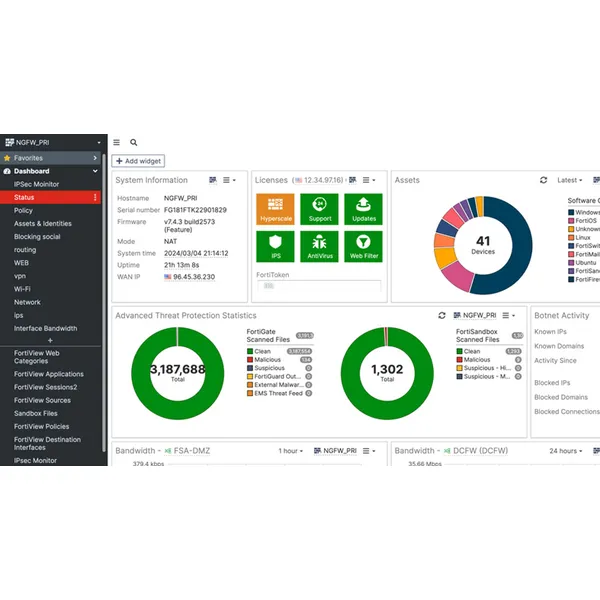
FortiGate VM Tanzania
FortiGate VM is Fortinet’s virtual next-generation firewall for organizations that need FortiOS security and networking capabilities inside virtualized, cloud and hybrid infrastructure. It can protect virtual networks, application tiers, data-center workloads, cloud-connected services and distributed environments without requiring a physical firewall at every protected boundary. For Tanzania businesses modernizing servers, moving applications to cloud platforms, building private clouds or segmenting virtual workloads, FortiGate VM provides a software-defined way to apply consistent security policy while remaining part of the wider Fortinet Security Fabric.

FortiGate VM Virtual Firewall Overview
Fortinet describes FortiGate VM as a cloud firewall that delivers consistent security across cloud and hybrid environments. The virtual appliance supports the security and networking services available through FortiOS, while centralized management can help administrators apply policy across distributed compute environments. This makes the platform relevant when security must follow workloads rather than remain tied only to a physical perimeter. Typical projects include virtual data centers, private cloud segmentation, public-cloud network security, development and production environment separation, application publishing, secure inter-site connectivity and hybrid architectures that combine physical FortiGate appliances with virtual firewalls.
Sizing should begin with the workload and inspection requirement, not simply a user count. Procurement teams should document expected traffic, east-west versus north-south flows, encrypted traffic, VPN demand, security profiles, number of interfaces, high-availability requirements, virtual domains where applicable, logging architecture and expected growth. Fortinet publishes FortiGate VM licensing levels based on virtual CPU capacity, including multiple vCPU tiers and an unlimited option in current product documentation. Exact throughput depends on the selected VM model, hypervisor or cloud platform, allocated compute resources, enabled inspection services and traffic characteristics, so a quotation should match the intended design rather than rely on a generic performance assumption.
Cloud-ready security
Deploy security controls within supported cloud and virtual environments where application workloads operate, reducing dependence on a single physical perimeter.
FortiOS platform
Use the FortiOS security and networking platform to build firewall policy, segmentation, VPN, routing and licensed threat-protection services around virtual workloads.
Flexible licensing
Evaluate traditional VM licensing, annual subscription options and FortiFlex usage-based entitlements according to project duration, scale and procurement preferences.
Licensing, Capacity and Procurement Planning
FortiGate VM is not a single fixed appliance SKU. Fortinet documentation identifies VM licensing choices that differ by license family and vCPU level. Current FortiGate VM S-series ordering information includes subscription tiers for 1, 2, 4, 8, 16 and 32 vCPU cores as well as an unlimited-vCPU option, while FortiFlex provides a points-based consumption model designed for dynamic deployment and scaling. Buyers should therefore avoid requesting only “one FortiGate VM license” without defining the environment. The useful procurement conversation includes the virtual platform, required capacity, FortiGuard service bundle, FortiCare requirement, term, number of instances, high-availability design and whether capacity may change during the project.
FortiFlex can be particularly relevant for organizations with variable cloud requirements because Fortinet positions it as a usage-based program that allows supported services to scale up, down, in or out. A conventional subscription can be easier for a stable environment with known capacity, while flexible consumption can suit projects where instances change frequently. The right approach depends on commercial and technical requirements. FourTeck can help translate architecture information into a clearer bill of materials and quotation request without assuming that every deployment needs the same license.
Deployment and Integration Considerations
Before deployment, map trust zones, subnets, routing, internet paths, application dependencies and management access. Decide whether FortiGate VM will operate at an internet edge, between application tiers, as a VPN termination point, within a private cloud, or as part of a hybrid design. Cloud route tables, virtual NIC placement, source and destination NAT, load balancers and platform-specific availability constructs can affect traffic flow. High availability should be designed for the chosen environment rather than copied from a physical appliance topology. Logging destinations and centralized administration should also be planned early so security events remain visible after the firewall goes live.
Organizations already using Fortinet hardware can use FortiGate VM to extend a more consistent operating model into virtual infrastructure. FortiManager can provide centralized management in supported designs, while FortiAnalyzer can support centralized analytics and logging where licensed and deployed. This consistency can reduce policy drift when teams operate branches, data centers and cloud networks together. It is still important to test change control, backup, recovery and upgrade procedures for each environment because virtualization and cloud networking introduce dependencies beyond the firewall itself.
FortiGate VM Tanzania
Tanzania organizations increasingly operate a mix of office networks, hosted applications, virtual servers, cloud services and remote connectivity. FortiGate VM can fit this mixed architecture when a security control must sit inside the virtual or cloud layer rather than only at the physical internet edge. Banks, professional services firms, education providers, hospitality groups, logistics operators, NGOs, healthcare organizations and growing enterprises can use a virtual firewall architecture to segment workloads, enforce access policy and connect remote environments securely. The most important buying decision is to establish where the protected traffic actually flows. If business applications are hosted in a virtual data center, routing all traffic through a distant physical appliance may be inefficient; a virtual firewall positioned near the workload can provide a more direct policy boundary.
For Tanzania procurement, prepare a clear statement of work before requesting price. Include the virtualization or cloud platform, number of FortiGate VM instances, expected vCPU requirement, internet and internal traffic rates, VPN users or tunnels, security services, log-retention expectations and availability objective. Also identify whether the project is new, a migration from another firewall, an extension of existing Fortinet infrastructure or a license renewal. These details help separate the VM base entitlement from security subscriptions and deployment services. If an organization expects rapid growth or temporary project environments, it should also evaluate whether FortiFlex consumption licensing is commercially appropriate rather than assuming a fixed license is the only route.
A Tanzania deployment should also account for operational ownership. Decide who will administer policy, approve changes, monitor events, maintain subscriptions and coordinate incident response. Cloud security is not completed when the VM boots successfully; routing, identity, segmentation, least-privilege rules, logging, backups and software lifecycle management all contribute to the outcome. FourTeck can help customers frame these requirements for a quotation and deployment plan. For broader regional infrastructure options, customers can also review FourTeck Africa technology solutions, which relates to multi-country projects that extend beyond a single Tanzania environment.
FortiGate VM Dar es Salaam
Dar es Salaam businesses often concentrate headquarters, data-center connectivity, hosted services and internet-facing applications in the same technology program. FortiGate VM is relevant where these services run on virtual infrastructure and require a policy enforcement point close to the application. A company can design separate security zones for public services, internal application tiers, management networks and partner access, then use FortiOS policy to control permitted flows. This approach is useful for enterprises modernizing from flat virtual networks to segmented architectures and for organizations that want their cloud or virtual security controls to align with existing Fortinet branch firewalls.
For a Dar es Salaam quotation, technical teams should provide peak traffic rather than only ISP bandwidth. East-west application traffic may be substantial even when public internet usage is moderate. Identify TLS inspection expectations, IPS and application-control requirements, IPsec VPN demand, remote administration methods and logging destinations. If business continuity is important, describe the hypervisor cluster or cloud availability design and ask how FortiGate VM high availability should integrate with it. Procurement teams should also specify whether they want a fixed annual subscription or need flexible capacity for development, seasonal workloads or changing customer environments.
Implementation planning should include a rollback method. Virtual firewalls can be inserted into critical routing paths, so a route-table or policy error can affect many applications at once. Stage policies, validate management access, test DNS and application dependencies, confirm monitoring and document emergency bypass procedures before production cutover. Organizations with multiple offices can combine FortiGate VM at the hosted workload layer with site-to-site connectivity from physical or virtual FortiGate locations. The result can be a consistent security architecture without assuming that one firewall form factor suits every part of the business.
FortiGate VM Mwanza
Mwanza organizations that rely on centralized applications, hosted ERP, remote branches or virtual server environments can use FortiGate VM to protect the computing layer while keeping local office connectivity separate. This can be valuable for businesses whose application servers are not physically located beside users. A virtual firewall can create controlled access between user networks, server segments and external services, while VPN capabilities can support protected connectivity to other sites. The architecture should be based on application flows: finance systems, inventory applications, databases, web portals and administrative interfaces should not automatically share the same trust level.
When sizing FortiGate VM for Mwanza projects, account for both current demand and the effect of enabled security inspection. Raw firewall traffic, encrypted traffic and threat-protection workloads place different demands on a virtual appliance. The underlying host must also provide reliable compute, memory and networking resources. Buyers should not treat allocated vCPU as the only capacity variable; platform architecture, traffic profile and FortiOS services all matter. A proof-of-concept or staged deployment can be useful where the workload is complex or where an existing virtual network must be re-routed through a new security layer.
Procurement documentation should list license term, FortiGuard services, support requirement, management tools and professional services separately enough to understand the complete lifecycle cost. Renewals should be tracked before expiry so security services do not become an afterthought. For organizations expanding into Kenya or operating cross-border infrastructure, FourTeck Kenya provides a related regional reference for firewall and IT infrastructure requirements, while the Tanzania project should still be designed around its own workload, connectivity and support scope.
FortiGate VM Arusha
Arusha businesses in tourism, hospitality, professional services, education and regional operations may operate applications that are shared by several properties, offices or remote teams. FortiGate VM can secure the virtual environment hosting those services and provide controlled connectivity between locations. For example, an organization can isolate reservation or business-management systems from public-facing web services, restrict administrative access to trusted networks and use VPN connectivity for branch communication. The objective is not merely to place a firewall in a VM platform; it is to define meaningful security boundaries around business applications.
A strong Arusha design starts with inventory. List applications, server networks, public IP requirements, cloud dependencies, administrators, third-party support access and data flows between systems. Then decide which traffic must pass through FortiGate VM. Overly broad routing can create unnecessary inspection load, while bypass paths can undermine segmentation. Security profiles should be enabled according to risk and licensing, and logging should be directed to an appropriate destination so teams can investigate policy hits and security events. Where multiple FortiGate devices exist, centralized management can make policy governance easier.
Buyers should ask for a quote that clearly identifies the VM capacity tier and subscription bundle rather than comparing only headline license prices. A lower-capacity license may not be economical if it immediately requires redesign, while an oversized entitlement may waste budget. If demand varies substantially, FortiFlex may deserve consideration because Fortinet positions it for flexible, consumption-based scaling. The final choice should reflect predictable workloads, project duration, operational processes and the organization’s procurement model.
FortiGate VM Dodoma
Dodoma organizations planning virtualized government, enterprise, education or service-delivery applications can use FortiGate VM as a software security boundary around workloads that do not sit behind a dedicated physical appliance. The virtual form factor is useful when infrastructure teams need repeatable deployment, logical segmentation and policy control across virtual networks. A project can place different application zones behind controlled interfaces, apply firewall and licensed security inspection, and connect approved users or sites through VPN architecture. The design should respect application availability and change-management requirements, especially where shared services support many departments.
For procurement, define whether the environment is private cloud, public cloud or a hybrid combination. The answer influences deployment mechanics, network interfaces, route control and availability options. Document expected traffic between application tiers as well as internet traffic, because internal workload flows can determine VM sizing. Include management and logging requirements, and decide whether the organization needs FortiManager or FortiAnalyzer as part of a broader Fortinet operating model. These tools are separate planning considerations and should not be assumed to be included in every FortiGate VM purchase.
Security governance is equally important. Establish named administrators, change approval, backup frequency, software upgrade policy, incident escalation and subscription renewal ownership. A well-sized virtual firewall with unmanaged rules can still accumulate risk over time. Periodic policy review helps remove obsolete access and confirms that application changes have not created unintended paths. FourTeck can use this information to structure a more accurate FortiGate VM Tanzania quotation and implementation scope instead of relying on a generic license request.
FortiGate VM UAE
UAE enterprises frequently combine on-premises infrastructure, hosted data centers, public cloud services and branch networks. FortiGate VM can provide FortiOS-based controls inside those virtual and cloud environments, complementing physical FortiGate deployments where a hardware edge remains appropriate. The virtual appliance can be considered for cloud network segmentation, application protection, secure connectivity and consistent policy across hybrid infrastructure. Organizations should map their cloud landing zones and network architecture before selecting capacity because a centralized inspection design can have very different traffic demands from distributed firewalls placed closer to individual workloads.
UAE procurement teams should define whether licensing will be bring-your-own-license, subscription based, marketplace based where supported, or part of a FortiFlex strategy. Commercial flexibility matters for projects that scale quickly, but technical suitability remains the first requirement. The selected entitlement must align with vCPU capacity and service bundle needs, and cloud platform costs should be considered separately from Fortinet licensing. High availability, inter-zone data transfer and load-balancing components can also affect the total solution cost.
For businesses coordinating UAE and Tanzania infrastructure, common policy standards can simplify operations while local connectivity and hosting choices remain different. FourTeck’s UAE IT and cybersecurity solutions provide a related regional path for projects involving UAE infrastructure. Customers should provide cloud platform, region, expected traffic, number of instances, FortiGuard requirements and management architecture when requesting a FortiGate VM quote so the proposal can be matched to the actual deployment.
FortiGate VM Uganda
Uganda organizations with hosted applications, private virtualization or cloud workloads can deploy FortiGate VM where security needs to operate within the virtual network. The platform is useful for separating application zones, controlling internet exposure, supporting VPN connectivity and applying FortiOS policy around virtual servers. It can also complement branch FortiGate appliances, allowing an organization to use hardware at office edges and virtual security around hosted workloads. This hybrid approach is often more practical than forcing every traffic path through one location.
A Uganda deployment should be sized from measured or realistically estimated traffic. List business-critical applications, concurrent users, branch tunnels, remote-access needs, internal server flows and security inspection profiles. Determine whether logs remain locally accessible or feed centralized analytics. If several FortiGate instances are expected, consider how administrators will keep policy naming, objects and upgrades consistent. Centralized management can reduce manual differences between environments, but it should be included deliberately in the architecture and commercial scope.
Procurement teams can use FourTeck Uganda IT solutions as a regional reference when coordinating Uganda requirements. A quote request should distinguish the VM entitlement, security bundle, support term and implementation services. If a project is temporary or capacity changes frequently, ask whether FortiFlex is appropriate. If the environment is stable, compare fixed licensing options. The purpose is to choose a licensing model that follows the operational reality rather than selecting solely from initial price.
FortiGate VM Kampala
Kampala businesses running virtual servers for ERP, finance, customer portals, collaboration or internal applications can use FortiGate VM to create a controlled security boundary around those systems. The firewall can be positioned between application tiers or at a virtual network edge depending on architecture. This gives administrators a place to enforce access rules, inspect permitted traffic using licensed services and record security events. For companies with multiple branches, the VM can also participate in a wider connectivity design where office FortiGate devices establish secure paths to centralized workloads.
During design, avoid treating all virtual servers as one trusted LAN. Group workloads by business function and sensitivity, then identify required communication. Database servers may only need connections from specific application servers; management interfaces may only need administrator networks; public web services may require carefully controlled access to backend systems. Segmentation rules should reflect these relationships. This approach reduces unnecessary reachability and makes security policy easier to explain during audits and troubleshooting.
For a Kampala purchase, document expected growth over the license term. If more applications will move into the environment, capacity planning should include that roadmap. Confirm whether the selected VM license supports the planned vCPU allocation and whether additional FortiGuard or FortiCare services are required. Include configuration, migration and testing effort in the project scope, especially when replacing an existing firewall. A successful cutover should validate routing, DNS, application access, VPNs, logging and rollback before the old security path is retired.
FortiGate VM Arua
Arua organizations may consume centralized applications from remote hosting environments rather than maintaining every business service locally. FortiGate VM can protect the hosted side of that architecture while physical branch equipment or secure client access protects users. This division of responsibilities can make sense when workloads are virtualized and several locations connect to the same service. The virtual firewall can enforce application access, VPN policy and segmentation close to the servers, while branch networks retain their own local security controls.
Connectivity quality should be considered in the architecture. A virtual firewall cannot compensate for an unstable WAN path, so VPN and application design should account for available links, latency and failover. Where multiple internet connections or sites are involved, define routing behavior before implementation. Security teams should also plan certificate handling, administrator authentication, configuration backups and monitoring. These operational details are essential for a firewall that may protect systems used across a large geographic area.
When requesting a FortiGate VM quote for an Arua-connected project, provide the location of the actual VM workload as well as the user locations. Licensing and technical architecture follow the virtual appliance environment, not merely the city of the end users. Include expected tunnel count, bandwidth, applications, service bundle and support term. This prevents a procurement request from being reduced to an ambiguous “virtual firewall price” and gives the solution team enough information to recommend an appropriate tier.
FortiGate VM Mbarara
Mbarara businesses with distributed operations can use FortiGate VM as the protected gateway for centrally hosted virtual applications. A retailer, education provider, healthcare group or service company might maintain local users in Mbarara while applications run in a private data center or cloud. The virtual firewall can segment those application networks, terminate approved connectivity and apply FortiOS security policy. This can create a clearer separation between branch access, administrative access, public services and sensitive backend systems.
Sizing should consider security inspection and peak concurrency. An application environment can generate bursts during backups, reporting, synchronization or batch processing that are not visible from average bandwidth figures. Discuss these patterns before choosing a VM tier. If the organization plans SSL inspection or intensive threat-protection profiles, include those requirements explicitly. The underlying compute platform must also have sufficient resources and reliable virtual networking; allocating a license alone does not guarantee performance if the host is constrained.
A deployment plan should define test cases for every critical application. Verify login, database access, API integrations, remote support, printing or peripheral dependencies where relevant, and branch VPN behavior. Record the required firewall objects and rules so the production policy is understandable. After cutover, review denied traffic carefully rather than immediately opening broad access. This disciplined approach helps preserve the segmentation benefits that motivated the FortiGate VM project in the first place.
FortiGate VM Gulu
Gulu organizations accessing cloud-hosted or virtualized business systems can benefit from a firewall positioned at the workload layer. FortiGate VM allows security policy to be applied inside virtual infrastructure where a physical appliance may not have direct visibility into traffic between virtual networks. The deployment can support secure branch connectivity, workload segmentation and controlled internet access for hosted services. The architecture should identify which traffic genuinely requires inspection so that routing remains efficient and the selected VM capacity matches business demand.
For organizations with limited local IT staff, management simplicity deserves attention during design. Standardized objects, documented policies, centralized monitoring and clear escalation paths can reduce troubleshooting time. Remote administration should be restricted to approved management paths and protected with strong authentication practices. Backups and configuration versioning should be scheduled, and license renewal dates should be visible to both technical and procurement teams. These controls are operational rather than product features, but they strongly influence the security outcome.
A Gulu-focused quote request should explain whether the firewall protects workloads physically hosted in Uganda, in another regional data center or in public cloud. The hosting location affects network design, while the user location affects connectivity requirements. Include branch counts, tunnel needs, expected traffic and security services. If capacity is uncertain because the project is expanding, compare conventional subscription licensing with FortiFlex flexibility before finalizing the commercial model.
FortiGate VM Kenya
Kenya businesses with private cloud, hosted data centers and public cloud deployments can use FortiGate VM to bring FortiOS controls into virtual network paths. This is particularly relevant for organizations that already use FortiGate appliances at branches and want a more consistent security platform around cloud workloads. The virtual firewall can protect application tiers, connect networks with VPNs and enforce policy at software-defined boundaries. It should be designed alongside the cloud or hypervisor network rather than installed as an isolated appliance.
The Kenya project scope should document the platform, number of instances, availability zones or host clusters, route design, public-facing services, internal application flows and logging destination. If high availability is required, the solution must account for how the chosen platform handles failover and address movement. Performance estimates should use the appropriate Fortinet model data and real traffic assumptions. Do not compare VM tiers only by vCPU count without considering the security profiles that will be enabled.
FourTeck’s FortiGate Kenya product category provides related firewall options for organizations comparing physical and virtual deployments. Hardware FortiGate may be appropriate at an office edge, while FortiGate VM can be better suited to virtual workloads. Many hybrid designs use both. A complete quotation should identify which form factor protects each part of the architecture and how licenses, support and centralized management fit together.
FortiGate VM Kuwait
Kuwait organizations adopting cloud services and virtualized data centers can use FortiGate VM to enforce network security within software-defined infrastructure. The virtual appliance can sit at cloud network boundaries, between application segments or in secure connectivity paths depending on the design. This flexibility is useful for businesses that need to protect workloads without adding physical appliances inside hosted environments. FortiOS provides a familiar policy model for teams that already operate Fortinet firewalls elsewhere.
Procurement should consider whether workloads are stable or elastic. Stable private-cloud environments may suit fixed capacity and conventional subscription terms, while rapidly changing environments can justify evaluating FortiFlex. Fortinet describes FortiFlex as a points-based, usage-oriented program that can dynamically adjust supported security services. Commercial flexibility should be balanced with governance: teams still need controls for who can provision entitlements, how usage is monitored and how capacity changes are approved.
Before implementation, create a traffic matrix and identify all dependent services. Cloud applications often rely on DNS, identity providers, software repositories, APIs and monitoring systems. Firewall rules that omit these dependencies can cause confusing failures. Test policies in a controlled phase, enable logging and document approved flows. For multi-country programs, use consistent naming and security standards while allowing routing and connectivity to reflect each region’s hosting architecture.
FortiGate VM Ghana
Ghana enterprises can use FortiGate VM when important applications are hosted in virtual environments and require security controls that move closer to those workloads. This may include ERP systems, customer portals, internal databases, development platforms or shared services used by several offices. A virtual firewall can create policy boundaries between these systems, control inbound and outbound traffic and support encrypted connectivity. It can also form part of a broader Fortinet architecture with physical appliances at offices and virtual appliances around hosted resources.
Sizing should be based on traffic paths and inspection needs. A database segment with heavy east-west traffic has different requirements from a small public web gateway. Document peak bandwidth, session behavior, VPN load and security profiles. Also confirm the virtual platform’s supported deployment model and resource requirements using current Fortinet documentation. This is especially important during migrations, because an older design may have assumptions that do not transfer directly to a new hypervisor or cloud environment.
Organizations coordinating projects in Ghana can reference FourTeck Ghana IT and firewall solutions for broader infrastructure context. A FortiGate VM quotation should still be specific: state the VM tier or required capacity, service bundle, support period, management approach, number of instances and implementation scope. Clear inputs help avoid both undersizing and unnecessary licensing cost.
FortiGate VM Nigeria
Nigeria organizations operating large distributed networks, cloud applications and virtual data centers can use FortiGate VM as one component of a hybrid security architecture. Virtual firewalls are useful where traffic between cloud networks or virtual application tiers never reaches a physical edge appliance. By placing policy enforcement within those paths, teams can reduce blind spots and apply consistent access controls. The platform can also terminate secure connectivity for branches or administrators when the design calls for it.
Large environments should consider management scale from the beginning. Repeating manual policy changes across many instances can lead to configuration drift. Define object naming, policy standards, logging, upgrade windows and centralized management before the number of firewalls grows. Capacity planning should also consider whether separate FortiGate VM instances by application or business unit provide better operational isolation than one very large centralized instance. The correct pattern depends on traffic, organizational boundaries, availability requirements and cloud architecture.
For regional procurement and related infrastructure, FourTeck Nigeria provides a relevant FourTeck network resource. When asking for FortiGate VM pricing, provide expected vCPU capacity, subscription term, security services, platform and deployment count. If workloads expand unpredictably, ask for a comparison of licensing approaches rather than assuming a perpetual or fixed subscription model. The goal is a supportable architecture whose commercial model can follow expected growth.
FortiGate VM Seychelles
Seychelles businesses in hospitality, financial services, professional services and multi-site operations may rely heavily on hosted applications because maintaining every system at each site is inefficient. FortiGate VM can secure the virtual environment hosting those applications and create controlled access for offices, properties and remote administrators. It can be deployed where supported virtual or cloud infrastructure exists, allowing security policy to sit close to the workload rather than depending only on a remote physical perimeter.
Connectivity resilience is an important planning topic for island environments. The firewall design should distinguish security availability from WAN availability: redundant FortiGate VM instances cannot preserve access if every external connectivity path is unavailable. Map ISP or upstream dependencies, VPN endpoints, DNS, identity services and failover routes. Where critical applications are hosted externally, test how users reconnect after link or firewall failover and document the recovery process.
A procurement request should include workload hosting location, number of sites, expected traffic, VPN design, security services, log retention and support needs. If several properties or business units share one hosted environment, segmentation requirements should be described so the VM architecture can preserve separation. Capacity and licensing can then be selected from documented requirements rather than guesswork. For organizations with broader African operations, the FourTeck Africa resource linked above can help frame multi-country infrastructure discussions.
FortiGate VM Selection Checklist
Before requesting a quotation, collect the virtualization or cloud platform, current and projected bandwidth, peak sessions where known, number of vCPUs required, number of instances, availability design, VPN requirements, public services, internal segmentation zones, FortiGuard security bundle needs, FortiCare support requirement, centralized management needs, logging destination, project term and expected growth. Identify whether the deployment is new, a migration, a capacity upgrade or a renewal. Also record any deadline that affects license provisioning or change windows. This information makes a technical and commercial comparison far more useful than a request based only on product name.
For sizing, distinguish raw firewall throughput from inspected traffic. Security services consume compute resources, and encrypted application traffic may require additional processing depending on policy. Use current Fortinet documentation for the selected VM model and validate the design against the actual platform. Where uncertainty is high, plan a controlled proof of concept or pilot. A pilot should reproduce representative traffic and security profiles rather than testing an empty firewall with synthetic connectivity alone.
Related Fortinet Security Planning
FortiGate VM often sits within a wider security stack. FortiManager may be considered for centralized management, FortiAnalyzer for centralized logging and analytics, and FortiGuard services for licensed threat-protection capabilities. The exact products and subscriptions should be selected from the project requirement rather than bundled by assumption. Organizations that also operate physical FortiGate appliances can standardize portions of policy and administration while keeping form factors appropriate to each network location.
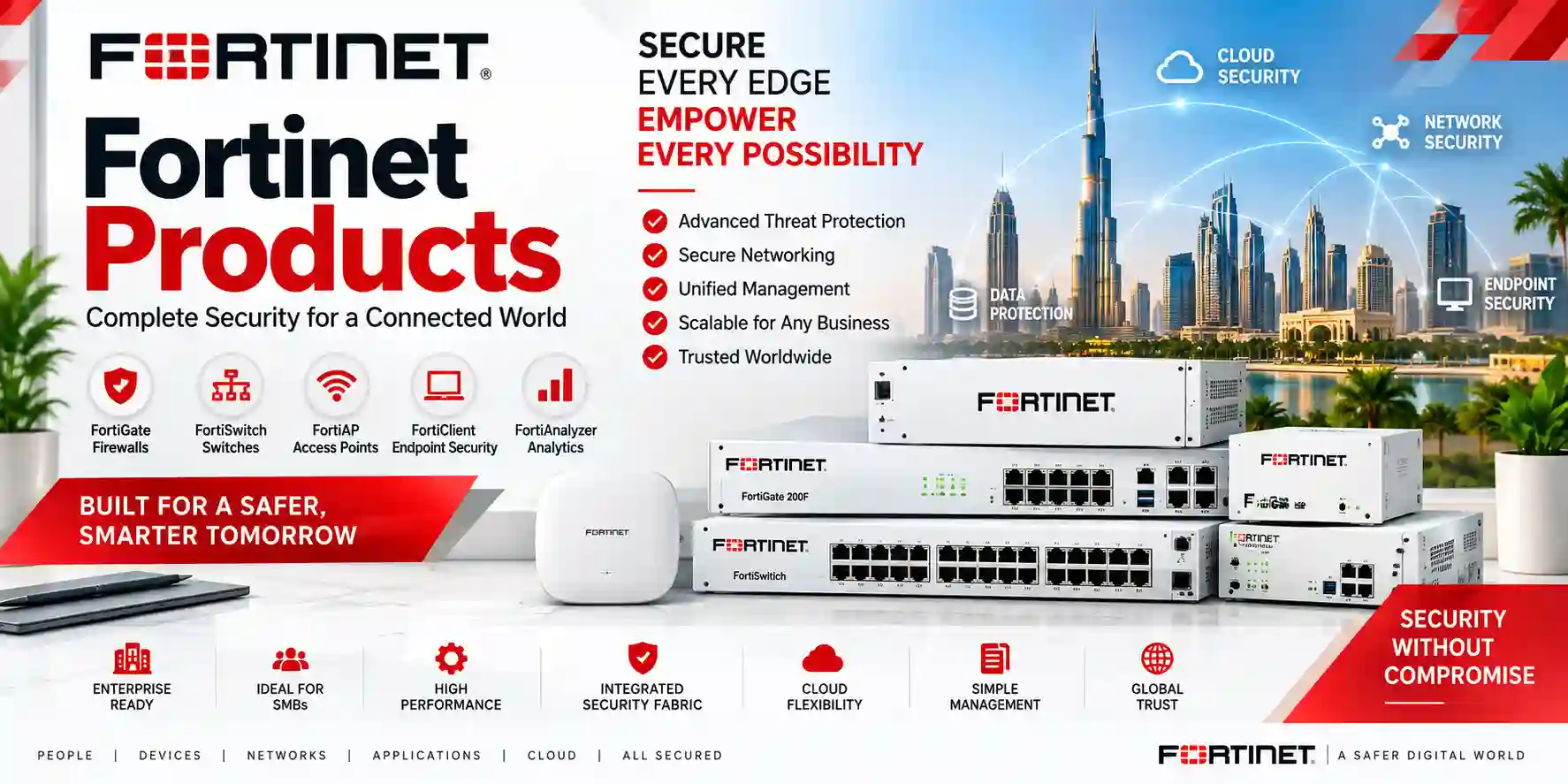
For general UAE and international IT infrastructure context, FourTeck technology solutions can complement the regional resources linked throughout this page. These links are intended to help organizations coordinate related networking and security requirements; they do not imply that every listed service or product is required for FortiGate VM.
FortiGate VM FAQs
What is FortiGate VM?
FortiGate VM is Fortinet’s virtual FortiGate firewall appliance for virtualized, cloud and hybrid environments. It brings FortiOS security and networking capabilities into software-defined infrastructure.
How is FortiGate VM licensed?
Fortinet documents several licensing approaches, including VM license families with vCPU-based tiers, annual subscription options and FortiFlex usage-based entitlements. The appropriate option depends on capacity, term, services and deployment model.
Can FortiGate VM protect private cloud and public cloud workloads?
Yes. Fortinet positions FortiGate VM for cloud and virtualized environments, including private and public cloud deployment scenarios. Platform support and deployment mechanics should be verified for the specific environment and current Fortinet release.
What information is needed for a FortiGate VM quote?
Provide the cloud or hypervisor platform, number of instances, expected vCPU capacity, traffic, security services, VPN requirements, high-availability needs, management tools and license term. This enables a more accurate configuration and quotation.
What is FortiFlex?
FortiFlex is Fortinet’s points-based usage licensing program for supported security solutions. Fortinet describes it as a flexible model that can scale services and capacity with consumption, making it relevant to dynamic cloud and hybrid environments.
Quotation Checklist and Decision Recap
A useful FortiGate VM proposal should identify the protected workloads, deployment platform, traffic profile, security inspection requirements, VM capacity, service bundle, support term, management design, logging, availability and implementation responsibilities. Compare licensing models in the context of the workload lifecycle. Choose a virtual firewall when the security boundary belongs inside virtual or cloud infrastructure; retain physical firewalls where the physical edge remains the correct enforcement point. Hybrid environments can use both.
FourTeck can help translate these requirements into a structured quotation discussion for Tanzania and regional projects. Share your existing topology, cloud or virtualization platform, bandwidth, applications, VPN requirements and growth plan. This reduces ambiguity and helps technical and procurement teams evaluate the complete solution rather than a license line item in isolation.
Consult FourTeck About FortiGate VM
If your organization is moving workloads into virtualization, building a private cloud, connecting branches to hosted applications or standardizing Fortinet security across physical and virtual infrastructure, prepare your technical requirements and request a tailored discussion. FourTeck can assist with solution scoping, licensing guidance, quotation preparation and deployment planning based on the information supplied for your environment.



Reviews
There are no reviews yet.