
FortiAP FAP-23JF Tanzania
Fortinet FortiAP FAP-23JF is a compact indoor wall-jack or desktop access point for organizations that want Wi-Fi 6 coverage, wired device connectivity and Fortinet-managed network security in a practical room-level form factor. It is especially relevant where a single network outlet must serve wireless users as well as Ethernet-connected endpoints such as workstations, IP phones or other business devices. FourTeck can help buyers in Tanzania evaluate the model, power design, management approach and deployment fit before requesting a commercial quotation.
FortiAP FAP-23JF Overview
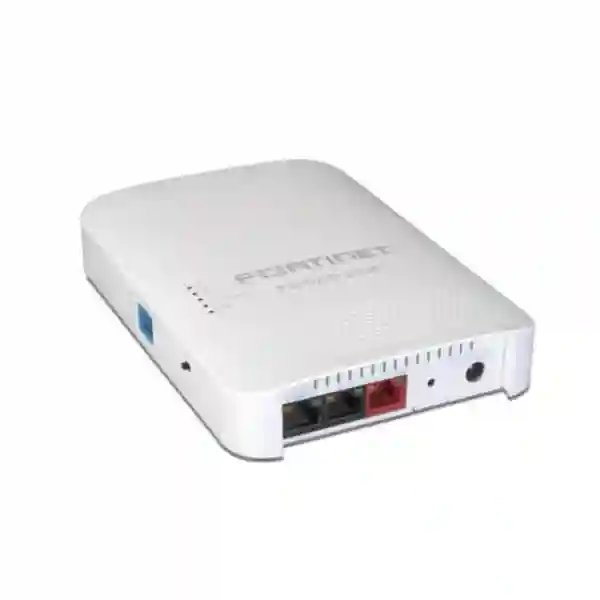
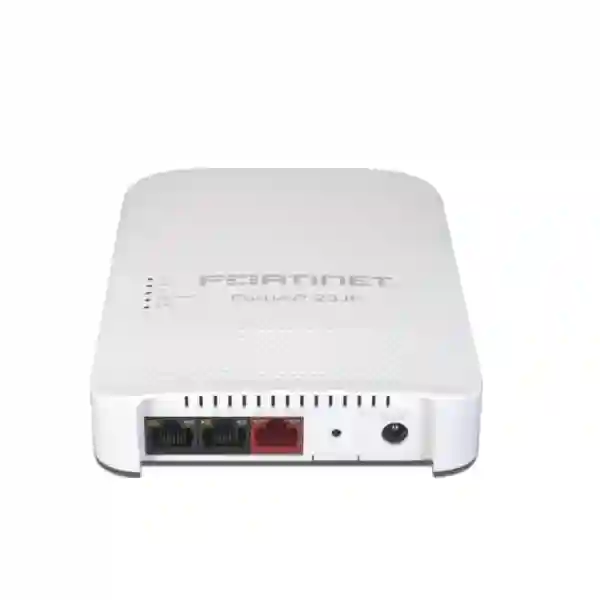
The FAP-23JF belongs to Fortinet’s FortiAP family and is positioned as a Wi-Fi 6, 2×2, internal-antenna access point in a wall-jack or desktop form factor. Unlike a conventional ceiling AP intended mainly to radiate across a larger shared area, a wall-jack AP can be placed close to the users and devices it serves. This makes the FAP-23JF useful for private offices, hotel-style rooms, meeting spaces, small branch areas and distributed room-by-room wireless designs. Its combination of wireless and wired connectivity can reduce the need to place a separate small access switch at every endpoint location.
The hardware provides three Wi-Fi radios plus BLE. Two radios serve clients: a 2.4 GHz radio supporting up to 574 Mbps and a 5 GHz radio supporting up to 1200 Mbps under supported conditions. A third 1×1 radio is dedicated to frequency scanning, helping keep monitoring activity separate from the two client-serving radios. Actual user throughput depends on client capabilities, radio conditions, channel planning, interference, upstream capacity, configuration and regulatory settings, so headline radio rates should not be treated as guaranteed application throughput.
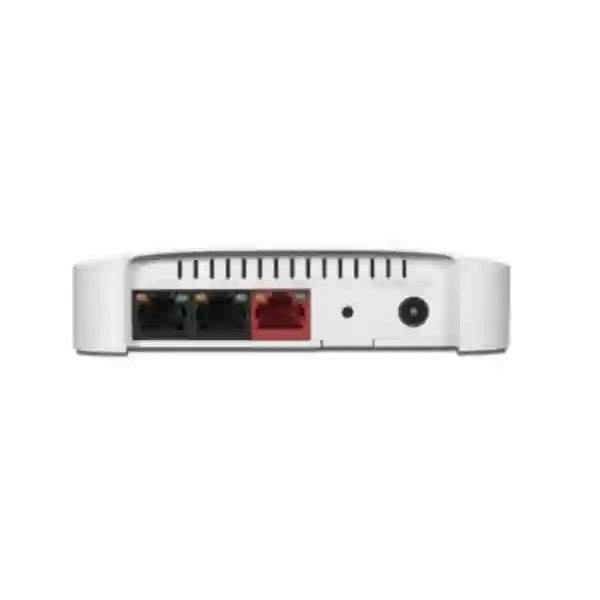
Fortinet lists four 10/100/1000Base-T RJ45 interfaces: one 802.3at PoE powered-device port, one 802.3af PoE power-sourcing port and two non-PoE ports. The unit also includes pass-through connectivity and an RJ45 RS-232 serial interface. For buyers, this port arrangement is a major reason to consider the model: it can provide Wi-Fi while also connecting several local wired endpoints from a compact room-side device.
2×2 client-serving radios for 2.4 GHz and 5 GHz wireless connectivity.
A separate 1×1 radio supports frequency scanning without consuming a client-serving radio.
Room-side wired connectivity includes PoE input, PoE output and non-PoE Ethernet ports.
Compact placement options suit distributed rooms, offices and branch spaces.
Verified FortiAP FAP-23JF Technical Highlights
| Hardware type | Indoor wall-jack / desktop access point |
| Wireless generation | Wi-Fi 6 (802.11ax), with supported legacy standards |
| Radios | 3 Wi-Fi radios + 1 BLE radio |
| 2.4 GHz service radio | 2×2, 20/40 MHz, up to 574 Mbps |
| 5 GHz service radio | 2×2, 20/40/80 MHz, up to 1200 Mbps |
| Scanning radio | 1×1 frequency scanning across 2.4 GHz and 5 GHz |
| Antennas | Internal PCB antennas; dual-band peak gain listed at 4.0 dBi for 2.4 GHz and 5 GHz |
| Ethernet | 4 x 10/100/1000Base-T RJ45 |
| PoE | 1 x 802.3at PoE PD input; 1 x 802.3af PoE PSE output |
| Additional interfaces | Pass-through in/out and RJ45 RS-232 serial |
| SSIDs | Up to 8 per client-serving radio; 7 when background scanning is enabled |
| Security / authentication | Supports WPA, WPA2 and WPA3 with 802.1X or pre-shared key, plus supported enterprise EAP methods |
Where the FAP-23JF Fits
The FAP-23JF is most compelling when network design is room-centric rather than ceiling-centric. A hospitality room, executive office, consultation room, training room or small branch workspace may need both strong nearby Wi-Fi and multiple wired connections. Placing a wall-jack AP near those endpoints can create a cleaner topology than installing a ceiling AP for Wi-Fi and a separate desktop switch for Ethernet. The design decision should still be based on a site survey, cable layout, client density, wall materials, interference and expected traffic.
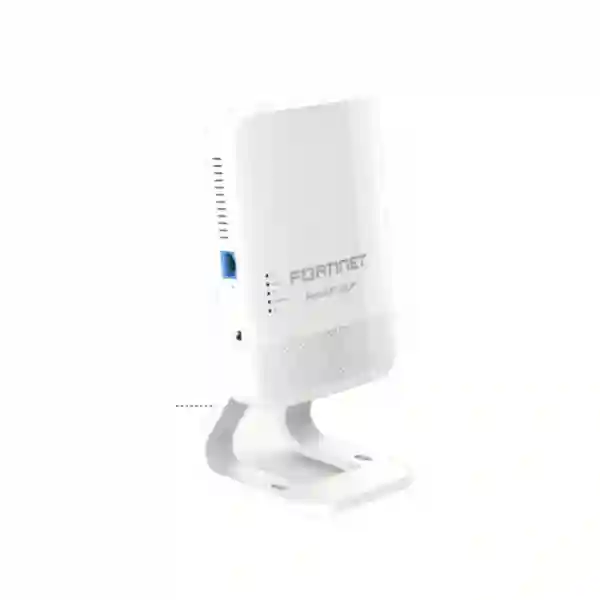
Power planning deserves special attention. The AP accepts 802.3at PoE through its powered-device interface, and Fortinet also identifies a compatible 48V, 1.04A, 50W power supply accessory for this model. Fortinet’s accessory documentation also lists desktop stand options compatible with FAP-23JF. When the downstream PoE-out function is important, confirm the complete power budget and selected power method before procurement rather than assuming every upstream source will support every downstream load.
Management is another procurement checkpoint. Fortinet positions FortiAPs as centrally managed access points within its secure networking architecture. Buyers should confirm their intended controller or cloud-management approach, existing FortiGate environment, firmware compatibility, licensing or support requirements, VLAN design, authentication method and monitoring policy before finalizing quantities. This avoids treating the AP as an isolated radio purchase when the actual objective is a manageable wired-and-wireless edge.
Buying and Sizing Guidance
Start with the room or zone, not simply a device count. Document the number of concurrent wireless clients, wired endpoints, voice devices, expected application mix, available Ethernet cabling and PoE source. Then identify whether each room needs its own AP or whether adjoining areas can be served by a shared ceiling-mounted model. FAP-23JF is particularly attractive where the wall-jack format and four Ethernet ports solve a physical deployment problem as well as a wireless requirement.
For quotation accuracy, provide the required quantity, deployment city, intended management platform, PoE availability, whether downstream PoE is needed, mounting preference, support term requirements and any accessories. Do not rely on a generic online price to represent a Tanzania project cost: region code, commercial terms, support, taxes, logistics and project scope can affect the final quotation.
FortiAP FAP-23JF Regional Procurement and Deployment
FortiAP FAP-23JF Tanzania
Organizations evaluating the FortiAP FAP-23JF in Tanzania commonly need more than a model number: they need to know whether a wall-jack Wi-Fi 6 architecture matches their building, endpoint mix and Fortinet environment. The FAP-23JF can be considered for offices, hospitality environments, education facilities, clinics, professional-services locations and distributed branches where users benefit from wireless coverage close to the room while wired devices remain connected locally. Its four Gigabit Ethernet ports make the design relevant where an existing structured-cabling outlet must support several endpoint types without adding a separate unmanaged switch at every desk or room.
For a Tanzania rollout, begin by mapping each target room, the Ethernet outlet position and the upstream PoE capability. Confirm which rooms need downstream PoE for an endpoint and which only need standard Ethernet. Wireless planning should account for construction materials, room separation, neighboring WLANs and client density rather than assuming one AP count from floor area alone. The 2.4 GHz and 5 GHz service radios provide Wi-Fi 6 connectivity while the dedicated scanning radio supports monitoring, but the practical result depends on RF design and configuration.
Procurement teams should request a quotation that clearly identifies hardware quantity, region-appropriate ordering details, support requirements, power accessories and mounting needs. Where a FortiGate already forms the security edge, the design can also be reviewed as part of a unified secure networking deployment. Visit FourTeck Tanzania for the local product and solution context, or use the consultation request below to prepare a project-specific bill of materials.
FortiAP FAP-23JF Dar es Salaam
Dar es Salaam buyers may evaluate FAP-23JF for corporate offices, hospitality properties, serviced apartments, clinics, training facilities and branch locations where room-level connectivity matters. In dense commercial buildings, wireless design should consider neighboring networks, partition walls and the number of active devices in adjacent rooms. The dedicated scanning radio is useful in a managed wireless design because monitoring does not need to rely solely on a client-serving radio. Still, channel planning, transmit power, placement and client behavior remain central to performance.
A practical deployment workflow starts with cable and power validation. Check whether each target wall position has Cat5e-or-better structured cabling suitable for Gigabit Ethernet, verify the upstream PoE standard and identify endpoints that may use the AP’s 802.3af PoE-out port. If an IP phone, small device or other powered endpoint is part of the room design, its power requirement must be considered in the overall budget. Where desktop placement is preferred, compatible stand accessories should be included in the bill of materials rather than improvised during installation.
For procurement, specify the exact FAP-23JF model family, quantity, project address, controller environment, support term and accessory needs. Ask for confirmation of current commercial availability instead of assuming stock or delivery time. A well-scoped request lets the supplier distinguish a hardware-only requirement from a complete secure WLAN project involving FortiGate integration, VLANs, authentication, guest access, wired endpoints and deployment services.
FortiAP FAP-23JF Mwanza
In Mwanza, the FAP-23JF can suit organizations planning compact wireless coverage for rooms, offices and branch environments where Ethernet access at the same location adds value. Buyers should evaluate the model against the actual physical topology: a wall-jack AP is strongest when users and wired devices are close to the installation point. Large open spaces, warehouses or outdoor zones may require a different FortiAP form factor, antenna approach or AP density, so the FAP-23JF should be selected for the right zone rather than used as a universal access point.
Project planning should include upstream connectivity and resilience. The AP’s client experience cannot exceed the capability of the WAN, switching and application environment behind it. Where business applications, cloud platforms, voice or video are important, define expected concurrency and traffic patterns before deciding AP quantities. Separate employee, guest and device networks can be planned using SSIDs and VLAN policies within the broader Fortinet architecture, with authentication requirements chosen according to the organization’s security policy.
Mwanza procurement teams can improve quotation quality by supplying a room count, floor plan or endpoint schedule. Include whether existing FortiGate equipment will manage the WLAN, whether PoE switching is already installed, and whether wired ports on the AP will be used. This information helps determine accessories, switching capacity and installation scope and reduces the risk of purchasing access points before power, mounting or management dependencies are understood.
FortiAP FAP-23JF Arusha
Arusha deployments may include hospitality, tourism-related businesses, professional offices, education sites and distributed administrative facilities. The FAP-23JF’s wall-jack format is particularly relevant to room-based environments because it can place Wi-Fi 6 close to guests or staff while providing local Gigabit Ethernet. In a hospitality-style layout, planners can evaluate whether each room or selected groups of rooms need dedicated APs based on wall attenuation, expected device counts and the service level required.
Guest connectivity should be designed as a network service, not merely an SSID. Consider segmentation, authentication, bandwidth policy, logging requirements, upstream Internet capacity and isolation from operational systems. Employee and business-device traffic may require different security policies. The FAP-23JF supports modern WPA security options and enterprise authentication methods, but the final security posture depends on controller configuration and the rest of the network architecture.
When requesting an Arusha quotation, identify whether the project is a new build, refurbishment or replacement of existing wall-jack access points. Existing back boxes, cable paths and switch ports can materially affect installation effort. Include the required quantity, power source, mounting style, support expectations and intended Fortinet management platform. This allows a proposal to focus on compatibility and deployment readiness rather than simply quoting an AP unit price.
FortiAP FAP-23JF Dodoma
Dodoma organizations considering FAP-23JF may include administrative offices, institutions, education facilities, professional workplaces and branches that need secure room-level Wi-Fi. The model’s value is strongest when the same installation point must support both wireless users and wired devices. Four Gigabit ports provide flexibility for local endpoints, while Wi-Fi 6 radios address modern client connectivity. This can simplify a room design, but it does not remove the need for appropriate upstream switching, security policy and Internet capacity.
For multi-room offices, establish a repeatable deployment standard: define wall position, cable label, switch port, VLAN mapping, SSID assignment, power method and test criteria for each AP. Consistency improves troubleshooting and future maintenance. A dedicated scanning radio can support the broader wireless monitoring strategy, while BLE capability may be relevant to supported location or beacon use cases. Any advanced use case should be validated against the intended management platform and current Fortinet documentation before procurement.
A Dodoma bill of materials should separate access point hardware from support, power accessories, mounting accessories, switching and professional services. If an organization already operates FortiGate, include the firewall model and software environment in the request so compatibility can be reviewed. If it does not, state the desired management approach. Clear technical context helps avoid a mismatch between the AP purchase and the operational model the IT team expects.
FortiAP FAP-23JF UAE
UAE buyers can evaluate FAP-23JF for offices, hotels, apartments, clinics and branch spaces that favor wall-jack or desktop access points. The model supports Wi-Fi 6 on 2.4 GHz and 5 GHz service radios and provides local Gigabit Ethernet, making it useful where a room needs both wireless and wired access. In high-density commercial environments, the RF plan should account for neighboring networks, floor construction and many adjacent APs; simply increasing transmit power can create more contention rather than better service.
Projects spanning Tanzania and the UAE should standardize configuration templates where practical while respecting regional radio regulations and local ordering requirements. Use consistent SSID naming, VLAN segmentation, authentication and monitoring policies, then validate the exact regional hardware variant and approved channel plan for each country. This approach can reduce operational differences across branches without assuming that every market uses identical regulatory settings or procurement codes.
For UAE-focused Fortinet context, FourTeck’s Fortinet UAE resource can complement a Tanzania-led multi-country procurement discussion. A quotation request should still identify destination, quantity, support requirements and management architecture separately for each deployment market.
FortiAP FAP-23JF Uganda
Uganda deployments can use FAP-23JF as a room-level Wi-Fi 6 and Ethernet edge where compact installation is important. Branch offices, hospitality rooms, consultation spaces and administrative facilities may benefit from the combination of internal antennas, local Gigabit ports and Fortinet management. Before specifying the model across a site, divide the building into room-oriented zones and open shared areas; the latter may be better served by ceiling access points designed for broader shared coverage.
Power and switching should be documented early. An 802.3at PoE source can power the AP through its PD interface, while the downstream PSE port can provide 802.3af PoE to a compatible endpoint when the complete design supports it. The other Ethernet ports can connect non-PoE devices. This makes the AP useful in a compact branch design, but the uplink still represents the path for both wireless and local wired traffic, so capacity and VLAN configuration should be planned accordingly.
Organizations coordinating procurement between Tanzania and Uganda can review FourTeck Uganda for country-specific solution context. Provide quantities and deployment details per country rather than assuming identical lead times or commercial terms.
FortiAP FAP-23JF Kampala
Kampala office and hospitality environments can present dense RF conditions, making careful placement and channel planning important. FAP-23JF’s close-to-user wall-jack design can help create predictable room coverage when deployed as part of a planned WLAN. The dedicated scanning radio is a useful architectural feature because it separates scanning duties from the two client-serving radios. However, a successful deployment still requires appropriate channel reuse, power settings, cabling and upstream capacity.
For rooms with wired endpoints, identify exactly how the four Gigabit ports will be used. An IP phone or another supported device may use the PoE-out port, while PCs or other equipment can use non-PoE ports. Network segmentation should be defined so wired endpoints do not automatically inherit inappropriate access merely because they connect through the AP. Map port roles and VLAN policies before installation and include them in acceptance testing.
Kampala buyers requesting a quote should state whether they need hardware supply only or a broader design covering configuration, FortiGate integration, switching, SSIDs, authentication and support. This distinction helps suppliers prepare a technically relevant response rather than a generic unit-price offer.
FortiAP FAP-23JF Arua
For Arua branches and institutional sites, a compact AP can be attractive where network equipment must be simple to place and support. FAP-23JF combines Wi-Fi 6 with room-side Ethernet, allowing a structured cable run to serve several local connectivity needs. Before choosing it, verify that the site is indoor, that wall-jack or desktop placement suits the coverage objective, and that the client population does not require a higher-density or different-form-factor FortiAP.
Remote-site maintainability should influence design. Standardize labeling, switch-port configuration, AP naming and management templates so a central IT team can identify each unit and its connected devices. Document the PoE source and any downstream powered device. Where WAN bandwidth is constrained, apply network policy appropriate to the applications rather than expecting a faster Wi-Fi standard alone to improve Internet performance.
For procurement, bundle the AP decision with the operational requirements: support term, spare strategy, compatible power accessories and configuration ownership. Request current availability and delivery information for the exact destination instead of relying on assumptions based on another city or country.
FortiAP FAP-23JF Mbarara
Mbarara businesses and institutions can consider FAP-23JF where room-level wireless and wired connectivity are both priorities. Typical evaluation questions include whether an existing wall outlet can be reused, whether the upstream switch supports the required PoE standard, and how many wired endpoints need connectivity at each location. The AP’s internal antennas and compact format reduce visible infrastructure compared with some multi-device arrangements, but RF performance still depends on the physical environment.
A pilot installation can be valuable before a larger rollout. Test representative rooms with the actual client types and applications, validate roaming behavior where users move between areas, measure coverage at the edges, and confirm wired-port operation. If voice or video is important, test those applications under realistic concurrency rather than relying solely on speed-test results. This produces a more defensible AP count and configuration template.
When moving from pilot to purchase, document the approved configuration and request matching hardware, accessories and support. Include any FortiGate or Fortinet switching dependencies in the procurement notes so the final design can be checked as an integrated secure network rather than as standalone wireless hardware.
FortiAP FAP-23JF Gulu
Gulu sites evaluating FAP-23JF should focus on practical branch requirements: reliable indoor coverage, manageable security, simple wired connections and a repeatable installation method. The wall-jack/desktop format can suit rooms where ceiling mounting is inconvenient or where local Ethernet ports add operational value. It should not be selected solely because it is Wi-Fi 6; the form factor and port arrangement are equally important parts of the model’s fit.
Plan for lifecycle operations from the beginning. Keep records of AP serials, locations, switch ports, firmware policy and support coverage. Central management can simplify configuration consistency, but physical documentation still matters when a remote branch needs troubleshooting. If the AP powers a downstream device, record that relationship so technicians understand the dependency during power or switch changes.
A quotation request for Gulu should include quantity, target deployment date, exact destination, existing network equipment, PoE capability and whether installation or configuration assistance is required. Availability and logistics should be confirmed during quotation; they should not be inferred from product listings for other markets.
FortiAP FAP-23JF Kenya
Kenya projects can evaluate FAP-23JF for distributed office rooms, hospitality environments and branches where a wall-jack AP can replace a combination of separate Wi-Fi and small Ethernet devices. The four Gigabit ports provide local connectivity while the two 2×2 service radios deliver Wi-Fi 6 across 2.4 GHz and 5 GHz. A dedicated scan radio supports monitoring without requiring a service radio to perform all scanning tasks.
For organizations operating in both Tanzania and Kenya, standardization can simplify support. Define a common WLAN policy, naming convention, VLAN model and authentication approach, then validate each country’s regulatory and ordering requirements separately. If different building types are involved, do not force the same AP model everywhere; use FAP-23JF where room-side ports and wall placement are useful and select other FortiAP form factors for open areas or specialized environments.
Country-specific solution information is available through FourTeck Kenya. For a cross-border quotation, list quantities and delivery destinations independently so commercial and logistics details can be confirmed for each market.
FortiAP FAP-23JF Kuwait
Kuwait buyers can consider the FAP-23JF for indoor room and office deployments that need a compact Wi-Fi 6 access point with integrated Ethernet. The design can be useful in hospitality and commercial buildings where structured cabling terminates at wall outlets close to users. Because RF conditions differ substantially between buildings, coverage should be validated rather than extrapolated from another project or from theoretical radio rates.
Multi-country IT teams should maintain consistent security policy while accounting for local radio and procurement requirements. Record the exact hardware region variant, management platform and support contract associated with each deployment. If the AP is expected to supply PoE to a downstream endpoint, validate the upstream power design and device requirements before ordering. Include compatible accessories in the same bill of materials where possible.
The broader FourTeck network can support discussions for organizations coordinating technology standards across multiple markets. Commercial availability, price and delivery should be confirmed specifically for Kuwait at the time of quotation.
FortiAP FAP-23JF Ghana
Ghana organizations considering FAP-23JF can evaluate it as a secure room-level wireless edge for offices, accommodation, clinics, education and branch environments. The model is not simply a wireless radio: its Ethernet ports can support local wired endpoints, making cabling and VLAN design part of the purchasing decision. The 802.3at PoE input and 802.3af PoE output arrangement should be reviewed with the upstream switch and any intended downstream device.
Where a Fortinet security architecture is already present, buyers can assess how AP management, network segmentation and security policy fit the existing environment. For greenfield sites, compare management options and operational responsibilities before purchase. Decide who will create SSIDs, manage firmware, monitor events and handle configuration changes. These operational questions often matter more over the product lifecycle than the initial installation itself.
For a Ghana quotation, provide floor or room information, quantities, existing firewall and switch details, and accessory requirements. Confirm current regional ordering and availability at quote time. Avoid treating third-party web prices as a guaranteed local project price because support, logistics and commercial terms can differ.
FortiAP FAP-23JF Nigeria
Nigeria deployments may range from compact branch offices to large multi-floor properties. FAP-23JF is best evaluated for the room or desk-side portion of such networks, especially where several wired endpoints and Wi-Fi users share a local connectivity point. For larger shared spaces, compare alternative FortiAP models and perform RF planning rather than expanding wall-jack AP quantities without a coverage rationale.
Network resilience should be considered end to end. Wi-Fi 6 can improve the local wireless layer, but application availability still depends on switching, firewalling, WAN connectivity, DNS and cloud services. Segment business, guest and device traffic according to security requirements. Where the AP’s wired ports are used, include those endpoints in the same policy design and testing process as wireless clients.
For procurement, state the exact deployment locations, quantity per site, support expectations and whether configuration services are needed. Confirm the correct regional ordering code and current commercial availability with the supplier. This is particularly important for organizations standardizing across Tanzania and Nigeria, where a shared technical design does not necessarily imply identical commercial terms.
FortiAP FAP-23JF Seychelles
Seychelles hospitality and office projects can find the FAP-23JF format relevant where rooms need both Wi-Fi and wired Ethernet from a discreet indoor access point. In guest-room scenarios, close placement can help contain coverage to intended spaces, but wall materials, corridors and adjacent-room interference still require survey and tuning. Wired ports may support room equipment or business endpoints, subject to network policy and power requirements.
For island deployments, procurement planning should pay close attention to completeness of the bill of materials. Confirm power method, mounting accessories, support coverage and any spares before shipment. A missing power or mounting component can create disproportionate deployment delay. Do not assume availability or delivery schedules; request current confirmation for the project destination and planned installation window.
Operationally, use central configuration standards, document every room installation and maintain a clear mapping between APs, switch ports and connected endpoints. If the project is part of a broader Africa network standard, FourTeck Africa provides a regional point of reference while the Tanzania team can coordinate the primary inquiry.
Compatibility and Integration Checklist
Confirm the intended Fortinet management platform and compatibility with the existing security environment.
Verify 802.3at PoE input or compatible power accessory, plus downstream PoE requirements.
Validate structured cabling, switch capacity, VLANs and Gigabit uplink operation.
Plan channel use, AP placement, expected clients, walls, interference and roaming.
Quotation Checklist
For a faster and more accurate FAP-23JF quotation, include the following information in your request:
Required quantity; deployment country and city; room or zone count; existing FortiGate model if applicable; switching and PoE availability; whether the AP must power a downstream device; wall-jack or desktop mounting preference; support term; required accessories; wired endpoint count; authentication requirements; guest Wi-Fi needs; target installation schedule; and whether you require supply only, configuration assistance or a broader secure wireless design.
FortiAP FAP-23JF FAQ
Is FortiAP FAP-23JF a Wi-Fi 6 access point?
Yes. Fortinet lists FAP-23JF as a Wi-Fi 6 model with 2×2 client-serving radios on 2.4 GHz and 5 GHz.
Can FAP-23JF be mounted on a wall or used on a desk?
It is designed as an indoor wall-jack/desktop AP. Fortinet accessory documentation lists compatible desktop stand options; confirm the required accessory when ordering.
How many Ethernet ports does FAP-23JF have?
It has four 10/100/1000Base-T RJ45 Ethernet ports: one 802.3at PoE input, one 802.3af PoE output and two non-PoE ports.
Does FAP-23JF have a dedicated scanning radio?
Yes. In addition to its two client-serving radios, the model includes a 1×1 frequency-scanning radio covering 2.4 GHz and 5 GHz.
What is the maximum radio data rate?
Fortinet lists up to 574 Mbps for the 2.4 GHz service radio and up to 1200 Mbps for the 5 GHz service radio. These are radio data rates, not guaranteed application throughput.
Is FAP-23JF suitable for outdoor use?
No. Fortinet identifies it as an indoor wall-jack/desktop AP. Outdoor deployments should use an access point designed and rated for that environment.
How should I request a FortiAP FAP-23JF price in Tanzania?
Provide the required quantity, city, intended management environment, PoE design, accessory needs and support term. Request a current quotation because commercial terms and availability can change.
Decision Recap
Choose the FAP-23JF when your design specifically benefits from an indoor wall-jack or desktop Wi-Fi 6 AP with integrated Gigabit Ethernet ports, a dedicated scanning radio and Fortinet secure-networking management. Compare another FortiAP form factor when the primary requirement is broad ceiling coverage, outdoor operation, a different radio density or newer wireless-generation capability.
Before ordering, validate management compatibility, PoE, downstream device power, cabling, RF placement, support and regional ordering details. That verification turns a product selection into a deployable network design.
Plan Your FortiAP FAP-23JF Deployment
FourTeck can use your room count, network topology, Fortinet environment and endpoint requirements to structure a quotation discussion around the FAP-23JF. Share the project city, quantities, PoE situation, management platform and expected wired/wireless use so the hardware and accessory requirements can be reviewed before purchase.




Reviews
There are no reviews yet.