
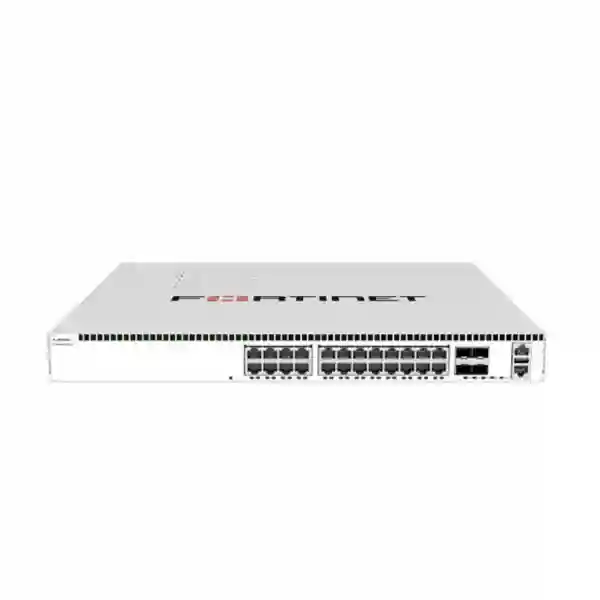
FortiSwitch FS-624F Tanzania
Fortinet FortiSwitch FS-624F is built for organizations that need multigigabit access and high-speed aggregation without a PoE requirement. The platform provides 24 multigigabit RJ45 interfaces supporting up to 5GE and four 25GE SFP28 uplinks, creating a practical foundation for bandwidth-intensive campus, server-access and aggregation designs. For Tanzanian businesses modernizing wired infrastructure, the central purchasing question is not simply how many ports are available; it is whether the switching architecture has enough access speed, uplink capacity, redundancy, security integration and management consistency for current workloads and future expansion.
Up to 5GE copper access connectivity for devices and infrastructure that can benefit from more than traditional 1GbE.
High-speed fiber uplinks help reduce aggregation bottlenecks and provide design flexibility between racks, floors and network tiers.
FS-624F is the non-PoE variant. Buyers requiring powered endpoints should evaluate the separate FS-624F-FPOE model rather than assume PoE capability.
FortiSwitch FS-624F overview and verified capabilities
Fortinet places the FS-624F in its 600 Series switching portfolio. Its interface mix is particularly relevant where conventional Gigabit Ethernet has become a constraint but a full fiber-to-every-endpoint design is unnecessary. Twenty-four copper multigigabit ports allow a network team to retain familiar RJ45 connectivity while creating headroom for compatible workstations, wireless infrastructure, servers or other high-throughput devices. Four 25GE SFP28 interfaces provide faster northbound connectivity for aggregation, backbone or inter-switch links. Fortinet documentation also identifies the 624F/648F class for large-campus and multi-tier environments, making design context important: the switch should be selected as part of an architecture, not simply as a port-count replacement.
Fortinet publishes a switching capacity of 880 Gbps and packet forwarding performance of 1309 Mpps for this platform family, together with support for 4K VLANs, IPv4/IPv6 routing and link aggregation. Those figures are useful when comparing switch classes, but real deployment quality still depends on topology, optics, cabling, endpoint capabilities and configuration. The FS-624F uses dual hot-swappable AC power supplies and front-to-back airflow according to Fortinet’s current data sheet. Rack, cooling, power and airflow planning should therefore be included in the bill of materials and installation checklist.
| Access interfaces | 24 × multigigabit RJ45, up to 5GE |
| High-speed interfaces | 4 × 25GE SFP28 |
| PoE | No on FS-624F |
| Switching capacity | 880 Gbps |
| Packet forwarding | 1309 Mpps, 64-byte packets |
| VLANs | 4K |
| Power | Dual hot-swappable AC power supplies |
Where FS-624F fits in a network design
The FS-624F is most compelling when endpoint or aggregation bandwidth is the real design driver. Examples include office or campus environments with multigigabit-capable access points, high-performance engineering workstations, local server traffic, storage-heavy workflows or a distribution layer that must aggregate several lower-speed access segments. The 25GE uplinks can help preserve capacity upstream, but they also create dependencies: suitable SFP28 optics or direct-attach components, compatible peer interfaces, fiber type, distance and transceiver selection must be checked before ordering.
A non-PoE switch can be the correct choice for aggregation and data-heavy wired endpoints, yet it may be the wrong choice when most ports need to power access points, IP phones or cameras. Procurement teams should map powered and non-powered endpoints before choosing between FS-624F and the FPOE variant. This avoids paying for an unnecessary PoE budget in one design or discovering too late that a non-PoE switch cannot directly power the intended devices.
Fortinet integration, segmentation and management
FortiSwitch is designed to operate as part of the broader Fortinet networking and security environment, including management through compatible FortiGate deployments using FortiLink. For organizations already standardizing on Fortinet, coordinated switching and security can simplify policy visibility and reduce the operational gap between the LAN and firewall layers. That does not eliminate the need for sound network engineering. VLAN design, addressing, routing boundaries, spanning-tree behavior, link aggregation, authentication policy and change control should still be documented before deployment.
Businesses evaluating the switch alongside perimeter security can review FourTeck Tanzania’s broader networking and cybersecurity portfolio. For projects that include installation, configuration or lifecycle assistance, the FourTeck Tanzania services page explains the wider project approach. These links are useful when the switching requirement is part of a larger refresh rather than an isolated hardware purchase.
FortiSwitch FS-624F Tanzania
For organizations in Tanzania, FS-624F procurement should begin with the traffic profile and network topology. A head office upgrading from 1GbE access may have very different needs from a campus connecting multiple buildings or a data-intensive team moving large files between local servers and workstations. The 24 multigigabit copper interfaces are useful where existing structured cabling can support the intended Ethernet rate and where endpoints genuinely benefit from speeds above 1GbE. Cabling quality, run length and termination condition should be checked rather than assuming every installed copper run will deliver the desired multigigabit performance.
Uplink planning matters equally. Four 25GE SFP28 ports can provide strong aggregation capacity, but the receiving switch, firewall, server or backbone device must support the selected link speed and optic. Buyers should identify whether links are within one rack, across a server room, between floors or between buildings. That determines whether DAC, multimode fiber or single-mode fiber may be appropriate and helps prevent an incomplete quotation. Redundancy requirements should also be stated early so that the design can account for dual links, link aggregation or a paired-switch architecture where needed.
Tanzanian procurement teams should include rack space, power feeds, UPS capacity, cooling and support requirements in the request. Fortinet specifies front-to-back airflow and dual hot-swappable AC power for the FS-624F; these details should align with the rack’s airflow strategy and available circuits. A clean deployment plan also documents VLANs, management addresses, uplink ports, optic types, cable labels and firmware baseline. This information becomes valuable during troubleshooting and later expansion.
For quotation preparation, state the FS-624F quantity, required support term, intended FortiGate or standalone management approach, number and type of 25GE uplinks, optic distances, existing rack environment and whether any connected devices need PoE. This makes it easier to distinguish the standard FS-624F from FS-624F-FPOE and to identify accessories that may otherwise be missed. FourTeck Tanzania can use this project context to discuss compatibility and sourcing without assuming stock, delivery time or final configuration before the requirement is confirmed.
FortiSwitch FS-624F Dar es Salaam
Dar es Salaam businesses evaluating the FS-624F may be dealing with headquarters, multi-floor offices, technology companies, hospitality operations, logistics environments or larger commercial sites where network demand is concentrated. In these settings, the practical value of multigigabit switching is the ability to remove a 1GbE access bottleneck for selected devices without converting every copper connection to fiber. Before procurement, network administrators should inventory which endpoints are actually capable of 2.5GE or 5GE and identify the traffic paths that justify higher access speeds.
A building with fast wireless access points, local virtualization hosts or large creative and engineering workloads may benefit from faster copper links, while ordinary office endpoints may remain adequately served at lower rates. This mixed-speed reality makes port mapping important. The FS-624F should be placed where its multigigabit interfaces and 25GE uplinks provide measurable architectural value rather than simply because it is a higher-specification model.
For a Dar es Salaam installation, the quotation should include the upstream architecture. If 25GE uplinks terminate on another switch, confirm SFP28 compatibility on both ends. If the design connects toward a firewall, confirm interface speed, transceiver support and whether the firewall is intended to route inter-VLAN traffic. Where high availability matters, document how a single switch, uplink or power-path failure affects users. Dual power supplies improve hardware resilience, but true service continuity also depends on upstream redundancy and power design.
Environmental planning should not be overlooked. Rack ventilation, front-to-back airflow, UPS sizing and cable management can influence reliability as much as the switch specification. Businesses can contact FourTeck Tanzania through the verified Tanzania sales and project enquiry page with the model, quantity, topology, uplink distances and support expectations. Supplying those details helps turn a generic price request into a more complete infrastructure quotation.
FortiSwitch FS-624F Mwanza
Organizations in Mwanza considering the FortiSwitch FS-624F should evaluate the switch in relation to site scale, available technical support, power continuity and the distance between network areas. A larger office, institutional campus, hospitality property or operational site may have network racks separated by floors or buildings. In those environments, the 25GE SFP28 uplinks can become an important part of the backbone design, but only when paired with the correct fiber infrastructure and compatible equipment.
A useful planning exercise is to separate access, aggregation and core requirements. If most connected devices are standard desktops, printers and low-bandwidth endpoints, a multigigabit switch may not be required everywhere. The FS-624F can instead be positioned where faster devices converge, such as a distribution point serving high-capacity wireless, server connectivity or demanding user groups. This targeted approach can improve design efficiency and keep the bill of materials aligned with actual needs.
Mwanza buyers should also consider maintainability. Record the intended port roles, VLAN assignments, management method, firmware policy, optic part numbers and spare strategy. If the site is part of a wider branch network, standardizing naming conventions and configuration templates can simplify remote support. Where FortiGate already provides security and routing, FortiLink-managed switching may offer operational consistency, subject to compatibility and design requirements.
Because FS-624F does not provide PoE, any plan involving powered access points, phones or cameras needs a separate PoE layer, local power injectors where appropriate, or evaluation of the FS-624F-FPOE variant. Clarifying this before purchase is especially important in projects where the switch is expected to serve both high-bandwidth users and powered network devices. A quotation request should therefore state endpoint types, powered-device counts, backbone distances, existing Fortinet equipment and expected growth.
FortiSwitch FS-624F Arusha
Arusha enterprises and institutions can approach FS-624F selection by asking where multigigabit access will make a practical difference. Hospitality groups, larger offices, education environments and operations with heavy local data movement may need more than 1GbE at selected network points. The FS-624F provides 24 copper ports capable of up to 5GE, which can support a staged upgrade strategy when compatible endpoints and cabling are already present or planned.
The switch’s four 25GE SFP28 interfaces make backbone planning a central part of the design. A high-speed access layer connected to a slow upstream path simply moves the bottleneck. The aggregation or core equipment should therefore be reviewed at the same time. Network teams should estimate simultaneous traffic, server access patterns, wireless uplink requirements and inter-VLAN flows, then decide where 25GE links are justified and how redundancy should be arranged.
For sites where uptime is important, dual hot-swappable AC power supplies are useful, but the surrounding infrastructure must also support resilience. Separate power paths, appropriate UPS capacity, stable rack cooling and redundant uplinks can be more meaningful than a redundant component inside one device. Maintenance planning should include configuration backups, firmware review, labeled patching and an escalation path for hardware or software support.
Procurement teams in Arusha should request a line-item quotation that distinguishes the switch, FortiCare or support requirements, optics, fiber patch leads, rack accessories and implementation services. This makes commercial comparison easier and reduces the risk of receiving a switch without the components needed to connect it. Where powered wireless or surveillance devices are part of the same project, clearly identify their PoE needs because standard FS-624F is non-PoE.
FortiSwitch FS-624F Dodoma
For Dodoma organizations planning a campus, administrative network or larger business LAN, the FortiSwitch FS-624F can serve as a high-capacity switching element where multigigabit access and 25GE uplinks match the architecture. Selection should be driven by application flows and growth rather than a simple desire to maximize port speed. Mapping current utilization and expected upgrades helps determine whether the switch belongs at the access layer, aggregation layer or a specialized high-bandwidth segment.
Network segmentation is another planning priority. Government, institutional and commercial environments commonly need to separate user groups, servers, guest connectivity, management traffic and specialized systems. Fortinet documents support for a large VLAN scale on the FS-624F family, but the design still requires a clear routing and policy model. Decide which device performs inter-VLAN routing, where security inspection occurs and how administrative access to the switch is protected.
Physical infrastructure should be reviewed before installation. The switch is rack-mounted equipment with front-to-back airflow and dual AC power supplies. Rack depth, ventilation, power distribution and UPS capacity should be checked in advance. If 25GE fiber uplinks leave the room, document fiber type, connector type, distance and the compatible optics at both endpoints. These details are easy to omit from a hardware-only request but essential for a working deployment.
A Dodoma quotation request should include the desired management approach, existing FortiGate model if applicable, number of high-speed uplinks, target distances, support term and implementation scope. If the project includes wireless access points, cameras or IP phones, specify their power requirements. Standard FS-624F will not supply PoE, so the design may need a separate powered access switch or the FPOE variant depending on the topology.
FortiSwitch FS-624F UAE
Organizations with operations in the UAE may evaluate FS-624F for campus aggregation, high-performance office networks and Fortinet-standardized infrastructure. The same technical selection principles apply across regions: validate the need for 5GE copper access, confirm 25GE uplink compatibility, map PoE requirements and design resilience around the complete path rather than a single appliance. Businesses coordinating projects between Tanzania and the UAE can benefit from keeping model standards, VLAN naming, management practices and support documentation consistent.
For a UAE deployment, dense wireless environments and high-speed internet circuits can make multigigabit access particularly relevant, but endpoint capability remains important. A switch port capable of 5GE does not guarantee that the connected device, cable plant or upstream network will use that capacity. Site surveys and cable certification may be appropriate when existing infrastructure is being reused. For new projects, cabling and rack design should be specified alongside active equipment.
The four 25GE SFP28 ports provide options for uplinks and aggregation, yet optics must be selected according to distance and peer equipment. Procurement should avoid treating SFP28 modules as generic accessories. Vendor compatibility, wavelength, fiber mode and connector type all matter. Support subscriptions and implementation services should also be separated clearly in the quotation so stakeholders understand the appliance cost versus lifecycle support.
FourTeck’s regional network can support cross-market requirement discussions through FourTeck UAE. For multi-country businesses, a repeatable architecture can simplify operations, but each site should still be validated for its local cabling, power, rack, ISP and application conditions rather than copying a design without assessment.
FortiSwitch FS-624F Uganda
Ugandan organizations considering FS-624F can use it as part of a Fortinet-centered campus or aggregation strategy where higher-speed copper access is justified. A useful first step is to identify whether the switch will connect end users directly, aggregate other switches or serve a mixed role. That decision affects port utilization, redundancy, VLAN design and the quantity of 25GE optics required.
In a multi-site organization, consistency between Tanzania and Uganda can reduce operational overhead. Common switch naming, management addressing, configuration templates and monitoring practices make remote support more predictable. However, standardization should not ignore site-specific differences. One branch may need extensive PoE for wireless and cameras while another may need mostly non-PoE high-speed data connectivity. Because FS-624F is non-PoE, powered endpoint counts must be identified before standardizing the model.
Uplink design deserves special attention. A pair of 25GE links can provide significant backbone capacity, but the peer switch and optic selection must be compatible. Fiber distance, patching, transceiver type and route diversity should be documented. Where a FortiGate participates in the architecture, confirm how FortiLink, routing and security policy will be implemented and whether the selected FortiGate platform supports the intended topology.
For Uganda-specific sourcing discussions, businesses can reference FourTeck Uganda while coordinating broader regional standards through the Tanzania project team. A complete request should include switch quantity, support term, optics, rack conditions, endpoint inventory and deployment scope.
FortiSwitch FS-624F Kampala
Kampala offices, campuses and technology-intensive environments may consider FS-624F when conventional Gigabit access is no longer sufficient for selected workloads. The 24 multigigabit copper ports can support a practical transition because devices capable of higher Ethernet rates can be connected without requiring fiber at every desk. Network planners should still verify cable category, termination quality and endpoint NIC capability before setting performance expectations.
A common design mistake is to focus on access-port speed while leaving the aggregation path unchanged. Four 25GE SFP28 interfaces give the FS-624F strong uplink options, but those ports create value only when connected to an appropriate core, firewall or peer switch. Capacity planning should consider simultaneous user traffic, wireless backhaul, server access and east-west flows. Link aggregation may be useful for resilience or capacity where supported by the overall topology.
Kampala procurement teams should also separate powered and non-powered endpoint requirements. If access points, cameras or phones are expected to draw power from the switch, standard FS-624F is not the correct PoE source. A mixed design may use FS-624F for aggregation and dedicated PoE access switches at the edge, or may evaluate FS-624F-FPOE where its powered-port capability better fits the requirement.
Operational readiness includes more than hardware. Define the management VLAN, administrator access controls, monitoring platform, configuration backup process and firmware maintenance window. Label fiber and copper connections, record optic models and keep an updated topology. These practices make a high-performance switch easier to support over its lifecycle and reduce troubleshooting time when the network expands.
FortiSwitch FS-624F Arua
For organizations in Arua, the decision to deploy a high-capacity switch such as FS-624F should consider not only headline performance but also the practicality of operating and supporting the environment. A remote or distributed site can benefit from standardized Fortinet management and documented configurations, particularly when technical administration is shared with a central IT team. The switch’s multigigabit interfaces may be useful for specific high-bandwidth endpoints, while 25GE uplinks can support a fast local backbone.
Infrastructure readiness is important. Confirm that the rack has suitable depth, ventilation, reliable power and UPS coverage. Fortinet specifies front-to-back airflow and dual hot-swappable AC power supplies for this model, so rack orientation and power distribution should be planned accordingly. Where power continuity is a concern, redundancy must extend beyond the switch itself to the UPS and circuit strategy.
Fiber uplinks should be designed as a complete link. Measure distance, identify fiber mode, verify connectors and select compatible SFP28 optics for both endpoints. If a 25GE link is unnecessary for a particular segment, the broader architecture should determine the correct interface choice rather than forcing the highest available speed. Documenting these choices makes future upgrades more predictable.
Arua buyers should also confirm whether endpoint power is needed. FS-624F does not provide PoE, so it may be better suited to aggregation, servers and high-speed wired devices than directly powering cameras or wireless access points. Include endpoint counts, expected bandwidth, PoE demand, management approach and support requirements in the quotation request so the final bill of materials reflects the complete deployment rather than only the switch chassis.
FortiSwitch FS-624F Mbarara
Mbarara businesses and institutions evaluating the FS-624F can treat the model as an opportunity to redesign bottlenecks rather than simply replace an older switch. Begin by identifying which traffic currently saturates links: large file transfers, local servers, wireless aggregation, video workloads or inter-department traffic. If the bottleneck is actually the internet connection or firewall, upgrading access switching alone may not solve the user experience.
Where multigigabit access is justified, 24 RJ45 ports provide flexibility for devices capable of speeds up to 5GE. The 25GE SFP28 uplinks can then carry aggregated traffic toward a core or distribution layer. This architecture should be supported by suitable cabling and optics. Existing copper runs should be assessed for their ability to sustain the desired rate, and fiber links should be specified by distance and type.
Security and segmentation are also relevant. VLANs can separate business functions and device classes, while a compatible FortiGate can provide policy enforcement and coordinated management in a Fortinet architecture. The exact design should be documented so administrators know which device performs routing, where policies are enforced and how switch management is isolated from ordinary user traffic.
Because the standard FS-624F is non-PoE, Mbarara projects involving phones, access points or cameras should map their power source separately. A well-prepared procurement request identifies switch quantity, optic requirements, support term, rack and UPS conditions, existing Fortinet devices and installation scope. That information helps avoid omissions and gives stakeholders a clearer basis for comparing quotations.
FortiSwitch FS-624F Gulu
In Gulu, FS-624F can be relevant for organizations that need a robust aggregation layer or selected multigigabit access in a larger network. The model’s performance should be matched to a clear operational requirement. If most devices use only modest bandwidth, deploying high-speed ports everywhere may not be necessary. A more efficient design can concentrate FS-624F where high-capacity traffic converges and use suitable access switches elsewhere.
This layered approach also helps with PoE planning. The non-PoE FS-624F can aggregate dedicated PoE switches that serve wireless access points, cameras and IP phones. The 25GE SFP28 interfaces can provide high-capacity uplinks from aggregation toward the core, subject to compatibility. This separation of roles can make power budgets and switch selection easier to understand.
For a site that relies on centralized IT support, management consistency is valuable. Fortinet integration can support coordinated administration in compatible deployments, but organizations should still maintain local documentation. Port maps, VLAN tables, optic details, cable labels, firmware versions and configuration backups should be available to the support team. Remote troubleshooting is much easier when the physical and logical topology is current.
Gulu procurement planning should include resilience. Dual switch power supplies are useful only when connected to a power design that can preserve service during a fault. Uplink redundancy, UPS capacity and spare optics may also be considered according to business criticality. A quotation should clearly separate required hardware, support and implementation services so decision makers understand the complete lifecycle cost.
FortiSwitch FS-624F Kenya
Kenyan organizations with regional operations may use FS-624F as part of a standardized Fortinet switching design across offices or campuses. Standardization can simplify training, monitoring and configuration, but each location should still be sized independently. A Nairobi office with dense wireless and high-speed local servers may justify a different port allocation than a smaller branch, even if both use the same management framework.
The FS-624F’s combination of 24 multigigabit RJ45 ports and four 25GE SFP28 interfaces supports designs where faster access and aggregation are both needed. The key is to confirm the complete traffic path. Endpoint NICs, copper cabling, upstream interfaces, optics and firewall throughput all influence the result. A high-capacity switch cannot compensate for a constrained upstream device or unsuitable cable plant.
For cross-border projects, documentation should be repeatable. Define standard VLAN names, IP management ranges, port descriptions, firmware policy and monitoring requirements while allowing local variations in ISP connectivity, PoE demand and building layout. This gives regional IT teams a common operating model without forcing identical hardware quantities everywhere.
Kenyan buyers should also distinguish FS-624F from FS-624F-FPOE. The standard model does not power endpoints. If the intended access layer includes high-power wireless devices or other PoE equipment, the FPOE variant or separate PoE switching should be evaluated. FourTeck’s regional network can coordinate requirements through the relevant country operation when projects span Tanzania and neighboring markets.
FortiSwitch FS-624F Kuwait
For Kuwait deployments, the FortiSwitch FS-624F may suit enterprise networks that require multigigabit copper access with 25GE aggregation. High-performance office environments, campuses and server-adjacent network segments can benefit when workloads genuinely exceed traditional Gigabit capacity. The purchasing process should start with measured or expected traffic rather than a generic specification target.
Environmental and rack planning are particularly important for continuously operating network equipment. Confirm airflow direction, rack ventilation, available power and UPS design before installation. Fortinet specifies dual hot-swappable AC power supplies, but resilient service also depends on how those supplies are connected and whether upstream network paths are redundant. Cooling and cable organization should support maintenance without obstructing airflow.
The 25GE SFP28 uplinks require a deliberate optic strategy. Select transceivers according to distance, fiber type and peer compatibility. For in-rack connections, suitable direct-attach options may be considered where supported; longer links may require optical transceivers and appropriate fiber. These accessories should appear explicitly in the bill of materials rather than being assumed.
Organizations coordinating Kuwait and Tanzania infrastructure can benefit from consistent Fortinet operational standards, especially for configuration templates and monitoring. However, local site conditions and procurement requirements should be documented separately. The quotation should state the intended topology, FortiGate integration if any, support term, optic quantities, rack conditions and whether any powered endpoints require a separate PoE solution.
FortiSwitch FS-624F Ghana
Ghanaian businesses considering FS-624F should evaluate whether multigigabit access supports a real application need such as dense wireless aggregation, media workflows, engineering data, local servers or campus distribution. The switch can provide significant capacity, but an efficient network does not require every endpoint to operate at the maximum port speed. Segmenting high-bandwidth users from ordinary access can create a more cost-conscious design.
The four 25GE SFP28 ports make the upstream design important. Determine where those links terminate, what distances are involved and whether redundant paths are required. Fiber mode, connector type and transceiver compatibility should be confirmed before procurement. If multiple racks or buildings are involved, the backbone topology should be drawn and reviewed so that optic quantities and fiber paths are clear.
Fortinet environments may use FortiGate integration for coordinated switching and security administration. This can be useful for regional IT teams, but configuration governance remains essential. Management access, VLAN design, routing, monitoring, firmware updates and configuration backups should follow documented procedures. A high-capacity switch is easier to operate when its logical role is explicit.
FS-624F is a non-PoE model, so Ghana projects that include access points, IP phones or cameras should identify where endpoint power will come from. The correct architecture may use separate PoE access switches with FS-624F as aggregation. Procurement teams should request a complete bill of materials including support, optics, patching and implementation rather than comparing chassis prices alone.
FortiSwitch FS-624F Nigeria
Nigeria’s larger enterprise and campus networks can present demanding traffic profiles, making careful switching architecture important. FS-624F offers 24 multigigabit copper interfaces and four 25GE SFP28 ports, which can suit high-capacity access or aggregation roles. The model should be selected after identifying traffic sources, upstream capacity and redundancy needs, particularly where large offices or distributed environments depend on continuous network access.
Power resilience deserves explicit design attention. Dual hot-swappable switch power supplies can support hardware redundancy, but the benefit depends on the quality of the surrounding power architecture. Separate protected feeds, suitable UPS capacity and operational monitoring can reduce the impact of power events. Rack cooling and airflow should also be maintained because high-performance network equipment is designed for controlled operating conditions.
For backbone links, 25GE optics should be treated as engineered components. Confirm the exact peer port, supported transceiver, fiber type and distance. Where the switch connects to a FortiGate, verify the intended management and routing design. If traffic inspection occurs on the firewall, its enabled security services and interface capacity should be considered so that the firewall does not become the new bottleneck after the LAN upgrade.
Nigerian procurement teams should identify whether PoE is required. Standard FS-624F does not provide it, so powered edge devices may require separate switches or the FPOE variant. A comprehensive quotation request should include hardware quantities, optics, support, rack and UPS needs, configuration services and documentation requirements. This provides a clearer view of project cost than a switch-only price comparison.
FortiSwitch FS-624F Seychelles
Organizations in Seychelles may consider FS-624F for hospitality, corporate, institutional or multi-building networks where reliable high-capacity switching is required. Because island deployments can make logistics and on-site support planning especially important, the bill of materials should be complete before equipment is shipped or installed. Optics, patch leads, rack accessories and support coverage should be confirmed alongside the switch itself.
The multigigabit copper interfaces can support high-performance endpoints while retaining RJ45 connectivity, but existing cabling should be assessed for the intended rate. The 25GE SFP28 ports can form a fast backbone between network tiers. For links between buildings or distant racks, fiber design should consider route, distance, fiber mode and environmental protection. Redundant paths may be justified for critical hospitality or business services.
The non-PoE nature of FS-624F is an important selection point. Many hospitality and campus environments use large numbers of wireless access points, phones and cameras. Those devices require a powered access layer, so FS-624F may be better positioned as aggregation while dedicated PoE switches serve endpoints. Alternatively, the FPOE variant can be evaluated where its capabilities align with the design.
Operational documentation should travel with the project: topology diagrams, VLAN plans, port assignments, optic records, management addresses and support details. This helps local and remote teams troubleshoot consistently. A quotation request should specify the complete deployment scope, including installation and configuration expectations, so procurement decisions account for both hardware and the work required to make it operational.
Selection and quotation checklist
Before requesting a FortiSwitch FS-624F quotation, prepare the information that affects compatibility and project scope. State the number of switches, the role of each switch, connected endpoint types, expected access speeds, number of 25GE uplinks, fiber distances, peer devices, existing FortiGate model, management preference, VLAN count, redundancy requirement and support term. Include rack and UPS details where installation services are required.
Confirm whether any connected devices require PoE. Standard FS-624F is non-PoE; this is one of the most important distinctions to resolve before ordering. Also identify required SFP28 optics and patch cables. If the project is a replacement, provide the current switch model and explain the performance, capacity or management issue driving the upgrade. This helps determine whether FS-624F is appropriately sized or whether another FortiSwitch model would be a better architectural fit.
FortiSwitch FS-624F FAQs
Does FortiSwitch FS-624F support PoE?
No. The standard FS-624F is the non-PoE model. Fortinet lists FS-624F-FPOE as a separate powered variant. Confirm endpoint power requirements before selecting between them.
How many ports does FS-624F provide?
Fortinet specifies 24 multigigabit RJ45 ports supporting up to 5GE and four 25GE SFP28 interfaces. The SFP28 ports are commonly relevant to uplink and aggregation design.
Can FS-624F integrate with FortiGate?
FortiSwitch platforms are designed for Fortinet-integrated deployment, including FortiGate-managed environments through FortiLink where compatibility and topology requirements are met. Confirm the FortiGate model and intended architecture during design.
What should be included in an FS-624F quote?
Include switch quantity, support term, 25GE optic requirements, fiber distances, peer devices, rack and power needs, FortiGate integration, implementation scope and whether separate PoE switching is required.
Is FS-624F suitable for a campus network?
Fortinet positions the 624F/648F class for large-campus and multi-tier switching use. Suitability for a specific site depends on port count, traffic, topology, redundancy, PoE needs and upstream capacity.
Decision recap
Choose FS-624F when the design calls for 24 multigigabit copper access ports, high-speed 25GE uplinks and a non-PoE switching role within a scalable enterprise network. Do not choose it solely because it has faster ports. Validate cabling, endpoints, uplinks, FortiGate integration, optics, power, rack conditions and support requirements first. If powered endpoints dominate the access layer, compare the FPOE variant or a separate PoE access-switch design.
Consult FourTeck Tanzania about FS-624F
Send the exact model, quantity, deployment location, current network equipment and desired uplink design. For a more accurate project discussion, include a simple topology or list of connected devices. FourTeck Tanzania can then discuss product fit, compatible accessories, support requirements and implementation scope. Availability, pricing and delivery should be confirmed at quotation time rather than assumed from a product page.




Reviews
There are no reviews yet.