
FORTINET SECURE CAMPUS SWITCHING
FortiSwitch FS-648F-FPOE Tanzania
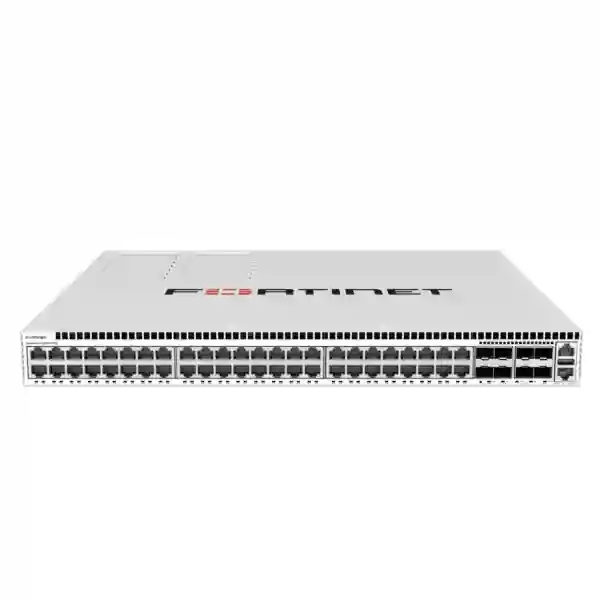
Build a high-density campus access layer with multi-gigabit copper, high-power PoE and 25GbE fiber uplinks. The FortiSwitch FS-648F-FPOE combines 32 × 2.5GbE RJ45 ports, 16 × 5GbE RJ45 ports and 8 × 25GbE SFP28 interfaces with an 1800W maximum PoE output, making it a strong fit for modern wireless access points, IP surveillance, collaboration endpoints and other powered network devices.
What is the FortiSwitch FS-648F-FPOE?
FortiSwitch FS-648F-FPOE is a Layer 2/3 FortiGate switch-controller-compatible campus switch designed for high-end access deployments. Its 48 multi-gigabit copper access ports give network designers a practical way to move beyond traditional 1GbE at the edge, while eight SFP28 interfaces provide up to 25GbE per uplink. The switch supports IEEE 802.3bt PoE and a maximum PoE output limit of 1800W. Fortinet also identifies the 600F family as a high-end access platform with MACsec-capable 25GbE uplinks.
For Tanzania projects, this combination is relevant when a building or campus has dense Wi-Fi, high-resolution IP cameras, VoIP, access control, workstations and other connected systems sharing the same switching infrastructure. Rather than selecting a switch by port count alone, buyers should calculate endpoint speeds, PoE demand, uplink utilization, fiber paths, redundancy, rack power and management architecture before ordering.
32 × 2.5GbE RJ45 plus 16 × 5GbE RJ45 access interfaces for bandwidth-hungry edge devices.
High-speed fiber interfaces help reduce uplink bottlenecks between access, aggregation and core layers.
802.3bt support and a high PoE ceiling provide headroom for demanding powered endpoints when correctly engineered.
Layer 2/3 capabilities, FortiGate controller compatibility and MACsec-capable uplinks support integrated enterprise designs.
FortiSwitch FS-648F-FPOE Technical Highlights
| Copper access ports | 32 × 2.5GbE RJ45 + 16 × 5GbE RJ45 |
| Fiber/uplink interfaces | 8 × 25GbE SFP28 |
| PoE | IEEE 802.3bt; maximum 1800W PoE output limit |
| Switch role | Layer 2/3, FortiGate switch-controller compatible |
| Security/uplink feature | MACsec hardware support on the 600F high-end access platform |
| Stacking | Fortinet documentation identifies ports 49–56 for supported FortiSwitch stacking deployments; validate the intended management mode and software release before design. |
Plan the PoE budget before purchase
An 1800W maximum PoE output does not mean every project should be designed to consume the full budget continuously. Create an endpoint schedule that records the quantity, PoE class and expected maximum draw of every access point, camera, phone, sensor and other powered device. Add reasonable growth capacity and consider how redundant power, UPS capacity and rack cooling affect the overall design. This is particularly important with Wi-Fi access points and intelligent cameras that may draw more power than older endpoints.
FortiSwitch FS-648F-FPOE for Wi-Fi, CCTV and converged LANs
Modern campus networks often carry several workloads at once. Wireless access points may need multi-gigabit Ethernet to avoid constraining newer radio capacity. Surveillance networks can create sustained traffic from many cameras toward recording infrastructure. Voice endpoints depend on predictable latency and power. Building-security devices, meeting-room systems and user workstations add further demand. The FS-648F-FPOE gives architects a dense physical platform, but the final result still depends on VLAN design, uplink sizing, spanning-tree or redundancy strategy, QoS policy, addressing, security controls and documentation.
For broader infrastructure planning, review FourTeck Tanzania’s integrated IT and networking solutions. Customers building regional environments can also reference FourTeck Kenya, FourTeck Uganda, FourTeck Ghana and FourTeck Nigeria when coordinating requirements across multiple African markets.
FortiSwitch FS-648F-FPOE Tanzania
Organizations evaluating the FortiSwitch FS-648F-FPOE in Tanzania are typically planning a network where ordinary gigabit access switching no longer provides enough headroom. A head office, university campus, hospital, hotel, industrial administration building or multi-floor commercial property may need to connect high-performance wireless access points while also powering cameras, phones and operational endpoints. The 32 × 2.5GbE and 16 × 5GbE access mix is useful because it allows different edge devices to use bandwidth appropriate to their capabilities without requiring 10GbE copper on every port.
Procurement should begin with a port and power worksheet. Count the devices required on day one, then reserve ports for realistic expansion. Identify which endpoints need 2.5GbE or 5GbE, which require 802.3bt power, and which can operate at lower power classes. Map the eight 25GbE SFP28 interfaces to the intended aggregation or core architecture and confirm optics, fiber type and distances separately. A complete bill of materials may therefore include the switch, compatible transceivers, patching, rack accessories, UPS capacity and support services rather than only the appliance SKU.
Tanzania deployments also benefit from careful power and environmental planning. A high-PoE switch can represent a substantial rack load when many endpoints are powered, so UPS sizing should reflect both switch consumption and the attached PoE load. Cooling and airflow should be checked at the rack level. For multi-floor or multi-building designs, fiber distribution can separate access closets while preserving high uplink capacity. Network documentation should identify VLANs, uplinks, PoE endpoints, patch-panel positions and management addresses so later changes remain controlled.
When requesting a quotation, provide the quantity of FS-648F-FPOE units, endpoint count, PoE device types, preferred management architecture, required optics and expected support term. If this switch is part of a FortiGate-managed design, include the FortiGate model and software environment so compatibility can be checked during planning. FourTeck Tanzania can use these inputs to discuss the complete switching requirement rather than treating the switch as an isolated purchase.
FortiSwitch FS-648F-FPOE Dar es Salaam
For Dar es Salaam businesses, the FS-648F-FPOE is suited to projects where high user density, modern Wi-Fi and extensive PoE endpoints converge on the same access layer. Corporate offices, hospitality sites, education environments and commercial campuses can have dozens of access points, cameras and phones distributed across floors. The practical design question is not simply whether 48 ports are enough, but whether each wiring closet has the correct mix of port speed, PoE capacity and uplink bandwidth for the applications it serves.
A Dar es Salaam head-office refresh can use the multi-gigabit ports to prepare for wireless access points whose aggregate radio throughput can exceed a traditional 1GbE connection. The eight 25GbE SFP28 interfaces create options for high-capacity links toward aggregation or core switching. Where two access switches are used for resilience, the topology, management mode and supported redundancy features should be validated against the intended FortiSwitchOS release rather than assumed from a generic network diagram.
Power planning is especially important when the switch is intended to power a dense set of endpoints. List the maximum power requirement of each device and avoid sizing from average consumption alone. UPS runtime calculations should include the PoE load if cameras, wireless or phones must remain operational during short interruptions. Rack ventilation, cable management and labeling also matter because high-density switching quickly becomes difficult to service if patching is undocumented.
For quotation preparation in Dar es Salaam, include floor count, number of network closets, endpoint quantities, fiber backbone details and whether existing switches or FortiGate appliances will remain. These details help identify whether the FS-648F-FPOE should operate as a high-end access switch, participate in a larger campus design or be paired with other switch models for areas that do not need multi-gigabit PoE on every port.
FortiSwitch FS-648F-FPOE Mwanza
Mwanza organizations considering the FS-648F-FPOE can use it as a consolidation point for demanding IP infrastructure where a smaller access switch would create port-speed, uplink or PoE constraints. A growing campus may combine wireless coverage, surveillance, IP telephony and business data on shared structured cabling. The switch’s multi-gigabit interfaces can help protect investment in newer access points and other high-throughput endpoints while its 25GbE SFP28 interfaces provide capacity for fiber uplinks.
Before procurement, survey the existing cabling. Multi-gigabit Ethernet performance depends on cabling quality, length and installation condition, so a switch upgrade should not be expected to correct poor copper infrastructure. Where closets connect over fiber, document fiber type, connector format and distance before selecting optics. A clean design should also identify which traffic requires segmentation—for example, separating staff, guest wireless, cameras, voice and infrastructure management.
PoE engineering can simplify endpoint deployment because power and data share the Ethernet connection, but it moves electrical demand into the network rack. The FS-648F-FPOE’s high maximum PoE output is useful only when the upstream electrical supply, UPS and cooling are designed accordingly. For sites with phased growth, reserve both PoE capacity and switch ports for planned expansion rather than consuming every resource during the initial installation.
A Mwanza quotation request should therefore describe the existing network, device list, target uplink speed, expected growth and any requirement for centralized Fortinet management. Including this information allows the project team to check transceivers, support, power and integration requirements alongside the switch itself.
FortiSwitch FS-648F-FPOE Arusha
In Arusha, the FortiSwitch FS-648F-FPOE can fit hospitality, institutional and enterprise environments where reliable wired and wireless access is a shared operational requirement. Hotels and conference properties, for example, may combine guest Wi-Fi, back-office connectivity, IP cameras, phones, access-control components and meeting technology. A high-density multi-gigabit PoE switch can reduce the need for separate power infrastructure at endpoints while supporting higher-speed wireless uplinks.
The design should still separate business functions logically. Guest networks should not automatically share unrestricted access with administrative systems. Camera traffic may need dedicated VLANs and predictable paths to recording servers. Voice traffic can require QoS treatment. Management interfaces should be protected from ordinary user access. These are architectural decisions, not features that appear automatically because a particular switch model is installed.
For multi-building properties, the eight 25GbE SFP28 interfaces can be considered for high-speed fiber links, subject to compatible optics and the topology. Fiber planning should account for distance, available strands, redundancy and termination. Inside each building, copper cabling should be tested if multi-gigabit operation is expected. Where not every closet needs the capacity of an FS-648F-FPOE, a mixed FortiSwitch design may be more economical, with the 600F platform placed where its density and uplinks deliver clear value.
Arusha buyers should request a line-item quotation that distinguishes switching hardware, optics, support, cabling and installation requirements. This makes comparisons more meaningful and reduces the risk of discovering missing transceivers, power components or rack dependencies after the core hardware has been ordered.
FortiSwitch FS-648F-FPOE Dodoma
Dodoma deployments can benefit from the FS-648F-FPOE when a government, institutional, education or corporate network requires dense PoE and multi-gigabit access in a structured campus design. The switch is particularly relevant where access points and other edge devices need more than 1GbE while the distribution layer requires substantially faster uplinks. Its 25GbE SFP28 interfaces give architects room to design a high-capacity path toward the core rather than aggregating many edge devices behind a narrow uplink.
A procurement specification should identify the expected management model, security segmentation and redundancy requirements. Fortinet documentation supports several deployment approaches across the FortiSwitch family, but feature availability can depend on software version and mode. Validate the proposed architecture before purchase, especially when stacking, MCLAG or centralized management is part of the design.
Operational planning should include spares strategy, configuration backup, firmware governance and documentation. A campus switch may serve many critical endpoints, so replacement planning and maintenance windows matter. If PoE devices include surveillance and access-control equipment, consider which services must remain powered during an outage and size UPS capacity accordingly. The electrical design should not assume that a high switch PoE rating creates power capacity by itself.
For Dodoma quotations, include quantities, intended port utilization, device PoE classes, fiber requirements and existing Fortinet equipment. A clear bill of materials makes it easier to evaluate total deployment cost and avoids comparing an appliance-only price with a complete project quote.
FortiSwitch FS-648F-FPOE UAE
UAE buyers evaluating the FS-648F-FPOE often have dense enterprise, hospitality, education or multi-tenant environments where Wi-Fi capacity and powered endpoints are growing faster than legacy access switching. The 48 multi-gigabit RJ45 interfaces allow a design to accommodate 2.5GbE and 5GbE edge requirements, while eight 25GbE SFP28 interfaces can support high-bandwidth aggregation. This makes the model relevant for campus refreshes that need stronger edge-to-core capacity without moving every copper endpoint to 10GbE.
Project teams should distinguish the switch hardware from the full solution. Optics, patch leads, structured cabling, rack power, UPS, support and configuration can all be separate items. If the switch will be integrated with FortiGate, document the firewall model and software version. If it will be deployed in another management mode, confirm licensing and support requirements before ordering.
High PoE capacity can be valuable for Wi-Fi and security systems, but UAE projects should calculate actual endpoint power rather than relying on the headline 1800W maximum. Dense racks may also need careful cooling and electrical distribution. When multiple switches are installed, uplink and redundancy design should prevent a single aggregation path from becoming a bottleneck or single point of failure.
For regional procurement, prepare a standardized bill of materials that identifies exact switch SKUs, optics and support terms. This is particularly useful when the same campus standard will be repeated across UAE and African offices, because it creates consistent documentation while still allowing site-specific cabling, power and quantity changes.
FortiSwitch FS-648F-FPOE Uganda
Uganda enterprises can consider the FS-648F-FPOE for high-density LAN projects that combine wireless, security and business endpoints. The multi-gigabit copper ports are useful when new access points or specialist devices exceed gigabit requirements, while the 25GbE SFP28 uplinks can connect access switching to a faster aggregation layer. This helps avoid designing a modern edge around an undersized backbone.
For multi-site organizations, standardization is valuable. Define a repeatable template for VLANs, device naming, uplinks, management, PoE reservation and monitoring. However, do not assume every branch needs the same switch. A headquarters or campus may justify an FS-648F-FPOE while smaller branches use lower-density models. Matching hardware to actual requirements can reduce cost and simplify support.
Uganda procurement teams should include optics and support in the evaluation and should confirm whether the intended FortiSwitchOS features align with the selected management mode. Power continuity also deserves attention: if the switch powers critical Wi-Fi, cameras or phones, the UPS design should account for the PoE load, not only the base switch consumption.
A useful quotation request includes device counts, floor or building layout, existing fiber, desired uplink speed and the FortiGate environment if applicable. FourTeck’s Uganda and Tanzania teams can use a common architecture brief for regional projects while keeping site-specific installation assumptions separate.
FortiSwitch FS-648F-FPOE Kampala
Kampala offices and campuses with expanding Wi-Fi and surveillance systems may reach the point where 1GbE access and 10GbE uplinks constrain growth. The FS-648F-FPOE addresses that class of requirement with multi-gigabit access and eight 25GbE SFP28 interfaces. The design can support dense floors while leaving uplink headroom for aggregated traffic.
A campus refresh should begin with traffic measurement and endpoint inventory. Identify which devices actually benefit from 2.5GbE or 5GbE, then map PoE classes and switch-port requirements. For wireless projects, consider both current access points and likely future upgrades. For CCTV, calculate sustained recording traffic and avoid routing unnecessary video streams across constrained links.
Kampala projects should also evaluate rack readiness. High PoE utilization increases electrical and thermal load, and the switch should be installed with appropriate airflow, UPS and cable management. Fiber uplinks require compatible transceivers selected for the installed fiber and distance. These supporting items should appear in the bill of materials instead of being treated as afterthoughts.
When requesting pricing, specify whether the need is hardware supply only or a complete deployment including configuration, fiber, rack work and testing. This distinction makes the commercial response easier to compare and reduces ambiguity about responsibilities.
FortiSwitch FS-648F-FPOE Arua
For Arua organizations, an FS-648F-FPOE deployment should be justified by endpoint density, bandwidth and PoE requirements rather than by model size alone. A regional facility with many cameras, access points, phones and business devices may benefit from consolidating those endpoints on a high-capacity access platform. Smaller sites may instead use a lower-density switch and connect back to a central architecture.
Where the FS-648F-FPOE is appropriate, plan the copper and fiber infrastructure at the same time. Multi-gigabit access depends on suitable cabling, and 25GbE uplinks depend on compatible optics and fiber. A pre-installation survey can identify cable limitations, rack space, power availability and environmental constraints before equipment arrives.
PoE also changes resilience planning. If cameras or wireless access points rely on switch power, an outage at the rack affects many services simultaneously. UPS capacity, electrical protection and recovery procedures should therefore be part of the design. Document port assignments and VLANs so troubleshooting can be performed methodically.
Arua procurement requests should include quantities, endpoint lists, fiber distances and the desired support scope. This information helps determine whether the FS-648F-FPOE is the correct platform and what accessories are needed for a complete deployment.
FortiSwitch FS-648F-FPOE Mbarara
Mbarara businesses and institutions planning a high-capacity LAN can use the FS-648F-FPOE where multi-gigabit edge connectivity and substantial PoE are both required. Typical drivers include wireless modernization, expanding IP surveillance and consolidation of multiple building systems onto managed Ethernet infrastructure.
The switch should be sized as part of the complete topology. Count access ports, reserve capacity for growth and determine how many 25GbE uplinks are required. Consider whether uplinks serve a core switch, aggregation pair or other design. If resilience is required, validate the supported topology and software features before procurement.
Power calculations should include the maximum expected draw of connected devices and realistic growth. A high PoE ceiling is useful, but it also places responsibility on rack power, UPS and cooling. For surveillance-heavy sites, maintaining PoE during short interruptions may be operationally important, which can materially change UPS sizing.
For Mbarara quotations, provide the endpoint schedule and existing infrastructure details. This makes it possible to include appropriate optics, cabling and support and to avoid purchasing a powerful switch without the surrounding components needed to use its capabilities.
FortiSwitch FS-648F-FPOE Gulu
Gulu organizations evaluating the FS-648F-FPOE should focus on whether their network needs dense multi-gigabit access, high-power PoE and fast fiber uplinks in one platform. Education, healthcare, hospitality and enterprise environments can all create this combination as wireless and IP-connected systems expand.
A good design maps endpoints to ports before installation. Separate staff, guest, voice, camera and management traffic according to security and operational requirements. Plan uplinks based on aggregate traffic rather than individual port speeds. Eight 25GbE SFP28 interfaces provide substantial flexibility, but the core and fiber infrastructure must be able to receive those links.
Physical infrastructure matters equally. Verify copper cabling for multi-gigabit operation, select optics for the actual fiber type and distance, and ensure the rack has appropriate power and cooling. If PoE endpoints are business-critical, calculate UPS runtime with their load included.
A Gulu project brief should state quantities, applications, connected device types and management expectations. This allows the quotation to cover the full switching solution and makes it easier to compare alternatives based on fit rather than headline port count.
FortiSwitch FS-648F-FPOE Kenya
Kenya campus and enterprise networks can use the FS-648F-FPOE where high-density wireless and PoE endpoints demand more than conventional gigabit switching. The model’s 2.5GbE and 5GbE access ports are particularly relevant to modern access points, while 25GbE uplinks can support aggregation designs with greater headroom.
For organizations operating across Nairobi and other Kenyan locations, standardizing on a small set of switch roles can simplify operations. The FS-648F-FPOE can serve as a high-end access option, while smaller models can cover branches with lighter requirements. A standard should include approved software versions, VLAN templates, optics, naming conventions and support procedures.
Procurement teams should distinguish appliance cost from deployment cost. Optics, cabling, rack power, UPS, support and engineering may all be necessary. If the switch will be managed through FortiGate, include the firewall environment in the design review. If advanced redundancy is required, confirm the exact supported topology for the software release.
A Kenya quotation request should include site count, switch quantities, expected PoE load and uplink requirements. Regional projects can then maintain common standards while adapting the bill of materials to each building.
FortiSwitch FS-648F-FPOE Kuwait
Kuwait enterprises considering the FS-648F-FPOE can use its multi-gigabit access ports for dense wireless and converged IP environments while using 25GbE SFP28 links for high-capacity aggregation. This is useful in large offices, hospitality properties, education campuses and other facilities where many powered endpoints share the LAN.
Thermal and rack planning should be treated as part of the network design. High PoE utilization can create significant power demand, so electrical distribution, UPS capacity and cooling must be assessed together. The 1800W PoE maximum provides capability, but actual design should be based on the connected device schedule.
For fiber, confirm transceiver compatibility, fiber type and distance. For copper, confirm cabling suitability for the intended multi-gigabit rates. If the switch is replacing older access equipment, a cable audit can identify whether the physical layer will prevent endpoints from achieving their expected speeds.
Kuwait buyers should request support and optics as explicit line items and provide details of any FortiGate integration. This produces a more accurate project quotation than requesting the switch SKU alone.
FortiSwitch FS-648F-FPOE Ghana
Ghana organizations planning campus upgrades can consider the FS-648F-FPOE when Wi-Fi, cameras and other powered systems need both higher edge speeds and a larger PoE budget. The 48 multi-gigabit access ports and eight 25GbE uplinks provide a platform for dense floors and high-capacity aggregation.
The switch should be deployed within a documented architecture. Define VLANs, IP addressing, uplinks, management access and endpoint roles before installation. For wireless, confirm which access points need 2.5GbE or 5GbE. For surveillance, calculate aggregate video traffic and storage paths. For phones and building systems, document PoE classes and resilience requirements.
Ghana projects should also evaluate rack power and UPS capacity. If a switch powers many endpoints, its outage affects a broad area, so power protection can be as important as switching redundancy. Optics and fiber should be selected from actual distances and installed cable type.
A complete Ghana quotation should include the FS-648F-FPOE quantity, optics, support term and installation scope. This allows buyers to evaluate the real deployment rather than an incomplete hardware-only figure.
FortiSwitch FS-648F-FPOE Nigeria
Nigeria enterprises with large campuses, dense office floors or high-capacity wireless deployments can use the FS-648F-FPOE as a high-end access platform. Its combination of 2.5GbE and 5GbE copper interfaces is designed for endpoints that need more than traditional gigabit Ethernet, while 25GbE SFP28 uplinks provide faster paths toward aggregation and core infrastructure.
For multi-branch organizations, place the switch where its capabilities are justified. A major headquarters may need dense multi-gigabit PoE, while smaller branches may be better served by lower-density models. Standardize configuration and management practices even when hardware varies by site.
Power design deserves detailed attention because the switch can support a substantial PoE load. Inventory endpoints, calculate maximum demand and include growth. Ensure UPS and electrical capacity are sized for the required runtime. In high-density racks, verify airflow and cooling as well.
Nigeria quotation requests should specify site, quantity, endpoint profile, optics and support. If FortiGate integration is planned, include the firewall model and target management design so compatibility can be checked before the bill of materials is finalized.
FortiSwitch FS-648F-FPOE Seychelles
Seychelles hospitality, commercial and institutional networks can consider the FS-648F-FPOE where a property requires high-density Wi-Fi, surveillance and other PoE-connected systems. Multi-gigabit access is useful for newer wireless access points, while the 25GbE SFP28 interfaces can provide high-speed fiber connections between access and aggregation layers.
For resort or multi-building environments, topology planning is especially important. Fiber can connect separate buildings or communications rooms, but transceivers must match distance and fiber type. Network segmentation can separate guest services, administration, cameras, voice and infrastructure management. This improves control and makes troubleshooting clearer.
PoE planning should account for the number and class of access points, cameras and other powered devices. Because these endpoints may be distributed across a property, the switch and UPS become shared dependencies. Document which services require backup power and size runtime accordingly.
A Seychelles quotation should include exact quantities, fiber distances, endpoint schedules and support requirements. This allows the switch, optics, cabling and power dependencies to be reviewed together before procurement.
Selection and deployment guidance
Choose the FS-648F-FPOE when the project genuinely needs its combination of port density, multi-gigabit access, 25GbE uplinks and high PoE capacity. If most endpoints are 1GbE and low-power, a smaller FortiSwitch may be more appropriate. If the project needs even faster core interfaces, evaluate the broader FortiSwitch portfolio rather than forcing an access model into a core role.
Before ordering, validate FortiSwitchOS compatibility, intended FortiGate integration, optics, rack power, UPS, cooling, cabling and support. Fortinet documentation also notes specific requirements and limitations for stacking, including homogeneous nodes and restrictions depending on deployment mode, so stacking should be designed from the current documentation rather than assumed.
Quotation checklist
FortiSwitch FS-648F-FPOE FAQs
How many copper ports does the FS-648F-FPOE have?
It has 48 multi-gigabit RJ45 access ports: 32 × 2.5GbE and 16 × 5GbE.
What uplinks are available?
The model provides eight 25GbE SFP28 interfaces. Optics should be selected separately for the intended fiber type and distance.
Does the FS-648F-FPOE support PoE++?
Yes. Fortinet lists 802.3bt PoE support with a maximum 1800W PoE output limit.
Can it be managed with FortiGate?
Fortinet describes the FS-648F-FPOE as FortiGate switch-controller compatible. Confirm the FortiGate model, FortiOS/FortiSwitchOS versions and intended topology for the project.
Is it suitable for Wi-Fi access points?
It can be a strong fit for dense modern wireless deployments because it combines multi-gigabit copper and high PoE capacity. The final choice should be based on access-point Ethernet speed, PoE class, quantity and uplink design.
What should I send for a Tanzania quotation?
Send the exact model, quantity, endpoint count, PoE requirements, fiber distances, optics requirements, existing FortiGate details and whether you need supply only or installation and configuration.
Decision recap
The FortiSwitch FS-648F-FPOE is best evaluated as a high-end secure campus access switch rather than a generic 48-port PoE switch. Its value comes from the combination of multi-gigabit access, eight 25GbE uplinks, 802.3bt PoE capacity and integration options within the Fortinet ecosystem. For a successful deployment, validate cabling, optics, management, power, UPS, cooling and support before finalizing the order.
Talk to FourTeck Tanzania
For a project-specific quotation, share your switch quantity, connected devices, PoE requirements and network topology. FourTeck can help turn the model request into a complete bill of materials for the intended environment.



Reviews
There are no reviews yet.