
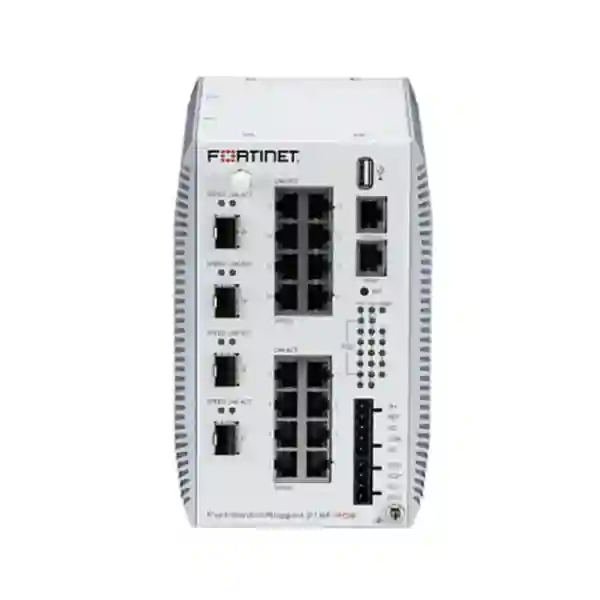
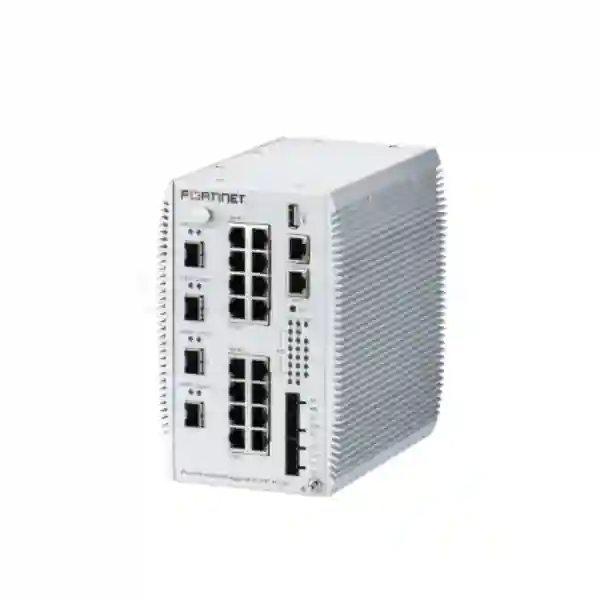
FortiSwitch FSR-216F-POE Tanzania
FortiSwitch FSR-216F-POE is a ruggedized Layer 2/3 PoE Ethernet switch for organizations that need dependable network access at operational edges where conventional office switching may not be the right fit. Fortinet specifies sixteen 10M/100M/1GbE RJ45 interfaces, four 1/10GbE SFP/SFP+ interfaces, sixteen 802.3af/at/bt PoE-capable ports, a maximum 360W PoE budget, 112Gbps switching capacity and 166Mpps packet forwarding. Its FortiGate switch-controller compatibility helps organizations align rugged access switching with a broader Fortinet-managed network architecture.
Verified FSR-216F-POE capabilities
The FSR-216F-POE is part of Fortinet’s FortiSwitch Rugged family and is specified with an IP40 rating. This makes the model relevant when network access must extend beyond conventional carpeted office spaces into operational and infrastructure-oriented deployments.
Sixteen copper ports support PoE, with Fortinet specifying 802.3af/at/bt capability and a maximum total PoE budget of 360W. This can simplify cabling for compatible powered devices such as wireless access points, cameras and IP communications endpoints.
Four 1G/10G SFP/SFP+ interfaces provide flexible fiber or compatible transceiver-based uplink choices. They are especially useful when the rugged switch must aggregate edge devices and connect back to distribution or core infrastructure over longer distances.
Technical specification overview
| Network interfaces | 16 × 10M/100M/1G RJ45; 4 × 1G/10G SFP/SFP+ |
| PoE ports | 16, supporting 802.3af/at/bt up to 90W per supported port profile |
| Total PoE budget | Maximum 360W under specified operating conditions |
| Switching capacity | 112Gbps duplex |
| Packet rate | 166Mpps duplex |
| MAC addresses | 16,000 |
Deployment and PoE planning
A successful rugged-switch deployment starts with more than a port count. Buyers should map every connected endpoint, expected PoE class, cable path, uplink medium, redundancy requirement and environmental condition. Fortinet’s quick-start guidance for the FSR-216F-POE specifies DC input requirements and notes that the available PoE budget varies with operating temperature: the documented maximum is 360W from -40°C to 60°C and 240W from -40°C to 75°C. The same guide recommends professional electrical installation and describes optional dual DC input failover. These details matter when the switch will power multiple high-draw devices.
Fortinet also advises using the SFP interfaces for switch interconnection rather than interconnecting FSR-216F-POE units or other power-sourcing equipment through the PoE ports. Before procurement, confirm transceiver requirements, fiber type, endpoint power requirements and the intended FortiSwitchOS/FortiOS management design. For broader Fortinet planning, visit FourTeck Tanzania, explore the regional technology portfolio at FourTeck Africa, and review regional resources through FourTeck Kenya, FourTeck Uganda, and FourTeck UAE.
FortiSwitch FSR-216F-POE Tanzania
For Tanzania projects, the FSR-216F-POE is relevant to organizations extending Ethernet and PoE connectivity into utility facilities, manufacturing areas, transportation infrastructure, outdoor-adjacent cabinets, security networks and other operational environments. Procurement teams should begin with the endpoint schedule: count cameras, access points, IP phones, sensors, controllers and other Ethernet devices, then record which devices require PoE and their maximum power draw. The 16 copper access interfaces make the switch straightforward to size for a defined edge zone, while four 10GbE-capable SFP+ uplinks provide options for aggregation and resilient upstream design. A project should also document DC power arrangements, grounding, cabinet conditions, fiber distances and transceiver selection before ordering.
Where FortiGate is already part of the network, FortiGate switch-controller compatibility can be an important architectural consideration. It can allow switching to be planned as part of a Fortinet-oriented access design rather than as an isolated unmanaged edge. Buyers should still verify software compatibility for the exact intended feature set and release. For quotation preparation, provide the required quantity, endpoint list, PoE loads, uplink speeds, fiber type and whether optics, patching, cabinets or related Fortinet components are needed. This produces a more useful bill of materials than requesting the switch alone.
FortiSwitch FSR-216F-POE Dar es Salaam
Dar es Salaam buyers may evaluate the FSR-216F-POE for industrial sites, logistics facilities, commercial infrastructure, surveillance aggregation and distributed enterprise edge networks. In dense operational environments, uplink planning is often as important as access capacity. The four SFP/SFP+ ports can support a design in which copper PoE endpoints terminate locally while fiber carries aggregated traffic toward a protected network room or distribution layer. This separation can be valuable when access devices are physically distant from the core network or when electromagnetic and pathway considerations favor fiber.
A quotation request should identify the expected number of powered endpoints and distinguish ordinary PoE devices from endpoints with higher power requirements. The total 360W maximum budget must be treated as a shared resource, and environmental conditions can affect the documented budget. Installation planning should therefore account for worst-case endpoint consumption rather than only typical draw. Organizations integrating surveillance and wireless infrastructure should also plan VLANs, uplink resilience, monitoring and maintenance access before deployment. FourTeck can use these requirements to structure a product discussion without assuming stock, delivery dates or a particular support arrangement until those points are confirmed in the quotation process.
FortiSwitch FSR-216F-POE Mwanza
In Mwanza, a rugged PoE switch can be considered where network endpoints sit in operational spaces rather than standard office conditions. The FSR-216F-POE combines sixteen Gigabit copper access ports with four 10GbE-capable SFP+ interfaces, allowing a local edge segment to consolidate endpoint traffic before forwarding it over higher-speed uplinks. This layout can suit video surveillance, wireless access and operational connectivity projects where the access layer needs a compact but capable aggregation point.
Procurement should include a cable and power survey. Confirm copper run lengths, fiber routes, connector and transceiver requirements, DC supply design and the maximum expected PoE draw. If redundancy is required, document it explicitly rather than assuming that adding a second power feed automatically satisfies the overall availability objective. Network availability also depends on upstream topology, fiber paths, endpoint design and configuration. Buyers should provide the current FortiGate model and software environment when centralized Fortinet management is part of the requirement, enabling compatibility and deployment choices to be checked before the bill of materials is finalized.
FortiSwitch FSR-216F-POE Arusha
Arusha organizations planning secure connectivity for campuses, hospitality infrastructure, industrial facilities or distributed security systems can assess the FSR-216F-POE where ruggedized edge switching is appropriate. Its sixteen PoE access ports can reduce separate power cabling for compatible endpoints, while the four SFP/SFP+ interfaces provide flexible upstream connectivity. The strongest fit is not determined by location alone; it depends on environmental conditions, power architecture, endpoint count, traffic profile and integration requirements.
For a practical purchase specification, list each endpoint and its required network speed and PoE class, then reserve capacity for expected additions. Identify whether uplinks need 1GbE or 10GbE operation and specify the fiber medium and distance. If the project includes FortiGate-controlled switching, include the planned software versions so supported features can be validated. This disciplined approach helps avoid two common design problems: insufficient PoE budget and incomplete uplink accessories. A complete quotation request should therefore cover the switch, compatible power arrangements, required optics, fiber patching and any implementation or configuration scope that the customer wants separately assessed.
FortiSwitch FSR-216F-POE Dodoma
For Dodoma deployments, the FSR-216F-POE can support rugged access-layer designs for institutional, infrastructure, security and operational networks. Sixteen Gigabit RJ45 ports provide endpoint connectivity and PoE, while the SFP+ uplinks allow the edge switch to connect into a higher-speed backbone. This can be particularly useful where the switch sits near field endpoints but upstream network equipment is located in a more controlled communications area.
Selection should be based on a documented engineering requirement. Buyers should confirm the required temperature range, enclosure design, DC power source, grounding, PoE consumption and uplink topology. The switch’s IP40 classification is a verified product characteristic, but it should not be interpreted as a substitute for an appropriately designed enclosure where site conditions demand additional protection. For government, education, enterprise or infrastructure procurement, it is also useful to include desired configuration standards, VLAN requirements, monitoring expectations and acceptance criteria. That makes the request more precise and helps separate hardware supply from optional design, installation or support services.
FortiSwitch FSR-216F-POE UAE
UAE projects can consider the FSR-216F-POE for industrial and infrastructure environments requiring rugged PoE access switching. The combination of sixteen Gigabit PoE ports and four 10GbE-capable uplinks supports designs in which cameras, wireless access points, communications devices and operational endpoints connect locally while traffic is aggregated upstream over fiber. Temperature and power engineering remain essential: Fortinet documents different maximum PoE budgets across operating-temperature ranges, so the project specification should be based on the actual installation environment rather than only the headline maximum.
A UAE quotation should state the intended application, quantity, endpoint power profile, fiber requirements, transceiver types and FortiGate integration needs. Where projects span multiple facilities, standardizing the access design can simplify documentation, but each site’s power and environmental conditions should still be assessed independently. Regional Fortinet-related resources are available through FourTeck Fortinet UAE for customers comparing broader Fortinet security and networking requirements.
FortiSwitch FSR-216F-POE Uganda
Uganda buyers can evaluate the FSR-216F-POE for rugged edge networks that need integrated data and power delivery. The model’s sixteen PoE interfaces allow compatible endpoints to receive network connectivity and power over the same Ethernet cable, reducing the need for local endpoint power adapters. Four SFP/SFP+ ports create a flexible path to distribution switching or protected network rooms, including designs where fiber is preferred for distance or electrical isolation considerations.
Before procurement, prepare a port schedule and PoE worksheet. Include endpoint model, expected wattage, VLAN, cable path and whether the device is business-critical. This allows power priorities and capacity to be planned deliberately. If the deployment is managed through FortiGate, confirm the FortiGate platform and intended software versions. Customers can also review FourTeck Uganda when coordinating broader regional requirements.
FortiSwitch FSR-216F-POE Kampala
Kampala deployments may involve enterprise campuses, security systems, logistics sites or operational facilities where the access switch must serve devices outside a conventional office rack. The FSR-216F-POE offers a useful balance between endpoint density and uplink capacity: sixteen Gigabit copper PoE ports serve local devices, while four SFP+ ports can provide 10GbE upstream connections. For surveillance-heavy networks, designers should calculate both PoE draw and aggregate traffic, especially when multiple high-resolution cameras share an uplink.
The purchasing process should identify whether optics and fiber accessories are part of the required supply. SFP/SFP+ interfaces do not remove the need to select compatible transceivers for the intended fiber type and distance. Similarly, the switch’s PoE capability should be matched against each endpoint’s standard and power demand. A well-prepared Kampala request should include the existing firewall and switching architecture, desired management model, rack or cabinet constraints and any redundancy objectives.
FortiSwitch FSR-216F-POE Arua
For Arua projects, the FSR-216F-POE can be assessed as a rugged access switch where distributed endpoints need reliable Ethernet and PoE connectivity. Rather than selecting solely by the number of ports, customers should define the complete edge zone: connected devices, expected bandwidth, PoE load, fiber uplink route, DC power source and environmental conditions. This is especially important for remote or operational sites where later hardware changes can be more disruptive than they would be in an office.
The four 1/10GbE SFP/SFP+ interfaces can support fiber-based backhaul and network resiliency designs, subject to the chosen topology and configuration. For maintainability, document port naming, VLAN assignments, endpoint priorities and spare capacity before installation. Where centralized Fortinet management is planned, software compatibility should be validated for the required features. A quotation request that includes these details helps ensure that the proposed bill of materials accounts for optics, cabling and power components rather than treating the switch as an isolated item.
FortiSwitch FSR-216F-POE Mbarara
Mbarara organizations can consider the FSR-216F-POE for industrial, campus, surveillance and infrastructure access networks where rugged construction and PoE are useful. Its sixteen Gigabit RJ45 interfaces can consolidate powered edge devices, and the four SFP+ interfaces offer higher-speed uplink options. The architecture is particularly relevant when an edge cabinet needs to serve multiple nearby endpoints while forwarding traffic over fiber to a central network location.
Power planning should use the endpoint manufacturers’ maximum consumption figures and leave sensible design margin. Fortinet documents a maximum 360W total PoE budget under specified temperature conditions, not an unlimited 90W allocation on every port simultaneously. The installation design should also account for DC input, grounding and cabinet protection. Buyers who expect FortiGate-managed operation should provide the existing Fortinet environment during quotation so that management and software considerations can be reviewed alongside the physical bill of materials.
FortiSwitch FSR-216F-POE Gulu
Gulu network projects may require edge connectivity for surveillance, wireless coverage, institutional facilities or operational technology. The FSR-216F-POE provides sixteen PoE-capable copper ports for endpoints and four SFP/SFP+ ports for uplinks, creating a compact architecture for combining local access with fiber backhaul. The rugged model is best evaluated where its environmental design and DC-powered deployment characteristics align with the intended site.
Procurement teams should avoid specifying only a model number. A complete request should include the number and type of powered endpoints, expected PoE load, uplink speed, fiber distance, transceiver requirement and desired management approach. Where uptime is important, include power-feed redundancy and upstream path requirements as explicit design objectives. This gives the supplier or integrator enough information to discuss a complete solution and prevents assumptions about accessories, configuration or support scope.
FortiSwitch FSR-216F-POE Kenya
Kenya customers can assess the FSR-216F-POE for ruggedized network access in industrial facilities, transport environments, utilities, security deployments and distributed enterprise infrastructure. Sixteen Gigabit PoE ports provide a practical endpoint layer, while four 10GbE-capable SFP+ interfaces can connect the switch to aggregation infrastructure. When planning camera or wireless deployments, both traffic and power should be calculated: an endpoint may fit within the port count while the combined PoE draw or uplink demand requires additional design attention.
For procurement, document the physical environment, DC supply, endpoint list, optics and fiber type. If the switch will be controlled through FortiGate, specify the management architecture and software baseline. Regional buyers can use FourTeck Kenya to coordinate related requirements while keeping the exact hardware specification tied to Fortinet’s published data.
FortiSwitch FSR-216F-POE Kuwait
Kuwait projects considering rugged access switching should pay close attention to installation temperature and PoE loading. Fortinet’s published quick-start guidance explicitly associates the FSR-216F-POE’s maximum PoE budget with temperature ranges, making environmental engineering a procurement issue rather than a post-purchase detail. The switch provides sixteen Gigabit PoE ports and four 1/10GbE SFP/SFP+ interfaces, enabling local powered-device connectivity with flexible fiber uplinks.
Customers should provide expected ambient conditions, cabinet design, endpoint power requirements, fiber distance and redundancy objectives when requesting a quotation. This allows the proposed solution to be checked against the real site instead of a generic office assumption. For regional coordination, FourTeck Kuwait can be used as a related FourTeck resource.
FortiSwitch FSR-216F-POE Ghana
Ghana deployments can use the FSR-216F-POE as a candidate for rugged PoE access where cameras, access points, communications devices or operational endpoints need to connect near the field edge. The sixteen copper interfaces provide Gigabit access and PoE, while four SFP/SFP+ interfaces allow higher-speed aggregation and fiber backhaul. This combination can reduce the number of separate devices required in an edge cabinet, provided the site power and environmental design are suitable.
A useful quotation brief should include the full endpoint inventory and identify any devices requiring high-power PoE. It should also specify whether the uplinks are single-mode or multimode fiber, expected distance and desired speed. Buyers can consult FourTeck Ghana for related regional technology requirements while validating final product specifications against current Fortinet documentation.
FortiSwitch FSR-216F-POE Nigeria
Nigeria organizations planning industrial networking, surveillance aggregation or resilient edge connectivity can consider the FSR-216F-POE where rugged switching and PoE are required together. Its sixteen Gigabit RJ45 ports can power compatible devices, and four SFP+ uplinks can support high-capacity connections to the wider network. A design should reserve sufficient PoE and uplink capacity for future additions rather than consuming all available resources on day one.
Site engineering should cover DC power, grounding, cabinet conditions, fiber routes and endpoint priorities. The FortiSwitch Rugged platform can also fit Fortinet-oriented network architectures through FortiGate switch-controller compatibility, but exact software and feature compatibility should be checked for the intended release. Related regional information is available at FourTeck Nigeria.
FortiSwitch FSR-216F-POE Seychelles
Seychelles projects may involve distributed facilities where fiber backhaul, PoE endpoints and compact rugged switching are useful. The FSR-216F-POE’s sixteen Gigabit PoE access ports can serve cameras, wireless access points and other compatible devices, while four SFP/SFP+ interfaces offer 1GbE or 10GbE uplink choices. Because environmental exposure varies greatly by installation, the IP40 product rating should be considered together with the actual enclosure, moisture protection, thermal management and electrical design required at the site.
Procurement should specify endpoint quantities, PoE draw, uplink media, transceiver requirements and the intended management platform. For multi-site deployments, create a standard port and VLAN template but validate power and environmental conditions per location. This approach supports consistency without assuming every site has identical physical constraints.
Selection and quotation checklist
Before requesting pricing, confirm the number of switches, number of connected devices, PoE standards and maximum wattage for each endpoint, required spare ports, expected uplink bandwidth, fiber type and distance, required SFP/SFP+ transceivers, DC power architecture, operating environment, FortiGate management requirements and any installation or configuration scope. Include existing network models and software versions when interoperability is important. This information allows the quotation to address the actual deployment rather than only the base switch.
FortiSwitch FSR-216F-POE FAQs
How many PoE ports does the FSR-216F-POE provide?
Fortinet specifies sixteen 10M/100M/1GbE RJ45 PoE ports supporting 802.3af/at/bt, with a maximum total PoE budget of 360W under the documented operating conditions.
Does it have 10GbE uplinks?
Yes. Fortinet specifies four 1G/10G SFP/SFP+ interfaces. Appropriate compatible transceivers and fiber should be selected for the required link type and distance.
Can the switch be managed with FortiGate?
Fortinet describes the FSR-216F-POE as FortiGate switch-controller compatible. The exact FortiOS and FortiSwitchOS release and desired features should be checked during deployment planning.
Is 360W PoE available at every temperature?
No. Fortinet’s quick-start guide documents up to 360W from -40°C to 60°C and up to 240W from -40°C to 75°C. Site temperature and endpoint loading should therefore be included in the power design.
Decision recap
Choose the FSR-216F-POE when the requirement calls for a Fortinet rugged Layer 2/3 access switch with sixteen Gigabit PoE ports, 10GbE-capable fiber uplinks and a substantial shared PoE budget. Validate the environmental, DC power, PoE and software-management requirements before purchase. For the most useful quotation, submit the endpoint schedule and uplink design together with the model request.
Discuss your FortiSwitch requirement
Share the project location, quantity, connected devices, PoE demand, fiber distances and Fortinet management requirements. FourTeck can use those details to prepare a more precise product and solution discussion for your Tanzania or multi-region deployment.



Reviews
There are no reviews yet.