
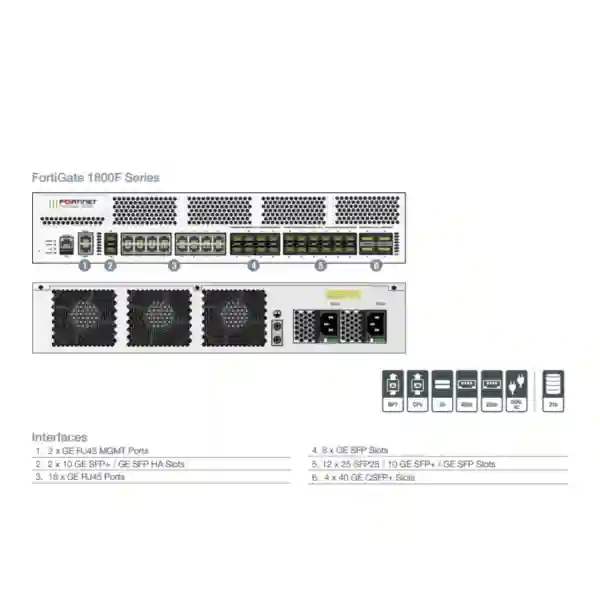
FortiGate 1800F Series Tanzania
FortiGate 1800F Series is a 2RU high-performance next-generation firewall family designed for large enterprise edges, data centers, internal segmentation, secure SD-WAN, VPN aggregation and hybrid infrastructure. Fortinet’s current datasheet lists up to 22 Gbps IPS throughput, 17 Gbps NGFW throughput and 15 Gbps threat-protection throughput, alongside high-speed 25/10GbE and 100/40GbE interfaces. For Tanzania organisations, the practical purchasing decision is not simply whether the appliance has a large headline firewall figure; it is whether the selected model, FortiGuard services, optics, inspection profile, HA architecture and support term match the real production workload.
FortiGate 1800F Series Overview
The FortiGate 1800F Series combines FortiOS security and networking functions with Fortinet purpose-built NP7 and CP9 processors. Fortinet positions the platform for high-performance security-driven networking across enterprise and hybrid IT environments. The series supports next-generation firewall inspection, segmentation, secure SD-WAN, IPsec VPN, SSL inspection, application control and FortiGuard security services. This makes it relevant when a network team wants a consolidated enforcement point rather than separate appliances for routing, firewalling, WAN policy and multiple inspection functions.
IPS throughput under Fortinet’s enterprise traffic mix test methodology.
NGFW throughput with firewall, IPS and application control enabled.
Threat-protection throughput with firewall, IPS, application control and malware protection enabled.
IPsec VPN throughput using Fortinet’s published AES256-SHA256 test.
Verified Hardware and Capacity Highlights
Both FG-1800F and FG-1801F variants provide sixteen hardware-accelerated GE RJ45 ports, eight hardware-accelerated GE SFP slots, twelve hardware-accelerated 25GE SFP28/10GE SFP+/GE SFP slots, four hardware-accelerated 100GE QSFP28/40GE QSFP+ slots, two GE RJ45 management ports and two 10GE SFP+/GE SFP HA slots. Fortinet lists 198/197/140 Gbps IPv4 firewall throughput for 1518/512/64-byte UDP packets, 210 Mpps firewall packet throughput, 12 million standard concurrent TCP sessions, 750,000 new TCP sessions per second, 11 Gbps SSL-VPN throughput, 12 Gbps SSL-inspection throughput and active-active, active-passive and clustering HA configurations. Some higher session figures require a Hyperscale Firewall license, so procurement teams should not treat every maximum as available in every license state.
The principal hardware distinction in the current datasheet is storage: FG-1800F has no onboard storage listed, while FG-1801F includes two 960 GB NVMe SSDs. That difference can matter when local storage is part of the logging or operational design. Both are rack-mount 2RU appliances and are available with AC or DC power variants. Fortinet lists redundant hot-swappable power supplies, with dual AC PSUs as the default 1+1 redundancy arrangement for AC models. Actual performance varies with configuration, traffic mix, enabled services, cipher suites and policy design, so sizing should be based on inspected production traffic rather than raw firewall throughput alone.
Security, Segmentation and Secure SD-WAN
For enterprise deployments, the value of the 1800F Series is its ability to combine high-capacity network enforcement with security services. FortiGuard services can add IPS, anti-malware, URL and DNS controls, application visibility and other protections depending on the selected service bundle. Fortinet also documents dynamic segmentation, including VXLAN-related use cases, to help organisations control east-west movement between network zones. In a data-center or campus environment, this can support designs where servers, user networks, management systems, guest services, OT zones or external-facing workloads require different trust policies.
Secure SD-WAN is relevant for organisations operating multiple WAN circuits, regional offices or cloud-connected environments. Instead of treating connectivity and firewall policy as separate projects, FortiOS can apply routing, path selection and security controls through a common platform. Buyers should still define link bandwidth, application priorities, SLA expectations, failover behaviour, BGP or static-routing requirements, VPN topology and inspection services before selecting the appliance and licensing package. A high-end firewall is most effective when its configuration is designed around measurable traffic and availability requirements.
FortiGate 1800F Series Tanzania
Tanzania buyers evaluating FortiGate 1800F Series are usually dealing with enterprise-scale requirements rather than a simple office internet gateway. A realistic project may include a headquarters edge, data-center perimeter, internal segmentation boundary, large campus, service-provider environment, multi-site VPN hub or high-throughput security layer between critical network zones. The first sizing step should therefore document internet and private-WAN bandwidth, expected growth, east-west traffic, SSL inspection scope, VPN demand, application-control requirements and the number of high-speed interfaces required. This avoids selecting the appliance only from the 198 Gbps raw firewall figure while overlooking the lower but more meaningful inspected-security figures.
For procurement in Tanzania, specify whether the project needs FG-1800F, FG-1801F, an AC or DC variant, an HA pair, FortiGuard subscriptions, FortiCare support and SFP/SFP28/QSFP optics. The 1801F’s local NVMe storage can be relevant to designs requiring onboard storage, while the 1800F may fit architectures where logging is sent to dedicated platforms. Organisations using FortiAnalyzer or central logging should include retention, reporting and compliance expectations in the bill of materials. Network teams should also confirm rack depth, 2RU allocation, power feeds, airflow, cooling and switch-side transceiver compatibility before ordering.
Tanzania deployments often need to connect sites with different carrier links and service characteristics. That makes secure SD-WAN, IPsec VPN and resilient routing useful design topics, but the final architecture should be based on the customer’s actual carriers and topology rather than generic assumptions. Enterprises with Dar es Salaam headquarters and regional branches, for example, may use the 1800F Series as a central security and VPN aggregation platform while selecting smaller FortiGate appliances at remote sites. The central unit can then enforce consistent policy while branch sizing remains appropriate to each location.
Before requesting a quotation, provide the expected throughput with security inspection enabled, number and speed of WAN/LAN handoffs, HA requirement, preferred support term, subscription bundle, VPN counts, logging design and required optics. FourTeck can use that information to prepare a more precise FortiGate 1800F Series Tanzania discussion without making unverified promises about stock, delivery or pricing. For broader regional firewall planning, see FourTeck’s Fortinet FortiGate Africa guide, which explains product-family sizing considerations for African organisations.
FortiGate 1800F Series Dar es Salaam
In Dar es Salaam, the FortiGate 1800F Series is most relevant to organisations whose network role goes beyond ordinary branch security. Corporate headquarters, data centers, financial-service environments, large hospitality groups, logistics operations, higher-education campuses, cloud-connected businesses and organisations aggregating many remote sites may need a firewall platform with high-speed interfaces and strong inspected throughput. The technical conversation should start with traffic flows: internet edge traffic, private WAN, server-to-user flows, inter-VLAN traffic, cloud connections, VPN tunnels and any east-west segmentation paths that will traverse the appliance.
A Dar es Salaam data-center deployment should map the FortiGate’s interface types to the switching fabric before the bill of materials is approved. The series provides 25/10GbE SFP28/SFP+ and 100/40GbE QSFP connectivity in addition to GE ports, but the correct optics, fibre type and peer-switch capabilities must be checked. Fortinet notes that supported FortiOS releases are required for 100GE operation. This is an important procurement detail: purchasing the chassis without validating software version, optics and switch-side requirements can delay commissioning even when the firewall itself is correctly sized.
High availability is another key design decision. Fortinet supports active-active, active-passive and clustering configurations, but the appropriate architecture depends on the organisation’s failure domains, maintenance requirements, routing design and budget. An HA project should account for two appliances where required, duplicated power and network paths, HA interfaces, upstream and downstream switch resilience, subscription alignment and change procedures. The firewall should not become the only resilient component inside an otherwise single-path design.
Dar es Salaam procurement teams can improve quotation accuracy by sharing current firewall utilisation, peak traffic, projected bandwidth, inspection requirements, rack and power information, subscription preference and whether local storage is needed. If the organisation is also comparing smaller or larger FortiGate families, FourTeck can frame the selection around actual inspected traffic and growth rather than model naming alone. This approach helps technical and finance teams understand why a particular appliance, service bundle and support term appear in the quotation.
FortiGate 1800F Series Mwanza
For Mwanza organisations, a FortiGate 1800F Series project may be driven by a regional headquarters, large campus, industrial network, financial operation, healthcare environment or a central site serving multiple remote locations. The 1800F Series should be considered where the firewall must sustain substantial inspected traffic, terminate many secure connections or provide high-speed interfaces for core network integration. It is not necessary to choose a high-end appliance merely because many users exist; the decisive factors are traffic volume, inspection depth, session behaviour, VPN load, segmentation and growth.
A useful Mwanza assessment separates north-south and east-west traffic. North-south traffic includes internet, cloud and external connectivity; east-west traffic can include movement between server, user, management and operational zones. If internal segmentation is part of the security programme, traffic that previously stayed inside the LAN may begin crossing the firewall, materially increasing required capacity. Fortinet specifically positions the 1800F Series for segmentation and documents VXLAN-related capabilities, so network architects can evaluate it for controlled boundaries between critical zones while keeping latency and throughput objectives visible.
WAN resilience should also be planned from application requirements. Businesses with multiple connectivity paths can use FortiGate secure SD-WAN functions to steer traffic according to policy and measured link conditions, but the project should define which applications need preferred links, which can fail over, how tunnels are built and how routing converges. For branch aggregation, IPsec design must include tunnel counts, encryption settings, routing and operational monitoring. Fortinet publishes up to 55 Gbps IPsec VPN throughput under its specified test method, but real deployments vary with configuration.
For quotation preparation in Mwanza, include the required appliance variant, whether an HA pair is needed, WAN and LAN port speeds, transceiver quantities, FortiGuard services, FortiCare term and central management or logging requirements. This creates a procurement document that can be checked by both network engineers and purchasing teams. FourTeck can then discuss the FortiGate 1800F Series in the context of the organisation’s architecture rather than treating the firewall as an isolated hardware purchase.
FortiGate 1800F Series Arusha
Arusha enterprises evaluating FortiGate 1800F Series may include hospitality groups, regional institutions, large campuses, NGOs, service organisations and businesses operating distributed sites. The platform becomes relevant when the central security gateway needs high throughput, extensive VPN connectivity, segmentation or high-speed links to switching and server infrastructure. Buyers should distinguish between raw internet bandwidth and the total traffic that the firewall will inspect, because internal segmentation, site-to-site VPN and cloud access can add substantial load beyond the public internet circuit.
For hospitality or campus-style networks, segmentation can separate guest, employee, management, server, voice, IoT and operational networks. The objective is not simply to create VLANs; it is to apply policy between zones so that compromised or unmanaged devices have limited reach. FortiGate can serve as an enforcement point where architecture calls for firewall-based segmentation. The design should document which zones communicate, expected throughput between them, applications that need exceptions and how identity or device context will be used.
Remote connectivity is another common planning area. Site-to-site IPsec can link offices and facilities, while secure access capabilities can support authorised remote users according to the chosen architecture and licensing. Network teams should document user populations, authentication integration, tunnel mode, application access and logging. If the firewall will also inspect encrypted internet traffic, SSL inspection capacity and certificate deployment processes should be considered early, because inspection policies can affect performance and endpoint operations.
An Arusha quotation request should therefore describe the network rather than merely ask for an 1800F price. Include user and device estimates, peak bandwidth, internal segmentation flows, WAN links, VPN requirements, desired HA topology, FortiGuard bundle, FortiCare term and optics. Where a smaller FortiGate may satisfy the workload, proper sizing can avoid unnecessary capital cost; where traffic and inspection requirements justify the 1800F Series, the same process provides a defensible reason for the investment.
FortiGate 1800F Series Dodoma
In Dodoma, the FortiGate 1800F Series can be evaluated for large institutional, enterprise, campus and data-center networks where availability, segmentation, secure connectivity and inspected throughput are important. Public-sector contractors, education environments, service providers and large organisations often have formal procurement processes, making specification discipline especially valuable. A request should identify measurable technical requirements instead of copying a generic datasheet into a tender without relating each requirement to the intended network role.
If the firewall is intended for an internet edge, define current and future bandwidth, concurrent connections, applications, security inspection and upstream routing. If it is intended for internal segmentation, define the protected zones, east-west throughput and number of interfaces. If it is a VPN hub, define branch counts, tunnel topology, encryption, dynamic routing and failover. If it is part of a data center, define 10/25/40/100GbE connectivity, optics and switch compatibility. These different roles can place very different loads on the same appliance.
Operational requirements matter after installation. FortiOS provides the policy framework, while FortiManager can support centralised management in larger Fortinet estates and FortiAnalyzer can be considered for logging and analytics architectures. The correct combination depends on device count, administrative model, audit needs and log-retention expectations. The 1801F includes onboard NVMe storage while the 1800F does not, so storage expectations should be explicitly discussed rather than assuming the two models are identical.
Dodoma buyers should also plan lifecycle support. FortiGuard security services and FortiCare support are not interchangeable concepts: security subscriptions enable selected threat-intelligence and protection services, while support services address product support and lifecycle needs according to the purchased level. Before approval, align hardware, subscription duration, support term and renewal ownership. This reduces the risk of a technically capable firewall entering production with an incomplete service plan.
FortiGate 1800F Series UAE
UAE procurement can be relevant to multinational organisations, regional purchasing teams and projects that coordinate Gulf and African infrastructure. FortiGate 1800F Series is suited to high-throughput enterprise edge, data-center, segmentation and VPN roles, but regional procurement should still begin with exact variant and service requirements. Buyers should specify FG-1800F or FG-1801F, AC or DC power, HA quantity, FortiGuard bundle, FortiCare term and every required optical module rather than requesting a chassis-only comparison.
The high-speed interface mix makes optics planning particularly important. The platform includes twelve 25GE SFP28/10GE SFP+/GE SFP slots and four 100GE QSFP28/40GE QSFP+ slots, alongside GE copper and fibre interfaces. The peer switches, fibre plant and transceivers must support the chosen speeds. Fortinet’s current documentation notes software-version requirements for 100GE support, so software compatibility belongs in the implementation checklist.
UAE-based teams managing multiple countries may also evaluate central policy, logging and SD-WAN architecture. A central FortiGate can aggregate secure tunnels and apply common policy, while branch appliances are sized independently. Where many Fortinet devices are deployed, central management and analytics products can reduce operational fragmentation. The objective should be a supportable architecture with clear ownership of policy, firmware, subscriptions, logs and incident response.
For UAE-specific Fortinet navigation, visit FourTeck Fortinet Products UAE. For a cross-border project, provide the destination country, hardware variant, licensing term, optics, rack/power requirements and support expectations so the quotation can reflect the actual deployment rather than a generic online configuration.
FortiGate 1800F Series Uganda
Uganda organisations considering FortiGate 1800F Series are likely to be designing a central enterprise security point, major campus, data-center boundary or VPN aggregation site. The series offers far more capacity than typical branch appliances, so the business case should be tied to inspected traffic, session scale, high-speed connectivity, segmentation and resilience. A distributed organisation can use an enterprise firewall centrally while choosing smaller FortiGate models for individual branches, creating a consistent FortiOS environment without oversizing every site.
For a national network, begin by documenting branch topology. Determine whether tunnels form a hub-and-spoke design, partial mesh or another architecture; whether dynamic routing is required; and how internet breakout and cloud access should operate. Secure SD-WAN can help manage multiple paths, but the policy needs to reflect real application priorities and link behaviour. At the central site, the firewall must have sufficient capacity for aggregate encrypted and inspected traffic during peak conditions and failover events.
High availability should include more than a second firewall. Review upstream carriers, switches, power, rack connectivity, HA links and downstream core paths so that maintenance or failure does not simply move the outage to another single component. The 1800F Series supports active-active, active-passive and clustering options, allowing architects to select a topology that fits operational requirements. Licensing and support should be aligned across the HA pair.
For related Uganda product planning, FortiGate 30G Uganda illustrates a smaller branch-class option that can be considered at remote sites while a higher-capacity platform serves the central network. This does not imply a fixed architecture; each site should be sized by its users, bandwidth, security services and growth.
FortiGate 1800F Series Kampala
Kampala is a natural location for centralised enterprise infrastructure in a Uganda-wide network, and the FortiGate 1800F Series can be assessed where a headquarters or data center must aggregate substantial traffic from branches, cloud services, remote users and internet connections. The first question is whether the workload justifies a high-end fixed appliance. Measure peak throughput with security services, concurrent sessions, VPN traffic and east-west segmentation rather than relying only on user count.
A Kampala headquarters may also require diverse carrier links. Secure SD-WAN can apply policy across multiple WAN connections, but deployment quality depends on clearly defined performance objectives. Identify critical applications, acceptable latency and loss, preferred links, failover conditions and how routing should behave when one circuit degrades. If branches terminate IPsec tunnels at the 1800F, account for the aggregate encrypted traffic and routing table design.
For data-center integration, confirm the speed and media of every handoff. The 1800F Series provides GE copper/fibre, 25/10GbE SFP28/SFP+ and 100/40GbE QSFP interfaces. Procurement should include compatible optics and cabling, and engineers should verify FortiOS requirements for the desired port mode. An appliance arriving without the correct transceivers can turn a straightforward installation into an avoidable delay.
Kampala buyers should also define logging, management and support. Decide whether local storage is required, which may influence the 1800F versus 1801F choice, and whether dedicated central logging is part of the design. Document FortiGuard services and FortiCare support terms so recurring costs are visible from the beginning. A complete quotation should make hardware, services, support and accessories separately understandable.
FortiGate 1800F Series Arua
For Arua, the 1800F Series would normally be considered when the location plays a major regional or aggregation role rather than functioning as a modest branch. If an Arua site is simply one endpoint in a larger enterprise network, a smaller FortiGate may be more appropriate, while the 1800F sits at the central hub. This distinction is important because firewall selection should follow traffic and security requirements, not a desire to standardise every location on the same high-end model.
Where Arua hosts significant infrastructure, planners should quantify internet bandwidth, private WAN traffic, VPN aggregation, internal segmentation and expected growth. If local services must remain reachable during carrier changes, the WAN design can include multiple paths with defined routing and failover policy. Secure SD-WAN features can assist with application-aware path decisions, but engineers need baseline measurements and clear SLA criteria to make those decisions meaningful.
Power and environmental planning also belongs in the firewall project. Fortinet lists the appliance as a 2RU rack-mount platform with redundant hot-swappable power supplies and specified operating-temperature requirements. The deployment should therefore confirm rack space, airflow direction, power feeds and cooling. Where infrastructure constraints exist, they should be identified before purchase rather than during installation.
Arua procurement teams can request a quote with the exact appliance role, interfaces, optics, licensing, support term and HA requirement. If the site is a branch, share the local bandwidth and user/application profile so a more appropriately sized FortiGate can be compared. The goal is a network design that is secure and supportable without unnecessary hardware cost or insufficient inspection headroom.
FortiGate 1800F Series Mbarara
Mbarara organisations may evaluate FortiGate 1800F Series for regional data-center, campus, healthcare, education, industrial or enterprise hub requirements. In these environments, segmentation can be as important as internet-edge protection. Different departments, server networks, management systems, guest services and operational devices may require controlled communication paths. If the firewall is placed between these zones, east-west traffic must be included in sizing because it can significantly exceed external internet traffic.
The platform’s NP7 network processor and CP9 content processor are designed to accelerate networking and security functions. Fortinet documents NP7 acceleration for functions including VPN and VXLAN, while CP9 accelerates SSL decryption and inspection-related workloads. This hardware architecture is one reason the series is positioned for demanding environments, but published maximums remain test results rather than guaranteed production figures. Policy complexity, traffic characteristics and enabled services affect real performance.
Mbarara deployments that connect remote sites should define IPsec and routing requirements early. The central firewall may terminate many tunnels, but each branch’s traffic profile and failover behaviour matters. Network teams should also decide whether internet traffic exits centrally or locally, because that choice changes bandwidth and inspection load at the hub. Centralised internet breakout can increase the 1800F workload, while local breakout shifts more security responsibility to branch appliances.
For purchasing, request the complete solution rather than an incomplete chassis quote: appliance variant, HA quantity, security subscription, FortiCare support, optics, rack accessories where applicable and any management or logging products. This makes comparison between proposals more meaningful because all vendors are responding to the same technical scope.
FortiGate 1800F Series Gulu
Gulu enterprises and institutions should approach the FortiGate 1800F Series as an architecture component rather than a standalone security box. The model is suited to demanding environments, but the correct fit depends on whether Gulu is a central hub, large campus, data-center site or regional aggregation point. For a conventional branch, a smaller FortiGate may provide the necessary security more economically. A structured sizing exercise helps distinguish these cases.
If the site has multiple network zones, map traffic between them. Segmentation policies can restrict lateral movement and reduce unnecessary trust between users, servers, management systems and specialised devices. Fortinet’s documented segmentation capabilities can support these designs, but network teams must define policy ownership and operational processes. Excessively complex rules can become difficult to maintain, so the deployment should include a clean zone model, naming conventions and review procedures.
For WAN connectivity, document the primary and secondary links, applications that require continuity and the behaviour expected during degradation. Secure SD-WAN can monitor path quality and apply routing policy, while IPsec can protect site-to-site connectivity. The design should be tested for failure conditions rather than assuming redundancy works because two circuits exist. Carrier diversity, physical path diversity and upstream equipment resilience may be as important as firewall configuration.
Gulu buyers can prepare a stronger quote request by including a simple network diagram, bandwidth table, required port speeds, VPN counts, security-service scope, HA preference and support term. FourTeck can then discuss whether the 1800F Series is appropriately sized or whether another FortiGate family better matches the site. This requirement-led process supports clearer budgeting and reduces the risk of purchasing on model reputation alone.
FortiGate 1800F Series Kenya
Kenya organisations evaluating the FortiGate 1800F Series may be securing large headquarters, data centers, campuses, service-provider environments or regional networks. High-speed enterprise connectivity makes interface planning especially important: the series can connect to 25/10GbE and 100/40GbE infrastructure in addition to GE networks. The procurement team should validate optics, switch compatibility, fibre type and software requirements before ordering, especially when 100GE links are part of the architecture.
A Nairobi or regional data-center design may use the firewall for perimeter protection and internal segmentation simultaneously. That can create a traffic profile very different from a simple internet edge. Security architects should estimate inspected north-south traffic, east-west traffic, encrypted sessions and failover peaks. Fortinet’s 22 Gbps IPS, 17 Gbps NGFW and 15 Gbps threat-protection figures provide useful reference points under the vendor’s stated test conditions, while actual production capacity depends on configuration.
Distributed Kenyan enterprises can also use secure SD-WAN and IPsec for branch connectivity. The central platform can aggregate traffic while smaller branch appliances enforce local security. Management and logging architecture should be considered as the device count grows, because consistent policy and usable telemetry become operational priorities. Renewal ownership should also be assigned so FortiGuard and support services do not lapse unnoticed.
For Kenya-focused Fortinet information, see FourTeck FortiGate Firewall Kenya. When requesting an 1800F Series quote, provide inspected throughput, HA requirement, port/optic list, subscription bundle, support term and deployment destination. This makes it easier to compare like-for-like proposals and identify missing components before purchase approval.
FortiGate 1800F Series Kuwait
Kuwait enterprise buyers can evaluate FortiGate 1800F Series for high-capacity perimeter, data-center, segmentation and secure connectivity projects. The platform’s 2RU form factor and redundant power architecture make it suitable for rack environments where resilience and high-speed interfaces are expected. However, procurement should treat the firewall as one component of a resilient path that also includes power, switching, carrier connectivity and management systems.
For internet-edge use, define peak and future bandwidth together with security inspection. A 10 or 25Gbps circuit does not automatically mean the same firewall capacity is required under every security profile; SSL inspection, IPS, application control and malware protection create different workloads. Fortinet publishes separate enterprise-mix figures precisely because raw stateful firewall throughput does not represent every production configuration. Use the figure corresponding most closely to the planned service set and retain growth headroom.
For data-center use, map 25/10GbE and 100/40GbE connections to the switching fabric and confirm transceivers. For VPN aggregation, document encryption, tunnel count and routing. For segmentation, document zones and east-west flows. For HA, define failure and maintenance behaviour. These design decisions should be captured before comparing prices so quotations include equivalent hardware and services.
Kuwait-linked regional projects may also coordinate infrastructure in Africa or the UAE. In that case, standardising FortiOS policies and operational processes can be useful while appliance sizing remains site-specific. Buyers should avoid assuming that a high-end central model is necessary at every branch. A tiered FortiGate design can preserve consistent security architecture while matching hardware capacity to each site’s workload.
FortiGate 1800F Series Ghana
Ghana organisations considering FortiGate 1800F Series may include large enterprises, financial environments, universities, data centers, industrial groups and distributed organisations that need a central security platform. The buying process should start with an architecture worksheet covering bandwidth, applications, VPN, segmentation, cloud connectivity, interfaces and availability. This turns a generic firewall request into a requirement that can be sized and quoted consistently.
Where the appliance protects encrypted web traffic, SSL inspection deserves specific planning. Fortinet lists up to 12 Gbps SSL inspection throughput under its test methodology. Actual results vary with cipher suites, session characteristics and policy, while endpoint certificate deployment and application compatibility also affect implementation. Security teams should decide which traffic requires deep inspection, which exceptions are necessary and how privacy or regulatory requirements are handled.
Ghana deployments with many branches can use the 1800F Series as a central VPN and security hub when capacity requirements justify it. The platform supports substantial IPsec performance and tunnel scale, but topology matters. Routing design, internet breakout, failover and branch appliance capacity should be planned together. Central management and logging can become important when many FortiGate devices are involved, helping operations teams maintain consistent policy and investigate events.
For procurement, specify appliance model, storage requirement, power variant, HA quantity, optics, FortiGuard bundle and FortiCare term. If the project is part of a broader African security programme, FourTeck’s Fortinet NGFW Solutions Africa guide provides additional product-family context. Current availability and delivery should be confirmed at quotation time rather than assumed.
FortiGate 1800F Series Nigeria
Nigeria’s large enterprise, financial, telecom, energy, education and data-center environments can generate the kind of throughput and segmentation requirements for which the FortiGate 1800F Series is designed. A high-capacity firewall decision should nevertheless be evidence-based. Collect peak traffic from existing gateways, projected WAN growth, session counts, SSL inspection scope, VPN traffic, internal segmentation flows and application requirements before selecting the model.
Where multiple carriers are used, secure SD-WAN can support policy-based path selection and link monitoring. The design should state how business-critical applications behave during loss, latency or outage conditions and whether internet breakout is centralised. For data-center environments, BGP or other routing requirements, high-speed interfaces and HA topology should be documented. The firewall should be tested against expected failure scenarios as part of commissioning.
Security subscriptions should be selected according to the controls the organisation intends to operate. FortiGuard service offerings can include IPS, anti-malware, web/DNS security and other capabilities depending on bundle. Procurement teams should compare service content and term rather than treating every FortiGate quote as equivalent. FortiCare support should also be explicitly listed so the operational support path is clear.
Nigeria projects frequently involve multiple sites with very different sizes. A central 1800F Series appliance can coexist with smaller FortiGate models at branches, but each location should be independently sized. Standardisation should focus on policy, management and support processes rather than forcing identical hardware everywhere. A quote request should therefore include a site inventory and topology when the purchase is part of a multi-location rollout.
FortiGate 1800F Series Seychelles
Seychelles organisations with centralised enterprise, hospitality, government-related, financial or data-center infrastructure can assess FortiGate 1800F Series where substantial inspected traffic and resilient connectivity are required. Because island environments may depend heavily on external connectivity, the firewall project should be coordinated with WAN resilience and business-continuity planning rather than considered only as a security appliance purchase.
If multiple WAN links are available, define their capacity, diversity and expected failover behaviour. Secure SD-WAN can help apply path-selection policies, but it cannot compensate for two circuits that share the same physical failure domain. The network design should identify which applications are critical, how VPN and cloud traffic are routed and what happens when capacity is reduced during an outage. Firewall sizing should consider degraded-mode traffic patterns as well as normal operation.
For large hospitality or campus networks, segmentation can separate guests, employees, payment-related systems, servers, management devices and operational technology. The FortiGate can enforce policy between selected zones, but the design should avoid unnecessary complexity. Document permitted flows, ownership and logging requirements, then size the appliance for the resulting east-west inspection load.
Seychelles procurement should include the complete bill of materials and service plan: model variant, HA quantity, power type, optics, FortiGuard services, FortiCare term and any central management or logging components. Shipping, availability, warranty route and delivery timing should be confirmed during quotation because they can vary. A technically complete request makes those commercial confirmations easier and reduces the chance of missing accessories.
FortiGate 1800F vs 1801F: Which Variant?
The two models share the principal interface and performance specifications in Fortinet’s current datasheet. The clearest published distinction is onboard storage: FG-1800F lists no onboard storage, while FG-1801F lists two 960 GB NVMe SSDs. If the design requires local storage, the 1801F deserves specific consideration. If logs and analytics are handled by dedicated external platforms, the 1800F may be evaluated. Storage is only one factor; availability, exact order code, power variant, licensing and project architecture should also be confirmed.
FortiGate 1800F Series Buying and Sizing Checklist
Traffic
Document current and projected WAN bandwidth, east-west segmentation traffic, peak sessions, VPN throughput and encrypted traffic. Size from inspected workload, not only raw firewall throughput.
Interfaces
List every copper and fibre handoff, speed, optic and peer switch. Confirm whether 1, 10, 25, 40 or 100GbE is required and validate supported software versions.
Resilience
Define HA mode, redundant power, switch paths, carrier diversity and maintenance expectations. A second firewall alone does not create end-to-end resilience.
Services
Select FortiGuard services and FortiCare support according to required controls and operational support. Record term length and renewal ownership.
Frequently Asked Questions
What is the FortiGate 1800F Series designed for?
Fortinet positions it for high-performance enterprise security including NGFW, data-center and hybrid environments, segmentation, secure SD-WAN, VPN and hyperscale-related use cases.
What are the published IPS, NGFW and threat-protection figures?
Fortinet’s current datasheet lists up to 22 Gbps IPS, 17 Gbps NGFW and 15 Gbps threat-protection throughput. Performance values are up to figures and vary with configuration.
Does FortiGate 1800F support 100GbE?
The current datasheet lists four hardware-accelerated 100GE QSFP28/40GE QSFP+ slots and notes supported FortiOS version requirements for 100GE operation. Validate software and optics before deployment.
What is the difference between 1800F and 1801F?
Their main listed hardware difference is onboard storage: the 1800F lists none, while the 1801F includes two 960 GB NVMe SSDs. Confirm the exact order code and power variant when purchasing.
Can the 1800F be deployed as an HA pair?
Yes. Fortinet lists active-active, active-passive and clustering HA configurations. The correct design depends on routing, failure domains, maintenance requirements and network architecture.
How should I request a FortiGate 1800F quote?
Provide deployment country, model/variant preference, HA quantity, bandwidth, security inspection scope, interfaces and optics, VPN requirements, FortiGuard bundle, FortiCare term, power type and logging/management requirements.
Decision Recap
Choose the FortiGate 1800F Series when verified enterprise traffic, security inspection, segmentation, VPN or high-speed interface requirements justify a high-performance 2RU platform. Decide between 1800F and 1801F with storage needs in mind, then validate HA, power, optics, FortiGuard services, FortiCare and management architecture. Do not base the purchase on headline firewall throughput or an unverified online price alone.
For broader Fortinet planning across the region, FourTeck resources include FortiGate Firewall Africa, FortiGate Firewall Kenya, FortiGate Uganda branch options and Fortinet Products UAE. These links help buyers compare regional procurement context and related FortiGate families.
Consultation and Quotation Preparation
To prepare a useful FortiGate 1800F Series quotation, share a network diagram if available, current firewall model and utilisation, internet and WAN bandwidth, projected growth, number of branches, VPN topology, required security services, interface speeds, optic types, HA preference, rack/power details, storage needs and preferred subscription/support term. FourTeck can use these inputs to frame product selection and quotation discussions. Current price, stock, delivery timing, warranty route and regional service arrangements should be confirmed during the quotation process because they can change and are not assumed on this page.



Reviews
There are no reviews yet.