
FortiGate 3500F Series Tanzania
The FortiGate 3500F Series is designed for organizations that need data-center-class firewall performance without separating networking and security into disconnected platforms. Built for high-throughput enterprise, hybrid data center and large-scale edge environments, the series combines FortiOS security and networking functions with purpose-built Fortinet processing. For Tanzania organizations planning data center refreshes, internet-edge consolidation, private-cloud protection, large VPN estates or high-capacity segmentation, the 3500F Series provides a platform engineered for demanding traffic volumes and encrypted application flows.
The family consists of the FG-3500F and FG-3501F. Both provide the same core high-speed interface architecture and published security performance, while the FG-3501F adds two 1.92 TB SSDs for onboard storage. Selection should therefore begin with traffic profiles, inspection requirements, interface speeds, resiliency design, logging architecture, subscription requirements and future growth rather than firewall throughput alone.
FortiGate 3500F Series Overview
Fortinet positions the FortiGate 3500F Series as a high-end next-generation firewall for securing data centers and hybrid IT. Current published specifications list up to 595 Gbps IPv4 firewall throughput for 1518-byte packets, 72 Gbps IPS throughput, 65 Gbps NGFW throughput and 63 Gbps threat-protection throughput. IPsec VPN throughput is listed at 165 Gbps, while SSL inspection throughput is 63 Gbps under Fortinet’s documented test conditions. These figures are useful for architectural comparison, but real deployments must be sized around enabled security services, traffic mix, packet sizes, encryption, logging, policy complexity and redundancy.
Published IPv4 firewall throughput at 1518-byte UDP packet size.
Published IPS throughput using Fortinet enterprise traffic mix.
Published threat-protection throughput with multiple security functions enabled.
Published IPsec VPN throughput using the vendor’s specified test method.
High-Speed Interfaces and Data Center Connectivity
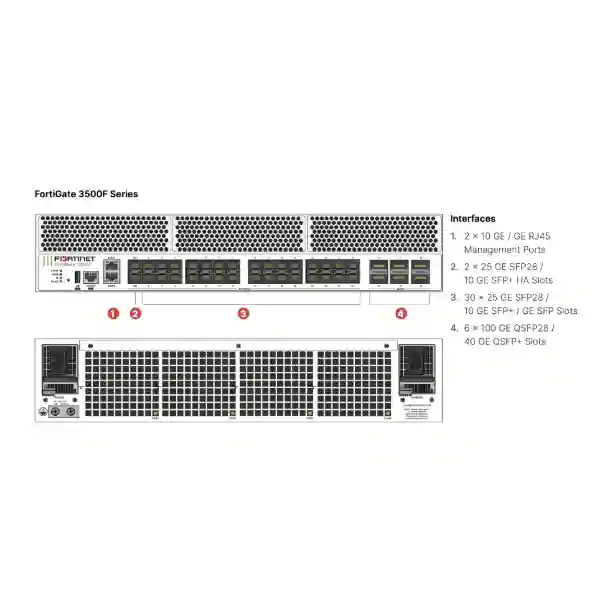
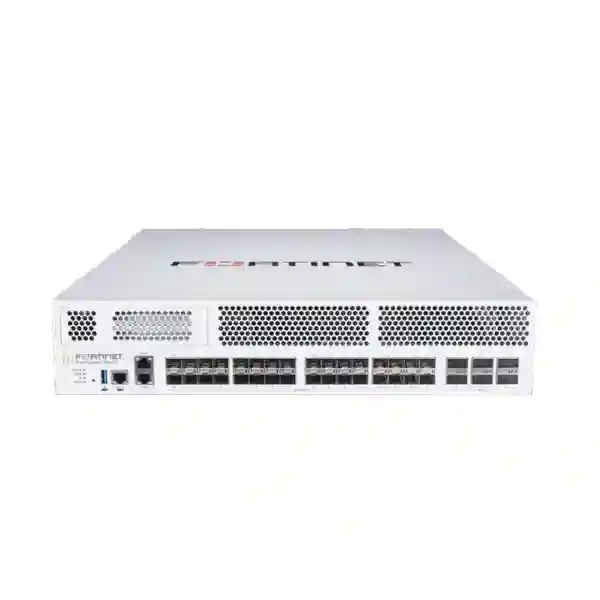
The FortiGate 3500F Series provides six hardware-accelerated 100 GE QSFP28 / 40 GE QSFP+ slots and 32 hardware-accelerated 25 GE SFP28 / 10 GE SFP+ / GE SFP slots, plus two 10GE/GE RJ45 management ports. This density supports designs where a firewall must sit between high-capacity switching fabrics, server networks, internet uplinks, WAN infrastructure and segmented security zones. Two SFP+ SR 10 GE transceivers are included according to the current datasheet, but complete optical requirements should always be mapped during procurement because production designs may require additional transceivers and cabling.
The appliance is a 2RU rack-mount platform with dual hot-swappable AC power supplies configured for 1+1 redundancy. Data center planning should account for front-to-back airflow, power availability, rack depth, heat load and upstream switching. These practical details matter because a high-end firewall is part of a broader resilient architecture; availability depends on power, links, routing, HA design and operational processes as much as the appliance itself.
Security, Segmentation and Encrypted Traffic
Modern enterprise traffic is increasingly encrypted, distributed and application-driven. A firewall refresh therefore needs to consider SSL inspection, intrusion prevention, application control, malware protection and segmentation together. FortiGate 3500F supports FortiOS capabilities across these use cases and can form part of a Fortinet Security Fabric deployment. For organizations operating private applications, public services, partner connectivity and cloud-connected workloads, this creates an opportunity to consolidate policy enforcement while retaining high-speed interfaces for east-west and north-south traffic.
The current datasheet lists 63 Gbps SSL inspection throughput, 60,000 SSL inspection connections per second and 15 million concurrent SSL inspection sessions under its documented test profile. Because certificate handling, cipher suites, application behavior and policy scope influence encrypted inspection, a proof-of-concept or detailed traffic study is advisable for sensitive high-volume environments. Organizations should also plan certificate governance, exceptions, privacy requirements and change management before enabling broad decryption.
VPN, High Availability and Scale
For inter-site and remote connectivity, Fortinet publishes 165 Gbps IPsec VPN throughput, support for up to 40,000 gateway-to-gateway IPsec VPN tunnels and up to 200,000 client-to-gateway IPsec VPN tunnels. SSL-VPN throughput is listed at 16 Gbps with a recommended maximum of 30,000 concurrent tunnel-mode users. These are platform maximums or test results rather than a promise for every topology. Authentication design, cryptography, routing, inspection, identity services and endpoint behavior must be included in sizing.
High-availability options include active-active, active-passive and clustering. The platform supports 10 virtual domains by default and up to 500 maximum according to the datasheet. Organizations considering multi-tenant segmentation, separate business units or service-provider architectures should validate licensing and operational requirements for the intended VDOM count. A resilient design should also remove single points of failure in switches, carriers, power and management systems.
FortiGate 3500F vs FortiGate 3501F
| Area | FG-3500F | FG-3501F |
|---|---|---|
| Core performance | Same published series performance | Same published series performance |
| Onboard storage | No onboard SSD listed | 2 × 1.92 TB SSD |
| Form factor | 2RU | 2RU |
The storage distinction is important when evaluating local logging and operational requirements. For centralized environments, buyers should also consider how FortiAnalyzer or another approved logging architecture fits retention, reporting and compliance needs.
FortiGate 3500F Series Tanzania
Tanzania enterprises evaluating the FortiGate 3500F Series are typically dealing with requirements beyond a conventional branch firewall: large internet edges, data center segmentation, private-cloud workloads, high-capacity VPNs, multi-site connectivity, encrypted application traffic and stringent uptime expectations. The right procurement process should begin with measured peak traffic, anticipated growth, security services that will be enabled and the speed of existing or planned switching infrastructure. A platform capable of hundreds of gigabits of raw firewall throughput can still be incorrectly sized if the design ignores threat inspection, SSL decryption, session rates or redundancy.
For a Tanzania deployment, document WAN circuits, internal VLANs or VRFs, routing protocols, public services, NAT requirements, remote-access users, site-to-site tunnels and critical applications before choosing the final configuration. The six 100/40 GE slots and 32 25/10/1 GE fiber slots make the platform suitable for high-speed aggregation, but optics and link types need to match the surrounding network. Procurement teams should therefore request a bill of materials that covers appliance model, required subscriptions, support, transceivers and any management or analytics components rather than comparing appliance prices alone.
Security teams should define which traffic needs IPS, application control, malware protection and SSL inspection. This allows expected inspected throughput to be compared with Fortinet’s published enterprise-mix figures. Where internet-facing applications are business critical, high availability should be designed with redundant upstream and downstream connectivity. Power, cooling and rack planning are also important because the 2RU appliance uses redundant power supplies and has defined environmental requirements.
FourTeck can be approached for solution planning and quotation preparation. Buyers can also review broader Tanzania enterprise technology solutions and use the contact process to discuss requirements. For cross-border architecture, the FourTeck Africa technology portfolio provides an additional regional reference point. Final availability, licensing, support terms and lead time should be confirmed in the quotation rather than assumed from a generic product page.
FortiGate 3500F Series Dar es Salaam
Dar es Salaam organizations often operate the country’s most bandwidth-intensive corporate environments, including headquarters, financial services, telecom-related operations, large campuses, hosting environments and businesses with substantial regional connectivity. In these scenarios, the FortiGate 3500F Series can be evaluated as a high-capacity security gateway between internet services, core switching, server networks and hybrid-cloud connectivity. The primary design question is not simply whether the appliance is fast enough, but which traffic flows require inspection and how the security architecture will remain resilient during maintenance or a component failure.
A Dar es Salaam deployment assessment should inventory internet links, MPLS or SD-WAN connectivity, cloud circuits, DMZ services, partner links and internal segmentation. If the firewall is expected to inspect encrypted traffic, estimate the percentage of TLS sessions and identify applications that cannot be decrypted. For high-transaction environments, concurrent sessions and connections per second can matter as much as aggregate bandwidth. The platform’s published 140 million TCP concurrent sessions and one million new TCP sessions per second in its standard figures provide useful reference points, while higher hyperscale figures require the applicable license.
High availability deserves particular attention. A pair of appliances can be deployed using supported HA modes, but a robust design also requires redundant switch paths, diverse carrier connectivity where available, resilient power and tested failover procedures. Teams should establish management access, configuration backup, monitoring and incident-response processes before production cutover. Migration planning should map existing rules to business applications and remove obsolete policies rather than simply copying years of accumulated configuration.
When requesting a quotation for Dar es Salaam, provide current firewall model, peak throughput, interface requirements, expected user and server counts, VPN volumes, required security services and preferred support term. This produces a more useful commercial response than asking for hardware alone. Buyers with multi-country operations can also review FourTeck Fortinet-focused resources for broader Fortinet solution context while keeping the Tanzania deployment requirements distinct.
FortiGate 3500F Series Mwanza
For organizations in Mwanza, a FortiGate 3500F Series project may be driven by centralized data services, regional operations, large user populations, manufacturing or distribution networks, and connectivity to branches or cloud workloads. The platform is most relevant where traffic scale and security inspection justify a high-end appliance. Before procurement, network teams should establish a baseline of normal and peak utilization and determine whether growth will come from internet bandwidth, data-center east-west traffic, VPN traffic or additional sites.
Connectivity design is especially important when high-speed firewall ports connect to switching infrastructure that may operate at different speeds. The 3500F Series provides a broad mix of 100/40 GE and 25/10/1 GE fiber connectivity, enabling flexible designs, but the final bill of materials must account for compatible optics and cabling. Management interfaces should be placed on a protected management network, and console access should be incorporated into operational recovery procedures.
Security policy should be organized around applications and trust boundaries. Rather than treating every internal network as equally trusted, enterprises can use segmentation to reduce lateral movement and apply inspection appropriate to each zone. If the appliance will terminate large numbers of site-to-site IPsec tunnels, document encryption settings, routing and failover behavior. Remote-access requirements should be evaluated separately because user authentication, endpoint posture and identity integration affect both security and user experience.
Mwanza procurement teams should also plan subscriptions and lifecycle costs. FortiGuard security services and FortiCare support are separate commercial considerations from the appliance itself, and the appropriate bundle depends on the required functions. Ask for a quotation that clearly identifies hardware, subscription term, support level and optional management or logging components. For distributed networks, related guidance on FourTeck Uganda solutions can be relevant to organizations coordinating infrastructure across East Africa, while the Tanzania design should remain based on local technical requirements.
FortiGate 3500F Series Arusha
Arusha businesses considering the FortiGate 3500F Series may include large hospitality groups, enterprise campuses, regional headquarters, institutions and organizations connecting multiple sites. For these buyers, the value of a high-end NGFW lies in combining substantial network capacity with security inspection and policy enforcement. A design workshop should identify which services are centralized in Arusha, which applications are hosted elsewhere and which user groups require remote or partner access.
If the firewall will sit at a data center or core aggregation point, interface mapping should be completed before purchase. The platform’s 100 GE and 25 GE capabilities can support modern switching fabrics, while 10 GE and 1 GE compatibility on relevant slots can assist transition from older infrastructure. However, physical connectivity is only one part of the project. Routing convergence, VLAN or VRF structure, NAT, application dependencies and HA behavior should be documented and tested.
Encrypted traffic inspection is another major sizing factor. Organizations should decide which categories of TLS traffic can be decrypted under their policies and which require exceptions. The firewall’s published SSL inspection performance is high, but operational success also depends on certificate deployment, application compatibility and help-desk readiness. IPS and malware protection policies should be tuned to actual risk and monitored after migration rather than enabled indiscriminately without observing application behavior.
For quotation preparation in Arusha, include anticipated bandwidth growth over the planned service life, not just today’s circuit size. Also specify HA requirements, expected VPN counts, logging retention and whether centralized Fortinet management or analytics are part of the architecture. A well-defined request makes it easier to compare a complete solution instead of an incomplete appliance-only price. Cross-market buyers can reference FourTeck Kenya enterprise technology solutions when planning connected East African operations.
FortiGate 3500F Series Dodoma
In Dodoma, high-capacity firewall requirements may arise in government-adjacent enterprises, large institutions, national organizations, data-intensive campuses and centralized networks supporting multiple remote locations. FortiGate 3500F Series can be considered where high throughput, segmentation and secure connectivity need to coexist. Procurement should be based on a documented architecture and verified performance needs rather than selecting a model solely because it belongs to a high-end product family.
Start by separating traffic into internet, data-center, inter-site, cloud and management flows. This makes it easier to determine which sessions require full threat inspection and which interfaces require 100 GE, 40 GE, 25 GE or 10 GE connectivity. If the firewall will provide site-to-site VPN aggregation, calculate both aggregate encrypted bandwidth and tunnel counts. Where remote access is required, assess identity providers, multifactor authentication and endpoint access policies as part of the project.
Operational continuity should be designed from the outset. Fortinet supports active-active, active-passive and clustering options on this series, but the appropriate topology depends on routing, state synchronization and maintenance objectives. Teams should schedule failover testing and define rollback procedures before migration. Logging and monitoring should also be sized so that security teams can investigate incidents without overwhelming local storage or losing visibility during high-volume periods.
A Dodoma quotation request should identify whether the FG-3500F or storage-equipped FG-3501F is preferred, while allowing the solution team to validate the choice. Include desired subscription duration, support level, optics, rack environment and integration requirements. For national deployments, standardization can simplify policy and operations, but each site should still be sized to its role. Use FourTeck’s Tanzania contact channel for current commercial details rather than assuming stock, price or delivery from static web content.
FortiGate 3500F Series UAE
UAE organizations evaluating the FortiGate 3500F Series often have dense data center connectivity, high-speed internet edges, cloud interconnects and strict expectations for availability. The appliance’s 100 GE and 25 GE interface density makes it relevant to high-capacity environments, while FortiOS provides integrated networking and security functions. Buyers should map the platform to workload architecture, inspection scope and growth rather than treating headline firewall throughput as the sole selection metric.
Data centers commonly need segmentation between application tiers, shared services, tenant environments and external zones. A 3500F design can enforce these boundaries while supporting large session volumes, but policy architecture should remain understandable. Excessive rule sprawl can make even powerful hardware difficult to operate. Migration projects should therefore include policy cleanup, object normalization, routing validation and staged cutover tests.
For encrypted workloads, assess SSL inspection and IPsec requirements independently. The published 63 Gbps SSL inspection and 165 Gbps IPsec VPN figures use specific test methodologies and should be treated as design references. Real traffic includes mixed packet sizes, applications and cryptographic profiles. If the environment has exceptionally demanding traffic, proof testing can validate expected behavior before final rollout.
Organizations procuring for UAE operations can review FourTeck UAE enterprise solutions and the dedicated Fortinet UAE solution resource. Confirm the exact appliance, FortiGuard services, FortiCare term, optics and management components in a current quotation. Do not assume licensing, stock or delivery conditions from a product description because commercial conditions change.
FortiGate 3500F Series Uganda
Uganda enterprises with large centralized networks can evaluate FortiGate 3500F Series for data center perimeter security, segmentation, VPN aggregation and high-throughput internet access. The appliance is designed for environments where security inspection must operate at substantial scale. A procurement exercise should quantify current and future traffic, then compare those requirements with the vendor’s inspected-throughput figures rather than raw firewall performance alone.
For multi-site Ugandan networks, VPN and SD-WAN architecture may be central to the design. The 3500F can act as a high-capacity hub, but branch platforms, carrier diversity, routing and failover policies determine end-to-end service quality. Teams should document critical applications and determine which links should be preferred under normal conditions and during outages. Centralized monitoring can help distinguish carrier issues from security or application problems.
Data center deployments should also consider HA, redundant switching and power. The appliance includes dual hot-swappable AC supplies for 1+1 redundancy, but upstream and downstream components need equivalent resilience. If the FG-3501F’s onboard SSDs are attractive for logging, retention requirements should still be assessed against centralized analytics needs. Larger security operations may benefit from dedicated logging and reporting architecture.
Uganda buyers can review FourTeck Uganda technology solutions when coordinating regional requirements. A complete request for quotation should state required subscription services, support term, optics, expected VPN scale and integration with existing switching, identity and monitoring systems. This avoids comparing quotations that include different service levels or incomplete accessories.
FortiGate 3500F Series Kampala
Kampala is a natural concentration point for large corporate networks, financial organizations, service providers and national operations. In such environments, FortiGate 3500F Series can be assessed for high-capacity edge security and data center segmentation. Design teams should first establish whether the firewall is protecting internet traffic, private applications, cloud connectivity, customer-facing services or all of these simultaneously, because each workload changes sizing and policy requirements.
The platform’s large session capacity is relevant to environments with many users, servers or customer connections. Yet session count should be considered alongside new-session rate, SSL inspection, IPS and threat protection. Traffic captures and monitoring data from the current firewall can provide a stronger sizing baseline than circuit speed alone. Capacity planning should also include anticipated business growth and new digital services.
For high availability, network architects should validate routing symmetry and link behavior during failover. Testing should include appliance failure, individual link failure, switch failure and maintenance scenarios. Configuration backups and administrative access controls should be established before migration. If multiple security teams or tenants share the appliance, VDOM design can create administrative and policy separation, subject to the platform’s licensing and maximum limits.
Kampala procurement teams should ask for a clear distinction between appliance hardware, FortiGuard subscriptions, FortiCare support and optional centralized management or analytics. Optics should be specified according to actual link distance and switch compatibility. A detailed bill of materials reduces the risk of discovering missing components during installation and makes commercial comparisons more meaningful.
FortiGate 3500F Series Arua
Arua organizations considering a high-end firewall may be supporting regional hubs, institutions, logistics operations or distributed networks that depend on centralized applications. FortiGate 3500F Series is best evaluated when the central site aggregates substantial traffic or hosts services requiring high availability and advanced inspection. For smaller environments, sizing should confirm that a high-end platform is genuinely warranted rather than assuming a larger appliance is automatically the better choice.
Where WAN connectivity is a critical dependency, the firewall architecture should accommodate multiple links and clear failover behavior. Network teams should identify which applications require low latency, which can tolerate alternate paths and how routing changes will affect active sessions. VPN tunnels to branches or partners should be catalogued with encryption parameters and bandwidth expectations. This preparation makes migration and troubleshooting more predictable.
Security policies should align with business roles and data sensitivity. Segmentation between user, server, guest, management and partner networks can reduce exposure, while IPS and application controls can be applied where they provide meaningful protection. SSL inspection should be introduced with a certificate and exception strategy so that critical applications are tested before broad enforcement.
For Arua procurement, request an architecture review alongside pricing. Specify current switching interfaces, rack and power conditions, subscription needs and support expectations. If the design connects back to Kampala or another national data center, size both the hub and branch sides of the topology. A complete solution should be operationally supportable, not merely capable on paper.
FortiGate 3500F Series Mbarara
Mbarara enterprises may require centralized security for regional operations, campuses, production environments or multi-site business networks. The FortiGate 3500F Series can serve as a high-performance enforcement point where traffic volumes justify its capacity. Sizing should start with observed peak traffic and security requirements, then add realistic growth headroom. This helps avoid both under-sizing and unnecessary capital expenditure.
If the firewall is deployed between core switching and servers, segmentation design should be coordinated with VLAN, VRF and routing architecture. High-speed 25 GE and 100 GE connectivity can support modern networks, but interface selection should match the switching fabric and transceiver plan. Management traffic should remain isolated from production wherever practical, with administrative access protected through strong authentication and role-based permissions.
The 3500F Series also supports substantial VPN scale, making it relevant to centralized connectivity for branches or partners. However, tunnel counts do not alone determine performance; encryption choices, inspection, routing and traffic distribution all contribute. Operational teams should monitor tunnel health and maintain clear documentation for failover and key-management processes.
Mbarara buyers should include implementation dependencies in the quotation process: optics, cabling, subscriptions, support, logging and migration assistance where required. If replacing an existing firewall, export a policy inventory and identify rules that are no longer needed. Cleaning policy before migration improves security and reduces troubleshooting complexity after cutover.
FortiGate 3500F Series Gulu
For Gulu organizations operating regional hubs or centralized infrastructure, FortiGate 3500F Series offers a high-end option for consolidating firewall, VPN and advanced inspection requirements. Its suitability depends on the scale of the environment. Teams should quantify traffic and application behavior before choosing the model, particularly if the network relies on lower-speed WAN circuits but expects substantial internal data-center traffic.
Resilience planning should consider more than appliance HA. Carrier paths, core switches, power and management access can all become single points of failure. A design review should document what happens when each component fails and how traffic returns to the preferred path. Planned maintenance should be tested in a controlled window before the system is treated as production-ready.
Security services should be enabled according to risk and performance objectives. IPS policies can protect vulnerable services, application control can improve visibility and malware protection can contribute to layered defense. Encrypted inspection requires additional governance because organizations need to decide which traffic is appropriate to decrypt and how certificates are distributed. Monitoring after rollout is essential to identify unexpected application dependencies.
For a Gulu quotation, provide topology diagrams and a summary of existing equipment where possible. This allows interface and integration requirements to be understood early. Ask for subscription and support terms to be itemized so renewals can be planned. High-end security infrastructure is a multi-year operational commitment, and predictable licensing and support are part of the design decision.
FortiGate 3500F Series Kenya
Kenya organizations operating large data centers, digital platforms, financial services, cloud-connected environments or regional headquarters may evaluate FortiGate 3500F Series where high-speed inspection and dense interfaces are required. The platform’s published performance makes it a candidate for demanding network edges, but production sizing should reflect the exact security stack enabled on real traffic.
Architecture teams should compare expected IPS, NGFW and threat-protection load rather than relying on the 595 Gbps headline firewall figure. If substantial encrypted traffic will be inspected, SSL performance becomes a key metric. If the platform is a VPN hub, IPsec capacity, tunnel counts and routing behavior matter. Where public applications generate rapid connection turnover, new sessions per second can be particularly important.
Kenyan deployments may also serve neighboring markets, making segmentation and administrative separation important. VDOMs can help divide environments, but the design should establish who owns each policy domain and how shared services are controlled. Centralized logging and management can improve consistency across multiple firewalls and sites, subject to the organization’s operational model.
For procurement and related regional planning, visit FourTeck Kenya. Request a bill of materials that identifies the exact 3500F family model, subscriptions, support term, optics and any Fortinet management or analytics components. Commercial availability and delivery should be confirmed at quotation time.
FortiGate 3500F Series Kuwait
Kuwait enterprises with high-throughput data centers and large internet edges can assess FortiGate 3500F Series for consolidated network security. Dense 100 GE and 25 GE connectivity can fit modern switching environments, while FortiOS provides security and networking functions on a unified platform. The procurement process should match security throughput to workload requirements and include environmental planning for rack, power and cooling.
For organizations hosting critical applications, segmentation can limit lateral movement between workloads and reduce the scope of security incidents. Policies should be based on application and business requirements, with change control and logging designed from the outset. SSL inspection should be tested against production-like traffic because encryption standards and application behaviors can influence actual performance.
High availability should be designed with redundant upstream and downstream links and tested routing convergence. The dual hot-swappable power supplies support appliance-level power resilience, but the surrounding infrastructure must also be redundant. Teams should document how management access remains available during failures and how configuration changes are backed up.
Kuwait buyers can review FourTeck Kuwait solutions for regional technology context. A quotation should identify hardware, FortiGuard services, FortiCare support, optics and implementation dependencies. Confirm current commercial terms directly rather than relying on assumptions about price, stock or lead time.
FortiGate 3500F Series Ghana
Ghana enterprises modernizing data centers or regional network hubs can consider FortiGate 3500F Series for high-capacity firewalling, threat inspection and secure connectivity. The model is particularly relevant when multiple high-speed links converge at a security boundary. Accurate sizing should include inspected traffic, session behavior, VPN load and growth projections rather than a single bandwidth figure.
If the firewall protects internet-facing services, security teams should define DMZ segmentation, application dependencies and inbound inspection policies. Internal segmentation may also be appropriate between sensitive server groups, management systems and user networks. The platform’s interface density can support these designs, but switching and routing architecture must be coordinated to avoid asymmetric paths that complicate stateful inspection.
Operational planning should cover logging, alerting, configuration backup and administrative roles. The FG-3501F adds onboard SSD storage, while centralized analytics may still be appropriate for larger environments. Subscription selection should reflect the actual FortiGuard services required, and support coverage should align with the organization’s uptime objectives.
For Ghana-specific procurement context, organizations can visit FourTeck Ghana. Provide a network diagram and current firewall statistics when requesting a quote. This gives the solution team better evidence for model validation, interface planning and licensing recommendations.
FortiGate 3500F Series Nigeria
Nigeria’s large enterprise, financial, telecom-adjacent and digital-service environments can generate the traffic scale for which FortiGate 3500F Series is designed. When a firewall must protect high-capacity internet connections, data-center workloads and numerous VPNs simultaneously, architects should model each workload separately and then account for concurrent peaks. This provides a more realistic sizing basis than adding circuit speeds without understanding inspection requirements.
The series’ 100 GE and 25 GE interfaces can integrate with high-speed core and data-center switching. Before procurement, document link media, distances and redundancy so the correct transceivers can be included. For internet edge designs, consider DDoS strategy, routing, NAT scale and public-service segmentation as part of the wider architecture, while avoiding assumptions that one firewall feature replaces every layer of security.
Encrypted application traffic should be assessed carefully. SSL inspection can improve threat visibility but requires certificate governance and application testing. High-volume VPN environments likewise require attention to authentication, cryptographic settings and route design. Security operations should establish dashboards and alert thresholds so capacity and threat events can be distinguished quickly.
Nigeria buyers can review FourTeck Nigeria technology solutions for regional context. Ask for a complete quotation covering the selected appliance, FortiGuard subscriptions, FortiCare term, optics and optional management or logging platforms. Current availability and commercial conditions should always be confirmed during procurement.
FortiGate 3500F Series Seychelles
Seychelles organizations with centralized data services, hospitality infrastructure, financial operations or multi-site connectivity may evaluate FortiGate 3500F Series when security needs and traffic volumes justify a high-end platform. Island connectivity makes resilient WAN design particularly important, so firewall selection should be coordinated with carrier diversity, bandwidth economics and application priorities rather than treated as an isolated hardware purchase.
Where multiple links are available, routing and SD-WAN policies can help determine how applications use primary and alternate paths. The central firewall must have enough inspected throughput for the combined load while preserving headroom for failover events. If one circuit fails, remaining links may experience a sudden increase in traffic, so capacity planning should consider degraded-mode operation as well as normal conditions.
For data-center or core deployments, high-speed interfaces provide flexibility for segmentation and aggregation. Security teams should define zones around critical servers, management networks, guest services and partner access. VPN architecture can connect remote properties or offices, but identity, monitoring and configuration standards should remain consistent. High availability should include tested procedures and not merely a second appliance installed in the rack.
A Seychelles quotation request should include circuit topology, interface speeds, expected VPN usage, inspection services, logging needs and support objectives. If centralized procurement spans several countries, use a consistent requirements template while allowing each location’s connectivity and operational constraints to influence the final configuration.
Deployment and Migration Guidance
A successful FortiGate 3500F Series deployment starts before the appliance is racked. Collect interface utilization, session counts, policy hit counts, VPN inventories and routing tables from the existing environment. Identify obsolete rules and duplicate objects. Define the target zone architecture and management network. Confirm optics and cable types, power feeds, rack space and airflow. If HA is required, reserve addressing and switch ports for both units and establish how heartbeat links and monitored interfaces will be configured.
Migration should be staged. Build base configuration, update approved software, configure administrative controls, establish logging, then migrate routing and policies in a controlled sequence. Validate DNS, authentication, public services, VPNs and critical applications. For SSL inspection, pilot with representative users and applications before expanding scope. After cutover, monitor CPU, memory, sessions, dropped traffic, IPS events and link utilization to validate assumptions made during sizing.
Quotation Checklist
For a useful FortiGate 3500F Series quotation, provide: target country and site; preferred FG-3500F or FG-3501F if already determined; current firewall model; internet and WAN bandwidth; peak inspected throughput; number and speed of fiber links; required 100 GE, 40 GE, 25 GE and 10 GE interfaces; HA requirement; IPsec and remote-access VPN estimates; SSL inspection scope; required FortiGuard services; desired FortiCare term; logging and retention needs; VDOM requirements; routing protocols; identity integration; and planned deployment date. A topology diagram and current performance statistics are particularly valuable.
Frequently Asked Questions
What models are in the FortiGate 3500F Series?
The current Fortinet datasheet lists FG-3500F and FG-3501F. The FG-3501F adds two 1.92 TB SSDs of onboard storage; the core published performance and interface specifications are shared across the series.
What is the FortiGate 3500F threat-protection throughput?
Fortinet currently publishes up to 63 Gbps threat-protection throughput under its stated test conditions with firewall, IPS, application control and malware protection enabled. Actual deployment performance varies with configuration and traffic.
Does FortiGate 3500F support high availability?
Yes. Fortinet lists active-active, active-passive and clustering configurations. The correct topology depends on network design, routing, resiliency objectives and operational requirements.
How many high-speed ports are available?
The series lists six hardware-accelerated 100 GE QSFP28 / 40 GE QSFP+ slots and 32 hardware-accelerated 25 GE SFP28 / 10 GE SFP+ / GE SFP slots, plus two 10GE/GE RJ45 management ports.
Should I choose FG-3500F or FG-3501F?
The main published hardware distinction is onboard storage: FG-3501F includes two 1.92 TB SSDs. The appropriate model depends on logging, storage architecture, commercial configuration and broader solution requirements.
How should I request a FortiGate 3500F price in Tanzania?
Request a current quotation with the appliance model, subscription bundle, FortiCare support term, required optics and any management or logging components. Include traffic and topology details so the proposed configuration can be validated rather than pricing hardware in isolation.
Decision Recap
FortiGate 3500F Series is intended for high-capacity security environments where data center connectivity, encrypted inspection, VPN scale and session performance are major considerations. Its six 100/40 GE slots, 32 25/10/1 GE slots, published 72 Gbps IPS performance and 63 Gbps threat protection make it a substantial platform. The best buying decision comes from matching these capabilities to measured workloads, resilience goals and the exact FortiGuard and FortiCare services required.
Plan Your FortiGate 3500F Series Deployment
Share your network topology, current firewall statistics, target interface speeds, VPN requirements, HA design and subscription expectations with FourTeck. A requirements-led quotation helps identify the appropriate series model and avoids missing optics, licensing or management components that can affect deployment readiness.




Reviews
There are no reviews yet.