
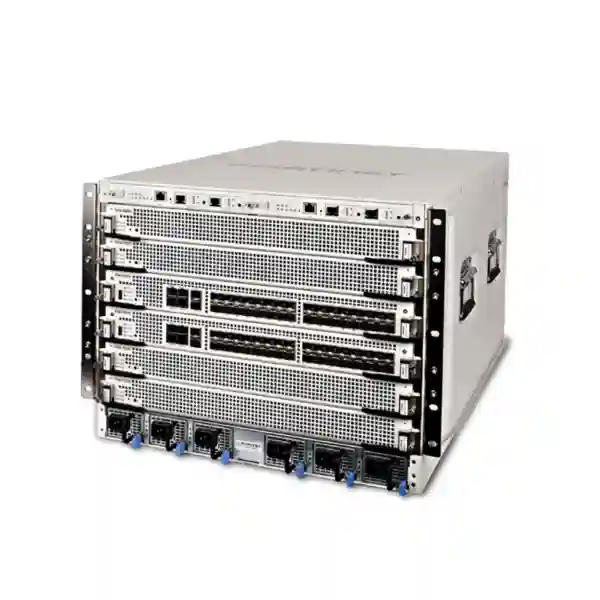
FortiGate 7000 Series
FortiGate 7000 Series is designed for organizations that need data-center-class firewall capacity without separating networking and security into disconnected platforms. Fortinet positions the 7000F family for large enterprises and service providers, with FortiGate 7081F and FortiGate 7121F in its current high-end next-generation firewall portfolio. The platform combines FortiOS secure networking, FortiGuard security services, high-speed connectivity, segmentation, VPN, application control, intrusion prevention and centralized operational capabilities. For Tanzania projects, the correct model should be selected from measured traffic, enabled inspection services, interface requirements, redundancy objectives, growth expectations and the architecture of the protected environment rather than from headline firewall throughput alone.
Verified 7000F performance
Fortinet’s published 7000F data sheet lists the FortiGate 7081F at 405 Gbps IPS, 330 Gbps NGFW and 312 Gbps threat protection, while FortiGate 7121F is listed at 675 Gbps IPS, 550 Gbps NGFW and 520 Gbps threat protection. These are model-specific vendor figures and should be interpreted with Fortinet’s test methodology and the intended security profile.
Designed for high-speed environments
The 7000F family supports high-speed Ethernet connectivity and modular expansion appropriate to large data-center and service-provider designs. Architecture planning should account for north-south internet traffic, east-west application flows, segmentation boundaries, encrypted traffic, routing, high availability and the operational model used by the security team.
Security and networking together
FortiOS provides the common operating foundation for firewalling and secure networking. Fortinet also positions the platform with AI/ML-powered FortiGuard services, integrated ZTNA enforcement, automation and centralized management capabilities, helping large environments coordinate policy and threat protection instead of treating the firewall as an isolated perimeter device.
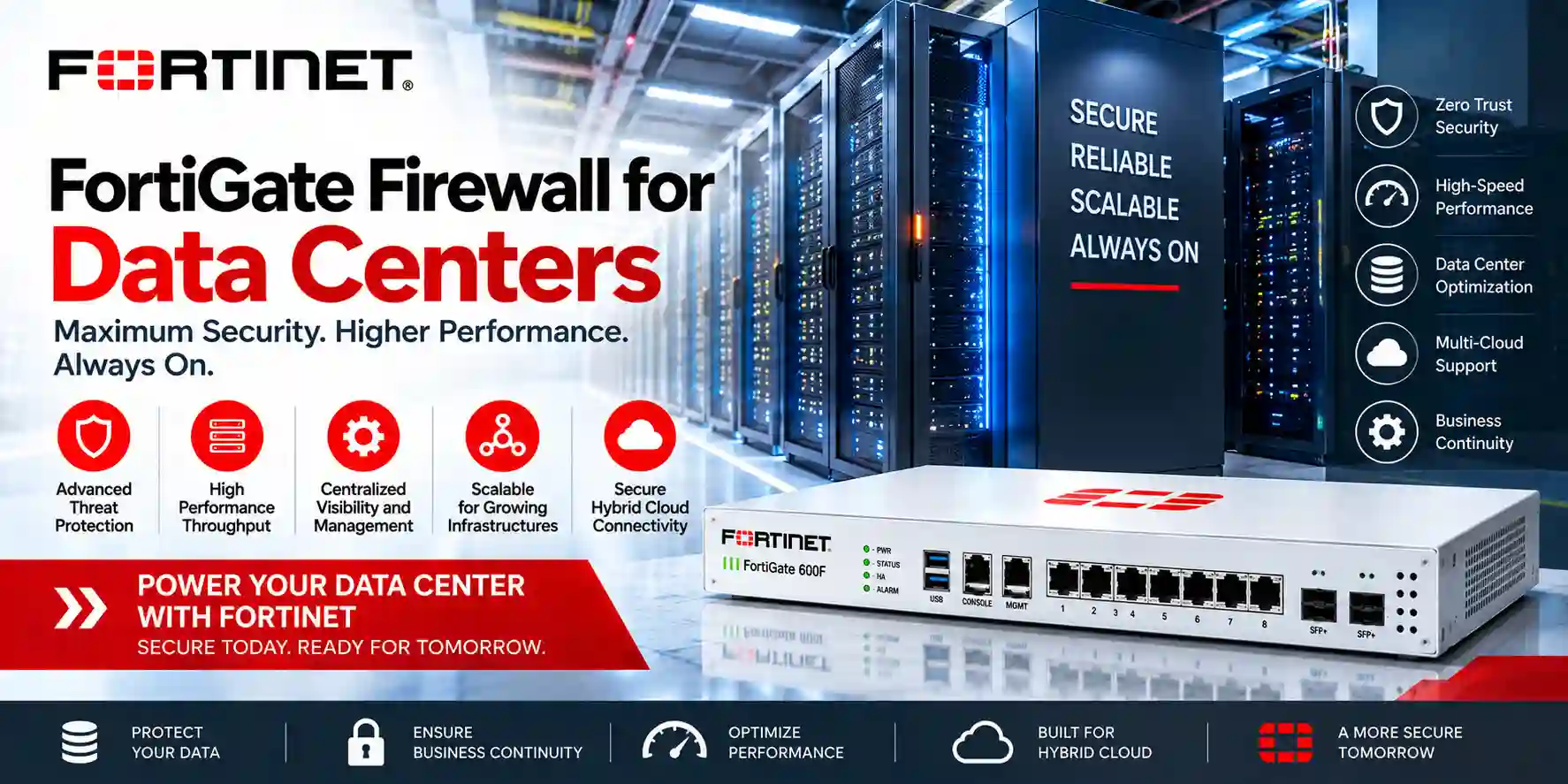
FortiGate 7000 Series overview and buying guidance
A high-end firewall purchase begins with workload definition. Document internet circuits, private WAN links, data-center interconnects, server VLANs, cloud connectivity, public services, remote-access demand, site-to-site VPNs and east-west segmentation. Then identify which flows require IPS, application control, web filtering, malware inspection, SSL/TLS inspection or other security services. This matters because a firewall must be sized for the security functions that will actually run in production, not only for basic Layer 3 forwarding.
The FortiGate 7000 Series is particularly relevant where security capacity must coexist with very high interface density and throughput. Typical design conversations include internet edge consolidation, data-center perimeter security, internal segmentation, carrier or service-provider environments, large campus aggregation, hybrid-cloud connectivity and environments where future bandwidth growth could quickly outgrow smaller appliances. High availability, power, rack space, transceiver selection, cabling, routing design and management integration should be reviewed before procurement.
Licensing is equally important. FortiGuard subscriptions and support choices should match the security functions, operational support requirements and renewal plan. Buyers should request a quotation that separates hardware, subscriptions, support, modules or interfaces where applicable, deployment services and any required accessories. This makes lifecycle cost easier to understand and avoids treating the chassis alone as the complete solution.
Related FourTeck security and infrastructure resources
For broader project planning, review FourTeck Tanzania product sourcing when the firewall is part of a wider infrastructure requirement, and use the FourTeck Tanzania services page to frame integration needs. The Tanzania technology enquiry page explains the network details that help with firewall selection. Regional projects can also reference FourTeck Uganda, FourTeck Kenya, FourTeck Ghana, FourTeck Nigeria and the FourTeck Fortinet UAE specialist site where cross-border requirements involve those markets.
FortiGate 7000 Series Tanzania
For Tanzania enterprises evaluating FortiGate 7000 Series, the key question is whether the protected environment genuinely requires a high-end data-center platform and, if so, which traffic and security assumptions determine the chassis configuration. Large banks, telecom environments, hosting platforms, government systems, universities, industrial groups and diversified enterprises can generate traffic patterns that differ sharply from ordinary office networks. A procurement brief should therefore identify current and planned internet capacity, data-center uplinks, internal segmentation zones, critical applications, remote branches, cloud connections and the amount of encrypted traffic expected to pass through inspection.
Tanzania deployments should also account for resilience. Where the firewall sits at a critical boundary, high availability, diverse upstream connectivity, redundant switching, power protection and an agreed recovery procedure can be as important as raw throughput. Teams should decide which security services must remain enabled during peak periods and whether internal east-west traffic will be inspected in addition to internet-facing traffic. This gives the sizing exercise a realistic security baseline.
When requesting a FortiGate 7000 Series quotation in Tanzania, provide the preferred model if already selected, but also provide enough architecture information to validate it. Include required interface speeds, port quantities, transceiver expectations, routing protocols, VPN counts, segmentation objectives, security subscriptions and support term. If the project is a migration, document the current firewall, policy count, address objects, NAT rules, VPNs and dependencies that must be retained. This reduces procurement ambiguity and helps separate hardware selection from migration planning.
FortiGate 7000 Series Dar es Salaam
Dar es Salaam organizations often concentrate headquarters, data-center, connectivity and business-critical application requirements in the same metropolitan environment. A FortiGate 7000 Series design can therefore be evaluated as part of the complete network edge rather than as a stand-alone security appliance. Begin with circuit speeds and traffic direction: internet breakout, private links, cloud paths, branch aggregation, partner connections and published applications can each create different inspection requirements. If multiple high-capacity links converge at the firewall, interface planning and redundancy deserve early attention.
For data-center deployments, map trust zones before selecting policies. Public-facing services, database networks, management networks, user networks, backup infrastructure and third-party connections should not automatically share the same security treatment. The 7000F platform is intended for environments where large-scale security and networking functions must coexist, but the value of that capacity depends on a clean segmentation and policy design. Migration workshops should identify which legacy rules are still required and which can be retired rather than copying years of accumulated policy without review.
A Dar es Salaam quotation request should specify whether the requirement is a new build, capacity upgrade, firewall refresh, data-center consolidation or high-availability project. Include expected growth over the intended lifecycle and identify whether FortiGuard security subscriptions, centralized management or logging are part of the scope. FourTeck Tanzania’s contact guidance specifically recommends sharing internet speed, VPN requirements, current firewall environment and expected users for firewall projects; for a 7000 Series project, add interface maps, peak traffic and application criticality so the discussion can focus on architecture as well as model selection.
FortiGate 7000 Series Mwanza
A Mwanza organization considering FortiGate 7000 Series may be connecting a regional data center, a large campus, multiple branches or high-volume digital services. The first design task is to establish whether traffic concentration justifies a high-end platform. Measure peak and sustained throughput, not only contracted WAN bandwidth, and distinguish uninspected traffic from flows that require intrusion prevention, application control or deeper security inspection. If the environment is expected to expand, model the likely bandwidth and service growth rather than buying solely for today’s utilization.
Connectivity resilience can influence the architecture. Multiple carriers or WAN paths may be used for continuity, but failover behavior, routing convergence and security policy consistency need to be tested. A firewall cluster should be designed alongside upstream routers, core switches and power systems so that redundancy does not stop at the security appliance. Operational teams should also decide how configuration backups, change control, logs, alerts and incident escalation will be handled.
For procurement, prepare a bill-of-requirements before requesting price. State the FortiGate 7081F or 7121F if a model has already been technically validated, required interfaces and optics, subscription term, support expectations, HA quantity and any management or logging components. Where the exact model is not yet known, provide the traffic and security profile instead of guessing. This allows the discussion to distinguish between a genuine 7000 Series requirement and a smaller FortiGate platform that may meet the workload more appropriately.
FortiGate 7000 Series Arusha
Arusha enterprises with large hospitality, institutional, regional headquarters, service-provider or multi-site environments may need firewall capacity that supports both business growth and stronger segmentation. FortiGate 7000 Series should be considered where high aggregate throughput, demanding inspection workloads and high-speed connectivity are central design requirements. A sound assessment starts by separating user internet traffic from server, branch, guest, partner, cloud and management traffic, then determining which flows cross the firewall and which security controls apply.
Application behavior matters. Real-time communications, cloud applications, large file transfers, backups and public-facing services can create very different traffic profiles. SSL/TLS inspection can also change sizing assumptions. Rather than selecting a chassis from a single performance number, document the combination of features expected to operate concurrently and validate the intended configuration against Fortinet’s current documentation.
For an Arusha project, include migration and operations in the purchase plan. Identify maintenance windows, policy migration method, VPN dependencies, rollback procedure, administrator access, logging retention and monitoring responsibilities. If the firewall protects services used across several sites, coordinate branch routing and DNS dependencies before cutover. Procurement teams should request clearly separated hardware, subscription, support and implementation elements, while technical teams confirm interface types, redundancy and growth capacity. This produces a more useful quotation and a safer path from procurement to production.
FortiGate 7000 Series Dodoma
Dodoma organizations evaluating high-end firewall infrastructure may place particular emphasis on centralized services, institutional networks, secure inter-site connectivity and continuity of critical applications. FortiGate 7000 Series can be relevant when the firewall must inspect very large traffic volumes while supporting segmentation, VPN and advanced threat protection. The architecture should be documented around business services first: which systems are public, which are internal, which sites connect to them, and what happens operationally if a link or firewall component fails.
A secure design should avoid using throughput as the only procurement metric. Consider concurrent sessions, new connections, encrypted traffic, routing, VPN scale, security profiles, logging and interface requirements. Fortinet’s published figures differ by model and test profile, so the selected 7081F or 7121F should be validated against the actual combination of services planned for production. Network diagrams and peak-traffic measurements can make this review more reliable.
For a Dodoma quotation, state whether high availability is required and whether the scope includes subscriptions, management, logging, optics or implementation. If replacing an existing platform, include policy and VPN migration requirements as well as integration with authentication, monitoring and adjacent switching. Change control should define testing and rollback before the maintenance window. These details help procurement compare complete project scope rather than hardware prices that omit essential subscriptions or deployment work.
FortiGate 7000 Series UAE
UAE data centers, large enterprises and service providers can use the FortiGate 7000 Series where high-density, high-throughput security is required at major network boundaries. Selection should be based on the architecture being protected: internet edge, data-center edge, internal segmentation, service-provider infrastructure or a combination of these roles. Document 100 GE or other high-speed interface requirements, expected aggregate traffic, encrypted traffic, inspection services and redundancy before choosing between models.
The 7000F platform is particularly suited to designs where future scaling and operational consistency matter. FortiOS provides a common security and networking environment, while FortiGuard services extend threat protection. Centralized management and analytics can be considered where the organization operates multiple FortiGate systems. Procurement should nevertheless separate optional services and support terms from appliance capabilities so the bill of materials accurately reflects the intended security posture.
For cross-region projects involving Tanzania and the UAE, align policy architecture, naming, logging and change-control standards before deployment. Similar standards can simplify operations without forcing every site to use identical hardware. Each location should still be sized for its own traffic and availability needs. The FourTeck Fortinet UAE resource can support regional product research while the Tanzania enquiry channel remains appropriate for Tanzania requirements.
FortiGate 7000 Series Uganda
Uganda enterprises considering FortiGate 7000 Series should begin by identifying the network boundary that needs high-end security capacity. A centralized data center aggregating branches, internet services and cloud connectivity can produce substantially different traffic from a conventional office perimeter. Build a traffic matrix covering source, destination, peak throughput, security inspection and business criticality. This makes it easier to decide whether the 7000F family is appropriate and which model should be evaluated.
High availability and WAN resilience should be designed together. If multiple upstream connections exist, test routing behavior and session continuity expectations. If the firewall protects branch connectivity, review IPsec design, route exchange and failure scenarios. Logging and management capacity should also be planned so that the security operations process can use the visibility generated by the firewall rather than merely store it.
A procurement request should include the desired support and FortiGuard subscription term, required interface modules or optics, HA quantity and any professional services. Avoid assuming that a chassis quote includes every element required for production. Cross-check the final bill of materials against Fortinet documentation and the network design. For organizations operating in both Uganda and Tanzania, keep local bandwidth and infrastructure differences in the sizing model while standardizing security policy principles where practical.
FortiGate 7000 Series Kampala
Kampala headquarters and data-center environments may aggregate large user populations, branches, hosted applications and internet connectivity through a small number of critical security points. FortiGate 7000 Series is relevant when those points require very high inspection performance and high-speed interfaces. Before selecting hardware, collect traffic telemetry during business peaks and important batch windows, because backups, replication and scheduled transfers can create demand that ordinary daytime averages miss.
Segmentation design should identify public services, server tiers, management systems, user networks and third-party access. Firewall policy can then be mapped to actual trust boundaries. If SSL inspection, IPS and application control will be enabled broadly, include those functions in the sizing assumptions. Fortinet publishes distinct IPS, NGFW and threat-protection figures, making it important to compare the relevant performance profile rather than the largest number on a specification sheet.
Kampala procurement teams should request a complete scope that identifies appliance, subscriptions, support, HA requirements, optics and implementation. Technical teams should provide routing, VLAN, VPN and logging requirements. A staged migration with defined acceptance tests can reduce risk for critical systems. Where existing policies are being transferred, review them for obsolete rules and duplicate objects rather than treating migration as a simple copy exercise.
FortiGate 7000 Series Arua
An Arua requirement for FortiGate 7000 Series should be justified by the workload rather than by product class alone. High-end firewalls are most useful where large aggregate traffic, advanced inspection, dense connectivity or substantial growth demands the platform. Organizations should measure WAN and internal traffic, identify critical applications and determine whether the firewall will protect only internet access or also internal data-center segments and site-to-site connections.
Infrastructure dependencies deserve equal attention. High-capacity firewall links require compatible switching, optics and cabling, while high availability requires redundant paths and power. If upstream connectivity is more constrained than the firewall capacity, the design may prioritize resilience and security services over maximum chassis throughput. Operational requirements such as logging, monitoring, administrator authentication and configuration backup should be included in the architecture from the start.
When seeking a quotation for Arua, provide a simple network diagram and expected three-to-five-year growth assumptions if available. State which security services must be licensed and whether the project includes migration. This helps suppliers quote comparable scopes and gives technical reviewers enough information to challenge over-sizing or under-sizing before purchase. A model decision should ultimately be validated against current Fortinet documentation and the intended production feature set.
FortiGate 7000 Series Mbarara
Mbarara organizations planning a major data-center or network-security upgrade can evaluate FortiGate 7000 Series when multiple high-speed services converge at the security layer. Start with business continuity requirements: identify applications that cannot tolerate extended outage, links that need redundancy and security controls that must remain active during peak traffic. This turns firewall selection into an availability and security exercise rather than a simple bandwidth comparison.
If the environment connects branches, cloud workloads and public applications, map each traffic class separately. Internet browsing, SaaS, remote access, site-to-site VPN, server publishing and replication may each need different policies and inspection. Consider whether east-west segmentation will significantly increase traffic through the firewall. The answer can materially affect capacity planning even when external internet bandwidth appears modest.
For procurement, define interface speeds, port counts, redundancy, subscription term, support level and implementation responsibilities. Confirm whether transceivers and other accessories are included. If centralized logging or management is required, include it as a separate architecture decision. A clear acceptance plan should test routing, security policies, VPNs, failover, logging and critical applications before the project is considered complete.
FortiGate 7000 Series Gulu
Gulu buyers should assess FortiGate 7000 Series in the context of current and future network concentration. If a central facility aggregates regional sites or hosts important services, the firewall may need to handle traffic beyond ordinary internet access. Document branch connectivity, hosted systems, remote users, partner links and any internal segmentation traffic. This creates a defensible basis for deciding whether a 7000F chassis is warranted.
Resilience planning should include more than an HA pair. Review upstream and downstream switch redundancy, power, routing and monitoring so a separate single point of failure does not undermine the firewall investment. Security operations teams should determine which events need alerting, how logs will be retained and who owns policy changes. FortiOS automation and centralized management capabilities can support larger operational models, but they should be mapped to the organization’s actual processes.
A Gulu quotation request should include traffic assumptions, required security services and the planned support term. For migrations, list VPN peers and external dependencies early, because coordination with remote sites can be more time-consuming than appliance installation. Validate the proposed model and components against current Fortinet documentation before purchase and keep a record of the sizing assumptions for future capacity reviews.
FortiGate 7000 Series Kenya
Kenya organizations with large data centers, financial platforms, service-provider networks or high-capacity enterprise cores can evaluate FortiGate 7000 Series for security at scale. A strong design starts with traffic engineering. Measure peak throughput, session behavior and encrypted traffic, then map security services to each flow. If the firewall is also used for internal segmentation, include east-west traffic that may never reach the internet.
The FortiGate 7081F and 7121F offer different published performance levels, so selection should follow the required inspection profile and growth margin. Interface planning is equally important: high-speed ports must align with the surrounding switching and routing architecture. HA topology, power, rack design, optics and cabling should be specified as part of the solution, not left until installation.
For procurement in Kenya, request transparent separation of hardware, FortiGuard subscriptions, support and implementation. If the organization already uses Fortinet products, review whether centralized management and logging can improve operational consistency. If this is a platform migration, define policy cleanup, VPN migration, testing and rollback. Cross-border groups can use common security standards across Kenya and Tanzania while sizing each deployment according to local traffic and service requirements.
FortiGate 7000 Series Kuwait
Kuwait enterprises and service providers considering FortiGate 7000 Series may be protecting dense data-center, cloud, campus or internet-edge traffic. Capacity planning should distinguish raw firewall forwarding from workloads with advanced security inspection. Fortinet publishes IPS, NGFW and threat-protection performance separately, and procurement teams should use the metric closest to their intended production configuration when comparing models.
High-speed connectivity can make physical design a major part of the project. Confirm port type, optics, switch compatibility and redundancy before finalizing the bill of materials. If multiple data halls, upstream carriers or core switches are involved, document the failure domains and expected traffic path during maintenance. This prevents a high-performance firewall from being constrained by an overlooked adjacent component.
A Kuwait quotation should identify the chosen subscription bundle or required security services, support term, HA quantity and migration scope. Security operations requirements such as centralized logging, policy governance and administrator authentication should be documented alongside hardware. For regional organizations, standard templates for policy and monitoring can improve consistency, while local sizing remains based on actual traffic and infrastructure.
FortiGate 7000 Series Ghana
Ghana organizations evaluating a FortiGate 7000 Series deployment should first determine the role of the firewall within the wider architecture. Internet edge, data-center segmentation, service-provider security and hybrid-cloud connectivity can each place different demands on throughput, sessions and interfaces. Collect measured traffic and identify the security controls required for each major flow before selecting the appliance.
Growth planning is important for long-lived infrastructure. Consider expected increases in internet bandwidth, cloud usage, encrypted traffic, remote connectivity and internal application traffic. The objective is not to maximize unused capacity but to maintain an appropriate margin while required security services remain enabled. Fortinet’s current data sheet should be used to validate model-specific figures and supported interfaces during final design.
Procurement teams should ask for a complete bill of materials with hardware, subscriptions, support, optics and deployment services identified separately. Technical teams should define routing, segmentation, VPN and logging requirements. If the firewall replaces an existing platform, schedule policy review and migration testing before cutover. These steps make quotations easier to compare and reduce the chance of discovering missing components late in the project.
FortiGate 7000 Series Nigeria
Nigeria’s large enterprise and service-provider environments can generate substantial security workloads across internet, cloud, data-center and branch connectivity. FortiGate 7000 Series can be evaluated where these flows converge at high speed and advanced inspection must be maintained. Start with measured utilization and application criticality, then estimate growth and the proportion of traffic that will use IPS, application control, web security or encrypted inspection.
Resilience requirements should be explicit. Determine whether the design needs active-passive or another supported HA approach, redundant upstream paths, diverse carriers and redundant core switching. Document how routing and sessions should behave during failure. Operational resilience also includes configuration backup, monitoring, support entitlement and a tested escalation process.
For Nigeria procurement, avoid comparing appliance prices without normalizing subscription and support terms. A technically complete quotation should state model, quantity, security services, term, interfaces or optics, management components and implementation scope. Migration projects should inventory existing policies, NAT, VPNs and integrations. Regional groups operating in Nigeria and Tanzania can benefit from common governance while allowing each site to use a model appropriate to its own capacity.
FortiGate 7000 Series Seychelles
Seychelles organizations with centralized digital services, hospitality groups, financial operations, government platforms or service-provider infrastructure may evaluate high-end firewall capacity where availability and consolidated security are critical. The suitability of FortiGate 7000 Series depends on actual traffic and inspection requirements. A smaller environment should not select a chassis simply because it offers more throughput; conversely, a critical centralized platform should not be undersized when growth and security services are known.
Connectivity constraints and redundancy can shape the architecture. Identify upstream links, backup paths, inter-site connectivity and cloud dependencies, then model how traffic changes during an outage. If the firewall is used for segmentation, include internal flows in the capacity plan. Logging and monitoring should be designed so administrators can detect policy, performance and threat events without relying solely on manual review.
For a Seychelles quotation, provide interface requirements, security subscriptions, support term, HA expectations and deployment scope. If equipment procurement involves cross-border logistics, keep technical acceptance separate from delivery assumptions and confirm commercial details at quotation time. Final model selection should reference current Fortinet documentation and a documented traffic profile so the organization can revisit sizing as bandwidth and services evolve.
FortiGate 7000 Series compatibility, integration and deployment
Integration planning should cover routing, VLANs, dynamic routing protocols where used, identity services, DNS, NTP, authentication, VPN peers, monitoring, logging and change-management systems. A high-end firewall often sits at a point where many teams have dependencies, so architecture documentation and ownership are essential. The migration plan should identify policies that can be tested before cutover and services that require coordinated validation with application owners.
High availability must be validated end to end. A redundant firewall pair cannot protect availability if both appliances depend on one switch, one power feed or one upstream circuit. Test planned failure scenarios and document the expected state. Capacity monitoring after deployment should compare actual traffic with the assumptions used during sizing, giving the organization an early warning when growth begins consuming the intended margin.
FortiGate 7000 Series quotation checklist
For a useful quotation, provide: preferred model if known; appliance quantity; HA requirement; current and future internet/WAN bandwidth; peak inspected traffic; interface speeds and quantities; required optics; segmentation zones; IPsec and remote-access VPN requirements; routing requirements; FortiGuard services; support term; management and logging requirements; current firewall details; migration scope; target deployment window; and any integration dependencies. If some information is unknown, state that clearly so it can be validated during solution design.
FortiGate 7000 Series FAQs
Which FortiGate 7000F models are currently highlighted by Fortinet?
Fortinet’s current high-end NGFW material lists FortiGate 7081F and FortiGate 7121F. Always verify the current product data sheet and lifecycle information when preparing a purchase.
What is the difference between firewall, IPS, NGFW and threat-protection throughput?
They represent different test profiles and enabled security functions. For sizing, use the performance profile closest to the services you expect to enable rather than comparing only the largest firewall-throughput figure.
Is FortiGate 7000 Series suitable for a normal branch office?
The 7000F family is positioned for high-end data-center, large-enterprise and service-provider use. A branch should be sized from its own bandwidth, users and security requirements; another FortiGate model may be more appropriate.
What information is needed before requesting a FortiGate 7000 Series quote?
Provide bandwidth, peak traffic, required security services, interfaces, HA expectations, VPNs, routing, subscription term, support needs and migration scope. A network diagram and growth estimate are especially useful for high-end firewall projects.
Does the hardware purchase automatically include all FortiGuard services?
Do not assume so. Subscription and support entitlements depend on the purchased bundle and term. Ask for these items to be identified explicitly in the quotation.
Decision recap
FortiGate 7000 Series is a high-end platform for environments where very large security workloads, high-speed interfaces, segmentation and resilience must operate together. FortiGate 7081F and 7121F should be compared using the security profile that matches the planned deployment. A defensible purchase decision combines traffic measurement, feature requirements, HA architecture, interface planning, subscriptions, support and migration scope. For Tanzania, provide these details to FourTeck so the quotation discussion can focus on fit and complete project scope rather than an isolated appliance price.
Plan your FortiGate 7000 Series requirement
Share your current firewall, internet and data-center bandwidth, required interfaces, security services, VPN needs, high-availability objective and expected growth. FourTeck Tanzania can use this information to discuss product selection and quotation requirements for your environment.



Reviews
There are no reviews yet.