
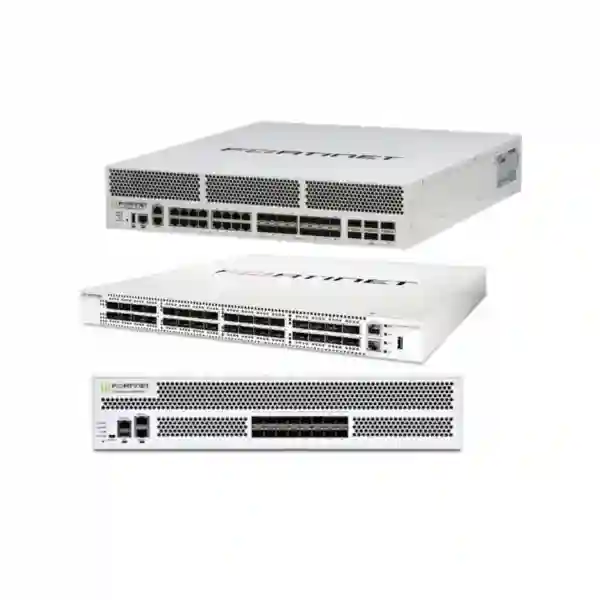
FortiSwitch 3000 Series
FortiSwitch 3000 Series is built for organizations that need dense, high-bandwidth Ethernet at the campus core, aggregation layer or data center. Fortinet currently lists the FortiSwitch 3032G in this class with 32 × 100GE QSFP28 interfaces and 2 × 10GE SFP+ interfaces, providing a compact platform for high-capacity switching designs. The series belongs to Fortinet’s campus core and data center portfolio, where performance, resiliency, centralized management and security integration are central design priorities.
For buyers in Tanzania, the practical question is not simply whether a switch has enough ports. Core switching decisions should account for server and storage traffic, firewall aggregation, fiber type and distance, optics, link redundancy, routing design, rack power, cooling, growth and the operational model used to manage the network. FourTeck Tanzania can help turn those requirements into a clearer bill of materials and deployment plan.
Fortinet lists 32 × 100GE QSFP28 ports on the current FortiSwitch 3032G.
Designed for high-throughput campus-core, aggregation and data-center switching requirements.
FortiSwitch supports standalone and integrated deployment approaches, including FortiGate management through FortiLink where supported.
What FortiSwitch 3000 Series solves
Modern data centers and large campus networks concentrate substantial traffic into the core. Virtualized servers, backup jobs, east-west application flows, storage, cloud connectivity, high-speed access layers and security appliances can all compete for bandwidth. A switch selected only around today’s average traffic may become a bottleneck when workloads consolidate or access-layer speeds increase. FortiSwitch 3000 Series addresses this class of requirement with high-density 100 Gigabit Ethernet connectivity intended for demanding backbone roles.
The value of a high-speed switch depends on architecture. A 100GE interface does not by itself guarantee an efficient network. The surrounding design should consider oversubscription, uplink topology, redundant paths, transceiver compatibility, fiber plant, VLAN and Layer 3 boundaries, failure domains, monitoring and change control. Buyers should therefore treat the FortiSwitch 3000 Series as part of a complete core design rather than an isolated appliance purchase.
Verified FortiSwitch 3032G highlights
High-density 100GE
The current Fortinet Ethernet switching portfolio lists the FS-3032G with 32 × 100GE QSFP28 interfaces plus 2 × 10GE SFP+ interfaces. This port profile makes it relevant to dense aggregation, core and data-center fabrics where many high-speed links terminate in a compact appliance.
Resiliency focus
Fortinet positions the campus core and data-center family around high throughput, low latency, scalability and resilience. Dual hot-swappable power supplies are among the family highlights, supporting designs where infrastructure continuity is important.
Flexible operations
FortiSwitch platforms provide centralized management options and can participate in Fortinet’s broader secure-networking architecture. Management mode, firmware compatibility and the intended FortiGate/FortiLink design should be confirmed for the final bill of materials.
Architecture and deployment planning
A core switch normally sits at a point where many dependencies converge. Before selecting FortiSwitch 3000 Series, document the number and speed of server connections, downstream switch uplinks, firewall interfaces, storage networks, inter-building links and WAN or internet edge connections. Identify which links require 100GE immediately and which may migrate later. This creates a defensible port plan and reduces the risk of consuming expensive high-speed interfaces without a clear purpose.
Optics and cabling require equal attention. QSFP28 connectivity can be implemented with different transceiver and cabling approaches depending on distance, fiber type and equipment at the far end. Never assume that an existing fiber run or transceiver will be compatible merely because the connector appears suitable. Confirm the approved optics, wavelength, fiber grade, distance and peer-device capability for every critical link. Where breakout connectivity is planned, confirm the exact supported configuration before procurement.
Redundancy should be designed end to end. Dual power feeds have limited value if both feeds terminate on the same unprotected circuit. Multiple switch paths help only when spanning, routing, link aggregation or multi-chassis design is correctly engineered. Similarly, redundant firewalls need appropriate upstream and downstream connectivity. The design should define what happens when a link, transceiver, power supply, switch or upstream device fails, and how traffic reconverges.
Operations teams should also decide how configuration, monitoring, firmware and backups will be managed. Fortinet supports integrated and standalone management approaches across the FortiSwitch portfolio. For an environment already standardized on FortiGate, FortiManager or other Fortinet tools, integration can reduce operational fragmentation. For a data-center team with established switching workflows, standalone requirements may also influence the architecture. The correct approach depends on the organization’s tooling, responsibility boundaries and change process.
Related FourTeck Tanzania infrastructure
Core switching should be coordinated with the surrounding environment. FourTeck Tanzania’s integrated IT infrastructure overview explains how networking, security, servers, Wi-Fi and supporting systems fit together. The technology services page is relevant when a switching requirement includes assessment, implementation or lifecycle work, while the FourTeck Tanzania shop provides a route into related technology procurement. For project scoping and quotations, use the FourTeck Tanzania contact page.
Organizations with regional operations can also coordinate requirements through FourTeck Uganda, FourTeck Kenya, FourTeck Ghana and FourTeck Nigeria. These regional references are useful for organizations trying to standardize network architecture, documentation and procurement across multiple countries.
FortiSwitch 3000 Series Tanzania
Organizations evaluating FortiSwitch 3000 Series in Tanzania are typically planning a network where core capacity, reliability and future expansion matter more than simple access-port count. The platform is relevant to data centers, enterprise headquarters, campus networks, service environments and organizations consolidating high-speed server, security and aggregation links. A Tanzanian deployment should begin with a traffic and topology assessment: identify present uplink speeds, server interface speeds, firewall capacity, inter-VLAN routing location, storage traffic, virtualization clusters and expected growth. That assessment determines whether 100GE density is justified and how many ports should be reserved for redundancy or expansion.
Procurement should include more than the switch chassis. A usable quotation may need compatible QSFP28 or SFP+ optics, fiber patching, cable management, rack accessories, redundant power arrangements, UPS capacity and any required management or support subscriptions. If the new core replaces an older platform, migration planning should map every existing VLAN, routed interface, trunk, LAG, spanning-tree dependency and monitoring connection. A staged migration can reduce disruption and make rollback clearer.
For multi-site Tanzanian organizations, the core can also be the anchor for standardization. Branch access networks may use different switch sizes, but VLAN naming, IP addressing, security zones, routing conventions and documentation can follow a common framework. When FortiGate firewalls and FortiSwitch are used together, FortiLink integration can help bring switching into a broader Fortinet management model. Exact design and software compatibility should be validated against the selected hardware and release.
Environmental readiness matters. High-performance network equipment should be installed in an appropriate rack with stable power, adequate cooling, controlled dust and organized fiber. A high-capacity core deserves redundant power planning and tested recovery procedures. Buyers requesting a FortiSwitch 3000 Series quotation in Tanzania should therefore provide their topology, required port speeds, fiber distances, current firewall and switch models, redundancy target and preferred management approach so the proposal reflects the complete deployment rather than only the base appliance.
FortiSwitch 3000 Series Dar es Salaam
Dar es Salaam organizations often concentrate headquarters, data-center, logistics, financial, hospitality, telecom and enterprise workloads into facilities where network downtime can affect many users and services at once. FortiSwitch 3000 Series can be evaluated for these high-capacity core roles when 100GE connectivity is needed between servers, firewalls, aggregation switches or other network infrastructure. The starting point should be a port-by-port design rather than a generic request for a “fast switch.” Map current and planned high-speed interfaces, then identify which links must be redundant and which can share aggregated capacity.
A Dar es Salaam deployment may connect multiple floors, buildings or equipment rooms. Fiber topology therefore becomes a major procurement item. Confirm whether existing fiber is appropriate for the required optical modules and distances, whether patch panels and cross-connects are documented, and whether spare strands are available for redundant paths. In a live facility, poorly documented fiber can turn a straightforward core replacement into a lengthy troubleshooting exercise. Labeling and test records are valuable deliverables.
Power and cooling should be checked before installation. Core equipment belongs on protected power, and redundant supplies should ideally follow separate protected paths where the facility design permits. Rack depth, airflow and cable bend radius should be considered alongside switch dimensions. High-density optical cabling can become difficult to maintain if patch leads are not routed and labeled systematically.
For quotation preparation, Dar es Salaam buyers should share the current network diagram, firewall model, server and storage interfaces, required 100GE port count, optics and fiber distances, routing requirements and migration window. FourTeck can use that information to discuss the switching platform in the context of the broader LAN, security and data-center environment rather than treating the appliance as a standalone purchase.
FortiSwitch 3000 Series Mwanza
For enterprises in Mwanza, a FortiSwitch 3000 Series project may be driven by centralized applications, server virtualization, large data transfers, campus aggregation or a desire to create a higher-capacity backbone for future access-layer upgrades. Before choosing a 100GE core, confirm where the bandwidth is actually required. A well-designed backbone can remove bottlenecks, but endpoints and applications will only benefit when server NICs, firewalls, downstream switches and storage paths are sized coherently.
Organizations with several buildings or operational areas should review the physical fiber plant early. The core design should distinguish links that remain within a rack or room from longer building-to-building runs. Each has different transceiver and cabling implications. Existing fiber should be tested and documented instead of assumed suitable. The quotation should clearly separate the switch, optics, patching and any cabling work so procurement teams can understand the full project cost.
Resilience is particularly important when the core aggregates many business systems. Consider redundant switch paths, dual power, UPS runtime, firewall connectivity and routing convergence. Maintenance procedures should include configuration backups, firmware planning and a record of optical links and port assignments. These operational details make future troubleshooting faster and reduce dependence on individual staff knowledge.
Mwanza buyers can prepare for a technical discussion by listing the number of racks, buildings, high-speed servers, virtualization hosts, firewalls and downstream switches that will connect to the core. Include current uplink speeds and anticipated growth. This information helps determine whether FortiSwitch 3000 Series is appropriately sized and what surrounding infrastructure is required for a stable deployment.
FortiSwitch 3000 Series Arusha
Arusha businesses and institutions considering FortiSwitch 3000 Series may include hospitality groups, campuses, corporate offices, service organizations and multi-building facilities with increasing dependence on centralized digital services. The 100GE-oriented 3032G is most relevant where many high-speed links converge; it should not be selected merely because it is the largest switch in a portfolio. The design should demonstrate a real requirement for dense backbone capacity, resilience or future consolidation.
In mixed environments, traffic can include business applications, voice, Wi-Fi, surveillance, backups and server workloads. These flows have different performance and security characteristics. Core design should define VLAN and routing boundaries, QoS needs, security inspection paths and whether east-west server traffic stays within the switching fabric or traverses security appliances. This prevents the core from becoming an unmanaged transit point with unclear dependencies.
For facilities with guest networks or multiple operational departments, segmentation is especially important. FortiSwitch integration with Fortinet security architecture can be valuable where the organization already uses FortiGate and wants coordinated visibility and policy. The exact management mode and topology should be designed around the selected FortiOS and FortiSwitch software versions rather than assumed from a generic diagram.
Arusha procurement teams should ask for a bill of materials that identifies every required optical module and accessory, not just the switch. They should also define installation responsibility, migration scope, configuration handover, documentation and support expectations. A complete scope makes commercial comparisons more meaningful because competing quotations may otherwise include very different assumptions.
FortiSwitch 3000 Series Dodoma
Dodoma organizations evaluating a high-capacity core switch should connect procurement requirements to measurable network needs. Government, institutional, education and enterprise environments can have strict change-control, documentation and continuity requirements. A FortiSwitch 3000 Series design should therefore identify critical services, acceptable downtime, redundant paths and the migration sequence before equipment is ordered.
The current FortiSwitch 3032G provides dense 100GE connectivity, which can support a core where multiple high-speed aggregation or data-center links terminate. However, the surrounding devices must be considered. If firewalls or downstream switches operate at lower speeds, the design should model where oversubscription occurs and whether link aggregation is appropriate. If a future server refresh will introduce 25GE or 100GE interfaces, reserve capacity and compatible optics planning can reduce later redesign.
Documentation should be part of the deployment deliverable. Record switch management addresses, VLANs, routed interfaces, trunks, LAGs, peer devices, optics, fiber destinations and power feeds. Keep configuration backups and firmware information with the network documentation. This is especially valuable when support is shared between internal teams and external providers.
A Dodoma quotation request should specify whether the project is new build, expansion or replacement. Include the current network vendor and models, desired management method, required 100GE links, rack and UPS information, and whether installation or migration assistance is needed. FourTeck Tanzania can then frame the product discussion around compatibility and deployment rather than relying on a generic hardware quote.
FortiSwitch 3000 Series UAE
UAE enterprises often operate high-density data centers, headquarters and distributed business environments where core networking must accommodate virtualization, cloud connectivity, security appliances and rapid growth. FortiSwitch 3000 Series can be assessed for 100GE aggregation and data-center switching when the port profile and Fortinet integration model align with the architecture. A design should identify whether the switch is serving as top-of-rack, aggregation, campus core or firewall aggregation, because each role changes port utilization and redundancy planning.
For organizations standardizing between the UAE and Tanzania, using a common design framework can simplify operations. The exact hardware need not be identical at every site, but naming conventions, VLAN strategy, management, firmware policy, monitoring and documentation can follow common standards. This helps regional IT teams compare performance and troubleshoot branches without relearning each environment.
High-speed optical procurement should be tightly controlled. Specify approved transceiver types, distances, connector formats and fiber paths. Data-center moves and expansions often expose undocumented optics or mixed fiber standards, so a pre-deployment audit can prevent delays. Power, rack airflow and redundant feed design should also be included in the implementation checklist.
Buyers can use FourTeck’s regional network to coordinate related requirements while keeping the Tanzania product discussion anchored to the Tanzanian project. For multinational procurement, provide site-by-site port counts and topology differences rather than assuming a single bill of materials can be copied unchanged across facilities.
FortiSwitch 3000 Series Uganda
Ugandan organizations planning a campus core or data-center refresh can evaluate FortiSwitch 3000 Series where 100GE density, centralized operations and Fortinet ecosystem integration are relevant. The strongest business case comes from documented traffic and growth requirements. Inventory current switch uplinks, firewall interfaces, server connections and inter-site services, then identify bottlenecks and future capacity targets.
If the environment already uses FortiGate, the design team can evaluate FortiLink and broader Security Fabric integration as part of the operational model. This can improve consistency between security and switching, but compatibility, scale and topology should be validated for the specific software release and device combination. Organizations should also decide who owns switching changes and how configuration backups and firmware upgrades will be controlled.
Fiber and optics are a major part of a 100GE project. Distances between racks, rooms or buildings should be measured, fiber type confirmed and every transceiver selected for the intended link. Spare optics and documented patching can improve recovery from failures. For sites with unstable utility power, protected power and UPS design are particularly important to core infrastructure.
FourTeck Uganda can provide regional context for related IT requirements, while a cross-border organization can maintain common network standards between Uganda and Tanzania. Procurement teams should submit a topology and expected port map with quotation requests so the proposed solution includes the infrastructure required to operate the switch successfully.
FortiSwitch 3000 Series Kampala
Kampala is a natural concentration point for enterprise headquarters, financial services, education, healthcare, hospitality and technology operations. In such environments, a core switch can carry traffic for hundreds or thousands of users and many server or security systems. FortiSwitch 3000 Series should be considered when 100GE backbone capacity is justified by these workloads and by the speed of connected infrastructure.
A Kampala core refresh should start with dependency mapping. Identify applications that cannot tolerate interruption, then trace their network path through access switches, aggregation, firewalls and servers. This shows where redundancy is essential and where maintenance windows must be coordinated. If two core switches are planned, define the multi-device topology and failure behavior rather than assuming redundancy is automatic.
Monitoring is another procurement consideration. The operations team should be able to see interface utilization, errors, link state and system health. Baseline measurements taken before migration are useful for comparing the old and new environments. After deployment, monitor peak utilization and optical health so capacity planning is based on evidence.
When requesting a FortiSwitch 3000 Series quotation for Kampala, include desired support coverage, optics, fiber distances, rack environment, management platform and whether professional installation is required. A detailed scope helps avoid a situation where the appliance arrives but critical transceivers, patch leads or migration tasks were omitted.
FortiSwitch 3000 Series Arua
Arua organizations with centralized infrastructure, regional operations or growing campus networks may consider FortiSwitch 3000 Series when they need a high-capacity backbone that can support future consolidation. Because 100GE switching represents a significant step beyond conventional access switching, the design should verify that the connected systems can use the available capacity and that the physical infrastructure is ready.
Longer-distance links between buildings or operational areas require careful fiber planning. Confirm cable routes, fiber type, termination quality and available strands before ordering optics. Where a link is business critical, diverse physical paths may be more valuable than simply adding another logical connection over the same cable route. Network resilience depends on removing common failure points.
Operational simplicity matters where specialist staff may not always be on site. Clear configuration standards, remote monitoring, labeled cabling, documented ports and tested backups reduce the time needed to diagnose incidents. If FortiGate is already used for network security, integrated FortiSwitch management may be considered as part of the overall operational approach, subject to model and software validation.
Arua buyers should describe the business outcome they expect from the upgrade—more server capacity, faster inter-building links, data-center consolidation, firewall aggregation or preparation for new access-layer speeds. This helps distinguish a genuine core requirement from a situation where a smaller FortiSwitch platform would be more appropriate.
FortiSwitch 3000 Series Mbarara
Mbarara enterprises can approach FortiSwitch 3000 Series as an infrastructure investment that should be justified by topology, bandwidth and resilience requirements. A high-speed core is especially relevant when many distribution switches, servers or security appliances converge and existing uplinks are approaching capacity. Traffic measurements should be collected where possible so the design is based on actual peaks and growth rather than assumptions.
The migration plan should be developed before installation day. Document current VLANs, gateways, trunks, routing adjacencies and aggregated links. Identify services that rely on static IP or MAC relationships and confirm monitoring and authentication dependencies. Build a rollback plan and define acceptance tests such as gateway reachability, application access, internet connectivity, server paths and redundancy failover.
Physical preparation includes rack space, cable management, cooling and protected power. Dense optical connections benefit from disciplined labeling at both ends. Maintain an optics inventory and document serial or asset information according to the organization’s normal process. These details are inexpensive compared with the cost of troubleshooting an unidentified fiber during an outage.
For Mbarara quotation requests, state the required deployment date, number of high-speed links, peer devices, fiber distances and support expectations. If the organization has other Ugandan or Tanzanian sites, mention standardization requirements so management and documentation can be aligned across the network estate.
FortiSwitch 3000 Series Gulu
Gulu organizations planning larger network environments should evaluate the FortiSwitch 3000 Series against both current demand and the expected lifecycle of the core. Access networks are moving toward faster uplinks, while servers, storage and security appliances increasingly support 25GE, 40GE or 100GE connectivity. A core selected today may therefore need to accommodate a different traffic profile several years from now.
Capacity planning should reserve ports for redundancy and growth rather than allocating every interface on day one. The design should also consider how 100GE links are distributed across downstream switches and whether a failure would concentrate traffic onto remaining paths. Network diagrams should show normal and failover traffic paths so oversubscription during an outage is understood.
If the site is remote from the organization’s primary network team, out-of-band access and remote operational procedures can be valuable. Core equipment should have documented management addressing, secure administrative access and current configuration backups. Changes should be logged so troubleshooting begins with an accurate view of the environment.
Gulu procurement teams should ask suppliers to identify assumptions in the quotation, especially around optics, cabling, configuration and installation. Comparing only appliance prices can be misleading when one proposal includes deployment components that another omits. A complete scope should make clear what is supplied, what is configured and what the customer must provide.
FortiSwitch 3000 Series Kenya
Kenyan enterprises with data centers, large campuses and high-capacity aggregation requirements can evaluate FortiSwitch 3000 Series as part of a secure networking architecture. The 3032G’s dense 100GE interface profile is aimed at environments where substantial traffic converges, making it relevant to server, storage, firewall and distribution-layer connectivity. The business case should be tied to measurable bandwidth demand and resilience goals.
For companies operating in both Kenya and Tanzania, network standardization can reduce operational complexity. Use common templates for VLAN naming, IP addressing, routing, monitoring and documentation while sizing hardware to each site. This avoids the opposite problems of uncontrolled variation and unnecessary over-specification. A Nairobi data center may require dense 100GE while a smaller branch can use a different FortiSwitch family under the same operational standards.
Optics, fiber and power should be quoted explicitly. Confirm the transceiver support matrix for the selected model and software, validate fiber distances and maintain clean patching. Redundant power supplies should connect to an appropriate facility power design. Where uptime requirements are strict, test failover rather than treating redundancy as complete when the second cable is installed.
FourTeck Kenya provides a regional point of reference for broader networking and security projects. Organizations seeking a coordinated East African design can prepare one architecture document with site-specific bills of materials, enabling consistent procurement while respecting differences in capacity and facility conditions.
FortiSwitch 3000 Series Kuwait
Kuwait enterprises considering FortiSwitch 3000 Series are likely to be planning a high-performance core, data-center aggregation layer or infrastructure refresh where 100GE connectivity is part of the target architecture. The selection process should begin with workload and topology requirements rather than a model number. Document virtualization clusters, storage networks, firewall throughput, internet edge capacity and downstream switch uplinks to establish where high-speed interfaces deliver value.
Data-center environmental controls are an important part of the deployment. Rack airflow, cooling, redundant power feeds and UPS/generator strategy should support the availability target of the network. Optical cabling should be routed so technicians can replace a transceiver or patch lead without disturbing adjacent links. Labeling standards are especially important on a switch with many high-speed fiber interfaces.
Security architecture should define which traffic is switched directly and which must traverse a firewall or other inspection point. Fortinet’s secure networking approach can provide operational advantages when FortiSwitch and FortiGate are deployed together, but the design must still respect performance, segmentation and failure-domain requirements. Management integration should be validated against the actual models and software releases.
For regional organizations, align Kuwait requirements with Tanzania and other sites through common documentation and support procedures. Procurement can remain site specific while configuration standards and governance remain consistent, making future expansion and troubleshooting more predictable.
FortiSwitch 3000 Series Ghana
Ghanaian organizations planning high-speed campus or data-center networks can assess FortiSwitch 3000 Series when core capacity and resilience have become strategic requirements. The current 3032G provides 32 100GE QSFP28 ports and two 10GE SFP+ ports, making it a specialized high-density platform rather than a general office access switch. It is best evaluated against aggregation, server, storage and security connectivity needs.
A design workshop should establish the number of high-speed peers, expected traffic between them and the required failure behavior. If the switch connects firewalls, confirm that firewall interfaces and inspected throughput align with the intended design. If it connects distribution switches, review their uplink capabilities and link aggregation options. If it connects servers or storage, confirm NICs, transceivers and multipath requirements.
For organizations with limited maintenance windows, migration rehearsal and configuration review can reduce risk. Build and validate as much of the new core as possible before moving production links. Use a checklist for each cable and service, then capture final diagrams after commissioning. Monitoring thresholds should be established once normal utilization is known.
FourTeck Ghana offers a related regional technology context, while Tanzania-based organizations with Ghana operations can use shared standards for network naming, security segmentation and documentation. A detailed quotation request should include optics, fiber and implementation scope so the commercial proposal reflects the complete project.
FortiSwitch 3000 Series Nigeria
Nigeria’s large enterprise, financial, technology, energy, education and service environments can generate substantial east-west and north-south network traffic. FortiSwitch 3000 Series is relevant where a dense 100GE core or aggregation layer is required to prevent the switching fabric from constraining server, firewall or distribution capacity. The design should be driven by measured utilization, application growth and resilience objectives.
High availability requires attention to common-mode failures. Two links in the same fiber tray may not provide meaningful path diversity, and dual power supplies connected to the same unprotected source do not eliminate the same electrical risk. Map physical and logical dependencies, then test representative failure scenarios after deployment. This turns redundancy from a specification into an operational capability.
Management and security policies should also scale. Define administrative roles, secure management access, configuration backup, logging, monitoring and firmware governance. If FortiGate and FortiSwitch integration is planned, document which device or platform is authoritative for configuration and how changes are approved. Consistent procedures become increasingly valuable as the network grows.
FourTeck Nigeria provides a regional reference for broader IT requirements. Organizations spanning Nigeria and Tanzania can standardize architecture principles while adapting bills of materials to local site scale. For accurate quotations, provide network diagrams, port-speed requirements, peer-device models, fiber distances and expected implementation responsibilities.
FortiSwitch 3000 Series Seychelles
Seychelles organizations with centralized hospitality, government, financial, service or data-center infrastructure may consider FortiSwitch 3000 Series where a compact high-capacity core is required. Because local sites can have concentrated operational dependencies, network resilience and maintainability should be planned alongside bandwidth. The 3032G’s 100GE density can support demanding aggregation designs, but the surrounding architecture determines whether that capacity is useful.
Procurement planning should account for lead-time-sensitive components such as specific optical modules and spare transceivers. A switch without the correct optics cannot be commissioned, so the bill of materials should identify each link, distance and module type. Keeping a small set of appropriate spares may be worth considering for critical environments, subject to the organization’s maintenance policy.
Remote support readiness is also valuable. Maintain current diagrams, configuration backups, port labels and secure remote management procedures. If an incident requires assistance from an off-island or regional team, accurate documentation can significantly reduce diagnosis time. Monitoring should alert on link errors and capacity trends before they become user-visible outages.
For Seychelles buyers working with Tanzanian or other regional operations, use common design templates but validate each facility independently. Power, cooling, fiber routes, internet connectivity and support logistics vary by site. A successful FortiSwitch 3000 Series deployment combines the right hardware with realistic facility and operational planning.
Selection and sizing checklist
Before requesting a quote, document the role of the switch, required 100GE and 10GE links, peer-device models, present and future bandwidth, VLAN and routing requirements, redundancy target, fiber type and distance, rack location, power feeds, management platform and migration scope. This information helps determine whether the FortiSwitch 3000 Series is the correct family and prevents an incomplete bill of materials.
Do not size a core solely by port count. Consider traffic patterns during backups, replication, virtualization events and failures. A network that performs well during normal operation may become congested when one redundant path is unavailable. Capacity planning should therefore examine both normal and degraded states.
Compatibility and integration
FortiSwitch is part of Fortinet’s secure networking portfolio and can integrate with FortiGate through FortiLink in supported designs. This can centralize aspects of switching and security management and extend visibility into the LAN. The exact supported topology, scale, firmware pairing and feature set should be checked against current Fortinet documentation for the selected model and software version before deployment.
Third-party connectivity also requires validation. Ethernet standards provide interoperability at the protocol level, but optics, breakout modes, LAG behavior, routing features and vendor-specific implementations can affect a design. Confirm peer-device capabilities rather than relying on connector type alone. For critical links, test interoperability before the migration window where possible.
Quotation checklist for FortiSwitch 3000 Series
Frequently asked questions
What is the current FortiSwitch 3000 Series model?
Fortinet’s current Ethernet switch portfolio lists the FortiSwitch 3032G in the 3000-class campus core and data-center family. It provides 32 × 100GE QSFP28 ports and 2 × 10GE SFP+ ports. Confirm current ordering status and regional availability when requesting a quotation.
Is FortiSwitch 3000 Series suitable for normal office access switching?
It is primarily relevant to high-capacity core, aggregation and data-center roles. Typical office access requirements are usually served by other FortiSwitch families with copper access ports and, where needed, PoE. The correct series depends on endpoints, uplinks and architecture.
Can FortiSwitch integrate with FortiGate?
FortiSwitch supports FortiGate management through FortiLink in supported deployments. Always validate model, FortiOS/FortiSwitchOS compatibility, scale and topology against current Fortinet documentation before final design.
What information is needed for a quotation?
Provide quantity, deployment role, number and speed of links, peer devices, fiber distances, required optics, redundancy expectations, FortiGate integration requirements, rack/power information and whether installation or migration support is required.
Does the switch price include optics?
Do not assume that optical transceivers are included with the base appliance. A project quotation should explicitly list the required QSFP28/SFP+ modules and any fiber patching or accessories based on the actual link design.
How should we plan redundancy?
Redundancy should cover logical and physical failure domains: switch paths, links, optics, power feeds, UPS, upstream firewalls and routing behavior. Define expected failover operation and test it after commissioning.
Decision recap
FortiSwitch 3000 Series is a specialized choice for high-capacity campus core and data-center environments. The current 3032G provides dense 100GE connectivity and belongs in designs where server, security, storage or aggregation traffic justifies that scale. The best procurement outcome comes from validating topology, optics, fiber, redundancy, power, management and migration requirements before ordering.
For Tanzania projects, FourTeck can help structure the requirement around the full network environment. Bring the current diagram, growth plan and critical application requirements to the discussion. This makes it possible to evaluate whether the 3000 Series is appropriate and to identify the supporting components needed for a production-ready deployment.
Talk to FourTeck Tanzania about your core network
A useful consultation starts with the business requirement and existing topology. Share the number of high-speed links, connected switch and firewall models, server/storage requirements, fiber distances, redundancy target and expected growth. FourTeck Tanzania can use that information to discuss product selection, related infrastructure and quotation scope without relying on unsupported assumptions about your environment.




Reviews
There are no reviews yet.