
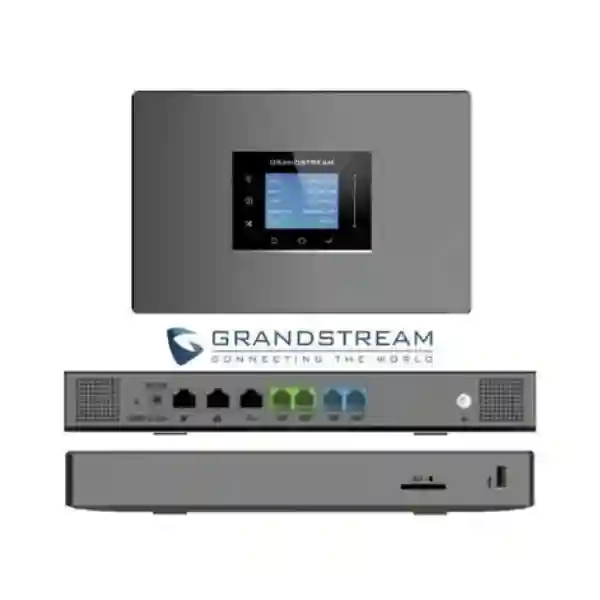
GRANDSTREAM UNIFIED COMMUNICATIONS • TANZANIA
Grandstream UCM6304 IP PBX
The Grandstream UCM6304 is a business IP PBX appliance for organizations that want an on-premises communications core capable of managing extensions, SIP trunks, analogue PSTN and analogue endpoints, call routing, conferencing, remote users and integrated collaboration. FourTeck Tanzania can help businesses plan the PBX around the real voice network: extension counts, receptionist workflows, analogue lines, SIP services, branch connectivity, PoE switching, VLANs, internet resilience, security and user adoption.
What the Grandstream UCM6304 is designed to solve
A growing office often reaches a point where basic phone lines, independent mobile numbers and ad-hoc call forwarding no longer provide enough control. Reception needs a consistent way to route callers. Departments need ring groups, queues and voicemail. Managers need visibility and mobility. Branches need extension-to-extension calling. Remote users need secure access to the corporate telephony environment. The UCM6304 addresses these requirements by bringing business call control into one manageable IP PBX platform.
The model combines IP telephony with analogue connectivity. Its four FXS ports can support analogue telephone or fax-style endpoint requirements where appropriate, while four FXO ports are available for PSTN line integration. This is useful for businesses transitioning from traditional lines to SIP or for environments that need to retain selected analogue services during an IP telephony upgrade. Three self-adaptive Gigabit network interfaces support switched, routed or dual-mode deployment, allowing the PBX to fit into different network designs.
The most successful deployments begin with call-flow design rather than a feature checklist. FourTeck recommends documenting inbound numbers, departments, extension ranges, office hours, after-hours routing, reception overflow, voicemail ownership, recording requirements, emergency-call policy, trunk failover, branch dialing and remote-user requirements before configuration begins. This planning reduces rework and makes the finished system easier for staff to understand and support.
Analogue migration
Four FXS and four FXO interfaces give organizations a practical bridge between legacy analogue requirements and an IP-first communications design.
Unified call control
Centralize extensions, IVR, queues, voicemail, schedules, routing and user privileges so the calling experience follows a consistent business policy.
Hybrid work readiness
Grandstream Wave and remote-connectivity options can extend collaboration beyond the physical office when the system and network are securely designed.
Verified UCM6304 technical highlights
| Area | UCM6304 |
|---|---|
| FXS | 4 RJ11 analogue telephone ports |
| FXO | 4 RJ11 PSTN line ports |
| Network | Three self-adaptive Gigabit interfaces; switched, routed or dual mode |
| Peripheral interfaces | 2 × USB 3.0 and SD card interface |
| Display | 128 × 32 dot-matrix graphic LCD |
| Mounting | Rack mount or desktop |
| Security mechanisms | Support includes SRTP, TLS, HTTPS, SSH and 802.1X |
| Voice / collaboration | SIP communications, conferencing and Grandstream Wave ecosystem integration |
Capacity and feature limits can vary by firmware, codec, conferencing mode and service configuration. A quotation should therefore match the intended user count and workloads against the current Grandstream documentation rather than rely on a single theoretical maximum.
Deployment, integration and buying guidance
A UCM6304 purchase should normally be planned together with the voice network. IP phones may require PoE switch capacity, voice VLANs, DHCP options, DNS, NTP, Quality of Service and secure firewall rules. SIP trunks require provider-specific credentials, addressing and codec settings. Remote users introduce internet, NAT traversal and security considerations. Call recording introduces storage and retention requirements. Branches may require VPN or other controlled connectivity. Treating these as one architecture creates a more predictable result than configuring the PBX after the network has already been fixed in place.
For organizations using Grandstream endpoints, ZeroConfig and central provisioning can simplify deployment. User roles should still be mapped carefully: receptionists, managers, shared-area phones, contact-centre-style users, conference spaces and remote workers may need different phone models or soft clients. A well-designed numbering plan makes extensions easy to remember, and documented call routes make future changes faster.
Power resilience deserves attention. The PBX, switching layer, router, firewall and internet equipment all participate in a VoIP call. Protecting only the PBX with a UPS does not preserve service if the access switch or upstream gateway loses power. Where analogue PSTN lifeline behavior is part of the design, confirm the exact wiring and failover behavior during commissioning. For larger sites, rack placement, ventilation, patching and labelled cabling improve maintainability.
Useful FourTeck Tanzania planning resources include the integrated Tanzania technology portfolio, the FourTeck Tanzania services overview for design and deployment context, and the Tanzania contact page for quotations. For regional requirements, customers can also review FourTeck Uganda and FourTeck Kenya when coordinating East African projects.
Grandstream UCM6304 Tanzania
For organizations searching for the Grandstream UCM6304 in Tanzania, the key procurement question is not simply whether the appliance is available; it is whether the complete voice environment is being sized correctly. Tanzanian businesses may be replacing analogue PBX platforms, consolidating extensions from multiple departments, introducing SIP trunks, supporting branch offices or adding remote staff. The UCM6304 is well suited to these migration scenarios because it combines four FXO and four FXS interfaces with IP-based extension management and unified-communications features. This enables a phased transition in which selected traditional lines can remain while new IP phones and SIP services are introduced.
A Tanzania deployment should begin with an extension and call-flow survey. Count desk users, shared phones, reception positions, conference areas and remote users. Identify inbound telephone numbers and determine whether they arrive over analogue PSTN, SIP or a mixture. Map working hours, holidays, overflow rules, voicemail destinations and escalation paths. If recording is required, define which calls are recorded, who can access recordings and how long they must be retained. If the system will connect multiple branches, document internet connectivity and security policy at each location.
Network readiness is equally important. Voice VLANs can separate phones from ordinary data devices, while QoS can prioritize latency-sensitive traffic when links are busy. PoE switch budgets need to support the selected IP phones. The router or firewall must be configured so SIP traffic is secure and predictable, and remote access should use supported secure methods rather than exposing management interfaces unnecessarily. Tanzania organizations with unstable or diverse internet links may also want to plan dual-WAN resilience at the network edge so remote extensions and SIP services have a more dependable path.
FourTeck Tanzania can help buyers prepare a quotation around the UCM6304, compatible Grandstream phones, PoE switches, network security, rack and UPS requirements. The objective is a maintainable business communications system rather than an isolated PBX appliance. Before purchase, provide the approximate extension count, number of analogue lines, SIP trunk details if known, branch count, remote-user requirements, desired call features and existing network equipment. That information makes model selection, licensing guidance and deployment planning significantly more accurate.
Grandstream UCM6304 Dar es Salaam
Dar es Salaam businesses often operate with a mix of headquarters staff, customer-facing teams, warehouses, service departments and remote employees. In that environment, the Grandstream UCM6304 can provide a central communications platform for reception, department extensions, queues, IVR, voicemail and collaboration. A distributor, professional-services company, hotel office, healthcare administration team or multi-department commercial operation may need callers to reach the correct person quickly without relying on personal mobile numbers. The PBX can bring those workflows into a controlled business dial plan.
The UCM6304 is especially useful where an organization is modernizing in stages. Four FXO interfaces allow integration with compatible analogue PSTN lines, while four FXS ports can accommodate selected analogue endpoints. At the same time, SIP-based desk phones and Wave users can form the main communications environment. This hybrid approach may reduce pressure to replace every element at once. During design, identify which analogue services truly need to remain and which can be moved to IP, because unnecessary analogue dependencies can complicate long-term management.
For Dar es Salaam sites with several floors or buildings, network topology should be reviewed before phone rollout. Confirm that switching supports enough PoE power, uplinks are not congested, voice VLANs are consistently configured and the PBX location has stable power and cooling. If branches or remote users connect over the internet, firewall rules and link capacity should be assessed together. Call quality problems are frequently caused by network conditions rather than by the PBX itself, so proactive testing is more useful than troubleshooting after users are live.
A practical quote request should include the number of employees, expected simultaneous calls, number of receptionists, analogue trunks, desired SIP provider, phone models already installed, conference requirements, call recording needs and plans for branches. FourTeck can then align the UCM6304 with IP phones, PoE switching and supporting infrastructure. Customers planning a wider communications upgrade can also use the main FourTeck Tanzania portfolio to coordinate voice with Wi-Fi, switching, firewall, structured cabling and UPS requirements.
Grandstream UCM6304 Mwanza
Organizations evaluating the Grandstream UCM6304 in Mwanza may need a phone system that can serve a main office while remaining practical for satellite locations, field teams or expanding departments. The UCM6304 allows businesses to create a consistent extension plan, route calls through IVR menus and ring groups, and give staff access to common telephony features regardless of whether they are seated in one department or spread across operational areas. This can be valuable for trading companies, logistics operations, hospitality administration, education, healthcare and service businesses where dependable internal communication supports daily coordination.
The appliance supports both IP and analogue integration, making it suitable for gradual modernization. Four FXO ports can connect compatible traditional lines, and four FXS ports can support legacy analogue endpoints where they remain necessary. The design should still aim for a clean future state. Buyers should decide which lines are temporary migration elements, which services are business-critical and which endpoints will move to SIP. This prevents a new PBX from inheriting years of undocumented analogue routing.
Mwanza projects should account for network and power conditions. The UCM6304, PoE switches, router and firewall should ideally be protected by suitable UPS capacity, because keeping only the PBX powered does not preserve IP calling when the network layer is offline. For sites with multiple switches, consistent VLAN configuration and uplink planning reduce intermittent audio issues. Where internet-based SIP trunks or remote users are involved, bandwidth, latency and failover options should be tested. A second internet path can be useful when voice continuity is important, provided failover is configured and validated at the firewall or router.
For procurement, include the current telephone environment in the request: existing analogue lines, extension count, expected growth, SIP requirements, call queues, recording, remote access and any branch-office plans. FourTeck can use this information to determine whether the UCM6304 is appropriately sized and which Grandstream phones, switches, network components and accessories belong in the solution. Clear requirements at the quotation stage help avoid both under-specification and unnecessary spending.
Grandstream UCM6304 Arusha
Arusha businesses often combine office administration with guest services, reservations, logistics, tourism operations, professional services, education or multi-site coordination. The Grandstream UCM6304 can support these environments by providing centralized extension management and flexible call routing. A caller can be presented with an IVR, routed to reservations or sales, transferred to a department, placed into a queue or sent to voicemail according to business rules. Internal users can dial consistent extensions instead of relying on a mix of personal mobile numbers and standalone lines.
For organizations that still depend on analogue PSTN connections, the four FXO interfaces offer a migration path, while the four FXS interfaces can support selected analogue devices. New users can be deployed on SIP phones, and remote or mobile staff can use supported Grandstream collaboration tools. This allows a business to modernize without forcing every endpoint onto the same migration schedule. The final architecture should nevertheless be documented so technicians know which calls use analogue trunks, SIP trunks or internal IP routes.
In hospitality and tourism-related operations, call handling often spans front office, reservations, finance, management and back-office teams. These groups may need different ring strategies and permissions. A receptionist may require more programmable keys and visibility, while ordinary users may need only straightforward calling and voicemail. Designing endpoint roles before purchasing phones reduces cost and improves user experience. Where a property or campus has several network segments, voice VLANs and managed switching make it easier to isolate, prioritize and troubleshoot traffic.
A FourTeck quotation for Arusha should ideally include approximate room or desk extension counts, staff extensions, current telephone lines, SIP provider details, call recording requirements, internet links and any branch connectivity. For wider infrastructure work, the UCM6304 can be planned alongside PoE switching, firewall security, Wi-Fi, rack organization, structured cabling and UPS systems. That integrated approach helps ensure the PBX is supported by a network designed for business voice rather than simply connected to whatever ports are available.
Grandstream UCM6304 Dodoma
Organizations seeking the Grandstream UCM6304 in Dodoma may be planning a new office, upgrading an older PBX or standardizing communications for multiple departments. The UCM6304 provides a structured foundation for extension dialing, incoming-call distribution, voicemail, queues, schedules and collaboration. Government-facing contractors, professional services, NGOs, education institutions, healthcare organizations and growing commercial teams can use a centralized PBX to keep business numbers independent from individual employee mobile devices and to create predictable call-routing policies.
A strong design begins with the caller journey. Determine which number a customer dials, what greeting they hear, which department receives the call, what happens if no one answers and how after-hours calls are handled. Then map internal workflows such as management extensions, reception transfer paths, departmental hunt groups, conference rooms and remote staff. With these decisions documented, configuration is easier to test and users receive a system that matches real operations rather than a generic template.
The UCM6304’s analogue interfaces can be valuable during transition. Four FXO and four FXS ports allow compatible PSTN lines and analogue endpoints to coexist with SIP devices. However, buyers should confirm analogue requirements early because trunk type, cabling and failover design affect installation. IP phone deployments should also include PoE capacity, DHCP planning, VLAN configuration and UPS protection. If SIP trunks are being introduced, provider interoperability and firewall behavior should be tested before cutover.
For Dodoma procurement, FourTeck can build a quote that includes the UCM6304, appropriate Grandstream phone families, PoE switching, rack and power components and configuration services. Provide the expected number of users, concurrent calls, analogue lines, branch sites, remote workers, queues and recording requirements. It is also useful to describe future growth, because extension count and conferencing demand can increase significantly after a system is deployed. Buying with a realistic three-to-five-year view can reduce disruptive redesign later.
Grandstream UCM6304 UAE
For UAE organizations considering the Grandstream UCM6304, the buying decision commonly centers on replacing legacy PBX hardware, integrating SIP trunks, supporting hybrid users and standardizing communications across offices. The UCM6304 provides a compact on-premises unified communications platform with IP extension management plus four FXO and four FXS interfaces for analogue integration. This makes it attractive for businesses that want to modernize while retaining selected traditional line or endpoint requirements during migration.
UAE deployments often involve structured office networks and multiple managed services, so the PBX should be integrated deliberately with the firewall, switching, VLAN and internet design. SIP trunk behavior, NAT rules and QoS should be tested against the chosen carrier. Remote users should connect through supported secure mechanisms, and administrative interfaces should be restricted rather than publicly exposed. If the business has multiple branches, extension numbering, site codes and inter-office routing should be planned before the configuration is built.
Endpoint selection can be role-based. Reception may need a larger phone with programmable keys or an expansion module, managers may value premium features, standard users can use simpler desk phones and hybrid staff may combine a physical phone with Wave. This approach avoids paying for advanced hardware at desks that do not need it. The same planning applies to meeting rooms, where voice and video collaboration requirements should be separated from ordinary desk telephony.
FourTeck’s regional network can help organizations coordinate cross-border projects. UAE-focused customers can use FourTeck’s Grandstream UAE resource for regional Grandstream requirements, while Tanzanian deployments can be coordinated through FourTeck Tanzania. A complete quote should include user count, phone roles, SIP trunk information, analogue lines, branch topology, recording policy, conferencing demand and network-security requirements. Those details allow the UCM6304 to be assessed as part of the full communications architecture rather than as an isolated appliance.
Grandstream UCM6304 Uganda
Ugandan organizations evaluating the Grandstream UCM6304 may be managing a headquarters, several branches or a workforce split between offices and field locations. A centralized IP PBX can simplify this environment by giving users one extension plan, consistent call-routing rules and common voicemail, queue and meeting features. The UCM6304’s combination of SIP capability, Grandstream endpoint provisioning and analogue interfaces makes it suitable for businesses that are moving from traditional telephony toward a more flexible IP communications model.
Before deployment, identify how each branch connects to the main communications system. Some sites may use site-to-site VPN, while others may depend on secure remote connectivity over public internet. The goal is to protect signaling and media without making calls unnecessarily complex. Bandwidth and latency should be checked, especially when internet circuits are shared with cloud applications, CCTV uploads or large data transfers. Quality of Service can help prioritize voice when congestion occurs, but it cannot compensate for an unreliable link.
The four FXO ports can help retain compatible analogue trunks during migration, and the four FXS ports can support selected analogue devices. Still, buyers should avoid keeping legacy connections simply because ports are available. Each analogue dependency should have a documented business reason. New desks can be provisioned with SIP phones, while mobile users may use supported Wave options. Central provisioning and consistent templates are particularly valuable when phones are distributed across multiple locations.
For a Uganda quote, provide user and branch counts, expected simultaneous calls, current trunks, remote-user needs, phone preferences, recording requirements and desired support scope. FourTeck Uganda can be referenced at FourTeck Uganda for regional project coordination. Cross-border customers operating in both Uganda and Tanzania can use a common Grandstream architecture while adapting trunk services, network conditions and support workflows to each site.
Grandstream UCM6304 Kampala
Kampala businesses often need a phone platform that can handle a busy reception, sales or support queues, multiple departments and users who move between office and remote work. The Grandstream UCM6304 can centralize these functions and provide a consistent dial plan for organizations that have outgrown basic analogue systems. Incoming calls can be routed according to department, schedule or queue logic, while internal users receive standard extension and voicemail functions. This creates a more professional caller experience and reduces dependence on individual mobile numbers.
Network design is crucial in dense office environments. IP phones should ideally sit on a managed voice VLAN with appropriate QoS and controlled access to PBX services. PoE switches need adequate power budgets, and uplinks should be sized for the combined traffic of phones, PCs, wireless access points and other network devices. If the PBX uses SIP trunks, the firewall should be configured using the carrier’s supported requirements rather than generic port-forwarding assumptions.
The UCM6304’s four analogue FXO ports provide flexibility for organizations that still use PSTN connections, while four FXS ports can serve necessary analogue endpoints. That flexibility can reduce migration risk, but the target architecture should remain clear. Businesses should decide whether analogue trunks are permanent, backup or temporary. They should also document how incoming calls are distributed if a SIP service or internet path is unavailable.
A Kampala procurement request should include expected extensions, number of reception and queue users, trunk type, branch requirements, remote workers, call recording, conferencing and desired handset roles. FourTeck can then match the UCM6304 to suitable Grandstream endpoints and supporting switches, firewall and power infrastructure. For organizations with Tanzania operations as well, the same design principles can support a standardized multi-country deployment while keeping local carrier and network specifics separate.
Grandstream UCM6304 Arua
Businesses and institutions in Arua may value the Grandstream UCM6304 because it can consolidate office calling while supporting both modern SIP endpoints and selected analogue connections. For a regional office, NGO, healthcare administration unit, school, trading organization or service company, a structured extension plan can improve internal coordination and give external callers a stable business number with professional routing. Departments can be reached through IVR options, ring groups or queues instead of callers depending on direct personal numbers.
Connectivity planning is particularly important for sites that rely on shared or variable internet services. If SIP trunks or remote extensions are essential, the network should be tested for latency, jitter, packet loss and failover behavior. A secondary internet connection can improve resilience, but only when the router or firewall is configured to move voice sessions appropriately and the SIP provider supports the resulting network behavior. Local extension calling inside the office can remain available even when external connectivity is degraded, depending on the architecture.
Power protection should include the entire voice path. The UCM6304, PoE switches, router and firewall should be considered together when sizing UPS runtime. If analogue PSTN lines are part of the resilience strategy, the lifeline behavior and physical connections should be tested during commissioning rather than assumed. Good documentation is equally important, especially when support teams may need to troubleshoot the system remotely.
For an Arua quote, list current telephone lines, employee extensions, remote users, office hours, call queues, voicemail requirements and projected growth. Explain whether the site will operate independently or connect to Kampala, Tanzania or other branches. This allows the UCM6304 configuration to reflect the actual organization. Selecting phones by user role and planning spare capacity for future staff can also reduce later changes. FourTeck’s regional resources can help organizations keep a common Grandstream standard across East African locations.
Grandstream UCM6304 Mbarara
The Grandstream UCM6304 can suit Mbarara organizations that need a more organized approach to business calling across reception, administration, sales, service and management. Instead of routing calls manually through a small set of analogue extensions, the PBX can support a documented numbering plan, IVR menus, ring groups, queues and voicemail. This gives the business greater control over how callers are handled and how staff communicate internally.
A migration project should inventory existing equipment before deciding what to retain. The UCM6304 includes four FXO ports for compatible analogue trunks and four FXS ports for analogue endpoints. Those interfaces make phased migration possible, but every legacy connection should be tested for line quality and business necessity. New SIP phones can be rolled out department by department, and central provisioning can make configuration more consistent as the deployment grows.
If Mbarara is part of a multi-site organization, extension numbering should anticipate branch growth. A simple site-code scheme can make internal dialing more intuitive and help administrators understand call routes. Branch connectivity may use secure IP links or supported remote-connectivity methods. Network bandwidth, firewall policy and internet resilience determine how dependable inter-site calls will be. Voice VLANs and QoS can improve manageability and prioritize traffic, while UPS protection keeps the supporting network online during short power interruptions.
A useful quotation request should state how many employees need phones, how many calls are expected at busy times, whether reception uses a console-style workflow, which analogue or SIP trunks are available and whether recording or conferencing is required. FourTeck can then build the PBX into a wider solution with Grandstream endpoints, PoE switches, network security and rack or power components. This approach is more reliable than purchasing the PBX first and discovering infrastructure limitations during installation.
Grandstream UCM6304 Gulu
Gulu organizations considering the Grandstream UCM6304 may be looking for a platform that provides professional call handling without requiring a complex enterprise communications stack. The appliance can centralize extensions, inbound routing, voicemail, queues and meeting functions while supporting Grandstream SIP endpoints and selected analogue connections. This can be useful for offices, institutions, NGOs, service companies and regional operations that need a consistent communication platform for staff and callers.
Deployment quality depends on planning. Start by deciding how many users require dedicated desk phones, how many can use soft clients, which departments share ring groups and where after-hours calls should go. Document any requirement for call recording, external paging, fax-style devices or analogue trunks. The four FXS and four FXO interfaces can be useful, but they should be allocated deliberately rather than treated as generic spare ports.
For remote or branch connectivity, measure internet quality and security requirements before promising a seamless experience. Packet loss and unstable latency can affect voice even when general web browsing appears acceptable. Managed switching, voice VLANs and QoS create better control inside the site. UPS design should include the PBX, switches and gateway equipment so that communications do not fail simply because one upstream device loses power.
A Gulu quote can be more accurate when the buyer provides a simple communications worksheet covering extension count, concurrent calls, current PSTN or SIP lines, branch offices, remote users, existing switches and firewall, and expected growth. FourTeck can then assess whether the UCM6304 is the right model and pair it with suitable phones and infrastructure. Organizations operating across Uganda and Tanzania can also standardize configuration templates, phone families and support documentation while allowing each branch to keep its local carrier arrangements.
Grandstream UCM6304 Kenya
Kenyan businesses considering the Grandstream UCM6304 may need a communications platform for a single large office, a network of branches or a mixed office-and-remote workforce. The UCM6304 can provide centralized call control while supporting SIP endpoints, Grandstream Wave users and analogue migration requirements. Four FXO and four FXS ports provide flexibility for organizations that still have traditional lines or devices, while the broader UCM6300 platform supports modern IP-based calling and collaboration.
For multi-branch organizations, planning should focus on extension ranges, trunk routing and WAN resilience. Branches can use a common dialing structure so users call colleagues as extensions rather than as external numbers. The firewall and network design should protect PBX services while supporting secure remote access. If SIP trunks are centralized at one site, the organization should consider what happens to branch calling when that site or its internet service is unavailable. Distributed trunks or other continuity strategies may be appropriate depending on business priorities.
Phone selection should reflect user roles. Reception staff benefit from programmable keys and line visibility; ordinary users may need reliable basic SIP phones; managers may want richer displays or connectivity; meeting rooms may use separate conferencing equipment. Central provisioning can reduce deployment effort when many devices are involved. Managed PoE switching and voice VLANs also improve support by making it easier to identify and isolate phone traffic.
FourTeck Kenya is available at FourTeck Kenya for Kenyan project context, while Tanzania requirements can be coordinated through FourTeck Tanzania. Businesses operating in both markets can benefit from a consistent Grandstream architecture, shared configuration standards and common documentation. A procurement request should include user count, concurrent calls, trunk providers, branch topology, recording, conferencing and support requirements so the UCM6304 can be evaluated against the real workload.
Grandstream UCM6304 Kuwait
Kuwait organizations evaluating the Grandstream UCM6304 may be replacing a legacy PBX, deploying a new office or creating a standardized voice platform for several departments. The UCM6304 offers a practical combination of IP communications and analogue connectivity. Its four FXO and four FXS ports can support migration from traditional lines and endpoints, while SIP phones and Grandstream Wave can form the basis of a modern unified communications deployment.
A well-designed Kuwait deployment should begin with trunk strategy and user roles. Confirm the carrier services that will connect to the PBX, whether existing analogue lines remain in use and which users need mobility. Determine how calls should route during working hours, after hours and during trunk failure. For reception-heavy businesses, define overflow and queue behavior so callers are not left ringing indefinitely. Recording and retention policies should also be decided before storage requirements are finalized.
The underlying LAN must support real-time voice. Managed PoE switching, VLANs, QoS and stable routing create a predictable environment for IP phones. Firewalls should allow only necessary PBX and SIP traffic and should not expose management interfaces broadly. For branch or remote connectivity, encryption and access control are essential. The UCM6304 can participate in this architecture, but the security model must cover the full network rather than the PBX alone.
Regional buyers can refer to FourTeck Kuwait for Kuwait-focused coordination. For organizations with Tanzania and Kuwait operations, a common Grandstream platform can reduce training and support variation while allowing local trunk services to remain independent. Include endpoint counts, call concurrency, trunk types, meeting requirements, recording, remote users and expected growth in the quotation so that the UCM6304 is assessed within the full communications design.
Grandstream UCM6304 Ghana
Ghanaian businesses seeking the Grandstream UCM6304 may want a locally controlled IP PBX that can support formal call routing, internal extension dialing, departmental queues and hybrid users. The UCM6304 can serve as the communications core for organizations moving away from fragmented analogue telephone systems. Its four FXO and four FXS ports offer a bridge for compatible traditional trunks and endpoints, while SIP-based phones can be deployed as the main user experience.
A migration plan should define which analogue lines remain and which services move to SIP. If the business depends on external SIP trunks, test interoperability, codecs, caller ID behavior, DTMF and failover before the final cutover. If multiple branches will connect, the numbering plan should be designed centrally so new sites can be added without renumbering existing users. Remote access should be implemented using secure supported methods, with administrative access restricted to authorized networks or users.
Power and internet continuity are important parts of voice design. A UPS should cover the PBX as well as the switches and network edge that carry calls. Voice VLANs and QoS can improve consistency on busy networks, while monitoring helps identify packet loss or congestion before users report persistent call-quality issues. For larger organizations, documenting switch ports, phone MAC addresses, extensions and user assignments can save substantial time during support and staff changes.
Ghana-focused requirements can be coordinated through FourTeck Ghana, with Tanzania deployments handled through FourTeck Tanzania. A cross-regional organization can standardize PBX templates, endpoint families and support procedures while selecting trunks and network services independently in each market. For a useful quote, provide extension counts, simultaneous-call estimates, analogue requirements, branch topology, recording, conferencing and user mobility needs.
Grandstream UCM6304 Nigeria
Nigerian businesses evaluating the Grandstream UCM6304 often need a communications system that can scale across departments while remaining manageable by an internal IT team or service provider. The UCM6304 supports centralized extensions, SIP trunks, call routing, voicemail, conferencing and remote collaboration, with four FXO and four FXS interfaces available for analogue integration. This balance makes it suitable for organizations that cannot move every legacy line or endpoint to IP at once.
Because many businesses operate from multiple sites, branch planning is a major part of deployment. Extension numbering should make sense across locations, and internet links should be evaluated for voice quality rather than only raw bandwidth. A link with high throughput can still create poor calls if latency, jitter or packet loss are unstable. QoS can prioritize voice inside the managed network, while redundant internet paths can improve resilience when properly configured. SIP trunk providers should also be tested for how they behave during failover.
Security should be built into the design from the beginning. PBX administration should be restricted, strong credentials should be used, firmware should be maintained and unnecessary services should remain disabled. Remote users need controlled access, and firewall rules should be specific rather than broadly permissive. Call recording and voicemail data should be protected according to the organization’s policies. These operational measures are as important as choosing the correct PBX appliance.
Nigeria-focused projects can use FourTeck Nigeria, while Tanzania organizations can work through FourTeck Tanzania. A procurement brief should list users, peak simultaneous calls, branch offices, analogue lines, SIP trunks, phone types, conferencing and recording requirements. With that information, the UCM6304 can be sized and integrated with suitable Grandstream phones, PoE switches, network security and power infrastructure instead of being purchased as a stand-alone box.
Grandstream UCM6304 Seychelles
Seychelles businesses considering the Grandstream UCM6304 may include hotels, resorts, professional offices, service companies and multi-site organizations that need a controlled business telephony environment. The UCM6304 can centralize internal extensions, reception workflows, call routing, voicemail and collaboration. Its analogue interfaces can help integrate selected PSTN lines or legacy endpoints while the wider deployment moves toward SIP phones and unified communications.
Hospitality and customer-service environments should plan call flows in detail. Reception, reservations, management and operational departments may require different ring groups and escalation rules. The PBX should make it easy for a caller to reach the correct team while allowing staff to transfer calls without confusion. If guest-room telephony or specialized hospitality integration is required, compatibility should be validated separately rather than assumed from general PBX capability.
Island connectivity can make network resilience particularly important for remote access and SIP services. Businesses should evaluate internet quality, redundancy and firewall behavior before relying on a cloud-based trunk or remote extension as the only calling path. Managed PoE switches, voice VLANs and UPS protection provide a stable local foundation. If analogue lines are retained for continuity, their routing and failover behavior should be tested during installation so staff understand what remains available during an internet outage.
For Seychelles procurement, provide the number of office users, reception positions, analogue lines, SIP trunks, branches or properties, recording requirements and expected growth. FourTeck can use this information to determine whether the UCM6304 is an appropriate fit and what phones, network components and power protection should be included. Organizations with operations elsewhere in Africa can also benefit from standardized Grandstream configuration and documentation, while adapting carrier services and resilience plans to each country.
Related infrastructure for a UCM6304 deployment
Grandstream IP phones
Choose phone models by role: reception, management, standard desk users, conference rooms and mobile staff. Standardization simplifies provisioning and support.
Managed PoE switching
PoE switches power IP phones and support VLAN and QoS policies. Capacity should include both port count and total PoE budget with growth margin.
Firewall and WAN resilience
Secure SIP and remote connectivity, control management access and design failover around the actual trunk and internet architecture.
UCM6304 quotation checklist
For a more accurate quotation, prepare the following information:
- Total extension count now and expected in the next few years
- Estimated peak simultaneous external calls
- Existing analogue PSTN lines and analogue devices
- SIP trunk provider and account details if already selected
- Reception, queue and call-centre-style workflows
- Call recording and retention requirements
- Branch offices and inter-site dialing requirements
- Remote or mobile user requirements
- Existing Grandstream phones or other SIP endpoints
- PoE switch, firewall, internet and UPS environment
- Required implementation, migration and support scope
Frequently asked questions about Grandstream UCM6304
Does the UCM6304 support analogue telephone lines?
Yes. The UCM6304 has four FXO ports for compatible PSTN line connections. It also has four FXS ports for analogue endpoint requirements. The exact wiring, carrier characteristics and failover behavior should be tested during deployment.
Can the UCM6304 be used with Grandstream IP phones?
Yes. Grandstream provides provisioning and ZeroConfig capabilities intended to simplify supported Grandstream endpoint deployment. Phone models should be selected according to user role and required features.
Can remote employees use the UCM6304?
The UCM6300 platform supports remote-collaboration options including Grandstream Wave. Remote access should be designed securely and matched to the current firmware and service capabilities in Grandstream documentation.
Is the UCM6304 rack mountable?
Yes. Grandstream documents the UCM6304 for rack-mount or desktop installation. Rack deployments should allow suitable ventilation, organized patching and protected power.
What network preparation is recommended?
Managed PoE switching, a documented voice VLAN, QoS, stable DNS and NTP, secure firewall policy, adequate internet capacity and UPS protection are common design elements. The exact requirements depend on phone count, trunk type, remote users and branch architecture.
How should I choose between UCM6304 and another UCM model?
Compare the current official model limits with your expected extension count, simultaneous calls, conferencing demand, analogue-port requirements and projected growth. A model should be selected around real workloads, not only the number of employees.
Decision recap
Choose the Grandstream UCM6304 when the organization needs a business-class on-premises IP PBX with a meaningful mix of IP communications and analogue connectivity, rack deployment, central call control and collaboration features. The model is especially relevant to businesses that want to migrate in stages while keeping four FXO and four FXS interfaces available.
The PBX should be treated as one part of the communications system. Phones, PoE switching, VLANs, firewall rules, internet services, SIP trunks, UPS protection, recording storage and user training all influence the result. FourTeck can help align these components with the business call flow and procurement plan.
Consult FourTeck Tanzania about UCM6304
When requesting a Grandstream UCM6304 quotation, include enough information for the communications design to be checked before products are finalized. A short list of users and phones is helpful, but a better request also includes trunk types, expected call concurrency, branches, remote users, reception workflow, queues, recording, conferencing and existing network infrastructure. This gives the project team a basis for recommending the correct PBX, phone mix, PoE switching and supporting equipment.
Use the FourTeck Tanzania contact page to request a UCM6304 quote or discuss an IP PBX migration. For larger technology projects, FourTeck can also coordinate the PBX with switching, firewall, Wi-Fi, cabling, rack and UPS requirements so the communications platform is designed as part of the wider business network.



Reviews
There are no reviews yet.