

Grandstream HT812 v2 Tanzania
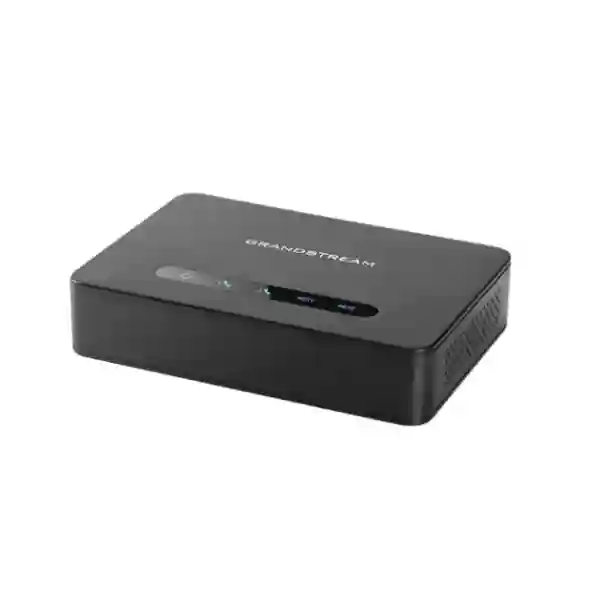
The Grandstream HT812 v2 is a two-port analog telephone adapter designed for businesses and service providers that need to connect existing analog telephones or fax devices to modern SIP-based voice services. It combines two RJ11 FXS ports with dual 10/100/1000 Mbps Ethernet interfaces and an integrated NAT router, making it more than a basic analog-to-IP converter. For organisations in Tanzania that want to retain familiar analog handsets while introducing IP PBX, hosted SIP or branch VoIP services, the HT812 v2 provides a practical bridge between legacy endpoints and current IP communications.
Choose the HT812 v2 when you need two analog phone or fax connections, SIP registration and Gigabit Ethernet in one compact ATA. It is particularly useful when replacing analog trunks or extending an IP PBX to devices that still require an FXS interface.
Small offices, reception points, branch sites, service desks, home offices, fax migration projects and multi-site organisations that want to keep selected analog endpoints while standardising the wider voice platform on SIP.
Before ordering, confirm the number of analog endpoints, SIP service credentials, PBX compatibility, dial plan, fax requirements, network addressing and whether the integrated NAT function will be used or the ATA will sit behind an existing router or firewall.
What the Grandstream HT812 v2 does
An analog telephone adapter converts the signaling and audio from a traditional analog telephone or fax device into IP-based voice traffic. The HT812 v2 provides two FXS interfaces, so two analog endpoints can be connected directly. Each port can be associated with SIP service configuration, allowing organisations to preserve devices that are still useful while moving call routing, extensions and carrier connectivity to an IP platform.
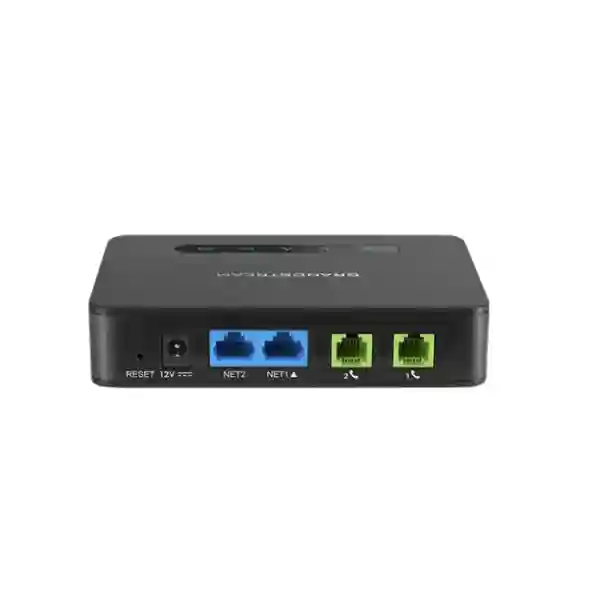
The integrated dual Gigabit Ethernet interfaces are a key distinction between the HT812 v2 and simpler two-port ATAs. Grandstream documents two 10/100/1000 Mbps RJ45 network ports. In the default configuration, NET1 acts as the WAN-side interface and NET2 as the LAN-side interface, and their roles can be changed through the web interface. This makes the HT812 v2 suitable for deployments where a compact ATA also needs to participate in local routing. The design supports residential and business deployments, including larger rollouts where automated provisioning and central management matter.
Key features and customer benefits
Two FXS ports
Connect two analog phones or fax devices using standard RJ11 interfaces. This supports selective migration where analog endpoints remain in service while the surrounding telephony platform moves to SIP.
Two SIP profiles
The platform supports two SIP profiles through its FXS ports. This gives administrators flexibility when mapping services, extensions and provider settings to connected analog devices.
Dual Gigabit Ethernet
Two 10/100/1000 Mbps Ethernet ports make the HT812 v2 suitable for modern networks where an ATA may sit between upstream connectivity and a local Ethernet device or subnet.
Integrated NAT router
The device includes NAT routing functionality, which can simplify compact deployments. Where a site already uses a business firewall or managed router, the preferred topology should be planned to avoid unnecessary double-NAT or conflicting DHCP behaviour.
Secure voice options
Grandstream lists TLS and SRTP technologies for protecting SIP signaling and media, plus AES encryption and a unique security certificate per unit. Actual protection depends on compatible configuration across the ATA, PBX and provider.
T.38 fax support
T.38 fax relay is supported, with G.711 pass-through available in compatible deployments. Fax over IP remains dependent on the PBX, SIP trunk, network quality and remote endpoint, so end-to-end testing is recommended.
Automated provisioning
TR-069 and XML configuration options are documented for automated provisioning. This is useful for providers and IT teams managing multiple units because standard settings can be repeated more consistently than manual setup.
Grandstream UCM integration
Grandstream identifies the HT812 v2 as compatible with UCM series IP PBXs for Zero Configuration provisioning, making it a natural fit for organisations already standardising on Grandstream communications infrastructure.
HT812 v2 technical specification summary
| Specification | Verified detail |
|---|---|
| Analog interfaces | Two RJ11 FXS ports |
| SIP capacity | Two SIP profiles |
| Network interfaces | Two 10/100/1000 Mbps RJ45 Ethernet ports |
| Routing | Integrated NAT router |
| Voice security | TLS and SRTP; AES encryption and device-specific certificate are supported |
| Fax | T.38 Group 3 fax relay up to 14.4 kbps with G.711 pass-through support |
| Voice codecs | G.711, G.722, G.723.1, G.729A/B, G.726-32, iLBC and OPUS are documented in the HT81x v2 administration guide |
| Provisioning | TR-069 and XML configuration files |
| Conferencing | 3-way voice conferencing per port |
| Failover | Secondary SIP server failover supported |
| Indicators | POWER, NET1, NET2, PHONE1 and PHONE2 |
Specifications above are based on current Grandstream product documentation. Confirm firmware, regional package contents, local power supply and service-provider interoperability at quotation or deployment stage.
Deployment, configuration and integration guidance
A successful HT812 v2 deployment starts with a clear call-flow and network plan. Connect the analog device to the required FXS port, connect NET1 or NET2 according to the selected topology, apply power using the appropriate adapter and then configure SIP account details through the web interface or provisioning system. Grandstream documentation identifies NET1 as WAN by default and NET2 as LAN by default, with DHCP client and DHCP server roles respectively. These defaults can be changed, which is useful when adapting the device to a particular branch or service-provider design.
For a business environment, the ATA should normally be considered part of the voice architecture rather than installed in isolation. Confirm VLANs, QoS, firewall rules, SIP ALG behaviour, DNS, NTP, upstream routing and failover expectations. Where a managed firewall already provides routing and DHCP, decide whether the HT812 v2 NAT function is necessary. In many office deployments, using the existing network edge for routing can simplify monitoring and policy control, while the ATA focuses on voice conversion.
For customers using Grandstream UCM IP PBX systems, Zero Configuration can simplify provisioning. For other SIP platforms, verify registration credentials, transport protocol, codecs, DTMF method, caller ID requirements and dial plan. If fax is important, test both T.38 and any required fallback method with the actual provider rather than assuming compatibility from the ATA alone.
Useful FourTeck resources for a complete voice deployment
The HT812 v2 often sits inside a wider IP telephony project. Review the FourTeck Tanzania technology shop when you need related IP phones, PBX equipment, networking hardware or supporting infrastructure. For organisations planning migration, installation or configuration work, the FourTeck Tanzania services page provides broader context around integrated IT and communication support.
Regional projects can also use the FourTeck Uganda, FourTeck Kenya and FourTeck Kuwait sites as reference points for multi-country ICT requirements. These links are useful for organisations that standardise telephony across regional branches and need a consistent purchasing or technical discussion.
Grandstream HT812 v2 Tanzania
For customers evaluating the Grandstream HT812 v2 in Tanzania, the main purchasing question is usually how to retain specific analog telephones or fax machines while moving the wider organisation toward SIP-based communications. The HT812 v2 is particularly relevant where an office already has an IP PBX, hosted SIP service or planned VoIP migration but still depends on two analog endpoints. The two FXS ports allow those endpoints to remain usable without dedicating a full analog gateway, while the dual Gigabit Ethernet interfaces and integrated NAT capability give the device more network flexibility than a basic single-port ATA.
A Tanzania deployment should be scoped around the actual service provider and network environment. Buyers should confirm whether the SIP service uses TLS, whether SRTP is supported end to end, which codecs are preferred, how caller ID is presented and whether emergency or special-service numbers require particular dialing rules. If the device will be used for fax, T.38 support on the HT812 v2 is only one part of the path; the IP PBX and carrier also need compatible handling. For branch offices or organisations operating multiple sites, central provisioning using TR-069 or XML can reduce configuration drift and make replacement units easier to prepare consistently.
Power and connectivity resilience should also be considered. An ATA does not keep communications available if the upstream router, switch, internet connection or PBX loses power. Where voice availability matters, place the HT812 v2 and supporting network equipment on suitable UPS protection and document the call path. Procurement teams should request the exact model revision, quantity, required power accessories and deployment scope. They should also specify whether configuration, testing, SIP registration, dial-plan setup or on-site integration is required. This produces a more useful quotation than asking only for an HT812 v2 price in Tanzania.
For small offices, clinics, hotels, schools, retail branches, professional services, warehouses and other business environments, the HT812 v2 can be a focused migration tool. It does not replace a complete PBX, SIP trunk or network-security design, but it can preserve two analog devices while allowing the organisation to standardise the rest of its communications on IP. That makes it useful both for new deployments with legacy requirements and for phased migrations where analog services cannot be removed immediately.
Grandstream HT812 v2 Dar es Salaam
Businesses in Dar es Salaam often operate in environments where communications must serve reception desks, sales teams, administration, warehouses, hospitality sites and branch connections at the same time. The Grandstream HT812 v2 is useful when only a small number of analog endpoints need to remain part of that environment. A reception fax, legacy analog phone, intercom interface or other approved analog device can connect through one of the two FXS ports while the organisation continues using SIP for call routing and trunking.
Before purchasing an HT812 v2 in Dar es Salaam, map the device into the existing LAN. If the office already has a firewall, managed switches and VLANs, the ATA can be placed on the voice network according to the organisation’s segmentation policy. The dual Gigabit interfaces can provide local network flexibility, but the integrated NAT function should only be used when it fits the topology. Avoid creating double-NAT unintentionally, because that can complicate SIP registration, remote troubleshooting and port handling. Where possible, document IP addressing, DHCP reservations, DNS, NTP, SIP server details and the physical location of the unit.
Dar es Salaam buyers comparing ATA quotations should focus on configuration scope as well as hardware. Ask whether the quotation includes only the device or also SIP account setup, PBX integration, call testing, fax validation, firmware review and user handover. If the deployment is part of a Grandstream UCM environment, Zero Configuration can simplify provisioning. In third-party PBX environments, interoperability should be tested against the exact SIP platform and carrier. TLS and SRTP can improve protection when supported end to end, but they need coordinated settings across every component.
The HT812 v2 is therefore a good fit for Dar es Salaam offices that have a targeted need for two analog ports rather than a large analog gateway. It can support gradual VoIP migration, branch standardisation and preservation of selected analog equipment without forcing an organisation to keep an entire legacy telephony platform. For procurement, provide the intended analog devices, SIP provider, PBX model, network design and any fax requirements so the solution can be checked before order confirmation.
Grandstream HT812 v2 Mwanza
In Mwanza, the Grandstream HT812 v2 can support offices, branches, education sites, healthcare facilities, retail operations and service businesses that are modernising voice communications while retaining a small number of analog devices. The device’s two FXS ports are designed for exactly that type of transitional requirement. Instead of maintaining a larger analog PBX solely because one or two handsets or fax machines are still needed, the HT812 v2 can present those endpoints to a SIP-based service.
Connectivity planning is important for Mwanza deployments, especially when an office depends on an internet-based SIP trunk or cloud PBX. Call quality is affected by latency, packet loss, jitter and contention on the WAN link. The ATA supports wideband codecs including G.722 and OPUS, but the practical voice experience depends on what the provider and PBX negotiate and on the condition of the network. Businesses should prioritise voice traffic where appropriate, prevent large backups or guest traffic from saturating the connection and maintain clear firewall rules for the chosen SIP architecture.
The integrated NAT router may be useful in a compact branch, but it should not automatically become the main router in every installation. If the site already has a managed firewall, SD-WAN appliance or ISP router performing NAT, the network design should identify one clear routing boundary. This makes troubleshooting easier and reduces the chance of SIP-related problems caused by nested NAT. Administrators should also use secure credentials, review firmware and apply TLS or SRTP when supported by the service.
For procurement teams looking for the HT812 v2 in Mwanza, a useful quotation request includes the number of units, analog endpoint type, SIP server or IP PBX details, required deployment date, whether fax is involved and whether configuration assistance is needed. When several branches are being standardised, automated provisioning becomes more valuable because it allows similar settings to be deployed repeatedly. The goal is not simply to buy an ATA, but to introduce it as a controlled part of the organisation’s voice architecture.
Grandstream HT812 v2 Arusha
The Grandstream HT812 v2 is well suited to Arusha businesses that need a compact analog-to-SIP bridge for hospitality, tourism, offices, schools, professional services and branch operations. Many organisations modernise their phone systems in stages. IP phones may be introduced for most users while selected analog devices remain because they are familiar, embedded in a process or still cost-effective. With two FXS ports, the HT812 v2 gives those devices a route into a modern SIP environment without requiring a large analog gateway.
For hospitality and service environments, clear call routing and predictable recovery are more important than the ATA in isolation. Define which extension or DID maps to each analog port, what happens when the SIP server is unavailable and which users need voicemail, forwarding or call waiting. Grandstream documents failover SIP server support, allowing the device to switch to a secondary server if the primary is lost, but the second server must be correctly prepared within the overall PBX or provider design. Configuration backups and provisioning records should be maintained so a unit can be restored quickly if replaced.
Fax requirements should be investigated early. The HT812 v2 supports T.38, yet fax success over IP depends on the complete route. If a hotel, tour operator, clinic or back office still exchanges faxes, confirm how the SIP carrier handles T.38 and whether G.711 fallback is appropriate. Test real documents in both directions before declaring the service ready. This avoids discovering interoperability issues after the existing analog line has already been retired.
Arusha buyers should also review power protection and network dependencies. If the ATA serves a critical reception or operations function, powering only the adapter from a UPS is insufficient when the switch, router or internet equipment can still go down. Treat the entire voice path as one service. A well-prepared quotation should identify unit quantity, FXS usage, SIP platform, network topology, security preference and installation support so the HT812 v2 is supplied as part of a workable communication solution.
Grandstream HT812 v2 Dodoma
Organisations in Dodoma evaluating the Grandstream HT812 v2 are usually looking for a practical way to bring one or two traditional analog endpoints into an IP communications environment. The device provides two FXS ports, two SIP profiles and dual Gigabit network interfaces, giving small offices and institutional sites a compact bridge between older endpoint hardware and newer PBX or SIP infrastructure. It is useful for staged modernisation where replacing every device at once is not operationally necessary.
Government-related offices, professional services, NGOs, education facilities and branch operations may value consistent provisioning and documentation. For more than a few devices, manual configuration can become difficult to control. The HT812 v2 supports TR-069 and XML provisioning methods, so standard SIP profiles, dial plans, time settings and management parameters can be deployed more systematically when the wider management platform is prepared. This is especially relevant where an organisation wants identical behaviour across several offices.
Network governance should be part of the design. Place voice devices on a suitable segment, restrict management access, use strong passwords and coordinate TLS and SRTP with the PBX or provider if encrypted signaling and media are required. The presence of an integrated NAT router does not remove the need for a broader firewall policy. If a corporate firewall already handles internet access, routing and remote connectivity, the HT812 v2 should be integrated into that design rather than creating a second uncontrolled edge.
For procurement in Dodoma, specify whether the requirement is hardware only or a configured solution. A useful scope can include device supply, firmware check, SIP registration, FXS port assignment, caller-ID validation, inbound and outbound test calls, fax testing where applicable and basic handover documentation. This makes the investment easier to support after installation. The HT812 v2 is most valuable when it solves a defined analog integration problem inside a structured IP telephony plan.
Grandstream HT812 v2 UAE
For businesses in the UAE, the Grandstream HT812 v2 can be used when an IP PBX or SIP deployment still needs two analog interfaces. Typical examples include a legacy telephone, fax device or other analog endpoint that must remain active during a phased migration. The two FXS ports support two SIP profiles, while the dual Gigabit network interfaces and integrated NAT router offer additional flexibility for compact office or branch designs.
UAE deployments are often part of larger multi-site environments where standardisation matters. If several offices use the same Grandstream UCM platform, Zero Configuration can reduce deployment time and help keep settings consistent. In mixed-vendor environments, administrators should confirm SIP registration, supported codecs, DTMF handling, caller-ID requirements and the chosen security transport. TLS and SRTP are available on the HT812 v2, but successful encryption requires compatible configuration across the entire call path.
When the ATA connects to a corporate network protected by a firewall, the integrated NAT function should be reviewed carefully. It may be useful for a small standalone site, but many organisations will prefer the existing security gateway to remain the primary routing and policy device. Voice VLANs, QoS, DNS, NTP and controlled management access all contribute to a predictable installation. Where internet connectivity is business-critical, the upstream WAN design and failover mechanism should be considered alongside SIP server redundancy.
Procurement teams in the UAE should avoid comparing the HT812 v2 on unit price alone. Clarify the required quantity, endpoint type, SIP platform, whether fax is needed, installation location, configuration scope and testing expectations. If the device is being purchased for branch standardisation, create a repeatable template and asset record. The HT812 v2 is compact, but good documentation and network integration determine whether it becomes a dependable part of the communication environment.
Grandstream HT812 v2 Uganda
The Grandstream HT812 v2 can support Ugandan businesses moving from analog telephony toward SIP without immediately discarding every existing analog endpoint. Two FXS ports allow two traditional devices to register through an IP voice platform, making the ATA suitable for small offices, branch locations, education sites, clinics, hospitality businesses and distributed operations where a limited number of analog interfaces are still required.
For a Uganda deployment, the first technical check is the connection between the ATA, the local LAN and the SIP service. If the organisation relies on cloud telephony, internet quality and firewall policy directly affect call stability. Prioritise voice where congestion is possible, avoid unnecessary NAT layers and document how inbound and outbound SIP traffic is handled. The HT812 v2 includes two Gigabit interfaces and NAT routing, but those capabilities should be used according to the site architecture rather than by default.
Security should be coordinated with the service. TLS can protect signaling and SRTP can protect media when the PBX or carrier also supports them. Device-specific certificates and secure provisioning features can contribute to a stronger deployment, but administrators should still change credentials, restrict management access and keep firmware under controlled review. For organisations managing many branches, TR-069 or XML provisioning can reduce inconsistent manual settings.
When requesting a quotation in Uganda, include whether each FXS port will carry voice or fax, which SIP system is in use and whether remote installation support is required. If fax is business-critical, validate T.38 across the full service path. If the ATA connects to a Grandstream UCM PBX, consider using Zero Configuration. A clear requirement allows the HT812 v2 to be selected for what it does well: preserving two analog endpoints while the organisation gains the routing, management and flexibility of IP telephony.
Grandstream HT812 v2 Kampala
Kampala organisations often need to connect branch offices, service desks and reception points to a central PBX while working with equipment installed at different stages. The Grandstream HT812 v2 is useful where two analog devices need to remain in the solution. Rather than maintaining separate legacy voice infrastructure, the ATA can convert those endpoints into SIP-connected resources within the existing communication platform.
In a well-managed Kampala office network, the device should be assigned a defined role. If the corporate firewall handles routing, DHCP and VPN, consider leaving those functions at the network edge and using the HT812 v2 primarily as an ATA. If the device is used in a smaller branch where its integrated NAT capability adds value, document the addressing plan and ensure upstream routing is clear. Voice problems can otherwise be difficult to diagnose when several devices perform NAT simultaneously.
Call features such as transfer, forwarding, waiting, hold, do-not-disturb and 3-way conferencing are supported, but user experience depends on the analog handset and PBX configuration. For reception or service teams, test the actual workflows rather than assuming every feature will behave identically to an IP desk phone. When using fax, T.38 compatibility should be tested against the SIP provider and remote destinations. For encrypted deployments, align TLS and SRTP settings with the PBX.
A Kampala buyer comparing options should therefore provide more than the model number. Include the PBX brand and version, SIP trunk provider, number and type of analog devices, intended network connection and configuration scope. If the unit will be rolled out across several branches, ask for a repeatable provisioning approach and basic asset documentation. This converts a small hardware purchase into a manageable component of the organisation’s voice service.
Grandstream HT812 v2 Arua
For an office or branch in Arua, the Grandstream HT812 v2 can solve a focused problem: how to keep up to two analog phones or fax devices working after the organisation adopts SIP telephony. The compact ATA provides two FXS ports and two SIP profiles, which is appropriate when only a small analog requirement remains. This avoids oversizing with a larger gateway while still providing dual Gigabit Ethernet and integrated NAT features for network flexibility.
In branch locations, reliability often depends more on the surrounding infrastructure than the ATA itself. The internet connection, local router, DNS, power supply and central PBX must all remain reachable for calls to work. Where communications are operationally important, consider UPS protection for the ATA and upstream network devices, plus a documented recovery procedure. Grandstream’s failover SIP server feature can provide a second registration target, but the secondary service must be intentionally configured and tested.
Remote support can also be improved through consistent provisioning. Rather than manually entering every parameter at each site, IT teams can use XML configuration or TR-069-based processes where their management environment supports them. Standardised firmware, naming, passwords, SIP profiles and dial plans make troubleshooting easier. Management access should be restricted, and secure signaling or media options should be enabled only when the whole service path supports them correctly.
When sourcing the HT812 v2 for Arua, procurement should describe the use case and whether the unit will be preconfigured. If the site uses fax, request compatibility testing; if it connects to a Grandstream UCM, identify the PBX model so Zero Configuration can be planned. A clear bill of requirements helps ensure that the device arrives ready for the actual network instead of becoming another box that must be redesigned during installation.
Grandstream HT812 v2 Mbarara
Mbarara businesses that are replacing older phone systems can use the Grandstream HT812 v2 to preserve two analog endpoints during a phased transition. The ATA can connect standard analog phones or fax devices to SIP services without forcing the business to keep an outdated PBX simply for a small number of remaining ports. This is valuable for branches, clinics, hospitality environments, education sites and commercial offices that want a controlled migration path.
The dual Gigabit network ports distinguish the HT812 v2 from entry-level ATAs with slower or single network interfaces. For a small standalone location, one port can face the upstream network while the other can serve a local device or segment according to the chosen configuration. In a managed enterprise network, however, the topology should be simplified around the existing routing and firewall architecture. Avoid introducing a second DHCP server or NAT boundary without a clear reason.
Operational configuration should include SIP credentials, failover server details, codec order, DTMF, dial plan, caller ID and any fax parameters. Security options such as TLS and SRTP are useful when supported by the provider, while strong administrator credentials and restricted management access remain essential. Firmware should be checked against Grandstream’s current supported release policy, particularly because the vendor documents version-specific downgrade restrictions on the V2 platform.
For Mbarara procurement, request the exact HT812 v2 revision and identify whether supply, configuration and testing are expected. If several sites will use the same design, standardise the configuration before roll-out. That approach reduces support effort and helps each branch behave consistently. The best value comes from using the HT812 v2 where two analog interfaces are genuinely required, not from treating it as a universal replacement for every type of phone endpoint.
Grandstream HT812 v2 Gulu
In Gulu, the Grandstream HT812 v2 offers a compact approach for connecting two analog endpoints to a SIP-based phone system. It is especially suitable for organisations that have already moved most users to IP phones but still need an analog telephone or fax machine in a reception, administration, clinic, service point or branch office. The ATA extends the life of those endpoints while allowing the business to keep call routing and management on the IP side.
Branch deployments should be designed for remote support. Assign consistent device names, reserve IP addresses where appropriate, document which FXS port connects to which endpoint and record the corresponding SIP extension. If the branch has limited technical staff, automated provisioning can reduce errors and make replacement more straightforward. Grandstream supports TR-069 and XML configuration methods, which can be integrated into a broader device-management process.
Network quality should be monitored because voice depends on predictable packet delivery. Even a capable ATA cannot correct severe congestion, unstable internet or poorly configured firewall rules. Apply QoS where required, isolate guest traffic and large transfers from the voice path, and review whether SIP ALG features on upstream routers help or hinder the chosen provider. The HT812 v2 includes failover SIP server capability, but failover should be tested rather than assumed.
A Gulu quotation request should include unit count, PBX or hosted-voice service, number of analog phones or fax devices, configuration requirements and any need for remote commissioning. When fax is involved, T.38 compatibility should be confirmed through actual end-to-end tests. For organisations building a repeatable branch standard, the HT812 v2 can be a sensible two-port analog component within a larger design that includes managed routing, power protection and documented support procedures.
Grandstream HT812 v2 Kenya
Kenyan organisations can use the Grandstream HT812 v2 when a SIP migration needs to retain exactly two analog endpoints. The device is appropriate for branch offices, reception areas, legacy fax workflows and business locations that have modernised the PBX or trunking layer but still depend on traditional RJ11 devices. Two FXS ports, two SIP profiles and dual Gigabit Ethernet provide a practical combination for this requirement.
In multi-site Kenyan deployments, consistency is an important advantage. A standard template can define SIP server addresses, secure transport, codec preferences, time settings, dial plans and failover servers. XML or TR-069 provisioning can then help IT teams reproduce those settings across units rather than relying on local manual configuration. This becomes useful for retailers, professional services, hospitality groups and organisations with branches in several cities.
The dual Ethernet interfaces and NAT function should be used according to the network architecture. At a small branch, the ATA may participate in local routing. At a larger office, an enterprise firewall will usually remain the preferred policy and internet gateway. The important point is to define the role before installation. SIP traffic can be sensitive to unnecessary NAT layers, inconsistent DNS and restrictive firewall policies, so the network team and voice provider should agree on the path.
For procurement in Kenya, specify the exact HT812 v2 model, quantity, endpoint types and required services. If fax is essential, confirm T.38 handling with the carrier. If the organisation uses Grandstream UCM, identify the PBX platform so Zero Configuration can be considered. A properly scoped purchase combines hardware with the information needed to register, test and support the device. This is more dependable than choosing an ATA solely from a feature list or quoted price.
Grandstream HT812 v2 Kuwait
The Grandstream HT812 v2 is relevant to Kuwait businesses that need to retain two analog devices while adopting SIP-based communications. It can bridge traditional handsets or compatible fax devices into an IP PBX environment, reducing the need to maintain legacy analog lines solely for a small number of endpoints. Dual Gigabit Ethernet, secure SIP options and automated provisioning make it suitable for both single offices and managed branch deployments.
In enterprise environments, the ATA should be integrated with the organisation’s network standards. Determine whether voice runs on a dedicated VLAN, how DHCP and DNS are provided, whether the SIP service requires static firewall rules and how remote administrators will access the device. The built-in NAT router is available, but if a corporate firewall already provides routing and security, a simpler topology may improve visibility and supportability. The aim is one clearly understood path from analog endpoint to PBX and carrier.
Grandstream documents TLS and SRTP support for protecting signaling and media. These should be enabled where the SIP service supports them and where certificates, ports and policies are correctly configured. Automated provisioning through TR-069 or XML can help maintain consistent settings across multiple units. For Grandstream UCM users, Zero Configuration can further simplify deployment and reduce repetitive setup.
Kuwait procurement teams should define whether they need equipment supply only or a complete configured service. A useful request includes the SIP provider, PBX model, quantity, analog device type, required call features, fax requirements and network topology. This allows compatibility issues to be addressed before installation. The HT812 v2 is best viewed as a specialised two-port bridge that protects the value of selected analog equipment while the wider phone system benefits from IP-based management and routing.
Grandstream HT812 v2 Ghana
For customers in Ghana, the Grandstream HT812 v2 provides two analog FXS interfaces for businesses that are moving calling onto SIP. A company may have already adopted an IP PBX or hosted voice platform but still need to connect a fax machine, legacy handset or other approved analog endpoint. Rather than maintain separate analog service, the HT812 v2 can register those devices through the existing IP telephony environment.
The network should be prepared for voice. Call quality depends on stable connectivity, predictable latency and enough bandwidth during peak periods. The ATA supports modern codecs, including wideband options documented by Grandstream, but codec choice should be coordinated with the PBX and carrier. When links are congested, QoS and sensible traffic segmentation can protect voice from large downloads, backups or guest traffic.
Security and management are equally important. TLS and SRTP are available for secure signaling and media when the service supports them. Device administration should use strong passwords and restricted access. In larger roll-outs, XML or TR-069 provisioning can make configuration repeatable and easier to audit. Organisations using Grandstream UCM can also take advantage of Zero Configuration to simplify extension deployment.
When requesting the HT812 v2 in Ghana, state whether one or both FXS ports will be used, whether fax is required and which SIP platform will handle registration. Include any need for preconfiguration, remote support or installation testing. For multi-branch projects, define a standard profile and document each unit. The value of the device comes from solving a specific analog integration requirement cleanly while keeping the organisation’s broader communications strategy focused on manageable IP infrastructure.
Grandstream HT812 v2 Nigeria
Nigerian businesses with distributed offices, retail branches, service locations or corporate facilities can use the Grandstream HT812 v2 to retain two analog endpoints inside an IP voice system. Two FXS ports connect standard analog equipment, while SIP registration allows the endpoints to participate in modern call routing. This is a practical fit for phased migration projects where legacy devices remain useful but the organisation does not want to preserve an entire analog PBX.
For branch deployments, resilience planning matters. If SIP service is delivered over the internet, upstream connectivity, DNS and firewall availability become part of the voice service. The HT812 v2 supports secondary SIP server failover, but the alternate server and routing path should be configured and tested. Where sites experience power variation, include appropriate power protection for the ATA, switches, routers and internet equipment because the phone service depends on the whole chain.
Central management can reduce operational cost at scale. Rather than sending technicians to configure every unit, businesses can use TR-069 or XML provisioning where their management architecture supports it. Standard security settings, dial plans, SIP accounts and time parameters can then be applied consistently. TLS and SRTP can protect signaling and media when supported by the provider, while strong administrator passwords and controlled management access remain basic requirements.
Nigeria procurement teams should include the expected quantity, branch count, PBX or hosted voice platform, analog device type and any fax requirements in the quotation request. For fax, validate T.38 end to end before migrating a critical workflow. For Grandstream UCM environments, Zero Configuration can simplify deployment. The HT812 v2 is compact hardware, but it should be purchased as one element of a planned voice architecture with clear support ownership and documented settings.
Grandstream HT812 v2 Seychelles
The Grandstream HT812 v2 can serve Seychelles businesses that need a small analog-to-SIP bridge within hotels, offices, professional services, retail environments and branch operations. With two FXS ports, it is appropriate when only one or two analog endpoints must remain active while the main telephony platform has moved to IP. This can reduce unnecessary legacy infrastructure and keep extension management within the SIP PBX.
For island and hospitality environments, network and power resilience should be considered together. A reliable ATA cannot maintain calls if the upstream router, switch, internet connection or PBX is unavailable. Put critical communication equipment on appropriate UPS protection, maintain configuration records and test recovery after power restoration. The HT812 v2 also supports secondary SIP server failover, which can be valuable when the provider or PBX design includes a suitable redundant service.
The device’s dual Gigabit interfaces and integrated NAT router provide flexibility for smaller sites, but larger hotels or businesses may already have managed firewalls and segmented networks. In those environments, the ATA should be integrated with established VLAN, DHCP and security policies. For voice encryption, TLS and SRTP are available when the rest of the call path is compatible. For remote fleet management, automated provisioning can standardise configuration across locations.
When requesting an HT812 v2 quotation for Seychelles, identify which analog devices are being preserved and whether fax is part of the requirement. Include the SIP platform, carrier, network topology and any installation support needed. If the project uses Grandstream UCM, Zero Configuration can streamline setup. A precise requirement allows the ATA to be supplied and configured as a dependable bridge rather than treated as a generic accessory added after the phone system is already designed.
HT812 v2 selection and comparison guidance
Choose HT812 v2 when
You need two FXS ports plus dual Gigabit Ethernet and integrated NAT routing. It is a stronger fit than a simpler ATA when network flexibility matters alongside two analog interfaces.
Consider HT802 v2 when
You still need two analog ports but do not require the HT812 v2 routing design or dual Gigabit interfaces. The exact choice should be based on network topology, not only port count.
Consider larger HT81x models when
You need more than two FXS ports. Grandstream’s HT814 v2 and HT818 v2 extend the family to four and eight FXS ports respectively, which can simplify sites with several analog endpoints.
Quotation checklist for Grandstream HT812 v2
Frequently asked questions
What is the Grandstream HT812 v2 used for?
It connects up to two analog phones or fax devices to a SIP-based VoIP system. It is commonly used for migration projects, small offices, branches and locations where analog endpoints must remain while the PBX or carrier service operates over IP.
How many FXS ports does the HT812 v2 have?
It has two RJ11 FXS ports and supports two SIP profiles.
Does the HT812 v2 support Gigabit Ethernet?
Yes. Grandstream specifies two 10/100/1000 Mbps RJ45 Ethernet ports.
Can the HT812 v2 work with fax?
The device supports T.38 Fax-over-IP and G.711 pass-through. Reliable fax operation still depends on the PBX, SIP provider, network quality and remote destination, so end-to-end testing is recommended.
Does the HT812 v2 support secure SIP?
Grandstream documents TLS and SRTP support, along with AES encryption and a unique security certificate per unit. These features must be supported and correctly configured by the PBX or provider to secure the complete call path.
Can the HT812 v2 be centrally provisioned?
Yes. TR-069 and XML configuration file provisioning are supported. Grandstream UCM systems can also use Zero Configuration with supported HT devices.
Is the HT812 v2 a router as well as an ATA?
It includes an integrated NAT router and dual Gigabit Ethernet ports. Whether that routing function should be used depends on the site design. Offices with an existing managed firewall may prefer to keep routing at the network edge.
What information is needed for an HT812 v2 quotation?
Provide quantity, country or city, analog endpoint type, PBX or SIP service, fax requirement, network design and whether configuration or installation support is required. This helps ensure the quotation covers compatibility and deployment scope rather than hardware alone.
Decision recap
The Grandstream HT812 v2 is a strong choice when your requirement is specifically two analog FXS ports combined with SIP connectivity, dual Gigabit Ethernet and integrated NAT routing. It supports secure voice options, T.38 fax, automated provisioning, failover SIP servers and a broad set of telephony features. For Grandstream UCM customers, Zero Configuration can further simplify deployment.
Before buying, confirm the endpoint type, PBX or carrier compatibility, fax requirements, network topology and management approach. If you need more than two FXS ports, compare larger HT81x v2 models. If you only need basic two-port analog conversion without the HT812 v2 network design, compare the HT802 v2. The right model is the one that matches both the analog port requirement and the site architecture.
Talk to FourTeck about your HT812 v2 requirement
Share the number of analog endpoints, your SIP or PBX platform, installation city and whether you need fax, secure SIP, provisioning or configuration assistance. FourTeck can use those details to prepare a more accurate product and deployment discussion for Tanzania or a regional project.




Reviews
There are no reviews yet.