
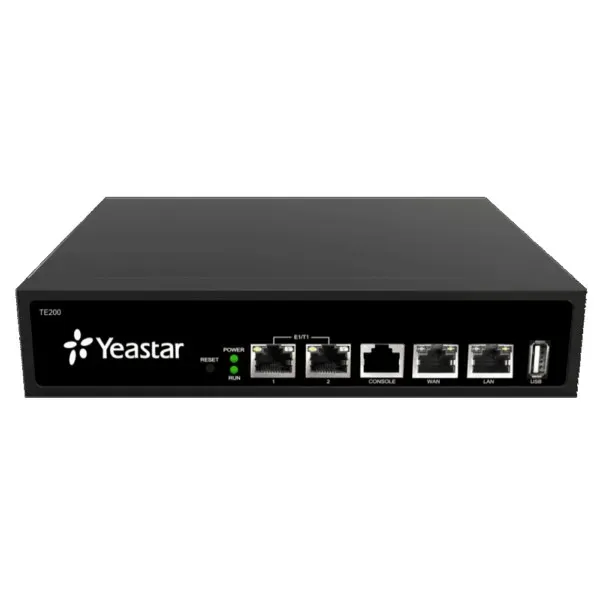
Yeastar TE200 E1 T1 PRI VoIP Gateway
The Yeastar TE200 is a dual-port E1/T1/J1 VoIP gateway designed to connect legacy digital trunks and PRI-based telephone systems with modern SIP networks. Yeastar specifies two software-configurable E1/T1/J1 ports, support for PRI and E&M, SIP based on RFC3261, secure transport options including TLS and SRTP, and up to 60 simultaneous VoIP-to-ISDN calls. For organisations modernising telephony without replacing every existing component at once, the TE200 can serve as the practical bridge between established carrier circuits, legacy PBXs, IP PBXs, hosted voice systems and SIP trunks.
Consider the TE200 when you need two digital E1/T1/J1 interfaces, a SIP migration path, flexible inbound and outbound routing, or a way to extend legacy PRI connectivity into an IP-based phone environment.
Two software-configurable E1/T1/J1 interfaces for dual-trunk PRI environments and migration projects.
Yeastar positions the TE200 for up to 60 simultaneous VoIP-to-ISDN calls across its two digital interfaces.
Designed to interconnect PRI services, ISDN PBXs, IP PBXs, softswitches and SIP trunks with flexible routing.
Browser-based administration supports configuration, diagnostics, routing, logging, backup, restore and firmware tasks.
What the Yeastar TE200 does
The central role of the TE200 is protocol and network interconnection. Many organisations still have usable PRI circuits, an existing ISDN PBX, a digital trunk from a carrier, or a voice environment built around E1/T1 interfaces. At the same time, new communication platforms are increasingly SIP based. Replacing the entire phone system in one step can be disruptive and unnecessary. A PRI VoIP gateway allows both environments to operate together while the organisation controls the pace of migration.
The TE200 converts between the digital telephony side and the IP voice side. A company can use it to connect an IP PBX to an existing E1/T1/J1 service, connect an older digital PBX to SIP trunking, or link telephony environments at different stages of migration. Yeastar also publishes interoperability guidance for platforms including 3CX and FreePBX, which illustrates the general role of the gateway as an intermediary between E1 trunking and SIP-based call control.
This makes the TE200 particularly relevant where continuity matters. A finance office may want to retain an established carrier circuit while modernising extensions. A hotel may have a legacy PBX with dependable room-phone integration but want SIP connectivity for external calling. A contact centre may need to preserve PRI access while moving call-control applications to an IP environment. In each case, the gateway is not the phone system itself; it is the bridge that allows two different telephony domains to communicate.
Verified technical highlights
| Model | Yeastar TE200 |
| E1/T1/J1 ports | 2 software-configurable ports; official current Yeastar page lists support for PRI and E&M |
| Concurrent calls | Up to 60 simultaneous VoIP-to-ISDN calls |
| VoIP protocol | SIP (RFC3261) |
| Transport | UDP, TCP, TLS, SRTP |
| Codecs | G.711 alaw/ulaw, G.722, G.726, G.729A, GSM, ADPCM and Speex |
| Echo handling | ITU-T G.168 LEC echo cancellation and dynamic jitter buffer |
| DTMF | RFC2833, SIP INFO and in-band |
| Network functions | DDNS, firewall, PPPoE, static IP, QoS and static routing |
| LAN / WAN | 1 x Gigabit LAN and 1 x Gigabit WAN on the current Yeastar specification table |
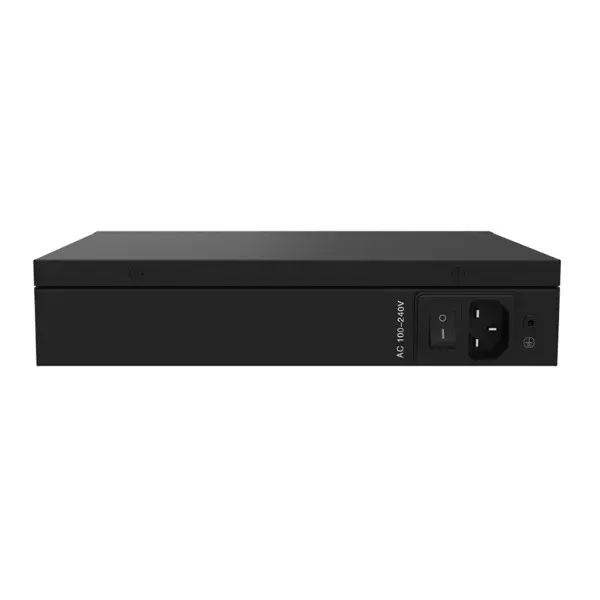
| Power | AC 100-240V input through supplied 12V 2A power arrangement as specified by Yeastar |
| Dimensions | 213 x 160 x 44 mm |
Features that matter in a real deployment
Call routing rules
Flexible call routing allows administrators to define how calls move between the PRI side and SIP trunks or IP PBX destinations. Dialed digits can be manipulated when necessary so legacy numbering plans and modern SIP routing can coexist.
SIP trunk support
The gateway can connect to SIP providers or SIP-based platforms, giving organisations a migration path from carrier PRI services to IP-based telephony without forcing an immediate full-system replacement.
Diagnostics and logging
E1/T1/J1 diagnostics, system logs, packet capture and call detail records can assist technical teams when validating trunks, tracing call-routing issues or checking signalling behaviour.
Fax support
T.38 fax support can be useful when organisations still depend on fax workflows and need to carry fax traffic through an IP telephony environment.
Security-oriented transport
TLS and SRTP are listed among supported transport options. Deployment security still depends on the surrounding network, access controls, firewall policies and correct credential management.
Configuration continuity
Backup and restore functions help administrators retain known-good configurations, while HTTP/TFTP firmware upgrade options and web management simplify operational maintenance.
Where the TE200 fits in a telephony architecture
The TE200 can sit between a carrier PRI service and an IP PBX, between an existing ISDN PBX and a SIP trunk, or between legacy telephony equipment and a softswitch. This flexibility is useful when a business wants to modernise in stages. It can preserve working infrastructure while introducing SIP services, IP phones, unified communications or newer call-control systems around it.
For related system planning, review FourTeck Tanzania’s business technology services, business technology shop, integrated IT and telecom solutions, and quotation contact page. These verified Tanzania pages help buyers coordinate gateway selection with IP PBX, network switching, firewall policy, cabling, power protection and endpoint requirements rather than purchasing the gateway in isolation.
Buying and deployment guidance
Before ordering a TE200, confirm the exact digital trunk type and signalling used at the site. E1, T1 and J1 environments are not interchangeable assumptions, and the number of bearer channels, framing, switch type and carrier configuration must be understood. For PRI projects, the technical team should document the carrier handoff, line coding, clocking, numbering plan, DDI/DID ranges, inbound and outbound call requirements, and any digit manipulation needed between the PRI and SIP environments.
The IP side should be checked just as carefully. Define the IP PBX or softswitch, SIP trunk authentication method, codec expectations, DTMF method, firewall or NAT traversal requirements, VLAN design and Quality of Service policy. If the TE200 will be placed in a branch connected to a central PBX over a WAN, link reliability and latency should be included in the design. If the gateway is providing the only path to a public telephone service, power protection and resilience deserve special attention.
A quotation request is more useful when it includes the number of PRI circuits, approximate concurrent-call requirement, existing PBX or IP PBX platform, carrier details, intended migration objective, installation location, and whether configuration or integration support is required. This allows the gateway itself to be evaluated together with the wider voice environment.
Yeastar TE200 E1 T1 PRI VoIP Gateway Tanzania
For organisations in Tanzania, the Yeastar TE200 is relevant when traditional digital telephony remains part of day-to-day operations but the business wants the flexibility of SIP. A company may still receive dependable E1 PRI service from a carrier, operate an established PBX with PRI interfaces, or maintain a call-handling environment built before IP telephony became the standard. Rather than discarding all of that infrastructure immediately, the TE200 can provide a controlled interconnection point. Its two E1/T1/J1 ports and support for up to 60 simultaneous calls make it suitable for environments that need more than a single digital span or want capacity for two trunk interfaces within one gateway.
Tanzania deployments should begin with the actual trunk and call-flow requirement. Buyers should confirm whether the site uses E1 PRI, how many concurrent calls are expected at the busiest hour, whether both digital ports will be active, and what platform sits on the SIP side. The answer may be an on-premises IP PBX, a hosted PBX, a softswitch, or a SIP trunk service. This detail determines routing rules, codec selection, DTMF behaviour, firewall policy and the number plan that must be translated between systems.
Network readiness is also important. Voice traffic should not simply be connected to any available switch port without considering addressing, security and QoS. The gateway can support network features such as static IP, QoS and static routes, but the overall call quality still depends on the LAN, WAN and service provider path. Where a branch uses the TE200 to reach a central PBX, the WAN connection should be reviewed for latency, loss and stability. Where the gateway connects directly to a local SIP service, the firewall and NAT design should be checked to avoid one-way audio or registration problems.
FourTeck Tanzania can approach the TE200 as part of a complete voice architecture rather than as a stand-alone appliance. Buyers can coordinate PRI gateway selection with IP PBX requirements, managed switching, voice VLANs, firewall rules, UPS protection, rack placement and endpoint planning. The objective is to preserve useful legacy infrastructure while creating a practical path toward SIP-based communications. For organisations comparing migration options, the key question is not merely whether the TE200 supports E1/T1/J1, but how those interfaces will be used in the future-state call architecture.
Yeastar TE200 E1 T1 PRI VoIP Gateway Dar es Salaam
In Dar es Salaam, the TE200 can suit headquarters, hotels, financial institutions, call centres, logistics companies, healthcare organisations and established offices where PRI connectivity remains important. These environments often have existing telephone numbers, reception workflows, hunt groups or call-centre processes that cannot simply be interrupted during a migration. A dual-port PRI gateway helps create a transition architecture in which the existing carrier circuit and the new IP telephony platform can coexist while configuration is tested and users are moved in a planned sequence.
For a Dar es Salaam headquarters, one practical design question is whether both E1 interfaces are required for active traffic or whether one is reserved for a separate trunk, another PBX, or staged migration. Capacity planning should be based on busy-hour concurrency rather than total employee count alone. A business with 300 extensions may not need 300 external channels, while a smaller call-handling operation can generate a much higher percentage of simultaneous external calls. The TE200’s maximum of 60 simultaneous calls should therefore be evaluated against real traffic patterns.
Installation planning should also cover power, rack or shelf location, cabling and administration access. Voice gateways often become critical infrastructure after deployment, so the equipment should not be placed where accidental disconnection, overheating or undocumented changes are likely. UPS-backed power, labelled PRI patching, documented IP addressing and saved configuration backups can reduce support problems. The gateway’s diagnostics, call detail records, system logs and packet capture functions are useful when troubleshooting signalling or audio issues, but they are most effective when the original design is properly documented.
Dar es Salaam buyers requesting a quotation should provide their PBX model, carrier PRI details, number of E1 circuits, expected concurrent-call demand and the intended SIP destination. If 3CX, FreePBX or another IP PBX is part of the project, the technical team should also define the SIP trunk parameters and routing requirements. This allows the gateway, network and call-control platform to be prepared as one solution instead of leaving integration questions until after the hardware arrives.
Yeastar TE200 E1 T1 PRI VoIP Gateway Mwanza
Businesses in Mwanza may use the TE200 when a branch, hospital, hotel, educational institution, industrial site or regional office needs to retain a digital trunk while connecting to an IP PBX or central SIP platform. One common reason to choose a gateway is to avoid replacing a working PRI-based phone system simply because a new part of the organisation has adopted VoIP. The TE200 provides the conversion layer that lets both systems exchange calls while the business decides how quickly to modernise the rest of its telephony.
For branch connectivity, it is useful to separate two questions: how the branch reaches the public telephone network and how it reaches the organisation’s internal voice platform. The E1/T1/J1 interfaces address the digital trunk side, while SIP handles the IP side. If the branch communicates with a central PBX over an IP link, network stability becomes critical. QoS can help prioritise voice, but it cannot repair a poor WAN circuit. The design should therefore examine latency, packet loss, failover strategy and what should happen to calls if the IP connection to the central site is unavailable.
A Mwanza deployment can also benefit from keeping the dial plan simple. Legacy PBXs and new IP PBXs may use different extension lengths, access codes or number formats. The TE200 supports routing rules and digit manipulation, so technical teams can translate numbers where necessary. This should be planned carefully rather than changed repeatedly after go-live, because inconsistent dial rules can make support difficult for users and administrators.
When procuring the TE200 for Mwanza, buyers should confirm the exact gateway model, quantity, included accessories, power requirements and the support scope they expect. If on-site or remote configuration is needed, that requirement should be stated with the order. The most efficient projects begin with a simple call-flow drawing showing the carrier, TE200, PBX or softswitch, network path and important inbound and outbound routes. That drawing gives both procurement and technical teams a common reference for the installation.
Yeastar TE200 E1 T1 PRI VoIP Gateway Arusha
Arusha businesses in hospitality, tourism, professional services, education, healthcare and administration can use a PRI VoIP gateway when established telephony must connect to newer IP communications. Hotels are a particularly clear example: an existing PBX may already integrate guest rooms, reception, billing processes or analogue extensions, while the organisation wants SIP trunks or a newer IP-based system for external communications. Replacing every component at once may introduce unnecessary risk, whereas the TE200 can provide a staged migration path.
In such environments, compatibility planning should go beyond the words “E1” and “SIP.” The existing PRI switch type, number presentation, DDI mapping, codec preference and DTMF behaviour should be documented. If fax services remain in use, T.38 requirements should be reviewed. If users depend on caller ID presentation or specific access codes, those functions should be tested during commissioning. The gateway supports many of these capabilities, but successful operation depends on matching both sides of the connection correctly.
Arusha sites may also have branch or remote connectivity requirements. An organisation could keep a local PRI service for continuity while connecting extensions to a central PBX through SIP. Another organisation may use SIP as the primary service but keep the existing digital PBX in operation during a phased upgrade. These are different architectures and should not be treated as the same project. The TE200 is flexible enough to participate in either model, but routing, resilience and management responsibilities will differ.
Before requesting pricing, define the business reason for the gateway. Is it intended to preserve a legacy PBX, connect an IP PBX to PRI, provide two digital spans, enable migration to SIP, or consolidate voice connectivity? Once that objective is clear, the project team can determine whether the TE200’s two-port capacity, up-to-60-call concurrency and routing features match the requirement. This approach prevents overspending on unnecessary hardware while also avoiding under-sizing a gateway that becomes a bottleneck during busy periods.
Yeastar TE200 E1 T1 PRI VoIP Gateway Dodoma
In Dodoma, organisations planning telephony upgrades can use the TE200 to connect established PRI infrastructure with a SIP-based environment. Government-related offices, educational institutions, professional organisations, healthcare facilities and corporate branches may have telephone systems that were designed around digital trunks and fixed call-routing workflows. A gateway-based migration can reduce disruption because the organisation does not need to change every PBX, number and endpoint at the same time.
The TE200 is especially relevant when two E1/T1/J1 interfaces are required. One port may connect to one carrier service and the second to another digital span, or both may be used to provide the required call capacity. Because E1 PRI can carry up to 30 bearer channels, two E1 interfaces can align with the TE200’s published maximum of 60 simultaneous calls. Actual usable capacity depends on the configured line type and service arrangement, so procurement teams should confirm the carrier specification rather than assuming all PRI circuits are identical.
Security and management should also be included in the design. The gateway supports firewall functions and secure transport options, but it should still be placed within an appropriately segmented network and administered through controlled access. Credentials, backup files and firmware practices should be documented. Where remote administration is required, access should be restricted rather than leaving management interfaces broadly exposed. The same principle applies to SIP: firewall and NAT rules should support the required media and signalling flows without opening unnecessary services.
For a Dodoma quotation, include the current phone system, PRI provider, number of spans, expected call volume, SIP destination and any integration services required. If the new IP PBX is not yet selected, the gateway can still be evaluated, but the final configuration should wait until the PBX and trunk design is known. Clear requirements at the procurement stage reduce installation delays and help ensure that the TE200 is purchased for a defined architecture rather than as a generic “VoIP adapter.”
Yeastar TE200 E1 T1 PRI VoIP Gateway UAE
For UAE organisations, the TE200 can support projects where enterprise telephony still depends on PRI circuits while IP PBX and SIP services are introduced. Hotels, clinics, offices, warehouses, trading companies and multi-site organisations may have legacy PBXs with significant operational value. A PRI-to-SIP gateway lets the business connect those systems to modern IP communications without replacing all endpoints and call-control functions immediately.
The dual-port format is useful when a site has two PRI spans, needs additional call capacity or wants to separate digital connections. Because the TE200 supports SIP, common codecs and routing controls, it can be positioned between carrier services and IP PBX platforms as part of a broader migration. Buyers should still verify signalling, numbering, DTMF, codec and carrier requirements before deployment. PRI projects often fail because teams focus on hardware compatibility but overlook the exact call-control parameters used by the carrier or PBX.
UAE customers can also coordinate the gateway with wider FourTeck resources. The FourTeck UAE technology site covers regional IT and communications requirements, while the specialist IP PBX Dubai resource is relevant to business telephony planning. These links help place the TE200 in the context of PBX design, SIP trunking, IP phones, network readiness and branch communications rather than treating the gateway as an isolated product.
When requesting a UAE quotation, state whether the project is an IP PBX-to-PRI connection, a legacy PBX-to-SIP migration, or a mixed environment. Include the number of digital spans, expected concurrency, carrier details and preferred PBX platform. That information helps determine whether the TE200 fits the required capacity and whether additional switching, firewall, cabling, rack or power-protection components should be included in the overall solution.
Yeastar TE200 E1 T1 PRI VoIP Gateway Uganda
Uganda organisations modernising business telephony may choose the TE200 when E1/T1/J1 connectivity must remain available while SIP is introduced. The gateway is useful for preserving a functioning PRI-based telephone environment during migration, connecting a new IP PBX to a digital carrier trunk, or linking older PBX equipment to SIP services. This is particularly practical for businesses that cannot interrupt their main phone numbers or reception workflows while a wider communications upgrade is underway.
The first step should be to confirm the trunk type, existing PBX interfaces and required call capacity. Two digital ports do not automatically mean every project needs both ports active. Some organisations need one port today and want a second for expansion; others already have two PRI spans. Capacity should be based on actual simultaneous external calls. The TE200’s published maximum of 60 concurrent calls can suit substantial branch or head-office requirements, but correct sizing depends on peak usage and the configured digital line standard.
Network planning is equally important. SIP signalling and RTP media need reliable IP connectivity, appropriate firewall policy and QoS where congestion is possible. For multi-site companies, the gateway may connect a regional PRI service to a central call-control platform. In that case, a failover plan should define what happens if the inter-site IP link is disrupted. Keeping emergency or critical calling paths in mind can improve the operational resilience of the design.
FourTeck’s Uganda IT and PBX solutions site provides a regional point of reference for related telephony, networking and security requirements. A complete procurement brief should include carrier information, PBX platform, PRI quantity, SIP destination, expected concurrency, installation scope and support requirements. This allows the TE200 to be assessed as part of a complete communications architecture.
Yeastar TE200 E1 T1 PRI VoIP Gateway Kampala
Kampala businesses often manage a mix of established telephony and newer IP-based services. Banks, hotels, healthcare providers, NGOs, enterprise offices, call-handling teams and multi-branch organisations may still depend on PRI circuits because those circuits support known telephone numbers and stable external connectivity. The TE200 can bridge that digital trunk environment to a SIP PBX or softswitch, allowing modernisation to occur without immediately abandoning proven infrastructure.
A Kampala head office using two PRI spans can evaluate whether the TE200’s dual-port design and up-to-60-call capacity matches busy-hour demand. Call-centre style environments should pay special attention to concurrency because many users may be on external calls simultaneously. General office environments may have many extensions but lower external concurrency. Sizing based only on headcount can therefore be misleading. Traffic data from the existing PBX or carrier records can provide a more reliable basis for selecting gateway capacity.
Integration testing should cover inbound and outbound call routing, caller ID, number presentation, DTMF, fax if required, and any digit manipulation between the old and new numbering plans. Administrators should also save configuration backups after commissioning and record the exact PRI and SIP parameters. These details become important when firmware is updated, equipment is replaced, or another engineer must troubleshoot the system later.
For procurement teams, a complete quotation should identify whether installation and configuration are required or whether only the hardware is needed. If a PBX migration is part of the same project, list extension count, reception requirements, call queues, recording needs, remote users and branch connectivity. The TE200 is most valuable when its role is clearly defined within that overall telephony plan, allowing Kampala organisations to preserve service continuity while adopting SIP capabilities in a controlled way.
Yeastar TE200 E1 T1 PRI VoIP Gateway Arua
In Arua, organisations with regional offices, healthcare facilities, educational campuses, hospitality operations or distributed business sites may need to connect a traditional digital voice service to a central or cloud-based IP telephony platform. The TE200 can provide that bridge where E1/T1/J1 infrastructure is still part of the local environment. This allows the branch to retain its carrier connection or older PBX while gaining access to SIP-based routing and centralised call control.
For regional-site deployments, resilience should be discussed at the same time as connectivity. If the TE200 sends all calls to a central IP PBX over a WAN, what happens when the WAN is unavailable? The answer depends on the chosen architecture. Some organisations may prefer local survivability, while others accept that central services are unavailable during an outage. The gateway itself does not replace a complete resilience strategy, so the surrounding PBX, network and carrier design must be considered together.
Power quality and physical installation also matter. A voice gateway serving an entire branch should be connected to suitable UPS protection and installed where it can be securely managed. PRI cabling should be labelled, network interfaces documented and administrator credentials protected. Configuration backups can simplify recovery if settings are accidentally changed or the unit must be restored after maintenance.
Arua buyers should provide the technical details of the existing line rather than requesting a gateway solely by model name. The carrier handoff, PBX type, expected call volume, SIP destination and any remote-management requirement should be part of the quotation. This helps ensure the TE200 is supplied for a workable deployment and gives technical teams enough information to prepare routing, addressing and security policies before installation day.
Yeastar TE200 E1 T1 PRI VoIP Gateway Mbarara
Mbarara organisations can use the TE200 as part of a gradual telephony transition where digital PRI services remain in place but new offices, departments or applications are moving to SIP. This can be useful for healthcare, education, financial services, distribution, hospitality and multi-site businesses that need continuity while modernising. By connecting the PRI and IP worlds, the gateway lets an organisation extend the useful life of existing infrastructure instead of forcing an all-or-nothing replacement.
A careful deployment should document both the physical and logical interfaces. Physically, the project needs the correct digital trunk handoff, network cabling and reliable power. Logically, it needs SIP trunk parameters, IP addressing, routes, codecs, DTMF and the dial plan. Caller ID and DID/DDI mapping should be tested with real inbound and outbound calls. Where the old PBX and new IP PBX use different numbering conventions, digit manipulation should be kept as simple as possible so administrators can understand the configuration later.
The TE200 includes tools such as call detail records, logs and packet capture that can support troubleshooting. These tools are most helpful when there is a clear baseline: the known carrier settings, PBX configuration and expected call path. Without documentation, troubleshooting can become trial and error. For that reason, configuration backup and handover notes should be considered part of the deployment rather than optional extras.
For Mbarara procurement, the main sizing questions are number of PRI spans and maximum concurrent calls. If a single E1 is sufficient, buyers may also compare whether the one-port TE100 is more appropriate; if two spans or higher capacity are needed, the TE200 is the natural dual-port option in the family. The final selection should reflect actual capacity, migration plans and resilience requirements rather than purchasing the larger model without a defined reason.
Yeastar TE200 E1 T1 PRI VoIP Gateway Gulu
Gulu businesses and institutions planning voice upgrades may have a practical need to preserve existing PRI services while introducing SIP-based communications. A gateway such as the TE200 is appropriate when that transition must happen without disrupting public telephone numbers, reception services or internal PBX workflows. It can connect digital trunks to IP call-control platforms and create a staged path from older telephone infrastructure to modern VoIP.
The two-port architecture can support environments with more than one digital trunk or provide additional capacity within the same gateway. However, procurement should begin with measured demand. A branch with modest call traffic does not benefit from unused capacity, while an institution with many simultaneous external calls can suffer if the gateway is undersized. Busy-hour call statistics, extension usage and inbound call patterns provide a better planning basis than organisation size alone.
For Gulu sites that depend on a central IP PBX, voice network quality should be treated as an operational requirement. Packet loss and unstable links can affect audio even if the PRI side is functioning perfectly. QoS, reliable WAN connectivity, sensible firewall rules and voice VLAN planning can help maintain predictable service. If remote branches are involved, the project should also define whether calls can still be made when the central site is unreachable.
A useful quotation request should list the current carrier, digital trunk type, existing PBX, intended SIP platform, number of trunks and support scope. If the gateway will be installed by an internal team, remote configuration assistance may still be useful during commissioning. If a wider phone-system upgrade is planned, include extension counts and user roles so the TE200 can be evaluated as one part of the complete communications design rather than as a stand-alone purchase.
Yeastar TE200 E1 T1 PRI VoIP Gateway Kenya
Kenyan businesses with existing PRI infrastructure can use the TE200 to bridge E1/T1/J1 services and SIP-based telephony. The model is relevant for enterprises, hospitality, healthcare, finance, education and call-handling environments where legacy circuits remain operational but the organisation wants to adopt an IP PBX, softswitch or SIP trunk. Rather than treating old and new systems as mutually exclusive, the gateway creates an integration point between them.
For organisations with multiple sites, the TE200 can be placed at the location where the PRI service terminates and linked to a central PBX over the IP network. This architecture can centralise call management while preserving local carrier access. It also creates design questions around WAN resilience, security and failover. The gateway should therefore be included in the network plan, not deployed without coordination with the switching and firewall environment.
Kenya buyers can reference the FourTeck Kenya IT and VoIP solutions site when planning related IP PBX, network and security requirements. A PRI migration often touches several systems at once: the PBX, SIP provider, carrier, firewall, switch, numbering plan, endpoints and sometimes recording or contact-centre applications. A clear system diagram helps every party understand which device controls each function.
When requesting the TE200 in Kenya, specify the number of PRI lines, peak concurrent calls, carrier service type and the platform on the SIP side. If two E1 spans are needed, the dual-port model offers an efficient fit. If only one span is required and growth is unlikely, compare the TE100 as well. Choosing between the two should be based on current demand plus realistic expansion, ensuring the gateway delivers appropriate capacity without unnecessary complexity.
Yeastar TE200 E1 T1 PRI VoIP Gateway Kuwait
In Kuwait, enterprises with established PRI connectivity can use the TE200 to connect digital trunks with SIP-based systems during PBX upgrades, carrier changes or phased VoIP migration. The gateway can preserve a working legacy PBX while new departments move to IP phones, or it can connect a modern IP PBX to E1/T1/J1 services that remain part of the organisation’s telecom strategy.
The dual-port design and up-to-60-call capacity can suit busy offices, service organisations and larger sites where one digital span is insufficient. Call capacity should still be verified against actual usage. A corporate headquarters with many extensions may have low external concurrency, while a customer-service team with fewer users may sustain many simultaneous calls. The gateway should be sized from call behaviour, not simply employee count.
Kuwait procurement teams should also consider the operational handover. The gateway supports logs, call records, packet capture, diagnostics and configuration backup. These capabilities allow internal IT teams or service providers to maintain the system more efficiently when the original settings are documented. Network addressing, SIP credentials, PRI parameters, routing rules and backup files should be stored securely as part of the project documentation.
The FourTeck Kuwait technology site is relevant for regional IT, network and VoIP planning. A TE200 request should include PBX make and model, carrier trunk details, concurrent-call expectation, SIP destination and whether integration support is required. This information helps determine the complete bill of materials and avoids discovering missing network, power or configuration dependencies after delivery.
Yeastar TE200 E1 T1 PRI VoIP Gateway Ghana
Ghanaian organisations can use the TE200 where digital trunking and IP telephony need to operate together. This may be a business moving from an ISDN PBX to SIP, an institution connecting an IP PBX to a carrier PRI service, or a multi-site organisation centralising call control while retaining digital access at a branch. The gateway’s role is to protect continuity during change by translating between the digital and SIP environments.
Because the TE200 has two E1/T1/J1 interfaces, buyers should define how each port will be used. Both may be active for capacity, one may connect to a separate service, or the second may be reserved for future expansion. The published maximum of 60 concurrent calls is relevant for sizing, but exact capacity depends on the configured digital service. The project should also confirm whether PRI, E&M or another supported signalling mode is required.
The IP environment should be prepared for voice traffic. SIP registration or peer configuration, codec preferences, DTMF, NAT traversal and firewall rules can all affect interoperability. If the gateway connects to a hosted or central PBX, WAN performance should be measured rather than assumed. Voice quality is sensitive to packet loss and jitter, so the networking layer must be included in acceptance testing.
The FourTeck Ghana technology site can support wider regional planning for IP telephony, networking and related infrastructure. Procurement teams should provide the current PBX model, carrier details, number of PRI spans, expected concurrency, SIP platform and installation scope. That information allows the TE200 to be quoted as part of a complete, supportable migration rather than supplied without the context needed for reliable integration.
Yeastar TE200 E1 T1 PRI VoIP Gateway Nigeria
Nigeria organisations with established PRI services can use the TE200 to connect legacy digital telephony with SIP-based communication systems. This is useful when a business wants to retain carrier circuits, PBX features or telephone numbers while introducing newer IP PBX platforms, centralised SIP trunks or multi-site routing. A gateway allows migration to be planned around operational priorities instead of requiring immediate replacement of every telephone component.
Large offices and call-handling teams should evaluate the TE200 against busy-hour call demand. Two E1 interfaces and up to 60 simultaneous calls can accommodate substantial traffic, but real requirements vary. Contact centres may use nearly all available external channels during peak periods, while administrative offices often have much lower concurrency. Historic call records can help technical teams estimate the correct channel requirement and determine whether one or both digital ports are necessary.
Power and connectivity resilience can be particularly important in voice projects. If the gateway is the main connection between the PBX and the public telephone service, UPS protection and documented recovery procedures should be part of the design. If SIP services traverse an internet or WAN connection, the architecture should define what happens during link failure. The TE200 can participate in a resilient design, but overall continuity depends on the network, PBX, carrier and power strategy.
The FourTeck Nigeria IT services site provides a regional reference for related telephony and infrastructure needs. For an accurate TE200 quotation, include the PBX platform, carrier trunk specification, number of spans, expected concurrency and desired migration outcome. This enables technical and procurement teams to evaluate not only the gateway but also the network, firewall, switching and support elements required for a stable deployment.
Yeastar TE200 E1 T1 PRI VoIP Gateway Seychelles
In Seychelles, hotels, resorts, government-related organisations, healthcare facilities and businesses with established PBX systems can use the TE200 when legacy digital trunks must connect to newer SIP services. Hospitality is a strong example because a traditional PBX may remain integrated with guest-room telephones and operational workflows even as the organisation adopts IP phones, SIP trunks or cloud-connected communications for administrative teams. A PRI gateway can allow both systems to work together during a controlled transition.
Island and multi-site environments can place extra emphasis on continuity. If a SIP connection depends on a WAN link, teams should define what happens when that link is unavailable. Keeping a local PRI service connected through the TE200 may form part of a continuity plan, depending on the overall architecture. Conversely, a legacy PBX may use the gateway to reach a SIP service when traditional trunk arrangements are being reduced. The correct design depends on which side of the system must remain available during a failure.
Physical installation deserves attention as well. The TE200 is compact, but a business-critical gateway should still be placed in a secure, ventilated communications location with UPS-backed power and labelled cabling. Administrators should retain a current backup of the configuration and document PRI settings, SIP routes, number translations and credentials. This makes future support more predictable, especially where specialist resources are not always on site.
Seychelles buyers requesting the TE200 should provide the existing PBX type, PRI line details, SIP platform, expected concurrent-call requirement and the scope of configuration support needed. The gateway’s value comes from interoperability and migration flexibility, so a successful purchase is one where its exact role is defined before deployment. That approach reduces integration risk and helps the organisation preserve useful telephony investments while moving toward a more flexible IP-based communications environment.
Related FourTeck resources
A PRI gateway depends on the systems around it. FourTeck Tanzania’s integrated technology overview explains how telecom, networking, security and infrastructure are coordinated. The services page is useful when a TE200 project also requires PBX planning, network configuration or deployment support. The Tanzania shop provides a starting point for related IP PBX, IP phone, switching, firewall, UPS and infrastructure products, while the contact page is the verified path for quotations.
Regional planning can also use the verified FourTeck network: Uganda, Kenya, Ghana, Nigeria, Kuwait, Africa-wide IT solutions and FourTeck UAE. These sites are relevant when a project spans multiple countries or needs related regional technology planning.
Quotation checklist for the Yeastar TE200
Frequently asked questions
What is the Yeastar TE200 used for?
It is a dual-port E1/T1/J1 VoIP gateway used to bridge digital PRI telephony and SIP networks. Typical uses include connecting an IP PBX to PRI lines, connecting a legacy ISDN PBX to SIP trunks, and supporting staged migration from traditional telephony to VoIP.
How many calls can the TE200 handle?
Yeastar specifies support for up to 60 simultaneous VoIP-to-ISDN calls. Actual channel use depends on the configured E1/T1/J1 services and deployment design.
Does the TE200 support SIP?
Yes. Yeastar lists SIP based on RFC3261, with UDP, TCP, TLS and SRTP transport options.
Can the TE200 work with 3CX or FreePBX?
Yeastar publishes integration guides demonstrating TE-series connectivity with 3CX and FreePBX. Exact compatibility should still be checked against the specific software version and deployment settings being used.
Does the TE200 support fax?
Yes. Yeastar lists T.38 fax support among TE-series features. Successful fax operation also depends on the connected systems and network conditions.
What information is needed before buying?
Provide the digital trunk type, number of spans, carrier details, expected concurrent calls, existing PBX, intended SIP platform, DID/DDI information and whether installation or configuration support is required.
Decision recap
Choose the Yeastar TE200 when you need two E1/T1/J1 digital interfaces, up to 60 simultaneous calls, SIP interoperability and a practical bridge between legacy PRI telephony and a modern IP voice environment. It is especially suitable for phased migrations where business continuity matters and existing carrier circuits or PBX investments still have value.
Before ordering, verify the exact trunk standard, signalling, capacity, PBX platform, SIP parameters, network readiness and support scope. This turns the TE200 from a generic gateway purchase into a well-defined part of a reliable telephony architecture.
Plan your PRI-to-SIP migration with FourTeck Tanzania
Share your existing PBX, carrier PRI details, number of trunks, expected simultaneous calls and target SIP platform. FourTeck can help you evaluate the TE200 within the wider IP PBX, network, firewall, switching, power and endpoint design so the deployment is technically clear before procurement.




Reviews
There are no reviews yet.